Nonlin. Processes Geophys., 18, 727–733, 2011 www.nonlin-processes-geophys.net/18/727/2011/ doi:10.5194/npg-18-727-2011
© Author(s) 2011. CC Attribution 3.0 License.
Nonlinear Processes
in Geophysics
The evolution of electron current sheet and formation of secondary
islands in guide field reconnection
C. Huang1,2, Q. Lu1, Z. Yang1, M. Wu1, Q. Dong3, and S. Wang1
1CAS Key Laboratory of Basic Plasma Physics, Department of Geophysics and Planetary Sciences, University of Science and Technology of China, Hefei 230026, China
2State Key Laboratory of Space Weather, Chinese Academy of Sciences, Beijing 100190, China
3Beijing National Laboratory of Condensed Matter Physics, Institute of Physics, Chinese Academy of Sciences, Beijing 100080, China
Received: 12 July 2011 – Revised: 10 October 2011 – Accepted: 11 October 2011 – Published: 20 October 2011
Abstract. Two-dimensional (2-D) particle-in-cell (PIC) sim-ulations are performed to investigate the evolution of the electron current sheet (ECS) in guide field reconnection. The ECS is formed by electrons accelerated by the inductive elec-tric field in the vicinity of the X line, which is then extended along thexdirection due to the imbalance between the elec-tric field force and Ampere force. The tearing instability is unstable when the ECS becomes sufficiently long and thin, and several seed islands are formed in the ECS. These tiny islands may coalesce and form a larger secondary island in the center of the diffusion region.
1 Introduction
Magnetic reconnection is a fundamental physical process in plasma, which provides an effective mechanism for fast en-ergy conversion from magnetic enen-ergy to plasma kinetic and thermal energies (Vasyliunas, 1975; Biskamp, 2000; Priest, 2000). It is believed that magnetic reconnection plays an important role in many explosive phenomena, which occurs in space and laboratory plasma, such as solar flares in the corona (Giovanelli, 1946), the heating of solar corona (Ulm-schneider et al., 1991), substorms in the Earth’s magneto-sphere (Nishida, 1978), and disruptions in fusion experi-ments (Wesson, 1997).
Hall effect is considered to be a critical ingredient in col-lisionless magnetic reconnection. At the scale length be-tween the ion inertial lengthc/ωpi(wherecandωpiare the
Correspondence to: Q. Lu
light speed and ion plasma frequency) and electron inertial lengthc/ωpe(where ωpe is the electron plasma frequency), only electrons are frozen in magnetic field lines, and ions can move across magnetic field lines (Sonnerup, 1979; Tera-sawa, 1983; Birn et al., 2001; Shay et al., 2001; Lu et al., 2010; Wang et al., 2010a). This region is called as ion dif-fusion region, and the ion-electron decoupling causes Hall effect. At the scale length belowc/ωpe, the electron frozen-in constrafrozen-int is also broken, and the motions of electrons are demagnetized. Both ions and electrons can move across the magnetic field lines (Birn et al., 2001; Ma et al., 2001; Pritchett, 2001). The region is called as electron diffusion region (EDR). Therefore, magnetic reconnection is consid-ered to be of multiscale features – a small EDR is embedded in a larger ion diffusion region.
728 C. Huang et al.: The evolution of electron current sheet and formation of secondary islands
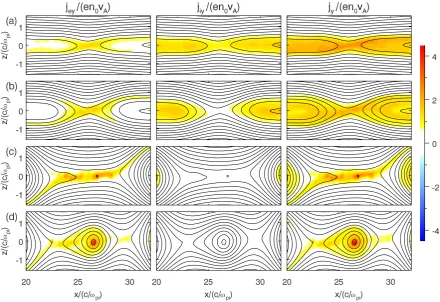
Fig. 1. The time evolution of the current sheet aroundx=26.6cωpiatit=(a) 18, (b) 22, (c) 29 and (d) 36, respectively. The left, middle and right panels describe the electron currentjey, ion currentjiyand total currentjy. The magnetic field lines (solid lines) are also plotted for reference
electron flow jets in the EDR can be explained by a combina-tion of electric field drifts and of diamagnetic effects through the combination of the gradients of particle pressure and of the magnetic field (Hess et al., 2008).
The extension of the ECS, as well as the formation of sec-ondary islands can also been found in guide field reconnec-tion (Drake et al., 2005, 2006; Daughton et al., 2011). Drake et al. (2006) found that in guide field reconnection, the cur-rent layer develops a pronounced tilt as electrons accelerated parallel to the magnetic field stream preferentially outward along two of the four separatrices connected to the x-line. With the extension of ECS, it is unstable to the tearing in-stability, which then forms secondary islands. Secondary islands not only can affect reconnection rate (Daughton et al., 2006) and energize electrons effectively (Wang et al., 2010b; Oka et al., 2010), but also they may be related to the bursty nature of reconnection (Drake et al., 2006). Recently, Daughton et al. (2011) studied the three-dimensional (3-D) evolution of guide field reconnection. The evolution is dom-inated by the formation and interaction of helical magnetic structures known as flux ropes, which leads to a turbulent evolution where electron dynamics plays a critical role.
In this paper, by performing 2-D PIC simulations, we will further investigate more quantitatively how a current sheet is developed during guide field reconnection. It is found that the current sheet extends due to the imbalance between the electric field force and Ampere force, and the current is dom-inated by the electrons before it is unstable to the tearing in-stability and forms secondary islands. The paper is organized as follows. The simulation model is presented in Sect. 2, and the simulation results are described in Sect. 3. Section 4 gives discussion and conclusions.
2 Simulation model
A 2-D PIC code is used in this paper to investigate the evolu-tion of the ECS and the formaevolu-tion of the secondary magnetic island in guide field reconnection. In the simulation, the elec-tromagnetic fields are defined on the grids and updated by solving the Maxwell equations with a full explicit algorithm (Birdsall and Langdon, 1985; Pritchett, 1985). The initial configuration is a one-dimensional Harris current sheet in the
C. Huang et al.: The evolution of electron current sheet and formation of secondary islands 729
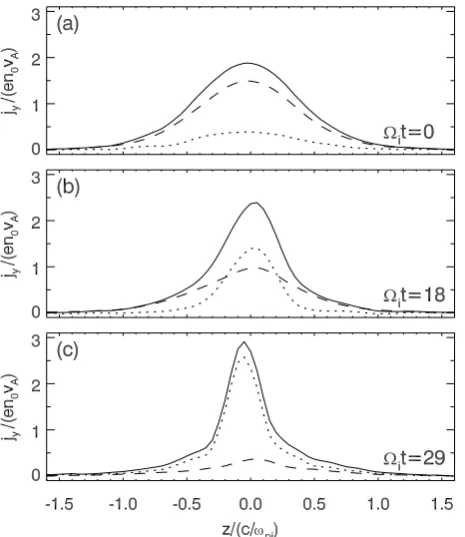
Fig. 2. The profiles of the current sheet alongx=26.6c/ωpiat (a)it=0, (b)it=18 and (c)it=29. The dashed, dotted and solid lines present the electron currentjey, the ion currentjiyand the total currentjy, respectively.
B0(z)=B0tanh(zδ)ex+By0ey, (1) where δ is the half-width of the current sheet. B0 is the asymptotical magnetic strength. By0is the amplitude of the guide field. The corresponding number density is
n(z)=nb+n0sech2(zδ), (2)
wherenb represents the density of the background plasma and n0 is the peak Harris density. The distribution func-tions for the ions and electrons are Maxwellian, and their drift speeds in the y direction satisfyVi0/Ve0= −Ti0/Te0, whereVi0(Ve0)and Ti0(Te0) are the initial drift speed and temperature for ions (electrons), respectively. In our simula-tions, the temperature ratio isTi0/Te0=4, andn0=5nb. The half-width of the current sheet isδ=0.5c/ωpi, wherec/ωpi is the ion inertial length defined byn0. The mass ratio is set tomime=100 (wheremeis the rest mass of the electron). The light speed isc=15vA, wherevA is the Alfven speed defined byB0andn0. An initial guide fieldBy0= −B0is used in the simulations.
The computation is carried out in a rectangular do-main in the (x,z) plane with dimension Lx×Lz =
(51.2cωpi)×(12.8c
ωpi). AnNx×Nz=1024×256 grid system is employed in the simulations, so the spatial resolu-tion is1x=1z=0.05c/ωpi=0.5c/ωpe. The time step is
Fig. 3. The time evolutions of the characteristics of the ECS, (a) the lengthLe, (b) the half-widthδe, and (c) the ratio of the length to the half-widthLe/δe.
i1t=0.001, wherei is the ion gyrofrequency. We em-ploy more than 1.0×10⁷particles per species in the simula-tions. The periodic boundary conditions are used along the
x direction, while the ideal conducting boundary conditions for electromagnetic fields are employed in the zdirection. An initial flux perturbation is introduced in the simulations.
3 Simulation results
Figure 1 shows the time evolution of the current sheet around
x=26.6c
ωpi atit= (a) 18, (b) 22, (c) 29 and (d) 36, respectively. In the figure, the left, middle and right pan-els describe the electron currentjey, ion currentjiyand to-tal currentjy, and the magnetic field lines are also plotted for reference. Initially, the current is carried mainly by ions, therefore, the ion currentjiyis much larger than the electron currentjey. With the proceeding of the reconnection, both ions and electrons are ejected from the vicinity of the X line. However, the electrons can be accelerated by the inductive electric field in they direction around the X line (Huang et al., 2010). From aboutit=20, the current is dominated by the electron current, and the current sheet becomes an ECS. Then, the ECS is extended along the x direction. When the ECS becomes sufficiently long, the sheet is unstable to the tearing instability. By the end of the simulation, a secondary island remains near the center of the diffusion region and is bounded by two X-lines.
730 C. Huang et al.: The evolution of electron current sheet and formation of secondary islands
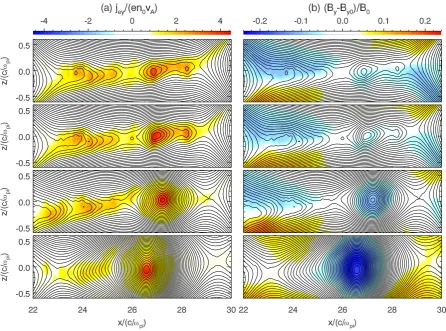
Fig. 4. The contours of (a) the electron currents along theydirectionjey, and (b) the out-of-plane magnetic field(By−By0)/B0atit=29, 29.5, 30.5 and 33.5 from the top to the bottom panels. The magnetic field lines (solid lines) are also represented in the figure.
Fig. 5. Time evolution of the flux difference1ψ in the reconnec-tion, where the magnetic flux1ψ is defined as the flux difference between the position (26.6c/ωpi, 0) and the first O line formed dur-ing the reconnection.
Figure 2 shows the profiles of the electron currentjey(dotted lines), ion currentjiy(dashed lines) and total currentjy(solid lines) alongx=26.6c/ωpi at (a)it=0, (b)it=18 and (c)it=29. Figure 3 depicts the evolution of the character-istics of the ECS, (a) the lengthLe, (b) the half-widthδe, and (c) the ratio of the length to the half-widthLe/δe. The length
Leand the half-widthδeof the ECS are properly determined from the simulation results at the given times. The length
C. Huang et al.: The evolution of electron current sheet and formation of secondary islands 731
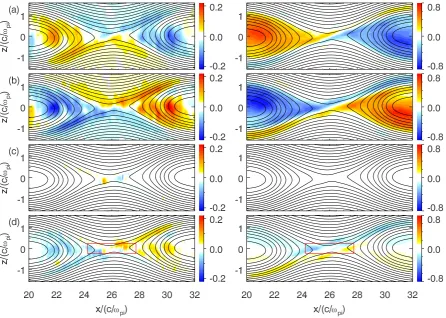
Fig. 6. (a) The electric field force−eneE, (b) the Ampere forceje×B, (c) the pressure gradient−∇ ·Pe, and (d) the sum of the above three forces atit=25. The left (right) panels show thex(z)component of the forces.
the seed islands formed in the ECS during the tearing insta-bility. Figure 4a and b shows the electron currents in they
directionjeyand out of plane magnetic field(By−B0)B0at
it=29, 30.5, 30 and 33.5 from the top to the bottom panel. Atit=29, there exist three seed islands. The two seed is-lands in the right coalesce into one island at aboutit=30.5, while the seed island in the left is expelled into the left out-flow region. Atit=33.5, only a secondary island remains, where the out-of-plane magnetic field is obviously enhanced. At last, the secondary magnetic island is also expelled into the left out-flow region (not shown). According to the linear theory (Wang et al., 1990), the tearing instability is unstable in a current sheet when 2π δe< λ(whereλis the wavelength of the tearing instability). In our simulations, we can calcu-late that during the linear growth stage of the tearing insta-bility the average length of the island is about 2c/ωpi, and the half-width of the ECSδe is about 0.15c/ωpi. The con-dition of the tearing instability is satisfied, as described by Daughton et al. (2006).
The influence of the evolution of the ECS on the reconnec-tion rate can be demonstrated in Fig. 5, which shows the time evolution of the flux difference1ψ. Here1ψis defined as
the flux difference between (x=26.6cωpi,z=0)and the first O line formed during the reconnection, and its slope can be served as an indicator of the magnetic reconnection rate. Similar to the results obtained by Daughton et al. (2006), dur-ing the extension of the ECS, the reconnection rate reduces significantly, which is then raised with the formation of the secondary island.
732 C. Huang et al.: The evolution of electron current sheet and formation of secondary islands
4 Discussion and conclusions
The evolution of the electron current sheet is considered to play a critical role in determining the reconnection rate in collisionless magnetic reconnection. In anti-parallel recon-nection, the ECS is found to be extended to tens of ion in-ertial lengths, and the reconnection rate is reduced signifi-cantly during the extension. The fast reconnection is realized by the following impulsive excitation of the tearing instabil-ity that generate secondary islands in the ECS (Daughton et al., 2006). In this paper, with 2-D PIC simulations, we in-vestigate the evolution of the electron current sheet in guide field reconnection. The ECS is found to be formed due to the energetic electrons accelerated by the inductive electric field in the vicinity of the X line. Then the ECS is extended along thexdirection exerted by the Ampere force. At last, the ECS is unstable to the tearing instability, and a secondary island is formed in the center of the ion diffusion region at last. The out-of-plane magnetic field is enhanced in the secondary is-land, which is consistent with the Cluster observations (Wang et al., 2010b).
Acknowledgements. This research was supported by the Na-tional Science Foundation of China, Grant Nos. 40931053, 40725013, 40974081, Ocean Public Welfare Scientific Research Project, State Oceanic Administration People’s Republic of China (No. 201005017), the Specialized Research Fund for State Key Laboratories, and the Fundamental Research Funds for the Central Universities (WK2080000010).
Edited by: G. Lapenta
Reviewed by: Z. Voros and another anonymous referee
References
Birdsall, C. K. and Langdon, A. B.: Plasma Physics via Computer Simulation, Mcgraw-Hill Book Company, 1985.
Birn, J., Drake, J. F., Shay, M. A., Rogers, B. N., Denton, R. E., Hesse, M., Kuznetsova, M., Ma, Z. W., Bhattacharjee, A., Otto, A., and Pritchett, P. L.: Geospace Environmental Model-ing (GEM) Magnetic Reconnection Challenge, J. Geophys. Res., 106, 3715, doi:10.1029/1999JA900449, 2001.
Biskamp, D.: Magnetic Reconnection in Plasmas, Cambridge Univ. Press, Cambridge, UK, 2000.
Daughton, W.: Surprising new results on the structure of the dif-fusion region, Eos Trans. AGU, 88, Jt. Assem. Suppl., Abstract SM53C-04, 2007.
Daughton, W., Scudder, J., and Karimabadi, H.: Fully kinetic sim-ulations of undriven magnetic reconnection with open boundry conditions, Phys. Plasmas, 13, 072101, doi:10.1063/1.2218817, 2006.
Daughton, W., Roytershteyn, V., Karimabadi, H., Yin, L., Albright, B. J., Bergen, B., and Bowers, K. J.: Role of electron physics in the development of turbulent magnetic reconnection in collision-less plasmas, Nature Phys., 7, 539–542, doi:10.1038/nphys1965, 2011.
Drake, J. F., Shay, M. A., and Thongthai, W.: Production of Ener-getic Electrons during Magnetic Reconnection, Phys. Rev. Lett., 94, 095001, doi:10.1103/PhysRevLett.94.095001, 2005. Drake, J. F., Swisdak, M., Schoeffler, K. M., Rogers, B. N.,
and Kobayashi, S.: Formation of secondary islands dur-ing magnetic reconnection, Geophys. Res. Lett., 33, L13105, doi:10.1029/2006GL025957, 2006.
Fujimoto, K.: Time evolution of the electron diffusion region and the reconnection rate in fully kinetic and large system, Phys. Plasmas, 13, 072904, doi:10.1063/1.2220534, 2006.
Giovanelli, R. G.: A theory of chromospheric flares, Nature, 158, 81–82, doi:10.1038/158081a0, 1946.
Harris, E. G.: On a plasma sheath separating regions of oppositely directed magnetic field, Nuovo Cimento Soc. Ital. Fis., 23, 115– 121, doi:10.1007/BF02733547, 1962.
Hesse, M., Zenitani, S., and Klimas, A.: The structure of electron outflow jet in collisionless magnetic reconnection, Phys. Plas-mas, 15, 112102, doi:10.1063/1.3006341, 2008.
Huang, C., Lu, Q. M., and Wang, S.: The mechanisms of electron acceleration in antiparallel and guide field magnetic reconnec-tion, Phys. Plasmas, 17, 072306, doi:10.1063/1.3457930, 2010. Karimabadi, H., Daughton, W., and Scudder, J.: Multi-scale
struc-ture of the electron diffusion region, Geophys. Res. Lett., 34, L13104, doi:10.1029/2007GL030306, 2007.
Lu, Q. M., Huang, C., Xie, J. L., Wang, R. S., Wu, M. Y., Vaivads, A., and Wang, S.: Features of separatrix regions in mag-netic reconnection: Comparison of 2-D particle-in-cell simula-tions and Cluster observasimula-tions, J. Geophys. Res., 115, A11208, doi:10.1029/2010JA015713, 2010.
Ma, Z. W. and Bhattacharjee, A.: Hall magnetohydrodynamic re-connection: The Geospace Environment Modeling challenge, J. Geophys. Res., 106, 3773, doi:10.1029/1999JA001004, 2001. Nishida, A.: Geomagnetic Diagnostics of the Magnetosphere,
Springer, New York, 1978.
Oka, M., Fujimoto, M., Shinohara, I., and Phan T. D.: “Island surfing” mechanism of electron acceleration dur-ing magnetic reconnection, J. Geophys. Res., 115, A08223, doi:10.1029/2010JA015392, 2010.
Priest, E. and Forbes, T.: Magnetic Reconnection: MHD The-ory and Applications, Cambridge Univ. Press, Cambridge, UK, 2000.
Pritchett, P. L.: Electromagnetic particle simulation codes, Space Sci. Rev., 42, 17–27, doi:10.1007/BF00218220, 1985.
Pritchett, P. L.: Geospace Environment Modeling magnetic reconnection challenge: Simulations with a full parti-cle electromagnetic code, J. Geophys. Res., 106, 3783, doi:10.1029/1999JA001006, 2001.
Sonnerup, B. U. ¨O.: Magnetic field reconnection, in Solar System Plasma Physics, edited by: Lanz`eerotti, L. J., Kennel, C. F., and Parker, E. N., North-Holland, New York, vol. 3, p. 46, 1979. Shay, M. A., Drake, J. F., Rogers, B. N., and Denton, R. E.:
Alfv´enic collisionless magnetic reconnection and the Hall term, J. Geophys. Res., 106, 3759, doi:10.1029/1999JA001007, 2001. Shay, M. A., Drake, J. F., and Swisdak, M.: Two-scale
structure of the electron dissipation region during collision-less magnetic reconnection, Phys. Rev. Lett., 99, 155002, doi:10.1103/PhysRevLett.99.155002, 2007.
C. Huang et al.: The evolution of electron current sheet and formation of secondary islands 733
Ulmschneider, P., Priest, E. R., and Rosner, R.: Mechanisms of Chromospheric and Coronal Heating, edited by: Rosner, R., Springer, Berlin, 1991.
Vasyliunas, V. M.: Theoretical models of magnetic field line merg-ing, Rev. Geophys. Space Phys., 13, 303–336, 1975.
Wang, R. S., Lu, Q. M., Huang, C., and Wang, S.: Mul-tispacecraft observation of electron pitch angle distributions in magnetotail reconnection, J. Geophys. Res., 115, A01209, doi:10.1029/2009JA014553, 2010a.
Wang, R. S., Lu, Q. M., Du, A. M., and Wang, S.: In situ obser-vations of a secondary magnetic island in ion diffusion region and associated energetic electrons, Phys. Rev. Lett., 104, 175003, doi:10.1103/PhysRevLett.104.175003, 2010b.
Wang, X. and Bhattacharjee, A.: Collisionless tearing instability in magnetic plasma, J. Geophys. Res., 95, 15047–15057, 1990. Wesson, J.: Tokomaks, Oxford Univ. Press, New York, 1997. Zenitani, S., Hesse, M., Klimas, A., and Kuznetsova, M.: