ORIGINAL ARTICLE
IJPHY
ABSTRACT
Background: Endurance of the back muscles is important for stability of the trunk and therefore essential for normal functioning of an individual. Prone back extension exercises are traditional measures to improve back endurance. More recently Swiss ball exercises have become popular as a means to improve back endurance. Purpose of this study is to compare Prone back extension exercises with back extension exercise on Swiss ball on the improvement of the back extensor muscles performance, and thereby to find out which one is more appropriate for the prevention of back pain resulting from low extensor endurance. Back endurance can be measured by Bierring Sorensen endurance test. A low Sorensen score indicates low back endurance, which is associated with incidence of back pain.
Methods: This study included 60 undergraduate students aged 18 to 23 years. The subjects were randomly divided into 2 equal groups. Pretest assessment was done by measurement of endurance of back extensors using Sorensen test.One group was given a series of prone back extension exercises on floor consisting of 5 levels. The second group was given a series of 5 exercises on Swiss ball. Each subject was assessed at the end of six weeks of intervention and after two weeks of finishing the regime (follow up) to compare the effectiveness of Prone back extension exercises with Swiss ball exercises.
Results: The results indicated that both the groups showed improvement in Sorensen score after 6 weeks of exercise. The average improvements of Prone back extension exercises and Swiss ball groups were 60.83 seconds and 66 seconds respectively. At two weeks follow up there is a slight change in the Sorensen score, with an average reduction of 1.34% and 0.95% for Prone back extension exercises and Swiss ball group respectively. However comparison of improvements in Sorensen score of Prone back extension exercises with Swiss ball exercises showed there is no significant difference between the effectiveness of these two exercises programs (P = 0.26).
Conclusion: There is no difference in the effects of Prone back extension exercises and Swiss ball exercises on the per-formance of back extensors and their endurance level were not significantly differing with the protocol used.
Keywords: Back extensor endurance, prone back extension exercise, Swiss ball exercise, Sorensen score.
Received 13th June 2016, revised 28th July 2016, accepted 03rd August 2016
www.ijphy.org
10.15621/ijphy/2016/v3i4/111052
CORRESPONDING AUTHOR
Int J Physiother. Vol 3(4), 445-450, August (2016) ISSN: 2348 - 8336
A COMPARTIVE STUDY TO KNOW THE EFFECTIVENESS OF
PRONE BACK EXTENSION EXRECISES AND SWISS BALL
EX-ERCISES ON BACK EXTENSOR MUSCLES PERFORMANCE
*1Subhanjan Das ²C K Senthil Kumar ³Abhijit Dutta
*1Subhanjan Das
Associate Professor,
Burdwan Institute of Medical and Life Sciences, Golapbag, University Campus, Near planetarium Burdwan, West Bengal. ²Dean and Director,
Bethel Medical Mission and Hosmat Hospital Educational Institutes, Bangalore -58
³Associate Professor,
HOD Dept. Of Physiotherapy, Assam down town University, Panikhaiti Guwahati Assam.
INTRODUCTION
Back pain is a major cause of morbidity worldwide. It is the second leading cause of absenteeism in work and re-sults more productivity reduction than any other medical condition [1].60-80% of the population are affected with low back pain (LBP) at some time during their life. It is estimated that the cost of back pain to the NHS (UK) prob-ably lie between 265-383 million pounds per annum [2], although the Indian data is unavailable as we do not have a centralized health scheme. In the United States alone, the annual combined cost of back-pain-related medical care and disability compensation is estimated at 50 billion dol-lars, or about 35 billion pounds [3]. Prevention of LBP thus becomes an area of global concern.
Stability allows the trunk to hold a static posture even under the influence of destabilizing external torques. Al-though ligaments and other connective tissues provide a secondary source of stability, only muscles can adjust both the magnitude and timing of the forces. Muscles of the trunk provide core stability [4] to the trunk and therefore to the body as a whole.Core stability of the trunk also es-tablishes a base for muscles to move the limbs, for instance during shoulder flexion the core muscles will be activated 38.9 mille seconds before the activation of anterior deltoid muscle [5].Core stability is particularly important in the lumbar and lumbosacral regions, where external forces applied against the upper body can develop substantial destabilizing leverage against the more caudal or inferior regions of the axial skeleton. Instability at the base of the spine can lead to postural malalignment throughout the entire vertebral column.
Low back pain is pain, muscle tension and stiffness below the costal margin and above the inferior gluteal folds, with or without leg pain [6].The delicate balance of spine over pelvis, the high amount of stress it has to withstand and the situation of the neural axis inside spinal canal makes the back susceptible for injury and pain.Mechanical low back pain may be defined as pain secondary to overuse of a normal anatomic structure or pain secondary to injury or deformity of an anatomic structure [7]. Mechanical low back pain has been classified by McKenzie into three syn-dromes, namely, postural, dysfunction and derangement syndromes[8]. The inability of back muscles to sustain a normal posture or its inability to stabilize the back can be the cause of all three low back pain syndromes. This in-dicates the role of endurance factor rather than strength factor in maintaining the postures for longer periods. Traditionally strengthening exercises of the back extensors are prescribed for mechanical back pain. It is argued that weakness of the back muscles produces failure to lift heavy objects or sustain the normal posture, which can be done away with by strengthening the back muscles. Modern studies, however, says the strength factor is overempha-sized [9].All activities require stability, but most need only
endurance. Endurance of the back muscles are important as spinal muscles hold the trunk in a fixed posture and en-able controlled spinal motions. The spinal muscles are par-ticularly suited to holding an upright posture, having char-acteristics similar to other endurance-type muscles [10]. Spinal muscles may protect the spine, especially during trunk flexion movements. However, this protective action may be impaired if the spinal muscles become fatigued. Patients with ongoing or intermittentlow back pain have significantly shorter endurance times than healthy subjects [11]. The knowledge of importance of back endurance gives a new insight about prevention of low back pain. Traditionally Prone back extension exercises have been administered to improve the endurance of the back exten-sor muscles. They involve active hyperextension of back in prone position from the floor with or without lifting of limbs. The resistance is usually varied either by increasing the leverage or by lifting both caudal and cranial sides si-multaneously. EMG studies of paraspinal muscles show that the hyperextension exercises are effective for improv-ing performance of back extensors [12]. Prone back exten-sion exercises are widely prescribed for both rehabilitation and prevention of LBP.
The use of Swiss ball as exercise equipment started about half a century ago [13].Exercises over ball provides an un-stable and dynamic base that claims to activate trunk ex-tensors for stability. Various studies have shown conflict-ing effects of Swiss ball exercises on back muscles, some reporting increased activation of back muscles where the others inform no added benefit[14,15].
The purpose of this study is to compare Prone back exten-sion exercisesversus back extenexten-sion exercise on Swiss ball in the improvement of performance of the back extensor muscles, and thereby to predict which one is more appro-priate for the prevention of back pain resulting from low extensor endurance by using Biering-Sorenson Muscular Endurance test (BSME).
METHODOLOGY
This study includes 60 healthy undergraduate students aged 18 to 23 years. Pretest assessment of back muscles endurance in both groups was done by Biering-Sorensen test11 (measures isometric holding time for the back
exten-sors). The subjects are divided into two groups of 30 each. The first group performs a series of 5 prone back extension exercises on floor. The second group is given a series of 5 back extension exercises on Swiss ball. All subjects were educated about respective exercises protocols and a prior informed consent is obtained.Both group exercises 5 days a week for 6 weeks. Each subject is assessed for back mus-cles endurance at the end of six weeks of intervention and after two weeks of finishing the regime (follow up) by using Biering-Sorensen test.
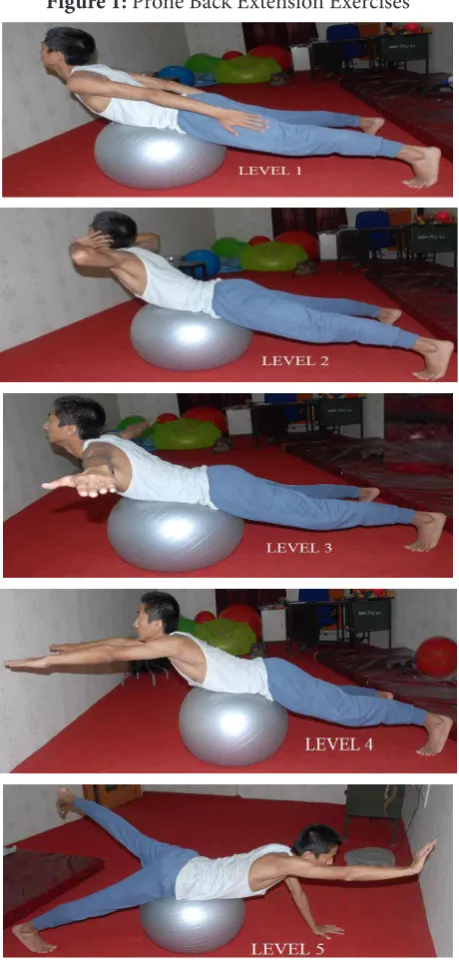
The whole sequence of 5 levels is repeated 6 times. 30 sec-onds rest after each 10 lifts is given. If a subject is unable to progress to the next level he continues the rest of the repetitions in the previous level.
Level 1.Trunk hyperextension with upper limbs beside the trunk.
Level 2.Trunk hyperextension with upper limbs behind the head.
Level 3. Trunk hyperextension with upper limbs in full el-evation with elbow extended.
Level 4.Lifting of comtralateral arm and leg.
Level 5. Lifting of both legs and both shoulders with arms 90º abducted and elbow 90º flexed.
The Swiss ball exercises (Figure 2) are designed to match with the prone back extension exercises. It too has 5 levels. For exercise 1-4 the body is positioned in slanting with feet on the floor, knees extended, trunk in prone with the ball supporting the upper abdomen. For the fifth exercise the subject is placed in prone over the ball.
Level 1.trunk extension with upper limbs beside the trunk. Level 2.trunk extension with upper limbs behind the head. Level 3.trunk extension with shoulders abducted 90º with elbow extended.
Level 4.trunk extension with upper limbs in full elevation with elbow extended.
Level 5.contralateral upper and lower limb rising over the ball in prone.
Same dosage as prone back extension exercises is used.
Figure 1: Prone Back Extension Exercises
Figure 2: Swiss Ball Exercises
DATA ANALYSIS
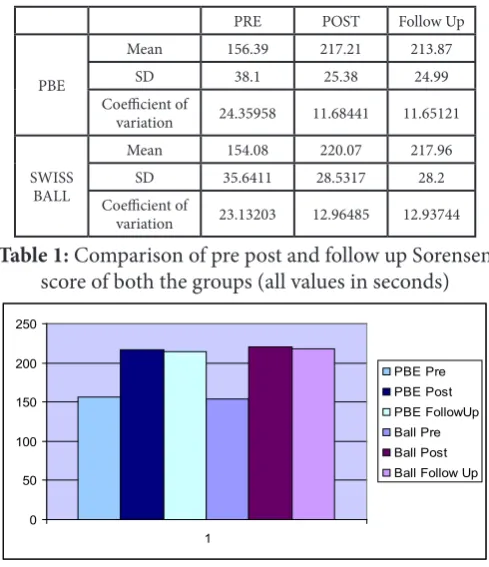
PRE POST Follow Up
PBE
Mean 156.39 217.21 213.87
SD 38.1 25.38 24.99
Coefficient of
variation 24.35958 11.68441 11.65121
SWISS BALL
Mean 154.08 220.07 217.96
SD 35.6411 28.5317 28.2
Coefficient of
variation 23.13203 12.96485 12.93744 Table 1: Comparison of pre post and follow up Sorensen
score of both the groups (all values in seconds)
0 50 100 150 200 250
1
PBE Pre PBE Post PBE FollowUp Ball Pre Ball Post Ball Follow Up
Figure 3: Comparison of mean Sorensen scores of both the groups
0 50 100 150 200 250 300
1 3 5 7 9 11 13 15 17 19 21 23 25 27 29
PBE pre PBE post follow up
Figure 4: Sorensen scores of all subjects in PBE group
0 50 100 150 200 250 300
1 3 5 7 9 11 13 15 17 19 21 23 25 27 29
ball pre ball post follow up
Figure 5: Sorensen scores of all subjects in SWISS BALL group
% Change PBE Ball
At 6 week 43.4 46.26
At follow Up -1.49 -0.99
RESULTS
The results obtained from PBE group after 6 weeks of in-tervention showed that PBE increased the isometric hold time for back extensors (Sorensen score) significantly (T value 18.16, P value 0.0000).The results obtained for Swiss ball group after 6 weeks of intervention showed that exten-sion exercises over Swiss ball also increased the Sorensen score for back extensors significantly ( T value 24.93, P val-ue 0.0000).
The average improvement of Sorensen score at 6 weeks for the PBE group is 60.83seconds or 43.40%. At two weeks fol-low up there is a slight change in the Sorensen score, with an average reduction of 1.34% and a standard deviation of 7.5 seconds. The average improvement of Sorensen score at 6 weeks for group II (Swiss ball group) is 66 seconds i.e. 46.26%. At two weeks follow up the Sorensen score shows an average reduction of 0.95% and a standard deviation of 2.27 seconds.
However, comparison of improvements in Sorensen score of PBE with Swiss ball exercises using two sample t- test showed there is no significant difference between the ef-fectiveness of these two exercises programs in improving back extensor endurance (T value -1.13, P value 0.26). The changes in mean Sorensen scores of both the groups show similar improvements in back endurance after sixth week, when expressed in percentage. At two weeks follow up the detraining effects are minimal in both the groups.
DISCUSSION
Biering-Sorenson (1984) found that individuals with less lumbar extensor muscle endurance had an increased oc-currence of first episode low back pain. The current opinion thus, emphasizes administration of low intensity high rep-etition endurance exercises to counter back problem[16]. Along with the muscular aerobic benefits, aerobic exercise also stimulates solute and metabolic transport which in turn enhances disc nutrition. The combined effect of all these changes makes the back extensors better equipped to maintain a good posture and sustain mechanical stresses. Design of the exercise were similar to those used by Mof-froid et al [17] in their study on PBE although the dosage were different as they performed their study on patient population whereas the present study included homoge-neous population of healthy male students who are not en-gaged with regular strenuous physical activity.
physiotherapy students, and the fact that a low Sorensen score increases the likelihood of back pain, this observa-tion is in accordance with Nyland LJ” [20]study on risk for low back pain in undergraduate physiotherapystudents. After 6 weeks of exercise both groups showed significant improvements, the PBE group improved their Sorensen score by 43.4% whereas the Swiss ball group improved 46.26%. This improvement is much more than the 22% im-provement obtained by Moffroid et al. The possible cause for this difference may be owing to the difference in the dosage of the protocols, the study subjects and the low-er baseline values of outcomes. The findings of the pres-ent study contradict the results of the study performed by Chock B et al [21] where 6 weeks of PBE could not increase Sorensen score significantly.
This research also finds that the isometric hold times of the subjects after 6 weeks of intervention are less variable (coefficient of variability 12.26) compared to the values obtained at the beginning (coefficient of variability 23.57). Also maximum improvement is seen to the people who were having low initial values.
The present study does not find any significant difference between the effectiveness of PBE and Swiss ball exercises, when performed using similar parameters, although in generalSwissball exercises were better tolerated and more enjoyable as reported by the participants. Our results are in accordance with the study performed by Lehman GJ et al, which concluded selected trunk muscle activity during certain upper limb strength training exercises is not con-sistently influenced by the replacement of an exercise bench with a Swiss ball. According to that study individ-uals respond differently to unstable surfaces. The authors go on to say that if a therapist merely wants variety in an exercise program and increased exercise compliance and enjoyment then the adoption of a Swiss ball appears rea-sonable but not justified biomechanically.
The results of the present study contradict the study per-formed by Cosio-Lima LM et al. which compared the ef-fects of 5 weeks of physioball core stability and balance ex-ercises with conventional floor exex-ercises in women which say ball exercises are better than the floor exercises using EMG as the outcome tool. This apparent difference may be due to the fact that the Sorensen test gives the outcome in terms of isometric hold time, not providing any insight to the actual electrical activity generated by the muscle. Whether the similar results of PBE and Swiss ball exercis-es are actually similar electromyographically would be an interesting topic for the further study. Although the effects of both PBE and Swiss ball exercises do not differ signifi-cantly, the comparison of the cross training effects of these exercises on the flexor side of the trunk stabilizers (abdom-inals) would be a matter of interest and should be included in future studies.
At two weeks follow up there is a slight change in the So-rensen score, with an average reduction of 1.34% for PBE and 0.95% for Swiss ball, which is in accordance with the principle of reversibility [22]. However even though
mus-cular endurance is reported to decrease after two weeks of inactivity [23] 10 out of 60 participants have shown a mini-mal increase in the isometric hold time at two weeks follow up. This shows that like the effects of training, effects of detraining are also variable from individual.
CONCLUSION
Both PBE and Swiss ball exercises improve isometric hold time for the back extensors as measured by Sorensen scale, but there is no significant difference in their effect, howev-er, the Swiss ball can be used to add variation in the work-out. So both the exercises can be used interchangeably for building back endurance, which can reduce the risk of low back pain.
REFERENCES
[1] Borenstein DG, Wiesel SW, Boden SD. Low back pain medical diagnosis and comprehensive management. 2nd edition; 1995.
[2] Adams N. The psychophysiology of low back pain. 1st edition; 1997.
[3] Deyo RA.Low-Back Pain. Sci Am. 1998 Aug;279(2):48-53.
[4] Neumann DA. Kinesiology of the musculoskeletal sys-tem: foundations for physical rehabilitation. 1st edi-tion; 2002.
[5] Hodges PW, Richardson CA. Insufficient muscular sta-bilization of the lumbar spine associated with low back pain: a motor control evaluation of transverses abdom-inis. Spine. 1996; 21(22):2640-2650.
[6] Vander Heidus GJ et al. De effectiviteit van tractiebi-jlagerugklachten. De resultaten van een pilot study. Nedtfysiotherapie. 1991; 101:37-43
[7] Borenstein DG, Wiesel SW, Boden SD. Low back pain medical diagnosis and comprehensive management. 2nd edition; 1995.
[8] Mechanical Low Back Pain Three Mechanical Low Back Pain Syndromes. virtual health care team. School of health professionals. university of Missouri- Colum-bia; Aug 2006.
[9] Oatis CA. Kinesiology: The mechanics and pathome-chanics of human movements. 2nd edition;2008.
[10] Foss LM, Keteyian SJ. Fox’s physiological basis for ex-ercise and sport. 6th edition;1998.
[11] Udermann BE, Mayer John M., Graves James E,
Mur-ray Steven R J. QuantitativeAssessment of Lumbar Paraspinal Muscle Endurance. Athl Train. 2003 Jul– Sep; 38(3): 259–262.
[12] Plamomdon A, Serresse O, Boyd K, Ladourceur D,
Desjardins P. Estimated moments at L5/S1 level and muscular activation of back extensors for six prone back extension exercises in healthy individuals. Scand J Med Sci Sports. 2002 Apr;12(2):81-89.
[13] BeateCarriere. The swiss ball (Theory, basic exercises and clinical application). Springer; 1998.
[14] Behm DG, Leonard AM, Young WB, Bonsey WA,
[15] Lehman GJ, Gordon T, Langley J, Pemrose P, Tregas-kisingS. Replacing a Swiss ball for an exercise bench causes variable changes in trunk muscle activity during upper limb strength exercises. Dynamic Med-icine. 2005, 4:6.
[16] Biering-Sorensen F. Physical measurements as risk
in-dicators for low-back trouble over a one-year period. Spine. 1984 Mar;9(2):106-19.
[17] Moffroid MT, Haugh LD, Haig AJ, Henry SM, Pope
MH. Endurance training of trunk extensor muscles. Physical Therapy. January 1993; vol 73 (1): 440-447.
[18] Melissa D McKeon, Wayne J Albert, J Patrick Neary.
Assessment of neuromuscular and haemodynamic activity in individuals with and without chronic low back pain. Dynamic Medicine. 2006, 5:6
[19] Nordin M, Kahanovitz N, Verderame R, Parnianpour M, Yabut S, Viola K, Greenidge N, Mulvihill M. Nor-mal trunk muscle strength and endurance in women and the effect of exercises and electrical stimulation. Part 1: Normal endurance and trunk muscle strength in 101 women. Spine. 1987 Mar; 12(2):105-11.
[20] Nyland LJ, Grimmer KA. Is undergraduate
physio-therapy study a risk factor for low back pain? A prev-alence study of LBP in physiotherapy students. BMC MusculoskeletDisord. 2003; 4: 22.
[21] Chock B, Lee R, Latimer J, Tan SB. Endurance
train-ing of the trunk extensor muscles in people with sub-acute low back pain. PhysTher. 1999; 79 (1): 1032-42.
[22] Kisner C, Colby LA. Therapeutic exercise foundations
and techniques. 4th edition;2002.
[23] Wilmore JH, costill DL. Physiology of sport and
exer-cise. 2nd edition;1996.
Citation