Unsupervised Morphological Segmentation with Log-Linear Models
Hoifung Poon∗
Dept. of Computer Sci. & Eng. University of Washington
Seattle, WA 98195 [email protected]
Colin Cherry Microsoft Research Redmond, WA 98052 [email protected]
Kristina Toutanova Microsoft Research Redmond, WA 98052 [email protected]
Abstract
Morphological segmentation breaks words into morphemes (the basic semantic units). It is a key component for natural language pro-cessing systems. Unsupervised morphologi-cal segmentation is attractive, because in ev-ery language there are virtually unlimited sup-plies of text, but very few labeled resources. However, most existing model-based systems for unsupervised morphological segmentation use directed generative models, making it dif-ficult to leverage arbitrary overlapping fea-tures that are potentially helpful to learning. In this paper, we present the first log-linear model for unsupervised morphological seg-mentation. Our model uses overlapping fea-tures such as morphemes and their contexts, and incorporates exponential priors inspired by the minimum description length (MDL) principle. We present efficient algorithms for learning and inference by combining con-trastive estimation with sampling. Our sys-tem, based on monolingual features only, out-performs a state-of-the-art system by a large margin, even when the latter uses bilingual in-formation such as phrasal alignment and pho-netic correspondence. On the Arabic Penn Treebank, our system reduces F1 error by 11% compared to Morfessor.
1 Introduction
The goal of morphological segmentation is to seg-ment words into morphemes, the basic syntac-tic/semantic units. This is a key subtask in many
∗ This research was conducted during the author’s
intern-ship at Microsoft Research.
NLP applications, including machine translation, speech recognition and question answering. Past approaches include rule-based morphological an-alyzers (Buckwalter, 2004) and supervised learn-ing (Habash and Rambow, 2005). While successful, these require deep language expertise and a long and laborious process in system building or labeling.
Unsupervised approaches are attractive due to the the availability of large quantities of unlabeled text, and unsupervised morphological segmentation has been extensively studied for a number of languages (Brent et al., 1995; Goldsmith, 2001; Dasgupta and Ng, 2007; Creutz and Lagus, 2007). The lack of supervised labels makes it even more important to leverage rich features and global dependencies. However, existing systems use directed generative models (Creutz and Lagus, 2007; Snyder and Barzi-lay, 2008b), making it difficult to extend them with arbitrary overlapping dependencies that are poten-tially helpful to segmentation.
In this paper, we present the first log-linear model for unsupervised morphological segmentation. Our model incorporates simple priors inspired by the minimum description length (MDL) principle, as well as overlapping features such as morphemes and their contexts (e.g., in Arabic, the string Al is likely a morpheme, as is any string between Al and a word boundary). We develop efficient learning and infer-ence algorithms using a novel combination of two ideas from previous work on unsupervised learn-ing with log-linear models: contrastive estimation (Smith and Eisner, 2005) and sampling (Poon and Domingos, 2008).
approach on datasets in Arabic and Hebrew. Our system, using monolingual features only, outper-forms Snyder & Barzilay (2008b) by a large mar-gin, even when their system uses bilingual informa-tion such as phrasal alignment and phonetic corre-spondence. On the Arabic Penn Treebank, our sys-tem reduces F1 error by 11% compared to Mor-fessor Categories-MAP (Creutz and Lagus, 2007). Our system can be readily applied to supervised and semi-supervised learning. Using a fraction of the labeled data, it already outperforms Snyder & Barzilay’s supervised results (2008a), which further demonstrates the benefit of using a log-linear model. 2 Related Work
There is a large body of work on the unsupervised learning of morphology. In addition to morpholog-ical segmentation, there has been work on unsuper-vised morpheme analysis, where one needs to deter-mine features of word forms (Kurimo et al., 2007) or identify words with the same lemma by model-ing stem changes (Schone and Jurafsky, 2001; Gold-smith, 2001). However, we focus our review specif-ically on morphological segmentation.
In the absence of labels, unsupervised learning must incorporate a strong learning bias that reflects prior knowledge about the task. In morphological segmentation, an often-used bias is the minimum description length (MDL) principle, which favors compact representations of the lexicon and corpus (Brent et al., 1995; Goldsmith, 2001; Creutz and La-gus, 2007). Other approaches use statistics on mor-pheme context, such as conditional entropy between adjacentn-grams, to identify morpheme candidates (Harris, 1955; Keshava and Pitler, 2006). In this pa-per, we incorporate both intuitions into a simple yet powerful model, and show that each contributes sig-nificantly to performance.
Unsupervised morphological segmentation sys-tems also differ from the engineering perspective. Some adopt a pipeline approach (Schone and Ju-rafsky, 2001; Dasgupta and Ng, 2007; Demberg, 2007), which works by first extracting candidate affixes and stems, and then segmenting the words based on the candidates. Others model segmenta-tion using a joint probabilistic distribusegmenta-tion (Goldwa-ter et al., 2006; Creutz and Lagus, 2007; Snyder and
Barzilay, 2008b); they learn the model parameters from unlabeled data and produce the most proba-ble segmentation as the final output. The latter ap-proach is arguably more appealing from the mod-eling standpoint and avoids error propagation along the pipeline. However, most existing systems use directed generative models; Creutz & Lagus (2007) used an HMM, while Goldwater et al. (2006) and Snyder & Barzilay (2008b) used Bayesian models based on Pitman-Yor or Dirichlet processes. These models are difficult to extend with arbitrary overlap-ping features that can help improve accuracy.
In this work we incorporate novel overlapping contextual features and show that they greatly im-prove performance. Non-overlapping contextual features previously have been used in directed gen-erative models (in the form of Markov models) for unsupervised morphological segmentation (Creutz and Lagus, 2007) or word segmentation (Goldwater et al., 2007). In terms of feature sets, our model is most closely related to the constituent-context model proposed by Klein and Manning (2001) for grammar induction. If we exclude the priors, our model can also be seen as a semi-Markov conditional random field (CRF) model (Sarawagi and Cohen, 2004). Semi-Markov CRFs previously have been used for supervised word segmentation (Andrew, 2006), but not for unsupervised morphological segmentation.
Unsupervised learning with log-linear models has received little attention in the past. Two notable ex-ceptions are Smith & Eisner (2005) for POS tagging, and Poon & Domingos (2008) for coreference res-olution. Learning with log-linear models requires computing the normalization constant (a.k.a. the partition function)Z. This is already challenging in supervised learning. In unsupervised learning, the difficulty is further compounded by the absence of supervised labels. Smith & Eisner (2005) proposed
contrastive estimation, which uses a small
neighbor-hood to computeZ. The neighborhood is carefully designed so that it not only makes computation eas-ier but also offers sufficient contrastive information to aid unsupervised learning. Poon & Domingos (2008), on the other hand, used sampling to approx-imateZ.1 In this work, we benefit from both tech-niques: contrastive estimation creates a manageable,
1
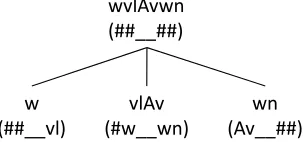
wvlAvwn (##__##)
w (##__vl)
vlAv (#w__wn)
[image:3.612.109.262.63.134.2]wn (Av__##)
Figure 1: The morpheme and context (in parentheses) features for the segmented word w-vlAv-wn.
informative Z, while sampling enables the use of powerful global features.
3 Log-Linear Model for Unsupervised Morphological Segmentation
Central to our approach is a log-linear model that defines the joint probability distribution for a pus (i.e., the words) and a segmentation on the cor-pus. The core of this model is a morpheme-context model, with one feature for each morpheme,2 and one feature for each morpheme context. We rep-resent contexts using the n-grams before and after the morpheme, for some constant n. To illustrate this, a segmented Arabic corpus is shown below along with its features, assuming we are tracking bi-gram contexts. The segmentation is indicated with hyphens, while the hash symbol (#) represents the word boundary.
Segmented Corpus hnAk w-vlAv-wn bn-w
Al-ywm Al-jmAEp
Morpheme Feature:Value hnAk:1 w:2 vlAv:1
wn:1 bn:1 Al:2 ywm:1 jmAEp:1 hnAk:1 wvlAvwn:1 bnw:1 Alywm:1 Alj-mAEp:1
Bigram Context Feature:Value ## vl:1
#w wn:1 Av ##:1 ## w#:1 bn ##:1 ## yw:1 Al ##:2 ## jm:1 ## ##:5 Furthermore, the corresponding features for the seg-mented word w-vlAv-wn are shown in Figure 1.
Each feature is associated with a weight, which correlates with the likelihood that the correspond-ing morpheme or context marks a valid morpholog-ical segment. Such overlapping features allow us to capture rich segmentation regularities. For example, given the Arabic word Alywm, to derive its correct segmentation Al-ywm, it helps to know that Al and
ywm are likely morphemes whereas Aly or lyw are
2
The word as a whole is also treated as a morpheme in itself.
not; it also helps to know that Al ## or ## yw are likely morpheme contexts whereas ly ## or ## wm are not. Ablation tests verify the importance of these overlapping features (see Section 7.2).
Our morpheme-context model is inspired by the constituent-context model (CCM) proposed by Klein and Manning (2001) for grammar induction. The morphological segmentation of a word can be viewed as a flat tree, where the root node corre-sponds to the word and the leaves correspond to morphemes (see Figure 1). The CCM uses uni-grams for context features. For this task, however, we found that bigrams and trigrams lead to much better accuracy. We use trigrams in our full model.
For learning, one can either view the corpus as a collection of word types (unique words) or tokens (word occurrences). Some systems (e.g., Morfessor) use token frequency for parameter estimation. Our system, however, performs much better using word types. This has also been observed for other mor-phological learners (Goldwater et al., 2006). Thus we use types in learning and inference, and effec-tively enforce the constraint that words can have only one segmentation per type. Evaluation is still based on tokens to reflect the performance in real applications.
In addition to the features of the morpheme-context model, we incorporate two priors which cap-ture additional intuitions about morphological seg-mentations. First, we observe that the number of distinct morphemes used to segment a corpus should be small. This is achieved when the same mor-phemes are re-used across many different words. Our model incorporates this intuition by imposing a lexicon prior: an exponential prior with nega-tive weight on the length of the morpheme lexi-con. We define the lexicon to be the set of unique morphemes identified by a complete segmentation of the corpus, and the lexicon length to be the to-tal number of characters in the lexicon. In this way, we can simultaneously emphasize that a lexi-con should lexi-contain few unique morphemes, and that those morphemes should be short. However, the lex-icon prior alone incorrectly favors the trivial seg-mentation that shatters each word into characters, which results in the smallest lexicon possible (sin-gle characters). Therefore, we also impose a corpus
mor-phemes used to segment each word in the corpus, which penalizes over-segmentation. We notice that longer words tend to have more morphemes. There-fore, each word’s contribution to this prior is nor-malized by the word’s length in characters (e.g., the segmented word w-vlAv-wn contributes 3/7 to the to-tal corpus size). Notice that it is straightforward to incorporate such a prior in a log-linear model, but much more challenging to do so in a directed gen-erative model. These two priors are inspired by the minimum description length (MDL) length princi-ple; the lexicon prior favors fewer morpheme types, whereas the corpus prior favors fewer morpheme to-kens. They are vital to the success of our model, providing it with the initial inductive bias.
We also notice that often a word is decomposed into a stem and some prefixes and suffixes. This is particularly true for languages with predominantly inflectional morphology, such as Arabic, Hebrew, and English. Thus our model uses separate lexicons for prefixes, stems, and suffixes. This results in a small but non-negligible accuracy gain in our exper-iments. We require that a stem contain at least two characters and no fewer characters than any affixes in the same word.3 In a given word, when a pheme is identified as the stem, any preceding mor-pheme is identified as a prefix, whereas any follow-ing morpheme as a suffix. The sample segmented corpus mentioned earlier induces the following lex-icons:
Prefix w Al
Stem hnAk vlAv bn ywm jmAEp
Suffix wn w
Before presenting our formal model, we first in-troduce some notation. LetW be a corpus (i.e., a set of words), andSbe a segmentation that breaks each word inW into prefixes, a stem, and suffixes. Letσ
be a string (character sequence). Each occurrence of
σwill be in the form ofψ1σψ2, whereψ1, ψ2are the adjacent charactern-grams, andc= (ψ1, ψ2)is the context ofσin this occurrence. Thus a segmentation can be viewed as a set of morpheme strings and their contexts. For a stringx,L(x)denotes the number of characters inx; for a wordw, MS(w) denotes the
3
In a segmentation where several morphemes have the max-imum length, any of them can be identified as the stem, each resulting in a distinct segmentation.
number of morphemes inwgiven the segmentation
S; P ref(W, S), Stem(W, S), Suf f(W, S) denote the lexicons of prefixes, stems, and suffixes induced bySforW. Then, our model defines a joint proba-bility distribution over a restricted set ofW andS:
Pθ(W, S) = 1
Z ·uθ(W, S)
where
uθ(W, S) = exp( X
σ
λσfσ(S) + X
c
λcfc(S)
+α· X
σ∈P ref(W,S)
L(σ)
+α· X
σ∈Stem(W,S)
L(σ)
+α· X
σ∈Suf f(W,S)
L(σ)
+β· X
w∈W
MS(w)/L(w) )
Here,fσ(S)andfc(S)are respectively the
occur-rence counts of morphemes and contexts under S, and θ = (λσ, λc : σ, c) are their feature weights.
α, β are the weights for the priors. Z is the nor-malization constant, which sums over a set of cor-pora and segmentations. In the next section, we will define this set for our model and show how to effi-ciently perform learning and inference.
4 Unsupervised Learning
As mentioned in Smith & Eisner (2005), learning with probabilistic models can be viewed as moving probability mass to the observed data. The question is from where to take this mass. For log-linear mod-els, the answer amounts to defining the set that Z
sums over. We use contrastive estimation and define the set to be a neighborhood of the observed data. The instances in the neighborhood can be viewed as pseudo-negative examples, and learning seeks to discriminate them from the observed instances.
Formally, letW∗be the observed corpus, and let
N(·) be a function that maps a string to a set of strings; letN(W∗)denote the set of all corpora that can be derived from W∗ by replacing every word
w∈W∗with one inN(w). Then,
Z = X
W∈N(W∗)
X
S
Unsupervised learning maximizes the log-likelihood of observingW∗
Lθ(W∗) = log X
S
P(W∗, S)
We use gradient descent for this optimization; the partial derivatives for feature weights are
∂ ∂λi
Lθ(W∗) =ES|W∗[fi]−ES,W[fi]
whereiis either a string σor a context c. The first expected count ranges over all possible segmenta-tions while the words are fixed to those observed in
W∗. For the second expected count, the words also range over the neighborhood.
Smith & Eisner (2005) considered various neigh-borhoods for unsupervised POS tagging, and showed that the best neighborhoods are TRANS1
(transposing any pair of adjacent words) and
DELORTRANS1 (deleting any word or transposing any pair of adjacent words). We can obtain their counterparts for morphological segmentation by simply replacing “words” with “characters”. As mentioned earlier, the instances in the neighbor-hood serve as pseudo-negative examples from which probability mass can be taken away. In this regard,
DELORTRANS1 is suitable for POS tagging since deleting a word often results in an ungrammatical sentence. However, in morphology, a word less a character is often a legitimate word too. For exam-ple, deleting l from the Hebrew word lyhwh (to the lord) results in yhwh (the lord). ThusDELORTRANS1
forces legal words to compete against each other for probability mass, which seems like a misguided ob-jective. Therefore, in our model we useTRANS1. It is suited for our task because transposing a pair of adjacent characters usually results in a non-word.
To combat overfitting in learning, we impose a Gaussian prior (L2 regularization) on all weights. 5 Supervised Learning
Our learning algorithm can be readily applied to su-pervised or semi-susu-pervised learning. Suppose that gold segmentation is available for some words, de-noted as S∗. If S∗ contains gold segmentations for all words inW, we are doing supervised learn-ing; otherwise, learning is semi-supervised.
Train-ing now maximizesLθ(W∗, S∗); the partial
deriva-tives become
∂ ∂λi
Lθ(W∗, S∗) =ES|W∗,S∗[fi]−ES,W[fi]
The only difference in comparison with unsuper-vised learning is that we fix the known segmenta-tion when computing the first expected counts. In Section 7.3, we show that when labels are available, our model also learns much more effectively than a directed graphical model.
6 Inference
In Smith & Eisner (2005), the objects (sentences) are independent from each other, and exact inference is tractable. In our model, however, the lexicon prior renders all objects (words) interdependent in terms of segmentation decisions. Consider the simple cor-pus with just two words: Alrb, lAlrb. If lAlrb is seg-mented into l-rb, Alrb can be segseg-mented into
Al-rb without paying the penalty imposed by the
lexi-con prior. If, however, lAlrb remains a single mor-pheme, and we still segment Alrb into Al-rb, then we introduce two new morphemes into the lexicons, and we will be penalized by the lexicon prior ac-cordingly. As a result, we must segment the whole corpus jointly, making exact inference intractable. Therefore, we resort to approximate inference. To computeES|W∗[fi], we use Gibbs sampling. To
de-rive a sample, the procedure goes through each word and samples the next segmentation conditioned on the segmentation of all other words. Withm sam-plesS1,· · ·, Sm, the expected count can be
approx-imated as
ES|W∗[fi]≈ 1
m
X
j
fi(Sj)
There are2n−1ways to segment a word ofn char-acters. To sample a new segmentation for a partic-ular word, we need to compute conditional proba-bility for each of these segmentations. We currently do this by explicit enumeration.4 Whennis large,
4
this is very expensive. However, we observe that the maximum number of morphemes that a word contains is usually a small constant for many lan-guages; in the Arabic Penn Treebank, the longest word contains 14 characters, but the maximum num-ber of morphemes in a word is only 5. Therefore, we impose the constraint that a word can be seg-mented into no more than k morphemes, where k
is a language-specific constant. We can determine
k from prior knowledge or use a development set. This constraint substantially reduces the number of segmentation candidates to consider; withk = 5, it reduces the number of segmentations to consider by almost 90% for a word of 14 characters.
ES,W[fi]can be computed by Gibbs sampling in
the same way, except that in each step we also sam-ple the next word from the neighborhood, in addition to the next segmentation.
To compute the most probable segmentation, we use deterministic annealing. It works just like a sam-pling algorithm except that the weights are divided by a temperature, which starts with a large value and gradually drops to a value close to zero. To make burn-in faster, when computing the expected counts, we initialize the sampler with the most probable seg-mentation output by annealing.
7 Experiments
We evaluated our system on two datasets. Our main evaluation is on a multi-lingual dataset constructed by Snyder & Barzilay (2008a; 2008b). It consists of 6192 short parallel phrases in Hebrew, Arabic, Ara-maic (a dialect of Arabic), and English. The paral-lel phrases were extracted from the Hebrew Bible and its translations via word alignment and post-processing. For Arabic, the gold segmentation was obtained using a highly accurate Arabic morpholog-ical analyzer (Habash and Rambow, 2005); for He-brew, from a Bible edition distributed by Westmin-ster Hebrew Institute (Groves and Lowery, 2006). There is no gold segmentation for English and Ara-maic. Like Snyder & Barzilay, we evaluate on the Arabic and Hebrew portions only; unlike their ap-proach, our system does not use any bilingual in-formation. We refer to this dataset as S&B . We also report our results on the Arabic Penn Treebank (ATB), which provides gold segmentations for an
Arabic corpus with about 120,000 Arabic words. As in previous work, we report recall, precision, and F1 over segmentation points. We used 500 phrases from the S&B dataset for feature develop-ment, and also tuned our model hyperparameters there. The weights for the lexicon and corpus pri-ors were set to α = −1, β = −20. The feature weights were initialized to zero and were penalized by a Gaussian prior withσ2 = 100. The learning rate was set to 0.02 for all experiments, except the full Arabic Penn Treebank, for which it was set to 0.005.5 We used 30 iterations for learning. In each iteration, 200 samples were collected to compute each of the two expected counts. The sampler was initialized by running annealing for 2000 samples, with the temperature dropping from 10 to 0.1 at 0.1 decrements. The most probable segmentation was obtained by running annealing for 10000 samples, using the same temperature schedule. We restricted the segmentation candidates to those with no greater than five segments in all experiments.
7.1 Unsupervised Segmentation on S&B
We followed the experimental set-up of Snyder & Barzilay (2008b) to enable a direct comparison. The dataset is split into a training set with 4/5 of the phrases, and a test set with the remaining 1/5. First, we carried out unsupervised learning on the training data, and computed the most probable segmentation for it. Then we fixed the learned weights and the seg-mentation for training, and computed the most prob-able segmentation for the test set, on which we eval-uated.6 Snyder & Barzilay (2008b) compared sev-eral versions of their systems, differing in how much bilingual information was used. Using monolingual information only, their system (S&B-MONO) trails the state-of-the-art system Morfessor; however, their best system (S&B-BEST), which uses bilingual in-formation that includes phrasal alignment and pho-netic correspondence between Arabic and Hebrew, outperforms Morfessor and achieves the state-of-the-art results on this dataset.
5The ATB set is more than an order of magnitude larger and
requires a smaller rate.
6With unsupervised learning, we can use the entire dataset
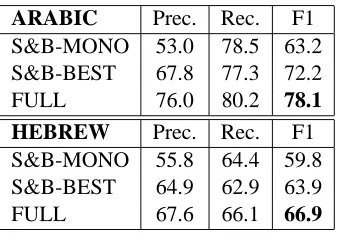
ARABIC Prec. Rec. F1 S&B-MONO 53.0 78.5 63.2 S&B-BEST 67.8 77.3 72.2
FULL 76.0 80.2 78.1
HEBREW Prec. Rec. F1
S&B-MONO 55.8 64.4 59.8 S&B-BEST 64.9 62.9 63.9
[image:7.612.102.272.58.175.2]FULL 67.6 66.1 66.9
Table 1: Comparison of segmentation results on the S&B dataset.
Table 1 compares our system with theirs. Our sys-tem outperforms both S&B-MONO and S&B-BEST by a large margin. For example, on Arabic, our sys-tem reduces F1 error by 21% compared to S&B-BEST, and by 40% compared to S&B-MONO. This suggests that the use of monolingual morpheme con-text, enabled by our log-linear model, is more help-ful than their bilingual cues.
7.2 Ablation Tests
To evaluate the contributions of the major compo-nents in our model, we conducted seven ablation tests on the S&B dataset, each using a model that differed from our full model in one aspect. The first three tests evaluate the effect of priors, whereas the next three test the effect of context features. The last evaluates the impact of using separate lexicons for affixes and stems.
NO-PRIOR The priors are not used. NO-COR-PR The corpus prior is not used. NO-LEX-PR The lexicon prior is not used. NO-CONTEXT Context features are not used. UNIGRAM Unigrams are used in context. BIGRAM Bigrams are used in context.
SG-LEXICON A single lexicon is used, rather than
three distinct ones for the affixes and stems. Table 2 presents the ablation results in compari-son with the results of the full model. When some or all priors are excluded, the F1 score drops substan-tially (over 10 points in all cases, and over 40 points in some). In particular, excluding the corpus prior, as in NO-PRIOR and NO-COR-PR, results in over-segmentation, as is evident from the high recalls and low precisions. When the corpus prior is enacted but not the lexicon priors (NO-LEX-PR), precision
ARABIC Prec. Rec. F1
FULL 76.0 80.2 78.1
NO-PRIOR 24.6 89.3 38.6 NO-COR-PR 23.7 87.4 37.2 NO-LEX-PR 79.1 51.3 62.3 NO-CONTEXT 71.2 62.1 66.3
UNIGRAM 71.3 76.5 73.8
BIGRAM 73.1 78.4 75.7
SG-LEXICON 72.8 82.0 77.1
HEBREW Prec. Rec. F1
FULL 67.6 66.1 66.9
NO-PRIOR 34.0 89.9 49.4 NO-COR-PR 35.6 90.6 51.1 NO-LEX-PR 65.9 49.2 56.4 NO-CONTEXT 63.0 47.6 54.3
UNIGRAM 63.0 63.7 63.3
BIGRAM 69.5 66.1 67.8
[image:7.612.336.519.59.309.2]SG-LEXICON 67.4 65.7 66.6 Table 2: Ablation test results on the S&B dataset.
is much higher, but recall is low; the system now errs on under-segmentation because recurring strings are often not identified as morphemes.
ARABIC %Lbl. Prec. Rec. F1 S&B-MONO-S 100 73.2 92.4 81.7 S&B-BEST-S 200 77.8 92.3 84.4
FULL-S 25 84.9 85.5 85.2
50 88.2 86.8 87.5 75 89.6 86.4 87.9 100 91.7 88.5 90.0
HEBREW %Lbl. Prec. Rec. F1
S&B-MONO-S 100 71.4 79.1 75.1 S&B-BEST-S 200 76.8 79.2 78.0
FULL-S 25 78.7 73.3 75.9
[image:8.612.326.532.59.174.2]50 82.8 74.6 78.4 75 83.1 77.3 80.1 100 83.0 78.9 80.9
Table 3: Comparison of segmentation results with super-vised and semi-supersuper-vised learning on the S&B dataset.
7.3 Supervised and Semi-Supervised Learning
To evaluate our system in the supervised and semi-supervised learning settings, we report the perfor-mance when various amounts of labeled data are made available during learning, and compare them to the results of Snyder & Barzilay (2008a). They reported results for supervised learning using mono-lingual features only (S&B-MONO-S), and for su-pervised bilingual learning with labels for both lan-guages (S&B-BEST-S). On both lanlan-guages, our sys-tem substantially outperforms both S&B-MONO-S and S&B-BEST-S. E.g., on Arabic, our system re-duces F1 errors by 46% compared to S&B-MONO-S, and by 36% compared to S&B-BEST-S. More-over, with only one-fourth of the labeled data, our system already outperforms S&B-MONO-S. This demonstrates that our log-linear model is better suited to take advantage of supervised labels.
7.4 Arabic Penn Treebank
We also evaluated our system on the Arabic Penn Treebank (ATB). As is common in unsupervised learning, we trained and evaluated on the entire set. We compare our system with Morfessor (Creutz and Lagus, 2007).7 In addition, we compare with Mor-fessor Categories-MAP, which builds on MorMor-fessor and conducts an additional greedy search specifi-cally tailored to segmentation. We found that it per-7We cannot compare with Snyder & Barzilay’s system as its
strongest results require bilingual data, which is not available.
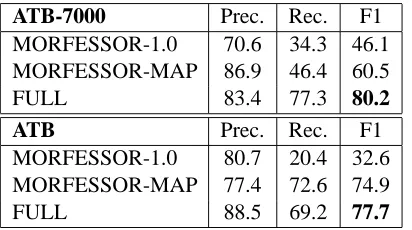
ATB-7000 Prec. Rec. F1
MORFESSOR-1.0 70.6 34.3 46.1 MORFESSOR-MAP 86.9 46.4 60.5
FULL 83.4 77.3 80.2
ATB Prec. Rec. F1
MORFESSOR-1.0 80.7 20.4 32.6 MORFESSOR-MAP 77.4 72.6 74.9
FULL 88.5 69.2 77.7
Table 4: Comparison of segmentation results on the Ara-bic Penn Treebank.
forms much better than Morfessor on Arabic but worse on Hebrew. To test each system in a low-data setting, we also ran experiments on the set con-taining the first 7,000 words in ATB with at least two characters (ATB-7000). Table 4 shows the re-sults. Morfessor performs rather poorly on ATB-7000. Morfessor Categories-MAP does much bet-ter, but its performance is dwarfed by our system, which further cuts F1 error by half. On the full ATB dataset, Morfessor performs even worse, whereas Morfessor Categories-MAP benefits from the larger dataset and achieves an F1 of 74.9. Still, our system substantially outperforms it, further reducing F1 er-ror by 11%.8
8 Conclusion
This paper introduces the first log-linear model for unsupervised morphological segmentation. It lever-ages overlapping features such as morphemes and their contexts, and enables easy extension to incor-porate additional features and linguistic knowledge. For Arabic and Hebrew, it outperforms the state-of-the-art systems by a large margin. It can also be readily applied to supervised or semi-supervised learning when labeled data is available. Future di-rections include applying our model to other flectional and agglutinative languages, modeling in-ternal variations of morphemes, leveraging parallel data in multiple languages, and combining morpho-logical segmentation with other NLP tasks, such as machine translation.
8Note that the ATB and ATB-7000 experiments each
[image:8.612.77.296.60.254.2]References
Galen Andrew. 2006. A hybrid markov/semi-markov conditional random field for sequence segmentation. In Conference on Empirical Methods in Natural
Lan-guage Processing (EMNLP).
Michael R. Brent, Sreerama K. Murthy, and Andrew Lundberg. 1995. Discovering morphemic suffixes: A case study in minimum description length induction. In Proceedings of the 15th Annual Conference of the
Cognitive Science Society.
Tim Buckwalter. 2004. Buckwalter Arabic morphologi-cal analyzer version 2.0.
Mathias Creutz and Krista Lagus. 2007. Unsupervised models for morpheme segmentation and morphology learning. ACM Transactions on Speech and Language
Processing, 4(1).
Sajib Dasgupta and Vincent Ng. 2007. High-performance, language-independent morphological segmentation. In Proceedings of Human Language
Technology (NAACL).
Vera Demberg. 2007. A language-independent unsuper-vised model for morphological segmentation. In
Pro-ceedings of the 45th Annual Meeting of the Association for Computational Linguistics, Prague, Czech
Repub-lic.
John Goldsmith. 2001. Unsupervised learning of the morphology of a natural language. Computational Linguistics, 27(2):153–198.
Sharon Goldwater, Thomas L. Griffiths, and Mark John-son. 2006. Interpolating between types and tokens by estimating power-law generators. In Advances in
Neu-ral Information Processing Systems 18.
Sharon Goldwater, Thomas L. Griffiths, and Mark John-son. 2007. Distributional cues to word segmenta-tion: Context is important. In Proceedings of the 31st
Boston University Conference on Language Develop-ment.
Alan Groves and Kirk Lowery, editors. 2006. The
minster Hebrew Bible Morphology Database.
West-minster Hebrew Institute, Philadelphia, PA, USA. Nizar Habash and Owen Rambow. 2005. Arabic
tok-enization, part-of-speech tagging and morphological disambiguation in one fell swoop. In Proceedings of
the 43rd Annual Meeting of the Association for Com-putational Linguistics.
Zellig S. Harris. 1955. From phoneme to morpheme.
Language, 31(2):190–222.
Samarth Keshava and Emily Pitler. 2006. A simple, intu-itive approach to morpheme induction. In Proceedings
of 2nd Pascal Challenges Workshop, Venice, Italy.
Dan Klein and Christopher D. Manning. 2001. Natu-ral language grammar induction using a constituent-context model. In Advances in Neural Information
Processing Systems 14.
Mikko Kurimo, Mathias Creutz, and Ville Turunen. 2007. Overview of Morpho Challenge in CLEF 2007. In Working Notes of the CLEF 2007 Workshop. Hoifung Poon and Pedro Domingos. 2008. Joint
un-supervised coreference resolution with markov logic. In Proceedings of the 2008 Conference on Empirical
Methods in Natural Language Processing, pages 649–
658, Honolulu, HI. ACL.
Ronald Rosenfeld. 1997. A whole sentence maximum entropy language model. In IEEE workshop on
Auto-matic Speech Recognition and Understanding.
Sunita Sarawagi and William Cohen. 2004. Semimarkov conditional random fields for information extraction. In Proceedings of the Twenty First International
Con-ference on Machine Learning.
Patrick Schone and Daniel Jurafsky. 2001. Knowlege-free induction of inflectional morphologies. In
Pro-ceedings of Human Language Technology (NAACL).
Noah A. Smith and Jason Eisner. 2005. Contrastive esti-mation: Training log-linear models on unlabeled data. In Proceedings of the 43rd Annual Meeting of the
As-sociation for Computational Linguistics.
Benjamin Snyder and Regina Barzilay. 2008a. Cross-lingual propagation for morphological analysis. In
Proceedings of the Twenty Third National Conference on Artificial Intelligence.
Benjamin Snyder and Regina Barzilay. 2008b. Unsuper-vised multilingual learning for morphological segmen-tation. In Proceedings of the 46th Annual Meeting of