Proceedings of NAACL-HLT 2018, pages 726–731
Gated Multi-Task Network for Text Classification
Liqiang Xiao and Honglun Zhang and Wenqing Chen
State Key Lab of Advanced Optical Communication System and Network, Shanghai Jiao Tong University
Artificial Intelligence Institute, Shanghai Jiao Tong University 800 Dongchuan Road, Shanghai, China
{xiaoliqiang,zhanghonglun,wenqingchen}@sjtu.edu.cn
Abstract
Multi-task learning with Convolutional Neu-ral Network (CNN) has shown great success in many Natural Language Processing (NLP) tasks. This success can be largely attributed to the feature sharing by fusing some lay-ers among tasks. However, most existing approaches just fully or proportionally share the features without distinguishing the help-fulness of them. By that the network would be confused by the helpless even harmful fea-tures, generating undesired interference be-tween tasks. In this paper, we introduce gate mechanism into multi-task CNN and propose a new Gated Sharing Unit, which can filter the feature flows between tasks and greatly reduce the interference. Experiments on9text classi-fication datasets shows that our approach can learn selection rules automatically and gain a great improvement over strong baselines.
1 Introduction
The combination of multi-task learning and neural networks has shown its advantages in many tasks, ranging from computer vision (Misra et al.,2016;
Ruder et al.,2017) to natural language processing
(Collobert and Weston, 2008). Multi-task
learn-ing (MTL) has the ability to share the knowledge among the joint tasks, which implicitly increases the training materials (Caruana,1997). The shared knowledge help the network learn a more univer-sal representation for the inputs. Inspired by this, more DNN-based approaches (Liu et al., 2015;
Zhang et al., 2017) utilize multi-task learning to
improve their performance.
The scheme for information sharing is the linch-pin for designing an elaborate multi-task network. Most existing work attempts to find a appropriate proportion to sharing the layers between tasks, de-spite they entirely reuse the shallow layers (Liu
et al., 2015;Caruana,1993) or add the layers up
at a ratio (Fang et al.,2017). And recently, the lat-ter one shows its advantages for controlling rela-tional intensity among tasks and become prevail-ing. More models adopt this thought to enhance the performance (Liu et al.,2015,2016).
However, under the scheme of proportional ad-dition (Ruder et al.,2017;Misra et al.,2016), all the features are shared with the same weight be-tween every pair of tasks. Helpless or harmful features may be transported between tasks with the same importance as helpful ones, namely, the interference is generated. This would burden the network for distinguishing the helpful features and even mislead the predictions.
To solve above problem, we propose a new CNN-based architecture for multi-task learning, which can share features in a selective way. Our model allocates a private subnet to each task and transport the features between the subnets with a well-designed module—Gated Sharing Unit. It has the ability to filter features with gate mecha-nism (Chung et al.,2014;Srivastava et al.,2015) and select the helpful ones to benefit the tasks in hand, which expands the feature spaces and pro-vides more evidence for right predictions. Our model is an end-to-end method and the proposed Gated Sharing Unit is easy to train.
We conduct extensive experiments on9
bench-mark datasets for text classification. The results show that our model greatly improves the perfor-mance and surpasses the single-task models and other competitors.
2 Gated Multi-Task Network
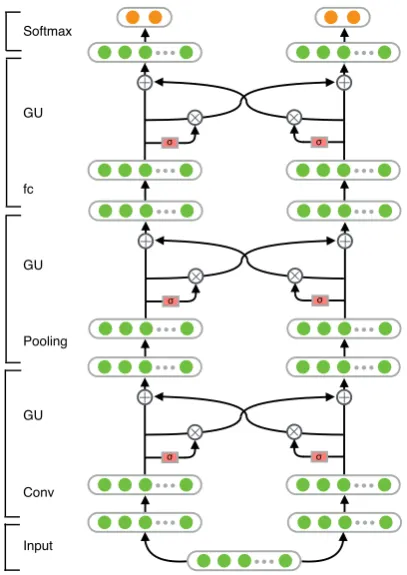
To make full use of multiple datasets and, mean-while, avoid the interference, we introduce a new structure for multi-task learning in this section. The new structure is designed in a separative way—every task owns a private subnet. To share
Conv GU Pooling fc GU
GU
···
···
GCU
···
···
~
~
Softmax
···
InputGCU
···
···
···
···
~
×
σ
×
σ
···
···
···
···
×
σ
×
σ
···
···
···
···
×
σ
×
σ
···
···
···
···
×
σ
×
σ
Figure 1: Illustration of the architecture for Gated Multi-Task CNN .
features across the subnets, gate mechanism is de-signed to selectively allow the features been ex-changed. Our new model can be trained end-to-end, needing no extra supervision or handcraft hy-perparameters. And it can be easily transferred to other networks such as DNN, RNN, LSTM, etc. Figure1 illustrates the design of model structure and other details.
2.1 Model Architecture
Multi-task model with deeper layers shared can augment deeper knowledge and greatly increase the feature space (Zhang et al.,2017). But unde-sirable interference inevitably and simultaneously comes with the benefits, especially between less-related tasks. This would burden the models with the overhead on distinguishing helpful features. To overcome this problem, we assign each task a private subnet as illustrated in Figure 1. Tasks are relatively separated and can borrow the useful information from others through a bridge, Gated Sharing Unit (GSU). The weight of each feature in this unit is automatically learned from previ-ous layers, needing no extra supervision, so there is more selectivity across the tasks. By filtering out useless features, tasks receive less interference
···
···
···
···
×
√ √
Task j Task k σ
Fj l+1
Fj l
Fkl gjk l
⊙
[image:2.595.79.283.60.348.2]W
Figure 2: Illustration of Gated Sharing Unit
from each other.
2.2 Gated Sharing Unit
For reducing interference, it important to filter the information flows among the tasks. Hence, in this section, we introduce the mechanism of gate, which originates from the cells of recurrent neural networks like Long-Short Term Memory (LSTM)
(Hochreiter and Schmidhuber, 1997), Gated
Re-current Unit (GRU) (Chung et al., 2014). Gated mechanism in existing studies not only shows its convenience for training (Srivastava et al.,2015), but also behaves as tool to route the information (He et al.,2016).
Inspirited by gate mechanism, we propose a new module GSU to control the information flows and selectively share the features among tasks. The details of this module is shown in Figure 2. For notation, we refer toC as the collection ofN
tasks andC ={1,2,· · ·, N}. For a sample from arbitrary taskj, a series of feature maps are
gener-ated in subnets. When taskjborrows the features
from taskk, a gategis inserted to select the help-ful ones, which is calculated from the prior layer by
gljk =σ(Wjkl ·Flk+bljk) (1)
wherelmeans the level of the layers andσdenotes
the nonlinear activation of sigmoid, which guaran-tees the values ofgin the[0,1]. Note that the gate
gjkl is vector. Each component in it controls the
pass of a corresponding feature. Their states move between pass and interception, or choose a middle ground if needed.
For taskj, the outputFlj+1of gates is calculated
by fusing the lower layersFlfrom all the tasks by
Flj+1= ∑
k∈C,k̸=j
gljk⊙Flk+Flj (2)
[image:2.595.315.517.63.180.2]represent the output for all the tasks C, we can stack Eq. (2) in matrix form
Fl1+1 Fl2+1
...
FlN+1
=
1 g12l · · · gl1N gl21 1 · · · gl2N
... ... ... ...
glN1 glN2 · · · 1
Fl1 Fl2
...
FlN
(3) From Eq. (2) and (3), we know that, in the GSU, the feature map for current task directly passes into the next layer. But the features from other tasks are merged into current task after the se-lection by gates. In this way, the shared features tend to be pure and helpful for current task, which avoids the harmful interference existing in conven-tional models.
For comparison, here we briefly introduce the methods that share the features by proportional ad-dition (Misra et al.,2016;Ruder et al.,2017;Fang
et al., 2017). They can be constructed by
insert-ing a scaler weightαl
jk between every two tasks
i, j. αl
jk is updated by back-propagation and
re-flects the degree of association between tasks, but do not select the features. In this paper, this kind of models is alluded to as PA-CNN.
2.3 Output Layer and Loss
In the last layer of task j, vector representations
ˆ
Fj of input sequences are ultimately fed into
cor-responding softmax layers to fit the number of classes, which emits the prediction of probability distribution for the taskj
ˆ
yj =sof tmax(WjFˆj+bj) (4)
whereyˆj is predictive result;Wj is the weight of
the full-connected layer; andbjis the bias term.
Given the prediction of all tasks, a global loss function forces the model to minimize the cross-entropy of prediction and true distribution for all the tasks:
Φ =
N
∑
j=1
λjL(ˆyj, yj) (5)
whereλjis the weight for the taskj. In this paper,
we setλjto1/N for allN tasks to make a balance.
3 Experiments
In this section, we demonstrate the empirical per-formance of our model on 9 related benchmark
tasks for text classification. And the results are compared with the state-of-the-art models.
Dataset Train Dev. Test V L
Books 1398 200 400 22K 159
Electronics 1398 200 400 11K 111
DVDs 1400 200 400 22K 189
Kitchen 1400 200 400 10K 93
Apparel 1400 200 400 8K 64
Baby 1300 200 400 9K 173
RN 7860 1122 2246 29K 147
SUBJ 8000 1000 1000 21K 23
[image:3.595.309.527.62.194.2]TREC 4907 545 500 10K 10
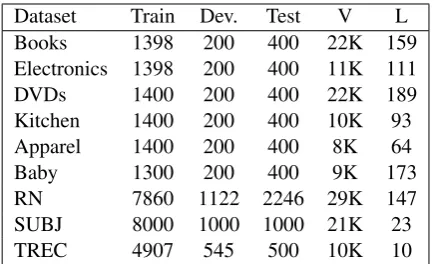
Table 1: Statistics of the text classification datasets. Train, Dev. and Test denote the size of train, devel-opment and test set respectively; C: Vocabulary size; L: Average sentence length.
3.1 Datasets
As Table1shows, we select 9 related benchmark datasets for text classification.
The first 6 datasets are all about product
re-views, which are comprised of Amazon product reviews in 6 domains, including books, DVDs,
cameras, etc. These corpora are classified accord-ing to the sentiment of positiveness or negative-ness. They are collected from the raw data pub-lished by (Blitzer et al.,2007).
The rest 3 datasets are RN, SUBJ and TREC.
RN is a dataset about news topic classification, which is collected from Reuters Newswire and published by (Velasco et al.,1994); SUBJ is a sub-jectivity dataset, whose task is to classify a sen-tence level text as being subjective or objective
(Pang et al.,2004); TREC dataset has the task of
classifying a question into6 types (the questions
are about location, person, numeric information, etc.)(Li and Roth,2002).
3.2 Hyperparameters and Training
For all the experiments, we employ Word2Vec (Mikolov et al.,2013) to initialized the word vec-tors, which is trained on Google News with 100 billion words. The vectors have dimensionality of 300 and are trained by continuous bag-of-words architecture. All the other parameters are initial-ized with random values from uniform distribution in [-0.1, 0.1]. For every subnet we use: rectified linear units, filter windows of 3,4,5 with 100 fea-ture maps each, mini-batch size of 50, dropout rate of 0.5,l2constrain of 3, learning rate of10−3. All
stan-Dataset DCNN LSTM BiLSTMSingle-Task (%) MT-DNN MT-RNN Multi-Task (%)MT-CNN PA-CNN GMT-CNN
Books 80.7 79.5 81.0 82.3 83.3 84.0 82.2 84.4
Electronics 78.3 80.5 78.5 81.6 84.6 83.1 84.8 86.9
DVDs 80.6 81.7 80.5 83.8 84.2 84.0 83.7 85.4
Kitchen 79.8 78.0 81.2 80.8 86.0 83.4 85.1 85.9
Apparel 84.2 83.2 86.0 85.1 86.3 83.6 87.2 87.0
Baby 84.1 84.7 84.5 88.0 87.6 87.8 86.5 88.3
RN 83.6 83.5 83.7 83.9 84.2 84.3 83.6 85.0
SUBJ 93.0 93.1 93.2 92.7 94.1 92.9 93.1 94.0
TREC 93.0 92.7 93.0 93.2 93.5 93.7 93.3 94.2
[image:4.595.308.524.320.388.2]Avg. 84.1 84.1 84.6 85.7(+1.1) 87.0(+2.4) 86.3(+1.7) 86.6(+2.0) 87.9(+3.3)
Table 2: Accuracies of our model against other state-of-the-art methods. Single-Task column shows the results of plain DCNN(Kalchbrenner et al.,2014), LSTM(Jozefowicz et al.,2015) and BiLSTM. First 3 models in the Multi-Task column shows the results of multi-task models: MT-DCNN (Liu et al.,2015), MT-RNN (Zhang et al.,2017), MT-CNN (Collobert and Weston,2008). The remaining columns of PA-CNN and GMT-CNN shows the perfor-mance of proportional addition or gate mechanism. Number in round bracket denotes the average improvement over BiLSTM.
dard dev set we randomly select 10% as dev set. The whole network is trained through stochastic gradient decent using Adadelta update rule (Zeiler,
2012).
3.3 Performance of Multi-task CNN
Table 2 shows the comparison of the accuracies. All the results for multi-task learning models are achieved by training simultaneously on9datasets.
From the table, we can see that the models em-ploying multi-task learning improve the perfor-mance on most tasks beyond the single-task mod-els, in which our model achieves the highest ac-curacies. Specifically, our model boosts the per-formance by3.3%over the best single-task model
BiLSTM, outstripping other multi-task models by at least0.9%. Additionally, we also compare our
model with the PA-CNN, a variant keeps the struc-ture of GMT-CNN but shares the feastruc-tures by pro-portional additions. For PA-CNN, performance on several datasets is decreased than single-task due to the interference. In contract, our model shows steady improvement in all the datasets and sur-passes PA-CNN by1.3%, which indicates the
ef-fectiveness of gate mechanism.
3.4 Visualization
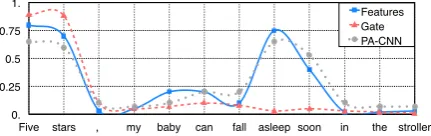
To intuitively show the selection process, we de-sign an experiment to show the values of gates and how they block the useless features. For the first convolutional layer and GSU, we visualize the ac-tivationsF1j of the filters with normalized values
and show their corresponding weightsg1
jk in the
0. 0.25 0.5 0.75 1.
Five stars my baby can fall asleep soon in the stroller Features Gate PA-CNN
Figure 3: Features line illustrates feature weights in
F1
dvdsin DVDs subnet. And Gate line shows the value ofg1
baby←dvdsthat filters the features from DVDs sub-net to Baby subsub-net. PA-CNN line visualizes the feature weights in the first layer of PA-CNN.
gate units. By that we can easily find what kind of features are discarded as interference.
4 Conclusion and Future Work
In this paper, we introduce gate mechanism in multi-task CNN to reduce the interference. The proposed model has an ability to select the po-tentially useful features, which can reduce the in-terference among tests. The effectiveness of our method is fully validated on 9 datasets for text classification and further illustrated by visualiza-tion experiment.
In future work, we would like to investigate the effect of memory mechanism for multi-task learn-ing, which is similar to gate mechanism but more complex. It originates from recurrent neural net-work and have been proven effective for feature selection.
5 Acknowledge
We would like to thank Yaohui Jin and Yongkun Wang for their careful guidance. Besides, we appreciate the constructive advices from Naoki Yoshinaga and the valuable comments from anonymous reviewers. This research was funded by National Natural Science Foundation of China under Grant No. 61371048.
References
John Blitzer, Mark Dredze, and Fernando Pereira. 2007. Biographies, bollywood, boom-boxes and blenders: Domain adaptation for sentiment classi-fication. InACL 2007, Proceedings of the 45th An-nual Meeting of the Association for Computational Linguistics, June 23-30, 2007, Prague, Czech
Re-public. http://aclweb.org/anthology/
P07-1056.
Rich Caruana. 1993. Multitask learning: A knowledge-based source of inductive bias. In Ma-chine Learning, Proceedings of the Tenth Inter-national Conference, University of Massachusetts, Amherst, MA, USA, June 27-29, 1993. pages 41–48. Rich Caruana. 1997. Multitask learning. Machine
Learning28(1):41–75.
Junyoung Chung, C¸aglar G¨ulc¸ehre, KyungHyun Cho, and Yoshua Bengio. 2014. Empirical evaluation of gated recurrent neural networks on sequence mod-eling. CoRR abs/1412.3555. http://arxiv.
org/abs/1412.3555.
Ronan Collobert and Jason Weston. 2008. A unified architecture for natural language processing: deep neural networks with multitask learning. In Ma-chine Learning, Proceedings of the Twenty-Fifth In-ternational Conference (ICML 2008), Helsinki, Fin-land, June 5-9, 2008. pages 160–167. https:
//doi.org/10.1145/1390156.1390177.
Yuchun Fang, Zhengyan Ma, Zhaoxiang Zhang, Xu-Yao Zhang, and Xiang Bai. 2017. Dynamic multi-task learning with convolutional neural network. In
Proceedings of the Twenty-Sixth International Joint Conference on Artificial Intelligence, IJCAI 2017, Melbourne, Australia, August 19-25, 2017. pages 1668–1674. https://doi.org/10.24963/
ijcai.2017/231.
Kaiming He, Xiangyu Zhang, Shaoqing Ren, and Jian Sun. 2016. Deep residual learning for image recog-nition. In 2016 IEEE Conference on Computer Vision and Pattern Recognition, CVPR 2016, Las Vegas, NV, USA, June 27-30, 2016. pages 770–
778. https://doi.org/10.1109/CVPR.
2016.90.
Sepp Hochreiter and J¨urgen Schmidhuber. 1997.
Long short-term memory. Neural Computa-tion 9(8):1735–1780. https://doi.org/10.
1162/neco.1997.9.8.1735.
Rafal Jozefowicz, Wojciech Zaremba, and Ilya Sutskever. 2015. An empirical exploration of recur-rent network architectures. In International Con-ference on International ConCon-ference on Machine Learning. pages 2342–2350.
Nal Kalchbrenner, Edward Grefenstette, and Phil Blunsom. 2014. A convolutional neural network for modelling sentences. In Proceedings of the 52nd Annual Meeting of the Association for Com-putational Linguistics, ACL 2014, June 22-27, 2014, Baltimore, MD, USA, Volume 1: Long Pa-pers. pages 655–665. http://aclweb.org/
anthology/P/P14/P14-1062.pdf.
Xin Li and Dan Roth. 2002. Learning question classi-fiers. Coling12(24):556–562.
Pengfei Liu, Xipeng Qiu, and Xuanjing Huang. 2016. Recurrent neural network for text classification with multi-task learning .
Xiaodong Liu, Jianfeng Gao, Xiaodong He, Li Deng, Kevin Duh, and Ye Yi Wang. 2015. Representation learning using multi-task deep neural networks for semantic classification and information retrieval. In
Conference of the North American Chapter of the Association for Computational Linguistics: Human Language Technologies. pages 912–921.
Tomas Mikolov, Ilya Sutskever, Kai Chen, Greg Cor-rado, and Jeffrey Dean. 2013. Distributed represen-tations of words and phrases and their composition-ality. Advances in Neural Information Processing Systems26:3111–3119.
Ishan Misra, Abhinav Shrivastava, Abhinav Gupta, and Martial Hebert. 2016. Cross-stitch networks for multi-task learning. In The IEEE Conference on Computer Vision and Pattern Recognition (CVPR). Pang, Bo, Lee, and Lillian. 2004. A sentimental
Sebastian Ruder, Joachim Bingel, Isabelle Augenstein, and Anders Sgaard. 2017. Sluice networks: Learn-ing what to share between loosely related tasks .
Rupesh Kumar Srivastava, Klaus Greff, and J¨urgen Schmidhuber. 2015. Highway networks. CoRR
abs/1505.00387. http://arxiv.org/abs/ 1505.00387.
E Velasco, L. C. Thuler, C. A. Martins, L. M. Dias, and V. M. Gonalves. 1994. Automated learning of deci-sion rules for text categorization. Acm Transactions on Information Systems12(3):233–251.
Matthew D. Zeiler. 2012. Adadelta: An adaptive learn-ing rate method.Computer Science.
Honglun Zhang, Liqiang Xiao, Yongkun Wang, and Yaohui Jin. 2017. A generalized recurrent neural architecture for text classification with multi-task learning. InProceedings of the Twenty-Sixth Inter-national Joint Conference on Artificial Intelligence, IJCAI 2017, Melbourne, Australia, August 19-25, 2017. pages 3385–3391. https://doi.org/