The Computational Complexity of Distinctive Feature Minimization in
Phonology
Hubie Chen
Computer Science and Information Systems Birkbeck, University of London
Mans Hulden Department of Linguistics
University of Colorado [email protected]
Abstract
We analyze the complexity of the problem of determining whether a set of phonemes forms a natural class and, if so, that of finding the minimal feature specification for the class. A standard assumption in phonology is that find-ing a minimal feature specification is an au-tomatic part of acquisition and generalization. We find that the natural class decision problem is tractable (i.e. is inP), while the minimiza-tion problem is not; the decision version of the problem which determines whether a natural class can be defined with k features or less isN P-complete. We also show that, empir-ically, a greedy algorithm for finding minimal feature specifications will sometimes fail, and thus cannot be assumed to be the basis for hu-man perforhu-mance in solving the problem.
1 Introduction
The distinctive featureis held by many phonol-ogists, independently of theoretical orientation, to be the fundamental unit of analysis of sound patterns in language. The underlying working assumption of most phonological approaches is that a single sound or a set of sounds is ex-pressed through a combination of positive or neg-ative features and that these features are in some sense universal across languages (Mielke,2008a). The exact makeup of the feature set employed has varied over time, ranging from the limited, more acoustic-oriented features ofJakobson et al. (1951), to the richer model presented in Chom-sky and Halle(1968), to more complex hierarchi-cally organized features inClements(1985). The concept ofnatural classis intimately tied to such feature systems and is taken to be any set of seg-ments that share some number of distinctive fea-tures. Furthermore, phonological alternations that do not target natural classes are hypothesized not to occur.
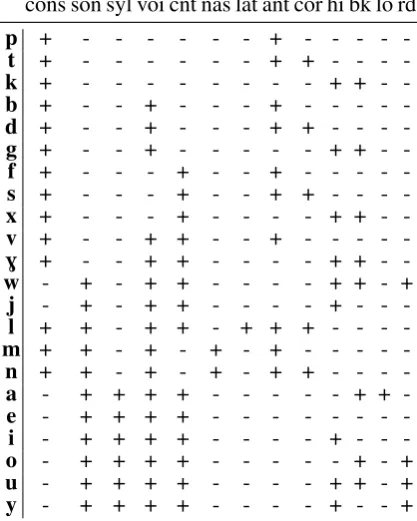
Another assumption that is found in phonolog-ical literature—often less explicit—is that when-ever a phonological process targets a group of sounds, that group is to be expressed nonredun-dantly by the minimum number of features re-quired to do so. In general, one can find a mul-titude of ways in which a set of phonemes can be specified using positive or negative features. For example, using the feature system shown in Ta-ble1, the set{m,n} has the obvious minimal de-scription[+nas], since m and n are the only nasals.
But that set could also be specified non-minimally as:
+cons -cnt
-hi -bk +voi +son
(1)
The potential complexity of this problem, find-ing a minimal specification, is not addressed in the phonological literature. Yet, finding such a min-imal specification is not trivial. Using more re-alistic feature systems such as the ones given in Hayes (2011), there are, for example, 208 dis-tinct solutions to specifying the set {e,i} in En-glish, only four of which have the minimum length of 3 features. While such modern feature sys-tems work with 25–30 features, one can actually assume more features are needed to cover more cross-linguistically exotic contrasts such as those produced by including click consonants (Miller, 2011). The P-base 3 resource (Mielke,2008b) lists 398 features over 8 feature systems, covering 629 languages.
The general notion of feature economy has a long tradition in phonology (Jakobson,1942; Mar-tinet,1955;Clements,2003), mostly targeting en-tire feature systems in a language, i.e. advocating
that on the grammar level, individual languages make maximal use of the feature inventory avail-able (Fant, 1966). Equally prominent is the as-sumption that any specification of phonological al-ternations be made with the minimal number of features necessary: “one should use the minimum number of features required to specify all and only the sounds in the class.” (Zsiga, 2012, p.282). Hayes (2011), among others, argues, following Ockham’s Razor, that this is how generalization can take place and that phonological hypotheses are made in precisely this way—witnessing alter-nations that target a set of sounds, learners find the minimal feature specification that is consis-tent with the alternating sounds, generalizing from there to other sounds that may enter the language. Halle (1962) also proposes a mechanism of “fea-ture counting” as a methodology to rule out spuri-ous generalizations one might propose—a process which implicitly includes the capability of feature minimization.
Similar arguments of feature minimization are used to perform an optimization of an entire phonological grammar. In Radical Underspecifi-cation,Archangeli(1984) refers to what is termed FEATURE MINIMIZATIONPRINCIPLE: “A gram-mar is most highly valued when underlying repre-sentations include the minimal number of features necessary to make the different phonemes of the language” (Archangeli,1984, p. 48).
Given such claims concerning acquisition and phonological analysis, it is of some interest to as-sess the actual computational complexity of fea-ture minimization. This entails answering how difficult it is in the worst case to determine whether a set of segments represents a natural class, and also how to find the minimal feature specification.
2 Overview
We will assume a set of phonemes P—the phoneme inventory—and another set Q, our tar-get set that we want to express through a combi-nation of features, and a feature system F such as the one shown in Table 1. The first problem we address is that of determining whether a set of phonemesQforms anatural class, which we call thefeature description problem. We show that this is decidable in polynomial time. Further, we will show that a minimization version of the problem, which we call thefeature minimization problemis N P-complete (Garey and Johnson,1979;Sipser,
cons son syl voi cnt nas lat ant cor hi bk lo rd
p + +
-t + + +
-k + + +
-b + + +
-d + + + +
-g + + + +
-f + + +
-s + + + +
-x + + + +
-v + + + +
-G + + + + +
-w - + - + + - - - - + + - +
j - + + + +
-l + + + + + + +
-m + + + + +
-n + + + + + +
-a - + + + + + +
-e - + + + +
-i - + + + + +
-o - + + + + - - - + - +
u - + + + + - - - - + + - +
[image:2.595.313.522.69.330.2]y - + + + + - - - - + - - +
Table 1: An example typical feature system (truncated to 13 features).
2013). We will show this by reduction from the well known set covering problem (Karp,1972).
Many phonologists espouse a combination of binary (equipollent) and privative (univalent) fea-tures (Trubetzkoy,1969;Ewen and van der Hulst, 1985;Goldsmith,1985). The rationale is that, for example, the feature [±labial] has rarely, if ever, been found to play a role in a phonological system as [−labial], i.e. phonological processes that tar-get non-labials seem to be absent. Hence, many phonologists favor the use of a single possibility [LABIAL] in a specification that includes the labi-als. For this reason, we analyze separately both the complexity of using only such privative features (positive features only), which we call thepositive feature description problem(is Qa natural class if we only use positive features?) and the corre-spondingpositive feature minimization problem.
3 Notation and terms
Throughout, whenAis a set, we use℘(A)to
de-note the power set ofA.
Relative to a set P of phonemes, we define a
feature systemto be a subset F ⊆ ℘(P). When
Q ⊆ P, we define a F-description of Q to be a sequence G1, . . . , Gm ⊆ P such that there
ex-ist pairwise dex-istinct elements F1, . . . , Fm ∈ F
• eachGiis equal to eitherFiorP\Fi, and
• Q=G1∩ · · · ∩Gm.
We refer tomas thesizeof the description. We say that such a description ispositiveif eachGiis
an element ofF.
We define the feature description problem as follows. An instance consists of a set P of phonemes, a feature systemF, and a non-empty subsetQ ⊆ P; the problem is to decide whether or not there exists aF-description ofQ.
We define the feature minimization problem
as follows. An instance consists of a tuple
(P,F, Q, k) whereP, F, andQ are an instance of the feature description problem, andk≥1is a
natural number. The problem is to decide whether or not there exists aF-description ofQhaving size less than or equal tok.
We define thepositive feature description prob-lemto have the same instances as thefeature de-scription problem, but where the problem is to decide whether or not there exists a positive F-description ofQ. Analogously, we define the posi-tive feature minimization problemto have the same instances as thefeature minimization problem, but where the problem is to decide whether or not there exists a positiveF-description ofQobeying the size restriction.
3.1 The feature description problems
We will first show that the feature description problems are decidable in polynomial time.
Proposition 1. The feature description problem and the positive feature description problem are each polynomial-time decidable.
Proof. The algorithm for the feature descrip-tion problem is as follows. Given an instance
(P,F, Q), compute a set C ⊆ ℘(P) as follows.
For each F ∈ F, place F in C if Q ⊆ F, and placeP \F inC ifQ ⊆ P \F. Then, check if T
C = Q; if so, accept, otherwise, reject. It
suf-fices to argue that if there exists a F-description ofQ, then the elements ofCconstitute such a de-scription. If there exists aF-description ofQ, say, G1, . . . , Gm, we have Q ⊆ Gi for each i; thus,
G1, . . . , Gm ∈ Cand we have
Q⊆\C ⊆G1∩ · · · ∩Gm=Q,
implying that the elements of C provide a F-description ofQ.
For the positive feature description problem, the algorithm computes C+ to contain each F ∈ F such that Q ⊆ F, and accepts if and only if T
C+ =Q. The proof of correctness is similar to that given for the general feature description prob-lem.
3.2 The minimization problems
An instance (U,S, k) of the set cover problem
consists of a non-empty set U, a subset S ⊆ ℘(U), and a natural number k ≥ 1. A set cover
S1, . . . , Sm is a sequence of sets fromS such that
S1∪ · · · ∪Sm =U;mis said to be its size. The
problem is to decide whether or not there exists a set cover of size less than or equal tok (Karp, 1972). We prove that both the feature minimiza-tion problem and the positive feature minimizaminimiza-tion problem areN P-complete, by reducing from set cover.
The reduction is the same for both of these problems, and is as follows. Given an instance
(U,S, k)of set cover, letxbe a fresh element not inU.
Define
P =U∪ {x}
F ={(U \S)∪ {x} |S ∈ S} Q={x}
The resulting instance is(P,F, Q, k).
The following establishes the correctness of this reduction.
Proposition 2. The following are equivalent:
1. There exists a sizemset cover ofU.
2. The setQ={x}has a positiveF-description of sizem.
3. The setQ={x}has aF-description of size m.
Proof. 1 ⇒ 2: Let (Si) be such a set cover, so
thatS1 ∪ · · · ∪Sm = U. Then, by DeMorgan’s
laws, (U \S1) ∩ · · · ∩ (U \ Sm) = ∅, and so
((U\S1)∪ {x})∩ · · · ∩((U\Sm)∪ {x}) ={x}.
2⇒3 is immediate.
3⇒1: Suppose thatG1, . . . , Gmis such a
de-scription. Sincex ∈Gi for eachi, it follows that
eachGiis an element ofF. DefineS1, . . . , Sm to
be the sets such thatGi = (U \Si) ∪ {x}. By
In the just-given reduction, the parameter kis not changed. We show that there in fact exists a reduction in the other direction, from set cover to each of the minimization problems, that like-wise does not change the parameterk. This indi-cates a tight relationship between these minimiza-tion problems and the set cover problem.
Proposition 3. Let(P,F, Q, k)be an instance of
the feature minimization problem; letC be the set
(from Proposition 1). The mapping which, upon being given this instance, returns(U,S, k)where
U = P \Q and S = {G\Q | G ∈ C}, is a
reduction to the set cover problem; here, the com-plement is with respect toU. Likewise, one obtains
a reduction from the positive feature minimization problem to the set cover problem, by usingC+ in
place ofC.
Proof. We argue this for the feature tion problem as follows (the positive minimiza-tion case is analogous). It was seen in the proof of Proposition 1 that (P,F, Q, k) is a ‘yes’
in-stance if and only if there existG1, . . . , Gm ∈ C,
with m ≤ k, such that G1 ∩ · · · ∩ Gm = Q.
This equality holds if and only if (G1 \ Q) ∩ · · · ∩(Gm \Q) = ∅, which holds if and only if
(G1\Q)∪ · · · ∪(Gm\Q) =U.
Parametrized complexity The set cover prob-lem, with the value k taken to be parameter, is known to be W[2]-complete in parameterized complexity theory (Cygan et al., 2015, Theorem 13.21). As we have given polynomial-time reduc-tions between set cover and each of the minimiza-tion problems that do not change the valuek, we obtain the following.
Proposition 4. Both the feature minimization problem and the positive feature minimization problem are W[2]-complete, when viewed as pa-rameterized problems with k taken to be the
pa-rameter.
4 Empirical concerns
Many N P-hard problems can in practice often be solved by either a greedy algorithm (Chvatal, 1979) or a branch-and-bound algorithm (Land and Doig, 1960) that recursively explores the search space, terminating search branches as soon as some defined limit is exceeded.
Greedy Search We have implemented a greedy search strategy that starts with no features, and
S = {{a,b,c},{b,d},{c,d},{d,e}}, U = {a,b,c,d,e}, k = 2
F1 = {d,e,x}
F2 ={a,c,e,x}
F3 ={a,b,e,x}
F4 ={a,b,c,x}
+F1
+F4
SETCOVERING
MINPHONFEAT
“yes” P = U ∪ {x} Q = {x}
[image:4.595.310.515.66.196.2]= Q k = 2
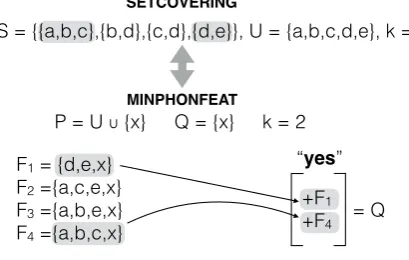
Figure 1: Illustration of the reduction fromSETCOVER -ING: we can solve an instance of the set cover problem (SETCOVERING) by a call to a solver for the feature minimization problem (MINPHONFEAT). There are re-ductions both from and to the set cover problem.
then picks a single (±) feature from the known, possibly non-minimal description C discussed in §3.1 in such a way as to rule out the majority of phonemes not in the desired setQ. Features are added to the description until only the setQis de-scribed. For example, in describing the set {m} using the example in Table1, the greedy approach would first pick the feature [+nas] since this cuts down the number of corresponding phonemes to just two (m and n), less than any other feature choice. This is essentially an analogue to the well-known greedy approximation algorithm for set cover (Chvatal,1979).
This greedy algorithm, however, in many prac-tical cases fails to find the correct minimal speci-fication, and is therefore not a viable candidate for efficient feature minimization. A simple example is finding the featural specification for the set{@} in English under the fairly standard featural sys-tem provided inHayes (2011) and van Vugt and Hayes(2012): the algorithm recovers the features [-tense, -back, -front, -coronal] while the minimal specification is [-back, -front, -coronal].
Set {h} {i, e} {r} {j} {m, n} {p, t, k}
BF 32,768 262,144 131,072 524,288 2048 4,096
B&B 3,432 11,482 3,444 4,790 1,450 1,315
Table 2: The number of search nodes explored during a brute-force search (BF) for finding a minimal solution for various sets of phonemes, or a branch-and-bound search (B&B). The feature inventory is one used for English (van Vugt and Hayes,2012;Hayes,2011).
5 Discussion
Humans have been noted to outperform sim-ple, low-polynomial time heuristic algorithms for some intractable problems such as the travel-ing salesman problem (MacGregor and Ormerod, 1996) using intuition and visual inspection of the problem structure. It is, however, unclear if such performance carries over to other problems of a different structure, such as MINPHONFEAT, or whether the hypothesis that a phonological acqui-sition process should include this type of mini-mization is too strong.
An important point to address in the complex-ity analysis is whether we are operating in a bounded domain. With a fixed, finite set of fea-tures to choose from and a fixed finite phoneme inventory, the problem can be considered static and solvable in constant time by memorizing or pre-calculating all the possible patterns of feature combinations and their corresponding phoneme sets. Such counter-arguments have been leveled (Kornai, 2006) at other N P-completeness analy-ses, such as those that have shown that Optimality Theory is potentially intractable (Eisner,2000; Id-sardi, 2006). In the case at hand, however, such an argument has less traction since the domain in question is rather large (potentially hundreds of features) and it seems inevitable that some search method must be used by speakers (or phonolo-gists) to discover the minimum number of features required. The fact that simple greedy algorithms do not always find the minimum specification, and that branch-and-bound algorithms, while efficient for practical computational use, still need to ex-plore a large search space, prompts the question whether some alternative strategy would work par-ticularly well with phonological feature structures proposed in the literature. This could address the problem that this intractability poses to phonolog-ical learning.
6 Conclusion
We have shown that one of the commonly assumed subtasks of acquisition of phono-logical generalizations—distinctive feature minimization—is computationally intractable. The decision version of the minimization problem isN P-complete, and it follows that the optimiza-tion version N P-hard. This is true even if one limits oneself to using only positive features, i.e. a privative feature system. Furthermore, a simple greedy strategy for solving the problem can not be attributed to purported human performance in finding minimal feature specifications since such a strategy will sometimes fail to find a minimal description with commonly proposed feature systems and phonological inventories. The problem of simply deciding whether a set of phonemes constitutes a natural class—the feature description problem—is solvable in polynomial time.
Reproducibility
Our feature systems data and code for the feature description and minimization problems is avail-able at https://github.com/mhulden/ minphonfeat.
Acknowledgements
References
Diana Bennett Archangeli. 1984. Underspecification in Yawelmani phonology and morphology. Ph.D. thesis, Massachusetts Institute of Technology. Noam Chomsky and Morris Halle. 1968. The Sound
Pattern of English. Harper & Row.
Vasek Chvatal. 1979. A greedy heuristic for the set-covering problem. Mathematics of operations re-search, 4(3):233–235.
George N. Clements. 1985. The geometry of phono-logical features. Phonology, 2(1):225–252.
George N Clements. 2003. Feature economy in sound systems. Phonology, 20(03):287–333.
Marek Cygan, Fedor V. Fomin, Lukasz Kowalik, Daniel Lokshtanov, D´aniel Marx, Marcin Pilipczuk, Michal Pilipczuk, and Saket Saurabh. 2015. Param-eterized Algorithms. Springer.
Jason Eisner. 2000. Easy and hard constraint ranking in optimality theory. InProceedings of the 5th Work-shop of the ACL Special Interest Group in Computa-tional Phonology (SIGPHON), pages 22–33. Colin J. Ewen and Harry van der Hulst. 1985.
Single-valued features and the nonlinear analysis of vowel harmony. Linguistics in the Netherlands, pages 39– 48.
Gunnar Fant. 1966. The nature of distinctive features. STL-QPSR, 4(1966):1.
Michael R. Garey and David S. Johnson. 1979. Com-puters and intractability: A guide to the theory of NP-completeness.
John Goldsmith. 1985. Vowel harmony in Khalkha Mongolian, Yaka, Finnish and Hungarian. Phonol-ogy, 2(1):253–275.
Morris Halle. 1962. Phonology in generative grammar. Word, 18(1-3):54–72.
Bruce Hayes. 2011. Introductory Phonology. John Wi-ley & Sons.
William J. Idsardi. 2006. A simple proof that optimal-ity theory is computationally intractable. Linguistic Inquiry, 37(2):271–275.
Roman Jakobson. 1942. The concept of phoneme. In Linda R. Waugh and Monique Moville-Burston, ed-itors, On Language, pages 218–241. Harvard Univ. Press, Cambridge, MA.
Roman Jakobson, C. Gunnar M. Fant, and Morris Halle. 1951. Preliminaries to Speech Analysis. The distinctive features and their correlates. MIT Press, Cambridge, MA.
Richard M. Karp. 1972. Reducibility among combina-torial problems. InComplexity of computer compu-tations, pages 85–103. Springer.
Andr´as Kornai. 1993. The generative power of feature geometry. Annals of Mathematics and Artificial In-telligence, 8(1-2):37.
Andr´as Kornai. 2006. Is OT NP-hard? Rutgers Opti-mality Archive (ROA).
Ailsa H. Land and Alison G. Doig. 1960. An automatic method of solving discrete programming problems. Econometrica: Journal of the Econometric Society, pages 497–520.
James N. MacGregor and Tom Ormerod. 1996. Human performance on the traveling salesman problem. At-tention, Perception, & Psychophysics, 58(4):527– 539.
Andr´e Martinet. 1955. ´Economie des changements phon´etiques. A. Francke, Bern, Switzerland.
Jeff Mielke. 2008a. The Emergence of Distinctive Fea-tures. Oxford University Press.
Jeff Mielke. 2008b. P-base 3. http://pbase. phon.chass.ncsu.edu/. Accessed: 2017-10-01.
Amanda Miller. 2011. The representation of clicks. In Mark van Oostendorp, Colin J. Ewen, Elizabeth Hume, and Keren Rice, editors,The Blackwell Com-panion to Phonology, volume 1, pages 416–439. Blackwell.
Michael Sipser. 2013. Introduction to the Theory of Computation, 2nd edition. Cengage Learning.
Nikolai Sergeevich Trubetzkoy. 1969. Principles of phonology. Univ. of California Press, Berkeley.
Florian van Vugt and Bruce Hayes. 2012. Phea-tures speadsheet: User’s manual. Technical report, UCLA.