12
Acquiring Annotated Data with Cross-lingual Explicitation
for Implicit Discourse Relation Classification
Wei Shi†, Frances Yung† and Vera Demberg†,‡
†Dept. of Language Science and Technology
‡Dept. of Mathematics and Computer Science, Saarland University Saarland Informatic Campus, 66123 Saarbr¨ucken, Germany
{w.shi, frances, vera}@coli.uni-saarland.de
Abstract
Implicit discourse relation classification is one of the most challenging and important tasks in discourse parsing, due to the lack of con-nectives as strong linguistic cues. A principle bottleneck to further improvement is the short-age of training data (ca. 18k instances in the Penn Discourse Treebank (PDTB)).Shi et al.
(2017) proposed to acquire additional data by exploiting connectives in translation: human translators mark discourse relations which are implicit in the source language explicitly in the translation. Using back-translations of such explicitated connectives improves dis-course relation parsing performance. This pa-per addresses the open question of whether the choice of the translation language matters, and whether multiple translations into differ-ent languages can be effectively used to im-prove the quality of the additional data.
1 Introduction
Discourse relations connect two sentences/clauses to each other. The identification of discourse re-lations is an important step in natural language understanding and is beneficial to various down-stream NLP applications such as text summariza-tion (Yoshida et al., 2014; Gerani et al., 2014), question answering (Verberne et al.,2007;Jansen et al.,2014), machine translation (Guzm´an et al., 2014;Meyer et al.,2015), and so on.
Discourse relations can be marked explicitly us-ing a discourse connective or discourse adverbial such as “because”, “but”, “however”, see example 1. Explicitly marked relations are relatively easy to classify automatically (Pitler et al., 2008). In example 2, the causal relation is not marked ex-plicitly, and can only be inferred from the texts. This second type of case is empirically even more common than explicitly marked relations (Prasad et al.,2008), but is much harder to classify auto-matically.
1. [No one has worked out the players’ average age.]Arg1But[most appear to be in their late 30s.]Arg2
— Explicit, Comparison.Contrast
2. [I want to add one more truck.]Arg1 (Implicit = Because) [I sense that the busi-ness will continue grow.]Arg2
— Implicit, Contingency.Cause
The difficulty in classifying implicit discourse relations stems from the lack of strong indicative cues. Early work has already shown that implicit relations cannot be learned from explicit ones by just removing the discourse markers, which may lead to a meaning shift in the examples (Sporleder and Lascarides, 2008), making human-annotated relations currently the only reliable source for training implicit discourse relation classification.
Due to the limited size of available training data, several approaches have been proposed for acquiring additional training data using automatic methods (Wang et al.,2012;Rutherford and Xue, 2015). The most promising approach so far,Shi et al.(2017), exploits the fact that human tors sometimes insert a connective in their transla-tion even when a relatransla-tion was implicit in the orig-inal text. Using a back-translation method, Shi et al.showed that such instances can be used for acquiring additional labeled text.
can be achieved by using those instances that were consistently explicitated in several languages. We use cross-lingual explicitation to acquire more re-liable implicit discourse relation instances with separate arguments that are from adjacent sen-tences in a document, and conducted experiments on PDTB benchmark with multiple conventional settings including cross validation. The experi-mental results show that the performance has been improved significantly with the additional training data, compared with the baseline systems.
2 Related Work
Recognizing implicit discourse relation, as one of the most important and challenging part of dis-course parser system, has drawn a lot of attention in recent years after the release of PDTB (Prasad et al.,2008), the largest available corpus with an-notated implicit examples, including two shared task in CoNLL-2015 and CoNLL-2016 (Xue et al., 2015,2016).
Early attempts focused on statistical machine learning solutions with sparse linguistic features and linear models. They used several linguisti-cally informed features like polarity tags, Levin verb classes and brown cluster etc. (Pitler et al., 2009;Park and Cardie,2012;Rutherford and Xue, 2014).
Recent methods for discourse relation classifi-cation have increasingly relied on neural network architectures (Ji et al., 2016; Qin et al., 2016, 2017;Shi and Demberg,2018). However, with the high number of parameters to be trained in more and more complicated deep neural network archi-tectures, the demand for more reliable annotated data has become even more urgent. Data exten-sion has been a longstanding goal in implicit dis-course relation classification. Wang et al. (2012) proposed to differentiate typical and atypical ex-amples for each relation and augment training data for implicit only by typical explicits. Ruther-ford and Xue (2015) designed criteria for select-ing explicit samples in which connectives can be omitted without changing the interpretation of the discourse. More recently, Shi et al. (2017) pro-posed a pipeline to automatically label English implicit discourse samples based on explicitation of discourse connectives during human translat-ing in parallel corpora, and achieve substantial improvements in classification. Our work here directly extends theirs by employing
document-aligned cross-lingual parallel corpora and majority votes to get more reliable and in-topic annotated implicit discourse relation instances.
3 Methodology
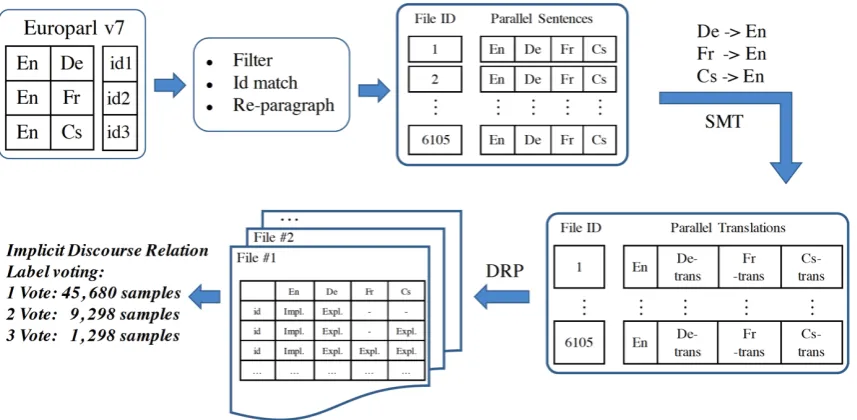
Our goal here aims at sentence pairs in cross-lingual corpora where connectives have been in-serted by human translators during translating from English to several other languages. After back-translating from other languages to English, explicit relations can be easily identified by dis-course parser and then original English sentences would be labeled accordingly.
We follow the pipeline proposed in Shi et al. (2017), as illustrated in Figure1, with the follow-ing differences:
• Shi et al. (2017) suffered from the fact that typical sentence-aligned corpora may have some sentences removed and make the sentences no longer coherent to get inter-sentential discourse relation instances. Here we filter and re-paragraph the line-aligned corpus to parallel document-aligned files, which makes it possible to obtain in-topic inter-sentential instances. After preprocess-ing, we got 532,542 parallel sentence pairs in 6,105 documents.
• Shi et al.(2017) pointed out that having cor-rect translation of explicit discourse connec-tive is more important than having the cor-rect translation of the whole sentence. In this paper we use a statistical machine translation system instead of a neural one for more stable translations of discourse connectives.
• Instead of a single language pair, we use three language pairs and majority votes between them to get annotated implicit discourse re-lation instances with high confidence.
Figure 1: The pipeline of proposed method. “SMT” and “DRP” denote statistical machine translation and discourse relation parser respectively.
3.1 Preprocessing
We use European Parliament Proceedings Paral-lel Corpus (Europarl1) (Koehn,2005) and choose
English-French, German and Czech pairs as our parallel corpora. Each source-target pair consists of source and target sentences along with a sen-tence ID with which we could easily identify the location of the sentence in certain paragraphs. In order to get document-aligned parallel sentences among all these four languages, we do preprocess-ing steps as follows:
• Filtering: remove those sentences that don’t have all the three translations in French, Ger-man or Czech.
• ID matching: re-group each sentence into dif-ferent documents by the sentence IDs.
• Re-paragraph: rank the sentences in each documents by the ID and re-paragraph them.
3.2 Machine Translation
We train three MT systems to back-translate French, German and Czech to English. To have word alignments, better and stable back-translations, we employ a statistical machine translation system MOSES (Koehn et al., 2007), trained on the same parallel corpora. Source and target sentences are first tokenized, true-cased and then fed into the system for training. In our case,
1Data is downloaded fromhttp://opus.nlpl.eu/
Europarl.php
the translation target texts are identical with the training set of the translation systems; this would not be a problem because our only objective in the translation is to back-translate connectives in the translation into English. On the training set, the translation system achieves BLEU scores of 66.20 (French), 65.30 (German) and 69.05 (Czech).
3.3 Discourse Parser
We employ the PDTB-style parser proposed in (Lin et al.,2014), which achieved about 96% accu-racy on explicit connective identification, to pick up those explicit examples in back-translations in each document. Following the definitions of dis-course relations in the PDTB that the arguments of the implicit discourse relations should be ad-jacent sentences but not for the explicit relations, we screen out all those explicit samples from the outputs of the parser that don’t have consecutive arguments.
3.4 Majority Vote
instance, the French translator may have explici-tated a relation, while the German and the Czech translators didn’t do so), or that they proposethe samecoherence label: the human translation can introduce “noise” in the sense of the human trans-lators inferring different coherence relations, the machine translation model can introduce errors in back-translation, and the discourse parser can mislabel ambiguous explicit connectives. When we use back-translations of several languages, the idea is that we can eliminate much of this noise by selecting only those instances where all back-translations agree with one another, or the ones where at least two back-translations allow us to in-fer identical labels.
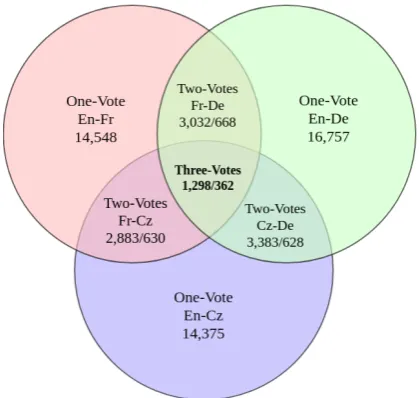
Figure2illustrates the number of automatically labeled implicit discourse relation examples to-gether with the information of how many of the instances that just one, two or all three back-translations provided the same labels.
In the One Vote agreement, every explicit re-lation has been accepted and the original implicit English sentences have been annotated corre-spondingly. Likewise, Two Votes agreement needs at least two out of three languages to have the same explicit relation label after back-translation; agreement between all three back-translations is denoted as Three Votes.
4 Experiments and Results
4.1 Data
Europarl Corpora: The parallel corpora used
here are from Europarl (Koehn,2005), it contains about 2.05M French, 1.96M English-German and 0.65M English-Czech pairs. After preprocessing, we got about 0.53M parallel sen-tence pairs in all these four languages.
The Penn Discourse Treebank (PDTB): PDTB
(Prasad et al., 2008) is the largest available man-ually annotated corpus of discourse relations from Wall Street Journal. Each discourse relation has been annotated in three hierarchy levels. In this paper, we follow the previous conventional set-tings and focus on the second-level 11-ways clas-sification (Lin et al.,2009;Ji and Eisenstein,2015; Rutherford et al.,2017;Shi et al.,2017), after re-moving the relations with few instances.
4.2 Implicit discourse relation classification
[image:4.595.311.521.61.260.2]To evaluate whether the extracted data is help-ful to this task, we use a simple and effective
Figure 2: Numbers of implicit discourse relation in-stances from different agreements of explicit inin-stances in three back-translations. En-Fr denotes instances that are implicit in English but explicit in back-translation of French, same for En-De and En-Cz. The overlap means they share the same relational arguments. The numbers under “Two-Votes” and “Three-Votes” are the numbers of discourse relation agreement / disagree-ment between explicits in back-translations of two or three languages.
Figure 3: Bi-LSTM network for implicit discoure rela-tion classificarela-tion.
bidirectional Long Short-Term Memory (LSTM) (Hochreiter and Schmidhuber,1997) network.
A LSTM recurrent neural network processes a variable-length sequencex = (x1, x2, ..., xn). At
time stept, the state of memory cellctand hidden
htare calculated with the Equations1:
it
ft
ot
ˆ
ct
=
σ σ σ
tanh
W·[ht−1, xt]
ct=ftct−1+itcˆt
ht=ottanh(ct)
[image:4.595.313.524.407.547.2]After being mapped to vectors, words are fed into the network sequentially. Hidden states of LSTM cell from different directions are averaged. The representations of two arguments from two separate bi-LSTMs are concatenated before being fed into a softmax layer for prediction. The archi-tecture is illustrated in Figure3.
Implementation: The model is implemented in
Pytorch2. All the parameters are initialized uni-formly at random. We employ cross-entropy as our cost function, Adagrad with learning rate of 0.01 as the optimization algorithm and set the dropout layers after embedding and output layer with drop rates of 0.5 and 0.2 respectively. The word vectors are pre-trained word embeddings from Word2Vec3.
Settings:We follow the previous works and evalu-ate our data on second-level 11-ways classification on PDTB with 3 settings: Lin et al. (2009) (de-notes as PDTB-Lin) uses sections 2-21, 22 and 23 as train, dev and test set;Ji and Eisenstein(2015) uses sections 2-20, 0-1 and 21-22 as train, dev and test set; Moreover, we also use 10-folds cross val-idation among sections 0-23 (Shi and Demberg, 2017). For each experiment, the additional data is only added into the training set.
0 1000 2000 3000 4000 5000 6000 7000 8000
Exp.List Exp.Exception Exp.Alternative Exp.RestatementExp.Instantiation Exp.Conjunction Comp.Prag.ConcessionComp.Concession Comp.Prag.ContrastComp.Contrast Cont.Prag.ConditionCont.Condition Cont.Prag.CauseCont.Cause Temp.Synchrony
[image:5.595.78.282.441.662.2]Temp.AsynchronousExplicitation in French, German and CzechPDTB En-Fr En-De En-Cz
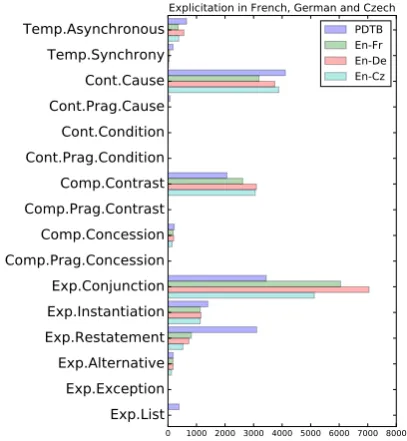
Figure 4: Distributions of PDTB and the extracted data among each discourse relation.
2
https://pytorch.org/
3https://code.google.com/archive/p/ word2vec/
4.3 Results
4.3.1 Distribution of new instances
Figure 4 shows the distributions of expert-annotated PDTB implicit relations and the implicit discourse examples extracted from the French, German and Czech back-translations. Overall, there is no strong bias – all relations seem to be represented similarly well, in line with their general frequency of occurrence. One inter-esting exception is the higher number of Ex-pansion.Conjunction relation from the German translations. The over-representation of Expan-sion.Conjunctionrelation in German indicates that German translators tend to use more explicit cues to mark these relations. This is an independently discovered well-known finding from the literature (Kunz and Lapshinova-Koltunski, 2015), which observed that German tends to mark conjunc-tion relaconjunc-tions with discourse cues, while English tends to use coreference instead. We also find that Expansion.Restatement relations are under-represented in our back-translation method, indi-cating that these relations are explicitated partic-ularly rarely in translation. We also find that we can identify more Contingency.Cause and Com-parison.Contrast relations from the German and Czech back-translations compared to the French ones. This provides us with an interesting lead for future work, to investigate whether French tends to explicitate these relations less, expressing them implicitly like in the English original, or whether French connectives for causal and contrastive re-lations are more ambiguous, causing problems in the back-translations.
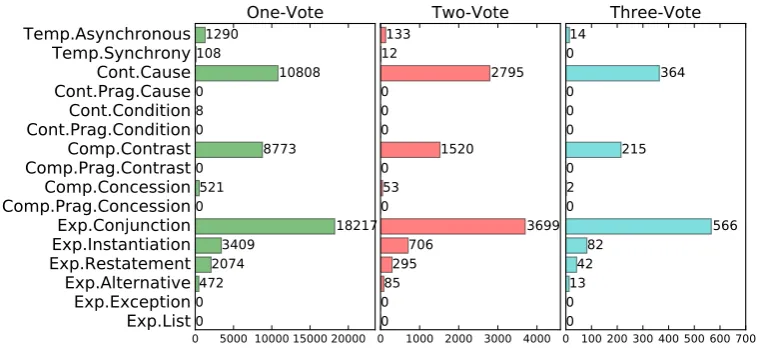
Figure 5 shows that the filtering by majority votes (including only two cases where at least two back-translations agree with one another vs. where all three agree) does again not change the distribu-tion of extracted reladistribu-tions.
Exp.List
Exp.Exception
Exp.Alternative
Exp.Restatement
Exp.Instantiation
Exp.Conjunction
Comp.Prag.Concession
Comp.Concession
Comp.Prag.Contrast
Comp.Contrast
Cont.Prag.Condition
Cont.Condition
Cont.Prag.Cause
Cont.Cause
Temp.Synchrony
Temp.Asynchronous
00 5000 10000 15000 20000
0472 20743409
18217 0521
0 8773 0
8
0 10808
1081290
One-Vote
00 1000 2000 3000 4000
085 295706
3699 053
0 1520 0
0
0 2795
12133
Two-Vote
0 100 200 300 400 500 600 7000
013 4282
566 02
0 215 0
0
0 364
014
[image:6.595.109.491.64.238.2]Three-Vote
Figure 5: Distributions of discourse relations with different agreements.
PDTB-Lin PDTB-Ji Cross Validation size of extra data
Majority Class 26.11 26.18 25.59
-Rutherford et al.(2017) 38.38 - -
-Shi et al.(2017) 45.50 - 37.84 102,314
PDTB only 37.95(0.59) 40.57(0.67) 37.82(0.14)
-PDTB +
En-Fr 38.96(0.69) 40.14(0.78) 38.32(0.62) 14,548 En-De 39.65(0.95) 39.96(0.44) 37.97(0.46) 16,757 En-Cz 37.90(1.27) 40.59(0.51) 37.42(0.50) 14,375 All 37.73(0.74) 40.41(0.65) 37.16(0.64) 45,680
[image:6.595.92.507.274.445.2]PDTB + 2-votes 40.34(0.75) 41.95(0.97) 38.98(0.14) 9,298 PDTB + 3-votes 39.88(0.79) 41.19(0.63) 38.33(0.50) 1,298
Table 1: Performances with different sets of additional data. Average accuracy of 10 runs (5 for cross validations) are shown here with standard deviation in the brackets. Numbers in bold are significantly (p<0.05) better than the
PDTB onlybaseline with unpaired t-test.
4.3.2 Quantitative Results
Table 1 shows that best results are achieved by adding only those samples for which two back-translations agree with one another. This may rep-resent the best trade-off between reliability of the label and the amount of additional data. The set-ting where the data from all languages is added performs badly despite the large number of sam-ples, because this method contains different labels for the same argument pairs, for all those instances where the back-translations don’t yield the same label, thus introducing noise into the system. The size of the extra data used in Shi et al.(2017) is about 10 times larger than our 2-votes data. The selection of instances differs in their paper from ours, in that they only use French, and in that they, unlike this paper, focus on intra-sentential sam-ples. The model using the few reliable samples
ex-tracted from the back-translations of the three lan-guages here significantly outperforms the results found inShi et al. (2017) in the cross-validation setting. On the PDTB-Lin test set, we don’t match performance, but note that this test set is based only on 800 instances, as opposed to the 16k in-stances in the cross-validation evaluation.
4.3.3 Qualitative analysis
Finally, we want to provide insight into what kind of instances the system extracts, and why back-translation labels sometimes disagree. We have identified four major cases based on a manual analysis of 100 randomly sampled instances.
Case 1: Sometimes, back-translations from
recog-nized as a discourse relation marker by the auto-matic discourse parser4. This can actually help us to identify new alternative lexicalisation for dis-course relations, and thus represents a promising technique for improving discourse relation classi-fication also on texts for which no translations are available.
Original English:I presided over a region crossed by heavy traffic from all over Europe, with significant accidents which gave rise to legal actions.What is more,In 2002, two
Mem-ber States of the European Union appealed to the European Court of Justice to repeal Directive 2002/15/EC because it in-cluded self-employed drivers ; the Court rejected their appeal on the grounds of road safety.
French back-translation: I presided over a region crossed by heavy traffic from the whole of Europe, with significant accidents which gave rise to legal actions,
moreover, (Expansion.Conjunction) in 2002 , two Member States have appeal on the European Court of Justice, which has condemned the rejection of the grounds of road safety.
German back-translation:I presided over a region crossed by heavy traffic from across Europe, with significant ac-cidents which,moreover(Expansion.Conjunction) in 2002, two Member States of the European Union appealed to the European Court of Justice to repeal Directive 2002/15/EC , because it included self-employed drivers ; the Court quashed
for reasons of road safety.
Czech back-translation:I was in the region with very heavy traffic from all over Europe, with significant accidents which
gave rise to legal actionstherefore(Contingency.Cause) af-ter all, in 2002, two Member States of the European Union appealed to the European Court of Justice to repeal Directive
2002/15/EC that also applies to self-employed drivers; the Court rejected their appeal on the grounds of road safety.
The expression what is more is not part of the set of connectives labeled in PDTB and hence was not identified by the discourse parser. Our method is successful because such cues can be automatically identified from the consistent back-translations into two languages. (The case in Czech is more complex because the back-translation contains two signals,thereforeand af-ter all, see case 4.)
We also found some similar expressions in this case like:
“in reality” (“implicit”, original English)→“in fact” (explicit, back-translation);
“for that reason”→“therefore”;
4In the following examples, the original English sentence
is shown is followed by the back-translations from French, German and Czech along with the connectives and senses.
“this is why”→“therefore”;
“be that as it may”→“however / nevertheless”; “for another” → “furthermore / on the other hand”;
“in spite of that” → “however / nevertheless” and so on.
Case 2: Majority votes help to reduce noise
related to errors introduced by the automatic pipeline, such as argument or connective misiden-tification: in the below example,alsoin the French translation is actually the translation ofalong with.
Original English: on behalf of the PPE-DE Group. (DE) Madam President, Commissioner, ladies and gentlemen,
the public should be able to benefit in two ways from the potential for greater road safety.For this reason, along with the report we are discussing today, I call for more research
into the safety benefits of driver-assistance systems.
French back-translation: (DE) Madam President, Com-missioner, ladies and gentlemen, citizens should be able
to benefit in two ways of the possibility of improving road safety. also(Expansion.Conjunction) when we are discussing this report today, I appeal to the intensification
of research at the level of the benefits of driver-assistance systems in terms of security, as well as the transmission of information about them.
German back-translation: (DE) Madam
Presi-dent, Commissioner, ladies and gentlemen, road
safety potentials should citizens in the dual sense
therefore(Contingency.Cause) I urge, together with the report under discussion today, the prevention and education about the safety benefits of driver-assistance
systems.
Czech back-translation: (DE) Madam President, Com-missioner, ladies and gentlemen, the public would be the
potential for greater road safety should have a two-fold benefit,therefore(Contingency.Cause) I call, in addition to the report, which we are debating today , for more research
and education in the safety benefits of driver-assistance systems.
Case 3: Discrepancies between connectives in
back-translations can also be due to differences in how translators interpreted the original text. Here are cases of genuine ambiguities in the implicit discourse relation.
Original English: with regard, once again, to European Union law, we are dealing in this case with the domestic legal system of the Member States. That being said, I
French back-translation:with regard, once again, the right of the European Union, we are here in the domestic legal sys-tem of the Member States. however,(Comparison.Contrast) I cannot respond to the place of the Council of Europe or for the European Court of Human Rights, which have issued a decision that I understand may raise questions in this House.
German back-translation: once again on the right of the European Union, we have it in this case with
the national legal systems of the Member States.
therefore,(Contingency.Cause) I cannot, for the Council of Europe and the European Court of Human Rights, which have issued a decision, which I can understand, in Parliament raises some issues.
Czech back-translation: I repeat that, when it comes to the European Union, in this case we are dealing with the domestic legal system of the Member States.
in addition,(Expansion.Conjunction) I cannot answer for the Council of Europe or for the European Court of Human Rights , which has issued a decision that I understand may
cause in Parliament some doubts.
Case 4: Implicit relations can co-occur with
marked discourse relations (Rohde et al., 2015), and multiple translations help discover these in-stances, for example:
Original English:We all understand that nobody can return Russia to the path of freedom and democracy,(implicit: but) what is more, the situation in our country is not as
straight-forward as it might appear to the superficial observer.
French back-translation: we all understand that nobody can return Russia on the path of freedom and
democ-racy but Russia itself, its citizens and its civil society
but(Comparison.Contrast) there is more, the situation in our country is not as simple as it might appear to be a superficial
observer.
German back-translation: we are all aware that no-body Russia back on the path of freedom and
democ-racy, as the country itself, its people and its civil society
but(Comparison.Contrast) the situation in our country is not as straightforward as it might appear to the superficial
ob-server.
Czech back-translation: we all know that Russia can-not return to the path of freedom and democracy
there, but Russia itself, its people and civil society.
in addition(Expansion.Conjunction) the situation in our country is not as straightforward as it might appear to the
superficial observer.
5 Conclusion
We compare the explicitations obtained from translations into three different languages, and find
that instances where at least two back-translations agree yield the best quality, significantly outper-forming a version of the model that does not use additional data, or uses data from just one lan-guage.
We also found that specific properties of the translation language affect the distribution of the additionally acquired data across coherence rela-tions: German, for instance, is known to mark con-junction relations using discourse cues more fre-quently, while English and other languages tend to express these relations rather through lexical co-hesion or pronouns. This was reflected in our ex-periments: we found a larger proportion of explic-itations for conjunction relations in German than the other translation languages.
Finally, our qualitative analysis shows that the strength of the method partially stems from being able to learn additional discourse relation signals because these are typically translated consistently. The method thus shows promise for the identifica-tion of discourse markers and alternative lexicali-sations, which can subsequently be exploited also for discourse relation classification in the absence of translation data. Our analysis also shows that our method is useful for identifying cases where multiple relations holding between two arguments.
6 Acknowledgments
We would like to thank all the anonymous review-ers for their careful reading and insightful com-ments. This research was funded by the German Research Foundation (DFG) as part of SFB 1102 “Information Density and Linguistic Encoding”.
References
Shima Gerani, Yashar Mehdad, Giuseppe Carenini, Raymond T Ng, and Bita Nejat. 2014. Abstractive summarization of product reviews using discourse structure. InProceedings of the 2014 Conference on Empirical Methods in Natural Language Processing (EMNLP), pages 1602–1613.
Francisco Guzm´an, Shafiq Joty, Llu´ıs M`arquez, and Preslav Nakov. 2014. Using discourse structure im-proves machine translation evaluation. In Proceed-ings of the 52nd Annual Meeting of the Association for Computational Linguistics (Volume 1: Long Pa-pers), volume 1, pages 687–698.
Peter Jansen, Mihai Surdeanu, and Peter Clark. 2014. Discourse complements lexical semantics for non-factoid answer reranking. In Proceedings of the 52nd Annual Meeting of the Association for Compu-tational Linguistics (Volume 1: Long Papers), vol-ume 1, pages 977–986.
Yangfeng Ji and Jacob Eisenstein. 2015. One vector is not enough: Entity-augmented distributed semantics for discourse relations. Transactions of the Associa-tion for ComputaAssocia-tional Linguistics, 3:329–344.
Yangfeng Ji, Gholamreza Haffari, and Jacob Eisen-stein. 2016. A latent variable recurrent neural net-work for discourse relation language models. In
Proceedings of the 2016 Conference of the North American Chapter of the Association for Computa-tional Linguistics on Human Language Technology, pages 332–342. Association for Computational Lin-guistics.
Philipp Koehn. 2005. Europarl: A parallel corpus for statistical machine translation. InMT summit, vol-ume 5, pages 79–86.
Philipp Koehn, Hieu Hoang, Alexandra Birch, Chris Callison-Burch, Marcello Federico, Nicola Bertoldi, Brooke Cowan, Wade Shen, Christine Moran, Richard Zens, et al. 2007. Moses: Open source toolkit for statistical machine translation. In Pro-ceedings of the 45th annual meeting of the ACL on interactive poster and demonstration sessions, pages 177–180. Association for Computational Linguis-tics.
Kerstin Kunz and Ekaterina Lapshinova-Koltunski. 2015. Cross-linguistic analysis of discourse vari-ation across registers. Nordic Journal of English Studies, 14(1):258–288.
Ziheng Lin, Min-Yen Kan, and Hwee Tou Ng. 2009. Recognizing implicit discourse relations in the penn discourse treebank. InProceedings of the 2009 Con-ference on Empirical Methods in Natural Language Processing, pages 343–351, Singapore. Association for Computational Linguistics.
Ziheng Lin, Hwee Tou Ng, and Min-Yen Kan. 2014. A pdtb-styled end-to-end discourse parser. Natural Language Engineering, 20(02):151–184.
Thomas Meyer, Najeh Hajlaoui, and Andrei Popescu-Belis. 2015. Disambiguating discourse connectives for statistical machine translation. IEEE Transac-tions on Audio, Speech, and Language Processing, 23(7):1184–1197.
Joonsuk Park and Claire Cardie. 2012. Improving im-plicit discourse relation recognition through feature set optimization. InProceedings of the 13th Annual Meeting of the Special Interest Group on Discourse and Dialogue, pages 108–112. Association for Com-putational Linguistics.
Emily Pitler, Annie Louis, and Ani Nenkova. 2009. Automatic sense prediction for implicit discourse re-lations in text. InProceedings of the 47th Annual Meeting of the Association for Computational Lin-guistics, pages 683–691, Suntec, Singapore. Associ-ation for ComputAssoci-ational Linguistics.
Emily Pitler, Mridhula Raghupathy, Hena Mehta, Ani Nenkova, Alan Lee, and Aravind K Joshi. 2008. Easily identifiable discourse relations. Technical Reports (CIS), page 884.
Rashmi Prasad, Nikhil Dinesh, Alan Lee, Eleni Milt-sakaki, Livio Robaldo, Aravind K. Joshi, and Bon-nie L. Webber. 2008. The penn discourse treebank 2.0. InLREC, Marrakech, Morocco. European Lan-guage Resources Association.
Lianhui Qin, Zhisong Zhang, and Hai Zhao. 2016. Im-plicit discourse relation recognition with context-aware character-enhanced embeddings. In Proceed-ings of COLING 2016, the 26th International Con-ference on Computational Linguistics.
Lianhui Qin, Zhisong Zhang, Hai Zhao, Zhiting Hu, and Eric P. Xing. 2017. Adversarial connective-exploiting networks for implicit discourse relation classification. In Proceedings of the 55th Annual Meeting of the Association for Computational Lin-guistics (Volume 1: Long Papers), pages 1006– 1017, Vancouver, Canada. Association for Compu-tational Linguistics.
Hannah Rohde, Anna Dickinson, Chris Clark, Annie Louis, and Bonnie Webber. 2015. Recovering dis-course relations: Varying influence of disdis-course ad-verbials. In Proceedings of the First Workshop on Linking Computational Models of Lexical, Senten-tial and Discourse-level Semantics, pages 22–31.
Attapol Rutherford, Vera Demberg, and Nianwen Xue. 2017. A systematic study of neural discourse mod-els for implicit discourse relation. InProceedings of the 15th Conference of the European Chapter of the Association for Computational Linguistics: Volume 1, Long Papers, volume 1, pages 281–291.
Attapol Rutherford and Nianwen Xue. 2014. Discover-ing implicit discourse relations through brown clus-ter pair representation and coreference patclus-terns. In
Proceedings of the 14th Conference of the European Chapter of the Association for Computational Lin-guistics, pages 645–654. Association for Computa-tional Linguistics.
Wei Shi and Vera Demberg. 2017. On the need of cross validation for discourse relation classification. In
Proceedings of the 15th Conference of the European Chapter of the Association for Computational Lin-guistics, pages 150–156. Association for Computa-tional Linguistics.
Wei Shi and Vera Demberg. 2018. Learning to explici-tate connectives with seq2seq network for implicit discourse relation classification. arXiv preprint arXiv:1811.01697.
Wei Shi, Frances Yung, Raphael Rubino, and Vera Demberg. 2017. Using explicit discourse connec-tives in translation for implicit discourse relation classification. InProceedings of the Eighth Interna-tional Joint Conference on Natural Language Pro-cessing (Volume 1: Long Papers), volume 1, pages 484–495.
Caroline Sporleder and Alex Lascarides. 2008. Using automatically labelled examples to classify rhetori-cal relations: An assessment. Natural Language En-gineering, 14(3):369–416.
Suzan Verberne, Lou Boves, Nelleke Oostdijk, and Peter-Arno Coppen. 2007. Evaluating discourse-based answer extraction for why-question answer-ing. InProceedings of the 30th annual international ACM SIGIR conference on Research and develop-ment in information retrieval, pages 735–736. ACM.
Xun Wang, Sujian Li, Jiwei Li, and Wenjie Li. 2012. Implicit discourse relation recognition by select-ing typical trainselect-ing examples. In Proceedings of the 24th International Conference on Computational Linguistics (COLING-2012), pages 2757–2772.
Nianwen Xue, Hwee Tou Ng, Sameer Pradhan, Rashmi Prasad, Christopher Bryant, and Attapol Rutherford. 2015. The conll-2015 shared task on shallow dis-course parsing. In Proceedings of the CoNLL-15 Shared Task, pages 1–16. Association for Compu-tational Linguistics.
Nianwen Xue, Hwee Tou Ng, Attapol Rutherford, Bon-nie Webber, Chuan Wang, and Hongmin Wang. 2016. Conll 2016 shared task on multilingual shallow discourse parsing. In Proceedings of the CoNLL-16 shared task, pages 1–19. Association for Computational Linguistics.