Original Article
The X-ray repair cross complementing group 1
Arg194Trp polymorphism is a risk factor for glioma:
evidence from 15 case-control studies
Hongtao Qu1, Yafei Xiao1, Hong Liu1, Zhiqing Zeng1, Yimin Li1, Xiangyang Zhou1, Xiao Xiao1, Jianghong Chen1,
Wei He1, Renxian Cao2
1Department of Neurosurgery, Nanhua First Affiliated Hospital, University of South China, Hengyang 421001,
Hunan, P. R. China; 2Institute of Clinical Cancer Research, Nanhua First Affiliated Hospital, University of South
China, Hengyang 421001, Hunan, P. R. China
Received January 17, 2016; Accepted May 17, 2016; Epub July 15, 2016; Published July 30, 2016
Abstract: Gliomas are the most common type of primary brain tumors. The X-ray repair cross complementing group 1 (XRCC1) Arg194Trp variant affects the proliferating cell nuclear antigen (PCNA) binding region, which suggests that this mutation may contribute to glioma genesis. A number of articles have examined the association between
XRCC1 Arg194Trp and the susceptibility to glioma. However, the results were conflicting. Methods such as the test
of heterogeneity, sensitivity analysis, meta-analysis, and assessment of publication bias were all performed in our present meta-analysis, addressing a total of 6,839 patients and 9,173 healthy people. In the overall analysis the
XRCC1 Arg194Trp polymorphism indicated a significant association with glioma susceptibility in a homozygous
co-dominant model (for TrpTrp vs. ArgArg: OR=1.64, 95% CI=1.26-2.14, I2=51.3%). In addition, analysis of subgroups
presented an increased hazard in Asians and populations-based on both hospitals and populations. The results
suggest that the XRCC1 Arg194Trp polymorphism is a genetic risk factor for glioma, especially in Asian populations.
Keywords: XRCC1, Arg194Trp polymorphism, glioma, meta-analysis
Introduction
Gliomas are the most common type of primary brain tumors [1], with an incidence rate of roughly 6/100,000 per year worldwide. Despite the advances in neurosurgery and chemothera-py, median survival of only 12 to 15 months among patients in the United States with glio-blastoma, the most common type of glioma [2]. Nowadays, the cause of glioma is still unknown and the etiology has been poorly understood, and may be multifactorial resulting from the interaction of intrinsic and environmental fac-tors [3, 4]. The only established environmental risk factor is the common exposure to
thera-peutic or high-dose ionizing radiation [4-6]. X-ray repair cross complementing group 1 (XRCC1) acts as a scaffolding protein that func-tions in the repair of base excision and DNA single-strand breaks [7, 8], the two most com-mon repair pathways in cellular DNA [9]. XRCC1 interacts with a number of proteins crucial to
the BER/SSBR pathways, including OGG1, NEIL2, NTH1, MPG, UNG2, AP endonuclease-1 (APE-1), poly (ADP-ribose) polymerase, DNA
polymerase β, and DNA ligase 3 [9-15]. Eight non-synonymous coding single nucleotide poly-morphism sites were detected in XRCC1, three were related to glioma in former extensively studies. These are: Arg194Trp (R194W, rs17- 99782, exon 6), Arg280His (R280H, rs25489, exon 9) and Arg399Gln (R399Q, rs25487, exon 10). Among them, the XRCC1 Arg194Trp variant located in the proliferating cell nuclear antigen (PCNA) binding region, which suggests that this mutation may result in glioma genesis. However, these studies have failed to yield a consistent conclusion [16-30].
Recently, Jiang L [31] reported that XRCC1
glioma in Asian but not Caucasian population; however, only fourteen literatures were includ-ed in this meta-analysis and some data from original research was wrong. Subsequently seven molecular epidemiologic studies on the association between this polymorphism and glioma risk also demonstrated contradictory results. Here, we update previous meta-analy-ses, with additional data to evaluate the effect of XRCC1 Arg194Trp polymorphism on glioma incidence. In this meta-analysis, we tried to aim at obtaining outline risk evaluates for the XRCC1 Arg194Trp associated with glioma risk.
Materials and methods
We thoroughly searched all of the available electronic databases such as Web of Science, PubMed, EMBASE, The Cochrane Library, The China National Knowledge Infrastructure (CNKI) Platforms, VIP and Wan Fang using such terms (“glioma” or “gliomas” or “glioblastoma” or “astrocytoma” or “ependymoma” or “oligoden-droglioma” or “oligoastrocytoma cancer” or “brain cancer” or “brain tumor”), (“XRCC1” or “Arg194Trp” or “A194T” or “rs1799782” or “X-ray cross-complementing group 1” or “DNA repair gene” or “DNA repair genes” or “X-ray repair cross-complementation group 1” or “X-ray repair cross-complementing group 1” or “BER”) and (“variant” or “variants” or “varia-tion” or “polymorphism” or “polymorphisms” or
“mutation” or “gene mutant” or “genotypes” or “SNP” or “SNPs” or “single nucleotide polymor-phism”) (last search was updated on May 1, 2016).
The inclusion criteria indicators of this meta-analysis were: 1) XRCC1 Arg194Trp
polymor-phism and glioma; 2) sufficient maternal geno -type data for calculating an odds ratio (OR) with
a 95% confidence interval (CI); and 3) published
in English. The criteria for the exclusion of stud-ies are as follows: 1) not relate to the XRCC1 Arg194Trp polymorphism and glioma; 2) not a primary case-control study; 3) no usable or
suf-ficient maternal genotype data reported.
Data collection
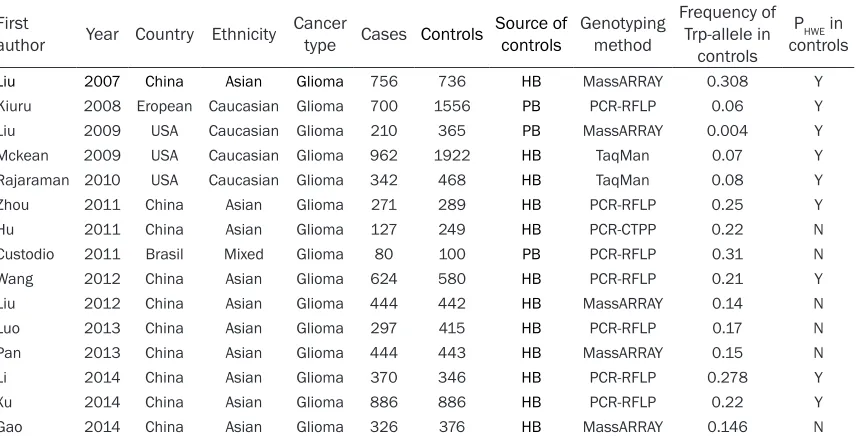
The first author, publication year, country of ori -gin, ethnicity, sources of controls, genotyping method, frequency of Trp-allele in controls, number of detected cases and controls were collected independently by two authors (HT.Q and YF.X) in Table 1.
Odds ratio (OR) plus 95% CIs was used to esti-mate the strength of association between glio-ma risk and the XRCC1 Arg194Trp polymor-phism. The pooled ORs were presented for the
additive model (Trp versus Arg), homozygous
co-dominant model (TrpTrp versus ArgArg),
het-erozygote co-dominant model (ArgTrp versus
[image:2.612.95.523.98.316.2]ArgArg), dominant model (TrpTrp+ArgTrp versus
Table 1. Characteristics of Studies on XRCC1 Arg194Trp Polymorphism and Glioma Risk included in the meta-analysis
First
author Year Country Ethnicity Cancertype Cases Controls Source of controls Genotypingmethod
Frequency of Trp-allele in
controls
PHWE in controls
Liu 2007 China Asian Glioma 756 736 HB MassARRAY 0.308 Y
Kiuru 2008 Eropean Caucasian Glioma 700 1556 PB PCR-RFLP 0.06 Y
Liu 2009 USA Caucasian Glioma 210 365 PB MassARRAY 0.004 Y
Mckean 2009 USA Caucasian Glioma 962 1922 HB TaqMan 0.07 Y
Rajaraman 2010 USA Caucasian Glioma 342 468 HB TaqMan 0.08 Y
Zhou 2011 China Asian Glioma 271 289 HB PCR-RFLP 0.25 Y
Hu 2011 China Asian Glioma 127 249 HB PCR-CTPP 0.22 N
Custodio 2011 Brasil Mixed Glioma 80 100 PB PCR-RFLP 0.31 N
Wang 2012 China Asian Glioma 624 580 HB PCR-RFLP 0.21 Y
Liu 2012 China Asian Glioma 444 442 HB MassARRAY 0.14 N
Luo 2013 China Asian Glioma 297 415 HB PCR-RFLP 0.17 N
Pan 2013 China Asian Glioma 444 443 HB MassARRAY 0.15 N
Li 2014 China Asian Glioma 370 346 HB PCR-RFLP 0.278 Y
Xu 2014 China Asian Glioma 886 886 HB PCR-RFLP 0.22 Y
Gao 2014 China Asian Glioma 326 376 HB MassARRAY 0.146 N
ArgArg) and recessive model (TrpTrp versus TrpArg+ArgArg).
Statistical methods
First, we assessed HWE for the controls in each study. X2 test of heterogeneity was
calcu-lated in comparison with pooled articles, when
P value was >0.10 we applied fixed-effects model (Mantel-Haenszel); in contrast, the ran -dom-effects models (Der Simonian and Laird) was used. Subgroup analyses were also con-ducted by ethnicity, source of control,
genotyp-ing method, HWE and sample size. Also, the
methods of sensitivity analyses and publication bias were performed. In the process of each analysis a single article was removed, and
then we analyzed the rest of the articles respec -tively. The methods of Egger and Begg were to test the publication bias. The result consists of the Begg’s funnel plot and Egger’s test. All sta-tistical analyses were performed using the STATA software version 12 (Stata Corporation, College Station, TX). Two-sided P values less than 0.05 were considered statistically signi-
ficant.
Results
Literatures
The characteristics of the selected studies are
summarized in Table 1. In total 593 studies
Meta analysis
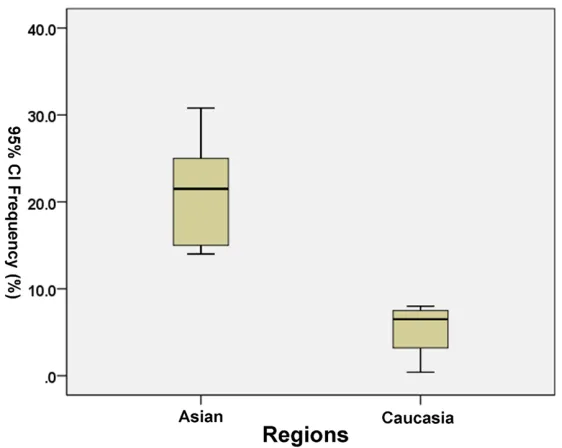
Overall, the Trp194 allele was 16.47% (95% CI, 11.33-21.61) among all over the glioma, which was between Caucasian and Asian. There were
significant differences in terms of the variant
Trp194 allele frequency between the only two
ethnicities (Caucasians, 5.35%; 95% confi -dence interval (95% CI), -0.06-10.76; Asian, 20.92%; 95% CI, 16.77-25.07; p=0.000, Figure 1).
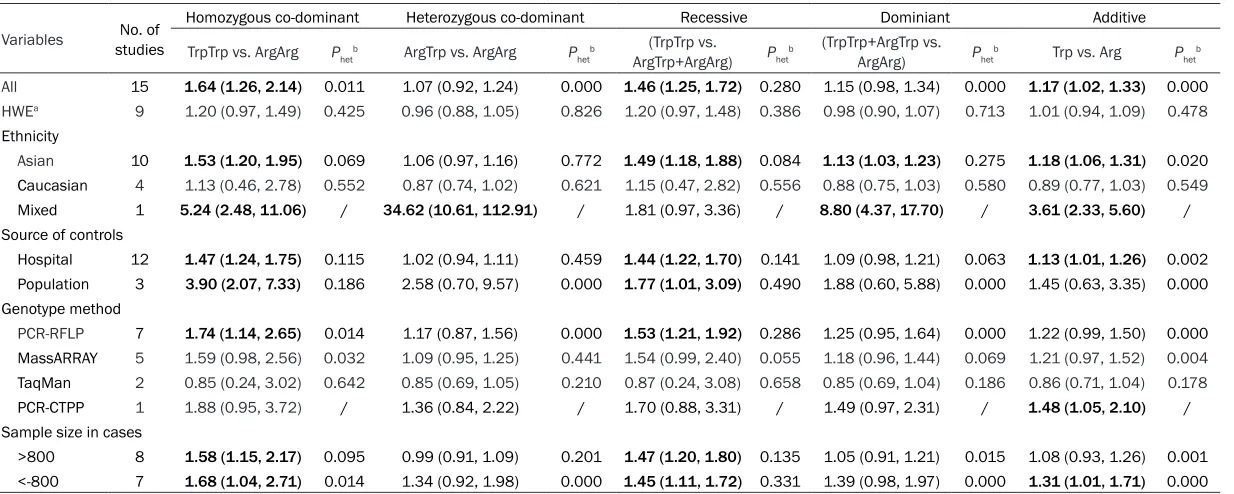
ArgArg or Arg genotype was as reference group in our meta-analysis. All ORs and 95% CIs were in Table 2. In short, among pooled analysis XRCC1 Arg194Trp polymorphism indicated a
significant association with glioma
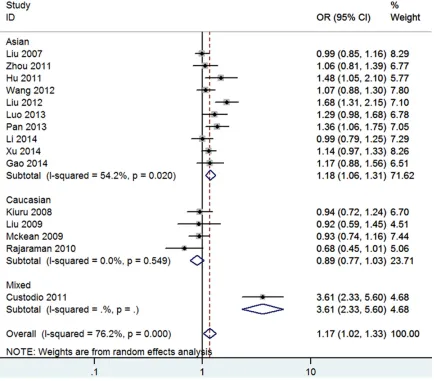
suscepti-bility (for Trp vs. Arg: OR=1.17 (Figure 2), 95% CI=1.02-1.33, I2=76.2%; for TrpTrp vs. ArgArg:
OR=1.64 (Figure 3), 95% CI=1.26-2.14, I2=
51.3%; for ArgTrp vs. ArgArg: OR=1.07, 95% CI=0.92-1.24, I2=69.6%; for TrpTrp vs. ArgArg
+ArgTrp: OR=1.46 (Figure 4), 95% CI=1.25-1.72, I2=22.1%; for ArgTrp+TrpTrp vs. ArgArg:
OR=1.15, 95% CI=0.98-1.34, I2=74.6%). The
forest plot of homozygous co-dominant
mo-del, additive model and recessive model result were shown in Figures 2-4.
Subgroup analysis
[image:3.612.90.371.70.294.2]The similar association between Arg194Trp polymorphism and glioma risk was discovered Figure 1. Allele frequencies and their 95% CIs of the XRCC1 Arg194Trp
Polymorphism among control subjects by Different Regions.
meet our search terms, and 15
eligible studies were finally
included in this meta-analysis. Totally, 6,839 patients and 9,173 healthy people were used for this meta-analysis. Among our analysis nine stud-ies of study population were Asians and four of them were Caucasians, three studies were population-based controls and twelve studies were hospital-based controls. The distribu-tions of the genotypes in the control groups in 6 studies were not in HWE. All of included
arti-cles were able to analyze for the allele model, homozygous co-dominant model, heterozygote
Table 2. Meta-analysis of the association between XRCC1 Arg194Trp polymorphism and cancer risk
Variables studiesNo. of
Homozygous co-dominant Heterozygous co-dominant Recessive Dominiant Additive
TrpTrp vs. ArgArg Phetb ArgTrp vs. ArgArg P hetb
(TrpTrp vs.
ArgTrp+ArgArg) Phetb
(TrpTrp+ArgTrp vs.
ArgArg) Phetb Trp vs. Arg Phetb
All 15 1.64 (1.26, 2.14) 0.011 1.07 (0.92, 1.24) 0.000 1.46 (1.25, 1.72) 0.280 1.15 (0.98, 1.34) 0.000 1.17 (1.02, 1.33) 0.000 HWEa 9 1.20 (0.97, 1.49) 0.425 0.96 (0.88, 1.05) 0.826 1.20 (0.97, 1.48) 0.386 0.98 (0.90, 1.07) 0.713 1.01 (0.94, 1.09) 0.478
Ethnicity
Asian 10 1.53 (1.20, 1.95) 0.069 1.06 (0.97, 1.16) 0.772 1.49 (1.18, 1.88) 0.084 1.13 (1.03, 1.23) 0.275 1.18 (1.06, 1.31) 0.020
Caucasian 4 1.13 (0.46, 2.78) 0.552 0.87 (0.74, 1.02) 0.621 1.15 (0.47, 2.82) 0.556 0.88 (0.75, 1.03) 0.580 0.89 (0.77, 1.03) 0.549
Mixed 1 5.24 (2.48, 11.06) / 34.62 (10.61, 112.91) / 1.81 (0.97, 3.36) / 8.80 (4.37, 17.70) / 3.61 (2.33, 5.60) /
Source of controls
Hospital 12 1.47 (1.24, 1.75) 0.115 1.02 (0.94, 1.11) 0.459 1.44 (1.22, 1.70) 0.141 1.09 (0.98, 1.21) 0.063 1.13 (1.01, 1.26) 0.002
Population 3 3.90 (2.07, 7.33) 0.186 2.58 (0.70, 9.57) 0.000 1.77 (1.01, 3.09) 0.490 1.88 (0.60, 5.88) 0.000 1.45 (0.63, 3.35) 0.000
Genotype method
PCR-RFLP 7 1.74 (1.14, 2.65) 0.014 1.17 (0.87, 1.56) 0.000 1.53 (1.21, 1.92) 0.286 1.25 (0.95, 1.64) 0.000 1.22 (0.99, 1.50) 0.000
MassARRAY 5 1.59 (0.98, 2.56) 0.032 1.09 (0.95, 1.25) 0.441 1.54 (0.99, 2.40) 0.055 1.18 (0.96, 1.44) 0.069 1.21 (0.97, 1.52) 0.004
TaqMan 2 0.85 (0.24, 3.02) 0.642 0.85 (0.69, 1.05) 0.210 0.87 (0.24, 3.08) 0.658 0.85 (0.69, 1.04) 0.186 0.86 (0.71, 1.04) 0.178
PCR-CTPP 1 1.88 (0.95, 3.72) / 1.36 (0.84, 2.22) / 1.70 (0.88, 3.31) / 1.49 (0.97, 2.31) / 1.48 (1.05, 2.10) /
Sample size in cases
>800 8 1.58 (1.15, 2.17) 0.095 0.99 (0.91, 1.09) 0.201 1.47 (1.20, 1.80) 0.135 1.05 (0.91, 1.21) 0.015 1.08 (0.93, 1.26) 0.001
<-800 7 1.68 (1.04, 2.71) 0.014 1.34 (0.92, 1.98) 0.000 1.45 (1.11, 1.72) 0.331 1.39 (0.98, 1.97) 0.000 1.31 (1.01, 1.71) 0.000
Figure 2. Forest Plot of Glioma Risk Associated with the XRCC1 Arg194Trp Polymorphism (Trp vs. Arg) in Overall and Different Ethnicity. The overall odds ratio (OR) is shown. The OR of each study is marked with a black dot. The % weight of OR is indicated by a gray square. The overall OR is indicated by a blue diamond.
in the subgroup analyses. In the subgroup anal-yses were based on Ethnicity, sources of
con-trol, genotype method and sample size in
included cases. The results of subgroup analy-sis were robust, which did not vary materially
after we excluded the study not fit in with HWE. The following is significant results to describe.
Among subgroup of ethnicity, only in Asian
existed significant results were in following
genetic models: additive model (for Trp vs. Arg: OR=1.18, 95% CI=1.06-1.31, I2=54.2%), ho-
mozygous co-dominant model (for TrpTrp vs.
ArgArg: OR=1.53, 95% CI=1.20-1.95, I2=43.4%)
and recessive model (for TrpTrp vs. ArgArg+ ArgTrp: OR=1.49, 95% CI=1.18-1.88, I2=41.0%)
dominant model (for ArgTrp+TrpTrp vs. ArgArg:
OR=1.13, 95% CI=1.03-1.23, I2=18.3%), re-
spectively (Table 2). While in Caucasian sub-group it suggested that XRCC1 Arg194Trp poly-morphism was no association with glioma. As well in population-based subgroups, similar
sig-nificant results were found in subgroup of hos -pital. The detailed information was in Table 2.
Additionally, most models presented signifi -cantly increased risks when the Genotype method was PCR-RFLP.
Test for heterogeneity, sensitivity analyses and publication bias
Pooled comparisons and subgroup analyses were examined the heterogeneity. In additive
pooled analysis the heterogeneity of P values were all <0.1, the results were shown in Table 2. Therefore, we performed the source of het-erogeneity among Ethnicity, sources of control,
genotype method, sample size of case and
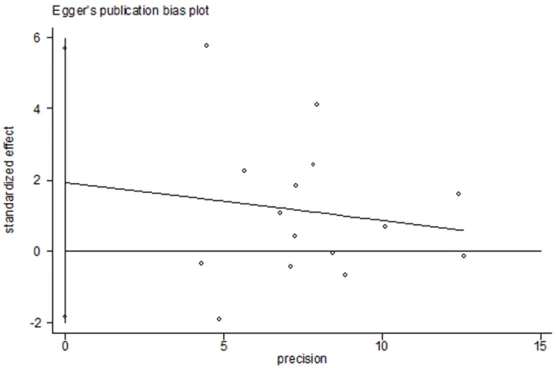
HWE. Sensitivity analysis was conducted by removing the single studies, one at a time and recalculating the summary ORs to identify the stability of the models. When we performed the sensitivity analyses, no matter overall analyses or subgroup analyses ORs were not altered, suggesting that our results were stability and liability statistically. Also the sensitivity result was in Figure 5. We conducted the Begg’s fun-nel plot and Egger’s test to test the publication bias of the eligible studies. The result showed
no significant evidence of publication bias (for
additive model t=1.11, P=0.287; for recessive
model t=0.02, P=0.982). The Egger’s funnel plot Figure was in Figure 6.
Discussion
Glioma is generally considered to be a gene-environment interaction disease, and a better understanding of the mechanism of glioma will
help us find better ways to prevent, diagnose,
or treat glioma. At present, notwithstanding some risk factors have been found, the etiology of glioma is still poorly understood [33, 34]. However, it is universally acknowledged that the genetic factors play crucial roles in the occurrence of glioma [35, 36]. Confirmed of
biomarkers of genetic factors could expect to do early diagnosis, predict patient’s outcome,
[image:6.612.89.525.72.447.2]Figure 4. Forest Plot of Glioma Risk Associated with the XRCC1 Arg194Trp Polymorphism (TrpTrp vs. ArgArg+ArgTrp) in Overall and Different Ethnicity. The overall odds ratio (OR) is shown. The OR of each study is marked with a black dot. The % weight of OR is indicated by a gray square. The overall OR is indicated by a blue diamond.
markers has been identified as good biomark
-ers for glioma patients. To find some glioma
relevant genetic biomarkers is of the most importance to improve the prognosis.
It is universally acknowledged that DNA repair genes could maintain the genome integrity, and thus DNA repair genes polymorphisms are potential candidates which can modify the development of gliomas. XRCC1 is one of the most important DNA repair genes responsible for BER pathway and DBS caused by IR. The XRCC1 Arg194Trp polymorphism is located in an evolutionary conserved linker region, makes the chances of occurrence of chromosomal breaks highly increased [37]. Up to now, a num-ber of articles have been performed to address the association between XRCC1 Arg194Trp
polymorphism and the risk of gliomas, but
yielded conflicting results. Contradictory results
from relatively small articles and previous meta-analysis indicated that XRCC1 Arg194Trp polymorphism was no association with the development of glioma, so an updated meta-analysis should be a proper way to obtain a
more definitive conclusion.
Although previous meta-analysis studies have
confirmed that the results did not show any
Figure 5. Outlier analysis for the XRCC1 Arg194Trp polymorphism
illustrat-ing the influence of each study on pooled OR.
To derive a more accurate estimation of the association between XRCC1 Arg194Trp poly-morphism and glioma risk, we performed a meta-analysis. This meta-analysis, including a total of 6,839 glioma cases and 9,173 controls from 15 case-control studies, examined the potential association of the polymorphisms of the DNA repair gene XRCC1 Arg194Trp with gli-oma risk. We observed a random overall 17% increased risk of glioma for the Trp allele of the Arg194Trp polymorphism, compared with the wild allele (OR, 1.17; 95% CI, 1.02-1.33). We
also observed a fixed overall 46% increased
of glioma, particularly in Asian, but not in Cau-
casian. It is notable that given the specific mul -tiplicity of possible comparisons and the ines-capable adaptation of choosing, associations may have been detected by chance alone. Some articles have been proposed for evaluat-ing correlations between genetic polymor-phisms and disease [46]. The claim was that studies “ideally should have the large sample
sizes, small P values, report associations that make biological sense and alleles that affect the gene product in a physiologically meaning-ful way” [47]. The scientific hypotheses and
Figure 6. Egger’s funnel plot of glioma risk associated with the XRCC1 Arg-194Trp polymorphism (Trp vs. Arg) in overall populations. Each point repre-sents a separate study for the indicated association.
risk of glioma for the recessive model (for TrpTrp vs. ArgArg+ ArgTrp) (OR, 1.46; 95% CI, 1.25-1.72). Similarly, for the Arg 194Trp, the variant genotypes (TrpTrp), compared with the
wild-type homozygote (Arg/Arg), were associated with a signifi -cantly increased glioma risk (OR, 1.64; 95% CI, 1.26-2.14) for ethnicity types without between-study heterogeneity. However, due to the presence of marginal statistical evidence
and small sample size for
[image:8.612.91.369.315.499.2]sample size of the study are crucial to know the ratio of false-positive findings of meta-analysis
that are attributable to constituent studies with selection bias from publication, poor study
design, and non-differential misclassification
errors [48].
One study conducted in region of Europe with 700 glioma patients and 1556 controls report-ed that no association between the Arg194Trp polymorphism and glioma cancer risk [17]. The other studies in USA consisted of a total
sam-ple size (1514 cases and 2755 controls)
show-ed that Arg194Trp did not confer an effect on glioma [18-20]. Two of articles did not contain sex, age and other match statistic parameters, whereas since 2012, published articles in- cluded detailed statistic parameters such as
smoking, drinking, cancer history of first rela -tives and IR exposure, which suggested that support the current meta-analysis that XRCC1 Arg194Trp may play a role in individual suscep-tibility to glioma.
In addition, between-study heterogeneity is a potential problem which was not avoidable. Despite several differences in the studies
about ethnicity, sample sizes, source of con -trols, genotype method and HWE, we didn’t
observe significant heterogeneity between
studies for the Arg194Trp polymorphism. Im- portantly, sensitivity analysis was preformed repeatedly after removal of each particular
study. The overall statistical significance of the
results in all models was not changed after each removal, suggesting that our results were stability and liability statistically. The sensitivity analysis results were showed in Figure 5. In view of this, the results of our meta-analysis, substantially, are sound and reliable.
Similar to other meta-analyses, our study also has a few potential limitations. First, owing to lack of adjusted variables the present meta-analysis was based primarily on unadjusted effect estimates and CIs, thus the effect esti-mates were relatively imprecise, a more accu-rate analysis could be conducted if adjusted variables were available in all articles. Second,
quite small sample size existed for several sub -group analyses, such as source of controls from population. Third, glioma is known as a multifactor disease, due to lack of detailed data, such as environmental factors, physical
inactivity and dietary state factors, thus the gene-gene and gene-environment interactions were not addressed in this meta-analysis. Fourth, several articles indicated that demo-graphic parameters are not well adjusted sta-tistically [17, 19]. Fifth, misclassifications of
genotypes may also impact the results be-
cause cases were not verification by other gold
standard methods in several studies, and the quality control of genotype method was also
not well-verificated in some articles. Lastly, although we did not find publication bias, selec -tion bias may exist because only literatures published in English were included.
In conclusion, our current study indicates that XRCC1 Arg194Trp polymorphism may contrib-ute to individual susceptibility of glioma. To fur-ther evaluate gene-gene and gene-environment interactions on XRCC1 polymorphisms and glio-ma risk, thousands of subjects and
tissue-spe-cific biochemical characterizations are required.
Disclosure of conflict of interest
None.
Address correspondence to: Dr. Renxian Cao, Insti- tute of Clinical Cancer Research, Nanhua First
Affiliated Hospital, University of South China, 69
Chuanshan Road, Hengyang 421001, Hunan, P. R. China. E-mail: [email protected]
References
[1] Ricard D, Idbaih A, Ducray F, Lahutte M, Hoang-Xuan K, Delattre JY. Primary brain tumours in adults. Lancet 2012; 379: 1984-96.
[2] Wen PY, Kesari S. Malignant gliomas in adults. N Engl J Med 2008; 359: 492-507.
[3] Connelly JM, Malkin MG. Environmental risk factors for brain tumors. Curr Neurol Neurosci Rep 2007; 7: 208-14.
[4] Bondy ML, Scheurer ME, Malmer B,
Barnholtz-Sloan JS, Davis FG, Il’yasova D, Kruchko C,
McCarthy BJ, Rajaraman P, Schwartzbaum JA, Sadetzki S, Schlehofer B, Tihan T, Wiemels JL, Wrensch M, Buffler PA; Brain Tumor
Epidemiology Consortium. Brain tumor epide-miology: consensus from the Brain Tumor Epidemiology Consortium. Cancer 2008; 113: 1953-68.
[5] Schwartzbaum JA, Fisher JL, Aldape KD,
[6] Ostrom QT, Barnholtz-Sloan JS. Current state
of our knowledge on brain tumor epidemiology. Curr Neurol Neurosci Rep 2011; 11: 329-35. [7] Turner KM, Sun Y, Ji P, Granberg KJ, Bernard B,
Hu L, Cogdell DE, Zhou X, Yli-Harja O, Nykter M, Shmulevich I, Yung WK, Fuller GN, Zhang W.
Genomically amplified Akt3 activates DNA re -pair pathway and promotes glioma progres-sion. Proc Natl Acad Sci U S A 2015; 112: 3421-6.
[8] Shlien A, Campbell BB, de Borja R, Alexandrov LB, Merico D, Wedge D, Van Loo P, Tarpey PS, Coupland P, Behjati S, Pollett A, Lipman T,
Heidari A, Deshmukh S, Avitzur N, Meier B,
Gerstung M, Hong Y, Merino DM, Ramakrishna M, Remke M, Arnold R, Panigrahi GB, Thakkar NP, Hodel KP, Henninger EE, Göksenin AY, Bakry D, Charames GS, Druker H, Lerner-Ellis J, Mistry M, Dvir R, Grant R, Elhasid R, Farah R, Taylor GP, Nathan PC, Alexander S, Ben-Shachar S, Ling SC, Gallinger S, Constantini S, Dirks P, Huang A, Scherer SW, Grundy RG, Durno C, Aronson M, Gartner A, Meyn MS, Taylor MD, Pursell ZF, Pearson CE, Malkin D, Futreal PA, Stratton MR, Bouffet E, Hawkins C, Campbell PJ, Tabori U; Biallelic Mismatch
Repair Deficiency Consortium. Combined he -reditary and somatic mutations of replication error repair genes result in rapid onset of ultra-hypermutated cancers. Nat Genet 2015; 47: 257-62.
[9] Caldecott KW, Tucker JD, Stanker LH,
Thompson LH. Characterization of the
XRCC1-DNA ligase III complex in vitro and its absence from mutant hamster cells. Nucleic Acids Res 1995; 23: 4836-43.
[10] Dianov GL, Prasad R, Wilson SH, Bohr VA. Role of DNA polymerase beta in the excision step of long patch mammalian base excision repair. J Biol Chem 1999; 274: 13741-3.
[11] Thompson LH, West MG. XRCC1 keeps DNA from getting stranded. Mutat Res 2000; 459: 1-18.
[12] Vidal AE, Boiteux S, Hickson ID, Radicella JP. XRCC1 coordinates the initial and late stages of DNA abasic site repair through protein-pro-tein interactions. EMBO J 2001; 20: 6530-9. [13] Marsin S, Vidal AE, Sossou M, Menissier-de
MJ, Le Page F, Boiteux S, de Murcia G, Radicella JP. Role of XRCC1 in the coordination and stim-ulation of oxidative DNA damage repair initiat-ed by the DNA glycosylase hOGG1. J Biol Chem 2003; 278: 44068-74.
[14] Campalans A, Marsin S, Nakabeppu Y, O’Connor TR, Boiteux S, Radicella JP. XRCC1 interactions with multiple DNA glycosylases: a model for its recruitment to base excision re-pair. DNA Repair (Amst) 2005; 4: 826-35. [15] Akbari M, Solvang-Garten K, Hanssen-Bauer A,
Lieske NV, Pettersen HS, Pettersen GK, Wilson
DR, Krokan HE, Otterlei M. Direct interaction between XRCC1 and UNG2 facilitates rapid re-pair of uracil in DNA by XRCC1 complexes. DNA Repair (Amst) 2010; 9: 785-95.
[16] Liu YH. Associations between DNA double-strand break repair pathway gene polymor-phism and genetic susceptibility to glioma Shanghai: Fudan University, 2007.
[17] Kiuru A, Lindholm C, Heinavaara S, Ilus T, Jokinen P, Haapasalo H, Salminen T, Christen- sen HC, Feychting M, Johansen C, Lonn S, Malmer B, Schoemaker MJ, Swerdlow AJ, Auvinen A. XRCC1 and XRCC3 variants and risk of glioma and meningioma. J Neurooncol 2008; 88: 135-42.
[18] Liu Y, Scheurer ME, El-Zein R, Cao Y, Do KA,
Gilbert M, Aldape KD, Wei Q, Etzel C, Bondy
ML. Association and interactions between DNA repair gene polymorphisms and adult glioma. Cancer Epidemiol Biomarkers Prev 2009; 18: 204-14.
[19] McKean-Cowdin R, Barnholtz-Sloan J, Inskip PD, Ruder AM, Butler M, Rajaraman P, Razavi
P, Patoka J, Wiencke JK, Bondy ML, Wrensch M. Associations between polymorphisms in DNA repair genes and glioblastoma. Cancer Epidemiol Biomarkers Prev 2009; 18: 1118-26.
[20] Rajaraman P, Hutchinson A, Wichner S, Black
PM, Fine HA, Loeffler JS, Selker RG, Shapiro
WR, Rothman N, Linet MS, Inskip PD. DNA re-pair gene polymorphisms and risk of adult me-ningioma, glioma, and acoustic neuroma. Neuro Oncol 2010; 12: 37-48.
[21] Zhou LQ, Ma Z, Shi XF, Yin XL, Huang KX, Jiu ZS, Kong WL. Polymorphisms of DNA repair gene XRCC1 and risk of glioma: a case-control study in Southern China. Asian Pac J Cancer Prev 2011; 12: 2547-50.
[22] Hu XB, Feng Z, Fan YC, Xiong ZY, Huang QW. Polymorphisms in DNA repair gene XRCC1 and increased genetic susceptibility to glioma. Asian Pac J Cancer Prev 2011; 12: 2981-4. [23] Custodio AC, Almeida LO, Pinto GR, Santos
MJ, Almeida JR, Clara CA, Rey JA, Casartelli C. Analysis of the polymorphisms XRCC1 Arg194Trp and XRCC1 Arg399Gln in gliomas. Genet Mol Res 2011; 10: 1120-9.
[24] Wang D, Hu Y, Gong H, Li J, Ren Y, Li G, Liu A. Genetic polymorphisms in the DNA repair gene XRCC1 and susceptibility to glioma in a Han population in northeastern China: a case-con-trol study. Gene 2012; 509: 223-7.
[25] Liu HB, Peng YP, Dou CW, Su XL, Gao NK, Tian FM, Bai J. Comprehensive study on associa-tions between nine SNPs and glioma risk. Asian Pac J Cancer Prev 2012; 13: 4905-8. [26] Luo KQ, Mu SQ, Wu ZX, Shi YN, Peng JC.
glioma and meningioma. Asian Pac J Cancer Prev 2013; 14: 449-52.
[27] Pan WR, Li G, Guan JH. Polymorphisms in DNA repair genes and susceptibility to glioma in a chinese population. Int J Mol Sci 2013; 14: 3314-24.
[28] Gao K, Mu SQ, Wu ZX. Investigation of the ef-fects of single-nucleotide polymorphisms in DNA repair genes on the risk of glioma. Genet Mol Res 2014; 13: 1203-11.
[29] Xu G, Wang M, Xie W, Bai X. Three polymor-phisms of DNA repair gene XRCC1 and the risk of glioma: a case-control study in northwest China. Tumour Biol 2014; 35: 1389-95. [30] Li J, Qu Q, Qu J, Luo WM, Wang SY, He YZ, Luo
QS, Xu YX, Wang YF. Association between XRCC1 polymorphisms and glioma risk among Chinese population. Med Oncol 2014; 31: 186.
[31] Jiang L, Fang X, Bao Y, Zhou JY, Shen XY, Ding MH, Chen Y, Hu GH, Lu YC. Association be-tween the XRCC1 polymorphisms and glioma risk: a meta-analysis of case-control studies. PLoS One 2013; 8: e55597.
[32] Li J, Chen Q, Liu B, Yang J, Shao L, Wu T. Association between X-ray repair cross-com-plementing group 1 gene polymorphisms and glioma risk: a systematic review and meta-analysis based on 22 case-control studies. Int J Clin Exp Med 2015; 8: 11863-80.
[33] Kishida Y, Natsume A, Toda H, Toi Y, Moto- mura K, Koyama H, Matsuda K, Nakayama
O, Sato M, Suzuki M, Kondo Y, Wakabayashi T. Correlation between quantified promoter methylation and enzymatic activity of
O6-methylguanine-DNA methyltransferase in glio-blastomas. Tumour Biol 2012; 33: 373-81. [34] Marumoto T, Saya H. Molecular biology of
glio-ma. Adv Exp Med Biol 2012; 746: 2-11. [35] Melin B. Genetic causes of glioma: new leads
in the labyrinth. Curr Opin Oncol 2011; 23: 643-7.
[36] on Deimling A, Korshunov A, Hartmann C. The next generation of glioma biomarkers: MGMT methylation, BRAF fusions and IDH1 muta-tions. Brain Pathol 2011; 21: 74-87.
[37] Monaco R, Rosal R, Dolan MA, Pincus MR, Brandt-Rauf PW. Conformational effects of a common codon 399 polymorphism on the BRCT1 domain of the XRCC1 protein. Protein J 2007; 26: 541-6.
[38] Lohmueller KE, Pearce CL, Pike M, Lander ES, Hirschhorn JN. Meta-analysis of genetic asso-ciation studies supports a contribution of com-mon variants to susceptibility to comcom-mon dis-ease. Nat Genet 2003; 33: 177-82.
[39] Zhang L, Wang Y, Qiu Z, Luo J, Zhou Z, Shu W. The XRCC1 Arg194Trp polymorphism is not a risk factor for glioma: A meta-analysis involving 1,440 cases and 2,562 controls. Exp Ther Med 2012; 4: 1057-62.
[40] Sun JY, Zhang CY, Zhang ZJ, Dong YF, Zhang AL, Wang ZW, Mei XL. Association between XRCC1 gene polymorphisms and risk of glioma development: a meta-analysis. Asian Pac J Cancer Prev 2012; 13: 4783-8.
[41] Gu X, Sun H, Chang L, Sun R, Yang H, Zhang X, Cong X. Correlation between X-ray cross-com-plementing group 1 polymorphisms and the onset risk of glioma: A meta-analysis. Neural Regen Res 2013; 8: 2468-77.
[42] Adel FM, Schwartzbaum J, Frumento P,
Feychting M. Association between DNA repair gene polymorphisms and risk of glioma: a sys-tematic review and meta-analysis. Neuro Oncol 2014; 16: 807-14.
[43] He LW, Shi R, Jiang L, Zeng Y, Ma WL, Zhou JY. XRCC1 gene polymorphisms and glioma risk in Chinese population: a meta-analysis. PLoS One 2014; 9: e111981.
[44] Feng YZ, Liu YL, He XF, Wei W, Shen XL, Xie DL. Association between the XRCC1 Arg194Trp polymorphism and risk of cancer: evidence from 201 case-control studies. Tumour Biol 2014; 35: 10677-97.
[45] Xu C, Chen P, Liu W, Gu AH, Wang XR. Association between the XRCC1 Arg194Trp polymorphism and glioma risk: an updated meta-analysis. Asian Pac J Cancer Prev 2014; 15: 7419-24.
[46] Freely associating. Nat Genet 1999; 22: 1-2. [47] Hu Z, Ma H, Chen F, Wei Q, Shen H. XRCC1
polymorphisms and cancer risk: a meta-analy-sis of 38 case-control studies. Cancer Epide- miol Biomarkers Prev 2005; 14: 1810-8. [48] Wacholder S, Rothman N, Caporaso N. Coun-
terpoint: bias from population stratification is