Multilingual Open Relation Extraction
Using Cross-lingual Projection
Manaal Faruqui Carnegie Mellon University
Pittsburgh, PA 15213 [email protected]
Shankar Kumar Google Inc. New York, NY 10011 [email protected]
Abstract
Open domain relation extraction systems iden-tify relation and argument phrases in a sen-tence without relying on any underlying schema. However, current state-of-the-art re-lation extraction systems are available only for English because of their heavy reliance on linguistic tools such as part-of-speech tag-gers and dependency parsers. We present a cross-lingual annotation projection method for language independent relation extraction. We evaluate our method on a manually annotated test set and present results on three typolog-ically different languages. We release these manual annotations and extracted relations in ten languages from Wikipedia.
1 Introduction
Relation extraction (RE) is the task of assigning a semantic relationship between a pair of arguments. The two major types of RE are closed domain and open domain RE. While closed-domain RE systems (Bunescu and Mooney, 2005; Bunescu, 2007; Mintz et al., 2009; Yao and Van Durme, 2014; Berant and Liang, 2014) consider only a closed set of re-lationships between two arguments, open domain systems (Yates et al., 2007; Carlson et al., 2010; Fader et al., 2011; Mausam et al., 2012) use an ar-bitrary phrase to specify a relationship. In this pa-per, we focus on open-domain RE for multiple lan-guages. Although there are advantages to closed domain RE (Banko and Etzioni, 2008), it is expen-sive to construct a closed set of relation types which would be meaningful across multiple languages.
Open RE systems extract patterns from sentences in a given language to identify relations. For
learn-ing these patterns, the sentences are analyzed uslearn-ing a part of speech tagger, a dependency parser and pos-sibly a named-entity recognizer. In languages other than English, these tools are either unavailable or not accurate enough to be used. In comparison, it is eas-ier to obtain parallel bilingual corpora which can be used to build machine translation systems (Resnik and Smith, 2003; Smith et al., 2013).
In this paper, we present a system that performs RE on a sentence in a source language by first trans-lating the sentence to English, performing RE in En-glish, and finally projecting the relation phrase back to the source language sentence. Our system as-sumes the availability of a machine translation sys-tem from a source language to English and an open RE system in English but no any other analysis tool in the source language. The main contributions of this work are:
• A pipeline to develop relation extraction sys-tem for any source language.
• Extracted open relations in ten languages based on Wikipedia corpus.
• Manual judgements for the projected relations in three languages.
We first describe our methodology for language independent cross-lingual projection of extracted re-lations (§2) followed by the relation annotation pro-cedure and the results (§3). The manually anno-tated relations in 3 languages and the automati-cally extracted relations in 10 languages are avail-able at: http://cs.cmu.edu/˜mfaruqui/ soft.html.
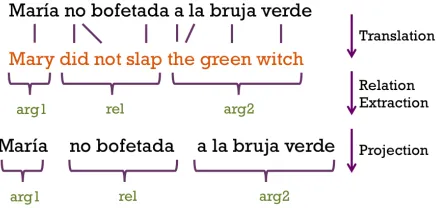
Figure 1: RE in a Spanish sentence using the cross-lingual relation extraction pipeline.
2 Multilingual Relation Extraction
Our method of RE for a sentences=hs1, s2, . . . sNi in a non-English language consists of three steps: (1) Translation of s into English, that generates a sen-tence t = ht1, t2, . . . tMi with word alignments a relative tos, (2) Open RE ont, and (3) Relation pro-jection fromttos. Figure 1 shows an example of RE in Spanish using our proposed pipeline. We employ OLLIE1(Mausam et al., 2012) for RE in English and
GOOGLETRANSLATE2API for translation from the
source language to English, although in principle, we could use any translation system to translate the language to English. We next describe each of these components.
2.1 Relation Extraction in English
Supposet=ht1, t2, . . . , tMiis a tokenized English sentence. Open relation extraction computes triples of non-overlapping phrases (arg1; rel; arg2) from the sentence t. The two arguments arg1and arg2 are connected by the relation phraserel.
We utilized OLLIE(Mausam et al., 2012) to
ex-tract the relation tuples for every English sentence. We chose OLLIE because it has been shown to
give a higher yield at comparable precision rela-tive to other open RE systems such as REVERB
and WOEparse (Mausam et al., 2012). OLLIE was
trained by extracting dependency path patterns on annotated training data. This training data was boot-strapped from a set of high precision seed tuples ex-tracted from a simpler RE system REVERB (Fader
et al., 2011). In Godse killed Gandhi, the
ex-1http://knowitall.github.io/ollie/ 2https://developers.google.com/
translate/
Data:s,t,a,pt Result:ps
P ←PhraseExtract(s,t,a)
ps =∅,score=−∞,overlap= 0 for(phrs, phrt)∈P do
ifBLEU(phrt, pt)> scorethen if phrt∩pt6=∅then
pt←phrt
score←BLEU(phrt, pt)
overlap←phrt∩pt
ifoverlap6= 0then length=∞
for(phrs, pt)∈P do
iflen(phrs)< lengththen length←len(phrs) ps←phrs;
else
ps←WordAlignmentProj(s,t,a,pt);
Algorithm 1:Cross-lingual projection of phrasept from a target sentencetto a source sentencesusing word alignmentsaand parallel phrasesP.
tracted relation (Godse; killed; Gandhi) can be ex-pressed by the dependency pattern: arg1↑nsubj ↑
rel:postag=VBD↓ dobj ↓ arg2.3 OLLIE also
nor-malizes the relation phrase for some of the phrases, for exampleis president of is normalized tobe pres-ident of. 4
2.2 Cross-lingual Relation Projection
We next describe an algorithm to project the ex-tracted relation tuples in English back to the source language sentence. Given a source sentence, the GOOGLE TRANSLATEAPI provides us its
transla-tion along with the word-to-word alignments rela-tive to the source. Ifs = sN
1 and t = tM1 denote
the source and its English translation, then the align-menta ={aij : 1 ≤i ≤ N; 1 ≤ j ≤M}where, aij = 1ifsi is aligned totj, and is0otherwise. A
3Example borrowed from Mausam et al. (2012)
4For sentences where the veracity of a relation depends on
a clause, OLLIEalso outputs the clause. For example, inEarly
naive word-alignment based projection would map every word from a phrase extracted in English to the source sentence. This algorithm has two drawbacks: first, since the word alignments are many-to-many, each English word can be possibly mapped to more than one source word which leads to ambiguity in its projection; second, a word level mapping can pro-duce non-contiguous phrases in the source sentence, which are hard to interpret semantically.
To tackle these problems, we introduce a novel algorithm that incorporates a BLEU score (Papineni et al., 2002) based phrase similarity metric to per-form cross-lingual projection of relations. Given a source sentence, its translation, and the word-to-word alignment, we first extract phrase-pairs P using the phrase-extract algorithm (Och and Ney, 2004). In each extracted phrase pair(phrs, phrt)∈ P,phrsandphrtare contiguous word sequences in s and t respectively. We next determine the trans-lations of arg1, rel and arg2 from the extracted phrase-pairs.
For each English phrasep∈ {arg1,rel,arg2}, we first obtain the phrase-pair (phrs, phrt) ∈ P such that phrt has the highest BLEU score relative to p subject to the condition that p∩ phrt 6= ∅ i.e, there is at least one word overlap between the two phrases. This condition is necessary since we use BLEU score with smoothing and may obtain a non-zero BLEU score even with non-zero word overlap. If there are multiple phrase-pairs inP that correspond to the same target phrasephrt, we select the shortest source phrase (phrs). However, if there is no word overlap between the target phrase pand any of the target phrases inP, we project the phrase using the word-alignment based projection. The cross-lingual projection method is presented in Algorithm 1.
3 Experiments
Evaluation for open relations is a difficult task with no standard evaluation datasets. We first describe the construction of our multilingual relation extraction dataset and then present the experiments.
Annotation. The current approach to evaluation for open relations (Fader et al., 2011; Mausam et al., 2012) is to extract relations from a sentence and manually annotate each relation as either valid (1) or invalid (0) for the sentence. For
exam-ple, in the sentence: “Michelle Obama, wife of Barack Obama was born in Chicago”, the follow-ing are possible annotations: a) (Michelle Obama; born in; Chicago): 1, b) (Barack Obama; born in; Chicago):0. Such binary annotations are not avail-able for languages apart from English. Further-more, a binary1/0 label is a coarse annotation that could unfairly penalize an extracted relation which has the correct semantics but is slightly ungrammat-ical. This could occur either when prepositions are dropped from the relation phrase or when there is an ambiguity in the boundary of the relation phrase.
Therefore to evaluate our multilingual relation ex-traction framework, we obtained annotations from professional linguists for three typologically differ-ent languages: French, Hindi, and Russian. The an-notation task is as follows: Given a sentence and a pair of arguments (extracted automatically from the sentence), the annotator identifies the most rel-evant contiguous relation phrase from the sentence that establishes a plausible connection between the two arguments. If there is no meaningful contigu-ous relation phrase between the two arguments, the arguments are considered invalid and hence, the ex-tracted relation tuple from the sentence is considered incorrect.
Given the human annotated relation phrase and the automatically extracted relation phrase, we can measure the similarity between the two, thus alle-viating the problem of coarse annotation in binary judgments. For evaluation, we first report the per-centage of valid arguments. Then for sentences with valid arguments, we use smoothed sentence-level BLEU score (max n-gram order = 3) to measure the similarity of the automatically extracted relation rel-ative to the human annotated relation.5
Results. We extracted relations from the entire Wikipedia6 corpus in Russian, French and Hindi
from all sentences whose lengths are in the range of 10 −30 words. We randomly selected 1,000
relations for each of these languages and annotated them. The results are shown in table 1. The percent-age of valid extractions is highest in French (81.6%)
5We obtained two annotations for≈300Russian sentences.
Between the two annotations, the perfect agreement rate was 74.5% and the average BLEU score was0.85.
Language Argument 1 Relation phrase Argument 2 French HeIl fut enrˆol´e de force auwas conscripted to RADRAD
Hindi Many peoplebahut se log came toaaye cailiforniaCalifornia
[image:4.612.153.460.59.148.2]Russian АвтокатастрофаCrash произошлаoccured ЧерногорииMontenegro
Table 3: Examples of extracted relations in different languages with English translations (Hindi is transliterated).
Language % valid BLEU Relation lengthGold Auto
French 81.6% 0.47 3.6 2.5
Hindi 64.9% 0.38 4.1 2.8
[image:4.612.335.518.185.260.2]Russian 63.5% 0.62 1.8 1.7
Table 1: % of valid relations and BLEU score of the ex-tracted relations across languages with the average rela-tion phrase length (in words).
[0-0.1) [0.1-0.2) [0.2-0.4) [0.4-0.6) [0.6-0.8) [0.8-1) [1] Binned BLEU Score
0 50 100 150 200 250 300 350 400
Number of Relations
[image:4.612.80.292.186.249.2]French Hindi Russian
Figure 2: Number of automatically extracted relations binned by their BLEU scores computed relative to the manually annotated relations.
followed by Hindi and Russian (64.0%). Surpris-ingly, Russian obtains the lowest percentage of valid relations but has the highest BLEU score between the automatic and the human extracted relations. This could be attributed to the fact that the average relation length (in number of words) is the shortest for Russian. From table 1, we observe that the length of the relation phrase is inversely correlated with the BLEU score.
Figure 2 shows the distribution of the number of extracted relations across bins of similar BLEU scores. Interestingly, the highest BLEU score bin (1) contains the maximum number of relations in
Language Size Language Size
French 6,743 Georgian 497
Hindi 367 Latvian 491
Russian 7,532 Tagalog 102
Chinese 2,876 Swahili 114
[image:4.612.83.289.303.464.2]Arabic 707 Indonesian 1,876
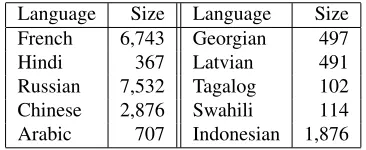
Table 2: Number of extracted relations (in thousands) from Wikipedia in multiple languages.
all three languages. This is an encouraging result since it implies that the majority of the extracted re-lation phrases are identical to the manually anno-tated relations. Table 2 lists the sizes of automat-ically extracted relations on 10 different languages from Wikipedia that we are going to make publicly available. These were selected to include a mix-ture of high-resource, low-resource, and typologi-cally different languages. Table 3 shows examples of randomly selected relations in different languages along with their English translations.
4 Related Work
Tseng et al. (2014) describe an open RE for Chi-nese that employs word segmentation, POS-tagging, dependency parsing. Lewis and Steedman (2013) learn clusters of semantically equivalent relations across French and English by creating a semantic signature of relations by entity-typing. These rela-tions are extracted using CCG parsing in English and dependency parsing in French. Blessing and Sch¨utze (2012) use inter-wiki links to map relations from a relation database in a pivot language to the target language and use these instances for learn-ing in a distant supervision settlearn-ing. Gerber and Ngomo (2012) describe a multilingual pattern ex-traction system for RDF predicates that uses pre-existing knowledge bases for different languages.
5 Conclusion
We have presented a language independent open do-main relation extraction pipeline and have evalu-ated its performance on three typologically differ-ent languages: French, Hindi and Russian. Our cross-lingual projection method utilizes OLLIE and
GOOGLE TRANSLATE to extract relations in the
language of interest. Our approach does not rely on the availability of linguistic resources such as POS-taggers or dependency parsers in the target guage and can thus be extended to multiple lan-guages supported by a machine translation system. We are releasing the manually annotated judgements for open relations in the three languages and the open relations extracted over the entire Wikipedia corpus in ten languages. The resources are avail-able at: http://cs.cmu.edu/˜mfaruqui/ soft.html.
Acknowledgment
This work was performed when the first author was an intern at Google. We thank Richard Sproat for providing comments on an earlier draft of this pa-per. We thank Hao Zhang for helping us with the re-lation extraction framework, and Richard Zens and Kishore Papineni for their feedback on this work. We are grateful to Bruno Cartoni, Vitaly Nikolaev and their teams for providing us annotations of mul-tilingual relations.
References
Michele Banko and Oren Etzioni. 2008. The tradeoffs between open and traditional relation extraction. In Proceedings of ACL.
J. Berant and P. Liang. 2014. Semantic parsing via para-phrasing. InProceedings of ACL.
Andre Blessing and Hinrich Sch¨utze. 2012. Crosslingual distant supervision for extracting relations of different complexity. InProceedings of CIKM.
Razvan C. Bunescu and Raymond J. Mooney. 2005. A shortest path dependency kernel for relation extrac-tion. InProceedings of EMNLP.
Razvan C. Bunescu. 2007. Learning to extract relations from the web using minimal supervision. In Proceed-ings of ACL.
Andrew Carlson, Justin Betteridge, Bryan Kisiel, Burr Settles, Estevam R. Hruschka Jr., and Tom M. Mitchell. 2010. Toward an architecture for never-ending language learning. InProceedings of AAAI. Anthony Fader, Stephen Soderland, and Oren Etzioni.
2011. Identifying relations for open information ex-traction. InProceedings of EMNLP.
Pablo Gamallo, Marcos Garcia, and Santiago Fern´andez-Lanza. 2012. Dependency-based open information extraction. InProceedings of ROBUS-UNSUP. Daniel Gerber and Axel-Cyrille Ngonga Ngomo. 2012.
Extracting multilingual natural-language patterns for rdf predicates. In Proceedings of the 18th Inter-national Conference on Knowledge Engineering and Knowledge Management.
Rebecca Hwa, Philip Resnik, Amy Weinberg, Clara Cabezas, and Okan Kolak. 2005. Bootstrapping parsers via syntactic projection across parallel texts. Natural Language Engineering, 11:11–311.
Seokhwan Kim and Gary Geunbae Lee. 2012. A graph-based cross-lingual projection approach for weakly su-pervised relation extraction. InProceedings of ACL. Seokhwan Kim, Minwoo Jeong, Jonghoon Lee, and
Gary Geunbae Lee. 2011. A cross-lingual anno-tation projection-based self-supervision approach for open information extraction. InProceedings of IJC-NLP.
Seokhwan Kim, Minwoo Jeong, Jonghoon Lee, and Gary Geunbae Lee. 2014. Cross-lingual annotation projection for weakly-supervised relation extraction. ACM Trans. Asian Lang. Inf. Process., pages 3–3. Mike Lewis and Mark Steedman. 2013. Unsupervised
induction of cross-lingual semantic relations. In Pro-ceedings of EMNLP.
Mike Mintz, Steven Bills, Rion Snow, and Dan Jurafsky. 2009. Distant supervision for relation extraction with-out labeled data. InProceedings of ACL.
Franz Josef Och and Hermann Ney. 2004. The align-ment template approach to statistical machine transla-tion. Comput. Linguist., pages 417–449.
Sebastian Pad´o and Mirella Lapata. 2009. Cross-lingual annotation projection of semantic roles. Journal of Ar-tificial Intelligence Research, 36:307–340.
Kishore Papineni, Salim Roukos, Todd Ward, and Wei-Jing Zhu. 2002. Bleu: A method for automatic evalu-ation of machine translevalu-ation. InProceedings of ACL. Philip Resnik and Noah A. Smith. 2003. The web as a
parallel corpus. Computational Linguistics.
Ellen Riloff, Charles Schafer, and David Yarowsky. 2002. Inducing information extraction systems for new languages via cross-language projection. In Pro-ceedings of COLING.
Jason R. Smith, Herve Saint-Amand, Magdalena Pla-mada, Philipp Koehn, Chris Callison-Burch, and Adam Lopez. 2013. Dirt cheap web-scale parallel text from the common crawl. InProceedings of ACL. Yuen-Hsien Tseng, Lung-Hao Lee, Shu-Yen Lin,
Bo-Shun Liao, Mei-Jun Liu, Hsin-Hsi Chen, Oren Etzioni, and Anthony Fader. 2014. Chinese open relation ex-traction for knowledge acquisition. InProceedings of EACL.
Xuchen Yao and Benjamin Van Durme. 2014. Informa-tion extracInforma-tion over structured data: QuesInforma-tion answer-ing with freebase. InProceedings of ACL.
David Yarowsky and Grace Ngai. 2001. Inducing multi-lingual pos taggers and np bracketers via robust pro-jection across aligned corpora. In Proceedings of NAACL.