Designing Random Assignment Mechanisms
Fuhito Kojima1
Overview
Social planner wants to assign goods to its members. Student placement mechanisms (NYC, Boston). House allocation in colleges.
Constraints:
No monetary transfer, random assignments.
Model
There is a fixed set of types of goods O, plus the null good (receiving no good) ø.
Each agent i has strict preferences overO∪ {ø}.
Arandom assignment is a matrixP = [Pia]i,a wherePia is the
Random Priority Mechanism
Random Priority (RP):
1 Draw each ordering of the agents with equal probability, and 2 The first agent receives her most preferred good, the next agent his
most preferred good among the remaining ones, and so on. RP is
Easy to implement. Strategy-proof.
Fair (equal treatment of equals). Ex post efficient.
RP is Ex Ante Inefficient
Real goods O ={a,b} with one copy each and agents N ={1,2,3,4},
1 and 2 like a,b,ø (in this order), 3 and 4 like b,a,ø.
The random assignments underRP
Good a Good b Good ø
Agents 1 and 2 5/12 1/12 1/2
Agents 3 and 4 1/12 5/12 1/2
Everyone prefers
Good a Good b Good ø
Ordinal Efficiency
A random assignment P (first-order) stochastically dominates another random assignmentP0 if, for every agent,
Pr[i getsa or more preferred underP]
,
≥ Pr[i getsaor more preferred underP0], for all i,a,
with strict inequality for at least one pairi,a.
A random assignment isordinally efficient(sd-efficient) if it is not stochastically dominated by any other random assignment.
In environments where only ordinal preferences can be used, ordinal efficiency is a natural efficiency concept.
Probabilistic Serial Mechanism
Bogomolnaia and Moulin (2001) define PS based on an “eating algorithm”:
1 Imagine each good is a divisible good of “probability shares.” 2 Imagine there is a time interval [0,1].
3 Each agent “eats” the best good with speed one at every time (among goods that have not been completely eaten away).
PS Mechanism Example
The same example as before: O ={a,b}, with one copy each, N ={1,2,3,4},
1 and 2 like a,b,ø (in this order), 3 and 4 like b,a,ø.
Compute the PS assignment:
1 t= 0: Agents 1 and 2 start eatinga, and agents 3 and 4 start eatingb. 2 t= 1/2: goodsaandbare eaten away. No (real) goods remain. The resulting assignment
Good a Good b Good ø
Agents 1 and 2 1/2 0 1/2
Agents 3 and 4 0 1/2 1/2
PS is Ordinally Efficient
More generally,
Theorem
For any reported preferences, the PS mechanism produces an ordinally efficient assignment with respect to the reported preferences.
Proof sketch
An intuitive reason that PS is ordinally efficient comes from the nature of “eating.”
At each moment of time in the time interval, everyone is eating (infinitesimal share of) his or her favorite available good.
PS is fair
We can think of an appropriate fairness criterion for random assignments.
We say that a random assignment isenvy-free if everyone likes his or her assignment better than assignment of anyone else (in the sense that her assignment stochastically dominates others’).
Theorem
Proof sketch
An intuitive reason that PS is envy-free is, again, from the nature of “eating.”
At each moment of time in the time interval, everyone is eating (infinitesimal share of) his or her favorite available good.
PS is not strategy-proof
goods {a,b,ø}with one unit each, N={1,2,3,4}, 1 likes a,b,ø (in this order),
2 likes a,ø, 3,4 like b,ø.
If 1 reports true preferences,
Good a Good b Good ø
Agents 1 and 2 1/2 0 1/2
Agents 3 and 4 0 1/2 1/2
If 1 reports a lie: b,a,ø,
Good a Good b Good ø
Impossibility Result
So, PS is better in efficiency (ordinal efficiency), but RP is better in incentives (strategy-proofness).
Is there any other mechanism that can dominate both RP and PS?
Theorem (Bogomolnaia and Moulin)
There is no mechanism that satisfies ordinal efficiency, strategy-proofness and equal treatment of equals.
So, in a sense, we cannot avoid the tradeoff by trying to find another mehcanism.
NYC’s data
Pathak (2008) used NYC’s data to compare RP and PS:
NYC’s supplementary round: RP is currently used. Note that RP is strategy-proof, so we can expect that the submitted preferences are truthful.
Pathak notes the difference is small: about 4,999 students (out of 8,255) receive their top choice from RP, while 5,016 students receive their top choice from PS, a difference of 0.3%.
PS becomes strategy-proof in large markets
Kojima and Manea show that PS becomes strategy-proof in large markets (motivated by applications like NYC)
Theorem (Kojima and Manea 2010)
Fix agent i ’s utility function ui, and assume ui represents strict
preferences. There is a finite bound M such that, if qa ≥M for all a∈O,
then truthtelling is a dominant strategy for i under PS. The conclusion holds no matter how many other agents are participating in the market.
Remark Truthtelling is an exact dominant strategy in a finitely large markets.
Intuition of the Theorem
Manipulations have two effects: (1) given the same set of available objects, reporting false preferences may prevent the agent from eating his most preferred available object; (2) reporting false preferences can affect expiration dates of each good.
(1) always hurts the manipulating agent, while (2) can benefit the agent. Intuitively, the effect (2) becomes small as the market becomes large.
Asymptotic Equivalence
Consider a sequence of economies, where aq-economy is composed of
q copies of each (real) good and infinite copies of ø, and Set of agents: we only assume
(number of agents with preference πinq-economy)
q
converges as q→ ∞for every preferenceπ (the limit can be zero).
Theorem (Che and Kojima (2009))
Fix the set of types of goods. The random assignments in RP and PS converge to each other as q→ ∞.
Formally,
limq→∞maxπ,a|RPaq(π)−PSaq(π)|= 0, where
Intuition of the Theorem (1)
In PS, the random assignment is completely pinned down by the expiration dates of the goods. Expiration dateTaq of gooda is the
time at which ais completely consumed away.
The probability that an agent receives good ais duration of consuming gooda, so
max{Taq−max{Tbq|b is preferred to a},0}.
probability of receiving a
Intuition of the Theorem (2)
Proof Idea: Find RP-analogues of expiration dates, and show that they converge to expiration dates in PS (in probability).
Alternative formulation of RP.
1 Each agent draws a number iid uniformly distributed in [0,1].
2 The agent with the smallest draw receives her favorite good, and so on. Given realized draws, the cutoff ˆTaq of goodaunder RP is the draw
of the agent who receives the last copy of a.
Since random draws are uniform over [0,1], an agent will receive good a with probability
E[max{Tˆaq−max{Tˆbq|b is preferred to a},0}].
draws such that the agent receivesa
Intuition of the Theorem (3)
We show cutoffs of RP converge to expiration dates of PS (in probability).
They are different in general: In PS, a good is consumed
proportionately to the number of agents who like it: In RP, a good may be consumed disproportionately to the number of agents who like it because of the randomness of draws.
For RP in large markets, the law of large numbers kicks in: with a very high probability, a good is consumed almost proportionately to the number of agents who like that good best among available goods.
Nature of Ordinal Inefficiency in RP
We need to make a convergence argument, because for any finite size, RP and PS may not be exactly equivalent.
Consider a family of replica economies (i.e. agents of each preference type increase proportionately to q).
Proposition
In replica economies, if RP is ordinally efficient/inefficient in the base economy (i.e. q= 1), then RP is ordinally efficient/inefficient for all replicas.
Thus, inefficiency of RP does not disappear completely in any finite replica economy, if RP is inefficient in the base economy.
But our theorem says that the “magnitude” of ordinal inefficiency vanishes as markets become large.
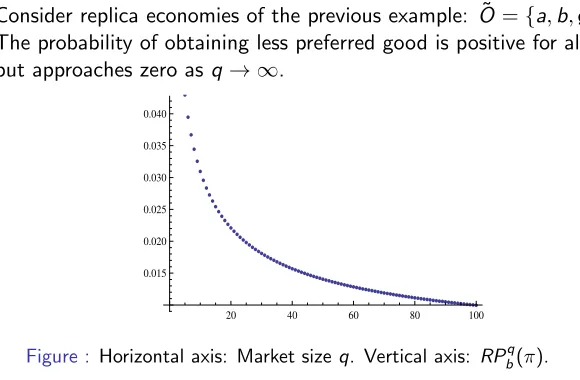
Example
Consider replica economies of the previous example: ˜O ={a,b,ø}. The probability of obtaining less preferred good is positive for all q but approaches zero asq → ∞.
20 40 60 80 100 0.015
[image:23.363.36.326.51.241.2]Extensions
Existing Priorities (e.g., university house allocation with priority for freshmen)
Asymmetric RP: agents draw numbers from different distributions, reflecting the priority structure.
Asymmetric PS: agents have different eating speeds.
The asymmetric RP and the asymmetric PS converge to the same limit. Multiunit demand: Each agent consumes up to k ≥2 units (Kojima, 2008).
Once-and-for-all RP: Draw a random order. An agent claims k units at her turn.
Implementing Random Assignments
Arandom assignment is a matrixP = (Pia) wherePia represents
the probability that agent i receives gooda(i.e., giving marginal distributions).
It’s often easier to work with random assignments directly rather than lotteries over sure outcomes, when considering (utilitarian) welfare, fairness, incentives, etc.
Example: A Simple Environment
Consider a problem where each ofn agents receives exactly one ofn goods each.
Each deterministic assignment can be expressed by a permutation matrix, i.e., a matrix where
Each entry is 0 or 1 (1 means receiving a good).
Each row sums up to one (each agent must receive exactly one good). Each column sums up to one (each object must be assigned to exactly one agent).
Any random assignment in this problem is a convex combination of permutation matrices, so it should be abistochastic matrix, i.e.,
Birkhoff-von Neumann Theorem
Theorem (Birkhoff-von Neumann)
Every bistochastic matrix can be written as a convex combination of permutation matrices.
This theorem implies that any random assignment can be implemented (why)?
Proof
Lemma
Let P be a bistochastic matrix that is not a permutation matrix. Then it can be written as a convex combination of two bistochastic matrices,
P =λP1+ (1−λ)P2,
where P1 and P2 has the following properties:
1 If Pia is an integer, then P1
ia and Pia2 are integers.
2 P1 and P2 has at least one more integral entry than P.
Note that the lemma implies the theorem.
What Random Assignments Can Be Implemented in
General?
Based on Budish, Che, Kojima and Milgrom (2009).
In many applications, there are more complicated constraints. Many-to-one assignment: Multiple seats in each school.
⇒Constraint may be an integer different from one Non-assignment: Opt out to private school.
⇒Constraint may be an inequality, not equality
Group-specific quota (“Controlled choice”): Affirmative action, Gender Balance, Test score balance, District Favoritism
⇒Sub-column constraint
Flexible capacity: the relative sizes of alternative programs across schools or within each school may be adjustible.
Other topics
Extending the PS mechanism:
Weak preferences: Katta and Sethuraman (2006)
Initial endowment (“existing tenants”): Yilmaz (2008, 2009) Group-specific quotas, flexible production, etc: Budish, Che, Kojima and Milgrom (2010), Ball (in progress)
Priorities: Kesten and Unver (2009)
Characterizing the PS mechanism (Hashimoto and Hirata, Kesten, Kurino, and Unver 2010, Bogomolnaia and Heo 2010)
An equivalent representation: Kesten (2006),
Characterizations of ordinal efficiency: McLennan (2002), Manea (2006), Carroll (2013), Abdulkadiroglu and Sonmez (2003), Ball (2013)
Stronger efficiency: Featherstone (2013)
Summary
The popular RP mechanism is challenged by the new PS mechanism, which may be more efficient.
PS becomes strategy-proof in large markets, and RP and PS mechanisms converge to the same limit as the copies of each good becomes infinitely large.
Both RP and PS may be good solutions in large markets. Further topics:
How well these mechanisms work in large finite economies. Asymptotic equivalence for other mechanisms.