Synchronization of analogue and digital solvers in
mixed-signal simulation on a SystemC platform
Tom J Kazmierski and Hessa Al Junaid School of Electronics and Computer Science
University of Southampton {tjk,hjaa01r}@ecs.soton.ac.uk
Abstract
This contribution proposes a synchronization technique for solvers able to handle ana-logue extensions to SystemC, for modelling of general, mixed-mode systems with digital and non-linear analogue behaviour. In order to comply with the SystemC simulation cycle se-mantics, we link the analogue kernel to the SystemC environment as a user module and synchronize it with the SystemC kernel via a lockstep synchronization algorithm. Opera-tion of the extended, mixed-signal SystemC simulaOpera-tion platform is demonstrated using the practical example of a boost power converter, in which analogue behaviour interacts with a digital control loop. We hope that the result presented here might aid the recent efforts to standardize analogue extensions for SystemC.
1
Introduction
Several high level hardware description languages, such as VHDL and Verilog, have recently been extended to provide mixed-signal modelling capability and new standards for VHDL-AMS [CB99] and Verilog-AMS [Ver98] are now widely available. In the light of the growing popularity of mixed, analogue and digital ASICs, this is not surprising.
Naturally, with the advent of SystemC, several research publications highlighted the possi-bility to extend the standard, digital modelling capabilities of SystemC ([Ger00, Mue01, Pan01, ECN+01]) to the analogue domain. Bjornsen et al. [BHY01] described an efficient software
framework for rapid behavioural modelling and simulation of analogue-to-digital converters based on SystemC. Their framework consists of three parts, the first is an analogue extension representing analogue signal classes, the second is a signal module library, which includes basic blocks required for A-D modelling, such as switched-capacitor integrators, operational amplifiers and a track-and-hold amplifier. The third part is a mixed-signal system test bench. Einwich et al. [ECN+01] presented a SystemC extension allowing an overall specification and verification
of mixed-signal systems with linear analogue models. They consider an ADSL line driver with analogue linear filters as an example.
loop. The results presented here might aid the current efforts to standardize analogue extensions for SystemC [VGE03].
2
Solver synchronization
Initialization
*
Process 1 Process n processKernel
All processes suspended
. . .
START
[image:2.596.171.424.153.341.2]STOP
Figure 1: SystemC simulation cycle [Mue01].
Like in the case of most high-level hardware description languages, a SystemC model consists of a hierarchical network of parallel processes which exchange messages under the control of the simulation kernel process concurrently update the values of signals and variables. Signal assignment statements do not affect the target signals immediately, but the new values become effective in the next simulation cycle. The kernel process resumes when all the user defined processes become suspended either by executing a wait statement or upon reaching the last process statement. On resumption, the kernel updates the signals and variable and suspends again while the user processes resume. If the time of the next earliest event tn is equal to the current simulation time tc, the user processes execute a delta cycle.
Initialization
*
Process 1
Analog kernel process
Digital Kernel process
All processes suspended
. . .
START
STOP Process n
Figure 2: Simulation cycle of a SystemC system with an analog extension.
[image:2.596.143.449.512.697.2]Delta cycle?
Restore analog state at tc(-)
Solve analog model at tc(+)
Solve analog model at tc(-) No (time has advanced)
Save current analog state (at tc(-) )
Select next step size h and schedule event at next local
time point tn = tc + h Yes
Resume
[image:3.596.160.434.65.374.2]Suspend
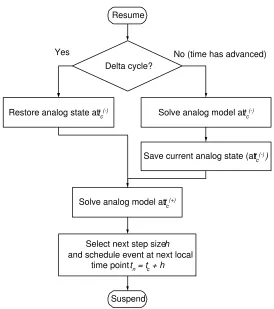
Figure 3: Analog kernel’s simulation cycle.
This scenario requires the analogue solver to be able to handle delta cycles in a manner similar to that of digital processes, namely, the state of the analogue solver may not be updated until after the SystemC kernel advances the simulation time ahead of the current simulation time
tc. In other words, the underlying analogue solver not only must be able to execute delta cycles with the step size h= 0, but also must have a capability to backtrack to the state just beforetc (t(−)
c ), should new events at tc change the analogue stimuli. The former requirement would be difficult to satisfy with most standard, SPICE-like simulators since they require a minimum step size greater than zero. Moreover, small step sizes can cause large round off errors and lead to inaccurate results. The analogue model proposed in section 3 can be solved with arbitrary step size, including h = 0 . If necessary, backtracking can be achieved by saving the analogue state
at t(−)
c when required. The analogue kernel repeatedly executes the simulation cycle shown in figure 2, which might involve delta cycles and backtracking.
Analogue simulators do not use events but instead employ an entirely different approach to time step control. The time step may be continually adjusted to minimise the errors caused by the numerical integration method used to solve differential equations in the circuit model. In order to minimise the error in the numerical methods, it may be necessary to repeatedly reject the circuit solution at a time point and to cut the time step. It is therefore necessary for the analogue kernel in a SystemC environment not to advance past the current simulation time tc lest a delta cycle occurs and re-evaluation of the current step is necessary.
Test Bench
Analogue Main Module
Analogue Module Analogue
Module
Digital Module Digital
Module
[image:4.596.178.419.66.230.2]Digital Module
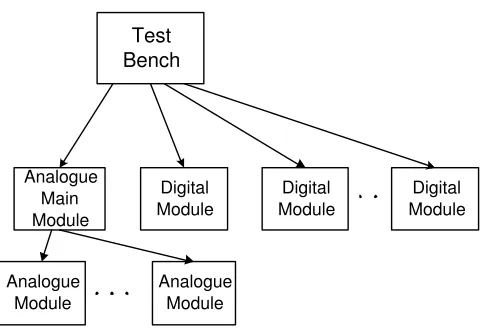
Figure 4: Analogue modules in a mixed-signal SystemC module.
kernel will make a step in time no larger that the analogue kernel’s step size. Since the analogue kernel runs as a user process and is controlled by the SystemC kernel, no sychronization deadlock may happen. The only causes for deadlock can arise due to a failure to converge in the analogue solver or due to unresolvable delta cycles.
Global nets and synchronization. The signals that pass between the digital and analogue domains are carried by global nets. The solution method adopted here allows each global net to be able to connect two partitions (the digital and analogue simulator), one of which owns the net. This means that a general global net is divided into two smaller terminal nets, implemented as SystemC ports. The synchronization approach adopted in this paper is based on the lock-step principle to ensure that no results are thrown away and there is no need for backtracking. Most existing digital solvers cannot backtrack and therefore no fundamental changes are required if a mixed-signal system is integrated to the SystemC kernel. Our lock-step synchronisation algorithm has been implemented as a modification to the digital kernel and can be described in the form of pseudo-code as follows:
time <- 0;
initialise both the analogue and digital kernel; while (time <= end_time) do
while (immediate notifications are pending) do execute the analogue kernel
distribute notifications generated by the analogue kernel on global nets
while (there are active processes) do run a selected process
end while (there are active processes)
update signals
end while (immediate notifications are pending) // delta cycle loop
advance time to the next timed notification end while (time<= end_time)
3
Analogue Model
The description of the analogue model relies on C++ classes that provide behaviour for circuit nodes and primitive components. The component classes contain virtual methods that are invoked at matrix build time each time the analogue solver requires to update the Jacobian according to modified nodal analysis stamps. The top analogue module must run a method named BuildCircuit() which contains the analogue circuit structure.
void analog::BuildCircuit(void){ // ---...
node v1("v1"),v2("v2"),vc("vc"),vout("vout"),vf("vf"); node vramp("vramp");
voltageS E("E",v1,0,1.5);
inductor l1("l1",v1,v2,10e03,5.0); // 10mH,5ohm resistor ro("ro",vout,0,500.0);
resistor r1("r1",vout,vf,23e3); resistor r2("r2",vf,0,10e3); MOS0 M1("M1",v2,vc,0); diode0 D1("D1",v2,vout); capacitor Co("Co",Vout,0,1e-3); voltage_ramp vr("vr",vramp,0,1e-6); ...
} // analog::BuildCircuit()
---The analogue kernel invokes BuildCircuit() once prior to the simulation. Additional user-defined methods represent interfacing components that provide functionality for synchronization between SystemC ports and their corresponding values in the analogue solver. The interfaces are bound at the build stage.
sc_signal<bool> ASig; sc_signal<double> FSig; sc_signal<bool> S1; sc_signal<double>S2;
sc_clock TestClk("TestClock", 0.1, SC_US,0.5);//label, period,duty cycle ...
analog analog1("analog1"); digital digital1("digital1");
analog1.Vcontrol(S1); analog1.Vout(S2); analog1.clock1(ASig); digital1.Vout(S2); digital1.Vcontrol(S1);
stim stim1("stimulus"); stim1.A(ASig);
stim1.Clk(TestClk);
mon monitor1("monitor"); monitor1.A(ASig); monitor1.F(FSig); monitor1.Clk(TestClk);
4
Example
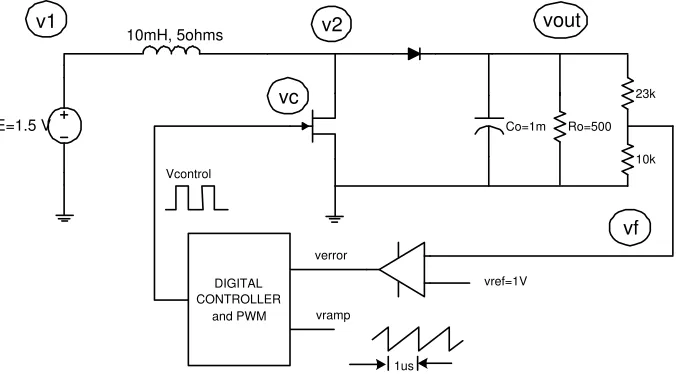
The analogue extensions added to the language contain classes to handle electrical nodes and primitive analogue components with user defined behaviour necessary to build and solve the analogue equation set. A boost 1.5V to 3.3V power converter has been used as an example of a non-trivial analogue and digital interaction. Systems of this kind usually put standard, SPICE-like simulators into difficulties because of the disparate time scales of their transients. In the case of a switched-mode power supply, the analogue transient in the output circuit is four to five orders of magnitude slower that the fast switching waveforms in the digital controller. As a typical simulation in a system of this kind might require a hundred million time points, excessive CPU times often occur when the entire system is modelled on the circuit level The capacity of SystemC to enable system-level, mixed-signal modelling can vastly reduce simulation times where concepts need to be verified quickly and detailed, circuit-level modelling is not required.
E=1.5 V Co=1m Ro=500
23k
10k
10mH, 5ohms
verror
vref=1V
vramp Vcontrol
1us
v1 v2 vout
DIGITAL CONTROLLER
and PWM
vc
[image:6.596.130.468.260.447.2]vf
Figure 5: Boost 1.5V to 3.3V switch-mode power supply with digital control.
The system’s block structure is presented in figure 4. The controller’s digital behaviour in the example is modelled as a standard SystemCSC MODULE. The testbench instantiates both the analogue and digital module and provides global nets. Sample simulation results at steady-state are presented in figure 4.
5
Conclusion
An extension to SystemC has been developed to simulate general, mixed-mode systems with digital and non-linear analogue behaviour. The analogue solver is coupled to the SystemC kernel via a lockstep synchronization algorithm, whose principle has been demonstrated using the practical example of a mixed-signal boost power converter, in which analogue behaviour interacts with a digital control loop. The results might be useful in future efforts to standardize analogue extensions for SystemC.
References
-200 -100 0 100 200
0.18 0.185 0.19 0.195 0.2
15 20 25
0.18 0.185 0.19 0.195 0.2
-0.6 -0.3 0 0.3 0.6
0.18 0.185 0.19 0.195 0.2
+0.6mV
3.33V
-0.6mV
0 1.5 3 4.5
0.18 0.185 0.19 0.195 0.2
mV verror
time [s]
time [s]
time [s] mA Inductor current
vout
v2
[image:7.596.106.491.75.437.2]time [s]
Figure 6: Simulation results for a 20ms time window in steady-state of the boost switch-mode power supply working in continuous mode.
[CB99] E. Christen and K. Bakalar. Vhdl-ams - a hardware description language for analog and mixed-signal application. IEEE Trans CAS II, 46(10):1263–1272, October 1999.
[ECN+01] K. Einwich, C. Clauss, G. Noessing, P. Schwarz, and H. Zojer. SystemC extensions for mixed-signal system design. Proc. FDL’2001, Lyon, France, September 2001.
[Ger00] J. Gerlach. System level design using the systemc modeling platform. Proc. SDL 2000, 2000.
[Mue01] W. Mueller. The simulation semantics of systemC. Proc. DATE 2001, 2001.
[Pan01] P. Panda. Systemc - a modeling platform supporting multiple design abstractions.
Proc. ISSS 2001, Montreal, Canada, 2001.
[Ver98] Verilog AMS Language Reference Manual, Accelera. August 1998.
[VGE03] A. Vachoux, C. Grimm, and K. Einwich. Systemc-ams requirements, design objective and rationale. Proc. DATE’2003, Munich, Germany, pages 388–393, March 2003.
![Figure 1: SystemC simulation cycle [Mue01].](https://thumb-us.123doks.com/thumbv2/123dok_us/1011620.615956/2.596.143.449.512.697/figure-systemc-simulation-cycle-mue.webp)