Constructive Proof of Brouwer’s Fixed Point
Theorem for Sequentially Locally Non-constant
and Uniformly Sequentially Continuous Functions
Yasuhito Tanaka,
Member, IAENG
Abstract—We present a constructive proof of Brouwer’s fixed point theorem for sequentially locally non-constant and uniformly sequentially continuous functions based on the ex-istence of approximate fixed points. And we will show that our Brouwer’s fixed point theorem implies Sperner’s lemma for a simplex. Since the existence of approximate fixed points is derived from Sperner’s lemma, our Brouwer’s fixed point theorem is equivalent to Sperner’s lemma.
Index Terms—Brouwer’s fixed point theorem, Sperner’s lemma, sequentially locally non-constant functions, uniformly sequentially continuous functions, constructive mathematics.
I. INTRODUCTION
I
T is well known that Brouwer’s fixed point theorem can not be constructively proved1. Sperner’s lemma which isused to prove Brouwer’s theorem, however, can be construc-tively proved. Some authors have presented an approximate version of Brouwer’s theorem using Sperner’s lemma. See [3] and [4]. Thus, Brouwer’s fixed point theorem is construc-tively, in the sense of constructive mathematics ´a la Bishop, proved in its approximate version.
Also Dalen in [3] states a conjecture that a uniformly con-tinuous function f from a simplex into itself, with property that each open set contains a point x such that x̸= f(x), which means|x−f(x)|>0, and also at every pointxon the boundaries of the simplexx̸=f(x), has an exact fixed point. We call such a property of functionslocal non-constancy. In this paper we present a partial answer to Dalen’s conjecture. Recently [5] showed that the following theorem is equiv-alent to Brouwer’s fan theorem.
Each uniformly continuous functionf from a com-pact metric space X into itself with at most one fixed point and approximate fixed points has a fixed point.
In [3], [4] and [5] uniform continuity of functions is assumed. We consider a weaker uniform sequential continuity of functions according to [6]. In classical mathematics uniform continuity and uniform sequential continuity are equivalent.
Manuscript received June 21, 2011; revised September 11, 2011. This work was supported in part by the Ministry of Education, Science, Sports and Culture of Japan, Grant-in-Aid for Scientific Research (C), 20530165, and the Special Costs for Graduate Schools of the Special Expenses for Hitech Promotion by the Ministry of Education, Science, Sports and Culture of Japan in 2011.
Yasuhito Tanaka is with the Faculty of Economics, Doshisha University, Kyoto, Japan. e-mail: [email protected].
1[1] provided aconstructiveproof of Brouwer’s fixed point theorem. But it is not constructive from the view point of constructive mathematics ´a la Bishop. It is sufficient to say that one dimensional case of Brouwer’s fixed point theorem, that is, the intermediate value theorem is non-constructive. See [2] or [3].
In constructive mathematics ´a la Bishop, however, uniform sequential continuity is weaker than uniform continuity2
And by reference to the notion of sequentially at most one maximum in [9] we require a condition that a function f is sequentially locally non-constant, and will show the following result.
Each sequentially locally non-constant and uni-formly sequentially continuous functionf from an n-dimensional simplex into itself has a fixed point, without the fan theorem3. Our sequential local
non-constancy, the condition in [3] (local non-constancy) and the condition that a function hasat most one fixed point in [5] are mutually different.
[11] constructed a computably coded continuous function f from the unit square into itself, which is defined at each computable point of the square, such that f has no computable fixed point. His map consists of a retract of the computable elements of the square to its boundary followed by a rotation of the boundary of the square. As pointed out by [12], since there is no retract of the square to its boundary, his map does not have a total extension.
In the next section we present Sperner’s lemma. Its proof is omitted indicating references. In Section 3 we present our Brouwer’s fixed point theorem and its proof. The first part of the proof proves the existence of an approximate fixed point of uniformly sequentially continuous functions using Sperner’s lemma, and the second part proves the existence of an exact fixed point of sequentially locally non-constant and uniformly sequentially continuous functions. In Section 4 we will derive Sperner’s lemma from Brouwer’s fixed point theorem for uniformly sequentially continuous and sequentially locally non-constant functions.
II. SPERNER’S LEMMA
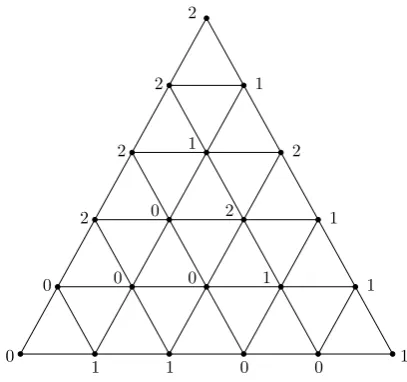
Let ∆ denote an n-dimensional simplex. n is a finite natural number. For example, a 2-dimensional simplex is a triangle. Let partition or triangulate the simplex. Fig. 1 is an example of partition (triangulation) of a 2-dimensional simplex. In a 2-dimensional case we divide each side of∆
inmequal segments, and draw the lines parallel to the sides
2Also in constructive mathematics sequential continuity is weaker than continuity, and uniform continuity (respectively, uniform sequential conti-nuity) is stronger than continuity (respectively, sequential conticonti-nuity) even in a compact space. See, for example, [7]. As stated in [8] all proofs of the equivalence between continuity and sequential continuity involve the law of excluded middle, and so the equivalence of them is non-constructive.
3In another paper [10] we have presented a partial answer to Dalen’s conjecture with uniform continuity and sequential local non-constancy, that is, a proof of the existence of a fixed point for a uniformly continuous and sequentially locally non-constant functions.
IAENG International Journal of Applied Mathematics, 42:1, IJAM_42_1_01
0 1 2
1 1 0 0
0 2
2 2
1 1 2 1
0 0 1
0 2
[image:2.595.65.269.53.244.2]1
Fig. 1. Partition and labeling of 2-dimensional simplex
of ∆.mis a finite natural number. Then, the 2-dimensional simplex is partitioned into m2 triangles. We consider par-tition of ∆ inductively for cases of higher dimension. In a 3 dimensional case each face of ∆ is a 2-dimensional simplex, and so it is partitioned into m2 triangles in the above-mentioned way, and draw the planes parallel to the faces of ∆. Then, the 3-dimensional simplex is partitioned intom3trigonal pyramids. And similarly for cases of higher dimension.
LetK denote the set of smalln-dimensional simplices of
∆constructed by partition. Vertices of these small simplices of Kare labeled with the numbers 0, 1, 2,. . .,nsubject to the following rules.
1) The vertices of ∆ are respectively labeled with 0 to n. We label a point (1,0, . . . ,0) with 0, a point
(0,1,0, . . . ,0) with 1, a point (0,0,1. . . ,0) with 2, . . ., a point (0, . . . ,0,1) with n. That is, a vertex whose k-th coordinate (k = 0,1, . . . , n) is 1 and all other coordinates are 0 is labeled withk.
2) If a vertex ofK is contained in ann−1-dimensional face of∆, then this vertex is labeled with some number which is the same as the number of one of the vertices of that face.
3) If a vertex ofK is contained in ann−2-dimensional face of∆, then this vertex is labeled with some number which is the same as the number of one of the vertices of that face. And so on for cases of lower dimension. 4) A vertex contained inside of ∆ is labeled with an
arbitrary number among 0, 1,. . .,n.
A small simplex ofK which is labeled with the numbers 0, 1,. . .,nis called afully labeled simplex. Sperner’s lemma is stated as follows.
Lemma 1 (Sperner’s lemma): If we label the vertices of Kfollowing the rules 1)∼4), then there are an odd number of fully labeled simplices, and so there exists at least one fully labeled simplex.
Proof: About constructive proofs of Sperner’s lemma see [13] or [14].
Sincenand partition of∆are finite, the number of small simplices constructed by partition is also finite. Thus, we can constructively find a fully labeledn-dimensional simplex of K through finite steps.
III. BROUWER’S FIXED POINT THEOREM FOR SEQUENTIALLY LOCALLY NON-CONSTANT AND UNIFORMLY SEQUENTIALLY CONTINUOUS FUNCTIONS
Letx= (x0, x1, . . . , xn) be a point in ann-dimensional
simplex ∆, and consider a function f from ∆ to itself. Denote thei-th components of xandf(x)by, respectively, xi andfi(x)or fi.
Uniform continuity, sequential continuity and uniform sequential continuity of functions are defined as follows;
Definition 1 (Uniform continuity): A function f is uni-formly continuous in ∆ if for any x, x′ ∈ ∆ and ε > 0
there existsδ >0 such that
If |x−x′|< δ, then|f(x)−f(x′)|< ε. δdepends on onlyε.
Definition 2 (Sequential continuity): A function f is se-quentially continuous at x ∈ ∆ in ∆ if for sequences
(xn)n≥1 and(f(xn))n≥1 in∆
f(xn)−→f(x) wheneverxn−→x.
Definition 3 (Uniform sequential continuity): A function f is uniformly sequentially continuous in∆if for sequences
(xn)n≥1,(x′n)n≥1,(f(xn))n≥1 and(f(x′n))n≥1 in∆ |f(xn)−f(x′n)| −→0 whenever |xn−x′n| −→0.
|xn−x′n| −→0 means
∀ε >0 ∃N ∀n≥N (|xn−x′n|< ε),
whereεis a real number, andnandN are natural numbers. Similarly,|f(xn)−f(x′n)| −→0means
∀ε >0 ∃N′ ∀n≥N′ (|f(xn)−f(x′n)|< ε).
N′ is a natural number. In classical mathematics uniform continuity and uniform sequential continuity of functions are equivalent. But in constructive mathematics ´a la Bishop uni-form sequential continuity is weaker than uniuni-form continuity. On the other hand, the definition of local non-constancy of functions is as follows;
Definition 4: (Local non-constancy of functions)
1) At a pointxon a face (boundary) of a simplexf(x)̸=
x. This meansfi(x)> xi or fi(x) < xi for at least
onei.
2) In any open set of∆ there exists a point xsuch that f(x)̸=x.
The notion that φ has at most one fixed point in [5] is defined as follows;
Definition 5 (At most one fixed point): For all x, y ∈ ∆, ifx̸=y, thenf(x)≠ xor f(y)̸=y.
Next, by reference to the notion of sequentially at most one maximum in [9], we define the property of sequential local non-constancy.
First we recapitulate the compactness (total boundedness with completeness) of a set in constructive mathematics.∆
is totally bounded in the sense that for each ε > 0 there exists a finitely enumerable ε-approximation to ∆4. An ε
-approximation to∆is a subset of∆such that for eachx∈∆
there exists y in that ε-approximation with |x−y| < ε.
4A setSis finitely enumerable if there exist a natural numberN and a mapping of the set{1,2, . . . , N}ontoS.
IAENG International Journal of Applied Mathematics, 42:1, IJAM_42_1_01
According to Corollary 2.2.12 of [15] we have the following result.
Lemma 2: For eachε >0there exist totally bounded sets H1, H2, . . . , Hn, each of diameter less than or equal to ε,
such that∆ =∪n i=1Hi.
The definition of sequential local non-constancy is as follows;
Definition 6: (Sequential local non-constancy of func-tions) There exists ε >¯ 0 with the following property. For eachε >0less than or equal toε¯there exist totally bounded sets H1, H2, . . . , Hm, each of diameter less than or equal
to ε, such that ∆ = ∪m
i=1Hi, and if for all sequences
(xn)n≥1, (yn)n≥1 in each Hi, |f(xn)−xn| −→ 0 and
|f(yn)−yn| −→0, then|xn−yn| −→0.
Now we show the following lemma, which is based on Lemma 2 of [9].
Lemma 3: Letf be a uniformly continuous function from
∆into itself. Assumeinfx∈Hi|f(x)−x|= 0for someHi⊂
∆ defined above. If the following property holds: For each δ > 0 there exists ε > 0 such that if x, y∈Hi,|f(x)−x|< εand|f(y)−y|< ε, then
|x−y| ≤δ.
Then, there exists a point z ∈Hi such that f(z) =z, that
is,f has a fixed point.
Proof: Choose a sequence (xn)n≥1 in Hi such that
|f(xn)−xn| −→0. ComputeN such that|f(xn)−xn|< ε
for alln≥N. Then, form, n≥N we have|xm−xn| ≤δ.
Since δ > 0 is arbitrary, (xn)n≥1 is a Cauchy sequence in
Hi, and converges to a limit z ∈ Hi. The continuity of f
yields|f(z)−z|= 0, that is,f(z) =z. Next we show
Lemma 4: If X is a totally bounded space, and φ is a uniformly sequentially continuous function of X into a metric space, then φ(X)is totally bounded.
Proof: Consider a sequence of positive real numbers
(εm)m≥1such thatε1> ε2>· · ·> εmandεm−→0, and a
sequence ofεm-approximationLm={x1m, x2m, . . . , xnm}
to X. For each x ∈ X and each εm, there exists a point
xim ∈L
msuch that|x−xim|< εm. Thus, we can construct
a sequence(xim)
m≥1such that|x−xim| −→0. The uniform sequential continuity implies |φ(x)−φ(xim)| −→ 0. |x−
xim| −→0 means
∀εm>0 ∃M ∀m≥M (|x−xim|< εm).
M is a natural number. Similarly, |φ(x)−φ(xim)| −→ 0 means
∀εm>0 ∃M′ ∀m≥M′ (|φ(x)−φ(xim)|< εm).
M′ is a natural number. Let m′ ≥ max(M, M′). Then, corresponding to an εm′-approximation to X there exists
an εm′-approximation to φ(X). Therefore,φ(X) is totally
bounded.
This is a modified version of Proposition 2.2.6 of [15]. From this lemma we see thatφhas the infimum inXby Corollary 2.2.7 of [15]. Then, |f(x)−x|has the infimum in∆.
With these preliminaries we show the following theorem.
Theorem 1: (Brouwer’s fixed point theorem for sequen-tially locally non-constant and uniformly sequensequen-tially con-tinuous functions) Any sequentially locally non-constant
and uniformly sequentially continuous function from ann -dimensional simplex∆ to itself has a fixed point.
Proof:
1) First we show that we can partition∆so that the con-ditions for Sperner’s lemma are satisfied. We partition
∆ according to the method in Sperner’s lemma, and label the vertices of simplices constructed by partition of∆. It is important how to label the vertices contained in the faces of∆. LetK be the set of small simplices constructed by partition of ∆, x = (x0, x1, . . . , xn)
be a vertex of a simplex of K, and denote the i-th component of f(x) by fi. Then, we label a vertex x
according to the following rule,
If xk > fk orxk+τ > fk, we label xwith k,
whereτ is a positive number. If there are multiplek’s which satisfy this condition, we label x conveniently for the conditions for Sperner’s lemma to be satisfied. We do not randomly label the vertices.
For example, let x be a point contained in an n−
1-dimensional face of ∆ such that xi = 0 for one
i among 0,1,2, . . . , n (its i-th coordinate is 0). With τ > 0, we have fi > 0 or fi < τ. In constructive
mathematics for any real number xwe can not prove that x≥0 or x < 0, that x >0 or x= 0 or x <0. But for any distinct real numbersx,y andz such that x > z we can prove thatx > y or y > z.
When fi >0, from
∑n
j=0xj = 1,
∑n
j=0fj = 1 and
xi= 0,
n
∑
j=0,j̸=i
xj> n
∑
j=0,j̸=i
fj.
Then, for at least one j (denote it by k) we have xk> fk, and we labelxwithk, wherekis one of the
numbers which satisfyxk > fk. Sincefi> xi= 0,i
does not satisfy this condition. Assumefi< τ.xi= 0
implies∑nj=0,j̸=ixj = 1. Since
∑n
j=0,j̸=ifj ≤1, we
obtain n
∑
j=0,j̸=i
xj≥ n
∑
j=0,j̸=i
fj.
Then, for a positive numberτ we have
n
∑
j=0,j̸=i
(xj+τ)> n
∑
j=0,j̸=i
fj.
There is at least onej(̸=i)which satisfiesxj+τ > fj.
Denote it by k, and we label x with k. k is one of the numbers other than i such that xk +τ > fk is
satisfied.i itself satisfies this condition (xi+τ > fi).
But, since there is a number other thaniwhich satisfies this condition, we can select a number other thani. We have proved that we can label the vertices contained in an n−1-dimensional face of ∆ such thatxi = 0
for onei among0,1,2, . . . , n with the numbers other thani. By similar procedures we can show that we can label the vertices contained in an n−2-dimensional face of ∆ such that xi = 0 for two i’s among
0,1,2, . . . , nwith the numbers other than thosei’s, and so on. Therefore, the conditions for Sperner’s lemma are satisfied, and there exists an odd number of fully labeled simplices inK.
IAENG International Journal of Applied Mathematics, 42:1, IJAM_42_1_01
Consider a sequence (∆m)m≥1 of partitions of ∆, and a sequence of fully labeled simplices (δm)m≥1. The larger m, the finer partition. The larger m, the smaller the diameter of a fully labeled sim-plex. Let x0
m, x1m, . . . and xnm be the vertices of a
fully labeled simplexδm. We name these vertices so
that x0
m, x1m, . . . , xnm are labeled, respectively, with
0, 1, . . ., n. The values of f at theses vertices are f(x0m), f(xm1), . . . and f(xnm). We can consider se-quences of vertices of fully labeled simplices. Denote them by(x0m)m≥1,(x1m)m≥1,. . ., and(xnm)m≥1. And consider sequences of the values of f at vertices of fully labeled simplices. Denote them by(f(x0
m))m≥1,
(f(x1
m))m≥1, . . ., and (f(xnm))m≥1. By the uniform sequential continuity off
|(f(xim))−(f(xjm))|m≥1−→0
whenever|(xim)−(xjm)|m≥1−→0, fori̸=j.|(xi
m)m≥1−(xjm)m≥1| −→0means ∀ε >0∃M ∀m≥M (|xim−xjm|< ε)i̸=j, and|(f(xi
m))m≥1−(f(xjm))m≥1| −→0means ∀ε >0∃M′ ∀m≥M′ (|f(xim)−f(xjm)|< ε)i̸=j.
Consider a fully labeled simplex δl in partition of∆
such that l ≥ max(M, M′). Denote vertices of δl
by x0, x1, . . ., xn. We name these vertices so that x0, x1, . . . , xn are labeled, respectively, with 0, 1,. . ., n. Then,|xi−xj|< εand|f(xi)−f(xj)|< ε. About x0, from the labeling rules we have x00+τ >
f(x0)
0. Aboutx1, also from the labeling rules we have
x1
1+τ > f(x1)1 which implies x11 > f(x1)1 −τ. |f(x0)−f(x1)|< εmeansf(x1)
1> f(x0)1−ε. On the other hand, |x0−x1| < ε means x0
1 > x11−ε. Thus, from
x01> x11−ε, x11> f(x1)1−τ, f(x1)1> f(x0)1−ε we obtain
x01> f(x0)1−2ε−τ
By similar arguments, for eachi other than 0,
x0i > f(x0)i−2ε−τ. (1)
Fori= 0we have x00+τ > f(x0)0. Then,
x00> f(x0)0−τ (2) Adding (1) and (2) side by side except for some i (denote it byk) other than 0,
n
∑
j=0,j̸=k
x0j >
n
∑
j=0,j̸=k
f(x0)j−2(n−1)ε−nτ.
From ∑nj=0x0
j = 1,
∑n j=0f(x
0)
j = 1 we have 1−
x0
k >1−f(x0)k−2(n−1)ε−nτ, which is rewritten
as
x0k < f(x0)k+ 2(n−1)ε+nτ.
Since (1) impliesx0
k > f(x0)k−2ε−τ, we have
f(x0)k−2ε−τ < x0k < f(x
0)
k+ 2(n−1)ε+nτ.
Thus,
|x0k−f(x
0
)k|<2(n−1)ε+nτ (3)
is derived. On the other hand, adding (1) from 1 ton yields
n
∑
j=1
x0j >
n
∑
j=1
f(x0)j−2nε−nτ.
From ∑nj=0x0
j = 1,
∑n j=0f(x
0)
j= 1we have
1−x00>1−f(x0)0−2nε−nτ. (4) Then, from (2) and (4) we get
|x00−f(x0)0|<2nε+nτ. (5) From (3) and (5) we obtain the following result,
|x0i −f(x0)i|<2nε+nτ for alli.
Thus,
|x0−f(x0)|< n(n+ 1)(2ε+τ). (6) Since n is finite, x0 is an approximate fixed point of f5. And sinceε >0andτ are arbitrary,
inf
x∈∆|x−f(x)|= 0.
By Lemma 2 we haveinfx∈Hi|x−f(x)|= 0for some
Hi⊂∆ defined in that lemma.
2) Choose a sequence(ξm)m≥1inHisuch that|f(ξm)−
ξm| −→0. In view of Lemma 3 it is enough to prove
that the following condition holds.
For each δ > 0 there exists ε > 0 such that if x, y ∈ Hi, |f(x)−x| < ε and |f(y)−y| < ε,
then|x−y| ≤δ. Assume that the set
K={(x, y)∈Hi×Hi: |x−y| ≥δ}
is nonempty and compact6. Since the mapping
(x, y) −→ max(|f(x)−x|,|f(y)−y|) is uniformly sequentially continuous, by Lemma 4 we can construct an increasing binary sequence (λm)m≥1 such that
λm= 0⇒ inf
(x,y)∈K
max(|f(x)−x|,|f(y)−y|)<2−m,
λm= 1⇒ inf
(x,y)∈K
max(|f(x)−x|,|f(y)−y|)>2−m−1. It suffices to findmsuch thatλm= 1. In that case, if
|f(x)−x|<2−m−1and|f(y)−y|<2−m−1, we have
(x, y)∈/K and|x−y| ≤δ. Assumeλ1= 0. Ifλm=
0, choose (xm, ym) ∈ K such that max(|f(xm)−
xm|,|f(ym)−ym|)<2−m, and if λm= 1, set xm=
ym =ξm. Then, |f(xm)−xm| −→0 and |f(ym)−
ym| −→0, so |xm−ym| −→0. ComputingM such
that |xM−yM|< δ, we must haveλM = 1. We have
completed the proof.
5In another paper [16] we have shown the existence of an approximate fixed point of each uniformly continuous function in a locally-convex space.
6See Theorem 2.2.13 of [15].
IAENG International Journal of Applied Mathematics, 42:1, IJAM_42_1_01
IV. FROMBROUWER’S FIXED POINT THEOREM FOR SEQUENTIALLY LOCALLY NON-CONSTANT AND UNIFORMLY SEQUENTIALLY CONTINUOUS FUNCTIONS TO
SPERNER’S LEMMA
In this section we will derive Sperner’s lemma from Brouwer’s fixed point theorem for sequentially locally non-constant and uniformly sequentially continuous functions. Let ∆ be an n-dimensional simplex. Denote a point on ∆
byx. Consider a functionf from∆ to itself. Partition∆in the way depicted in Fig. 1. LetKdenote the set of smalln -dimensional simplices of∆constructed by partition. Vertices of these small simplices of Kare labeled with the numbers 0, 1, 2,. . .,nsubject to the same rules as those in Lemma 1. Now we derive Sperner’s lemma expressed in Lemma 1 from Brouwer’s fixed point theorem for sequentially locally non-constant and uniformly sequentially continuous functions.
Denote the vertices of ann-dimensional simplex ofK by x0, x1, . . . , xn, the j-th coordinate of xi byxi
j, and denote
the label of xi by l(xi). Let τ be a positive number which
is smaller thanxi
l(xi)for all xi, and define a functionf(xi) as follows7:
f(xi) = (f0(xi), f1(xi), . . . , fn(xi)),
and
fj(xi) =
{
xi
j−τ forj=l(xi),
xi j+
τ
n forj̸=l(x
i). (7)
fj denotes thej-th component off. From the labeling rules
we have xi
l(xi)>0for allxi, and soτ >0 is well defined. Since ∑nj=0fj(xi) =
∑n j=0x
i
j = 1, we have
f(xi)∈∆.
We extendf to all points in the simplex by convex combina-tions on the vertices of the simplex. Letzbe a point in then -dimensional simplex ofKwhose vertices arex0, x1, . . . , xn.
Then, z andf(z)are expressed as follows; z=
n
∑
i=0
λixi, andf(z) = n
∑
i=0
λif(xi), λi≥0, n
∑
i=0
λi= 1.
We verify that f is uniformly sequentially continuous. Consider sequences (z(n))n≥1, (z′(n))n≥1, (f(z(n)))n≥1 and (f(z′(n)))n≥1 such that |z(n) −z′(n)| −→ 0. De-note each component of z(n) by z(n)j and so on. When
|z(n)−z′(n)| −→0,|z(n)j−z′(n)j| −→0for eachj. Then,
since τ >0 is finite, we have |f(z(n))−f(z′(n))| −→ 0, and so f is uniformly sequentially continuous.
Next we verify thatf is sequentially locally non-constant. 1) Assume that a point z is contained in an n −1 -dimensional small simplex δn−1 constructed by par-tition of ann−1-dimensional face of∆such that its i-th coordinate iszi= 0. Denote the vertices ofδn−1
byxj, j= 0,1, . . . , n−1and theiri-th coordinate by xji. Then, we have
fi(z) = n∑−1
j=0
λjfi(xj), λj≥0, n−1
∑
j=0
λj = 1.
Since all vertices of δn−1 are not labeled with i, (7) means fi(xj) > x
j
i for all j = {0,1, . . . , n−1}.
7We refer to [17] about the definition of this function.
Then, there exists no sequence (z(m))m≥1 such that |f(z(m))−z(m)| −→0in ann−1-dimensional face of ∆.
2) Let z be a point in an n-dimensional simplex δn.
Assume that no vertex ofδn is labeled withi. Then
fi(z) = n
∑
j=0
λjfi(xj) =zi+
(
1 + 1
n
)
τ. (8)
Then, there exists no sequence (z(m))m≥1 such that |f(z(m))−z(m)| −→0 inδn.
3) Assume that z is contained in a fully labeled n -dimensional simplexδn, and rename vertices ofδn so
that a vertex xi is labeled withifor each i. Then,
fi(z) = n
∑
j=0
λjfi(xj) = n
∑
j=0
λjx j i +
∑
j̸=i
λj
τ n−λiτ
=zi+
1
n
∑
j̸=i
λj−λi
τ for eachi. Consider sequences (z(m))m≥1 = (z(1), z(2), . . .),
(z′(m))m≥1= (z′(1), z′(2), . . .)such that|f(z(m))−
z(m)| −→0 and|f(z′(m))−z′(m)| −→0.
Let z(m) = ∑ni=0λ(m)ixi and z′(m) =
∑n
i=0λ′(m)ixi. Then, we have
1
n
∑
j̸=i
λ(m)j−λ(m)i−→0, and
1
n
∑
j̸=i
λ′(m)j−λ′(m)i −→0 for alli.
Therefore, we obtain
λ(m)i−→
1
n+ 1,and λ
′(m)
i−→
1
n+ 1.
These mean
|z(m)−z′(m)| −→0.
Thus, f is sequentially locally non-constant, and it has a fixed point. Letz∗ be a fixed point off. We have
z∗i =fi(z∗) for alli. (9)
Suppose that z∗ is contained in a small n-dimensional simplex δ∗. Let z0, z1, . . . , zn be the vertices of δ∗. Then,
z∗ andf(z∗) are expressed as z∗=
n
∑
i=0
λiziandf(z∗) = n
∑
i=0
λif(zi), λi≥0, n
∑
i=0
λi= 1.
(7) implies that if only one zk among z0, z1, . . . , zn is labeled withi, we have
fi(z∗) = n
∑
j=0
λjfi(zj) = n
∑
j=0
λjzij+ n
∑
j̸=k
λj
τ n−λkτ
=z∗i (zi∗ is thei−th coordinate of z∗). This means
1
n
n
∑
j̸=k
λj−λk= 0.
Then, (9) is satisfied with λk = n+11 for all k. If no zj is
labeled withi, we have (8) withz=z∗and then (9) can not
IAENG International Journal of Applied Mathematics, 42:1, IJAM_42_1_01
be satisfied. Thus, one and only onezjmust be labeled withi
for eachi. Therefore,δ∗must be a fully labeled simplex, and so the existence of a fixed point of f implies the existence of a fully labeled simplex.
We have completely proved Sperner’s lemma.
V. CONCLUDINGREMARKS
As a future research program we are studying the follow-ing themes.
1) An application of Brouwer’s fixed point theorem for se-quentially locally non-constant functions to economic theory and game theory, in particular, the problem of the existence of an equilibrium in a competitive economy with excess demand functions which have the property that is similar to sequential local non-constancy, and the existence of Nash equilibrium in a strategic game with payoff functions which satisfy sequential local non-constancy.
2) A generalization of the result of this paper to Kaku-tani’s fixed point theorem for multi-valued functions with property of sequential local non-constancy and its application to economic theory.
REFERENCES
[1] R. B. Kellogg, T. Y. Li, and J. Yorke, “A constructive proof of Brouwer fixed-point theorem and computational results,” SIAM Journal on Numerical Analysis, vol. 13, pp. 473–483, 1976.
[2] D. Bridges and F. Richman, Varieties of Constructive Mathematics. Cambridge University Press, 1987.
[3] D. van Dalen, “Brouwer’s ε-fixed point from Sperner’s lemma,” Theoretical Computer Science, vol. 412, no. 28, pp. 3140–3144, June 2011.
[4] W. Veldman, “Brouwer’s approximate fixed point theorem is equivalent to Brouwer’s fan theorem,” inLogicism, Intuitionism and Formalism, S. Lindstr¨om, E. Palmgren, K. Segerberg, and V. Stoltenberg-Hansen, Eds. Springer, 2009.
[5] J. Berger and H. Ishihara, “Brouwer’s fan theorem and unique exis-tence in constructive analysis,”Mathematical Logic Quarterly, vol. 51, no. 4, pp. 360–364, 2005.
[6] D. Bridges, H. Ishihara, P. Schuster, and L. Vˆıt¸˘a, “Strong continuity implies uniform sequential continuity,” Archive for Mathematical Logic, vol. 44, pp. 887–895, 2005.
[7] H. Ishihara, “Continuity properties in constructive mathematics,” Jour-nal of Symbolic Logic, vol. 57, pp. 557–565, 1992.
[8] D. Bridges and R. Mines, “Sequentially continuous linear mappings in constructive analysis,”Journal of Symbolic Logic, vol. 63, pp. 579– 583, 1998.
[9] J. Berger, D. Bridges, and P. Schuster, “The fan theorem and unique existence of maxima,”Journal of Symbolic Logic, vol. 71, pp. 713– 720, 2006.
[10] Y. Tanaka, “Constructive proof of Brouwer’s fixed point theorem for sequentially locally non-constant functions,” http://arxiv.org/abs/1103. 1776, 2011.
[11] V. P. Orevkov, “A constructive mapping of a square onto itself displacing every constructive point,”Soviet Math., vol. 4, pp. 1253– 1256, 1963.
[12] J. L. Hirst, “Notes on reverse mathematics and Brouwer’s fixed point theorem,” http://www.mathsci.appstate.edu/˜jlh/snp/pdfslides/bfp.pdf, pp. 1–6, 2000.
[13] F. E. Su, “Rental harmony: Sperner’s lemma for fair devision,” American Mathematical Monthly, vol. 106, pp. 930–942, 1999. [14] Y. Tanaka, “Equivalence between the existence of an approximate
equi-librium in a competitive economy and Sperner’s lemma: A constructive analysis,”ISRN Applied Mathematics, vol. Article ID 384625, pp. 1– 15, 2011.
[15] D. Bridges and L. Vˆıt¸˘a, Techniques of Constructive Mathematics. Springer, 2006.
[16] Y. Tanaka, “Proof of constructive version of the Fan-Glicksberg fixed point theorem directly by Sperner’s lemma and approximate Nash equilibrium with continuous strategies: A constructive analysis,” IAENG International Journal of Applied Mathematics, vol. 41, no. 2, pp. 133–140, 2011.
[17] M. Yoseloff, “Topological proofs of some combinatorial theorems,” Journal of Combinatorial Theory (A), vol. 17, pp. 95–111, 1974.