www.wjpr.net Vol 9, Issue 1, 2020. 1913
EFFECT OF SIMPLE CLEANSING METHODS ON MOUTHPIECES
DECONTAMINATION OF SHARED WIND INSTRUMENTS
Sri Agung Fitri Kusuma*, Wahyu Purwita Sari and Dewi Rusmiati
Department of Biology Pharmacy, Faculty of Pharmacy, Padjadjaran University, Sumedang,
West Java, Indonesia 45363.
ABSTRACT
Objective: This study was designed to determine a simple cleansing
method that can be applied to decontaminate mouthpieces of shared
wind instruments. Methods: In this study, 4 kinds of wind instruments,
i.e. trumpet, mellophone, trombone and tuba, were examined. The total
bacteria attached to the instrument was isolated using the swab method
and suspended it in a sterile physiological NaCl solution to determine
the number of initial bacterial colonies on the instrument. The effect of
decontamination was carried out by a simple cleansing method using
immersion the mouthpieces in hot water with the temperature of 100
0
C for 5 min and soaked using soap containing 2% of triclosan. The
survival colonies were evaluated using plate count method and
calculated using a colony counter. Results: The cleansing method using immersion in hot
water with the temperature of 100 0C for 5 min significantly decreasing the bacteria number
(91.85-99.91%), compared with that of liquid soap (50.30-91.67%). However, tuba
mouthpieces were the most easiest to be sterilized using both methods, because it has the
largest surface area. Conclusion: The immersion using hot water with the temperature of 100
0
C for 5 min can be used as a method of disinfection that is fast, simple and easy to be
applied to the mouthpieces of shared wind instruments.
KEYWORDS: disinfection, mouthpieces, musical instruments, hot water, soap, simple.
INTRODUCTION
Microorganisms are closely related to human life, some of which are beneficial and others are
harmful. The existence of these microorganisms must be a concern for people who play wind
instruments. Shared tools are more likely to be at high risk of germs contamination.
Volume 9, Issue 1, 1913-1917. Research Article ISSN 2277– 7105
Article Received on 22 Nov. 2019,
Revised on 12 Dec. 2019, Accepted on 01 Jan. 2020,
DOI: 10.20959/wjpr20201-16610
*Corresponding Author
Sri Agung Fitri Kusuma
www.wjpr.net Vol 9, Issue 1, 2020. 1914 Moreover, the instrument is directly related to the respiratory tract, thus, people who play
wind instruments seem to be at greater risk of airway inflammation and chronic sore throats.
Based on another study, there are millions of bacteria found in the mouthpieces of several
wind instruments when stored or after being played.[1] Some research prompted that
microorganisms in saliva might attach in the mouthpieces, then get blown deeper into the
wind instruments. Moreover, those wind instruments are usually on loan, thus, the
instruments may have been used by other people. The woodwind and brass instruments were
reported to be contaminated by several kinds of microbial flora related with allergic and
infectious diseases.[2]
The microbial identification demonstrated that those microbial flora were Gram-positive
cocci (32.2%), Gram-positive bacilli (44.4%) and Gram-negative bacilli (23.4%). The most
frequently isolated microorganism were Penicillium chrysogenum and Brevibacterium spp.[2]
In simulated study using several pathogenic bacteria, showed the survival of
Staphylococcus, Escherichia coli, Streptococcus, Moraxella, and attenuated Mycobacterium
tuberculosis when applied to reeds. Thus, it indicated that there's significant growth in the
levels of contamination in the period immediately after played. All bacteria species survived
for a maximum of 24–48 h on reeds, except Mycobacterium, which persisted through 13 d.[3]
Therefore, without the proper cleaning or disinfection, bacteria and fungi can evolve for
weeks and even for months after the last use. If the instrument is shared or obtained from a
commercial source, to reduce germs, it should be disassembled and then cleaned using
alcohol wipes, soap and water, or a commercial disinfectant. In this study, we investigate the
cleansing method which is easy to be applied, thus, the owner of the wind instruments can
clean and disinfect the wind instruments properly.
MATERIALS AND METHODS
Samples
The wind instruments, i.e. trumpet, mellophone, trombone and tuba, were examined and used
as sources of bacteria isolates. Mouthpiece samples taken were mouthpieces that have been
used after played.
Chemical Materials
The chemicals used were 70% ethanol, normal saline solution, commercial soap containing
2% of triclosan and distilled water. The Mueller Hinton Agar (MHA-Oxoid) and Mueller
www.wjpr.net Vol 9, Issue 1, 2020. 1915 Bacterial Isolation
The bacterial thrive in the mouthpieces were isolated by swabing the inside of the
mouthpieces using a sterile cotton swab, then suspend it into a 10 mL of sterile physiological
NaCl.
Cleansing Using Hot water
Mouthpiece of a wind instrument is immersed in hot water at a temperature of 1000C for 5
min. Then the suspended bacteria was diluted (10-4, 10-5 and 10-6) for the agar plate count.
Then the number of bacteria was calculated to determine the number of survival bacteria after
treatment.
Cleansing Using Soap Containing 2% Of Triclosan
Mouthpiece of a wind instrument is immersed in water containing soap containing 2% of
triclosan. Then the suspended bacteria was diluted (10-4, 10-5 and 10-6) for the agar plate
count. Then the number of bacteria was calculated to determine the number of survival
bacteria after treatment.
RESULTS AND DISCUSSION
Bacterial calculations on the mouthpieces were performed to determine the number of germs
contained in the mouthpiece for each treatment. Generally, only plate containing less than
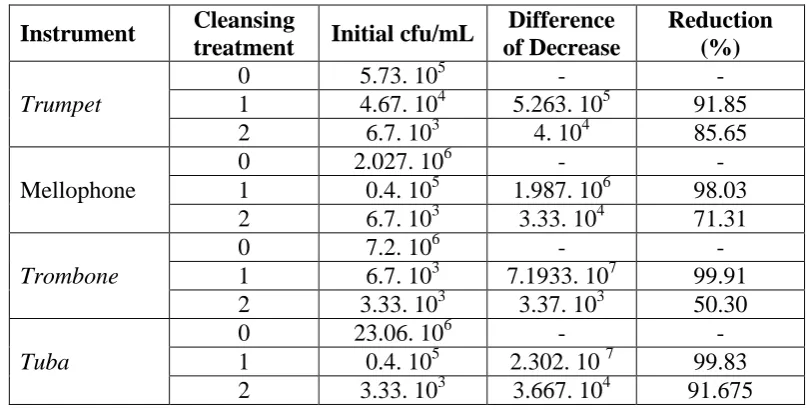
250-300 bacterial colonies can be counted.[4] The effect of cleansing treatment on decreasing
[image:3.595.94.498.539.744.2]the number of survival bacteria, can be seen in table 1.
Table 1: Percentage of Colony Decrease.
Instrument Cleansing
treatment Initial cfu/mL
Difference of Decrease
Reduction (%)
Trumpet
0 5.73. 105 - -
1 4.67. 104 5.263. 105 91.85
2 6.7. 103 4. 104 85.65
Mellophone
0 2.027. 106 - -
1 0.4. 105 1.987. 106 98.03 2 6.7. 103 3.33. 104 71.31
Trombone
0 7.2. 106 - -
1 6.7. 103 7.1933. 107 99.91 2 3.33. 103 3.37. 103 50.30
Tuba
0 23.06. 106 - -
www.wjpr.net Vol 9, Issue 1, 2020. 1916 Notes: 0 treatment= without treatment; 1= treatment using hot water at a temperature of
1000C for 5 min; 2= treatment using 2 % soap containing triclosan.
Based on observations, the largest number of bacteria per mL was found in the mouthpiece of
tuba. This allegedly happened because the tuba has a larger cross-sectional area than the
mouthpieces of other wind instruments. A large mouthpiece cross-sectional area allows a
wider area for bacterial growth. The cleansing method using immersion in hot water with the
temperature of 100 0C for 5 min significantly decreasing the bacteria number
(91.85-99.91%), compared with that of liquid soap (50.30-91.67%). The percentage of the colonies
reduction was the highest in disinfection of trombone mouthpieces. A1000C hot water is
commonly used to kill bacteria, due to the bacterial sensitivity at high temperatures. Washing
soap can kill bacteria by reduce the surface tension of bacterial cells.[5] Soaps and other
cleansing agents have been around for quite long time to reduce contaminants. Soaps are
intended for reduction of the inoculum sizes of both pathogenic and non-pathogenic
microorganisms. Soap containing triclosan exhibited the zone of inhibition on the tested
bacteria, i.e. Staphylococcus aureus and Candida albicans.[6] Triclosan (TCS) is an
antimicrobial used so ubiquitously that 75% of the U.S.A. population is likely exposed to this
compound via consumer goods and personal care products.[7] Recently, it was found that TCS
did not reduce the overall number of microbes but decreases the variety of microbial
species.[8] However, overutilization of antimicrobial soaps may spell to development of
resistance to microbicides. Several studies have purported to show a relationship between the
use of triclosan and antibiotic resistance.[9-11] Both treatments can be combined for optimal
cleansing the mouthpiece of a wind instrument. The ease of cleansing methods used, making
the frequency of cleansing of wind instruments will be more meaningful.
CONCLUSION
It could be concluded that the cleansing method using hot water in the temperature of 100 0C
was the simple conventional cleansing that can be used.
REFERENCES
1. Walter WG, Dorothy C. (Bacteriological and Cleaning Studies on the Mouthpieces of
www.wjpr.net Vol 9, Issue 1, 2020. 1917 2. Glass RT. (Used Instruments May Be Contaminated With Variety Of Microbial Flora).
Gen Dent, 2011; 59: 100-107.
3. Marshall B, Levy S. (Microbial contamination of musical wind instruments).
Int J Environ Health Res, 2011; 21(4): 275-85.
4. Tortora GJ, Funke BR, Case CL. Microbiology An Introduction, Ed.6th. California:
Addison Wesley Longman, 1997.
5. Pelczar MJ, Chan ECS. Dasar-Dasar Mikrobiologi, ed 2. Jakarta: Universitas Indonesia,
1988.
6. Mwambete KD, Lyombe F. (Antimicrobial Activity of Medicated Soaps Commonly Used
By Dar es Salaam Residents in Tanzania). Indian J Pharm Sci, 2011; 73(1): 92–98.
7. Tal T 2017. (Developmental exposure to triclosan alters microbiota commnity structure
and locomotor activity in larval zebrafish Society of Toxicology), Baltimore, MA.
8. Poole K. (Mechanisms of bacterial biocide and antibiotic resistance). J Appl
Microbiol, 2002; 92: S55–64.
9. Levy SB. (Antibacterial household products: Cause for concern). Emerg Infect Dis, 2001;
7: 512–5.
10.White DG, McDermott PF. (Biocides, drug resistance and microbial evolution). Curr
Opin Microbiol, 2001; 4: 313–7.
11.Weatherly LM, Gosse JA. (Triclosan exposure, transformation, and human health