FORMULATION,
IN-VITRO
EVALUATION AND ANALYTICAL
QUANTIFICATION OF ZALTOPROFEN MICROCAPSULES
Biresh K Sarkar*1, Manish Devgan2, Y.Ankamma Chowdary3
1
National Institute of Ayurvedic Pharmaceutical Research, Moti Bagh Road, Patiala, India.
2
R.P. Educational Trust Group of Institutions Karnal, Haryana, India.
3
NRI College of Pharmacy, Pothavarappadu, Krishna, A.P, India.
ABSTRACT
Zaltoprofen was formulated as novel enteric microcapsules for
improved delivery using the polymer ethyl cellulose as the retardant
material. Micro encapsulation of Zaltoprofen was done to achieve a
controlled drug release profile suitable for per oral administration.
Microcapsules were prepared by and emulsion solvent evaporation
method. The prepared microcapsules were evaluated for different
quality control parameter like; size analysis, drug content,
encapsulation efficiency, and drug release characteristics etc. Results
of study revealed that Zaltoprofen release from microcapsules greatly
affected by the size of the microcapsules. A precise UV method also
developed for the estimation of zaltoprofen in prepared dosage form. Drug followed the Beer-Lambert’s law in the concentration range of 5- 25μg/ml. Slope, intercept, correlation
coefficient, detection and quantization limits were also calculated. Results of the analysis
were validated statistically and were found to be satisfactory.
KEY WORDS: Zaltoprofen Micro Encapsulation, Formulation, Evaluation.
INTRODUCTION
Zaltoprofen, 2-(10,11–dihydro–10–oxodibenzo[b, f]thiepin–2-yl) propionic acid is a potent
Nonsteroidal Anti-Inflammatory Drug (NSAID) [1]. It possesses potent analgesic action on
inflammatory pain [2, 3]. It inhibits preferentially cyclooxygenase (COX)-2 [4, 5]. It also
selectively inhibits prostaglandin E2 (PGE2) production at inflammatory sites [6-10].
Microencapsulation is a common technique used in the production of sustained release
Volume 3, Issue 5, 837-843. Research Article ISSN 2277 – 7105
Article Received on 16 May 2014,
Revised on 10 June 2014, Accepted on 04 July 2014
*Correspondence for Author
dosage forms. Microcapsule based drug delivery system has received considerable attention
in recent years. Numbers of methods have been described by many researchers to prepare
microcapsules [11] selection of polymer is important factor in preparation of microcapsules
and these area have been studied extensively. [12, 13] The previous study on employed
different solvents such as chloroform, dichloromethane and ethyl acetate to study the effect of
solvent on formulation. The solvent employed in the preparation of microcapsules is likely to
influence both the permeability and drug release from the microcapsules [14]. Present study
involves formulation of Zaltoprofen microcapsules to prolong its action. Microcapsules were
prepared by an emulsion solvent evaporation method, using chloroform as a solvent. After
evaporation of solvent ethyl cellulose encapsulates the drug to form microcapsules of various
size ranges.
MATERIALS AND METHODS Materials
Zaltoprofen was obtained as a gift sample from Intas Pharmaceuticals Ltd. Ethyl cellulose
obtained from Loba Chemie. All other ingredients used were of an analytical grade.
Preparation of Microcapsules
Zaltoprofen microcapsules were prepared by Emulsion Solvent Evaporation method.
Chloroform was used as solvent. The polymer was dissolved in polymer solvent to form a
homogenous polymer solution. Drug was added to the polymer solution and mixed
thoroughly. The resulting mixture was added in continuous phase made up of 0.1N HCl and
sodium carboxy methyl cellulose in a beaker with stirring. Then solvent let to evaporate.
Microcapsules were obtained by decantation and washing with water. The product was then
dried.
EVALUATION OF MICROCAPSULES Particle size analysis
For size distribution analysis, different sizes in a batch were separated by sieving; using a set
of standard sieves. The amounts retained on different sieves were weighed.
Encapsulation efficiency
Encapsulation efficiency was calculated in microcapsules the encapsulation efficiency of
Estimation of Drug Content
Drug content in the microcapsules was calculated by UV spectrophotometric method. A
sample of microcapsules was dissolved in ethanol and the volume was adjusted upto 100 ml
using phosphate buffer of pH 6.8. The solution was filtered through Whatman No. 1 filter
paper. Then the filtrate was assayed for drug content by measuring the absorbance at 243 nm
after suitable dilution. The amount of drug estimated is mentioned in Table 1.
In vitro Drug release Studies
Drug release was studied by using USP type II dissolution test apparatus in Phosphate buffer
of pH 6.8 (900 ml). The paddle speed at 100 rpm and bath temperature at 37 ± 0.50C were
maintained throughout the experiment. A sample of microcapsules was used in each test.
Aliquot equal to 5ml of dissolution medium was withdrawn at specific time interval and
replaced with fresh medium to maintain sink condition. Sample was filtered through
Whatman No. 1 filter paper and after suitable dilution with medium; the absorbance was
determined by UV spectrophotometer at 243 nm. All studies were conducted in triplicate
(n=3).
DEVELOPMENT OF ANALYTICAL METHOD Method
A UV spectrophotometric method has been developed for the estimation of zaltoprofen in
formulation. Different aliquots of standard solution of zaltoprofen (5-25 μg/ml) were
prepared by dissolving in methanol (1ml) and made upto mark with distilled water. Absorbance of these solutions was noted at λmax of 243 nm against a reagent blank.
Preparation of Standard Zaltoprofen Solution
Accurately weighed 10 mg of pure drug and transferred into clean, dry 10 ml volumetric flask
and dissolved in small volume of methanol and adjusted volume with water up to mark. Then
1.0 ml of above solution was pipetted out into 10 ml volumetric flask and volume was made
up with water.
Calibration curve of the zaltoprofen (5-25μg/ml)
Appropriate volume of aliquots from standard zaltoprofen stock solution was transferred to
different volumetric flasks. The final aliquots were prepared by appropriate dilution.
zaltoprofen and the graph of absorbance against concentration was plotted. The regression
equation and correlation coefficient were obtained from calibration curve.
Sample preparation for determination of zaltoprofen from dosage form
Accurately measured quantity of formulation equivalent to 10 mg was dissolved in little
quantity of methanol (1ml) and volume was made up to 10 ml with water, sonicated for 20
min. The solution was filtered through whatmann filter paper no. 41 and aliquot portion of
filtrate was diluted to produce solution having appropriate concentration. The absorbance of
sample solution was measured at selected wavelength and the concentration of the drug was
estimated.
RESULTS AND DISCUSSION
Ethyl cellulose microcapsules containing zaltoprofen were prepared by an emulsion solvent
evaporation method employing chloroform as solvent. The microcapsules were obtained free
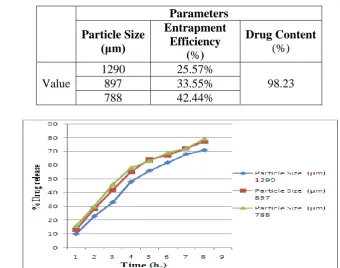
flowing and spherical. Result of encapsulation efficiency was found to be satisfactory (Table 1). Release from microcapsules was studied in phosphate buffer pH 6.8. Drug release from microcapsules was slow and spread over an extended period of time (Fig. 1). The drug
release from microcapsules depends on the size of the microcapsules. The chloroform
employed as a solvent serves as a promising solvent for preparing ethyl cellulose
[image:4.595.118.459.478.746.2]microcapsules for controlled and complete release of drug over a period of time.
Table 1: Results of quality control parameters
Parameters Particle Size
(μm)
Entrapment Efficiency
(%)
Drug Content
(%)
Value
1290 25.57%
98.23 897 33.55%
788 42.44%
Development And Optimization Of Uv Spectrophotometric Method
The solubility of Zaltoprofen was checked in water, methanol, acetone, acetonitrile. Based
upon the free solubility of Zaltoprofen in methanol (1ml) & water mixture, it was selected as
solvent for method development Zaltoprofen estimation.
Validation
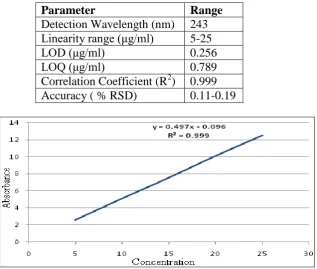
The summarize data of validation parameters mentioned in Table 2.
Linearity range
The linearity was determined for Zaltoprofen by plotting a calibration graph of concentration
against absorbance. Zaltoprofen showed linearity in the range of 5-25 μg/mL. Calibration
curve of Zaltoprofen was depicted in Figure 2.
Accuracy
Accuracy of developed method was determined by a recovery study at 3 concentration levels
by replicate analysis (n=3). Standard drug solutions were added to a pre-analyzed sample
solution and percentage of total drug content was calculated.
LOD and LOQ
The LOD and LOQ of Zaltoprofen were found to be 0.256μg/mL and 0.789μg/mL
[image:5.595.158.476.479.748.2]respectively.
Table 2. Results of Analytical parameter
Parameter Range
Detection Wavelength (nm) 243 Linearity range (μg/ml) 5-25 LOD (μg/ml) 0.256 LOQ (μg/ml) 0.789 Correlation Coefficient (R2) 0.999 Accuracy ( % RSD) 0.11-0.19
CONCLUSION
The present study illustrates the utility of microcapsules in extending the release of drug.
Microcapsules provide sustained release in localized areas and can be employed to reduce
medication doses and its frequency. The formulation also subjected for analysis by developed
UV Spectrophotometric method; which was found to be simple, economic, and highly
sensitive. Thus Microcapsules formulation can be utilized for the oral drug delivery system
and can be analyzed easily by UV Spectrophotometric method qualitatively and
quantitatively.
REFERENCES
1. A, Mori Y; Effect of a Novel Antiinflammatory Drug, 2-(10, 11-dihydro-10-oxodibenzo
[b,f]- thiepin-2-yl)propionic acid (CN-100), on the Proteoglycan Biosynthesis in Articular
Chondrocytes and Prostaglandin E2 Production in Synovial Fibroblasts. ResCommun
Chem Pathol Pharmacol., 1990; 70:131-142.
2. Kameyama T, Nabeshima T, Yamada S, Sato M; Analgesic and Antiinflammatory Effects
of 2-(10,11-dihydro-10-oxo-dibenzo [b,f] thiepin-2-yl)propionic acid in Rat and Mouse.
Arzneimittelforschung. 1987; 37: 19–26.
3. Tsurumi K, Kyuki K, Niwa M, Kokuba S, Fujimura H; Pharmacological investigations of
the New Antiinflammatory Agent 2-(10,11- dihydro-10-oxodibenzo[b,f] thiepin-2-yl)
propionic acid.1st Communication: Inhibitory Effects of Rat Paw Edema.
Arzneimittelforschung. 1986; 36: 1796–1800.
4. Hirate K, Uchida A, Ogawa Y, Arai T, Yoda K, Zaltoprofen A; Non-Steroidal Anti
Inflammatory Drug, Inhibits Bradykinin- Induced Pain Responses Without Blocking
Bradykinin Receptors. Neurosci Res., 2006; 54: 288-294.
5. Kawai S, Nishida S, Kato M, Furumaya Y, Okamoto R, Koshino T, Mizushima Y;
Comparison of Cyclooxygenase-1 and -2 Inhibitory Activities of Various Nonsteroidal
Anti-inflammatory Drugs using Human Platelets and Synovial Cells. Eur J Pharmacol.,
1998; 347: 87–94.
6. Beiche F, Scheuerer S, Brune K, Geisslinger G, Goppelt-Struebe M; Up-Regulation of
Cyclooxygenase-2 mRNA in the Rat Spinal Cord Following Peripheral Inflammation.
FEBS Lett, 1996; 390: 165–169.
7. Yang LC, Marsala M, Yaksh TL; Characterization of Time Course of Spinal Amino
Acids, Citrulline and PGE2 Release after Carrageenan/Kaolin-Induced Knee Joint
8. Uda R, Horiguchi S, Ito S, Hyodo M, Hayaishi O. Nociceptive Effects Induced by
Intrathecal Administration of Prostaglandin D2, E2, or F2 Alpha to Conscious Mice.
Brain Res., 1990; 510: 26–32.
9. Malmberg AB, Yaksh TL; Antinociceptive Actions of Spinal Nonsteroidal Anti-
Inflammatory Agents on the Formalin Test in the Rat. J Pharmacol Exp Ther., 1992; 263:
136–146.
10.Chapman V, Dickenson AH; The Spinal and Peripheral Roles of Bradykinin and
Prostaglandins in Nociceptive Processing in the Rat. Eur J Pharmacol., 1992; 219: 427–
33.
11.Jain N.K., Controlled and Novel Drug Delivery. 1st ed. New Delhi: CBS Publishers and
Distributors, 1997, 526- 555.
12.Benita S. and Donbrow M., Release kinetics of sparingly soluble drugs from ethyl
cellulose-walled microcapsules: salicylamide microcapsules, J. Pharm Pharmacol., 1982,
34 (9), 547-551.
13.Raghubanshi R.S., Jayaswal S.B. and Singh J., Controlled-release tablets of ethyl
cellulose coated salbutamol sulphate microcapsules, Pharmazie. , 1991, 46,144-145.
14.Murthy T.E.G.K. and Chowdary K.P.R., Formulation and Evaluation of Ethyl Cellulose
Coated Diclofenac Sodium Microcapsules: Influence of Solvents, Indian J. Pharm. Sci.,