The Physics of the Phenomena of Electrical Induced
Elements Separation in Solution of Salts in Liquid
Polar Dielectric
Mishik A. Kazaryan1, Igor V. Shamanin2*
1National Academy of Sciences of Republic Armenia, Yerevan, Armenia 2Tomsk Polytechnic University, Tomsk, Russia
Email: *[email protected]
Received October 28, 2011; revised November 29, 2011; accepted December 28, 2011
ABSTRACT
In the work [1] is shown the possibility of the use the phenomena of the electrical-induced selective drift of cationic aquacomplexes in the water solution of the salts for creating of the new, non-electrode, power-saving technology of the solution enrichment by desired element. The development of the naturally-scientific basis of this technology has showed that inertial properties of formed in the solution over-molecular structural units—clusters depends from that’s dimensions. Dimensions of these clusters are in limits from scores of angstrom to fractions of micron, at the same time liquid mediums are the base of functioning both biological and technological systems. Thus, water solution of salt con-tains nanoparticles and biological and many technological systems are functioning with the assistance of nanoparticles. For example, the ordinary blood circulatory system or many of chemical processing. The casual or intentional action of aperiodic electric field on systems containing salts solutions produces some positive or negative effects. This work shows new approach for theoretical describing of salts solution in dielectric liquids and contains some data on the real-ized experiments.
Keywords: Electromagnetic Field; Solution; Polar Liquid Dielectric; Solvation; Aqua Complex; Solvated Ion;
Hydration Shell; Over-Molecular Cluster; Polarization; Polarized Charge; Directed Drift; Separation; Oscillations; Own Frequencies
1. Condition of the Problem
At dissolution occurs complex formation therefore is formed supermolecular structure—in water solutions of hydrated aquacomplexes. Aquacomplex may be consid- ered as nanoparticle, formed from central ion and mole- cules of water.
At action of the external periodic electric field the solvated ions-clusters are drifting [1]. The oriented drift of the polarized solvated ions allows organizing the te- chnological process of element enrichment of water solu-tions of salts [2]. Experimental researches have shown, that it not the sole appendix of the found out phenome-non (effect). In particular, the solutions of salts of metals in the polar, liquid dielectrics (water, spirits, ketones) show interesting properties at action of the magnetic fields.
As show theoretical and experimental researches, the size of cluster is the quantity determining the majority of physical and technological properties of solutions.
Nowa-days, two approaches were developed for definition of properties of solutions. The opportunity of use of the plasma concept of a condition of solutions of electrolytes is noted in the works of M. M. Baldanov [3]. The second approach assumes the modeling of processes of solvation on the basis of the incorporated quantum-classical theory of the functional of density [4].
Both in that, and in other case, for the obvious reasons, properties of solutions are defined mainly by energy of multiparty interactions of ions in the dielectric medium. And it uniquely assumes attraction of such individual characteristics, experimental definition of which is im-possible (a condition of an electroneutrality), are prob- able only theoretical estimations, or semiempirical proc- essing of an experimental material on the basis of some plausible, but arbitrary assumptions.
The validity of the assumptions can be certain experi-mentally, for example, at comparison of observable and theoretical values of any parameter which value directly depends on the solution characteristic of the defined within the limits of this or that approach. Such works
have been begun in 30th years of the last century [5]. In the works [3,4] were received the radiuses values of the solvated ions, which compound units of angstroms. Use of such values at a theoretical explanation of the found out phenomenon (effect) of the selective drift of solvated cations under action of an asymmetric electric field [1] leads to estimated values of frequencies of the field (about 100 megahertz) at which it is necessary to expect display of the effect. Nevertheless, the phenome- non takes place at the frequencies which are not exceed-ing units of kilohertz, and at the certain concentration of salt in water—tens of hertz. Besides there are the experi- mental data specifying that clusters represent submicron formations [6].
In the work the solution is shown as quasi-neutral sys-tem of polarized charges which interacting with external electric field and among themselves. Consideration is spent with the purpose of definition of the geometrical sizes solvated ions—clusters and general characteristics of process of influence on the solution of an external electromagnetic field. Results will allow defining oppor-tunities of various appendices of the found out phe-nomenon (effect).
2. The Self-Consistent Field in the Solution
of Salt in the Liquid Polar Dielectric
Let’ consider, that each cation (anion) causes the polari- zation of surrounded solvent (water): the “atmosphere” is forming around each cation (anion) with abundance of polarized molecules of the water. This “atmosphere” is shielding cation’s (anion’s) field. The generalized elec- tronic shell of each polarized molecules of water is de- formed concerning unperturbed configuration, when full spin of the molecule is a zero. The perturbation is caused by the action of the cation’s (anion’s) electric field. The deformation of the shell is cause that the part of nucleus’ charge or electrons in the water’s molecule will be un- compensated. This uncompensated part of a charge repre- sents a polarizing charge of a molecule of water in a non-uniform electric field of the charged particle—cation (anion). According to representation about the self-coor- dinated field [7] there is such distribution of an electric field in system of the cooperating charged particles which creates the distribution of particles exciting a field. Salt solution is possible to consider as system of cooper- ating cations, anions, it is positive and negatively polar- ized molecules of water. For a finding of the self-coor- dinated field we shall use Poisson equation:
4πq
(1)
and Boltzman distribution:
exp k
k k
Z e n n
kT
where nk—concentration of particles with charging
num-ber Zk in a point with potential . For electrons, for
ex-ample, Z = –1. But in a solution are not present free elec-trons. For cations Z = m, and for anions Z = –m, where m-
valency of metal which salt is dissolved. nk in
distribu-tion (2) is a concentradistribu-tion of particles with charging number Zk in a point with the zero potential, equal to
average concentration of these particles on all volume of a solution.
Further an index“i” we shall designate cations, an in-dex“a” – anions, “p+”—polarized and being around of
anions molecules of water, “p–”—molecules of water
around cations.
Average concentration nk satisfies to a condition of
quasi-neutrality:
0
i i a a p p p p
i a p p
n Z n Z n Z n Z
(3)which show the fact, that the solution as a whole (from outside) is neutral.
Also following conditions take place:
i i a a a a p p
i a a p
i i p p
i p
n Z n Z n Z n Z
n Z n Z
, ,
(4)
In which it is considered, that charging numbers of cation and anion are equal on absolute value, but oppo-site, and charging numbers of the polarized molecules of water are determined by around of what they associated: around anions Zp 0, and around cations Zp 0.
Thus,
0, , , , k k
k
n Z k i a p p
(5)Also following connections take place:
1 1
; ; ;
; ; ;
a i p a p i
a i
a a i i a i m
p p
Z Z Z Z Z Z Z
N N
n N n n N n n n n
(6)
whereNa—number of molecules of water, associated
around of one anion;Ni—number of molecules of water,
associated around of one cation; Z—valency of metal, which salt is dissolved;nm—concentration of molecules
of salt in a solution, if to consider they are not dissoci- ated.
Volume charge thus,
k k k
q e
Z n (7)where e—the module of a charge of electron (in system
SI 1.6·10–19 C). The correlation (7) is very similar to
termined.
Equation of Poisson will copy in the form of:
4π exp k
k k k
Z e e Z n
kT
(8)Using series expansion and considering connections (4) and (6), it is possible to receive function:
2 1 1
exp k m 2
k k
k i a
Z e Z en Z n
kT kT N N
(9) Even if takes place no more, than secondary hydration, in hydrate shell it will be concentrated more than 10 molecules of water. Therefore it is possible to consider, that 21 Ni and 21 Na. In view of this, equation
of Poisson will become:
2
8πZ e kT
. (10)
The decision (10) for spherical symmetric distribution of potential (cation or anion) looks like:
exp
C r
r
, (11)
where constant of insulation is:
0.5 2
2 8π
m e Z n kT
(12)
The inverse value l1 refers to as length of insulation and it is possible to consider, that its value defines radius of solvation sphere within the limits of which the polarized molecules of water are built. They also insulate a field of cation (anion). Thus, value of cluster radius (solvated cation or anion) can be estimated, using:
0.5 2
2 8π
cl m
e
r Z n
kT
(13)
3. The Characteristic Values of Frequencies
of Excitation of Effect of Oriented Drift of
the Solvated Ions
The own frequency of solvated ion (cluster) can be ex-pressed of following equation: e k r, where
items correspond of frequencies of excitation of electron shells (e), oscillation an ion and solvated groups(k) and rotations solvated groups concerning an ion (r). It is supposed, that excitation of electronic shells or oscilla-tion of ion and solvated groups can be initiated only after deformation solvated shell (screen), which inhibits in- fluence of an electric field. Deformations (rotation sol- vated groups concerning an ion) correspond to itemr.
Frequencies of transition of oscillatory motions in ro- tary are defined by equation:
2 0 h 8π I (14)
where h—Planck’s constant, I—the moment of inertia of system of the connected particles. The given equation is valid if cluster it is possible to consider as linear system of two rigidly connected particles (an ion and solvated shell), and oscillatory movement of any of particles causes rotation of cluster as the whole. These frequencies in conditions of the achievement of relative mobility of clusters, which is required for activation of process of the selective drift under influence of field, is possible to con- sidered as the minimum frequencies of own free move- ments clusters. Broader range of frequencies of own mo- tions of clusters, which is connected with free rotary- onward motions, can be presented in the form of set of the frequencies of the allowed quantum levels of free rotation by analogy to a spherical top (all of its three principal of the moment of inertia are equal):
1
8π2J J h I
(15)
and frequencies of onward moving:
2 2 2
8 2
x y z
n n n h d
(16)
where J—quantum number,nx,y,z—the projections of the
vector of the rotation to coordinate axes, d—the size of cluster,μ—the brought weight of cluster. The frequency of onward moving is meant frequency of rotation of all clusters (an ion together with the solvated shell) as the whole when sets of all three main directions of the fluc-tuations will be transformed in each other
If in Formulae (15)-(16) the form of cluster take as spherical—“zero” approach, it is possible to consider, that J = 1,
2 2 2
1x y z
n n n . The number of the
mole-cules of water (the solvated groups) in the cluster, having radius rcl, is g,d = 2rcl, rcl rg1 3,
1 3
3 4
r V , where r,
V—radius and volume of the solvated groups,
respec-tively. Thus 2
cl r
IK r , whereKr—the factor equal to
the relation of the moment of inertia, corresponding rota-tion solvated shell around of an ion, to average of value of the projection of the oscillatory moment on the axis of rotation. This factor characterizes intensity of the Cari-oles interactions (the analogy to CariCari-oles forces in the classical mechanics). It have value 0.4 for the rotation the solvated shell around cation (anion) and 1.4—for the rotation around axis, passing regarding to surface cluster. As the weight of the solvated shell considerably sur- passes weight of the ion, positions of the centre of grav- ity (the center of inertia) and the ion practically coincide. The values of the frequencies received in the Formulae (14)-(16) for J = 1 (the minimal values), correspond to a case when only one aquacomplex is formed, and allow to estimate only values of the frequencies which should be expected in the experiments.
of the cluster is inversely to a square root from value of concentration of salt in water. Values of the frequencies are inversely to the value of the moment of inertia of the cluster. The moment of inertia is proportional to the equivalent mass of the cluster, that is the quantity of molecules of water in the solvated shell g
r rcl
3,and the square of radius of cluster rcl2. It tu t
the moment of inertia I ~ rcl 5 and values of the
frequen-cies of excitation of various components of motions
5 ~rcl
. Thus, values of the frequencies ~ 2.5 m n
.
resent time there are several use
rns out, tha
oaches but on
s of
4. The Fluctuations of the Polarized Charge
In external electric field polarized due to deformation of
- pl
7) where
At p d appr
ly two forms that are checked in experiments. One of them was investigated for concentration of the salts in water solution, providing performing the condition
2 H O i
n n , where nH O2 —an amount of the molecule
nit of the me, ni—for amount ion ditto, it
is possible to expect that: pote tial becomes too small on distances, smaller distances between most close located ions [1]. Values of frequencies, corresponding to differ-ent compondiffer-ents of the rotary-onward motion of cationic aquacomplexes, and values of the frequencies, corre-sponding to the turning of the oscillatory motion in rotary, are in limits from several hundreds Hertz to several ki-loHertz. If the solution is considered as quasi-neutral system of polarized charges which interacting with ex-ternal electric field and among them, frequencies of os-cillations are much less (no more than 100 Hertz).
water in u volu
n
in the Solution
the aquation shell of aquacomplexes are displaced. As a result there is a division of the aquacomplexes, displaced to a greater or lesser extent. Polarized charges of the di- vided aquacomplexes differ, at least, on absolute value. Thus, there is a division of charges and electrostatic forces in volume of a solution. Electrostatic forces should lead to excitation of own electrostatic fluctuations in volume on the average neutral (in an enough great vol- umes or for enough greater time intervals) a solution.
Let as a result of division of the polarized aquacom exes in a solution there is a polarized charge q. Thus
q divP (1
0
P E—a vector of polarization; —a
dielectric susceptibility of a solution; 0—an electric constant of vacuum; E—a vector of intensity of the elec-tric field acting on a solution. We shall remind that it is a question of solutions of salts of metals in polar dielectric liquids. Thus
n
(18) where —factor of polarizab
cluster;
ility of the solvated ion— —average number of clusters in unit of
vol-ume of a solution, and n2nm, where nm—number of
dissociating molecules of salt in unit of volume of a solu-tion.
The polarized charge of one cluster
n
p q n
will be defined, thus, by expression:0
2 m
p n
divE 0divE (19)
The According to the law of preservation of a charge
q t
divj (20) where j—density of a current.
by the polarized aquacomplexes. Then
Thus the current is carried
2 nm p
v
j (21) where v—speed of the aquacompl
The equation of movement polarized a
exes, carrying a current. quacomplex, hav- ing weight m, will enter the name in the form of
d d
m p
t
v E (22)
Differentiating the Equatio stituting (21) in (20), we shall receive
ns (20) and (21) and
sub-2 2
v
2 m
q
n p t t
div
(23)
Substituting in (23) expression for v t, received of
(22), and considering, that divE =4πq, we shall receive
2 2
2 q
8πn pm q (24)
m t
The received equation describes fluctuatio
simple harmonious n with circular frequency
2
8πn pm 0
m (25)
If the solution is placed between the
two flat electrodes, distance between which is not great, consideration of process can be spent in one-dimensional geometry. We shall designate through Ex absolute value of intensity
of the electric field acting on a solution. Then
0 0
8πnm divE
m (26)
or
0 0
8π
x m
E n
m
(27)
where ∆—thickness of a layer of a solution between the potential and earthed flat electrodes.
Thus, the density of a volumetric polarized charge in a solution will change with circular frequency 0
0 0 2π
after action on a solution of an externalnot by amplit
he
Solution
solu-
tio iquid polar dielectric leads to fluctuations
ude of intensity of this field, and divergence of intensity of a field in volume of a solution.
5. Electromagnetic Wave Action on t
As well as in plasma, any separation of charges in a n of salt in l
of density of a charge. On the average for many periods of fluctuations the solution behaves as quasi-neutral me- dium. Separation of polarizing charges is possible only on temporary intervals, smaller in comparison with tem- porary scale of separation of charges t0~
0 1. For spatial scale of separation of the charges d it is possible
to accept distance which solvated the io ermal
movement migrate in timet0, that is
n at the th
0 ~
d , where
—the average speed of thermal movement of
sol-vated ions (clusters), having weight m l scales,
ater in comparison with d, it is observed quasi-neutral the solution.
By definition the dielectric constant of the continuous environment
. In spatia gre
is the relation of intensity of external electric fieldЕ to intensity of the weakened field inside of this medium E' (dielectric). Thus always is more
than 1.
In a solution E' 1 . Hence for a solution < 1. Thus the
E
smaller frequency of an external electric field ,
2π
v , the m nge” of fluctuations polarized
solvated ions, that is amplitude of their displacement. It , that with diminution of the dielectric con- stant of a solution decreases also.
Also behave also free electrons in plasma that is used in techniques of sounding of plasm
ore “ra
turns out
a by radiowaves. In ca
he polarized charge in vol- um
se of plasma is critical value of frequency k of radio-
waves, at which dielectric constant of plasma = 0. Value of this frequency coincides with value the Long- muir frequencies of plasma.
In our case the analogue of Longmuir frequencies is frequency of fluctuations of t
e of a solution 0.
The dielectric constant of plasma is defined by the ra- tio:
1 k
(28) where —frequency of an external ra
frequency < k, then < 0.
ve in substance dio emission. If this
In Maxwell’s works it is established, that factor of re-fraction of an electromagnetic wa
. At < 0 electromagnetic waves cannot extend in substance and should be reflected completely fr
re in relation to waves with frequency < k
plasma is an ideal reflector. By analogy it is possible to assume, that a solution salt in liquid, polar dielectric will be a reflector for waves with frequency
0 0
8πnm m
divE (29)
whereЕ—intensity of an electric field in
ss of ions in solutions of salts in liq- s provides an opportunity of devel-
d the at- tit
constructed for separation of solvated io
ell of the base mixture of tw
thyl-D-glucopyranoside, -methyl-D-man- no
a wave.
6. Conclusions
The solvation proce uid, polar dielectric
opment of essentially new technologies and techniques. The conditions providing use of process mass transfer for the decision of various applied problems, first of all are defined by the sizes of solvated ions (clusters).
In particular, action of periodic electric fields with various combinations of frequency, intensity an
ude of amplitudes of intensity in half-cycles on solu- tions of salts in polar dielectrics causes excitation of ro- tary-forward motion solvated ions (clusters) and, hence, mass transfer.
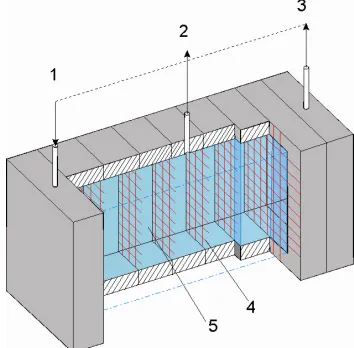
On the Figure 1 is shown the scheme of experimental
cell which was
ns of cerium and lanthanum.
At submission on the input of the separating element on the basis of a technological c
o component (a water solution of the mix of salts Ce(NO3)3 and Y(NO3)3 with concentration 3.5 and 3 g/l,
accordingly) the separation factor in an element without circulation of the solution after 4 hours of influence of the field with intensity Е+ = 14.3 V/cm, factor of
asym-metry A–/A+ = 0,66, with frequency 1.6 kHz have made:
in the selection 1.00499; in the dump 1.00179; full 1.00679. In a solution there was an enrichment on the cations Ce3+.
Checking of the condition of water in the solutions of sugars (-me
pyranoside, -methyl-D-glucopyranoside, Lactose and
[image:5.595.333.510.512.686.2]om it. Therefo
REFERENCES
[1] M. A. Kazarjan, I. V. Lomov and I. V. Shamanin, “Тhе
Physical Mod he Solvation
ess in Salts S tric,” International
Trutnev, I. V.
V. Mohoseev,
rov and A. A. Kornishev, “Unravelling
Sol-saccharine) by means Spectrophotometer Perkin-Elmer Model 180 have showed, that a marked difference occurs between spectrums of light absorption by solution before and after asymmetrical electric field action. The received facts confirm that action of field on the solution causes either changes of certain conditions of water in the solu- tion or changes of biological active compounds concen- trations in the gap between potential and neutral elec- trodes.
Action of an electromagnetic wave on a solution salt in liquid, polar dielectric causes division of charges and leads to fluctuations of density of a charge. At the certain combinations of parameters of an electromagnetic wave and a solution it is possible to expect partial or its full reflection from the medium formed by a solution that allows considering the problem opportunities of use of electromagnetic waves for definition of parameters of solutions.
els and Applications of t
olution in Polar Dielec
Proc-Scientific Journal for Alternative Energy and Ecology, Vol. 11, No. 55, 2007, pp. 145-154.
[2] A. L. Gusev, M. A. Kazarjan, Yu. A.
manin and I. V. Lomov, “The Non-Electrode Technology of the Water Solution Enrichment by Desired Element in the Complex Conversion of Nucleus Raw Material,” In-ternational Scientific Journal for Alternative Energy and Ecology, Vol. 3, No. 47, 2007, pp. 49-52.
[3] M. M. Baldanov, B. B. Tanganov and M.
“Conduction of Water Solution of the Weak Acids,” Dok-lady Akademii Nauk SSSR, Vol. 299, No. 4, 1988, pp. 899-904.
[4] M. V. Fedo
vent Response to Neutral Charged Solutes,” Molecular Physics, Vol. 105, No. 1, 2007, pp. 1-7.
doi:10.1080/00268970601110316
[5] A. N. Terenin, “Spectrums of the Absorption of
Electro-. VElectro-. Steblianko, “The Breach of
“Lekcii po Phyzike Plazmi,” lytic Solutions,” Uspekhi Phyzicheskikh Nauk, Vol. 17, No. 1, 1937, pp. 2-54.
[6] Yu. K. Stishkov and A
Homogeneity of the Weakly Conducting Liquids in Strong Electric Fields,” Zhurnal Tekhnicheskoi Fiziki, Vol. 67, No. 10, 1997, pp.105-111.