TEACHING AND LEARNING STRATEGIES USED IN THE IMPLEMENTATION OF INCLUSIVE
EDUCATION IN PRIMARY SCHOOLS IN KENYA
1,*
Peterson Ondieki Osero,
1
Department of Special Needs and Early Childhood Education, Jaramogi Oginga Odinga University of
2
Department of Special education, Jaramogi Oginga Odinga
3
Department of Psychology and Educational Foundations, Jaramogi Oginga Odinga University of Science and
ARTICLE INFO ABSTRACT
The term inclusive education has come to refer to a philosophy of education that promotes the education of all pupils in mainstream schools. Under the inclusion model, students with special needs spend most or all of their tim
offered, both special needs children and those who are less challenged, regular children, are taught in the same classroom. In some countries, inclusive education is thought of as an app
special educational needs children within general education settings. Inclusive education in Kenya is still at the grass roots. The purpose and objective of the study was to evaluate teaching and learning strategies used in the implementatio
The study used a descriptive survey design. The study targeted all teachers, 4000 and 5 education officers in Nyamira County. They are also involved in the implementation and delivery of the curriculum. The head teachers were targeted because, apart from being classroom teachers, had administrative role of coordinating and supervising teaching and learning activities in the schools. The study used simple random sampling which gives an equal chance
to be selected as a sample for a research study. The study used teacher questionnaire, interview schedule for head teachers and educational officers and observation schedules. Piloting was carried out in two schools in the
in communicating the learning experiences to learners in the process of implementing inclusive education. The study concluded that the strategies were appropriate for disseminating
experiences to learners in inclusive education.
research for appropriate strategies that would yield higher achievements; they should improvise teaching and learning materials and use locally availab
educational officers to sensitize parents to accept to take children with disabilities to school to be trained to independent and useful in future.
Copyright © 2015 Peterson Ondieki Osero et al. This
unrestricted use, distribution, and reproduction in any medium, provided the original work is properly cited.
INTRODUCTION
Teaching is an art that requires those who have the ability, skill, knowledge and the interest which would act as the spring
board for success to be realized. Orlich et al.,
teacher artistry does not just happen, teachers develop their a by using carefully planned fine-tuned lessons that reflect on an understanding of many different teaching strategies. Each teaching technique is skillfully applied to gain the desired intellectual, social, affective or kinesthetic skills.
*Corresponding author: Peterson Ondieki Osero
Department of Special Needs and Early Childhood Education, Jaramogi Oginga Odinga University of Science and Technology, Kenya
ISSN: 0975-833X
Vol.
Article History:
Received 25th September, 2015
Received in revised form 08th October, 2015
Accepted 27th November, 2015
Published online 30th December,2015
Citation: Peterson Ondieki Osero, Dr. Charles
implementation of inclusive education in primary schools in Kenya
Keywords:
Inclusive Education, Special Education Needs, Disability,
Regular Children, Strategy and Implementation
RESEARCH ARTICLE
TEACHING AND LEARNING STRATEGIES USED IN THE IMPLEMENTATION OF INCLUSIVE
EDUCATION IN PRIMARY SCHOOLS IN KENYA
Peterson Ondieki Osero,
2Dr. Charles Omoke and
3Dr. Calleb Owino Gudo
Department of Special Needs and Early Childhood Education, Jaramogi Oginga Odinga University of
Science and Technology, Kenya
Department of Special education, Jaramogi Oginga Odinga University of Science and Technology
Department of Psychology and Educational Foundations, Jaramogi Oginga Odinga University of Science and
Technology, Kenya
ABSTRACT
The term inclusive education has come to refer to a philosophy of education that promotes the education of all pupils in mainstream schools. Under the inclusion model, students with special needs spend most or all of their time with non-disabled students. In schools where inclusive education is offered, both special needs children and those who are less challenged, regular children, are taught in the same classroom. In some countries, inclusive education is thought of as an app
special educational needs children within general education settings. Inclusive education in Kenya is still at the grass roots. The purpose and objective of the study was to evaluate teaching and learning strategies used in the implementation of inclusive education in primary schools, Nyamira County. The study used a descriptive survey design. The study targeted all teachers, 4000 and 5 education officers in Nyamira County. They are also involved in the implementation and delivery of the iculum. The head teachers were targeted because, apart from being classroom teachers, had administrative role of coordinating and supervising teaching and learning activities in the schools. The study used simple random sampling which gives an equal chance
to be selected as a sample for a research study. The study used teacher questionnaire, interview schedule for head teachers and educational officers and observation schedules. Piloting was carried out in two schools in the County. The study concluded that there were a wide range of strategies used in communicating the learning experiences to learners in the process of implementing inclusive education. The study concluded that the strategies were appropriate for disseminating
experiences to learners in inclusive education. The study recommended that teachers should use research for appropriate strategies that would yield higher achievements; they should improvise teaching and learning materials and use locally available materials as much as possible; teachers and educational officers to sensitize parents to accept to take children with disabilities to school to be trained to independent and useful in future.
This is an open access article distributed under the Creative Commons Att use, distribution, and reproduction in any medium, provided the original work is properly cited.
Teaching is an art that requires those who have the ability, skill, knowledge and the interest which would act as the spring
et al., (2001) state that
teacher artistry does not just happen, teachers develop their art tuned lessons that reflect on an understanding of many different teaching strategies. Each teaching technique is skillfully applied to gain the desired intellectual, social, affective or kinesthetic skills.
Corresponding author: Peterson Ondieki Osero
Department of Special Needs and Early Childhood Education, Jaramogi Oginga Odinga University of Science and Technology,
The best teachers know their tools of the craft, when and how to use them. Teachers’ main tools are: schemes of work, lesson plans, progress records, teaching and learning resources and appropriate teaching and learning strategies. Teachers develop artistry by being aware of both what they are doing and how what they do affects their learners. This means that teachers must know their learners as individuals, know their abilities and weaknesses so that they may plan various learning activities that the learners would be able to deal with for maximum achievement in the learning process. Educational
practices depend heavily upon teachers and other
professionals. They are the group who can implement changes that are stated by policy-makers and educational adviso Teachers need to develop pedagogies for diversity, effective
International Journal of Current Research
Vol. 7, Issue, 12, pp.24599-24603, December, 2015
INTERNATIONAL
Peterson Ondieki Osero, Dr. Charles Omoke and Dr. Calleb Owino Gudo,2015. “Teaching and learning strategies used in the
implementation of inclusive education in primary schools in Kenya”, International Journal of Current Research,
TEACHING AND LEARNING STRATEGIES USED IN THE IMPLEMENTATION OF INCLUSIVE
Dr. Calleb Owino Gudo
Department of Special Needs and Early Childhood Education, Jaramogi Oginga Odinga University of
University of Science and Technology, Kenya
Department of Psychology and Educational Foundations, Jaramogi Oginga Odinga University of Science and
The term inclusive education has come to refer to a philosophy of education that promotes the education of all pupils in mainstream schools. Under the inclusion model, students with special needs disabled students. In schools where inclusive education is offered, both special needs children and those who are less challenged, regular children, are taught in the same classroom. In some countries, inclusive education is thought of as an approach to serve special educational needs children within general education settings. Inclusive education in Kenya is still at the grass roots. The purpose and objective of the study was to evaluate teaching and learning n of inclusive education in primary schools, Nyamira County. The study used a descriptive survey design. The study targeted all teachers, 4000 and 5 education officers in Nyamira County. They are also involved in the implementation and delivery of the iculum. The head teachers were targeted because, apart from being classroom teachers, had administrative role of coordinating and supervising teaching and learning activities in the schools. The study used simple random sampling which gives an equal chance to every item in the population to be selected as a sample for a research study. The study used teacher questionnaire, interview schedule for head teachers and educational officers and observation schedules. Piloting was carried The study concluded that there were a wide range of strategies used in communicating the learning experiences to learners in the process of implementing inclusive education. The study concluded that the strategies were appropriate for disseminating learning The study recommended that teachers should use research for appropriate strategies that would yield higher achievements; they should improvise le materials as much as possible; teachers and educational officers to sensitize parents to accept to take children with disabilities to school to be
open access article distributed under the Creative Commons Attribution License, which permits
The best teachers know their tools of the craft, when and how to use them. Teachers’ main tools are: schemes of work, lesson plans, progress records, teaching and learning resources and appropriate teaching and learning strategies. Teachers develop y by being aware of both what they are doing and how what they do affects their learners. This means that teachers must know their learners as individuals, know their abilities and weaknesses so that they may plan various learning ers would be able to deal with for maximum achievement in the learning process. Educational
practices depend heavily upon teachers and other
professionals. They are the group who can implement changes makers and educational advisors. Teachers need to develop pedagogies for diversity, effective
INTERNATIONAL JOURNAL OF CURRENT RESEARCH
Teaching and learning strategies used in the
use of learning support, teachers and other human and material resources for the full participation of all learners (UNESCO, 1998). However, to enable teachers to do so, a quality pre-service / in-pre-service training is an absolute necessity to equip them with essential skills meeting the needs of all in their classrooms.
The use of peer mediated instruction and intervention is often cited in the literature as one of the most effective strategies for inclusive classrooms. In several studies focused on students with mild disabilities, the use of peer mediated strategies results in improved academic outcomes for all students including those considered at-risk academically (Sailor, 2002). In a review of the literature, Fisher, Shumaker, and Deshler (1995) reported significant increases in reading, spelling, math, social studies, and other academic indicators for studies investigating the use of class-wide peer tutoring models (CWPT) where students serve as tutors and tutees in acquiring basic academic skills and factual knowledge. Positive outcomes are accrued when training for tutors is emphasized and in some cases, results in large effect on student outcomes (Stenhoff and Lignugaris / Kraft, 2007). Increases for both elementary and high school aged students were noted. Adequate training of teachers equips with skills for teaching and choice of strategies.
For students with learning disabilities, many studies describe instructional methods that extend the typical adaptations and help to promote progress in the core content areas for all students (including those without disabilities). These include graphic or advanced organizers, self regulation strategies, semantic maps, mnemonics, chunking, questioning, and visualizing strategies (Baker, Gersten, and Scanlon, 2002). Swanson and Hoskyn (2001) also confirmed the use of advanced organizers as an effective strategy for positively influencing student performance. The use of content enhancement routines, a type of advanced organizer, was shown to have dramatic results for students with learning disabilities in general education classrooms where the average unit quiz grade increased by ten percentage points (Len Schumaker, Deshler, Boudah, Vance, Kissam, Bulgren, and Roth, 1993).
These are measures that in certain circumstances should be seen as more than just tangible instruments, as may be increasing the number of computers or the hours dedicated to a subject, referring to an approach to the learning process, specifically to: A positive attitude towards the teaching of abilities by schools and the pupils’ ability to learn. The introduction of horizontal cooperation networks between teachers and schools, between teachers and pupils, between teachers and/or schools and families, between schools and their surrounding communities.
The fostering of channels of communication between schools and the education authorities in order to establish efficient sources of funding. The promotion of professional development and for upholding the daily practice of recapitulation and support for self-esteem. (Enguita and Abad, 2009). Teachers should constantly be aware that what they do affect the intellectual, attitudinal and psychomotor skills of
their learners. The strategies that they plan to use in a learning environment should cover those three major faculties for any meaningful learning to take place. A well-selected strategy would help the learners to remember the learnt content for a long time. Dale (1969) says that helping students to remember is one of the problems of teaching and learning. Certainly, every teacher often asks ‘why don’t my students remember what l teach them?’ and a pupil will search his/her mind for lost information and ideas that he/she thought he/she had learned. This implies that some strategies do not help the learner to remember what he/she had learned for a long time. On this note, Kenya Educational Commission Report (1964) blames the drill method of teaching, neglect of activity and pupil participation.
The commission advocates for activity-oriented methods which help the learner to learn more and sustains his/ her interest throughout the learning session. National Commission on Educational and Policies (1976) points out that the basic requirement of making education relevant to day-to-day problems and enabling the students to observe phenomena of the environment is to gather data about them, interpret the data and use them to solve problems. This is the whole essence of an appropriate teaching and learning strategy when it is correctly used. Some of the strategies that may be used are: inquiry approach, field trips, resource persons, discussions, dramatization, story-telling, lecture, question and answer, demonstration, group work, explanation and experimentation.
Leinhardt (1989) and Westermann (1991) argue that expert teachers know and recognize pupils experiencing difficulties diagnose sources of problems in their learning and identify strengths on which to build. Teachers should use the experiences their learners are undergoing to lead them to the new learning experiences they are about to introduce to them. The strategies selected and used by teachers to convey the content learner, to extent do influence the attitudes of teachers and those of learners. Teachers might either be motivated to teach or impart the desired knowledge to learners and such teachers express their liking of the subject. That is, indirectly they are expressing their positive attitudes towards the subject. Well selected strategies boost the teacher’s morale towards teaching or guiding learning sessions regardless of the level and type of learners in inclusive education classes.
Purpose and Objective
The purpose and objective of the study was to evaluate teaching and learning strategies used in the implementation of inclusive education in primary schools, Nyamira County.
Research Design
Target Population
The study targeted all teachers 4000 and 5 education officers in Nyamira County. Teachers were targeted because they were implementers of inclusive curriculum and therefore better positioned to share experiences they undergo. They are also involved in the implementation and delivery of the curriculum. The head teachers were targeted because, apart from being classroom teachers, had administrative role of coordinating and supervising teaching and learning activities in the schools. Head teachers also admitted pupils to school and to various classes every year. They are charged with the responsibility of ensuring that the government policies are delivered and implemented by teachers and other stakeholders. Hence, were in a position to provide required information about inclusive education.
Sample and Sampling Procedure
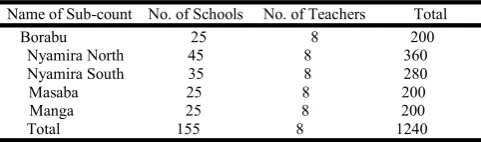
[image:3.595.44.285.355.426.2]The study used simple random sampling which gives an equal chance to every item in the population to be selected as a sample for a research study. Head teachers and education were purposively selected for study. Sampling of 1240 teachers who were involved in the study was carried out as in Table 1.
Table 1. Population Sample frame
Name of Sub-count No. of Schools No. of Teachers Total
Borabu 25 8 200
Nyamira North 45 8 360
Nyamira South 35 8 280
Masaba 25 8 200
Manga 25 8 200
Total 155 8 1240
Head teachers of sampled schools were purposively sampled because of their position and deemed to have important information pertaining to their position required by the study. The study sampled randomly schools in every Sub-County in Nyamira County as shown in the above table. This was appropriately done using lottery technique or wrote names of schools in pieces of paper which were folded then shaken properly and the required number of schools picked. Hence the schools in those papers were involved in the study. Upon reaching a sampled school, the researcher employed stratified sampling to select eight teachers among whom two teachers were those teaching lower primary. This gave a fair representation from both lower and upper primary, and also the head teachers as administrators and classroom teachers were purposively selected. This same procedure was carried out in every Sub-County and sampled school in the County. The study selected 155 head teachers, 5 education officers and 1085 teachers.
Research Instruments
The study used the following instruments:
Teacher questionnaire
The study used teacher questionnaire which had items which consisted of open and closed-ended items. The questionnaires were appropriate for the study because they were used to obtain data required by the study. It was also suitable to use a teacher
questionnaire because the number of respondents was large for any other instrument to be used. They covered both demographic information in regard to the objectives of the study and the respondent’s opinions to provide information in regard to inclusive education. The data was collected from teachers who were the main respondents.
Interview schedule for Head teachers
Interview schedules were used to collect data from head teachers. They were appropriate because the required information was gathered from respondents who are usually busy and do not have much time to spare out of their regular duties. Head teachers were requested to give information concerning the number of teachers, enrolment of learners in various classes, enrolment of Special Needs Education learners if any, etc. These were examples of information which was sought from head teachers.
Interview Schedule for Education Officers
This schedule was used to collect data from the education officers who due to their roles as supervisors and Quality Assurance and Standards Officer (QASO), were expected to provide relevant data about inclusion and the attitude of teachers towards inclusive education.
Observation schedule
Observation schedule was used to collect general information about the school. The instrument was appropriate because a large amount of information was collected and in a state as it existed. Information collected included the condition of classrooms, suitability of furniture and availability of teaching and learning resources. The researcher or research assistant filled one observation schedule for each school visited. The study involved a research assistant who l trained by taking him through all the instruments explaining the expected responses. The assistant was taken through a practical session by collecting data with him for three days. I made sure he was well acquainted with the exercise, that is, data collection and then sent him to collect data alone.
Piloting of Data Collection Instruments
Reliability
Reliability of measurements concerns the degree to which a particular measuring procedure gives equivalent results over a number of repeated trials. A questionnaire was considered reliable if various respondents at different institutions or places gave similar responses. Mugenda and Mugenda (1999) define reliability as a measure of degree to which a research instrument yields consistent results or data after repeated trials. The study used the internal consistency and test-retest methods to test reliability. It was expected that a high degree of coherence in the way questions were answered by different respondents would be achieved.
In test-retest, different respondents were required to answer the same questions and the coherence of their answers was assessed. The average reliability index for the study was established. The reliability of the test (instrument) was estimated by examining the consistency of the responses between the two tests. Questionnaires were given to at least eight teachers of sampled school for piloting and data collected was analyzed and correlation coefficient to determine reliability was calculated. Spearman Rank Order formula for test-retest was used to compute the correlation coefficient. Cohen (1988) asserts that although there are no formal standards for power, most researchers assess the power of their tests using 0.70 as a standard for adequacy.
Validity
Validity is defined as the degree to which the measured indicators really measure what they are supposed to measure (Kathuri and Pals, 2002). On the same note Orodho (2008) points out that validity is the degree to which the empirical measure or several measures accurately measure the concept. The validity of the content was enhanced by cross-checking with available data on the same study. The study expected to achieve both content and face validities. Content validity refers to the representation of the study items on the instrument, as they relate to the entire domain of content being measured. The content validity measure must sample adequately the domain of content the researcher claims it measures.
This is determined subjectively by a thorough examination of the instruments by a panel of experts, literature searches, and pre testing of open ended questions (Wilkinson, 1991). Face validity refers to the appeal and appearance of the instrument. The researcher ascertained face validity of the instruments by subjecting the instrument to a team of experts in the area of study including my supervisors. Pre-testing the study instruments was done to increase the likely hood of face validity.
RESULTS AND DISCUSSION
Evaluating teaching and learning strategies used in
inclusive education
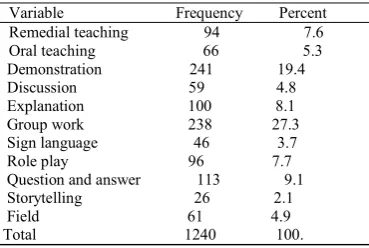
[image:4.595.340.525.77.201.2]In establishing teaching and learning strategies used in inclusive education, respondents were required to state the teaching and learning strategies they used. The responses were as presented in the Table 2
Table 2. Teaching and learning strategies in inclusive education
Variable Frequency Percent Remedial teaching 94 7.6 Oral teaching 66 5.3 Demonstration 241 19.4 Discussion 59 4.8 Explanation 100 8.1 Group work 238 27.3 Sign language 46 3.7 Role play 96 7.7 Question and answer 113 9.1 Storytelling 26 2.1 Field 61 4.9 Total 1240 100.
The table (2) shows that the most used strategy was group work at 27.3%. This may imply that most learning activities were geared towards enforcing group activities. Those teachers teaching learners in inclusive classes were more comfortable with the strategy and learners were projected to achieve better than when other methods were used. The use of the Demonstration method at 19.4% was ranked second highest and this could be because before they are involved in learning activities, the teacher demonstrates an activity as learners observe the stages, then they follow the procedure to realize similar results as the teacher’s. Other strategies identified and their scores were: question and answer at 9.1%; explanation at 8.1%; remedial teaching at 7.6%; oral teaching at 5.3%; field study at 4.9%; discussion at 4.8%; sign language at 3.7% and story-telling at 2.1%.
The study concluded that there were a wide range of strategies used in communicating the learning experiences to learners in the process of implementing inclusive education. During the study, data was also collected from units for special needs children. Teachers identified the teaching and learning strategies presented in Table 3.
Table 3. Responses of teachers in special school
Variable Variable Percent Demonstration 8 16.6 Oral teaching 6 12.5
Discussion 3 3.8
Role play 7 14.6 Sign language 4 8.3 Group work 10 20.8
[image:4.595.356.511.501.573.2]Conclusions and Recommendations
In evaluating teaching and learning strategies used in inclusive education, the study noted that teachers used a number of strategies in delivering the content to learners in inclusive education. The study found that strategies that were used in inclusive education were: group work, demonstration, question and answer, explanation, remedial teaching, oral teaching, field study, discussion, sign language and story-telling. The study concluded that the strategies were appropriate for passing on learning experiences to learners in inclusive education. The study recommended that teachers should use research for appropriate strategies that would yield higher achievements; they should improvise teaching and learning materials and use locally available materials as much as possible; teachers and educational officers to sensitize parents to accept to take children with disabilities to school to be trained to independent and useful in future.
REFERENCES
Baker, S., Gersten, R., and Scanlon, D. 2002. Procedural
facilitators and cognitive strategies: Tools for unraveling
the mysteries of comprehension and the writing process
and for providing meaningful access to the general
education curriculum. Learning Disabilities: Research and
Practice, 17, 65-77.
Cohen, J. 1988. Statistical power analysis for behavioral
Sciences (2nded.) Wikipedia Free Encyclopedia.
Dale, E. 1969. Audio-visual methods on teaching. New York:
Dryden press.
Enguita, M.F. and Abad, D. D 2009. Policies against
Educational Exclusion. Spanish Draft Report. Universidad
de Salamanca.
Fisher, J. B., Shumaker, J. B., Deshler, D. D. 1995. Searching
for validated inclusive practices: A review of literature.
Focus on Exceptional Children, 28(4), 1-20
Kathuri, N.J. and Pals, D.A. 2000. Introduction to educational
research. Nakuru: Education Media center, Egerton
University.
Leinhardt, G. 1989. Math lessons: A contrast of novice and
expert competence. Journal for Research in Mathematics
Education, 20(1), 52-75.
Lenz, B. K., et al., 1993. The unit planning routine: A guide for
inclusive unit planning (Research Report). Lawrence:
University of Kansas Center for Research on Learning.
Mugenda, O. M. and Mugenda, A.G. 1999. Research methods;
Quantitative and Qualitative approaches. Nairobi: Acts
Press.
Orodho, J.A 2008. Techniques of writing research proposal
and reports in educational social and sciences: Maseno:
Kenezja Hp Enterprises.
Republic of Kenya 1964. The Kenya Education Commission
(Ominde Commission) Nairobi: Government Printer.
Sailor, W. 2002. President’s Commission on Excellence in
Special Education: Research Agenda Task Force.
Nashville, TN
Stenhoff, D. M. and Lignugaris/Kraft, B. 2007. A review of
the effects of peer tutoring on students with mild
disabilities in secondary settings. Exceptional Children, 74(1), 8-30.
Swanson, H., and Hoskyn, M. 2001. Instructing adolescents
with learning disabilities: A component and composite
analysis. Learning Disabilities Research and Practice, 16,
109-119.
UNESCO 1998. Inclusive Education on the Agenda. Paris:
UNESCO.
Westermann, D.A. 1991. Expert and novice teacher decision making. Journal of Teacher Education, 42 (4), 292-
Wilkinson, A.M. 1991. The scientist’s handbook for
writing papers and dissertations. Englewood cliffs, New
Jersey: Prentice Hall.
Wilkinson, A.M. 1991. The scientist’s handbook for writing
papers and dissertations. Englewood cliffs, New Jersey:
Prentice Hall.