ISSN Online: 1947-394X ISSN Print: 1947-3931
DOI: 10.4236/eng.2018.108033 Aug. 6, 2018 477 Engineering
Construction of Comprehensive Development
Index and Analysis on the Development Trend
of Solar Energy Industry
Linlin Jia, Xuehua Zhang
*, Yahui Wu
Institute of Economics in Tianjin Polytechnic University, Tianjin, China
Abstract
As a strategic emerging industry, solar energy industry has been wished to ease the energy crisis and stimulate economic growth. In order to judge the development of the industry objectively, this paper constructs the index sys-tem of China’s solar energy industrial development from three dimensions of micro enterprise, medium industry and macroeconomic. This paper simulta-neously takes 27 specific indicators, 54 listed companies and 10206 data from 2010 to 2016 as an example to calculate the industrial development index. The result reveals that with the implementation of the support policies play-ing a positive role in the development of China’s solar energy industry, the solar industry has steadily improved. Solar energy industry in our country is under the support of national support policies and its technological innova-tion capability is relatively active. However, the moderate investment and fi-nancing activities and inadequate enterprise operational capacity, to some extent, alleviate the development of the solar energy industry. The above shows that the solar energy industrial development index and its evaluation methods can help people to accurately grasp the development trend of the solar energy industry and accurately identify the development of advantages and disadvantages.
Keywords
Solar Energy Industry, Development Index, Comprehensive Index Method, Analytic Hierarchy Process
1. Foreword
Under the circumstances of global warming, deterioration of the ecological en-vironment and shortage of conventional energy, the new energy industry has
How to cite this paper: Jia, L.L., Zhang, X.H. and Wu, Y.H. (2018) Construction of Comprehensive Development Index and Analysis on the Development Trend of Solar Energy Industry. Engineering, 10, 477-485.
https://doi.org/10.4236/eng.2018.108033
Received: May 18, 2018 Accepted: August 3, 2018 Published: August 6, 2018
Copyright © 2018 by authors and Scientific Research Publishing Inc. This work is licensed under the Creative Commons Attribution International License (CC BY 4.0).
DOI: 10.4236/eng.2018.108033 478 Engineering
received universal attention and support. The solar industry can not only ease the energy crisis, but also stimulate economic growth. Among the many new energy sources such as solar energy, nuclear energy, wind energy and biomass energy, solar energy industry, as a strategic emerging industry with its unique advantage, has become an important area of new energies.
Now, China’s solar energy enterprises create nearly 1 million 600 thousand employment opportunities. And the solar power installed capacity of 77 million 420 thousand kilowatts increases by 81.6% over the previous year, retaining the most solar power installed capacity in the world. During the “12th Five-Year” period, solar power generation jumped from 260 thousand kilowatts to 43 mil-lion 180 thousand kilowatts, with an average annual growth of 177% [1]. The solar industry in China is yet in its infancy. Whether it can shoulder the respon-sibility of alleviating the energy crisis and stimulating the economic growth is still needed to be accurately grasped and comprehensively evaluated.
The research on the solar energy industry mainly focuses on the analysis of policy promotion [2] [3] [4], the role of technological innovation [5], and the role of market factors [6]. These single factor studies are indicators for the de-velopment index of solar energy industry. But mere these mentioned factors are not enough for an industrial perspective of the strong theoretical and empirical studies. The analysis of industrial operation efficiency [7], industrial perfor-mance evaluation [8] and industrial competitiveness evaluation [9] conduce to evaluate the development prospect of the industry from the aspects of opera-tional efficiency, production efficiency and technological competitiveness. However, it still cannot concisely and objectively reflect the entire factors of the industry. Domestic and foreign literature search results show that the research on solar energy industrial development index has not been carried out yet.
Owing to the fact that solar energy industry has some similarities with culture industry [10], manufacturing industry [11], modern service industry [12], high-tech industry [13] and other industries, and that these industries already have some mature research achievements, this paper refers to the research re-sults of these industrial development indices in the process of constructing the “Solar Industry Development Index”. It takes comprehensive perspective of self-sustaining ability of micro enterprises, medium industrial structure and macroeconomic development factors into consideration, and then takes 54 solar energy listed enterprises as an example to measure the development index for the sake of providing reference for enterprises and management institutions.
2. Research Method
develop-DOI: 10.4236/eng.2018.108033 479 Engineering
ment index is generally based on a specific period. And its base number is 1 or 100.The original data during the inspection period divides the original data during the reference period, and then multiplies by the base number, that is, the development index of the field during the inspection period [14]. This paper sets 100 as base number.
2.1. Construction of Index System
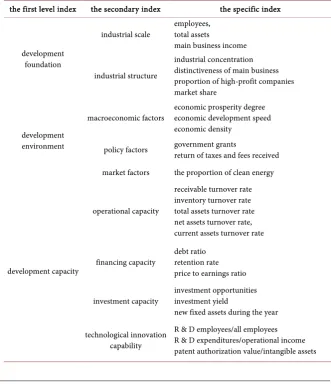
In this paper, the index system of solar energy industrial development is sifted from three dimensions: micro enterprise, medium industry and macroeconomic. The index system of China’s solar energy industrial development is divided into four diverse parts, that is, the development index layer, the first level index layer, the secondary index layer and the specific index layer. The basic framework is shown in Table 1.
2.2. The Measure of Development Index
2.2.1. Standardization of Specific Index [image:3.595.206.538.356.741.2]Standardized processing of raw data aims to eliminate the effect of raw data on
Table 1. The index system of solar energy industrial development.
the first level index the secondary index the specific index
development foundation
industrial scale employees, total assets
main business income
industrial structure
industrial concentration distinctiveness of main business proportion of high-profit companies market share
development environment
macroeconomic factors economic prosperity degree economic development speed economic density
policy factors government grants return of taxes and fees received
market factors the proportion of clean energy
development capacity
operational capacity
receivable turnover rate inventory turnover rate total assets turnover rate net assets turnover rate, current assets turnover rate
financing capacity debt ratio retention rate price to earnings ratio
investment capacity investment opportunities investment yield new fixed assets during the year
technological innovation capability
DOI: 10.4236/eng.2018.108033 480 Engineering
the order of magnitude. In order to reflect the dynamic characteristics of the de-velopment index, in the standardization course, the original data was processed by the ratio method, which divides the value of the inspection period by that of the reference period.
( )1
i it i t
V =X X − (1)
Among them, Vi is the normalized value of the i-th index. Xit is the value of
the i-th index in the t-phase (the value of the observation period). And Xi(t−1) is
the value of the i-th index in the t—1 period (The base period value).
2.2.2. Weight of the Index
The first level index is weighted by AHP [15], while the secondary index and specific index are weighted by equal rights method [16]. The detailed procedures are as follows.
The first step is to establish a hierarchical structure model. The index in-volved in the evaluation are divided into four levels, namely, the development index layer, the first level index layer, the secondary index layer and the specific index layer.
The second step is to build a judgment matrix. Construct a judgment ma-trix for the secondary indicators as formula (2) shown. Afterward, compare the factors of the same layer with each other. After that, score according to the signi-ficance by 1 to 9. Set the judgment matrix to A = (aij)n×n
The third step is to calculate the weight according to expert consultation. Mathematical models are needed to rank the consistency judgment matrix filled by experts. And then calculate the relative weights of each factor in each matrix. For the consistency judgment matrix, each column is normalized to the corres-ponding weight. While for the non-consistent judgment matrix, each column is normalized to its approximate corresponding weight.
The fourth step is to test the consistency. First, calculate consistency index
CI.
max
1
n CI
n
λ −
=
− (2)
Among them, λmax is the maximum eigenvalue of the matrix A, n is the order
of the matrix
After that, utilize MATLAB program to get the maximum eigenvalue of the matrix. Afterward, calculate the corresponding mean random consistency RI
[17], and then the consistency ratio CR, CR = CI/RI. It is generally accepted that when CR < 0.1, the consistency of the judgment matrix is acceptable.
DOI: 10.4236/eng.2018.108033 481 Engineering 2.2.3. Calculation of the Index
Based on the standardized data and the weight of the specific index, the com-prehensive index method is applied to calculate the index of China’s solar energy industrial development. The formula is as follows.
I i
SDI =
∑
W V⋅ (3)Among them, SDI is the index of China’s solar energy development, Wi is the
weight of ith index, and Vi is the standardized value of ith index.
3. Empirical Analysis—Taking 54 Solar Energy Industry
Listed Companies as an Example
3.1. Sample Selection and Data Sources
It is accessible to get the data of the solar energy industry listed companies, whose market sensitivity and policy sensitivity are high. The solar industry de-velopment index is measured by the sample. In the macro, it can be used as a barometer for the development of solar industry in China to reflect the devel-opment trend. Moreover, in the micro, it can reflect the develdevel-opment trend of a single enterprise. Based on the SFC industry and CITIC securities industry, this paper selects 54 solar energy industry listed companies from 323 listed compa-nies in Shanghai and Shenzhen A shares as data samples.
The micro-data comes from the enterprise accounting annual report, and the macro-data come from the national research network and the national statistical yearbook.
3.2. Evaluation of the Solar Energy Industrial Development
3.2.1. Index StandardizationAccording to formula (1), the standardization of specific indicators is carried out.
3.2.2. Determination of Weight
The weight of index is determined by questionnaire from expert, including solar energy experts, economists, entrepreneurs, government officials and the public. There were nearly 200 questionnaires issued in 3 rounds, and only 59 question-naires pass through consistency check. The geometric mean method was used to conduct the survey result statistics. The statistical results were input into the judgment matrix, and the weight of the secondary index is calculated by R soft-ware. The result is shown in Figure 1.
3.2.3. Evaluation of Index
DOI: 10.4236/eng.2018.108033 482 Engineering Figure 1. Weight of solar energy industry index.
From Figure 2, we can figure out that the curves of comprehensive
develop-ment index and the developdevelop-ment capability are roughly the same.
From Figure 3, the development foundation is mainly influenced by industri-al structure, while the industriindustri-al scindustri-ale tends to be stable.
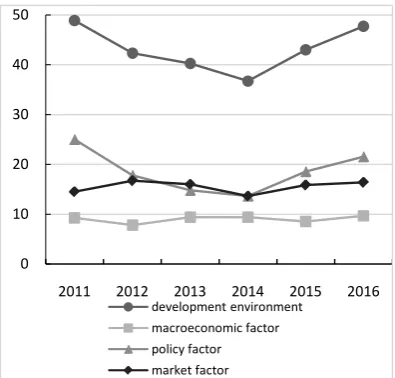
From Figure 4, the development environment is composed of three factors, macroeconomic, policy and market. The trend of macroeconomic and policy factors shows that the macroeconomic and policy support is inversely propor-tional. As a whole, the trend of the development environment is strongly influ-enced by the policy factors.
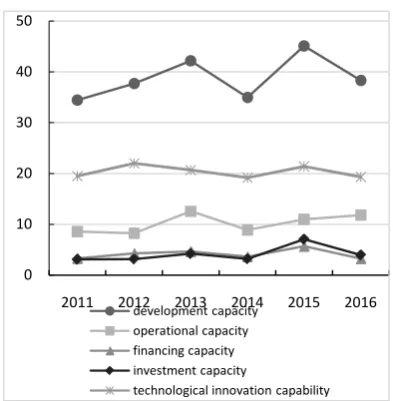
From Figure 5, the curves of the development capability and the financing capacity are almost similar. It can be said that the financing ability is the inditor of the development capability. There is a slight fluctuation in operating ca-pacity, and its trend is improving. The same trend of investment capability and technological innovation capability has a certain pulling effect on development capability.
4 Conclusions
By measuring the development index of the solar energy listed companies and analyzing the calculation results, there are a couple of results as follow.
1) The development of solar energy industry is steadily improved under the positive influence of the industrial development foundation, the development environment and the capacity.
2) In the case of the overall slowdown in economic growth, the solar energy market has also been affected, but with the implementation of the supporting, which has a positive effect on the development of the solar industry in China, it also creates new opportunities for the future development.
3) While the enterprises are paying attention to the growth of scale, the
Development foundation
20.0
Development environment
40.0
Development capacity
40.0
industrial scale 3.8
industrial structure 16.2
macroeconomic factors 9.0
policy factors 16.0
market factors 15.0
operational capacity 11.2
financing capacity 3.8
investment capacity 4.2
technological innovation capability 20.8 The index of solar energy
DOI: 10.4236/eng.2018.108033 483 Engineering Figure 2. Comprehensive development index and its first index trend in 2011-2016.
Figure 3. Development foundation its secondary index trend in 2011-2016.
Figure 4. Development environment and its secondary index trend in 2011-2016. 0
40 80 120
2011 2012 2013 2014 2015 2016
comprehensive development index development foundation development environment development capacity
0 10 20 30
2011 2012 2013 2014 2015 2016
development foundation industrial scale industrial structure
0 10 20 30 40 50
2011 2012 2013 2014 2015 2016
[image:7.595.274.472.512.701.2]DOI: 10.4236/eng.2018.108033 484 Engineering Figure 5. Development capacity and its secondary index trend in 2011-2016.
enterprises should also strengthen the fine management and improve their op-erating ability. Meanwhile, the national policy support should be used to streng-then the technological innovation and its own development ability.
To sum up, the sound development of the solar energy industry not only needs to strengthen the fine management themselves, improve the technological innovation, but also needs a good environment for development. Only by the common role of both inside and outside can the solar energy industry in China continue to move forward.
Research Project
National Social and Science Fund—Research on green development evaluation and planning system based on “total carbon” (18BJY079); Beijing Financial project—Study on optimization and upgrading of traditional high energy consump-tion industry and cultivaconsump-tion of new green industry in Beijing, Tianjin and Hebei (PXM2018_178216_000002_00299336_FCG-Innovation Engineering-Pre-research).
Conflicts of Interest
The authors declare no conflicts of interest regarding the publication of this pa-per.
References
[1] Ministry of Planning and Development of the China Electric Power Enterprise Fed-eration (2017) National Electricity Supply and Demand Situation Analysis and Forecast Report in 2016-2017. Electrical Appliance Industry, No. 02, 11-16.
[2] Winter, B. (2011) Economic Analysis of Government Subsidies for Solar Photovol-taic Industry. Price Monthly, No. 5, 73-76.
[3] See, Y. (2013) Research on the Policy Effect of China Solar Photovoltaic Industry. Liaoning University, Shenyang.
[4] Yang, J. and Liu, Y.C. (2012) Research on the Policy Support of China’s New Energy 0
10 20 30 40 50
2011 2012development capacity2013 2014 2015 2016
operational capacity financing capacity investment capacity
DOI: 10.4236/eng.2018.108033 485 Engineering Industry—Based on the Analysis of the Price Theory and Practice Based on the De-velopment of Solar Photovoltaic. Wind Power and New Energy Automobile Indus-try, No. 5, 72-73.
[5] Teng, F., Liu, Z.G., Liu, Y., et al. (2013) The Technological Innovation Ability and Competitive Situation of China’s Solar Energy Industry—Based on the Perspective of Patent Information Analysis. Economic Problems, No. 11, 84-90.
[6] Hu, X.H., Chen, L.Z. and Jiang, S.Y. (2015) Strategic Emerging Industries Encoun-tered the Impact and Prevention of Trade Restrictions Measures—Taking the Solar Cell Industry as an Example. Economic Problems, No. 2, 133-139.
[7] Wang, Y.H. and Liu, S.F. (2015) Performance Evaluation of H Photovoltaic Com-pany Based on Efficacy Coefficient. Finance and Accounting, No. 8, 25-28.
[8] Fu, R., James, T.L. and Woodhouse, M. (2015) Economic Measurements of Polysi-licon. IEEE Journal of Photovoltaics, 5, 515-524.
[9] Xu, Z.Q. (2002) Investigation and Analysis of Soybean Production and Circulation Costs in Heilongjiang Province. China Food and Nutrition, No. 06, 28-32.
[10] Zhou, F.X. (2008) Research on Development Index of China’s Manufacturing In-dustry. Statistics and Decision Making, No. 19, 46-48.
[11] Wang, J., Lu, C., Guo, Z., et al. (2015) An Empirical Study on the Quality Develop-ment Index of Multinational Manufacturing Industry and Its Changing Law.
Progress and Countermeasures in Science and Technology, No. 18, 43-50.
[12] Han, S.T. (2014) Construction and Improvement of China’s Service Industry Price Index System. China Statistics, No. 6, 9-11.
[13] Yang, Q., Duan, X.J., Zhang, W., et al. (2014) Analysis of the Development of the Development Level of China’s High and New Technology Industry and Analysis of Its Influencing Factors. Resources and Environment of the Yangtze River Basin, 23, 1649-1658.
[14] Li, F.Z. (2011) Principles of Statistics. Dongbei University of Finance and Econom-ics Press, Dalian, 123-128.
[15] Yang, L.Q. (2011) Prediction and Decision Making Method. Metallurgical Industry Press, Beijing, 175-177.
[16] Shi, Y., Chai, Y.Y. and Liu, Q.L. (2006) Evaluation of the Effectiveness of the Bank-ing System. Journal of Harbin Engineering University, 27, 461-464.
[17] Jian, L.R., Liu, S.F. and Liu, Y. (2016) Prediction and Decision Soft Computing Me-thods and Applications. Electronics Industry Press, Beijing, 122-123.
[18] Dong, H. (2006) AHP in Post Evaluation of Water Conservancy Projects. China Rural Water Conservancy and Hydropower, 4, 88-89.