Evaluation of Immunoreactivity of wheat bread
made from fermented wheat flour
Joanna Leszczyńska
1, anna Diowksz
2, agata Łącka
1, katarzyna woLska
1and adrian Bartos
11institute of General Food chemistry and 2institute of Fermentation technology
and Microbiology, technical University of Lodz, Lodz, Poland
Abstract
Leszczyńska J., DiowkszA., ŁąckaA., WolskaK., BartosA. (2012): Evaluation of immunoreactivity of wheat bread made from fermented wheat flour. Czech J. Food Sci., 30: 336–342.
Combined culture of lactic acid bacteria (Lactobacillus brevis, L. plantarum i L. sanfranciscencis) and baker’s yeasts was used in order to reduce immunoreactivity of gluten from wheat. Flour and dough samples were analysed in terms of lactic acid fermentation and thermal processing. Their immunoreactivity was determined with ELISA method using both anti-gliadin antibodies from patients suffering from coeliac disease and rabbit anti-QQQPP peptide (main epitope of flour allergen) antibodies. Also, immunoreactivity was measured in the final products after simulated digestion. The obtained total effectiveness of the fermentation and digestion processes amounted to less than 30% relative to immunoreactivity of human anti-gliadin antibodies and less than 10% relative to immunoreactivity of anti-QQQPP peptide antibodies as compared to the baking made with non-fermented flour.
Keywords: gliadins; immunoreactivity; lactic acid bacteria; bread, wheat
The consumption of wheat products or those supplemented with wheat proteins can evoke vari-ous undesired reactions in the organism. The most common symptoms include: urticaria, atopic der-matitis (AD), and wheat-dependent exercise-in-duced anaphylaxia (WDEIA). However, AD mainly occurs in children whereas urticaria and WDEIA affect adults (Palosuo 2003; Battais et al. 2005). Apart from food allergy, there are disorders associ-ated with digestive gluten intolerance, also known as coeliac disease (CD). In this case, gluten intake results in small intestinal disorders and in the end does harm to epithelium and triggers inflamma-tory response, with the strongest response being caused by peptides received from the digestion of wheat gliadins – one of the fractions of gluten proteins (Shan et al. 2002).
Fermented grocery products are significant for the sake of their dietary function and can display different immunoreactivity values compared to non-processed foods. Lactic acid fermentation conducted with the use of lactic acid bacteria is a safe, natural, and favourable process. Its objective is to create specific aromatic compounds, to stop undesirable fermentation by other microorganisms, to delay the expiration date of the obtained bread and improve its nutritional value, as compared to bread only made through the addition of baker’s yeasts (Liljeberg & Bjōrck 1996; Hammes & Gänzle 1998).
Numerous homo- and heterofermentative spe-cies of lactic acid bacteria were isolated from sourdough. The bacteria of Lactobacillus genus prevail in sourdough (De Vuyst & Neysens 2005; Rollan et al. 2005; Corsetti & Settani 2007).
It was proved that these bacteria synthesise a set of proteolytic enzymes capable of hydrolysing gliadin peptides that cause inflammation in coe-liac disease (Di Cagno et al. 2002; Rollan et al. 2005; Rizello et al. 2006).
In this work, we applied a mixed culture of se-lected lactic acid bacteria able to reduce the im-munoreactivity of wheat flour proteins. Also, we assessed their potential for obtaining ready-made products from fermented wheat flour exposed to thermal processing (baking and boiling). The im-munoreactivity of these products was estimated before and after the simulated digestion.
The immunoreactivity values of wheat flour, dough and its derivative products were determined with ELISA method using anti-gliadin antibodies from patients’ sera which were made available owing to the co-operation with Polish Mother’s Memorial Hospital Research Institute, Lodz. Also, rabbit sera containing QQQPP peptide anti-bodies were utilised. The peptide is considered by some authors as the main epitope in wheat allergy (Tanabe et al. 1996).
mATERIAL AND mETHODS
Type 500 wheat flour containing 18.8% gluten, 0.51% ash and 14.9% humidity was exposed to lactic acid fermentation. The fermentation as-says with wheat flour were conducted with dough preparation at efficacy of 200 (1 kg flour + 1 kg water, which makes 2 kg dough).
In this work, we applied lactic acid bacterial monocultures of Lactobacillus genus. The research engaged the following homo- and heterofermen-tative strains:
Lactobacillus plantarum – LOCK 0860, AD 98, LOCK 0858 (Pure cultures collection of the Insti-tute of Fermentation Technology and Microbiol-ogy, Technical University of Lodz – LOCK 105) and 2648 from the collection of DSMZ (Deutsche Sammlung von Mikroorganismen und Zellkulturen GmbH, Brauschweig, Germany).
Lactobacillus brevis – MS-99 from the collec-tion of LOCK 105 and 1267 from the colleccollec-tion of DSMZ.
Lactobacillus sanfranciscensis – MW-94 from the collection of LOCK 105 and 20663 from the col-lection of DSMZ.
saccharomyces cerevisiae K1 yeasts were also used, originating from the collection of the Institute
of Fermentation Technology and Microbiology, Technical University of Lodz. Fermentation was run at 30°C for 24 hours.
After the mixture of wheat flour, water, and mi-croorganisms was ready, the dough was mixed for 19 min in Aliphamix blender at the speed level 7, then incubated for 25 min in a grow chamber until fully grown. The dough samples were preserved thermally in three variants: (1) boiling in water at 100°C for 10 min; (2) steam-cooking for 25 min; (3) baking at 220°C for 15 minutes. Gluten was ex-tracted from these samples by a modified method of ethanol extraction with the addition of guanidine and mercaptoethanol (Garcia et al. 2005).
Immunoreactivity determination. IgG
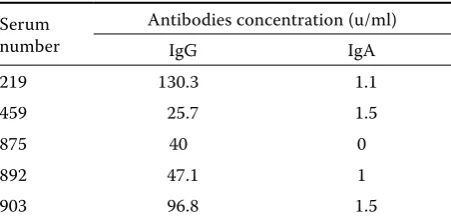
antibod-ies from the sera of allergic patients with coeliac disease were used for wheat flour antigenicity determination. The determined concentration of anti-gliadin antibodies is presented in Table 1. Pentapeptide QQQPP was received from the In-stitute of Organic Chemistry, Technical University of Lodz. In order to conjugate QQQPP peptide with a protein, glutaraldehyde was added into a solution containing ovoalbumine and the peptide in the ratio of 1:40 (10 mg QQQPP and 0.25 mg ovoalbumine in 1 ml phosphate buffered saline – PBS pH 7.4 buffer) until the final concentration reached 1%. The reaction was carried on for 1 h at 37°C and was stopped with the addition of NaBH4 (10 mg/ml). The reaction product was subjected to dialysis against PBS. The antibodies against the complex of QQQPP peptide and ovoalbumine were received from the immunised rabbits by POLGEN Ltd. (Łódź, Poland).
The supernatants were diluted 100-fold for im-munoreactivity determination. The coating step involved the use of 0.05M carbonate buffer pH 9.6 (Sigma, town, state) prepared by dissolution of 1 reagent capsule in 100 ml distilled water. To block the uncoated surfaces, we used 3% pow-dered skimmed milk solution in PBS. Indirect
non-Table 1. Human sera applied in research
Serum number
Antibodies concentration (u/ml)
IgG IgA
219 130.3 1.1
459 25.7 1.5
875 40 0
892 47.1 1
[image:2.595.305.531.647.757.2]competitive ELISA method was used with primary antibodies being patients’ antibodies or anti-QQQPP peptide antibodies, produced by POLGEN Ltd. (Lodz, Poland), and secondary antibodies – anti-human IgG coupled with alkaline phosphatase or goat anti-rabbit immunoglobulin coupled with peroxidase. In the case of peroxidase conjugation, 3,3’, 5,5’-tetramethylbenzidine (TMB) solution was used as the substrate p-nitrophenyl phosphate (p-NPP) served as the substrate for alkaline phos-phatase. Enzymatic reaction was stopped with the use of 1M H2SO4 or 3M NaOH, respectively.
Phosphate buffer PBS (pH 7.2), with 0.1% Tween 20 was used to wash plates and for dilutions.
The assays were done with indirect ELISA meth-od. Microtitre plates EB 92029330 (Labsystem, Helsinki, Finland) were coated overnight at 48°C with 100 ml of the antigen solution (100 times diluted gliadins extracts obtained from the sam-ples) in 0.1M carbonate buffer (pH 9.6), containing about 1.5 mg of protein. The plates were washed and the free binding sites were blocked by incu-bation of the plates with a 3% solution of low fat milk in phosphate buffer (pH 7.2) containing 0.1% Tween-20, for 2 hours. This was followed by the removal of the buffer solution, rinsing the plates five times and further incubation with human sera containing antigliadin antibodies or rabbit antibodies, diluted with phosphate buffer, at room temperature for 1 hour. The plates were washed again and 100 ml of 1000-fold diluted solution of anti-IgG antibodies conjugated with alkaline phos-phatase or anti-rabbit immunoglobulin coupled with peroxidase was added. After the incubation
of the plates for 1 h and rinsing with phosphate buffer, the bound phosphatase activity was deter-mined by the reaction with p-NPP (phosphatase) or TMB (peroxidase) with Multiscan MC reader at 405 nm or 450 nm, respectively.
The remaining immunoreactivity was expressed in % relative to non-modified flour, referred to on a dry matter basis.
Simulated digestion. The experimental
condi-tions: pepsin – incubation for 1 h, 37°C, pH 2.0; trypsin – 1 h, 37°C, pH 8.3; enzyme:substrate ratio 1:30 (digestion conditions by Berti et al. 2003)
RESULTS AND DISCUSSION
In the previous paper (Leszczyńska et al. 2009) a set of lactic acid bacterial strains was examined in respect of their capacity to produce l-lactic acid, which decreases pH, and the ability to destruct gliadin epitopes recognised by antibodies from the patients’ sera. Dough acidity is significant as the prevailing proteolysis of wheat proteins is catalysed by endogenous aspartate proteases present in flour, requiring low pH to become ac-tivated (Spicher & Nierle 1988; Loponen et al. 2004). The strains of lactic acid bacteria also show an indirect property of destroying epitopes as in mixed cultures, where specific species cohabit in synergy, the resultant enzymatic activity turns out to be much higher than just the total activity from the individual species (De Angelis et al. 2006).
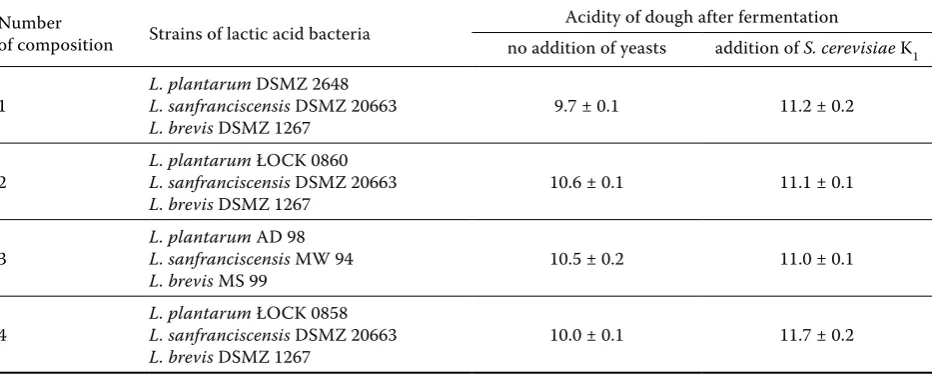
[image:3.595.65.532.570.757.2]Earlier research made us propose four compo-sitions of lactic acid bacterial starting cultures,
Table 2. Composition of starter cultures and acidity of dough obtained as a result of fermentation (expressed as a figure in milliliters of 0.1M NaOH per 10 g wheat dough)
Number
of composition Strains of lactic acid bacteria
Acidity of dough after fermentation
no addition of yeasts addition of s. cerevisiae K1
1 L. plantarumL. sanfranciscensis DSMZ 2648 DSMZ 20663
L. brevis DSMZ 1267 9.7 ± 0.1 11.2 ± 0.2
2 L. plantarumL. sanfranciscensis ŁOCK 0860 DSMZ 20663
L. brevis DSMZ 1267 10.6 ± 0.1 11.1 ± 0.1
3 L. plantarumL. sanfranciscensis AD 98 MW 94
L. brevis MS 99 10.5 ± 0.2 11.0 ± 0.1
4 L. plantarumL. sanfranciscensis ŁOCK 0858 DSMZ 20663
including homo- as well as heterofermentative bacteria. Especially the notable strain L. sanfran-ciscensis stimulates the growth of other lactic acid bacterial strains in sourdough due to its enzymatic properties. Phosphorolysis of maltose, which ac-counts for 60% of free sugars in dough, is an ability that favours the creation of populations associated with other microorganisms that require glucose and other monosaccharides for the growth and metabolism (Gobbetti & Corsetti 1996).
In Table 2, we show the contents of the applied compositions of the mixed lactic acid bacterial cultures as well as the acidity of dough that was fermented by them. Sourdough acidity varies only slightly and equals 9.7 to 11.7, with the yeast addi-tion contributing to its increase. The discrepancy is associated with symbiotic cohabitation of lactic acid bacteria and yeasts (Gobbetti 1998).
The application of mixed cultures in fermentation (Table 3) reduces immunoreactivity much more significantly than when only one strain is used
for wheat flour fermentation (Leszczyńska et al. 2009). Good results were obtained for starter composition No. 4, where we observed a decrease in immunoreactivity by approximately 20%. There-fore, in further research this particular lactic acid bacterial composition was utilised. The yeasts addition contributed to the drop in immunoreac-tivity being more substantial. Unfortunately, some sera indicated cross-reactivity between gluten and saccharomyces cerevisiae yeast proteins. Similar conclusions were reported by other researchers (Watanabe et al. 1995). Indigenous yeasts pres-ence in flour supports the necessity of making yeasts addition despite the prospective slight in-crease in immunoreactivity (Stolz 1999). If there is no competition from baker’s yeasts, they can grow and thus negatively affect the dough quality. To confirm the viability of fermented wheat flour in the production of foods with reduced immuno-reactivity, flour samples were exposed to thermal processing and subsequent analysis of
immuno-Table 3. Immunoreactivity of fermented dough in relation to the makeup of lactic acid bacterial starter culture as well as to applied human serum (expressed in relation to immunoreactivity of non-fermented dough)
Number of composition
Remaining immunoreactivity (%)
[image:4.595.66.532.113.225.2]no addition of yeasts addition of s. cerevisiae K1 S 459 S 892 S 459 S 892 1 66.9 ± 3.1 30.3 ± 2.1 46.5 ± 2.2 52.7 ± 3.8 2 49.8 ± 2.2 19.1 ± 2.3 49.2 ± 3.2 42.0 ± 3.6 3 63.1 ± 3.0 10.1 ± 1.9 42.0 ± 3.9 46.0 ± 2.6 4 24.3 ± 3.9 19.5 ± 2.2 30.6 ± 2.4 39.3 ± 2.3
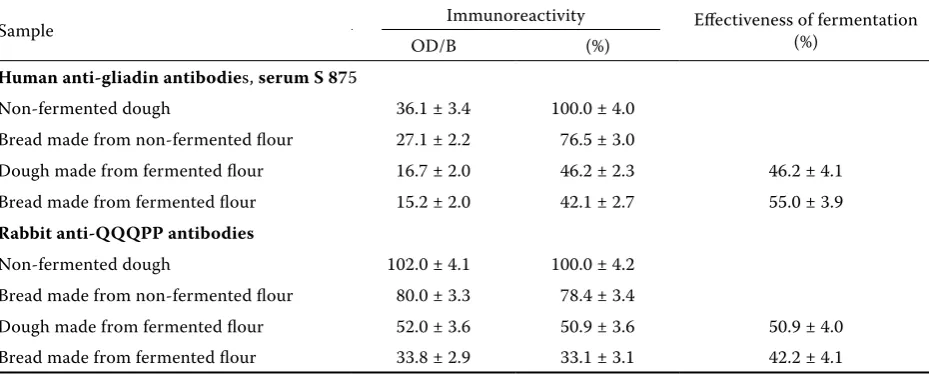
Table 4. Remaining immunoreactivity of the products made from fermented flour (starter composition 4) (effectiveness of fermentation – remaining immunoreactivity compared to analogous sample that was not subject to fermentation)
Sample Immunoreactivity Effectiveness of fermentation (%) OD/B (%)
Human anti-gliadin antibodies, serum S 875
Non-fermented dough 36.1 ± 3.4 100.0 ± 4.0 Bread made from non-fermented flour 27.1 ± 2.2 76.5 ± 3.0
Dough made from fermented flour 16.7 ± 2.0 46.2 ± 2.3 46.2 ± 4.1 Bread made from fermented flour 15.2 ± 2.0 42.1 ± 2.7 55.0 ± 3.9
Rabbit anti-QQQPP antibodies
Non-fermented dough 102.0 ± 4.1 100.0 ± 4.2 Bread made from non-fermented flour 80.0 ± 3.3 78.4 ± 3.4
[image:4.595.65.530.571.758.2]Table 5. Remaining immunoreactivity of the products made from fermented dough and exposed to thermal processing
Type of thermal processing
Remaining immunoreactivity (%)
human antibodies rabbit anti-QQQPP antibodies S 903 S 219
Non-fermented dough (reference) 100.0 ± 2.3 100.0 ± 2.6 100.0 ± 3.1 Fermented dough boiled in water 35.7 ± 3.2 69.5 ± 3.4 63.5 ± 3.1 cooked by steam 5.5 ± 3.4 66.9 ± 3.7 15.2 ± 2.6 batch (bread) 37.9 ± 2.9 48.7 ± 3.6 41.8 ± 2.9
reactivity was conducted of bread made from the fermented dough. Apart from human sera, rabbit anti-QQQPP pentapeptide antibodies were applied. These antibodies had been successfully applied before to determine the immunoreactivity of gluten proteins subjected to modifications (Leszczyńska et al. 2008). As can be seen in Table 4, fermentation allowed to halve immunoreactivity of the examined proteins relative to the initial values, no matter if rabbit or human serum was used.
In Table 5, we show the immunoreactivity values of the fermented products exposed to thermal processing. Both the anti-gliadin antibodies from coeliac disease-afflicted patients’ serum and rabbit anti-QQQPP peptide antibodies caused the im-munoreactivity to decrease. The largest drop in immunoreactivity was reported for steam-cooked. Complete reduction is more substantial with hu-man sera antibodies, rather than with rabbit anti-QQQPP antibodies.
The products made from wheat flour are con-sumed only if processed thermally, however, the bread immunoreactivity does not correspond with
the way in which the polypeptides it contains in-teract with an organism. The changes occurring in the digestive tract are significant for the allergenic and immunogenic properties of peptides.
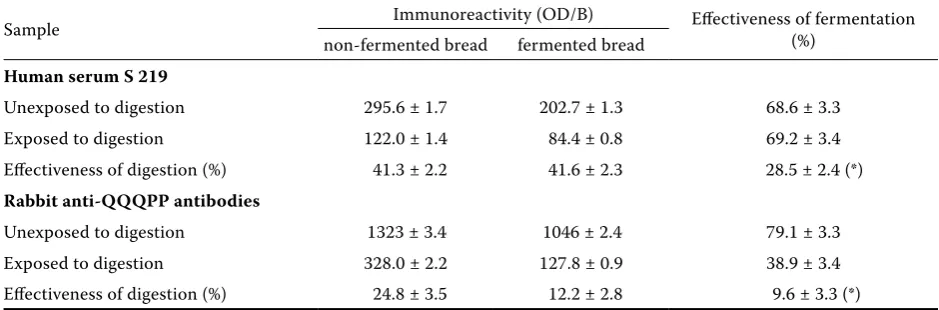
To confirm our results, we exposed the samples of baking made from both fermented and non-fermented dough to simulated digestion (Berti et al. 2003). The fermented baking samples made from flour exposed to digestion showed a much lower remaining immunoreactivity, approx. 1/4 relative to baking made from non-fermented flour in the assays with human serum and around 10% in those with rabbit serum (Table 6).
Our research proved that lactic acid bacteria are not capable of complete eradication of glia-dins immunoreactivity. This is not always crucial. Gliadins that were not hydrolysed in fermentation are more susceptible to proteolysis in the digestive tract and the products of the reaction indicate little or no celiac toxicity (Di Cagno et al. 2004; De Angelis et al. 2006).
Baking is considered as conducive to allergenicity increase when new epitopes are created as a result
Table 6. Immunoreactivity of bread made from either fermented or non-fermented dough and exposed to simulated digestion
Sample Immunoreactivity (OD/B) Effectiveness of fermentation (%) non-fermented bread fermented bread
Human serum S 219
Unexposed to digestion 295.6 ± 1.7 202.7 ± 1.3 68.6 ± 3.3 Exposed to digestion 122.0 ± 1.4 84.4 ± 0.8 69.2 ± 3.4 Effectiveness of digestion (%) 41.3 ± 2.2 41.6 ± 2.3 28.5 ± 2.4 (*)
Rabbit anti-QQQPP antibodies
Unexposed to digestion 1323 ± 3.4 1046 ± 2.4 79.1 ± 3.3 Exposed to digestion 328.0 ± 2.2 127.8 ± 0.9 38.9 ± 3.4 Effectiveness of digestion (%) 24.8 ± 3.5 12.2 ± 2.8 9.6 ± 3.3 (*)
[image:5.595.62.532.583.738.2]of Maillard reaction (Davis et al. 2001; Simonato et al. 2001). However, bread postdigestional immu-noreactivity is subject to change. After simulated digestion, wheat proteins extracted from fermented wheat bread cease to bind IgE from patients with wheat allergy (Rizzello et al. 2006). Our results also indicate that immunoreactivity of QQQPP epitopes in digested bread is strongly attenuated.
Our research allows to affirm that the proposed way of reducing allergenicity and immunogenicity of wheat flour is viable, even more so as fermentation is a natural process, which improves the organoleptic and healthy properties of the product.
CONCLUSIONS
The addition of baker’s yeast can entail an in-crease in gliadins immunoreactivity. This is prob-ably due to cross-reactivity.
The effectiveness of immunoreactivity reduction for wheat proteins caused by lactic acid fermenta-tion amounts to 20% up to 60% depending on the type of antibodies used.
The residual immunoreactivity of the final prod-ucts exposed to fermentation during the prepara-tion depends on the type of thermal processing used for dough.
For human antibodies, the effectiveness of the bread digestion does not depend on fermenta-tion. For rabbit antibodies it is in comparison, two-fold higher.
References
Battais F., Courcoux P., Popineau Y., Kanny G., Mo-neret-Vautrin D.A., Denery-Papini S. (2005): Food al-lergy to wheat: differences in immunoglobulin E-binding proteins as a function of age or symptoms. Journal of Cereal Science, 42: 109–117.
Berti C., Trovato C., Bardella M.T., Forlani F. (2003): IgA anti-gliadin antibody immunoreactivity to food pro-teins. Food and Agricultural Immunology, 15: 217–223. Corsetti A., Settani L., Valmorri S., Mastrangelo
M., Suzzi G. (2007): Identification of subdominant sour-dough lactic acid bacteria and their evolution during laboratory-scale fermentations. Food Microbiology, 24: 592–600.
Davis P.J., Smales C.M., James D.C. (2001): How can thermal processing modify the antigenicity of proteins? Allergy, 56 (Suppl. 67): 56–60.
De Angelis M., Rizzello C.G., Fasano A., Clemente M.G., De Simone C., Silano M., De Vincenzi M., Losi- to I., Gobbetti M. (2006): VSL#3 probiotic prepara-tion has the capacity to hydrolyze gliadin polypeptides responsible for celiac sprue. Biochimica et Biophysica Acta, 1762: 80–93.
De Vuyst L., Neysens P. (2005): The sourdough microflora: biodiversity and metabolic. Trends in Food Science and Technology, 16: 43–56.
Di Cagno R., De Angelis M., Lavermicocca P., De Vincenzi M., Giovannini C., Faccia M., Gobbetti M. (2002): Proteolysis of sourdough lactic acid bacteria: effects on wheat flour protein fractions and gliadin pep-tides involved in human cereal intolerance. Applied and Environmental Microbiology, 68: 623–633.
Di Cagno R., De Angelis M., Auricchio S., Greco L., Clarke C., De Vincenzi M., Giovannini C., D’Archivio M., Landolfo F., Parrilli G., Minervini F., Arendt E., Gobbetti M. (2004): Sourdough bread made from wheat and nontoxic flours and started with selected Lactobacilli is tolerated in celiac sprue patients.
Applied and Environmental Microbiology, 70: 1088–1096. Garcia E., Llorente M., Hernando A., Kieffer R.,
Wieser H., Méndez E. (2005): Development of a general procedure for complete extraction of gliadins for heat processed and unheated foods. European Journal of Ga-stroenterology and Hepatology, 17: 529–539.
Gobbetti M. (1998): The sourdough microflora: interac-tions of lactic acid bacteria and yeast. Trends in Food Science and Technology, 9: 267–274.
Gobbetti M., Corsett, A. (1996): Lactobacillus sanfran-cisco a key sourdough lactic acid bacterium: a review. Food Microbiology, 12: 78–90.
Hammes W.P., Gänzle M.G. (1998): Sourdough breads and related products. In: Woods B.J.B.: Microbiology of Fermented Foods. Vol. 1. Blackie Academic/Professional, London: 199–216.
Leszczyńska J., Łącka A., Bryszewska M., Brzezińska-Błaszczyk E. (2008): The usefulness of rabbit anti-QQQPP peptide antibodies to wheat flour antigenicity studies. Czech Journal of Food Sciences, 26: 24–30. Leszczyńska J., Diowksz A., Łącka A., Bryszewska M.,
Wolska K., Ambroziak W. (2009): Decrease of wheat flour allergenicity via lactic acid fermentation. Food and Agricultural Immunology, 20: 139–145.
Liljeberg H.G.M., Bjōrck I.M.E. (1996): Delayed gastric emptying rate as a potential mechanisms for lowered glyce-mia after eating sourdough bread: studies in humans and rats using test products with added organic acids or an organic salt. American Journal of Clinical Nutrition, 64: 886–893. Loponen J., Mikola M., Katina K., Sontag-Strohm T.,
during wheat sourdough fermentations. Cereal Chemis-try, 81: 87–93.
Palosuo K. (2003): Update on wheat hypersensitivity.
Current Opinion in Allergy and Clinical Immunology, 3: 205–209.
Rizello C.G., de Angelis M., Coda R., Gobbetti M. (2006): Use of selected sourdough lactic acid bacteria to hydrolyze wheat and rye proteins responsible for cereal allergy. European Food Research and Technology, 223: 405–411.
Rollan G., De Angelis M., Gobbetti M., de Valdez G.F. (2005): Proteolytic activity and reduction of gliadin-like fractions by sourdough lactobacilli. Journal of Applied Microbiology, 99: 1495–1502.
Shan L., Molberg O., Parrot I., Hausch F., Filiz F., Gray G.M., Sollid L.M., Khosla C. (2002): Structural basis for gluten intolerance in celiac sprue. Science, 297: 2275–2279.
Simonato B., Pasini G., Giannattasio M., Peruffo A.D.B., De Lazzari F., Curioni A. (2001): Food allergy to wheat products: the effect of bread baking and in vitro
digestion on wheat allergenic proteins. A study with bread
dough, crumb, and crust. Journal of Agricultural and Food Chemistry, 49: 5668–5673.
Spicher G., Nierle W. (1988): Proteolytic activity of sour-dough bacteria. Applied Microbiology and Biotechnology,
28: 487–492.
Stolz P. (1999): Microbiologie des Sauerteiges. In: Spicher G., Stephan H. (eds): Handbuch Sauerteig: Biologie, Biochemie, Technologie. 5th Ed. Behr’s Verlag, Hamburg:
35–60.
Tanabe S., Arai S., Yanagihara Y., Mita H., Takahashi K., Watanabe M. (1996): A major wheat allergen has a Gln-Gln-Gln-Pro-Pro motif identified as an IgE-binding epitope. Biochemical and Biophysical Research Commu-nications, 219: 290–293.
Watanabe M., Tanabe S., Suzuki T., Ikezawa Z., Arai S. (1995): Primary structure of an allergen peptide occurring in the chymotryptic hydrolysate of gluten. Bioscience, Biotechnology, and Biochemistry, 59: 1596–1597.
Received for publication March 28, 2011 Accepted after corrections August 19, 2011
corresponding author:
PhD. Joanna Leszczyńska, Technical University of Łodź, Faculty of Biotechnology and Food Sciences, Institute of General Food Chemistry, Stefanowskiego 4/10, 90-924 Łodź, Poland