JOURNAL OF FOREST SCIENCE, 50, 2004 (1): 47–54
Forestry is a typical example of production and services industry where the influence of the external environment is very significant. The working environment is a living environment as well and vice versa. And it is just here where the positive or negative relationship of the environ-ment to workers becomes useful. Workers in the Czech Republic typically have a negative relationship to the en-vironment because it strains and harms them. They think of the environment as of endangering, harmful, or even as their enemy, and it also shows in their work. The result of this attitude is careless execution of work that dam-ages the environment. Damage to the environment occurs though there is an increased effort to introduce environ-mentally friendly technologies. Although the technologies are just man’s tools, it depends how these tools are used. Even though the technology can be good, it always de-pends whether humans are able and/or willing to use the technology cautiously not to harm the environment. If hu-mans are careless towards the (working) environment, that means they do not have any knowledge of ecology (state of unknowing indifference), they have minimal sensitivity and no responsibility. Thus their use of these technolo-gies thereby would harm and destroy the environment. In consequence,if workers did not significantly change their attitude to their environment, we cannot expect the (working) environment to get any better. A condition to this needed cultural adaptive change is an understanding of relationships and structures of ecosystems and social systems and also an understanding of functional display of behaviour, of their parts and elements, and to build an atmosphere of ethical support.
It is a known fact that the impairment of the environ-ment, especially pollutants from industrial production, has
a negative impact on the health of the population in some areas. However, a less known fact is what this information does in the minds of people and how it affects their behav-iour. The major goal of this presented project was to find out a reflection of the cultural system of perception and experiencing the environment in the mind of a man. That means in hypothetical substructures by filling of cogni-tive part, ecologic sensitivity and personal responsibility towards the state of the environment. Furthermore, we wanted to discover mutual relationships, including the impacts of personal anamnesis, social background, level of the environment pollution and finally the consequences of their influence on the development of character and characteristics of behaviour (PERNICA unpubl.).
We assume a hypothetical existence of three important parts of the human mind: cognitive, emotive and cona-tive part of mind (KRETCH et al. 1962). By analogy, we deduced hypothetic cultural aggregates of ecological con-sciousness, that means ecological mind, ecological sen-sitivity, responsibility and reflected ecological behaviour. The result of the process of cultural adaptation in which these parts of the human mind markedly participate should be ecological activity leading to the effective self-reflec-tion of humankind: from the current unstable relaself-reflec-tionship of a man to nature to future symbiotic partnership and forehandedcooperation with nature.
The impact of environmental factors affects momen-tarily especially the part of experience, that means emo-tions and current part of psychological stability, named as ecological sensitivity for working purposes. Long-term factors affect attitude, value orientations and character features (PODRABSKÝ1987). We assume that perceived information is accumulated and afterwards affects
Forestry students and workers and their attitudes towards
the environment
M. P
ERNICAMendel University of Agriculture and Forestry, Faculty of Forestry and Wood Technology,
Brno, Czech Republic
ABSTRACT: In any activity, thus at work as well, there is an influence of the environment on a human being. This environment, to which every worker has his own individual relationship, becomes a part and background of the worker’s life. The realization of these interactions and relationships markedly affects achieved working results. The ecologically harmless technologies will not be used in forestry considerately towards the environment if forestry workers do not change their negative attitudes to their environment. In this project we tried to map out environmental knowledge of forestry workers.
changes in the dispositional part of psychological stability, which we call as filling of the cognitive part of ecological consciousness and restructuring of personality. We know that impacts of the environment are directly or indirectly provable, thus after the education we expect a change in attitude towards the environment contrary to the former common attitude, that means the state of unknowing in-difference. This attitude was caused by the fact that the motivational structure of the absolute majority of people was not stimulated to activity because of the absence of any cognitive information reflecting relationships between man and the environment.
A working hypothesis is that we suppose that the cog-nitive part of the mind influences all other hypothetical parts of the ecological mind and behaviour. The emotional part predetermines an attitude to ecological responsibil-ity. Emotional experience is related to personal and fam-ily anamnesis and also influences an interest in another cognition. Repleteness of cognitive and emotional part activates the processes of responsibility and judgments. Ecological responsibility should lead to reflected ecologi-cal behaviour that is predetermined by anamnestic family background. By self-reflection of man we understand the resolution of a human being toward the environment that is based on representation (I am…), self-image (I should be…), orientation (I want to be…), power (I can do…) and definition of society role (I am expected to do…).
METHOD AND MATERIAL
We used the method of questionnaire inquiry as the main method of our research. The questionnaire consisted of two main parts. The first part of the questionnaire was queries that concerned respondents’ attitudes towards the environment. This part comprised 31 multiple-choice questions where the respondent had a choice of several answers that reflected his emotional attitude, cognitive repletion or ecological responsibility. The second part was dedicated to queries about respondents’ personal back-grounds. These 19 queries served as sorting criteria.
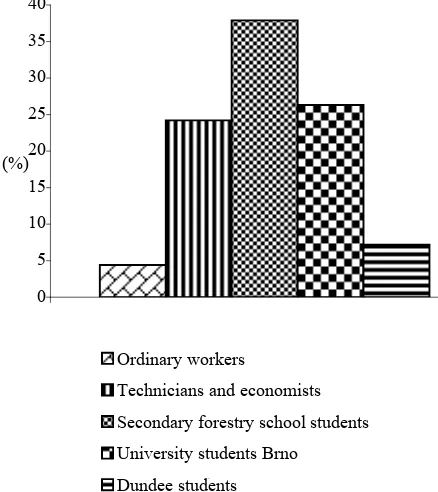
We collected questionnaires from a sample of 905 peo-ple working in or training for an occupation in forestry. The actual sample consisted of 343 secondary school students (37.9% of the whole sample) who studied at forestry schools in the Czech Republic in Hranice (116), Písek (88), Šluknov (30), Trutnov (54) and Žlutice (55). Other 238 university students were from the Faculty of Forestry and Wood Technology, Mendel University of Agriculture and Forestry in Brno (26.3%), 183 of them in Forestry Sciences and 55 in Landscape Sciences. These university subjects and secondary school students prepared themselves for a forestry occupation, but after a few years they will create an essential part of middle management. We obtained data from 65 Scottish students from University of Dundee (7.2 %). The data from these students were compared with data from Czech university students. We assumed better ecological knowledge and cognitional fulfilment of Dundee students because the
education of ecology has been on a higher level in Western Europe than in the Czech Republic in the last decades. We also questioned 206 technicians and economists (24.2%), namely from the school forestry firm Křtiny and from forestry companies in Bučovice, Kašperské Hory, Náměšť nad Oslavou, Ostrava, Svitavy, Tišnov and Znojmo. Tar-get groups of actual workers however consisted only of 40 occasional labourers from the school firm Křtiny and other forestry firms. In this latter group there existed great neediness. We did not know how to obtain data from the people who directly operated the new technologies that were considerate to the environment, to be accomplish-ing an intended aim – sustainable development in the forestry. The argument is simple: there is a cost for the employer since each worker-respondent loses about 3/4 of an hour completing our questionnaire, which reduces the employer’s profit, and we are not able to refund wages due to financial constraints. Neither will workers them-selves abstain from work by filling in some “useless” questionnaires. The control management is not disposed to disengage them nor to “unnecessarily” restrain them from productive work. The graph shows the structure of our sample of respondents.
The whole data file was statistically processed by SPSS Base program 11.0.
0% 5% 10% 15% 20% 25% 30% 35% 40% 1 Ordinary workers
Technicians and economists Secondary forestry school students University students Brno
Dundee Students 40 35 30 25 20 15 10 5 0 (%) students
SELECTED RESULTS AND DISCUSSION
Questions number 7, 9, 13, 14, 16 and some informa-tion on personal anamnesis were chosen to introduce our research.
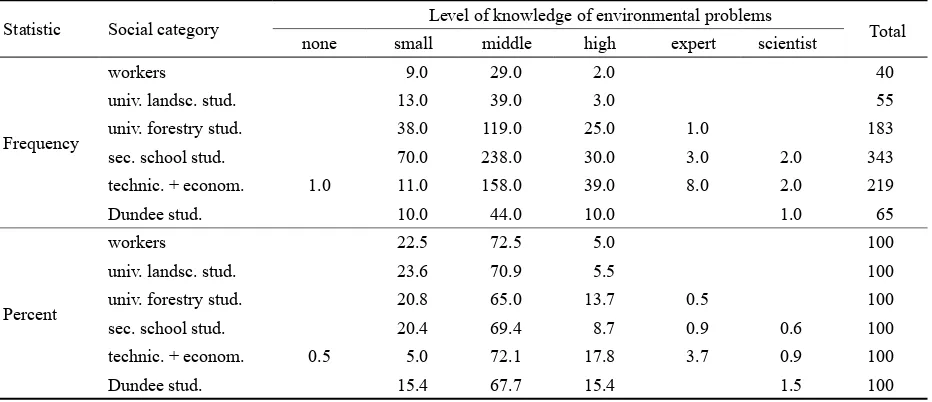
[image:2.595.307.526.363.609.2]hypothesis would contradict to the influence of age on ful-filment of the cognitive component of the consciousness. However, from the results we can see the inadequacy of reviewing of ecological knowledge by secondary school students, technicians and economists and students of Dundee University who presumptuously marked them-selves as experts and even as scientists. The “scientists” did not know about any concrete action trying to retrieve damage to the environment (except one respondent), and from those who marked themselves as “experts”, 60% did not mention anything in response to this same question. Furthermore, the four “scientists” did not introduce any concrete example of consequences of damaged environ-ments in the districts of their permanent residence. This
is a demonstration of how we detected “kidders” and we calculated lie-score by means of contingency tables of various variables.
From the next two tables we can see the influence of the education on environmental valuation (question No. 7).
[image:3.595.66.532.73.274.2]We can see from Table 3 that the differences between apprentices and secondary school and university students are not significant in terms of their evaluation of the envi-ronment. Does it mean that the frequency varieties are only accidental or are learners more optimistic? In any case, in the valuation of their own attitudes, 64.5% of learners did not respond, which documented their smaller knowledge or their inconsistent omission in the valuation of their own attitudes. In any case it is explicit that respondents’ fears Table 1. Level of knowledge (self-assessment) of environmental problems according to the social categories
Statistic Social category Level of knowledge of environmental problems
none small middle high expert scientist total
Frequency
workers 9.0 29.0 2.0 40
univ. landsc. stud. 13.0 39.0 3.0 55
univ. forestry stud. 38.0 119.0 25.0 1.0 183
sec. school stud. 70.0 238.0 30.0 3.0 2.0 343
technic. + econom. 1.0 11.0 158.0 39.0 8.0 2.0 219
Dundee stud. 10.0 44.0 10.0 1.0 65
Percent
workers 22.5 72.5 5.0 100
univ. landsc. stud. 23.6 70.9 5.5 100
univ. forestry stud. 20.8 65.0 13.7 0.5 100
sec. school stud. 20.4 69.4 8.7 0.9 0.6 100
technic. + econom. 0.5 5.0 72.1 17.8 3.7 0.9 100
[image:3.595.63.534.308.365.2]Dundee stud. 15.4 67.7 15.4 1.5 100
Table 2. Means of the level of knowledge concerning environmental problems
Social category Workers Un. landsc. students Un. forest. students Second. school students Technic. + econom. Dundee stud.
Mean of knowledge* 2.83 2.82 2.94 2.92 3.22 3.05
95% interval reliability 2.64–3.02 2.68–2.96 2.85–3.03 2.85–2.98 3.13–3.31 2.89–3.20 *mean is computed from score numbers 1–6 that were assigned to each level of knowledge about environmental problems
Table 3. Valuation of the environmental quality in districts of inhabitancy
Statistic Level of education Quality of the environment
it is good it is moderate it is bad total
Frequency
basic 1.0 2.0 3
apprenticeship 2.0 3.0 5
secondary school 69.0 108.0 5.0 182
university 55.0 90.0 17.0 162
Percent
basic 33.3 66.7 100
apprenticeship 40.0 60.0 100
secondary school 37.9 59.3 2.7 100
university 34.0 55.6 10.5 100
Total
[image:3.595.64.536.612.755.2]become numerous with increasing education level, which is consistent with the initial hypotheses. Here, the differ-ence is statistically significant (P < 0.05).
It is evident from the data gathered so far that over two thirds of respondents answered that their knowledge of environmental problems was intermediate. We now ex-amine how they evaluate the environment in the district of
their permanent residence in comparison with the reality determined according to the specifications made in the ecological data bank of TERPLAN Prague 1990.
[image:4.595.65.536.72.250.2]There is a statistically significant drift to moderate values. Over a half of the respondents pessimistically designated the environmental quality in relatively unpol-luted districts as moderate. On the contrary, in districts Table 4. Valuation of own attitudes towards the given environment in the district of inhabitancy
Statistic Level of education
Attitude towards the environment
it is all one to me
there are problems, but I have no anxiety
there are so many problems
that I am concerned
no answers Total
Frequency
basic 1.0 2.0 3
apprenticeship 9.0 2.0 20.0 31
secondary school 12.0 262.0 49.0 141.0 464
university 12.0 192.0 68.0 135.0 407
Percent
basic 33.3 66.7 100
apprenticeship 29.0 6.5 64.5 100
secondary school 2.6 56.5 10.6 30.4 100
[image:4.595.65.531.382.542.2]university 2.9 47.2 16.7 33.2 100
Table 5. Valuation of environmental quality in the district of their permanent residence as to its real quality (question No. 7)
Real quality Statistic Designated quality of the environment Total
it is good it is moderate it is bad Relatively
unpolluted environment
count 101.0 129.0 5.0 235.0
expected count 84.8 135.5 14.7 235.0
% within quality of the env. 43.0 54.9 2.1 100.0
Highly polluted environment
count 26.0 74.0 17.0 117.0
expected count 42.2 67.5 7.3 117.0
% within quality of the env. 22.2 63.2 14.5 100.0
Total
count 127.0 203.0 22.0 352.0
expected count 127.0 203.0 22.0 352.0
% within quality of the env. 36.1 57.7 6.3 100.0
Table 6. Data acquired from question No. 7: “How do respondents perceive the environment within which they live?”
Real quality Statistic
Attitudes of respondents
Total it is all one to me problems, but I there are
have no anxiety
there are so many problems that I
am concerned Relatively
unpolluted environment
count 9.0 124.0 26.0 159.0
expected count 10.0 114.7 34.3 159.0
% within quality of the env. 5.7 78.0 16.4 100.0
Highly polluted environment
count 7.0 60.0 29.0 96.0
expected count 6.0 69.3 20.7 96.0
% within quality of the env. 7.3 62.5 30.2 100.0
Total
count 16.0 184.0 55.0 255.0
expected count 16.0 184.0 55.0 255.0
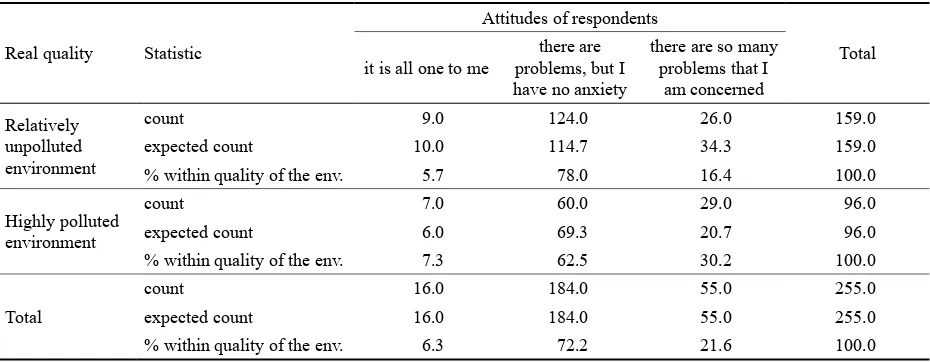
[image:4.595.65.530.575.756.2]with intermediate environmental quality over one third of the respondents optimistically designated environmental quality as good. And in districts with highly polluted environments, almost one quarter of the respondents designated environmental quality as good and over a half of them as moderate. From this it can be seen that the respondents’ answers are significantly different from reality. Thus incorrect reasons can come into existence as a consequence of limited knowledge. This finding means that saturation of the cognitive component of respondents’ consciousness by knowledge of the environment is weak, false positive and it is burdened by highly subjective mis-takes, which contradicts their assumptions that they have moderate knowledge of their environment!
There are positive findings that the attitudes expressed by answers “It is all one to me”, namely in the districts with relatively unpolluted environment, decreased highly statistically significantly, contrary to the primary research
conducted by ŠEDIVÝ (1994). It is also important that the concern for the environment increases in respondents from districts of inhabitancy with intermediately and highly polluted environments. However, the concern among the respondents that damage to the environment and indirect, consequential effects on health continue to be poor motivators towards positive ecological attitudes and approaches.
[image:5.595.62.537.72.203.2]The valuation of forestry influence between groups is not statistically significant; differences in frequency are stochastic only. It is alarming that 18.7% of graduated respondents think of forestry as endangering or without influence on the environment. Differences in frequencies about the valuation of agriculture are statistically signifi-cant on 0.05 level of statistical significance. A higher pro-portion of respondents from the apprenticeship understand that agriculture contributes to the improvement of the en-vironment, and none of them stated heavy deterioration Table 7. Valuation of the influence of agriculture on the environment according to education (question No. 9)
Education Basic Apprenticeship Second. school University
Influence of agriculture on environment N (%) N (%) N (%) N (%)
Contributes to its betterment 1 33.3 10 32.3 40 8.6 46 11.3
Has no influence 1 33.3 3 9.7 42 9.1 20 4.9
Damages to a little extent 1 33.3 11 35.5 235 50.6 215 52.8
Has a worsening impact 1 3.2 91 19.6 85 20.9
I do not know 5 16.1 34 7.3 26 6.4
No answer 1 3.2 22 4.7 15 3.7
[image:5.595.62.534.236.367.2]Total 3 100.0 31 100.0 464 100.0 407 100.0
Table 8. Valuation of the influence of forestry on the environment according to education (question No. 9)
Education Basic Apprenticeship Second. school University
Influence of forestry on environment N (%) N (%) N (%) N (%)
Contributes to its betterment 3 100 20 64.5 312 67.2 224 55.0
Has no influence 2 6.5 57 12.3 32 7.9
Damages to a little extent 7 22.6 77 16.6 95 23.3
Has a worsening impact 1 3.2 5 1.1 20 4.9
I do not know 1 3.2 10 2.2 24 5.9
No answer 3 0.6 12 2.9
Total 31 100.0 464 100.0 407 100.0
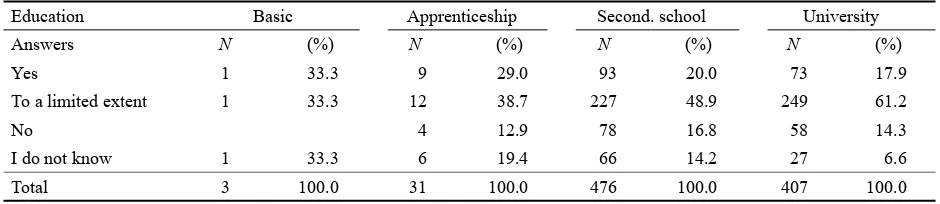
Table 9. Answers according to the education level to question No. 16: “Can industrial production be extended without devastating the environment?”
Education Basic Apprenticeship Second. school University
Answers N (%) N (%) N (%) N (%)
Yes 1 33.3 9 29.0 93 20.0 73 17.9
To a limited extent 1 33.3 12 38.7 227 48.9 249 61.2
No 4 12.9 78 16.8 58 14.3
I do not know 1 33.3 6 19.4 66 14.2 27 6.6
[image:5.595.62.532.654.756.2]of the environment while these answers were given by 19.6% of secondary school students and 20.9% of univer-sity students. It is also remarkable that the valuation of the influence of agriculture is according to the respondents’ answers on average about 1.5-scale degree worse than the valuation of forestry influence.
Seemingly similar is another question by asking it we look for respondents’ valuation of the influence of industrial production upon the environment. Testing the distribution of percent frequencies by means of chi-square test at 0.05 level of statistical significance reveals that there is a relationship between the education level and the evaluation of industrial production impact. With increas-ing education there is a decrease in positive answers, i.e. a decrease in false optimism.
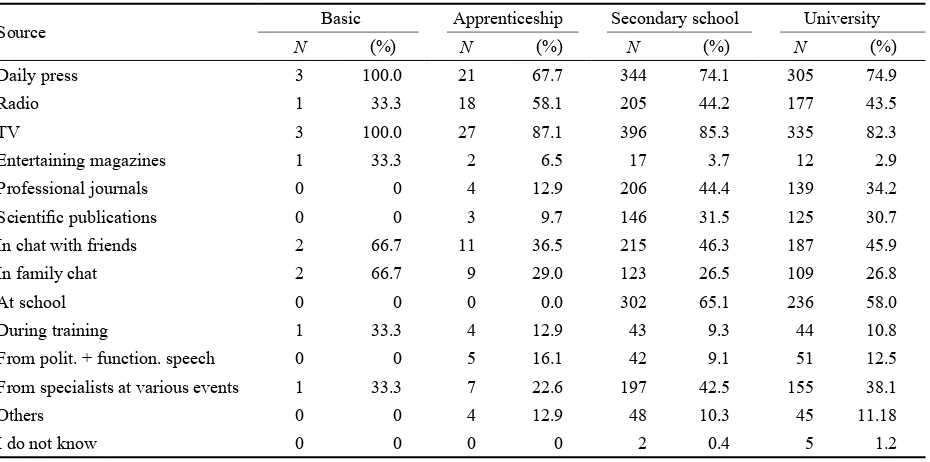
When we demonstrate from where respondents draw the information about ecology and consequences of the environment deterioration, it is less surprising that there exists a lack of real knowledge.
We found out that mass media led without any doubt: TV (84%), followed by daily press (74%) and radio (44%) are at the first place. From these sources true and com-plex information is communicated. School as a source is at the second place with 59.4% (statistical difference in frequencies on 0.05 level of significance). It is remarkable that school as a source did not impact upon any of the ap-prentices. It is disappointing that the role of school was mentioned only by about two thirds of the respondents as a source of information. Chats with friends (c. 42%) are at the third place; they have special meaning for young respondents. Data from experts and from professional journals was important (c. 30%) (statistical difference in frequencies on 0.05 level of significance). Over 20% of respondents make use of family chat and scientific publications.
CONCLUSION
[image:6.595.67.532.82.313.2]Important, but expected changes in the knowledge of forestry community about the environment are still far from being realized. Mainly opinions of graduated respondents or university students are very alarming. Almost 20% of these respondents think of forestry as endangering or without influence on the environment. This fact is important because these respondents are or will be managers with responsibility for environmentally friendly forest management. An effort to introduce and use new technologies considerate to the environment should have positive effects in future. It means that the only way of pushing forward correctly operating new technologies is in the first stage, only outwardly, by means of continual checks and sanctions, and this will continue to be so until the “ecological” knowledge of the population is improved, especially in fieldworkers and managers affecting long-term objectives of environ-ment protection and creation. However, internal changes through, for example, teaching ecological information from youth, in primary schools, in apprenticeship and secondary schools, have to play an important role in the younger generation because in the foreseeable future these students will be executive workers and managers of basal grades of control, and they will become middle managers with a decision-making authority and responsi-bility in the given task. We will try to compare our results with those in other countries. It appears that filling of the cognitive component of consciousness is still impossible to enforce. Another possibility how to enforce the consid-erate execution of work is seen in the transformation of forestry into a functionally integrated system of manage-ment where requiremanage-ments for environmanage-mentally friendly production play a major role.
Table 10. Sources of information about consequences of environment deterioration according to the level of education (question No. 13)
Source Basic Apprenticeship Secondary school University
N (%) N (%) N (%) N (%)
Daily press 3 100.0 21 67.7 344 74.1 305 74.9
Radio 1 33.3 18 58.1 205 44.2 177 43.5
TV 3 100.0 27 87.1 396 85.3 335 82.3
Entertaining magazines 1 33.3 2 6.5 17 3.7 12 2.9
Professional journals 0 0 4 12.9 206 44.4 139 34.2
Scientific publications 0 0 3 9.7 146 31.5 125 30.7
In chat with friends 2 66.7 11 36.5 215 46.3 187 45.9
In family chat 2 66.7 9 29.0 123 26.5 109 26.8
At school 0 0 0 0.0 302 65.1 236 58.0
During training 1 33.3 4 12.9 43 9.3 44 10.8
From polit. + function. speech 0 0 5 16.1 42 9.1 51 12.5
From specialists at various events 1 33.3 7 22.6 197 42.5 155 38.1
Others 0 0 4 12.9 48 10.3 45 11.18
References
KRETCH D., CRUTCHFIELD R.S., BALLANGHEY E.L., 1962. Man in Society. New York, Holt, Rineart, Winston, Inc.: 564.
PODRABSKÝ J., 1987. Environmentální stimulace, faktory a vlivy na psychiku. [Prac. zpráva.] Praha, Ústav racionalizace a řízení práce: 87.
ŠEDIVÝ V., 1994. Ekologická antropologie šestnáctiletých hochů. Brno, Masarykova univerzita: 115.
Received for publication August 15, 2003 Accepted after corrections September 29, 2003
Studenti lesnictví a pracovníci v lesním hospodářství a jejich postoje k životnímu
prostředí
M. PERNICA
Mendelova zemědělská a lesnická univerzita, Lesnická a dřevařská fakulta, Brno, Česká republika
ABSTRAKT: Při každé lidské činnosti, tedy i při práci, působí životní prostředí na lidské bytosti a naopak. Toto životní prostředí, ke kterému si každý pracovník vytvoří určitý vztah, se stává částí a pozadím pracovníkova života. Realizace těchto interakcí a vztahů významně ovlivňuje pracovní výsledky. Ekologicky šetrné technologie nebudou v lesním provozu ohleduplně používány, pokud pracovníci nezmění svůj negativní postoj k životnímu prostředí. V projektu jsme se pokusili zmapovat environmentální vědomosti pracovníků v lesním hospodářství.
Klíčová slova: sociální percepce; životní prostředí; technologie v lesnictví; chování
Životní prostředí hraje v životě člověka velmi význam-nou roli. Prostřednictvím vzájemných interakcí se životní prostředí a pracovníci ovlivňují. Tento vzájemný vliv je markantní zejména v takových oborech, jako je lesnictví. Je všeobecně znám vliv životního prostředí na tělesnou konstituci člověka, ale méně již víme, co se odehrává ve vědomí pracovníků. Cílem výzkumu bylo tedy zmapovat hypotetický systém ekologického vědomí (ekologické vědomosti, postoje a názory a orientačně postihnout škálu environmentálního chování) a případně i zachytit faktory jeho aktivace.
Jako základní metoda bylo použito dotazníkové šetření, kdy se dotazník skládal z části anamnestické a z části obsahující dotazy na vědomosti, názory a postoje respondentů. Pro vyhodnocení výsledků bylo použito metod popisné statistiky a metod komparatistiky. Soubor respondentů tvořili studenti středních lesnických škol, studenti lesního a krajinného inženýrství Mendelovy zemědělské a lesnické univerzity v Brně, THP pracov-níci a dělpracov-níci ze ŠLP, LČR, s. p., a z lesních akciových společností. Podařilo se získat i 65 dotazníků od studentů University of Dundee ve Skotsku.
Výsledky by se daly rozdělit do tří skupin: 1. část zkou-mající kognitivní složku vědomí, 2. část zkouzkou-mající emo-tivní a odpovědnostní složku vědomí a 3. část zkoumající vlastní ekologické chování respondentů. Na základě zjištěných výsledků můžeme konstatovat, že respondenti mají malou naplněnost kognitivní složky vědomí. Jsou ovlivněni především masmédii, která poskytují poměrně
nekvalitní informace o problematice životního prostředí. Potěšující je fakt, že škola jako zdroj nabývá na důležitosti, avšak optimum je ještě daleko. Z výsledků tedy vyplývá, že naplněnost kognitivní složky souvisí především s dosaženým vzděláním; prokázal se i rozdíl mezi stu-denty MZLU a stustu-denty z Dundee. Velice znepokojivým zjištěním je fakt, že zejména vysokoškolské kádry – ať už v pracovním procesu, nebo teprve se připravující na výkon svého povolání na vysoké škole – považují lesní hospodaření velmi často za poškozující ŽP či bez vlivu na ŽP. Předpoklad, že ekologická citlivost je heterogeni-zována kognicí a ekologické chování kognicí a působením citlivosti, se nám potvrdil. Nízká úroveň kognice ovlivňuje negativně i citlivost, kdy respondenti nezapojují do vnímání okolí myšlenkové procesy a využívají pouze senzorický aparát. Tato skutečnost je totožná s výsledky
ŠEDIVÉHO (1994), i když jsem zaznamenal jistý pozi-tivní posun směrem k zapojování myšlenkových procesů v poznávání svého okolí. Potěšitelný je nárůst případů aktivního ekologického chování proti roku 1994.
to, že ovlivnění lesních dělníků, aby zacházeli s moderními technologiemi šetrnými k ŽP, je zatím vynutitelné pomocí represí a neustálé kontroly jejich pracovního chování. Ale současně by se měly nastartovat vzdělávací kursy a semináře, které by naplnily kognitivní složku a po-změnily, event. změnily postoj pracovníků k ŽP.
Doufej-Corresponding author:
Ing. MICHAL PERNICA, Poličská 32, 568 02 Svitavy, Česká republika tel.: + 420 461 534 066, e-mail: [email protected]