Reduction of phosphorus excretion into the en-vironment has become one of the most important tasks in modern poultry production. As it is a meral essential for poultry growth, it is of special in-terest that diets fulfil poultry needs for phosphorus. Poultry diets are usually based on cereals in which 50–70% of total phosphorus is bound in the form of phytate, which is unavailable to the poultry due to the lack of the enzyme phytase. Additionally, nutritional problems arise because phytate makes complexes with minerals (calcium, magnesium, iron and zinc) and proteins (Enzymes in Animal Nutrition, 1998). Ca-phytate complexes bind starch (Thompson and Yoon, 1984; Thompson, 1988) and inhibit α-amylase activity (Deshpande and Cheryan, 1984), reducing solubility and digestibility of starch in this way. Phytates also form insoluble complexes with fatty acids and inhibit pepsin activity.
Nowadays two approaches to solving this prob-lem dominate: addition of phytase, enzyme that hydrolyses phytate acid, or using genetically
modi-fied cereals with lower phytate phosphorus content (Li et al., 2000; Waldroup et al., 2000).
Supplementation of enzymes to animal diets has been approved because they are natural fermen-tation products and therefore they do not pose a threat to animal and human health (Guenter, 1997). Supplemental enzymes are digested in the same way as other proteins and their residues are not present in the excreta (Enzymes in Animal Nutrition, 1998).
Numerous studies have shown beneficial effects of phytase supplementation on total and phytate phosphorus, calcium and nitrogen retention and excretion in broilers fed maize-soybean meal based diets (Sebastian et al., 1996a, 1997; Simons et al., 1990; Broz et al., 1994; Yi et al., 1996) but investiga-tions with diets based on other cereals are scarce. Ravindran et al. (1999) showed that supplementa-tion of phytase (1 200 PU/kg) improved the di-gestibility of protein and amino acids in maize, sorghum and wheat based diets. The magnitude
Effects of supplemental phytase on nutrient excretion
and retention in broilers fed different cereal based diets
J. PINTAR
1, B. HOMEN
1, K. GAZIĆ
1, Z. JANJEČIĆ
1, M. SIKIRIĆ
1,2, T. ČERNY
11Department of Animal Nutrition, Faculty of Agriculture, University of Zagreb, Croatia 2Laboratory of Radiochemistry, Ruđer Bošković Institute, Zagreb, Croatia
ABSTRACT: A 21-day experiment with day-old broilers was conducted in order to assess the effect of phytase supplementation to different cereals-soybean meal based diets on nitrogen, calcium, total and phytate phosphorus excretion and retention. Diets were formulated to contain 4 different cereals (maize, wheat, triticale and barley), 2 levels of dietary calcium (0.6 and 1.0%) and 3 levels of supplemental phytase (0, 500 and 1 000 PU/kg). Nutri-ent intake, excretion and retNutri-ention were determined in the first three days of the 2nd and 3rd week of trial. The increasing phytase level resulted in reducing phytate phosphorus excretion and increasing its retention. Significant differences were obtained only in the 2nd week (excretion P < 0.024 and retention P < 0.044). Phytase supplementa-tion significantly influenced total phosphorus excresupplementa-tion in the 3rd week (P < 0.048) and retention in the 2nd week (P < 0.015). The effects of 500 and 1 000 PU/kg were not statistically different from each other. No significant influence of phytase supplementation on nitrogen and calcium excretion and retention was observed.
Keywords: maize; wheat; triticale; barley; phytase; nitrogen; calcium; total phosphorus; phytate phosphorus; excre-tion; retention
of response varied between cereals. Supplemental phytase improved phosphorus retention in broilers fed wheat (Leske and Coon, 1999; Zyla et al., 2000), wheat midds, barley, defatted rice bran and canola based diets (Leske and Coon, 1999).
The aim of this investigation was to determine and compare the effects of phytase supplementa-tion to diets based on maize, wheat, barley and triti-cale on the broiler performance, nutrient retention and excretion, as well as bone mineralization. In the preceding paper we showed that the magnitude of beneficial effect of phytase supplementation on broiler performance varied between different cere-als and calcium levels (Pintar et al., 2004). In this paper the effects on nitrogen, calcium, total and phytate phosphorus excretion and retention are presented.
MATERIAL AND METHODS
Materials and manipulation. Two hundred forty-five day-old commercial male broiler chicks (Ross) were randomly assigned to 24 pens. Chickens were weighed on Mettler electrical balance (± 0.1 g). Average body weights in different groups were not statistically different.
The chicks were maintained in wire-floored pens with separated excreta trays, placed in an environ-mentally controlled room. The birds received con-stant electrical illumination.
Diets. The study was conducted as a 4 × 3 × 2 factorial arrangement of treatments to evaluate the effects of four cereals (maize, wheat, barley and triticale), three levels of supplemental phytase (0, 500 and 1 000 PU/kg) and two levels of calcium (0.6 and 1.0%) on broiler response. Feed and water were made available for ad libitum consumption.
Diet ingredients were obtained in bulk. The Novo CT (Novo Nordisk) phytase was used. Both ingre-dients and diets were analysed for moisture, ash, protein, fat, fibre, calcium and total phosphorus by usual methods ( ISO 6490-1, 1985; ISO 5983, 1997; ISO 6491, 1998; ISO 6496, 1999; ISO 5498, 1999; ISO 6492, 1999; ISO 5984, 2002). Phytate phosphorus content was determined according to Sooncharernying and Edwards (1993). In brief, phytate was selectively precipitated with FeCl3 × 6 H2O from an extract obtained after 24 hours of sample extraction with the solution of HCl and Na2SO4. The precipitate was degraded in a mixture of concentrated H2SO4 and HNO3 (2 : 3). The
con-tent of phytate phosphorus in the obtained solution was determined by the usual spectrophotometric method for phosphorus determination (ISO 6491, 1998). Compositions of diets are given in Table 1. Retention and excretion. During the first three days of the 2nd and 3rd week of trial all excreta were collected from each pen and feed consumption was determined. Excreta were stored in plastic bags at –20°C. Before chemical analysis samples were de-frosted, homogenized and dried at 60°C. Then they were weighed and ground to pass a 1-mm sieve. Calcium, nitrogen, total and phytate phosphorus contents were determined by the same chemical methods used in diet analysis. Retention was cal-culated as follows:
% Retention = (consumed – excreted) × 100/consumed Statistics. Three-way ANOVA was used to de-termine main effects (cereals, phytase and cal-cium levels) and their interactions using General Linear Models procedure. Mean differences were separated by Tukey’s test. The level of significance was set at P < 0.05. The data were analysed by the General Linear Models procedure of the SAS8.00 (SAS Institute, 1999).
RESULTS
Nutrient excretion
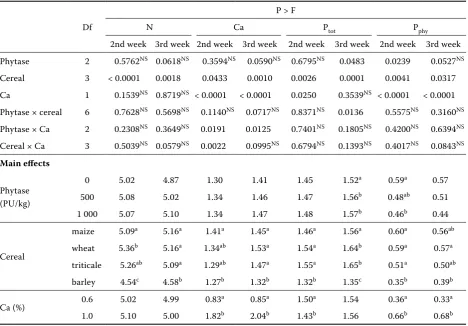
Average nitrogen, calcium, total and phytate phosphorus excretions in the 2nd and 3rd week of trial are listed in Table 2.
Main effects of cereals on nitrogen excretion were observed in both weeks of trial (P < 0.0001 and 0.0018, respectively). In both weeks the highest ni-trogen excretion was observed in broilers fed wheat based diets and lowest in those fed barley based diets. In the 3rd week broilers that were fed maize, wheat and triticale based diets had significantly higher nitrogen excretion in comparison with those fed barley based diets.
signifi-cantly higher than in those fed barley based diets. In both weeks significantly higher Ca excretion was observed in broilers fed diets containing 1.0% Ca (P < 0.0001). Several significant interactions were observed. In the 2nd week a cereal × Ca interac-tion was significant (P < 0.0022). Ca excretion of broilers fed diets containing 0.6% Ca decreased in the order wheat > barley > maize > triticale, while in those fed diets containing 1.0% Ca in the order maize > triticale > wheat ≈ barley. In both weeks a Ca × phytase interaction was significant (P < 0.0191
and 0.0125, respectively). In the 2nd week Ca ex-cretion of broilers fed diets containing 0.6% Ca de-creased while in those fed diets containing 1.0% Ca it increased with increasing supplemental phytase. In the 3rd week Ca excretion of broilers fed diets containing 0.6% Ca decreased in the order 500 > 1 000 ≈ 0 PU/kg, while in those fed diets containing 1.0% Ca it increased again with increasing supple-mental phytase.
[image:3.595.63.535.101.495.2]Total phosphorus excretion was influenced by phy- tase supplementation in the 3rd week (P < 0.0483),
Table 1. Composition of experimental diets (%)
Ingredient Ca (%)
0.6 1.0 0.6 1.0 0.6 1.0 0.6 1.0
Ground maize 57.23 55.20
Wheat 65.94 63.74
Barley 62.13 61.00
Triticale 59.80 57.70
Fish meal 3.00 3.00 3.00 3.00 3.00 3.00 3.00 3.00
Soybean meal 33.50 33.80 24.80 25.40 28.50 28.60 28.50 28.96
Oil 3.80 4.50 3.70 4.30 4.00 4.00 6.40 7.00
Calcium carbonate 0.07 1.10 0.19 1.21 0.14 1.17 0.12 1.14
Dicalcium phosphate 1.40 1.40 1.25 1.25 1.24 1.24 1.18 1.20
Sodium chloride 0.30 0.30 0.30 0.30 0.30 0.30 0.30 0.30
VAM PT1 0.50 0.50 0.50 0.50 0.50 0.50 0.50 0.50
DL-methionine 0.20 0.20 0.20 0.20 0.19 0.19 0.20 0.20
L-lysine 0.12 0.10
Calculated analysis
Crude protein (%) 21.06 21.06 21.09 21.07 21.08 21.01 21.05 21.04
Crude fat (%) 6.28 6.92 5.36 5.93 5.65 5.64 7.90 8.00
ME (kcal/kg) 3.003 3.007 3.003 3.001 3.024 2.992 2.998 3.002
Ca (%) 0.6 1.0 0.6 1.0 0.6 1.0 0.6 1.0
Ptot (%) 0.7 0.7 0.7 0.7 0.7 0.7 0.7 0.7
Pava (%)2 0.44 0.44 0.44 0.44 0.44 0.44 0.44 0.44
Pphy (%) 0.27 0.27 0.26 0.26 0.27 0.27 0.24 0.24
ME – metabolic energy, Ptot –total phosphorus, Pava – available phosphorus, Pphy – phytate phosphorus 1Vitamin and trace mineral premix provided (kg): vitamin A 13 500 i.u., vitamin D
3 2 000 i.u., vitamin E 30 mg, vitamin K3 2 mg, vitamin B1 1 mg, vitamin B2 6 mg, niacin 30 mg, pantothenic acid 12 mg, vitamin B6 3 mg, vitamin B12 10 µg, biotin 0.1 mg, choline chloride 500 mg, Fe 50 mg, Cu 8 mg, Mn 80 mg, Zn 60 mg, I 0.5 mg, Co 0.2 mg, Se 0.15 mg, sodium mon-ensin 100 mg and flavophospholipol 3 mg
different cereals in both weeks (P < 0.026 and 0.0001, respectively) and dietary Ca level in the 2nd week (P < 0.0250). Supplemental phytase significantly increased total phosphorus excretion in the 3rd week. Broilers fed maize, wheat and triticale based diets had significantly higher total phosphorus ex-cretion than those fed barley based diets in the 2nd week of study. In the 3rd week broilers fed wheat and triticale based diets had significantly higher total phosphorus excretion than those fed maize based diets, which in turn had significantly higher excretion than broilers fed barley based diets. Total phosphorus excretion in the 2nd week of trial was significantly higher in broilers fed diets containing 0.6% Ca. A significant phytase × cereal interaction was observed in the 3rd week (P < 0.0136). In broil-ers fed maize total phosphorus excretion decreased in the order 500 > 0 > 1 000 PU/kg, in those fed wheat in the order 500 > 1 000 PU/kg > 0, in those
fed triticale 1 000 > 0 > 500 PU/kg and in those fed barley 1 000 > 500 > 0 PU/kg.
[image:4.595.64.533.114.440.2]Main effects of phytase supplement on phytate phosphorus excretion were observed only in the 2nd week (P < 0.0239), while those of cereals (P < 0.0041 and 0.0317) and dietary Ca level (P < 0.0001) in both weeks. Supplemental phytase significantly reduced phytate phosphorus excretion. In the 2nd week phytate phosphorus excretion of broilers fed maize, wheat and triticale based diets was signifi-cantly higher than of those fed barley based diets. In the 3rd week broilers fed wheat had significantly higher phytate phosphorus excretion than broilers fed barley, while phytate phosphorus excretions of broilers fed wheat and triticale based diets were not significantly different from each other and from the other two cereals. In both weeks phytate phosphorus excretion increased with increasing dietary Ca level.
Table 2. Average excretion of nitrogen, calcium, total (Ptot) and phytate phosphorus (Pphy) in the 2nd and 3rd week of study (in %)
Df
P > F
N Ca Ptot Pphy
2nd week 3rd week 2nd week 3rd week 2nd week 3rd week 2nd week 3rd week Phytase 2 0.5762NS 0.0618NS 0.3594NS 0.0590NS 0.6795NS 0.0483 0.0239 0.0527NS
Cereal 3 < 0.0001 0.0018 0.0433 0.0010 0.0026 0.0001 0.0041 0.0317
Ca 1 0.1539NS 0.8719NS < 0.0001 < 0.0001 0.0250 0.3539NS < 0.0001 < 0.0001 Phytase × cereal 6 0.7628NS 0.5698NS 0.1140NS 0.0717NS 0.8371NS 0.0136 0.5575NS 0.3160NS Phytase × Ca 2 0.2308NS 0.3649NS 0.0191 0.0125 0.7401NS 0.1805NS 0.4200NS 0.6394NS Cereal × Ca 3 0.5039NS 0.0579NS 0.0022 0.0995NS 0.6794NS 0.1393NS 0.4017NS 0.0843NS
Main effects
Phytase (PU/kg)
0 5.02 4.87 1.30 1.41 1.45 1.52a 0.59a 0.57
500 5.08 5.02 1.34 1.46 1.47 1.56b 0.48ab 0.51
1 000 5.07 5.10 1.34 1.47 1.48 1.57b 0.46b 0.44
Cereal
maize 5.09a 5.16a 1.41a 1.45a 1.46a 1.56a 0.60a 0.56ab
wheat 5.36b 5.16a 1.34ab 1.53a 1.54a 1.64b 0.59a 0.57a
triticale 5.26ab 5.09a 1.29ab 1.47a 1.55a 1.65b 0.51a 0.50ab
barley 4.54c 4.58b 1.27b 1.32b 1.32b 1.35c 0.35b 0.39b
Ca (%) 0.6 5.02 4.99 0.83
a 0.85a 1.50a 1.54 0.36a 0.33a
1.0 5.10 5.00 1.82b 2.04b 1.43b 1.56 0.66b 0.68b
Nutrient retention
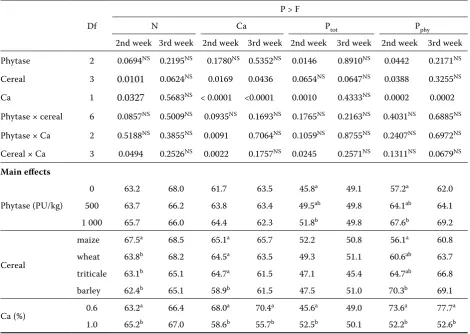
Average nitrogen, calcium, total and phytate phosphorus retention in the 2nd and 3rd week of trial is listed in Table 3.
Main effects of cereals (P < 0.0101) and Ca (P < 0.0327) as well as their interaction (P < 0.0494) on nitrogen retention were observed only in the 2nd week. The significantly highest nitrogen retention was observed in broilers fed maize based diets. No significant differences were observed between broilers fed wheat, triticale and barley based diets. Nitrogen retention significantly increased with in-creasing dietary Ca level. The analysis of cereal × Ca interaction showed that nitrogen retention in-creased with Ca dietary level in broilers fed wheat and barley based diets but it almost did not change in broilers fed maize based diets, and decreased in broilers fed triticale based diets.
Cereals (P < 0.0169 and 0.0436) and dietary Ca levels (P < 0.0001) significantly influenced Ca re-tention in both weeks of trial. In the 2nd week Ca retention was higher in birds fed maize, wheat and triticale based diets, but differences in the 3rd week could not be detected by Tukey’s test. An increasing Ca dietary level decreases calcium retention. In the 2nd week phytase × Ca and cereal × Ca interac-tions were observed. Ca retention of broilers fed diets containing 0.6% Ca decreased in the order 1 000 ≈ 500 > 0 PU/kg and wheat > maize ≈ triticale ≈ barley, while in those fed diets containing 1.0% Ca in the order 0 > 500 ≈ 1 000 PU/kg and maize ≈ triticale > wheat ≈ barley.
[image:5.595.64.535.403.737.2]Supplemental phytase (P < 0.0146) and calcium (P < 0.0010) main effects as well as cereals × Ca interaction (P < 0.0245) on total phosphorus re-tention were observed only in the 2nd week. Total phosphorus retention increased with increasing
Table 3. Average retention of nitrogen, calcium, total (Ptot) and phytate phosphorus (Pphy) in the 2nd and 3rd week of study (in %)
Df
P > F
N Ca Ptot Pphy
2nd week 3rd week 2nd week 3rd week 2nd week 3rd week 2nd week 3rd week Phytase 2 0.0694NS 0.2195NS 0.1780NS 0.5352NS 0.0146 0.8910NS 0.0442 0.2171NS
Cereal 3 0.0101 0.0624NS 0.0169 0.0436 0.0654NS 0.0647NS 0.0388 0.3255NS
Ca 1 0.0327 0.5683NS < 0.0001 <0.0001 0.0010 0.4333NS 0.0002 0.0002 Phytase × cereal 6 0.0857NS 0.5009NS 0.0935NS 0.1693NS 0.1765NS 0.2163NS 0.4031NS 0.6885NS Phytase × Ca 2 0.5188NS 0.3855NS 0.0091 0.7064NS 0.1059NS 0.8755NS 0.2407NS 0.6972NS Cereal × Ca 3 0.0494 0.2526NS 0.0022 0.1757NS 0.0245 0.2571NS 0.1311NS 0.0679NS
Main effects
Phytase (PU/kg)
0 63.2 68.0 61.7 63.5 45.8a 49.1 57.2a 62.0
500 63.7 66.2 63.8 63.4 49.5ab 49.8 64.1ab 64.1
1 000 65.7 66.0 64.4 62.3 51.8b 49.8 67.6b 69.2
Cereal
maize 67.5a 68.5 65.1a 65.7 52.2 50.8 56.1a 60.8
wheat 63.8b 68.2 64.5a 63.5 49.3 51.1 60.6ab 63.7
triticale 63.1b 65.1 64.7a 61.5 47.1 45.4 64.7ab 66.8
barley 62.4b 65.1 58.9b 61.5 47.5 51.0 70.3b 69.1
Ca (%) 0.6 63.2
a 66.4 68.0a 70.4a 45.6a 49.0 73.6a 77.7a
1.0 65.2b 67.0 58.6b 55.7b 52.5b 50.1 52.2b 52.6b
dietary Ca level and phytase supplementation. 1 000 PU/kg produced a significant effect. Total phosphorus retention in broilers fed diets contain-ing 0.6% Ca decreased in the order maize > triticale > wheat ≈ barley, and in those fed diets with 1.0% Ca in the order wheat > maize ≈ barley > triticale.
All three main effects on phytate phosphorus retention were observed in the 2nd week and only dietary Ca level in the 3rd. Increasing supplemen-tal phytase increased phytate phosphorus reten-tion (P < 0.0442). The effect of 500 PU/kg was not significantly different from the effects of 0 and 1 000 PU/kg, which were significantly different from each other. The highest phytate phosphorus retention was observed in broilers fed barley based diets and the lowest in those fed maize based diets. Phytate phosphorus retentions of broilers fed wheat and triticale based diets were not significantly dif-ferent from each other and from those of broilers fed barley and maize. In both weeks higher phytate phosphorus retention was observed in broilers fed diets containing 0.6% Ca. No significant interac-tions were observed indicating that the main effects were independent.
DISCUSSION
Intensive poultry production has raised the prob-lem of environmental pollution, with nitrogen and phosphorus from excreta being recognized as main pollutants. Different dietary strategies have been employed in order to reduce environmental pol-lution, bearing in mind that costs of production should remain at least at the same level. The influ-ence of dietary treatment on the excretion of pos-sibly harmful substances that were not adequately digested and absorbed can be reduced by making balance between nutrient intake and excretion.
Sebastian et al. (1996, 1997), Simons et al. (1990), Broz et al. (1994) and Yi et al. (1996) showed that phytase addition to male broiler diets resulted in increased phosphorus, nitrogen and calcium re-tention. However, this effect was not observed in female broilers.
The results obtained in this research are in partial agreement with literature. The increasing phytase level resulted in a reduction in phytate phosphorus excretion and in an increase in its retention (differ-ences were not always significant). This beneficial influence of phytase on excretion and retention was not so clearly observed in the case of total
phos-phorus because the diets contained recommended levels of total phosphorus.
The significance of calcium and phytate interplay was also shown in this study. Retention of both total and phytate phosphorus decreased while excretion increased with increasing calcium dietary levels.
According to Sebastian (1996b) phosphorus re-tention decreases with increasing calcium dietary levels due to: (i) precipitation of phytate through the Ca-phytate complex formation, (ii) increased intestinal pH, caused by Ca, which reduces mineral solubility, (iii) direct effect of Ca on phytate by competing for the active site of phytase. In this ex-periment the retention of phytate phosphorus, but not of total phosphorus, decreased with increasing calcium dietary levels.
These results indicate that phytate phosphorus from the diets could be made almost completely available if the diet contained appropriate calcium levels, Ca : Ptot ratio and phytase level. In this case phosphorus, and possibly nitrogen excretion into the environment could be reduced to a minimum.
Acknowledgment
We are grateful to Prof. Zeljko Beric for useful discussions and to Mrs. Ivana Brnic and Jelena Kutnjak for help with chemical analyses.
REFERENCES
Broz J., Oldale P., Perrin-Voltz A.H., Rychen G., Schulze J., Simoes Nunes C. (1994): Effect of supplemental phytase on performance and phosphorus utilization in broiler chickens fed a low phosphorus diet without addition of inorganic phosphates. Brit. Poultry Sci., 35, 273–280.
Deshpande S.S., Cheryan M. (1984): Effects of phytate, divalent cations and their implications on α-amylase
activity. J. Food Sci., 49, 516–519.
Enzymes in Animal Nutrition (1998): Arbeitsgemein-schaft für Wirkstoffe in der Tierernährung. Bonn, Ger-many.
Guenter W. (1997): Practical experience with the use of enzymes. In: Proceedings of the First Chinese Sympo-sium on Feed Enzymes, Enzymes in Poultry and Swine Nutrition, International Development Research Cen-tre, Ottawa, Canada.
ISO 5983 (1997): Animal feeding stuffs; Determination of nitrogen content and calculation of crude protein content; Kjeldahl method.
ISO 5984 (2002): Animal feeding stuffs; Determination of crude ash.
ISO 6490–1 (1985): Animal feeding stuffs; Determination of calcium content; Part 1: Titrimetric method. ISO 6491 (1998): Animal feeding stuffs; Determination
of phosphorus content; Spectrometric method. ISO 6492 (1999): Animal feeding stuffs; Determination
of fat content.
ISO 6496 (1999): Animal feeding stuffs; Determination of moisture and other volatile matter content.
Leske K.L., Coon C.N. (1999): A bioassay to determine the effect of phytase on phytate phosphorus hydrolysis and total phosphorus retention and feed ingredients as determined with broilers and laying hens. Poultry Sci., 78, 1151–1157.
Li Y.C., Ledoux D.R., Veum T.L., Raboy V., Ertl D.S. (2000): Effects of low phytic acid corn on phosphorus utilization, performance and bone mineralization in broiler chicks. Poultry Sci., 79, 1444–1450.
Pintar J., Homen B., Gazić K., Grbeša D., Sikirić M., Černy T. (2004): Effect of supplemental phytase on perform-ance and tibia ash of broilers fed different cereals based diets. Czech J. Anim. Sci., 49, 542–548.
Ravindran V., Cabahug S., Ravindran G., Bryden W.L. (1999): Influence of Microbial Phytase on Apparent Ileal Amino Acid Digestibility of Feedstuffs for Broilers. Poultry Sci., 78, 699–706.
SAS Institute Inc. (1999): The SAS System for Windows. Release 8.00.
Sebastian S., Touchburn S.P., Chavez E.R., Lague P.C. (1996a): The effects of supplemental microbial phytase on the performance and utilization of dietary calcium, phosphorus, copper and zinc in broiler chickens fed corn-soybean diets. Poultry Sci., 75, 729–736. Sebastian S., Touchburn S.P., Chavez E.R., Lague P.C.
(1996b): Efficacy of supplemental microbial phytase at different dietary calcium levels on growth performance
and mineral utilization of broiler chickens. Poultry Sci.,
75, 1516–1523.
Sebastian S., Touchburn S.P., Chavez E.R., Lague P.C. (1997): Apparent digestibility of protein and amino acids in broiler chickens fed a corn-soybean diet sup-plemented with microbial phytase. Poultry Sci., 76, 1760–1769.
Simons P.C.M., Versteegh H.A.J., Jongbloed A.W., Kemme P.A., Slump P., Bos K.D., Wolters M.G.E., Beudeker R.F., Verschoor G.J. (1990): Improvement of phospho-rus availability by microbial phytase in broilers and pigs. Brit. J. Nutr., 64, 525–540.
Sooncharernying S., Edwards H.M. Jr. (1993): Phytate Contents of Excreta and phytate retention in the gas-trointestinal tract of young chickens. Poultry Sci., 72, 1906–1916.
Thompson L.U., Yoon J.H. (1984): Starch digestibility as affected by polyphenols and phytic acid. J. Food Sci.,
49, 1228–1229.
Thompson L.U. (1988): Antinutrients and blood glucose. Food Technol., 42, 123–132
Yi Z., Kornegay E.T., Ravindran V., Denbow D.M. (1996): Improving phytate phosphorus availability in corn and soybean meal for broilers using microbial phytase and calculation of phosphorus equivalency values for phytase. Poultry Sci., 75, 240–249.
Waldroup P.W., Kerey J.H., Saleh E.A., Fritts C.A., Yan F., Stilborn H.L., Crum R.C. Jr., Raboy V. (2000): Non-phytate phosphorus requirement and phosphorus ex-cretion of broiler chicks fed diets composed of normal and high available phosphate corn with and without microbial phytase. Poultry Sci., 79, 1451–1459. Zyla K., Korelski J., Swiatkiewicz S., Wikiera A.,
Kujaw-ski M., Piironen J., Ledoux D.R. (2000): Effect of phos-phorylitic and cell wall-degrading enzymes on the performance of growing broilers fed wheat-based di-ets containing different calcium levels. Poultry Sci.,
79, 66–76.
Received: 04–02–13 Accepted after corrections: 04–10–07
Corresponding Author