warwick.ac.uk/lib-publications
Original citation:Aussems, Suzanne and Kita, Sotaro. (2017) Seeing iconic gestures while encoding events facilitates children's memory of these events. Child Development .
Permanent WRAP URL:
http://wrap.warwick.ac.uk/93164
Copyright and reuse:
The Warwick Research Archive Portal (WRAP) makes this work by researchers of the University of Warwick available open access under the following conditions. Copyright © and all moral rights to the version of the paper presented here belong to the individual author(s) and/or other copyright owners. To the extent reasonable and practicable the material made available in WRAP has been checked for eligibility before being made available.
Copies of full items can be used for personal research or study, educational, or not-for profit purposes without prior permission or charge. Provided that the authors, title and full bibliographic details are credited, a hyperlink and/or URL is given for the original metadata page and the content is not changed in any way.
Publisher’s statement:
This is the peer reviewed version of the following article: Aussems, S. and Kita, S. (2017), Seeing Iconic Gestures While Encoding Events Facilitates Children's Memory of These Events. Child Dev. doi:10.1111/cdev.12988, which has been published in final form at
https://doi.org/10.1111/cdev.12988 . This article may be used for non-commercial purposes in accordance with Wiley Terms and Conditions for Self-Archiving.
A note on versions:
The version presented here may differ from the published version or, version of record, if you wish to cite this item you are advised to consult the publisher’s version. Please see the ‘permanent WRAP url’ above for details on accessing the published version and note that access may require a subscription.
Seeing Iconic Gestures while Encoding Events Facilitates Children’s Memory of these Events
Suzanne Aussems& Sotaro Kita
University of Warwick
Author Note
Suzanne Aussems, Department of Psychology, University of Warwick
Sotaro Kita, Department of Psychology, University of Warwick
This research was supported by a PhD studentship grant awarded to the first author by the
Department of Psychology at the University of Warwick.
Correspondence concerning this article should be addressed to Suzanne Aussems,
Department of Psychology, University of Warwick, Coventry CV4 7AL, United Kingdom.
Abstract
An experiment with 72 three-year-olds investigated whether encoding events while seeing iconic
gestures boosts children’s memory representation of these events. The events, shown in videos of
actors moving in an unusual manner, were presented with either iconic gestures depicting how
the actors performed these actions, interactive gestures, or no gesture. In a recognition memory
task, children in the iconic gesture condition remembered actors and actions better than children
in the control conditions. Iconic gestures were categorized based on how much of the actors was
represented by the hands (feet, legs, or body). Only iconic hand-as-body gestures boosted actor
memory. Thus, seeing iconic gestures while encoding events facilitates children’s memory of
those aspects of events that are schematically highlighted by gesture.
Seeing Iconic Gestures while Encoding Events Facilitates Children’s Memory of these Events
Children spend a considerable proportion of their day watching what other people do.
Accurate memory of who did what is crucial for their social-cognitive development, because it
lies at the core of social interactions (Vogelsang & Tomasello, 2016), cooperative activities
(Milward, Kita, & Apperly, 2014), and learning how things “ought” to be done (Burdett et al.,
2016; Schmidt, Rakoczy, & Tomasello, 2016). To make sense of the events they see, children
must learn how to encode, process, and organize the various aspects of those events. Children
can recognize people’s actions in impoverished stimuli such as point-light displays at age 3 (e.g.,
Golinkoff et al., 2002), but rich action events with real people are much more complex to
encode. This study focuses on children’s memory of such events, more specifically, their
memory representation of real-life actors and their actions.
The Challenge of Encoding Action Events
Action events are difficult to encode for young children (Imai, Haryu, & Okada, 2005).
The challenge that they must overcome is understanding that an action event consists of both
stable components such as people and objects, and transient components such as the things that
people do (e.g., actions such as yawning or jumping). The transient nature of actions makes it
difficult for children to remember them. In an event recognition task, children remember stable
aspects of events (e.g., objects) better than actions (Imai et al., 2005). Because actions are
transient and other aspects of an event are stable, it is also difficult for children to focus on an
action as the sole referent of a verb. Word learning tasks in which children were taught a verb
while watching an actor performing an action on an object (e.g., whipping the whisk) showed
(Imai et al., 2005; 2008). Verb learning studies have repeatedly demonstrated that 3-4-year-old
children focus too much on stable aspects of action events (e.g., objects, instruments, actors)
rather than on actions (Behrend, 1990; Forbes & Farrar, 1993; Imai et al., 2005; 2008; Kersten &
Smith, 2002). This focus on stable aspects prevents children from generalizing action labels to
novel events in which the same actions are shown, but the objects, actors, or instruments have
changed.
Encoding with the Help of Iconic Gestures
In the current paper, we investigate whether seeing iconic gestures helps children to
encode an action event in a recognition memory task. People naturally produce iconic gestures
when they speak (McNeill, 1985). Iconic gestures are referential symbols, which function via
their formal and structural resemblance to events, objects, or people (McNeill, 1992). For
instance, an iconic gesture can depict the things that people do (e.g., wiggling the index and
middle fingers to depict a person walking).
Observing iconic gestures while encoding verbally presented information (e.g., words,
explanations) can influence children’s performance in a subsequent task, in which they use the
encoded information (e.g., a recall task, a test of word meaning, problem solving). Three lines of
evidence support this. First, iconic gestures facilitate memory for familiar and novel words. For
instance, 4-5-year-old children recalled more familiar words (e.g., look, swim, brush) when they
encoded these words while observing iconic gestures which were semantically related to those
words than when encoding words alone (So, Chen-Hui, & Wei-Shan, 2012). Additionally,
5-year-old French children who encoded common English words while observing iconic gestures
same words while observing pictures showing the word meanings (Tellier, 2008). Second,
children use iconic gestures to disambiguate the meanings of novel verbs. In an experiment by
Goodrich and Hudson Kam (2009), 3- and 4-year-olds were taught two novel verbs for actions
performed by a puppet on unfamiliar toys (e.g., rolling down a ramp in a tube). The experimenter
demonstrated two actions, one at a time. Subsequently, the experimenter taught the children one
verb per action, while accompanying each verb with an iconic gesture that depicted the action
(e.g., rolling down the ramp gesture; index finger tracing circles while moving downward at an
angle). When the children were subsequently asked “Which toy lets the puppet go (novel verb)
-ing?” (without a gesture), they picked the toy which operated in the way that corresponded to the
verb. Third, iconic gesture facilitates learning of verbally explained strategies for problem
solving. In a study by Ping and Goldin-Meadow (2008), 5-7-year-olds received verbal
instructions on how to solve Piagetian conservation problems. For instance, in the case of liquid
conservation with two differently shaped glasses that contained the same amount of water, an
experimenter explained to children that one glass was tall and skinny and the other was short and
wide. The explanation was either accompanied by iconic gestures indicating the height and width
differences between the glasses, or no gesture. For half of the children, the glasses were not
present during this instruction, and thus the gestures iconically depicted the dimensions of the
glasses. The participants were then asked whether the amount of water in the two glasses was the
same and if they could explain their answer. Children who saw iconic gestures during the
instruction solved the quantity conservation problems more often than children who did not see
gesture, even when the objects were not present during the instruction. The above studies
verbally presented information. However, much less is known about how seeing iconic gestures
influences memory of nonlinguistic information, for instance, memory of events.
Seeing Iconic Gestures Influences How Children Recall Events
Previous research on the impact of seeing iconic gestures on children’s event memory
always presented children with iconic gestures at the recall stage, but never at the encoding
stage. For instance, research on eyewitness testimony suggests that seeing iconic gestures at the
recall stage can alter children’s memory representation of an event long after they have
witnessed this event. In a study by Broaders and Goldin-Meadow (2010), a musician visited
5-6-year-olds in their classroom and in the weeks after the visit, the children were asked questions
about the appearance of the musician in scripted interviews. During the questioning, the
interviewer conveyed misleading information in gesture (e.g., moving the hand towards the head
as if putting on a hat), but not in speech (e.g., “What was the musician wearing?”). In their
responses to the interviewer’s questions, children often said that the musician wore a hat, which
was false. This information corresponded to what was encoded in the interviewer’s gestures, but
not in their speech. When children narrated the event in a free recall task a few weeks after the
scripted interviews, their stories included information gleaned from the interviewer’s gestures
during the scripted interviews. Children had thus incorporated misinformation from the
interviewer’s gestures in their memory representation of the event.
One might argue that children are prone to the influence of seeing iconic gestures at the
recall stage, because they presume that the experimenter is signaling the correct answers to them.
However, Kirk, Gurney, Edwards, and Dodimead (2015) showed that the influence of iconic
and 7-9-year-olds watched a video clip showing a series of events (e.g., a lady and a man
roller-skating) and were required to narrate the events to the experimenter afterwards. The
experimenter then questioned the children about the events (e.g., “What was the lady wearing?”)
under one of two conditions: accurate gesture (e.g., moving the hands towards the head as if
putting on a hat) or misleading gesture (e.g., moving the left hand over the right hand as if
putting on a glove). The lady in the video clip was in fact wearing a hat, but no gloves. After the
interview, the children narrated the events again to the experimenter. In both gesture conditions
and both age groups, children’s post-interview narrations included information that was absent
from their pre-interview narrations, but consistent with information the experimenter had
encoded in gesture during the interview. Seeing iconic gestures at the recall stage thus changed
children’s memory of events. Importantly, when children retold their version of the witnessed
events after the interview, they added more information gleaned from accurate gestures than
from misleading gestures to their stories, which rules out the possibility that gestures represent a
demand characteristic (i.e., children concur indiscriminately with any information conveyed by
the experimenter’s gestures under the presumption that the experimenter is signaling the correct
answers to them).
To summarize, seeing iconic gestures influences children’s memory of verbally presented
informationand nonlinguistic information. However, research on the influence of seeing iconic
gestures on children’s event memory is sparse, and in such studies, iconic gesture was always
manipulated at the recall stage (Broaders & Goldin-Meadow, 2010; Kirk et al., 2015), but never
at the encoding stage. From these studies, we can conclude that children’s memory
representation of an event is prone to the influence of (misleading) nonverbal cues at the recall
influence their memory representation of this event. In the current study, children performed an
event recognition task, in which iconic gestures were manipulated at the encoding stage.
Specifically, we asked whether encoding action events with the help of iconic gestures leaves
children with a stronger memory representation of these events.
Possible Mechanism
Observing iconic gestures can draw children’s attention to certain aspects of an event and
boost their memory of those aspects. Iconic gestures can encode information in an abstract,
schematic manner (Kita, 2000; de Ruiter, 2000). For example, when depicting the hopping
movement of a bunny going down a slope, an iconic gesture can capture this information simply
by tracing the animal’s trajectory (using the extended index finger to trace an arch for every hop,
while generally going downward diagonally). Such a gesture focuses on the manner and path of
the motion, stripping it from everything else (e.g., what the bunny looked like, any background
objects and characteristics of the landscape).
The literature on gesture production suggests that the schematic nature of the gestural
representation shapes the self-oriented function of gesture (Goldin-Meadow, 2015; Kita, Alibali,
& Chu, 2017; Novack, Congdon, Hemani-Lopez, & Meadow, 2014; Novack &
Goldin-Meadow, 2016). More importantly for the current study, Kita et al. (2017) claim that the
schematic nature of the gestural representation impacts how the observer processes information
about complex events. Because schematic representations highlight only a certain aspect of a
complex event, they may help observers to focus on certain information in the event. This idea is
supported by a study which demonstrates how iconic gestures shape children’s interpretations of
interpreted as manner verbs (e.g., “to pull”) or change-of-state verbs (e.g., “to break”). In one of
the trials, children saw a video of a hand creating a cloud shape by pushing pieces of paper
together with the index finger. Children were then taught a novel verb by the experimenter; for
some children, the experimenter produced a manner gesture (e.g., representing the manual action
of pushing the pieces into place), and for others, the experimenter produced an end-state gesture
(e.g., tracing the final cloud shape these pieces formed). Children’s performance on a verb
generalization task showed that they interpreted the novel verb meanings consistent with
information encoded in gesture: as manner verbs when they saw iconic manner gestures and as
change-of-state verbs when they saw iconic end-state gestures. Thus, the schematic
representation in iconic gesture directed children’s attention to a particular aspect of a complex
event.
The Current Research
This study investigates whether seeing iconic gestures facilitates children’s recognition
memory of action events. The events, which included videos of real-life actors moving across a
scene in an unusual manner, were presented in three gesture conditions. The first condition
showed iconic gestures depicting how the actors in the action events moved (i.e., their manner of
locomotion). The second condition showed interactive gestures (Bavelas, Chovil, Lawrie, &
Wade, 1992), which communicated excitement and surprise to the children, but were unrelated to
the action events. The third condition showed no gestures at all. After a delay, children were
asked to point out the video that they had seen before in a two-way forced choice task. Their
memory of both actions and actors was tested. For action memory, children chose between the
memory they chose between the seen video and an unseen video that included a different actor
moving in the same manner (cf. Imai et al., 2005).
When children encode events while observing iconic gestures that represent how an actor
moves, this may leave a stronger trace in children’s memory because a schematic gestural
representation focuses children’s attention on the motion event itself as opposed to other
information (e.g., details of the scene). Thus, we predict that seeing iconic gestures which
highlight how an actor moves will boost children’s action memory compared to seeing
interactive gestures, or no gesture. As the iconic gestures also represent, to some extent, the actor
who is carrying out the movement (e.g., both hands flicking upward to represent the actor’s legs
while marching), we predict that children’s actor memory will also be boosted when they see
iconic gesture, compared to seeing interactive gesture, or no gesture at all. However, since
manner of motion is omnipresent in the gestures and in most cases only part of the actor’s body
is gesturally represented, we predict that action memory will be boosted more so than actor
memory.
Furthermore, we predict that the extent to which the actor is represented in gesture could
have an impact on actor memory. In our iconic gestures, the hands represent either the feet, legs,
or body of the actors to depict how they moved. While the gestures do not express any
person-specific features of the feet, legs or body (e.g., a particular actor with long legs), they should
draw children’s attention to particular aspects of the actor that they depict. This idea is supported
by a previous finding that iconic gestures can make children focus on a particular aspect of a
complex event in a verb learning task (Mumford & Kita, 2014). We inferred that when children
focus on the actors’ bodies, they have more opportunities to pick up person-specific information,
should lead to better actor memory; that is, actor memory performance increases as more of the
actor is represented in gesture (e.g., hand-as-body gestures > hand-as-leg gestures > hand-as-foot
gestures). If this prediction is borne out, then this is also in line with the idea that gesture
schematizes information, which helps children to focus on particular aspects of events.
Method
Design
The experiment had a mixed 3 x 2 x 3 design with gesture type as a between-subjects
factor (iconic gesture vs. interactive gesture vs. no gesture) and memory type (action memory vs.
actor memory) and semiotic type (feet vs. legs vs. body) as within-subjects factors. The
dependent variable was children’s performance in each of 12 trials of an event recognition
memory task (binary: 1=correct, 0=incorrect).
Participants
The data were collected between the 23rd of March 2016 and the 27th of September 2016.
Our sample size was determined a priori using G*Power version 3.1.9.2 (odds ratio=2.30,
α=0.05, power=0.80).We recruited 85 typically developing children from a database of families
who showed interest in participating in child research and from six public and private nurseries
in the West-Midlands and Warwickshire, England. A total of 13 children were excluded because
they were outside the age range on the day of testing (N=11), or pointed exclusively to answers
on one side of the screen in test trials (N=2). The final sample included 72 children (35 girls)
between the ages of 35–48 months old (M=41.11, SD=3.67). There were 24 children in each of
the three gesture conditions. The gender distribution of the children was the same across
children were exposed to the English language at home for >75% of the time (as indicated by
their caregivers). Informed parental consent was obtained for all participants. In return for their
participation, nurseries received a voucher for educational goods and children who were tested in
the research lab received a certificate.
Materials
A set of 48 short video clips (4-14 seconds) was taken from the GRACE video database
(Aussems, Kwok, & Kita, 2017; in press). The set included videos of 24 actors (12 males, 12
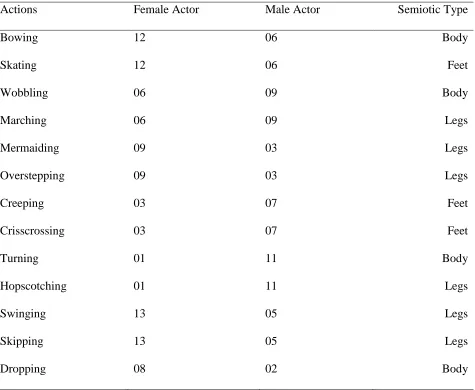
females), each performing two of 24 unusual actions (see Table A1 in Appendix A). Actors
always moved from the left side to the right side of a scene such that the path of motion was the
same for each action, but the manner of motion differed. To create a two-way forced choice task,
we organized the actions in 12 pairs of distinctive actions. Actions within each pair were
depicted by one male actor and one female actor in separate videos. Trials on which we tested for
children’s memory of actors always showed a distractor video of an actor of the opposite gender
performing the same action as the actor in the target video, because males and females have
naturally distinct appearances. We chose this set-up because we did not want to make the task
too difficult for the children. Each action pair was performed by different pairs of male actors
and female actors, whose videos were normed for how similar the same actions by different
actors were and how dissimilar the different actions by the same actor were. The videos are
available from Warwick Research Archive Portal (WRAP) at http://wrap.warwick.ac.uk/78493/.
Stimuli were displayed using slide presentation software Microsoft Office PowerPoint 2016 on a
14” touchscreen laptop.
Children were tested individually in a quiet area of their nursery or in the research lab at
the university. A female experimenter sat down with the children at a children’s table with small
chairs, always positioning herself to the child’s left side. The memory task consisted of two
phases: an encoding phase and a recognition phase. In the encoding phase, children were told
that they were going to watch videos with the experimenter on a touch screen computer. A big
button with a smiling star appeared on the screen and children were instructed to press the star
with their index finger to start a video. Children were presented with 12 videos, which showed
12 unusual actions performed by different actors (six males, six females). Each video was shown
twice in the following way. When the video played the first time the experimenter said: “Wow!
Look at what he (or she) is doing!” and when the video played the second time the experimenter
said: “Oh! Look, he (or she) is doing it again!”. Depending on the condition, the experimenter
produced iconic gestures, interactive gestures, or no gesture.
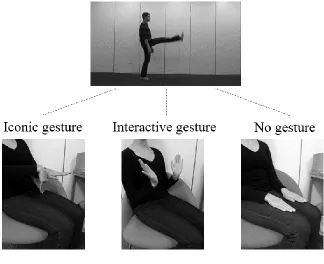
Figure 1 shows the three gesture conditions used in the experiment. Iconic gestures
depicted the manners in which actors moved across a scene in hand shape and in motion.
Interactive gestures indicated excitement and surprise, but were unrelated to the events (see
Figure B1 in Appendix B for more detail). In the no gesture condition, the experimenter kept her
hands in her lap while children viewed the action events.
-Insert Figure 1 about here-
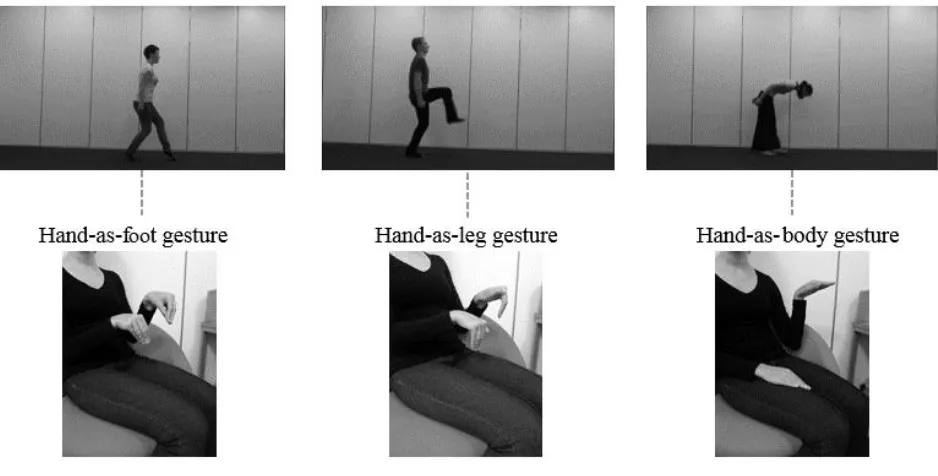
Each iconic gesture matched one manner of motion. Iconic gestures were categorized into
three semiotic types (see Figure 2). First, hand-as-foot gestures depicted the actors’ manners of
motion by representing the actors’ feet with both hands (the left panel in Figure 2; the hand
movements). Second, hand-as-leg gestures depicted the actors’ manners of motion by
representing the actors’ legs with both hands (the mid panel in Figure 2; the hand shape and the
alternating lifting movements resemble the actor’s trotting leg movements). Third, hand-as-body
gestures depicted the actors’ manners of motion by representing the body with one hand (the
right panel in Figure 2; bending the hand at the wrist resembles the actor’s body bending at the
torso).
-Insert Figure 2 about here-
All gestures were performed for the entire duration of a video and the experimenter
alternated her gaze between the child and the video (and did not look at her own gestures).
Gestures were produced in the left part of the children’s field of vision, in front of their left
shoulder and at eye height, so that they would not have to turn their heads to look at the gestures
while watching the videos. Note that the children were not instructed to look at the
experimenter’s gestures or remember the actors or actions. Children were not told about the
upcoming test trials either.
After the encoding phase, children spent approximately five minutes decorating a
wristband with colorful stickers. The experimenter asked children to count the stickers and name
the colors during this distraction task.
The recognition phase consisted of two practice trials and 12 experimental trials. During
practice trials participants saw a picture of a cat and a dog on the left and right sides of the
screen. Children were asked to point (without touching the screen) at the cat and the dog to
familiarize them with pointing at both sides of the screen. The experimental trials each showed
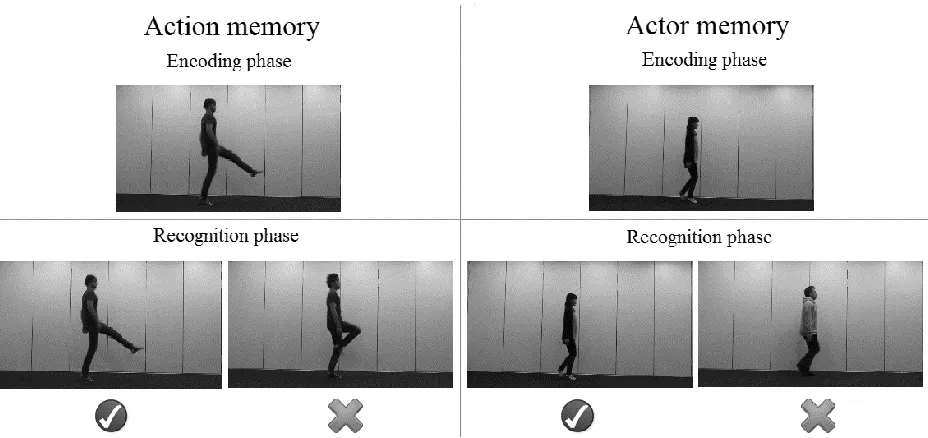
memory and the other half actor memory. In action memory trials, six of the videos that children
had seen during the encoding phase were paired up with videos of the same actor performing a
different action. In actor memory trials, the other six videos from the encoding phase were paired
up with videos of a different actor performing the same action. In each trial, the experimenter
asked the child “Which one did you see before?”. The experimenter looked at the child when
making this request and did not look at the screen. The videos played automatically on loop until
the child pointed at one of them. If the child did not respond or asked whether a video was shown
before, the question was repeated until a video was chosen. If the child pointed at both videos,
the experimenter asked the child to pick one.
-Insert Figure 3 about here-
Randomization and Counterbalancing
We created 24 versions of the experiment in which every stimulus video appeared as a
target and distractor on action memory trials and actor memory trials. We counterbalanced the
gender of the actors in the videos, the left-right position of the videos on the screen, and we
randomized the order of trials in each experiment version. Children were randomly assigned to
conditions using the nursery registers, which were either ordered alphabetically by the children’s
surname or by their date of birth. One nursery did not provide a register and the experimenter
used the order in which the consent forms were received. The conditions were rotated across
participants within each testing site, and the experimenter continued the order of conditions when
a participant was tested in the research lab in between nursery visits. Participants from each
testing site were thus presented equally in each condition.
Our binary dependent variable (correct vs. incorrect responses in the recognition memory
task) was analyzed using mixed-effects logistic regression analyses. We used a maximal
random-effects structure in all models (cf. Barr, Levy, Scheepers, & Tily, 2013), by including random
slope variation, random intercept variation, and the covariance between the two, for participants
and items. All analyses were carried out in the R software for statistical analyses (R
Development Core Team, 2011) with the lme4 package (Bates, Mächeler, Bolker, & Walker,
2015). Using likelihood ratio tests (χ2), we compared each model with updated versions of the
model that systematically excluded the main effect and interaction terms of interest. Both
marginal and conditional R2 values were calculated using the piecewiseSEM package (Nakagawa
& Schielzeth, 2013). Marginal R2 reflects variance explained by fixed factors and conditional R2
reflects variance explained by both fixed and random factors. The raw data file and the R
Markdown file with the analyses and plot code are available from the Open Science Framework
at https://osf.io/tqk34/.
Results and Discussion
General Findings
Figure 4 shows children’s recognition memory performance organized by gesture type
and memory type. Children’s recognition memory performance (correct vs. incorrect) was
entered into a mixed-effects logistic regression analysis with gesture type as between-subjects
factor and memory type as within-subjects factor. The main effect of gesture type was
significant, χ2(2)=13.18, p=.001, but not the main effect of memory type, χ2(1)=0.25, p=.617, or
the interaction, χ2(2)=2.89, p=.236. The model explained approximately 10% of the variance in
-Insert Figure 4 about here-
To further explore the nature of the main effect of gesture type, we examined the beta
estimates in a comparison of the three gesture conditions. Children’s recognition memory
performance was significantly better in the iconic gesture condition than in the interactive
gesture condition (β=-0.99, SE=0.27, p<.001) and the no gesture condition (β=-0.79, SE=0.27,
p=.003). Then, we compared recognition memory performance between the two control
conditions by releveling gesture type with the interactive condition as the reference point. The
performance did not differ significantly between the interactive gesture condition and the no
gesture condition (β=0.20, SE=0.25, p=.426).
To investigate whether children showed a better recognition memory performance than
chance for each of these gesture types, we compared the proportion of correct trials in each
condition against a test value of 0.5 (chance level of 50%). The proportion of correct trials was
analyzed with one-sample t-tests in which equal variance was assumed. In the iconic gesture
condition, children’s memory performance was significantly above chance (M=0.70, SD=0.21,
t(23)=5.71, p<.001, 95% CI [0.63, 0.77]), as well as in the no gesture condition (M=0.58,
SD=0.16, t(23)=3.05, p=.006, 95% CI [0.52, 0.63]), but not in the interactive gesture condition
(M=0.55, SD=0.22, t(23)=1.26, p=.220, 95% CI [0.47, 0.62]).
Thus far, our findings demonstrate that children who saw action events accompanied by
iconic gestures related to these events, recognized these events more often than children who saw
them accompanied by interactive gestures which were semantically unrelated to the events, and
children who saw no gesture at all. Our prediction that action memory would be boosted more
showed that iconic gestures boosted both action memory and actor memory, but descriptively
they boosted actor memory less than action memory.
Gesture Type, Memory Type, and Semiotic Type
We conducted a more in-depth analysis of the effect of seeing different semiotic types of
iconic gestures on children’s actor recognition memory. We categorized our iconic gestures as
representing the feet, legs, or body of the actors (see Figure 2 and Table A1 in Appendix A). We
reasoned that gestures which represent actors differently may influence children’s memory for
actors differently. In our analysis, we compared the iconic gesture condition with the no gesture
condition, because the experimenter’s hands in the no gesture condition certainly did not
represent aspects of the events (the analyses show the same results when the iconic gesture
condition is compared with the interactive gesture condition).
Figure 5 shows children’s recognition memory performance organized by gesture type,
memory type, and semiotic type. Children’s recognition memory performance was entered in a
mixed effects logistic regression analysis with gesture type as a between-subjects factor and
memory type and semiotic type as within-subject factors. Our analysis revealed a significant
interaction effect between gesture type, memory type, and semiotic type on children’s
recognition memory performance, χ2(2)=6.51, p=.039. The model explained approximately 23%
of the variance in recognition memory performance (marginal R2=.08, conditional R2=.23).
-Insert Figure 5 about here-
To further investigate the three-way interaction, we split our data based on memory type
(see panels of Figure 5). When action memory performance was entered into the analysis (left
significant, χ2(3)=10.40, p=.015, but not the main effect of semiotic type, χ2(4)=1.42, p=.842, or
the interaction, χ2(2)=0.50, p=.777. We predicted that actor memory would increase when more
of the actor is represented in gesture (e.g., as-body gestures > as-leg gestures >
hand-as-foot gestures). The right panel of Figure 5 shows that descriptively, the benefit of iconic
gestures (compared to no gesture) on actor memory increases as more of the actor is depicted in
gesture. When actor memory performance was entered into the analysis, we found a significant
interaction effect between gesture type and semiotic type on actor memory performance,
χ2(2)=6.81, p=.032. The three-way interaction is thus driven by the interaction effect on actor
memory. We compared the size of the iconic gesture vs. no gesture benefit by examining the beta
estimates for the interaction effect of each semiotic type (with iconic gesture as a reference point
for gesture type and hand-as-body gestures as a reference point for semiotic type, followed by
hand-as-leg gestures). Hand-as-body gestures boosted actor memory in comparison to the no
gesture condition more strongly than hand-as-leg gestures (β=1.88, SE=0.92, p=.040) and
hand-as-foot gestures (β=2.15, SE=1.03, p=.038), which themselves did not differ (β=0.26, SE=0.79,
p=.739). Though there was no statistically significant difference between as-foot and
hand-as-leg gestures, the overall descriptive trend was as predicted and the two conditions that were
predicted to be most different from each other were significantly different from each other. This
model explained approximately 27% of the variance in actor memory performance (marginal
R2=.11, conditional R2=.27). We split the data based on semiotic type to test whether children
performed better in the iconic gesture condition than in the no gesture condition. The iconic
gesture benefit was significant when the experimenter’s hands represented the body of the actors
(β=1.76, SE=0.65, p=.006), but not their feet (β=-0.17, SE=0.68, p=.803), or legs (β=0.07,
General Discussion
To examine whether seeing iconic gestures can help children to encode nonlinguistic
information, we conducted an experiment in which we tested children’s recognition memory of
action events. This study has two key findings. First, 3-year-old children who saw action events
(videos of actors moving in an unusual manner) accompanied by iconic gestures depicting those
events, remembered actions (manners) and actors better than children who saw the same events
accompanied by interactive gestures unrelated to the events, or no gesture at all. Thus, seeing
iconic gestures while encoding events facilitates children’s memory of these events. Second, the
benefit of iconic gesture on actor recognition memory increases as more of the actor is
represented in gesture. Thus, iconic gestures boost event memory by schematically highlighting
particular aspects of events. More specifically, we argue that iconic gestures facilitate action
memory because they encode distinctive features of actions in a schematic manner, thereby
drawing children’s attention to the actions in a complex event. Iconic hand-as-body gestures
facilitated actor memory because they guide children’s attention to the actors’ whole body,
which created more opportunities to pick up person-specific information about the actors.
Our findings go beyond the previous demonstration of the effect of seeing iconic gestures
on cognitive processes in the following way. Previous research has shown that observing gesture
while encoding verbally presented information (e.g., words and explanations) influences how
children remember and subsequently use this information (e.g., Booth et al., 2008; Goodrich,
Hudson-Kam, 2009; Mumford & Kita, 2014; So et al., 2012). Fewer studies have investigated
the impact of seeing iconic gestures on children’s memory of nonlinguistic information, such as
event memory. Some of the existing studies have shown that seeing iconic gestures at the recall
et al., 2015). However, our study is the first to show that seeing iconic gestures when encoding
events influences children’s memory of these events.
The finding that seeing iconic gestures facilitates action event memory is in line with
studies showing that producing iconic gestures facilitates action event memory (Cook, Yip, &
Goldin-Meadow, 2010). In their study, Cook et al. (2010) instructed participants to gesture or not
to gesture while encoding events shown in short video clips (e.g., a man spinning a bucket). It
was found that when participants produced gestures that encoded aspects of the events (e.g., a
circular movement with the hand shaped as a fist as if holding a bucket), they mentioned more
aspects of the events in a free recall task than participants who were instructed not to gesture.
Producing gestures thus facilitates a stronger memory representation of witnessed events than not
producing gesture.
Children’s event memory performance in the no gesture condition is consistent with Imai
et al.’s (2005) experiment on recognition memory for action events, in which the authors also
found that 3-year-old children recognize action events above chance level. However, in our no
gesture condition, and neither of the gesture conditions, did children reach the 84.5% memory
accuracy of children in Imai et al.’s study and this discrepancy needs further explanation. There
are three possible reasons for the worse performance of children in the current study. First,
children in our study had to encode twice as many events as in Imai et al.’s study. Second,
remembering an action and the actor who performs the action (the current study) may be more
difficult than remembering an action and the object acted upon (Imai et al.’s study). Encoding an
actor (e.g., a person), based on appearance, is more complex than encoding an object, which
could be based simply on its shape. Furthermore, the actor cannot be physically separated from
conditions of the current study divided their attention between the gestures and the stimulus
videos, which were both in children’s field of vision. However, this cannot be the sole reason for
the discrepancies with Imai et al.’s results, because the children in the no gesture condition, who
had no reason to divide their attention, also performed worse than children in Imai et al.’s study.
Can gestures that do not carry meaning relevant to the task boost event memory in
children? We argue that interactive gestures in our study did not improve memory performance
because they do not encode any information useful for the task. Consistent with this
interpretation, Goodrich and Hudson-Kam (2009) found that interactive gestures did not help 2-,
3-, and 4-year-old children in a verb learning task. Similarly, So et al. (2012) showed that beat
gestures did not help 4-5-year-old children to recall a list of words. However, Lüke and
Ritterfeld (2014) showed that children remembered novel character names better when they
encoded these names while seeing iconic gestures and “arbitrary gestures” than without gesture.
In their study, 3-5-year-olds were introduced to cartoon characters that had distinctive visual
features (e.g., a large nose). While the children heard the novel names of the characters, the
experimenter produced iconic gestures that encoded the characters’ distinctive visual features
(e.g., extending the nose with the hand), arbitrary gestures that did not depict such features (e.g.,
producing a circular motion with an open palm facing inward in front of the face), and no
gesture. Children then performed a picture selection task, in which they were presented with
pictures of the characters, and required to point at the character that one of the novel names
referred to. Children selected more characters correctly when they had seen iconic and arbitrary
gestures than when they had seen no gesture. Their result on iconic gestures is compatible with
the current finding; the iconic gestures helped children to zero-in on the distinctive features of
gestures benefited the children because they also helped children focus on the information
relevant to the task. The arbitrary gestures were hand movements produced around the face and
neck areas, and the characters could be distinguished from each other by features visible in those
areas (e.g., a large nose or a long beard). Thus, the arbitrary gestures may have focused
children’s attention on the (body) parts of the characters where the distinctive features could be
seen, and this helped children to map different novel names to the characters. This explanation is
similar to our explanation as to why the hand-as-body gestures, which did not encode any
actor-specific information, improved actor memory in the current study. Gestures that do not iconically
encode the specific relevant information for a task can still improve task performance if they
guide children’s attention to the part of the event where the useful information can be seen. The
arbitrary gestures in the study by Lüke and Ritterfeld (2014) did so via deixis (spatio-temporal
contiguity) and the hand-as-body gestures in the current study did so via iconicity (similarity).
Thus, the current study suggests that iconic gestures can boost memory in two different
ways. Iconic gestures helped children focus on key parts of action events, namely the action and
some parts of the actor’s body, and this focusing had two consequences. For action memory,
gestures directly encoded task-relevant information, namely, distinctive features of actions,
which left children with a stronger memory trace. This led to better action recognition memory.
For actor memory, gestures did not directly encode task-relevant information, but highlighted
particular parts of the event (e.g., the actor’s body) that may include task-relevant information,
and guided children’s attention to these parts. This, in turn, helped children find and encode
actor-specific features, which led to better actor recognition memory. It is well-documented that
pointing gestures (e.g., Langton, O’Malley, & Bruce, 1996) and the deictic component of iconic
2015), can direct the recipient’s attention to particular areas of the interactional space. The
current study demonstrates for the first time that iconicity in iconic gestures can also direct the
recipient's attention to a particular part of an event that includes the referent of the gestures.
The two mechanisms proposed above are based on the fact that iconic gestures convey
semantic information (Broaders & Meadow, 2010; Meadow, 2003;
Goldin-Meadow et al., 1993; Hostetter, 2011; Kirk et al., 2015; Mumford & Kita, 2014) by depicting a
referent in a schematic manner (Chu & Kita, 2008; de Ruiter, 2000; Goldin-Meadow, 2015; Kita
et al., 2017; Novack et al., 2014; Novack & Goldin-Meadow, 2016). Specifically, such schematic
representations are efficient in that they help children to focus on a subset of the information
useful for the task at hand, which is crucial to how observing gestures promotes cognitive
processing (Kita et al., 2017). In the current study, the iconic gestures schematically highlighted
the relevant parts of the events, which helped children focus on the information relevant for the
actor and action memory trials. This is in line with Mumford and Kita’s (2014) word learning
study, which showed that schematization of events by iconic gesture influences children’s
interpretation of novel verb meanings. Children interpreted novel verbs as manner verbs when
manner was highlighted in iconic gesture, but as change-of-state verbs when end-state was
highlighted in iconic gesture. Thus, observing iconic gestures can boost children’s event memory
and word learning by schematically highlighting the relevant component of complex events. That
is, schematization helps children to focus on the key information.
The current result may also provide an alternative explanation for the putative finding
that gesture production influences solving math problems via schematization (Novack et al.,
2014). In the study by Novack et al. (2014), children learned how to solve
children produced a pre-trained equalizer strategy in speech (e.g., “I want to make this side equal
to the other side. Six plus three plus eight is seventeen, …”) with one of three pre-trained hand
movements: actions (e.g., moving magnetic numbers to the other side of the equal sign), concrete
gestures (e.g., mimicking the movements of the practical actions), or abstract gestures (e.g.,
grouping the magnetic numbers important for solving the equations). Children in the gesture
conditions solved more problems in the paper-and-pencil posttest with new, similar equations
than children in the action condition. The authors concluded that gesture production, which is
based on schematic representations, leads to deeper and more flexible understanding of
mathematical-equivalence problems than actions. However, the gesture production manipulation
was confounded with what children observed in the pre-instruction phase. In this phase, the
experimenter produced the hand movements three times to show children how to move their
hands, which children repeated in the subsequent training phase. Thus, it is not clear whether
observing or producing gestures influenced the children’s post-test performance. Given the result
of the current study, the most parsimonious explanation may be to attribute this effect to seeing
gestures. However, there are two caveats. First, in Novack et al.’s study, children saw hand
movements only three times during pre-instruction, but produced hand movements 15 times
(three times during pre-instruction and 12 times during subsequent training). Thus, it is difficult
to distinguish between a potential effect of gesture observation and gesture production in this
study. But, an important note here is that gesture observation alone can indeed benefit children’s
understanding of mathematical equivalence (Cook, Duffy, & Fenn, 2013). Second, the current
study is about recognition memory, but Novack et al.’s study is about learning how to solve
beneficial effects of gesture observation and gesture production on children’s memory and
learning.
For future research, it may also be interesting to investigate whether iconic gestures can
help adults to teach children about fundamental movement skills such as stability (e.g.,
balancing, twisting), physical fitness (e.g., stretching, bending), locomotor skills (e.g., running,
jumping), object manipulation and control (e.g., throwing, catching), and the way the human
limbs work. If confirmed, iconic gestures would become an even more useful tool for teaching as
the mastery of fundamental movement skills is widely believed to facilitate children’s physical,
cognitive, and social development and provides the foundation for an active, healthy lifestyle
(Lubans, Morgan, Cliff, Barnett, & Okely, 2010).
To conclude, our study demonstrates that iconic gestures at the stage of encoding are
meaningful social cues, which can facilitate action event memory in 3-year-old children. The
mechanisms that underlie this effect are based on the information that gesture conveys. Iconic
gestures schematize particular aspects of complex events, and boost the recognition memory of
information that they selectively highlight. This is important as action event memory helps
children to construct knowledge of who does what, which is a key aspect of early
social-cognitive development (Burdett et al., 2016; Milward et al., 2014; Schmidt et al., 2016;
References
Aussems, S., Kwok, N., & Kita, S. (2017). Digital resource to support: GestuRe and ACtion
Exemplar (GRACE) video database [online]. University of Warwick, Department of
Psychology. Available at: http://wrap.warwick.ac.uk/78493/
Aussems, S., Kwok, N., & Kita, S. (in press). GestuRe and ACtion Exemplar (GRACE) video
database: Stimuli for research on manners of human locomotion and iconic gestures.
Behavior Research Methods. DOI: 10.3758/s13428-017-0942-2
Barr, D., Levy, R., Scheepers, C., & Tily, H. (2013). Random effects structure for confirmatory
hypothesis testing: Keep it maximal. Journal of Memory and Language, 68, 255–278.
DOI: 10.1016/j.jml.2012.11.001
Bates, D., Mächeler, M., Bolker, B., & Walker, S. (2015). Fitting linear mixed-effects models
using lme4. Journal of Statistical Software, 67, 1–48. DOI: 10.18637/jss.v067.i01
Bavelas, J., Chovil., N., Lawrie, D., & Wade, A. (1992). Interactive gestures. Discourse
Processes, 15, 469–489.
Booth, A., McGregor, K., & Rohlfing, K. (2008). Socio-pragmatics and attention: Contributions
to gesturally guided word learning in toddlers. Language Learning and Development, 4,
Broaders, S., & Goldin-Meadow, S. (2010). Truth is at hand: How gesture adds information
during investigative interviews. Psychological Science, 21, 623–628. DOI:
10.1177/0956797610366082
Burdett, E., Lucas, A., Buchsbaum, D., McGuigan, N., Wood, L., & Whiten, A. (2016). Do
children copy an expert or a majority? Examining selective learning in instrumental and
normative contexts. PLoS ONE, 11, e0164698. DOI: 10.1371/journal.pone.0164698
Chu, M., & Kita, S. (2008). Spontaneous gestures during mental rotation tasks: Insights into the
microdevelopment of the motor strategy. Journal of Experimental Psychology: General,
137, 706–723. DOI: 10.1037/a0013157
Cook, S., Duffy, R., & Fenn, K. (2013). Consolidation and transfer of learning after observing
hand gesture. Child Development, 84, 1863–1871. DOI: 10.1111/cdev.12097
Cook, S., Yip, T., & Goldin-Meadow, S. (2010). Gesturing makes memories that last. Journal of
Memory and Language, 63, 465–475. DOI: 10.1016/j.jml.2010.07.002
de Ruiter, J. P. (2000). The production of gesture and speech. In D. McNeill (Ed.), Language and
Gesture (pp. 284–311). Cambridge, UK: Cambridge University Press.
Forbes, J., & Farrar, M. (1993). Children’s initial assumptions about the meaning of novel
motion verbs: Biased and conservative? Cognitive Development, 8, 273–290.
Goldin-Meadow, S. (2003). Hearing gesture. Cambridge, MA: Harvard University Press.
Goldin-Meadow, S. (2015). From action to abstraction: Gesture as a mechanism of change.
Goldin-Meadow, S., Alibali, M., & Church, R. (1993). Transitions in concept acquisition: Using
the hand to read the mind. Psychological Review, 100, 279–297.
Golinkoff, R., Chung, H., Hirsh-Pasek, K., Liu, J., Bertenthal, B., Brand, R., Maguire, M., &
Hennon, E. (2002). Young children can extend motion verbs to point-light displays.
Developmental Psychology, 38, 604–614. DOI: 10.1037//0012-1649.38.4.604
Goodrich, W., & Hudson Kam, C. (2009). Co-speech gesture as input in novel verb learning.
Developmental Science, 12, 81–87. DOI: 10.1111/j.1467-7687.2008.00735.x
Hostetter, A. (2011). When do gestures communicate? A meta-analysis. Psychological Bulletin, 137,
297–315. DOI: 10.1037/a0022128
Imai, M., Haryu, E., & Okada, H. (2005). Mapping novel nouns and verbs onto dynamic action
events: Are verb meanings easier to learn than noun meanings for Japanese children?
Child Development, 76, 340–355. DOI: 10.1111/j.1467-8624.2005.00849_a.x
Imai, M., Li, L., Haryu, E., Okada, H., Hirsh-Pasek, K., Golinkoff, R., Shigematsu, J. (2008).
Novel noun and verb learning in Chinese-, English-, and Japanese-speaking children.
Child Development, 79, 979–1000. DOI: 10.1111/j.1467-8624.2008.01171.x
Kirk, E., Gurney, D., Edwards, R., & Dodimead, C. (2015). Handmade memories: The
robustness of the gestural misinformation effect in children’s eyewitness interviews.
Kita, S., Alibali, M., & Chu, M. (2017). How do gestures influence thinking and speaking? The
gesture-for-conceptualization hypothesis. Psychological Review, 124, 245–266. DOI:
10.1037/rev0000059
Langton, S., O’Malley, C., & Bruce, V. (1996). Actions speak no louder than words: Symmetrical
cross-modal interference effects in the processing of verbal and gestural information.
Journal of Experimental Psychology-Human Perception and Performance, 22, 1357–
1375. DOI: 10.1037/0096-1523.22.6.1357
Lubans, D., Morgan, P., Cliff, D., Barnett, L., & Okely, A. (2010). Fundamental movement skills
in children and adolescents: review of associated health benefits. Sports Medicine, 40,
1019–1035. DOI: 10.2165/11536850-000000000-00000
Lüke, C., & Ritterfeld, U. (2014). The influence of iconic and arbitrary gestures on novel word
learning in children with and without SLI. Gesture, 14, 204–225. DOI:
10.1075/gest.14.2.04luk
McNeill, D. (1985). So you think gestures are nonverbal? Psychological Review, 92, 350–371.
McNeill, D. (1992). Hand and mind: What gestures reveal about thought. University of Chicago
Press.
Milward, S., Kita, S., & Apperly, I. (2014). The development of co-representation effects in a
joint task: Do children represent a co-author? Cognition, 132, 269–279. DOI:
Mumford, K., & Kita, S. (2014). Children use gesture to interpret novel verb meanings. Child
Development, 85, 1181–1189. DOI: 10.1111/cdev.12188
Nakagawa, S., & H., Schielzeth (2013). A general and simple method for obtaining R2 from
generalized linear mixed-effects models. Methods in Ecology and Evolution, 4, 133–142.
DOI: 10.1111/j.2041-210x.2012.00261.x
Novack, M., & Goldin-Meadow, S. (2016). Gesture as representational action: A paper about
function. Psychonomic Bulletin Review, 24, 652–665. DOI: 10.3758/s13423-016-1145-z
Novack, M., Congdon, E., Hemani-Lopez, N., & Goldin-Meadow, S. (2014). From action to
abstraction: Using the hands to learn math. Psychological Science, 25, 903–910. DOI:
10.1177/0956797613518351
Ping, R., & Goldin-Meadow, S. (2008). Hands in the air: Using ungrounded iconic gestures to
teach children about conservation of quantity. Developmental Psychology, 44, 1277–
1287. DOI: 10.1037/0012-1649.44.5.1277
R Development Core Team. (2011). R: A language and environment for statisticalcomputing. R
Foundation for Statistical Computing, Vienna, Austria. ISBN 3-900051-07-0, Retrieved
from: http://www.R-project.org/.
Schmidt, M., Rakoczy, H., & Tomasello, M. (2016). Young children force social norms
selectively depending on the violator’s group affiliation. Cognition, 123, 325–333. DOI:
Sekine, K., & Kita, S. (2015). Development of multimodal discourse comprehension: cohesive
use of space by gestures. Language, Cognition and Neuroscience, 30, 12451258. DOI:
10.1080/23273798.2015.1053814
Tellier, M. (2008). The effect of gestures on second language memorisation by young children.
Gesture, 8, 219–235. DOI: 10.1075/gest.8.2.06tel
Vogelsang, M., & Tomasello, M. (2016). Giving is nicer than taking: Preschoolers reciprocate
based on the social intentions of the distributor. PLoS ONE, 11, e0147539. DOI:
Figure 1. Three gesture conditions used in the experiment. Top panel shows an action event in
which an actor performs a marching movement with stretched legs. From left to right the bottom
panels show an iconic gesture depicting the actor’s manner of motion, an interactive gesture
Figure 2. The semiotic types of iconic gestures used in the experiment. From left to right the
bottom panels show the experimenter’s hands depicting the manners in which the actors in the
top panels move by representing their feet (hand-as-foot gesture), legs (hand-as-leg gesture), or
Figure 3. Still frames of videos shown in the encoding phase and recognition phase of the
memory task, which show examples of action memory trials (left panels) and actor memory trials
[image:36.612.75.539.70.289.2]Figure 4. Children’s recognition memory performance (y-axis shows proportion of correct
responses) for actions (dark grey) and actors (light grey), organized by gesture type (x-axis).
Figure 5. Children’s recognition memory performance (y-axis shows proportion of correct
responses) in the iconic gesture condition (dark grey) and no gesture condition (light grey),
organized by memory type (panels) and semiotic type (x-axis). Error bars represent 95%
Appendix A
Table A1.
List ofVideo Files Taken from the GRACE Video Database for the Memory Task. Column 1
Describes the Action Labels Used for Reference to Video Files in the Database. Columns 2 and 3
List the ID Numbers of the Female Actors and Male Actors in the Database (Numbers 01-13 in
the Video File Names). Column 4 (Semiotic Type) Indicates Whether the Experimenter’s Hands
Were Representing the Feet, Legs, or Body of the Actors while Depicting How the Actors Moved.
The GRACE Video Database is Openly Accessible at http://wrap.warwick.ac.uk/78493/.
Actions Female Actor Male Actor Semiotic Type
Bowing 12 06 Body
Skating 12 06 Feet
Wobbling 06 09 Body
Marching 06 09 Legs
Mermaiding 09 03 Legs
Overstepping 09 03 Legs
Creeping 03 07 Feet
Crisscrossing 03 07 Feet
Turning 01 11 Body
Hopscotching 01 11 Legs
Swinging 13 05 Legs
Skipping 13 05 Legs
Folding 08 02 Legs
Twisting 04 01 Body
Stomping 04 01 Feet
Trotting 05 08 Legs
Hopping 05 08 Body
Flicking 11 10 Legs
Dragging 11 10 Feet
Grapevining 07 12 Legs
Shuffling 07 12 Feet
Groining 10 04 Legs
Appendix B
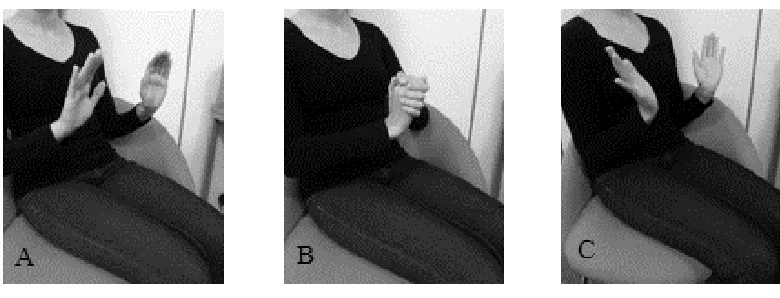
We presented children in the interactive gesture condition with three interactive gestures
(see Figure B1). A first interactive gesture involved the experimenter moving both hands up to
shoulder height with the palms facing forward to indicate surprise (Panel A). A second
interactive gesture involved moving both hands up and folding them together at chin height
(Panel B). A third interactive gesture also indicate excitement by moving two hands up to chin
height in a reversed triangle shape (Panel C). The experimenter rotated these interactive gestures
[image:41.612.109.499.312.461.2]across trials for each child in the interactive gesture condition.
Figure B1. Three interactive gestures (Bavelas et al., 1992) used in the experiment. The gestures