Ensemble Prospectism
∗Kim Kaivanto†
Lancaster University, Lancaster LA1 4YX, UK
this version: June 16, 2017
Abstract
Incomplete preferences displaying ‘mildly sweetened’ structure are common, yet theoretically problematic. This paper examines the properties of the rankings induced by the set of all coher-ent completions of the mildly sweetened partial preference structure. Building on these proper-ties, I propose an ensemble-based refinement of Hare’s (Analysis 70:237–247, 2010) prospectism criterion for rational choice when preferences are incomplete. Importantly, this ensemble-based refinement is immune to Peterson’s (Theory & Decision 78:451–456, 2015) weak money pump argument. Hence, ensemble prospectism ensures outcome rationality. Furthermore, by recog-nizing the structural isomorphism between mildly sweetened preference structures and Cover’s splitting rule in Blackwell’s Pick the Largest Number problem (Ann Math Stat 22:393–399, 1951), ensemble prospectism can be shown to yield better-than-even odds of selecting the ex-post higher-utility option – despite the absence of all-things-considered preferences ex ante.
Keywords: Prospectism; Refinement; Money pump; Outcome rationality; Ensemble method; Voting rules; Incomplete preferences; Mildly sweetened preferences; Cover rule; Hare; Peterson
JEL classification: D81
∗Copyright c
2016 Kim Kaivanto
1 Introduction
Along with reflexivity and transitivity, completeness is widely and routinely invoked as a
neces-sary condition of preference-relation rationality. Yet far from being fundamental to rationality,
the completeness axiom’s function is to ensure tractability. Moreover, its descriptive and
nor-mative validity is questioned, even among theorists.
Hare (2010) introduces an approach to decision making under incomplete preferences
la-belled prospectism. Informally, an action is permissible under prospectism if and only if, for
some particular completion of negatively transitive preferences which respects existing partial
preference structure, no alternative action yields higher utility. Prospectism thus offers guidance
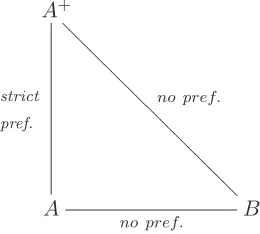
for action when a decision maker is confronted by the ‘mildly sweetened’ configuration of
incom-plete preferences where strict preference holds between the mildly sweetened optionA+ and its
unsweetened formA(A+≻A) but no preference holds between optionsA+ andB, nor between
optionsA and B. Importantly however, the permissible choice is not identified uniquely.
Peterson (2015) shows that this non-uniqueness characteristic renders the decision maker
susceptible to a weak money pump in which she is permitted to make a series of choices that
lead to a sure loss of utility. Peterson (2015) argues that this possibility – and the decision
maker’s advance knowledge that she may make such a utility-diminishing sequence of choices –
precludes prospectism from being a plausible theory of rational decision making. “A possible
conclusion is that the very idea of trying to find decision rules for decision makers who lack
complete preferences ... is problematic (Peterson, 2015).”
Although the problem is difficult, it is not insoluble. Moreover, it is soluble precisely by
building upon Hare’s (2010) central concept of a ‘coherent completion’ of preferences
consis-tent with existing partial preference structure. Just as refinements of game-theoretic solution
concepts narrow the number of candidate solutions and eliminate implausible equilibria, here
we develop a refinement of prospectism that addresses the multiplicity of permissible choices
under prospectism. This refinement is based on the entire ensemble of coherent completions of
preferences consistent with existing partial preference structure.
We characterize the properties of the set of rankings induced by the ensemble of coherent
completions of the mildly sweetened partial preference structure. The strict preferenceA+≻A
places a constraint on the number and nature of possible coherent completions. The ensemble
of coherent completions inherits this structure, which is reflected in the associated ensemble of
rankings.
The results obtained here are facilitated by two crucial insights.
exploited in Cover’s ‘splitting rule’ that delivers better-than-even odds of selecting the larger
(unknown) number in the problem known as Pick the Largest Number (Blackwell, 1951; Cover,
1987; Samet et al., 2004). We show that the Cover-rule solution applies equally to the problem
in which a decision maker must choose between options whose utilities are unknown ex ante.
Second, that ensemble-based methods – which we formalize through an ensemble voting
pro-cedure – constitute a suitable propro-cedure forrationally selecting a choice option under incomplete
preferences. Aggregation of individual preferences to inform collective decision making has been
studied extensively, for centuries, in the social-choice literature. Here we draw on this literature
in formalizing ensemble voting rules. Furthermore ensemble methods are used extensively in
diverse areas where a single decision maker seeks to improve predictive or inferential
perfor-mance by aggregating across diversiform models, hypotheses, or inferences. Ensemble methods
are also used in areas where the information to be aggregated is supplied by diverse individuals
or forecasters. Surowiecki (2004) provides numerous illustrations of, and a shortlist of
neces-sary preconditions for, successful aggregation across individuals, now popularly known as ‘the
wisdom of crowds’.1
Ensemble prospectism, which implements a voting procedure, delivers a unique ranking
that aggregates across the entire ensemble of rankings. Consequently ensemble prospectism is
immune to weak money pumps. In turn, it also satisfies outcome rationality.2 Moreover, due
to the structure of rankings and relative option frequencies picked up in the ensemble voting
procedure, by Cover’s (1987) splitting rule ensemble prospectism achieves better-than-even odds
of selecting the option with the larger ex-post utility, despite these utilities being unknown ex
ante.
2 Incomplete preferences
2.1 Provenance
The completeness axiom simplifies rational choice theory, and it is present in the most widely
known variants of revealed preference theory (Sen, 1973). Nevertheless completeness is neither a
requirement for, nor an implication of, rationality or revealed preference. Within the specialist
literature, a consistent view concerning the universal applicability of the completeness axiom
prevails among a large fraction of the authors responsible for developing rational choice theory:
that its appropriateness and convenience is dubious, that it is perhaps the most questionable of
all the axioms of utility theory, that it is without adequate justification, and that it is without
1after the title of his best-selling book 2
reason (see Table 1).
Although completeness, together with transitivity, is often advanced as a minimal
require-ment for consistency-based rationality – e.g. as in Savage’s first postulate (Savage, 1954) – recent
work has shown that completeness of psychological preferences is not a necessary requirement
for rationality when rationality is conceived as ‘outcome rationality’ (Mandler, 2005) or ‘making
choices that do not lower welfare’ (Gilboa et al., 2010). Only choices violating psychological
preferences – whether complete or incomplete – would, under this view, be viewed as violations
of rationality (Sen, 1973; Mandler, 2005).
Table 1: The completeness axiom’s provenance among theorists.
von Neumann & “It is very dubious, whether the realization of reality which treats this Morgenstern (1944) [completeness] postulate as a valid one, is appropriate or even convenient.”
Herman Chernoff (1954) “...this assumption is too much to make if one wants to determine whether a rational approach exists via the decision function formulation.”
Robert Aumann (1962) “Of all the axioms of utility theory, the completeness axiom is perhaps the most questionable.... ...we find it hard to accept even from the normative viewpoint.”
Robert Sugden (1991) “There is no adequate justification for the requirement that preferences are complete.”
Michael Mandler (2004) “...even for standard consumption goods there is no reason why agents should always be able to judge which bundles leave them better off.”
2.2 Prospectism
Here we presentprospectism following Hare (2010) except insofar as our context of application
permits simplification. Notably, the choice options in the mildly sweetened partial preference
structure – generically denoted oi ∈ O – are neither explicitly nor implicitly defined as being
risky or uncertain. For this reason we collapse Hare’s (2010) expected-utility formulation into
an ordinal utility-under-certainty formulation. An incomplete strict partial order ≻cannot be
represented by a real-valued function in the usual manner.3 However it is possible to associate
a function u∗: O → R, unique up to an affine transformation, such that for any comparable
pairs in ≻, oi ≻ oj implies u∗(oi) > u∗(oj) for all oi, oj ∈ O. u∗ constitutes a coherent
completion of ≻ over the set of all choice options O. The real-valued function u∗ imposes a
complete order onO. There is more than one possibleu∗ consistent with a specific partial order 3
Although Hare (2010) posits the existence of such a real-valued function, labelling it u, his subsequent
≻. Let L(O,≻) = U∗
O,≻ denote the set of all coherent completions of ≻, the existence of
which is guaranteed by Szpilrajn’s (1930) theorem.4 In turn, the original partial order may be
recovered as the intersection of all coherent completions:
≻ = \
u∗∈U∗
O,≻
u∗ . (2.1)
Definition 2.1 (Prospectism). It is permissible to choose an option iff, for some utility func-tion u∗ that represents a coherent completion of (partial, incomplete) preferences ≻, no other
option yields greateru∗-utility.
2.3 ‘Mildly sweetened’ partial preference structure
Consider the choice optionsoi, oj, ok∈O (i6=j6=k), for which we also have the more intuitive
labels oi = A+, oj = A, and ok = B. The absence of all-things-considered preferences is
sometimes illustrated asinsensitivity to mild sweetening. That is, knowing that a decision maker
has no preference between A and B, even the introduction of a discrete improvement over A –
a mild sweetening of A, which we label A+, and for which A ≺A+ is apparent – nevertheless
does not suffice for preferences of any sort to materialize between A+ and B. In other words,
the absence of preference between A and B, sometimes described as incommensurability, is
so fundamental that it is robust to the mild sweetening of A to A+. The mildly sweetened
[image:5.595.275.405.501.618.2]partial-preference structure is illustrated in Figure 1.
Figure 1: Mild sweetening.
A+ strict pref. no pref. ❄ ❄ ❄ ❄ ❄ ❄ ❄ ❄ ❄ ❄ ❄ ❄ ❄ ❄ ❄ ❄ ❄ ❄ ❄ ❄ ❄ ❄ ❄ ❄ ❄ A
no pref. B
2.4 Weak money pump
Peterson (2015) considers preference structures that are insensitive to mild sweetening (see
Section 2.3 above). As the definition of prospectism stipulates thepermissibility of choosing in
4The symbolL(·
,·) refers to the set of all linear orders, i.e. the set of all complete orders, which in keeping
accordance withany coherent completion u∗ of the underlying incomplete preferences, the weak
money pump is simple to construct.
At timet1 a decision maker with preferences illustrated in Figure 1 is offered a swap in which
she may give up A+ in exchange for B. Although she has no preferences between A+ and B,
there is a coherent completion of her preferencesu∗ in whichB ≻∗ A+. Hence, according to the
definition of prospectism, she is permitted to swap A+ for B at time t
1, although she is under
no obligation to do so. At the later datet2 she faces a choice situation in which she is offered a
swap in which she may give upB in exchange forA. Again, as she has no preferences between
B and A, she is not compelled by her preferences to choose either. But among the coherent
completions of her incomplete preferences there is a u∗ – different from that which permitted
choice at timet1 – in whichA≻∗ B. Hence, according to prospectism, she is permitted to swap
B forA. At a yet-later date t3 she faces a choice situation in which she is asked to pay a small
amount of money in order to swap A in exchange for A+. As she does have explicit preference
for the latter A≺A+, she increases her utility by accepting this swap – as long as the cost of
doing so is sufficiently small. Hence, it is also permissible under prospectism.
Taken together, this sequence of trades – each of which is permissible under prospectism –
leads to a sure monetary loss. The decision maker is not obligated by prospectism to participate
in these trades, but prospectism explicitly permits this sure-monetary-loss sequence. Peterson
(2015) asks the question, “How could rationality permit you to carry out a sequence of acts
that you know in advance will lead to a sure loss?” His answer is that a rational theory cannot
permit such a sure-loss-making sequence, and hence prospectism should be rejected as a theory
of rationality.
3 Cover’s random-threshold rule
3.1 Pick the largest number
Consider the following problem, a variant of which was originally introduced by David Blackwell
(1951).
Problem 1 (Pick the largest number ). Two slips of paperi= (1,2), each inscribed with a real numberxi∈R, lie face down. One of the two slips is chosen at random, and the numberxi
on it is shown to you. You have to guess whether your number is the larger of the two. How can
you guarantee that the probability of your guess being correct is strictly greater than one-half?
decide that it is the smaller; if greater thant, decide that it is the larger.
Regardless of the specific form of the density f(t), its cdf F(t) is monotonically strictly
increasing in t, given that f(t) > 0 ∀t ∈ (−∞,∞). Following Cover’s random-threshold
rule, the Guesser concludes that the unobserved number is larger than the observed number
xi according to a monotonically strictly decreasing function of the observed number xi, as
P(t−xi >0) = 1−F(xi).
Let Nature determine the numbers (x1, x2) as the realization of a pair of random variables
(X1, X2), the support of each being the entire real lineR. Nothing further is stipulated regarding
the specific distributions of X1 and X2. They may be viewed as arbitrary. It follows that
P(X1 6=X2) = 1, whereby it must hold that either x1 < x2 or x1 > x2. The following claims
(notation adapted) are proven by Samet et al. (2004).
Claim 1. If the Guesser plays an arbitrary threshold strategy against any realization (x1, x2),
then she
• wins with probability 1/2 when either x1, x2 < t or x1, x2> t;
• wins for sure when either x1 < t≤x2 or x2< t≤x1.
Consider the random-threshold strategyT such that P(t∈(x1, x2])>0 whenever x1 < x2
and similarly P(t∈(x2, x1])>0 whenever x2< x1.
Claim 2. The strategy T guarantees that the Guesser wins with probability higher than 1/2
against any realization (x1, x2).
Let us examine the x1< x2 case first. Here the realization t splits the two numbers x1 < t <
x2 with probability P(t∈(x1, x2])>0, whereby the Guesser correctly opts for the unobserved
number. If the realization t does not split the two numbers, the Guesser succeeds with
prob-ability 1/2. Overall, then, the Guesser succeeds with probability 1/2 +P(t ∈(x1, x2])>1/2.
Similarly in the x1> x2 case the Guesser succeeds with probability 1/2+P(t∈(x2, x1])>1/2.
Together, these two cases are exhaustive. Either way, the Guesser’s random-threshold splitting
strategy succeeds with probability greater than 1/2.
3.2 Application to mildly sweetened preference structure
The problem of choosing betweenA+andBin the mildly sweetened partial preference structure
is formally equivalent to a truncated variant of the problem of sticking or switching in Pick The
Recall that in Pick The Largest Number, the Guesser has to choose between two initially
unknown real numbersx1, x2 ∈R, one of which is revealed to be greater-than or less-than the
realization of a third real-valued t ∈ R random-threshold splitting number T. In the event
that the realized value of the third real number tis less than x1, it is possible to conclude that
P(x1 > x2)>1/2 by an mount 1/2≥P(t∈(x2, x1])>0.
Similarly, the decision maker’s task in the mildly sweetened preference structure is to choose
between two options yielding unknown real-valued utility u∗(A+), u∗(B)∈R, the utility of one
of which (A+) is revealed to be greater than the otherwise-unknown real-valued utility of a third
choice option (A); that is,u∗(A+)> u∗(A) ∀u∗(·)∈ U
O,≻. If in addition u∗(B)> u∗(A), then P(u∗(A+) > u∗(B)) = 1/2. If however P(u∗(A+) > u∗(A) > u∗(B)) > 0 then P(u∗(A+) >
u∗(B))>1/2.
Proof. Although the magnitude of the attribute increment(s) between A and A+ is (are)
known, the associated increment in utility is not known, due to the underlying incompleteness
of preferences. If the utility difference can takeany strictly positive (but arbitrarily small) value
u∗(A+)−u∗(A)∈R
++, thenP(u∗(A+)> u∗(A)> u∗(B))>0 no matter how close the spacing
u∗(A+)−u∗(B) ∈R
++, and thus P(u∗(A+)> u∗(B))>1/2. Let us assert the contrary, that
is u∗(A+)−u∗(A) ∈ {R
++\D} where D ⊂ R++ and D 6= ∅. However if D 6= ∅ we would
know the lower bound of the marginal utility (utilities) of the attribute(s) upon whichA+ and
A differ, thereby contradicting the absence of all-things-considered preferences.
4 Ensemble prospectism
Section 3.2 shows that choosingA+ overBis not only consistent withsomecoherent completion
of ≻, u∗, but that it is better than outcome rational to do so. Meanwhile, Peterson’s (2015)
weak money pump argument shows that Hare’s (2010) prospectism criterion does not ensure
outcome rationality on its own. Nevertheless, prospectism can be reconciled with outcome
rationality by bringing more of the information contained in the set of coherent completions
U∗
O,≻ to bear upon the choice between A+ and B. Specifically, this can be accomplished with
theensemble of rankings consistent with U∗
O,≻.
4.1 Preliminaries
Knowing only that A+ ≻A, three strict rank orderings are possible, and these correspond to
the set of rank-order equivalence classes within the set of all coherent completions of ≻,U∗
Label this set S (the ensemble of possible rank orderings):
S=
(A+, B, A),(B, A+, A),(A+, A, B) (4.1)
Properties 4.1 (Ensemble of rankings).
(i) The subset of first-ranked options is S1={A+, B, A+}, and
|S1|A+ |S1|
= 2/3, |S1|B
|S1|
= 1/3 .
(ii) The subset of first- or second-ranked options is S1,2 ={A+, B, B, A+, A+, A}, and
|S1,2|A+ |S1,2|
= 1/2, |S1,2|B
|S1,2|
= 1/3, |S1,2|A
|S1,2|
= 1/6 .
(iii) The subset of last-ranked options is S3={A, A, B}, and
|S3|A+ |S3|
= 0, |S3|B
|S3|
= 1/3, |S3|A
|S3|
= 2/3 .
(iv) Two rankings form a mutually off-setting symmetrical pair insofar asA+andB are ranked
above A: Ssym = {(A+, B, A),(B, A+, A))}. There is one symmetry-breaking ranking
Sn-sym={(A+, A, B)} in which A splits A+ and B.
In each of the ranking properties (i)–(iii), A+ dominates B by relative frequency.5 This
follows as a direct consequence of the symmetry-breaking rankingSn-sym={(A+, A, B)}, which
is detailed in property (iv). This ranking is precisely the splitting ranking that Section 3.2 proves
to occur with strictly positive probability. This symmetry-breaking ranking plays a pivotal role
in the ensemble-based approach, to which we now turn.
4.2 Ensemble approach
Ensemble methods are used extensively in diverse areas in which either (a) multiple individuals’
beliefs, forecasts, or preferences are aggregated for collective action or (b) a single
decision-making entity develops multiple different explanations, hypotheses, or models that it aggregates
for the purpose of making a specific inference. The term ‘ensemble method’ is used in machine
5
learning and artificial intelligence, while the same collection of aggregation techniques – by
voting or by averaging – are referred to by a variety of labels across the different areas in which
they are employed.
As in the contexts of artificial intelligence, multiple forecasters, and Bayesian model
un-certainty, the problem of choosing an option under incomplete preferences can be partitioned
into two steps, the first of which applies Epicurus’ (c. 342–270 BCE) Principle of Multiple
Explanations: If more than one theory is consistent with the observations, keep all theories.6
Construction of the set of all coherent completions of preferencesU∗
O,≻ is the corresponding step
in prospectism. It is in the second step where the presently proposed ‘ensemble prospectism’
departs from Hare’s (2010) seminal formulation. In a manner consistent with ensemble methods
more generally, ensemble prospectism utilizes the full range of coherent completions of the
deci-sion maker’s incomplete, partial preferences as enumerated inU∗
O,≻, rather than any (arbitrary)
individual element of this set, to guide choice. The task of rationally guiding choice in the context
of incomplete preferences can be viewed as a problem of inference about the decision-maker’s
underlying, as-yet unknown preferences. Due to this close parallelism, ensemble methods are
not only a convenient source of apposite terminology, but also a source of apposite solutions.
Because of the sparseness of information in this context, determining tight bounds on the
prior over the ensemble of possible rank orderings is problematic. Approaches based on Bayesian
Model Averaging – or, equally, weighted voting procedures – are therefore not suitable in the
present context. This leaves a large collection of potentially applicable unweighted voting
pro-cedures (Brams and Fishburn, 2002; Brandt et al., 2013). The problem is simplified from that
typically addressed in social choice however, because strategic voting is not a consideration
within the present context.
The second step can be formalized as the application of a voting rule to the ensemble of
rankingsSO,∗ ≻associated with7 the set of all coherent extensions of≻,U∗
O,≻. Given the number
of choice options |O|and the restriction(s) imposed by the strict preferences (if any) contained
in≻, the number of different rankings present in the ensemble is given by n=|S∗
O,≻|. The set
of all non-empty subsets of the choice options may be written as F(O), which we will see below
may be understood as the set of feasible voting-rule outcomes. We specialize the definition of a
voting rule to the ensemble of rankings as follows.
Definition 4.1. An ensemble voting rule is a function f : S∗
O,≻→ F(O) .
A voluminous literature has developed a veritable zoo of voting rules, and a decision maker
6Epicurus’ letter to Pythocles: events “have multiple causes of coming into being and a multiple prediction of
what exists, in agreement with the perceptions.”
might in principle employ any one of a large number of different voting rules. For ensemble
prospectism to be immune to weak money pump arguments, the ensemble voting rule must
satisfy additional requirements. First, the decision maker must not have the possibility to
switch from one voting rule to another within a time frame that would make it possible for the
different properties of distinct voting rules to introduce decision-sequence-level intransitivity.
Second, the voting rule must not be a member of the class of stochastic (or lottery) voting rules,
as such rules could also introduce decision-sequence-level intransitivity. Third – and for the very
same reason – the voting procedure should be resolute, yielding a unique winner, or else if it is
not resolute, and yields a set of co-winners, the tie-breaking rule applied must not be random.
In the definition below, the second and third requirements above are jointly invoked with the
‘completely non-stochastic’ qualification.
Definition 4.2 (Ensemble prospectism). It is permissible to choose an option iff it is iden-tified as the winner by the decision-maker’s completely non-stochastic ensemble voting rule f
applied to the ensemble of rankings S∗
O,≻ associated with the set of all coherent extensions of
≻,U∗
O,≻.
Many voting rules satisfy these requirements, including e.g. simple and common (positional)
scoring rules such as the plurality rule, the anti-plurality rule, and Borda’s rule. Among all
positional scoring procedures, Borda’s rule is least susceptible to paradoxes and other
patholog-ical behavior, including being the only scoring rule that will never award a Condorcet winner
the lowest cumulative score (Brandt et al., 2013). Where Borda’s rule and the other positional
procedures do fall short is in susceptibility to strategic manipulation – which, fortunately, is
not a consideration in the present context, just as it is not a consideration in contexts where
Borda’s rule has been used to combine inferences from diverse methods to improve inferential
performance (Marbach et al., 2012). Under the Borda rule each of the n rankings present in
S∗
O,≻ awards a score (or ‘points’) from a maximum of |O| −1 to the highest-ranked option,
through to 0 for the lowest-ranked option (|O|−1,|O|−2, ...,1,0). Each option’s Borda count is
the sum of its scores across all n ranking profiles, and the Borda rule chooses the option with
the highest Borda count. Indeed all |O|options may be ordered (completely and transitively)
by their respective Borda counts, which here we may denote≻BC.
In the example below we revisit the ensemble of possible rank orderingsSdetailed in equation
(4.1). We present its ensemble-prospectism solution, operationalized for illustrative purposes
with a ‘Borda’ ensemble-voting rule.
Example 4.1 (Ensemble-prospectism solution to mildly sweetened partial preferences).
transitive ordering ≻BC = (A+ ≻ B ≻ A) (see Borda scores in Table 2). The Borda-count
ranking≻BChere is consistent with the relative-ranking properties (i)–(iii) set out in Section 4.1
above. Moreover, the Borda-count ranking≻BC here is also consistent with the recommendation
derived from Cover’s (1987) splitting-number solution in Section 3.2.
Table 2: Application of Borda rule to mildly sweetened partial preferences.
ranking A+ B A
A+, B, A 2 1 0
B, A+, A 1 2 0
A+, A, B 2 0 1
Borda count 5 3 1
5 Conclusions
This paper develops a refinement of prospectism that reconciles Hare’s (2010) theory of
prospec-tism with Peterson’s (2015) weak money pump. The refinement restricts the range of prospecprospec-tism-
prospectism-consistent choices by grafting ensemble methodology upon Hare’s (2010) set of all coherent
com-pletions of the incomplete preference relation. The resulting ensemble-prospectism refinement
is not susceptible to weak money pump arguments. By precluding choices that would lower
individual welfare, ensemble prospectism ensures outcome rationality.
Yet there is also a sense in which the form of rationality embodied in ensemble prospectism
dominates outcome rationality. Ensemble voting rules not only ensure that individual welfare is
not lowered, but also ensure strictly greater-than-even odds of selecting the best option – despite
the absence of all-things-considered preferences. This surprising, counter-intuitive finding is
underpinned by the structural isomorphism between the problem of choice under incomplete
preferences – particularly under ‘mildly sweetened’ incomplete preferences – and the Guesser’s
problem in the game Pick the Largest Number. Whereas Cover’s random-splitting-number
solution ensures greater-than-even odds of guessing the larger (unknown) number in the latter
problem, ensemble voting rules ensure greater-than-even odds of selecting the higher (unknown)
utility option in the former problem. The symmetry-breaking ranking, which is pivotal to the
ensemble-voting result in the mildly sweetened preference structure, corresponds precisely to the
splitting-number case which is pivotal to achieving greater-than-even odds in Pick the Largest
References
Aumann, R.J. (1962). Utility theory without the completeness axiom. Econometrica, 30, 445–
462.
Blackwell, D. (1951). On the translation parameter problem for discrete variables. Annals of
Mathematical Statistics, 22, 393–399.
Brams, S.J., Fishburn, P.C. (2002). Voting procedures. Chapter 4 (pp. 173–236) in K.J.
Ar-row, A.K. Sen, K. Suzumura (eds.) Handbook of Social Choice and Welfare, Volume I. xxx :
Elsevier.
Brandt, F., Conitzer, V., Endriss, U. (2012). Computational Social Choice. Chapter 6 (pp.
213–286) in G. Weiss (ed.) Multiagent Systems, 2nd ed.Cambridge, MA: MIT Press.
Chernoff, H. (1954). Rational selection of decision functions. Econometrica, 22, 422–443.
Cover, T.M (1987). Pick the largest number. In T.M. Cover, B. Gopinath (eds.)Open Problems
in Communication and Coomputation, New York, NY: Springer.
Gilboa, I., Maccheroni, F., Marinacci, M., Schmeidler, D. (2010). Objective and subjective
rationality in a multiple prior model. Econometrica, 78, 755–770.
Hare, C. (2010). Take the sugar.Analysis, 70, 237–247.
Mandler, M. (2004). Status quo maintenance reconsidered: Changing or incomplete preferences.
Economic Journal, 114, F518–F535.
Mandler, M. (2005). Incomplete preferences and rational intransitivity of choice. Games and
Economic Behavior, 50, 255–277.
Marbach, D., et al. (2012). Wisdom of crowds for robust gene network inference.Nature Methods,
9:796–803.
von Neumann, J., Morgenstern, O. (1954). Theory of Games and Economic Behavior, 2nd
edi-tion. Princeton, NJ: Princeton University Press.
Peterson, M. (2015). Prospectism and the weak money pump argument.Theory & Decision, 78:
Samet, D., Samet, I., Schmeidler, D. (2004). One observation and two-envelope puzzles.
Amer-ican Mathematical Monthly, 111, 347–351.
Savage, L.J. (1954). The Foundations of Statistics. New York, NY: John Wiley & Sons.
Sen, A. (1973). Behaviour and the concept of preference.Economica, 40, 241–259.
Surowiecki, J. (2004). The Wisdom of Crowds. New York, NY: Anchor Books.
Szpilrajn, E. (1930). Sur lextension de lorde partiel. Fund. Math., 16, 386–389.
Sugden, R. (1991). Rational choice: A survey of contributions from economics and philosophy.