Privacy Preserving Data Reporting Protocol
Using Slot Reservation Scheme
Akhil G Nath P Tharcis
Students Assistant Professor
Department of Electronics Communication Engineering Department of Electronics Communication Engineering Christian College Of Engineering And Technology Christian College Of Engineering And Technology
Allwyn Antony Bintu Varghese
Students Students
Department of Electronics Communication Engineering Department of Electronics Communication Engineering Christian College Of Engineering And Technology Christian College Of Engineering And Technology
Nikhil John Students
Department of Electronics Communication Engineering Christian College Of Engineering And Technology
Abstract
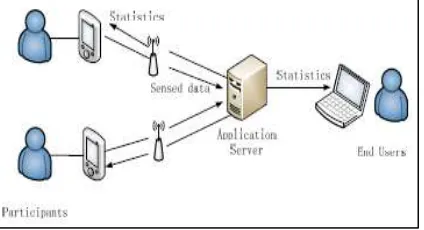
In this paper, we are proposing a privacy-preserving data reporting protocol for the participatory sensing applications, based on the notion of anonymity. The current available systems are used for the protection of the data and information only, they do not protect the privacy of the user and because of that a lot of hacking and complications are occurring. Therefore, protecting the privacy of participants is highly important in the success of participatory sensing. In this system the link between the data and the participant is broken after the transfer of the message .The key intuition is that, if we break the link between a data and the participant who reports or uploads the data, the participant’s privacy can be protected, without degradation of the data accuracy. This data reporting protocol operates mainly in two stages, slot reservation and data submission. In the slot reservation stage, a group of several participants collaborate each other to construct a vector which contains a set of slots in it, all with same length. Each slot contains a reservation message from any one of the participant. This slot reservation message consists of a pseudonym and the length of the data to be uploaded. The slots that are allocated to each participant will be unique. The slots are allocated by a third server authenticator which is present in the system, and because of that only the particular user and the third server authenticator knows about the particular slot. The participant will submit this reservation message in the data submission stage. Keywords: Data reporting, Participatory sensing, Slot Reservation, Data submission, Privacy
________________________________________________________________________________________________________
I. INTRODUCTION
The network security is the security provided for protecting the network and thereby protecting the user and the information from the outside attacks. There are several mechanisms which helps to keep the network secure in the network from the attacks. In this paper we are using an efficient anonymous data reporting protocol for the participatory sensing application. This protocol provides efficient data accuracy, strong user privacy, data privacy and generality. There is a lot of drawbacks in the existing systems which they mainly focus on the protection of the data and information and because of that the users privacy are in unsecured condition and so many intruders are utilizing this situation. In our system we keep the user privacy protected in an efficient manner and thereby the data and information are also protected. This system consists of two stages, Slot Reservation & Data Submission.
(IJSTE/ Volume 2 / Issue 10 / 035)
Slot Reservation
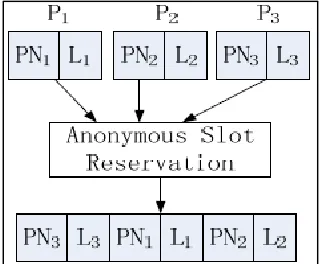
In the slot reservation stage, a group of participants collaborate each other to construct a vector that contains a set of slots in it, all with same length. In this each participant is allocated with separate slots. The allocated slots will be unique. The slot reservation for each participant is done by a third server authenticator which is already present in the system. At the time of slot reservation a reservation message which consists of a pseudonym and the length of the data is created for each participant the slots that are allocated will be only known by the third server authenticator and the particular participant only.
Fig. 2 :Illustration Of Anonymous Slot Reservation
Data Submission
The data submission is the submission or the Uploading of the message. The slot reservation message is uploaded in the time of the data submission. The secured data will only be submitted on the time of data submission.
Fig. 3: Illustration of Data Submission Round
Latency In Slot Reservation
In the existing system the latency and the low efficiency was the main problems and as a solution for these problems we are using our new scheme. In this scheme we use a buffer for reducing the latency in the slot reservation. This will work in a FIFO manner and because of that the latency will get reduced.
Fig. 4: Latency in slot reservation of a participant
II. RELATED WORKS
Privacy-Preserving Data Aggregation in Mobile Phone Sensing
Author(s) Y. Zhang ; State Key Laboratory for Novel Software Technology, Nanjing University, and also with the Computer Science and Technology Department, Nanjing University, Nanjing, 210023, China ; Q. Chen ; S. Zhong.
to efficiently calculate arbitrary/complicated aggregation functions. In this presents an effective efficient protocol that allows an untrusted data aggregator for periodical collection of sensed data from a group which consists of several mobile phone users without knowing about which data belongs to which of the user. Assume that there are n users in the group. The protocol will achieve n -source anonymity in sense that the aggregator will only be knows about the source of the data is one of the n users. After that we consider a scenario practically where the users should have source anonymity requirements differently and provides a solution based on the dividing of the users into different groups. This solution will optimize the efficiency of data aggregation and meets requirements of the user’s at the same time.
Privacy and Quality Preserving Multimedia Data Aggregation for Participatory Sensing Systems
Author(s) F. Qiu ; Dept. of Computer Science. & Engineering. Shanghai Jiao Tong Univ., Shanghai, China ; F. Wu ; G. Chen With the popularity of mobile wireless devices equipped with several types of sensing abilities, a new efficient service paradigm named participatory sensing has emerged to provide the user with a new life experience. This application of the participatory sensing has its own several challenges, in which the privacy and the multimedia data quality preserving are two of the critical problems. But none of the existing works have solved this very problem of preserving of the privacy and the quality participatory sensing with multimedia data. In this paper, we propose SLICER, which is the first k-anonymous privacy preserving scheme for participatory sensing with multimedia data. SLICER integrates a data coding technique and a message transfer strategy, to achieve strong protection of participants' privacy, while maintaining high data quality. Specifically, we study two kinds of data transfer strategies, namely transfer on meet up (TMU) and minimal cost transfer (MCT). For MCT, we propose two different but complimentary algorithms, including an approximation algorithm and heuristic algorithm, subject to different strengths of the requirement. Furthermore, we have implemented SLICER and has evaluated its performance using publicly released taxi traces. Our evaluation results show that SLICER achieves high data quality, with low computation and communication overhead.
A Trajectory Privacy Preserving Framework for Participatory Sensing
Author(s) S. Gao, School. of Computer. Science. & Technology., Xidian Univ., Xi'an, China ; J. Ma ; W. Shi ; G. Zhan The ubiquity of various cheap embedded sensors on mobile devices, for example cameras, microphones, accelerometers, and so on, is now enabling the emergence of participatory sensing applications. While participatory sensing can benefit the individuals and communities greatly, the collection and analysis of the participators' location and trajectory data may jeopardize their user privacy. However, the existing proposals only focus on participators' location privacy, and few are done on participators' trajectory privacy. The effective analysis on trajectories that contain spatial-temporal history information will reveal participators' whereabouts and their relevant personal privacy. In this paper, we propose a trajectory privacy-preserving framework, named as TrPF, for participatory sensing. Based on the framework, we improve the theoretical mix-zones model by considering the time factor from the perspective of graph theory. Finally, we analyze the threat models with different background knowledge and evaluate the effectiveness of our proposals on the basis of information entropy, and then compare with the performance of our proposal with previous trajectory privacy protections. The analysis and simulation results prove that our proposal can protect participators' trajectories privacy effectively with lower information loss and costs that could be afforded by the other proposals.
A Random Decision Tree Framework for Privacy-Preserving Data Mining
Author(s) J. Vaidya ; MSIS Dept., Rutgers Univ., Newark, NJ, USA ; B. Shafiq ; Wei Fan ; D. Mehmoo Distributed data is ubiquitous in the modern information driven applications. With multiple sources of data, the natural challenge is to determine how to collaborate effectively across proprietary organizational boundaries while maximizing the utility of collected informations. Since using only local data gives suboptimal utility, techniques for privacy-preserving collaborative knowledge discovery that must be developed. Existing cryptography-based work for privacy-preserving data mining is too slow to be effective for large scale data sets to face today's big data challenge. Previous work on random decision trees (RDT) shows that it is possible to generate equivalent and accurate models with much cheaper cost. We exploit the fact that RDTs can naturally fit into a parallel and fully distributed architecture, and develop protocols to implement the privacy-preserving RDTs that enable general and efficient distributed privacy-preserving knowledge discovery.
III. MATERIALS AND METHODS
Login & Registration
(IJSTE/ Volume 2 / Issue 10 / 035)
Slot Reservation
In this module an anonymous slot reservation scheme which can assign a data submission slot for each participant in an anonymous way where different slots are allotted for each of the participant for preserving the user privacy in the slot reservation stage, a group of participants collaborate each other to construct a vector. This vector contains a set of slots, all with the same length but each slot will be unique. The slot reservation is done by a third server authenticator which is already present in the system itself. Each slot contains a reservation message from a participant, which consists of a pseudonym and the length of the data that the participant will submit in the data submission stage. In this slot reservation scheme each participant has a private/public key pair, and each participant knows the public keys of all the others, but the private key is known by the user and the third server authenticator. Thus, all participants can identify each other by public keys and the private key will be secured. In this scheme the private key and public key is allotted by a trusted certification authority whose job is to associate each individual participant with his public key. But in some cases each participant can generate their own key pair them self and publish the public key at the application server, if the participant does not trust any authority.
File Uploading
In this module the file is uploaded by the file is uploaded in the group by the participant who is a member of the group. These files can only be readed and downloaded by the participants who all present in the group. At the time of file uploading the slots of each participant which is created at the time of slot reservation is used instead of the secret ID.
ID Creation & Encryption
In this stage secret ID is created for each participant of the group. The secret ID will be unique for each participant. The ID consists of a private key and a public key. This ID is always kept as hidden for preserving the privacy of the user. All the details of the participant is kept secured using this secret ID. This secret ID is not used anywhere in the working of the system to secure the user details.
In this module the data that was uploaded is secured from the intruder attacks using the encryption method. We can use any type of encryption method like DES,AES, SHA,RC4... The encryption is done at the time of file uploading. In this encryption scheme the data that needs to be uploaded is encrypted using the private key of the sender and the public key of the receivers which is created at the time of slot reservation.ie, The original private and public key which is allotted at the time of ID creation is not used and because of that no one can identify the origin of the message since the message contains all the participants key. Only the members who registered in the group can access this data because the public key of the participant who have right to read the message is already linked to the message. Each slot contains a reservation message from a participant, which consists of a pseudonym and the length of the data where it is linked with the message data in the data submission stage. And by this reservation message the third server authenticator can easily identify who all can access that message.
Data Decryption & Downloading
In this stage the encrypted data which is received is decrypted by using the Private key of the receiver and by the public key of the sender. Only the authorized participants who registered in the group can access the data if and only if there Public key that is created at the time of slot reservation is present in the message. And this process of checking is done by the third server authenticator which is already present in the system. The data can only be downloaded if the third server authenticator gives approval.
IV. CONCLUSION
The user privacy preserving is one of the main issue in the networking and participatory applications. Here we propose an efficient and better anonymous data reporting tool or protocol for the participatory sensing application to preserve the user’s privacy. There are mainly two stages in this, slot reservation and message submission. This can be used for large scale application because of the reduction of the latency problem and the encryption/decryption mechanism used. The key idea behind this protocol was that breaking the link between the user and the data that was reported by the user, thereby keeping the privacy of the user secured.
REFERENCES
[1] Anonymity-based Privacy-preserving Data Reporting for Participatory Sensing, Yonglei Yao, Laurence T. Yang, IEEE Senior Member, and Neal N. Xiiong, IEEE Senior Member, IEEE Transactions on Internet of Things Journal (Volume :PP , Issue: 99 ),06 March 2015.
[2] Kai Xing, Zhiguo Wan, Pengfei Hu, Haojin Zhu, Yuepeng Wang, Xi Chen, Yang Wang. Mutual Privacy-Preserving Regression Modeling in Participatory Sensing. in proc. 32rd Annual IEEE International Conference on Computer Communications (INFOCOM), April 2013.
[3] Xi Chen, Xiaopi Wuu, Xiang-Yang Liyy, Yuan He, Yunhao Liu. Privacy-Preserving High-Quality Map Generation with Participatory Sensing, in proc. 33rd Annual IEEE International Conference on Computer Communication (INFOCOM), April 2014.
Magazine, 2010.
[6] T. Denning, A. Andrew, R. Chaudhri, C.Hartung, J. Lester, G. Borriello, G. Duncan. BALANCE: towards a usable pervasive wellness application with accurate activity inference. In Proc. 10th workshop on Mobile Computing Systems and Applications (HotMobile), 2009.
[7] S. Eisenman, E. Miluzzo, N. Lane, R. Peterson, G. Ahn, A. Campbell, BikeNet: a mobile sensing system for cyclist experience mapping. ACM Transactions on Sensor Networks, 2009.
[8] S. Gaonkar, J. Li, R. R. Choudhury, L. Cox, A. Schmidt. Micro-blog: sharing and querying content through mobile phones and social participation. In Proc. 6th international conference on Mobile systems, applications, and services (MobiSys), June 2008.
[9] Rana, R., Chou, C., Kanhere, S., Bulusu, N., Hu, W., Ear-Phone: an end-to-end participatory urban noise mapping system. In Proc. 9th ACM/IEEE Int. Conference on Information Processing in Sensor Networks (IPSN), 2010.
[10] Mohan, P., Padmanabhan, V., Ramjee, R., Nericell: rich monitoring of road and traffic conditions using mobile smartphones. In Proc. 6th ACM Conference on Embedded Network Sensor Systems (SenSys), 2008.
[11] A. Molina-Markham, P. Shenoy, K. Fu, E. Cecchet, D. Irwin. Private memoirs of a smart meter, in Proc. of the 2nd ACM Workshop on Embedded Sensing Systems for Energy-Efficiency in Building, BuildSys., 2010.