© 2019, IRJET | Impact Factor value: 7.211 | ISO 9001:2008 Certified Journal
| Page 1889
IOT BASED DRINKING WATER MANAGEMENT SYSTEM
Ms. Reshma R
1, Siva priya S K
2, Sulthanafathimabeevi M B
3, Swathishri B
4, Tamil selvam T
51
Assistant Professor, Electronics and Communication Engineering, Sri Shakthi Institute of Engineering and
Technology, Coimbatore, Anna University, Chennai, Tamilnadu, India.
2,3,4,5
Electronics and Communication Engineering, Sri Shakthi Institute of Engineering and Technology,
Coimbatore, Anna University, Chennai, Tamilnadu, India.
---***---
Abstract - Water is one of the most important substanceson earth. People now days always want something that can make their life easier. In this Project is used to define the water monitoring systems such as Tank water level sensing monitoring, water pollution monitoring. By using IOT Technology we avoid the huge amount of water is being wasted by uncontrolled use of large apartments/ offices. The microcontroller (PIC) based Water level monitoring is used to indicate the level of water in the tank to agent. Sensor Based Water Pollution Detection, it will check the water quality by using these parameters such as the pH level, Gas are measured in real time by the sensors and it will monitor by an agent.
Key Terms: Sensors, PIC, IOT Module. 1. INTRODUCTION
Internet of Things (IOT) is a system of several physical devices which are interconnected with each other and can communicate and send data through the Internet. It consists of all the internet enabled devices which can collect, communicate and act upon data acquired using sensors, [3] processors and communication hardware from the surrounding environments. IOT due to its connectivity, heterogeneity, dynamic nature and intelligence is widely used. It finds its application in several domains such as agriculture, industrial control, home automation, retail, healthcare, logistics, smart meter, and smart cities. With the internet of things, the physical world is becoming one big information system. It is the next generation of the Internet and is taking a huge leap in automation. IOT plays a major role in industrial safety and control.
2. EXISTING SYSTEM
Water is a limited resource and is essential for agriculture, industry and for creature’s existence on earth including human beings. Lots of people don’t realize the true importance of drinking enough water every day. More water is wasted by many uncontrolled way. This problem is quietly related to poor water allocation, inefficient use, and lack of adequate and integrated water management. Therefore, efficient use and water monitoring are potential constraint for home or office water management system.
3. PROPOSED SYSTEM
Water pollution monitoring can help with water pollution detection, discharge of toxic chemicals and contamination in water. And also check the quality by using Gas, pH and turbidity are the typical parameters collected in river/lake water pollution/quality monitoring systems. The goal of this project is to design and manage a Wireless Sensor Network (WSN) that helps to monitor the quality of water with the help of information sensed by the sensors immersed in water, so as to keep the water resource within a standard described for domestic usage and to be able to take necessary actions to restore the health of the degraded water body.
4. Block diagram
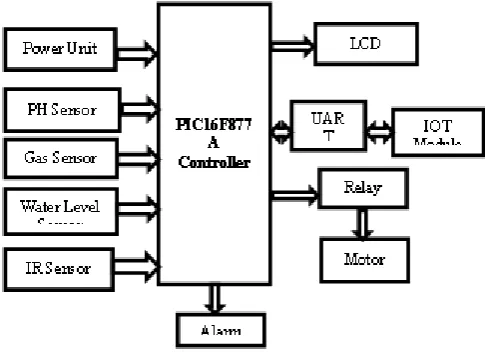
[image:1.595.315.558.465.646.2]The block diagram consists of components like power supply unit, alarm unit, display unit with various types of sensors that are managed by PIC controller. IOT section includes UART cables, relay and pumping motor.
Fig 1 Block diagram 4.1 PH Sensor
© 2019, IRJET | Impact Factor value: 7.211 | ISO 9001:2008 Certified Journal
| Page 1890
[image:2.595.107.212.135.257.2]measure of acidity and alkalinity, or the caustic and base present in a given solution. It is generally expressed with a numeric scale ranging from 0-14. The value 7 represents neutrality.
Fig 2 PH Sensor
PH commonly used for water measurements, is a measure of acidity and alkalinity, or the caustic and base present in a given solution. It is generally expressed with a numeric scale ranging from 0-14. The value 7 represents neutrality. PH is an important parameter that is measured in nearly every water quality application. In wastewater treatment, pH is regulated as part of discharge permitting and many treatment processes are pH dependent. In environmental sampling and monitoring, high or low pH values can be indicative of pollution.
4.2. Power Unit
There are different types of power supply circuits based on the power they are used to provide for devices. For example, the micro-controller based circuits, usually the 5V DC regulated power supply circuits, are used, which can be designed using different techniques for converting the available 230V AC power to 5V DC power. Generally the converters with output voltage less than
the input voltage are called as step-down
[image:2.595.406.482.198.257.2]converters.230V AC power is converted into 12V AC (12V RMS value wherein the peak value is around 17V), but the required power is 5V DC; for this purpose, 17V AC power must be primarily converted into DC power then it can be stepped down to the 5V DC. But first and foremost, we must know how to convert AC to DC.
Fig 3 Power Supply Unit
4.3 Gas Sensor
This is a simple-to-use liquefied petroleum gas (LPG) sensor, suitable for sensing LPG (composed of
[image:2.595.361.514.594.651.2]mostlypropane and butane) concentrations in the air. The MQ-6 can detect gas concentrations anywhere from 200 to 10000ppm.liquefied petroleum gas (LPG). The Grove - Gas Sensor (MQ2) module is useful for gas leakage detection (home and industry). It is suitable for detecting H2, LPG, CH4, CO, Alcohol, Smoke or Propane. Due to its high sensitivity and fast response time, measurement can be taken as soon as possible.
Fig 4 Gas Sensor
The MQ3 gas sensor is alcohol sensor which is used to detect the alcohol concentration on your breathe. This sensor provides an analog resistive output based on alcohol concentration. When the alcohol gas exist, the sensor’s conductivity gets higher along with the gas concentration rising. It is suitable for various applications of detecting alcohol at different concentration. This is an Analog output sensor. This needs to be connected to any one Analog socket in Grove Base Shield.
4.4. Level Sensors
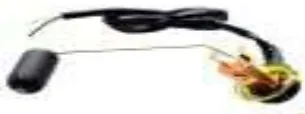
Level Sensors detect the level of substances that flow, including liquids, Slurries, granular materials, and powders. The substance to be measured can be inside a container or can be in its natural form. The level measurement can be either continuous or point values. Continuous level sensors measure level within aspecified range and determine the exact amount of substance in a certain place. While point-level sensors only indicate whether the substance is above or below the sensing point.
Fig 5 Level Sensor
[image:2.595.54.262.603.696.2]© 2019, IRJET | Impact Factor value: 7.211 | ISO 9001:2008 Certified Journal
| Page 1891
called position sensor and so on though all of them may be using the similar sensing principle. In a similar fashion, the sensor used for measurement of fluid levels is called a level sensor. Quite obvious from its name, level sensors are used to measure the level of the free-flowing substances. Such substances include liquids like water, oil, slurries, etc as well as solids ingranular/powder form (solids which can flow). These substances tend to get settled in the container tanks due to gravity and maintain their level in rest state. Level sensors measure their level against a pre-set reference.
4.5. PIC16F877A
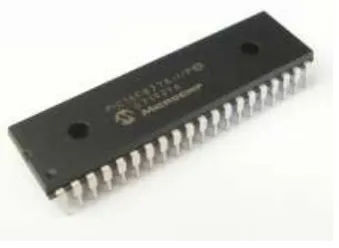
[image:3.595.352.523.372.519.2]PIC16F877A is useful as a reference device because it has a minimal instruction set but a full range of peripheral features. The general approach to microcontroller application design followed here is to develop a design using a chip that has spare capacity, then later select a related device that has the set of features most closely matching the application requirements. If necessary, we can drop down to a lower range (PIC10/12 series), or if it becomes clear that more power is needed, we can move up to a higher specification chip (PIC18/24 series). This is possible as all devices have the same core architecture and compatible instructions sets. The most significant variation among PIC chips is the instruction size, which can be 12, 14, or 16 bits.
Fig 6 PIC16F877A
PIC16f877a finds its applications in a huge number of devices. It is used in remote sensors, security and safety devices, home automation and in many industrial instruments. An EEPROM is also featured in it which makes it possible to store some of the information permanently like transmitter codes and receiver frequencies and some other related data. The cost of this controller is low and its handling is also easy. Its flexible and can be used in areas where microcontrollers have never been used before as in coprocessor applications and timer functions etc. you may also like to check complete list of pic microcontroller tutorials.
4.6. IOT Section (PC)
[image:3.595.76.246.429.553.2]In the field of monitoring and control, control devices with built-in computers called programmable logic controllers and process control stations are distributed near the equipment they are intended to control directly. Connecting these devices to a control local area network (LAN) makes it possible to collect data in a central monitoring and operation device for centralized monitoring and operation. This includes not only use as monitoring and control systems for individual facilities, such as water or sewage treatment plants and pumping stations, but also the use of telemetry or dedicated Internet Protocol (IP) lines to enable the interconnection and region-wide management of such facilities across the area served by a utility. In this way, the monitoring and control system themselves can form a network of things. However, although these monitoring and control systems have been networkedthe emphasis on real time performance and reliability has meant that they have developed as closed systems specific to individual vendors. Being part of the social infrastructure, water supply and sewerage have also adopted closed networks because of their need for security.
Fig 7 IOT Module
© 2019, IRJET | Impact Factor value: 7.211 | ISO 9001:2008 Certified Journal
| Page 1892
4.7. Relay
[image:4.595.99.218.265.353.2]A relay is a electromagnetic switch. Its basic function is to allow a low power control voltage operate a high power switch. The control and the switch are electrically isolated from each other and they have their own voltage and current ratings/requirements. The Coil Terminals control the switch. When voltage is applied across the coil it becomes an electromagnet. Its core attracts the switch armature and activates the switch. The Common Terminal (COM), Normally Open Terminal (NO) and Normally Closed Terminal (NC) make up the switch contacts. How they're connected depends on the application.When the coil is not energized, the COM terminal is connected to the NC terminal.
Fig 8 Relay
When the coil is energized, the COM terminal connects to the NO terminal. Here's a typical automotive application where we have two high power fog lights we want to turn On/Off. The switch applies 12V across terminals 85 and 86. Automotive relay coils typically draw 150 to 200mA (0.15 to 0.2A) which is much less than what the high powered fog lights need. We can use a low power switch and run smaller gauge wires for the coil side while letting the switch side handle the heavier load.
4.8. Pumping Motor
A DC motor is any of a class of rotary electrical machines that converts direct current electrical energy into mechanical energy. The most common types rely on the forces produced by magnetic fields. Nearly all types of DC motors have some internal mechanism, either electromechanical or electronic, to periodically change the direction of current flow in part of the motor. DC motors were the first type widely used, since they could be powered from existing direct-currentlighting power distribution systems. A DC motor's speed can be controlled over a wide range, using either a variable supply voltage or by changing the strength of current in its field windings. Small DC motors are used in tools, toys, and appliances. The universal motor can operate on direct current but is a lightweight brushed motor used for portable power tools and appliances. Larger DC motors are used in propulsion of electric vehicles, elevator and hoists, or in drives for steel rolling mills. The advent of power electronics has made replacement of DC motors with AC motors possible in many applications.
5. Functional Requirements
Software required are shown below
1. MPLAB IDE
2. Embedded C
3. PicKit 3
5.1 MPLAB
MPLAB is a Windows program package that makes writing and developing a program easier. It could best be described as developing environment for a standard program language that is intended for programming a PC. Some operations which were done from the instruction line with a large number of parameters until the discovery of IDE "Integrated Development Environment" are now made easier by using the MPLAB.
MPLAB consists of several parts:
- Grouping the projects files into one project (Project Manager)
- Simulator of the written program used for simulating program function on the microcontroller.
Minimal hardware requirements for starting the MPLAB are:
-- PC compatible computer 486 or higher.
-- Microsoft Windows 3.1 x or Windows 95 and new versions of the Windows operating system.
Fig 9 MP Lab
VGA graphic card.
-- 8MB memory (32MB recommended)
-- 20MBs of free space on hard disk.
5.2. Embedded C
[image:4.595.376.498.490.602.2]© 2019, IRJET | Impact Factor value: 7.211 | ISO 9001:2008 Certified Journal
| Page 1893
5.3 PICKIT 3
[image:5.595.329.543.135.264.2]Microchip has gone on to manufacture the Pickit3, a variation of the PICKIT 2 with the same form factor and a new translucent case.
Fig 10 PICKIT 3
It features a faster 16-bit PIC24F processor and a wider voltage regulation range. There are some complaints of it not being as reliable as the Pickit 2.
6. Working Module
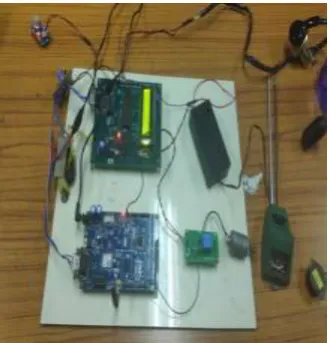
The circuit diagram is shown in Figure10 the circuit consisting of sensors, LCD display, PIC16F877A, IOT module, motor, relay, buzzer, power unit, etc are shown in the below figure clearly.
Fig 11 Working Module
The LCD is used to display the values of the sensor. It shows the PH value, water level, Gas value, Contamination values. The values in IOT page can be viewed in PC.
7. OUTPUT
The output of the process is shown in fig 11. It comprises the values of the sensors.
Fig 12 Sensor Values
Conclusion and Future Scope
Monitoring of Turbidity, PH, Gas & Water level sensor is used in monitoring water level with unique advantage and existing GSM network. The system can monitor water quality automatically.
Using the IOT cloud, android app can be developed for quality & quantity measurement and control will be easier.
Reference
1. Centre for Science and Environment, New Delhi, “Green Rating network,” Science and Environment fortnightly, Down To Earth, p.51, December 16, 2008.
2. Zhanwei Sun, Chi Harold Liu, ChatschikBisdikia_, Joel W. Branch and Bo Yang, 2012 9th Annual IEEE Communications Society
3. Sheila Kinkade and KatrinVerclas, “Environmental monitoring with mobile phones”in Wireless Technology for Social Change: Trends in Mobile use by NGOs, Communication Publication Series, vol. 2,pp. 52-54, 2006. Available:
4. Young JinJungetal.“Air pollution monitoring system based on geo sensor network”,in Proceedings of IGARRS,2008, pp. III-1370 – III-1373.
5. Yajie Ma et al.“Air pollution monitoring and mining based on sensor grid in London”,Sensors, pp. 3601-3623,
[image:5.595.86.233.148.239.2] [image:5.595.76.242.371.543.2]© 2019, IRJET | Impact Factor value: 7.211 | ISO 9001:2008 Certified Journal
| Page 1894
6. YadavandNivit Kumar, Reporters diary, “opportunity time,”Centre for Science and Environment, New Delhi, fortnightly, Down To Earth, January31, P. 50, 2008.
7. (SECON), 978-1-4673-1905-8/12/$31.00 ©2012 IEEE
8. Eoin O’Connell, Michael Healy, Sinead O’Keeffe, Thomas Newe, and Elfed Lewis, IEEE sensors journal, vol. 13, no. 7, July 2013,1530-437x/$31.00 © 2013 IEEE
9. Nidal Nasser, Asmaa Ali, Lutful Karim, Samir Belhaouari, 978-1-4799-0792-2/13/$31.00 ©2013 IEEE
10. AkankshaPurohit, UlhaskumarGokhale, Real Time Water Quality Measurement System based on GSM ,IOSR (IOSR-JECE) Volume 9, Issue 3, Ver. V (May -Jun. 2014)
11. MithailaBarabde, shrutiDanve, Real Time Water Quality Monitoring System,IJIRCCE, vol 3, June 2015.
12. SokratisKartakis, Weiren Yu, RezaAkhavan, and Julie A. McCann, 2016 IEEE First International Conference on Internet-of-Things Design and Implementation, 978-1-4673-9948-7/16 © 2016IEEE
13. Michal lom, ondrejpriby&miroslavsvitek, Internet 4.0 as a part of smart cities, 978-1-5090-1116-2/16/$31.00©2016 IEEE