© 2019, IRJET | Impact Factor value: 7.211 | ISO 9001:2008 Certified Journal
| Page 535
Comparative Analysis of (G+11) R.C.C. Frame Structure with Flat slab &
Conventional slab having different cross-sectional shape of columns
Baqar Husain
1, Bilal Siddiqui
2, Faheem Khan
31
MTech student, Dept. of Civil Engineering, BBD University, Lucknow, India
2Assistant Professor, Dept. of Civil Engineering, BBD University, Lucknow, India
3Assistant Professor, Dept. of Civil Engineering, BBD University, Lucknow, India
---***---Abstract -
Earthquake resistant design of structures dealswith such a design which reduces or minimizes the effect of earthquake in a building. A ground motion is sometime strong enough to collapse a building, mainly in seismic zone 5 of India which is earthquake prone zone. Earthquake generate a wave of forces in the ground which may become dangerous for a building which is unable to resist the earthquake wave forces and result is failure of the structure. So, now a days each and every high-rise structure are designed to resist earthquake forces and successfully work under these condition. This paper deals with a brief comparative analyzation of (G+11) R.C.C. frame structure with different slab & cross-sectional shape of column in seismic zone 5 .The software used for this seismic analysis is ETABS 2016. All the loadings such as dead load, live load, wall load is given as per Indian codes for dead load IS 875 (PART1), for live load IS 875 (PART 2). We will check the model for various load combination recommended by Indian code IS 875 (PART 5). The parameters on which we are going to perform our analysis are Max. & Min Storey Displacement, Storey Drift, Storey Shear, Storey Stiffness.
Key Words
:
Max. & Min Storey displacement, Storey
Drift, Storey Stiffness, Rectangular column, Circular column, Square column, Conventional slab, Flat slab, R.C.C. frame building.
1. INTRODUCTION
A R.C.C. Frame structure is a combination of various parts such as Columns, Beams & Slabs, each one of them performing their own role in supporting the building. A Column is a vertical member and beam is a horizontal member of a building and slab acts as a platform. Here in this paper we are taking two types of (G+11) R.C.C. Frame building, one is having conventional slab and other one is having flat slab. In conventional slab R.C.C. Frame structure the load is transferred such as slab transfers its load to the beam and beam transfer it to the column and through column it transferred to the ground by footing. In case of flat slab R.C.C. Frame structure the slab directly transfer its load to the column because in flat slab there is no beam, that means slab is directly rested on columns. The depth of slab in both the R.C.C. Frame structure is provided in such a way
that the volume of concrete in flat slab is equal to the volume of concrete in conventional slab and beam. We are using three shapes of column Circular, Rectangular & Square the size of column is selected in such a way that the volume of concrete will be equal in all of them. The types of R.C.C. Structure we are using for this comparative seismic analysis are as follows-
a) Conventional Slab with Circular column. b) Conventional slab with Rectangular column. c) Conventional slab with Square column. d) Flat slab with Circular column.
e) Flat slab with Rectangular column. f) Flat slab with Square column.
1.1 Objective
To compare the seismic performance of all the (G+11) R.C.C. Frame structure and find out which combination of slab and column gives the better result.
To find out Displacement, Storey Drift, Storey Shear and Storey Stiffness in (G+11) R.C.C. Frame structure.
To conduct seismic analysis of Conventional slab model and flat slab model with different shapes of columns in seismic zone 5, which has been modelled in ETABS 2016 software.
1.2 Need for Study
As we know the slab and column are the very important part of the R.C.C. Frame structure. The main aim of this study is
To decrease the Storey displacement of the building by using different slab and different shapes of column.
To decrease the Storey drift of the building by using different slab and different shapes of column. To increase the Storey Shear of the building by
© 2019, IRJET | Impact Factor value: 7.211 | ISO 9001:2008 Certified Journal
| Page 536
To increase the Storey Stiffness of the building byusing different slab and different shapes of column.
2. METHODOLOGY
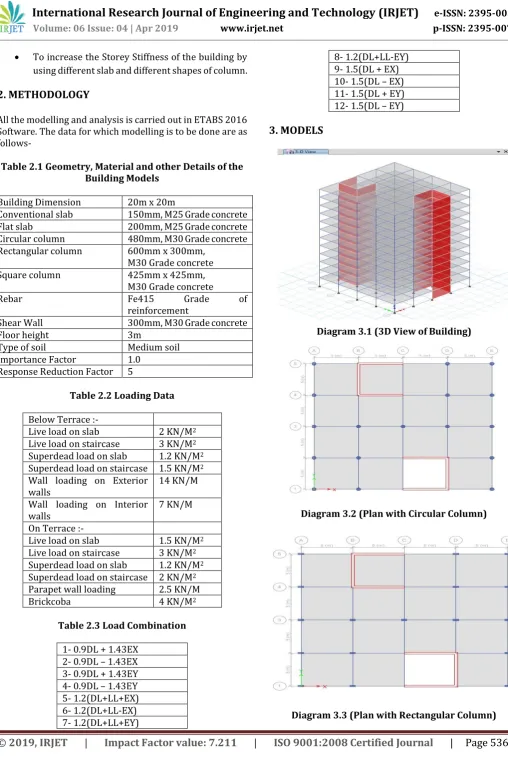
[image:2.595.39.548.43.805.2]All the modelling and analysis is carried out in ETABS 2016 Software. The data for which modelling is to be done are as follows-
Table 2.1 Geometry, Material and other Details of the Building Models
Building Dimension 20m x 20m
Conventional slab 150mm, M25 Grade concrete
Flat slab 200mm, M25 Grade concrete
Circular column 480mm, M30 Grade concrete Rectangular column 600mm x 300mm,
M30 Grade concrete
Square column 425mm x 425mm,
M30 Grade concrete
Rebar Fe415 Grade of
reinforcement
Shear Wall 300mm, M30 Grade concrete
Floor height 3m
Type of soil Medium soil
Importance Factor 1.0 Response Reduction Factor 5
Table 2.2 Loading Data
Below Terrace :-
Live load on slab 2 KN/M2 Live load on staircase 3 KN/M2 Superdead load on slab 1.2 KN/M2 Superdead load on staircase 1.5 KN/M2 Wall loading on Exterior
walls 14 KN/M
Wall loading on Interior
walls 7 KN/M
On Terrace :-
Live load on slab 1.5 KN/M2 Live load on staircase 3 KN/M2 Superdead load on slab 1.2 KN/M2 Superdead load on staircase 2 KN/M2 Parapet wall loading 2.5 KN/M
[image:2.595.314.558.56.582.2]Brickcoba 4 KN/M2
Table 2.3 Load Combination
1- 0.9DL + 1.43EX 2- 0.9DL – 1.43EX 3- 0.9DL + 1.43EY 4- 0.9DL – 1.43EY 5- 1.2(DL+LL+EX) 6- 1.2(DL+LL-EX) 7- 1.2(DL+LL+EY)
8- 1.2(DL+LL-EY) 9- 1.5(DL + EX) 10- 1.5(DL – EX) 11- 1.5(DL + EY) 12- 1.5(DL – EY)
3. MODELS
Diagram 3.1 (3D View of Building)
Diagram 3.2 (Plan with Circular Column)
© 2019, IRJET | Impact Factor value: 7.211 | ISO 9001:2008 Certified Journal
| Page 537
Diagram 3.3 (Plan with Square Column)4. RESULT
[image:3.595.305.561.337.482.2]4.1 Displacement
Fig 4.1 Displacement of (G+11) R.C.C. Frame Structure in X- Direction
4.2 Storey Drift
Fig 4.2 Storey drift of (G+11) R.C.C. Frame Structure in X- Direction
4.3 Storey Shear
Fig 4.3 Storey shear of (G+11) R.C.C. Frame Structure in X- Direction
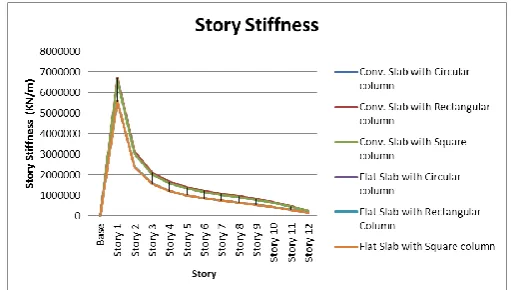
4.4 Storey Stiffness
Fig 4.4 Storey Stiffness of (G+11) R.C.C. Frame Structure in X- Direction
5. DISCUSSION
1. Conventional slab with Rectangular, Circular and Square column has less displacement for (G+11) R.C.C. Frame structure while comparing to the structure having Flat slab with Rectangular, Circular and Square.
2. The displacement for conventional slab with Rectangle column i.e. 30.209 mm and 28.628 mm has decreased to 23% and 11% while comparing to the Flat slab with Rectangular column i.e. 37.289 mm and 31.802 mm.
3. Conventional slab with Rectangular, Circular and Square column has less Story Drift for (G+11) R.C.C. Frame structure while comparing to the structure having Flat slab with Rectangular, Circular and Square.
[image:3.595.37.285.353.495.2]© 2019, IRJET | Impact Factor value: 7.211 | ISO 9001:2008 Certified Journal
| Page 538
to 28% and 14% while comparing to the Flat slabwith Rectangular column i.e. 0.001371 and 0.001144.
5. Conventional slab with Rectangular, Circular and Square column has more Storey shear for (G+11) R.C.C. Frame structure while comparing to the structure having Flat slab with Rectangular, Circular and Square.
6. The storey shear for (G+11) R.C.C. Frame structure is maximum for Conventional slab with Rectangular column i.e. 3751 KN and 3888 KN has increased by 22% and 9% while comparing to the Flat slab with Rectangular column i.e. 3072 KN and 3546 KN. 7. Conventional slab with Rectangular, Circular and
Square column has more Storey stiffness for (G+11) R.C.C. Frame structure while comparing to the structure having Flat slab with Rectangular, Circular and Square.
8. The story stiffness for (G+11) R.C.C. Frame structure is maximum for Conventional slab with Rectangular column i.e. 6719695 KN/M and 5464899 KN/M has increased to 21% and 6% while comparing to the Flat slab with Rectangular column i.e. 5550333 KN/M and 5154211 KN/M.
6. CONCLUSIONS
The slab and columns of structure has significant impact on the seismic analysis of a structure in terms of displacement, storey drift, storey shear and storey stiffness
1. The displacement for (G+11) R.C.C. Frame structure is minimum for Conventional slab with Rectangular column while comparing to the Conventional slab with Circular and Square column and all the flat slab structures.
2. The maximum displacement for Conventional slab with Rectangular Column (G+11) R.C.C Frame structure has decreased by 23% and 11% while comparing the Flat slab with Rectangular column. 3. The storey drift for (G+11) R.C.C. Frame structure is
minimum for Conventional slab with Rectangular column while comparing to the Conventional slab with Circular and Square column and all the flat slab models.
4. The maximum storey drift for (G+11) R.C.C. Frame structure is minimum for Conventional slab with Rectangular column has decreased to 28% and 14% while comparing to the Flat slab with Rectangular column.
5. The storey shear for (G+11) R.C.C. Frame structure is maximum for Conventional slab with Rectangular column while comparing to the Conventional slab with Circular and Square column and all the flat slab models.
6. The storey shear for (G+11) R.C.C. Frame structure is maximum for Conventional slab with Rectangular
column has increased by 22% and 9% while comparing to the Flat slab with Rectangular column. 7. The storey stiffness for (G+11) R.C.C. Frame structure is maximum for Conventional slab with Rectangular column while comparing to the Conventional slab with Circular and Square column and all the flat slab models.
8. The story stiffness for (G+11) R.C.C. Frame structure is maximum for Conventional slab with Rectangular column has increased to 21% and 6% while comparing to the Flat slab with Rectangular column. 9. With the use of Conventional slab in R.C.C. frame
building shows better performance under earthquake because it reduces the displacement and storey drift and increases the storey shear and storey stiffness.
7. FUTURE SCOPE
1. Analyze the Comparative seismic analysis of Conventional slab and Flat slab with various shapes of column is different seismic zones and compare the static analysis with time history analysis. 2. Analyze the Comparative seismic analysis of
Conventional slab and Flat slab with various shapes of column is different seismic zones with response spectrum analysis.
ACKNOWLEDGEMENT
I would like to express my sincere gratitude to all the scholars whose articles are cited and from that a valuable help received for completing this research paper. The authors are also grateful to the authors, editors and publisher of those journals and articles from where we get help to complete this Research paper.
REFERENCES
[1] Shital Arun Navghare, Prof. Amey Khedikar (Assistant
Prof.) “Research on Dynamic Analysis of RCC Columns
with Different Cross SectionsTECH CHRONICLE (ISSN NO: 2454-1958 Volume 2 : Issue 3 - May 2017)”. [2] Vidhya Purushothaman, Archana Sukumaran
“Comparative Study on Seismic Analysis of Multi Storied Buildings with Composite Columns (IJERT Vol. 6 Issue 06, June – 2017)”.
[3] Harman, Dr. Hemant Sood “Analyzing the Effect of Change in Cross-Section of Column on Unsymmetrical R.C.C. Frame Structure(IJERT VOL.6 Issue : 06, June- 2017)”.
[4] Amit A. Sathawane, R.S. Deotale “Analysis And Design Of Flat Slab And Grid Slab And Their Cost Comparison (IJERA Vol. 1, Issue 3)”.
© 2019, IRJET | Impact Factor value: 7.211 | ISO 9001:2008 Certified Journal
| Page 539
[6] Priyanka Vijaykumar Baheti, D.S.Wadie, G.R.Gandhe“Comparative seismic performance of Flat slab with Peripheral beam provided infill and shear wall panel at different heights (IOSP-JMCE Volume 14, Issue 3 Ver.IV. (May.-June.2017)”
[7] Mohit Jain, Dr. Sudhir S. Bhadauria, Danish Khan “Seismic analysis of flat slab and wide beam system (AJER Volume-5, Issue-10)”.
[8] J. Selwyn Babu & N. Mahendran “Design Criteria For Reinforced Concrete Columns Under Seismic Loading IJERT Vol. 2 Issue 4, April – 2013”
.
[9] Disha Sahadevan ,Megha Vijayan “An Equivalent Static Analysis Of Space Frame Structure With Different Cross Section Of Column” (IRJET Volume :04 Issue: 06 June-2017).
[10] Sachin Rajendra Ingle “Comparative study of seismic
behavior of Rectangle Column with Circular column” (IJCESR Volume: 04 Issue: 10, 2017).
[11] Sumit Pahwa, Vivek Tiwari, Madhavi Prajapati
“Comparative Study of Flat Slab with Old Traditional
Two Way Slab”(IJLTET Vol. 4 Issue 2 July 2014).
[12] Rasna P, Safvana P, Jisha P (12) “Comparative Study of Analysis of Flat Slab and Conventional Slab Using ETAB Software”(IJSRSET Volume 3).
[13] Pu Yang, Hongxing Liu and Zongming Huang “A COMPARISON OF SEISMIC BEHAVIOR BETWEEN SPECIALLY SHAPED COLUMN FRAME STRUCTURE AND RECTANGULAR COLUMN FRAME STRUCTURES”(The 14th World Conference on Earthquake Engineering October 12-17, 2008, Beijing, China).
[14] T. Matsumoto , E. Okstad, K. Kawashima and S. A. Mahin “SEISMIC PERFORMANCE OF RECTANGULAR COLUMNS AND INTERLOCKING SPIRAL COLUMNS” (The 14th World Conference on Earthquake Engineering October 12-17, 2008, Beijing, China).
[15] Kapil Verma “Comparative Study of Seismic Behavior of Open Ground Story Building After Replacing Rectangular columns with Circular columns” (International Journal of Advance Research, Ideas and Innovations in Technology, Volume 3, Issue 3).
BIOGRAPHIES
Mr. Baqar Husain was born in 1993 in Unnao, (U.P.). He received his Bachelor Degree in Civil Engineering from Uttar Pradesh Technical University, Lucknow in 2014. He is right now pursuing his Master of Technology in Structural Engineering from Babu Banarsi Das University, Lucknow.