© 2019, IRJET | Impact Factor value: 7.211 | ISO 9001:2008 Certified Journal
| Page 453
INTERNET OF THINGS TECHNOLOGIES FOR FUTURE OF SMART
CITIES: ARTIFICIAL INTELLIGENCE.
Ms. SATPUTE MAINAWATI TUKARAM
JSPM’S BIT BARSHI ELECTRONICS AND TELE-COMMUNICATION ENGINEERING
---***---
Abstract - The large deployment of Internet of Things is actually enabling Smart City projects and initiatives all over the world. Objects used in daily life are being equipped with electronic devices and protocol suites in order to make them interconnected to the Internet. According to a recent Gartner study, 50 billion connected objects will be deployed in smart cities by 2020. These connected objects will make our cities smart. However, they will also open up risks and privacy issues. As various smart city initiatives and projects have been launched in recent years, we have witnessed not only the expected benefits but the risks introduced. We describe the current and future trends of smart city and IoT. We also discuss the interaction between smart cities and Internet of Things and explain some of the drivers behind the evolution and development of Internet of Things and smart city. The potential application of smart cities with respect to technology development in the future.
Keywords—: Internet of Things; smart city; cloud platform; Wireless Sensor Network; Artificial Intelligence.
I. Introduction:
As cities grow and expand, smart and innovative solutions are crucial for improving productivity, increasing operational efficiencies, and reducing management costs. Citizens are gradually equipping their homes with Internet of Thing devices such as TV and Internet box. In the real estate sector, connected objects include thermostats, smart alarms, smart door locks, and other systems and appliances. At the United Nations conference on climate change (Cop21) held in Paris in 2016, connected objects were extensively addressed and gave to many local communities the opportunity to rethink their environmental objectives in order to reduce their CO2 emissions through the use of
Internet of Things. The latter can play a vital role in the context of smart cities. For example, intelligent waste containers can bring real benefits to citizens; they will be able to indicate that they are soon going to be full and must be emptied. Citizens can check through a smart phone application if the waste containers in the street are full or not. Also, after waste containers reports their status, companies can offer route optimization solution to the teams responsible for garbage collection. Places can be equipped with sensors and monitor environmental conditions, cyclists or athletes can find the most "healthy" trips and the city can respond by adjusting the traffic or by planting more trees in some areas. The data will be accessible to all citizens to promote the creation of applications using real-time information for residents. Cities have become hubs for knowledge sharing. The technologies and solutions needed for creating smart cities are just beginning to emerge. We present an overview of Internet of Things in the context of smart cities, and we discuss how IoT can enhance a city’s smartness. We also identify the weaknesses and risks associated with Internet of Things deployment and adoption in the smart city environment. In the next section, we present some background information on Internet of Things and smart city.
© 2019, IRJET | Impact Factor value: 7.211 | ISO 9001:2008 Certified Journal
| Page 454
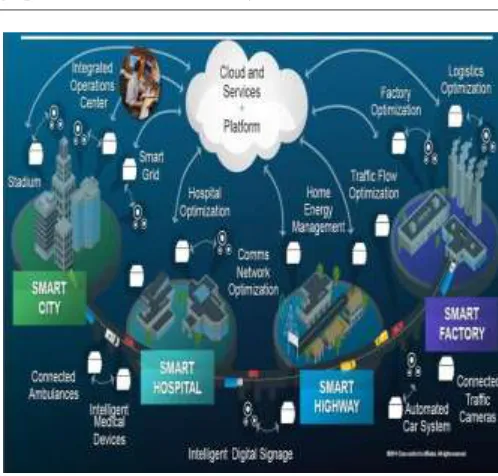
Fig. 1: Development of smart cities.
These, organizations are involved in standardizing such communications. Include the International Telecommunication Union the Institute of Electrical and Electronics Engineers, the Internet Engineering Task Force, Global Standard1, the Organization for the Advancement of Structured Information Standards, the Industrial Internet Consortium, and several others. A smart city is defined as a city connecting physical infrastructures, infrastructures, social infrastructures and business infrastructures to leverage the collective intelligence of the city. A city can be smart through a large deployment of Internet of Things (especially through machine-to- machine and human-to-machine communications). Wireless Sensor Networks, the sensing-actuation arm of the Internet of Things, seamlessly integrate into urban infrastructure forming a "digital skin" around it. The information generated is shared across diverse platforms and applications to develop a Common Operating Picture of the city.
III. Internet of Things as an enabling technology for Smart City:
The Internet of Things concept leverages several ubiquitous services to enable Smart City deployments all over the world. Internet of Things introduces new opportunities such as the capability to monitor and manage devices remotely, analyze and take actions based on the information received from various real-time traffic data streams. As a result, Internet of Things products are changing cities by enhancing infrastructures, creating more effective and cost-efficient municipal services, improving transportation services by decreasing road traffic congestion, and improving citizens’ safety. To achieve the full potential of Internet of Things, smart city architects and providers recognize that cities must not offer a separate smart city feature, but rather deliver scalable and secure IoT solutions that include efficient Internet of Things systems.
IV. Development of a Smart City:
Cities are densely populated areas with highly developed industry and commerce. They generally include functional zones such as residential, industrial, and commercial areas and have administrative jurisdiction. Smart cities use information technology in these zones to provide a variety of convenient smart applications and services for promoting more coordinated societal and natural development.
1. Mobile Network:
© 2019, IRJET | Impact Factor value: 7.211 | ISO 9001:2008 Certified Journal
| Page 455
2. Cloud Computing:
Cloud computing is not a new technology or technique, but a concept. The cloud represents the Internet. The Internet now provides substitutes for the software installed on computers and acts as an external hard disk space; the cloud in turn uses Internet services to perform various tasks and stores file data in a massive virtual space. According to the National Institute of Standards and Technology sp800-145 definition, cloud computing is a model for enabling ubiquitous, convenient, on-demand network access to a shared pool of configurable computing resources (e.g., networks, servers, storage, apps, and services) that can be rapidly provisioned and released with minimal management effort or service provider interaction. Furthermore, the roles of cloud computing, cloud computing activities, and cloud computing components, as well as the relationships between them, were clearly described. Cloud computing is provided as a service to customers through the Internet.
3. The Internet of Things:
The Internet of Things is one of the largest sources of Big Data, and when large amounts of data require high-frequency processing, transmission, and analysis, the Internet of Things and Big Data interact to transmit and store data. “Data security and privacy will play an important role in Internet of Things deployments. The Internet of Things is the creator of data, and different types of data can be useful information after format conversion. Making IoT smart renders the data it produces more meaningful. Therefore, big data can be available.
V. IoT Potential Applications for Smart Cities:
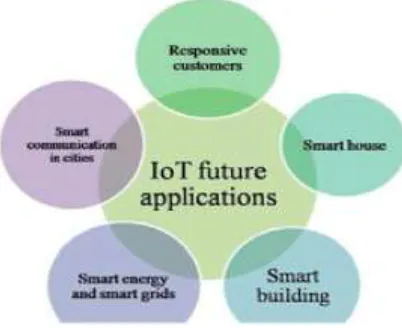
[image:3.596.196.397.410.574.2]Demonstrates several possible applications of Internet of Things for the smart city. The successful implementation of the IoT may lead to the production of several services which interact with the environment. Therefore, it can present a number of prospects for contextualization and geo- awareness. Moreover, collective intelligence develops procedures for governing and giving the residents authority and power.
Fig. 2: Application for smart cities.
© 2019, IRJET | Impact Factor value: 7.211 | ISO 9001:2008 Certified Journal
| Page 456
VI. Challenges:
Fig3 .Internet Of Things Challenges for smart cities.
A. Security and Privacy:
When all the information is gathered and evaluated in the same Internet of Things platform, the system may confront numerous attacks such as cross-site scripting, and side- channels. Moreover, the system can be subjected to significant vulnerabilities. In addition, its multi-tenancy may lead to the security problems as well and result in data leakage. Therefore, cities must adopt serious measures to ensure the privacy and security of citizen data.
B. Standards:
Lack of standards for developing Internet of Things devices will lead to poor design and make an Internet of Things device which suffers security issues. Strong standard and best practice are needed for developing Internet of Things devices. Various Technologies like network and communication protocols and data aggregation standards are managing, analyzing, processing and collecting from the sensors. Thus increases values of data with increase in scale, scope & frequency of data analysis. The challenges are Standards for managing, handling and processing unstructured data and leveraging of big-data tools.
c. Security challenges:
Security is major challenge for Internet of Things. With the increasing no. of Internet of Things devices, there is increase in practices to exploit security vulnerability. The hacking of smart devices, thermostats, cameras and even radios signifies security threat. The main focus will be on functionality and security will be on backseat.
d. Intelligent Data Analytics:
Large data are analyzed to make required actions. Even small data will lead false assumptions. Internet of Things needs various no. of algorithms to analyze the data in real time. The problem of inaccurate analysis due to some flaws, ability to analyze real time solutions and unstructured data analysis. Deep learning algorithms, enhanced neural network will be a key challenge for Internet of Things in future.
e. Digital Forgetting:
© 2019, IRJET | Impact Factor value: 7.211 | ISO 9001:2008 Certified Journal
| Page 457
g. Real-time solution:
It’s very difficult to maintain and implement “ANYTIME, ANYWHERE” concept of Internet of Things in reality. Internet of Things monitors and manages data through analysis. With the increasing advancement in Internet of Things, the need of high quality data with real time data monitoring and acquisition system is required smart cities and tale- diagnostic in medical field. The main functioning of the smart home system in Internet of Things Environment should be done in real time.
h. Stability and Data Storage:
Connectivity and issues on how devices perform without internet should be consider while developing the Internet of Things devices. As Internet of Things is getting vast in application there is collection of large amount of data. The major challenge will to of storage of collected data. Some more advanced Artificial intelligence algorithm will be applied to extract meaningful data and avoid redundancy.
I. Coordination & Integration:
Integration of applications in Internet of Things environment will be key challenge for specific purposes. The more is the integrated environment, the more will be ease for communication. Coordination with globally connected networks, objects, humans, process controls, etc. have the major impact in future
j. Network Self-Organization:
There will be a challenge for creation of network structure in such a way that every device should be connected and being self -organized .Self organizing of devices attached to the network will play a crucial role in nearby future.
advancements.AI combined Internet Of Things, which can be used to analyze the human behavior through various wireless sensors via Bluetooth, motion sensors biometrics and facial recognition and advanced feature of automatic adjustment of room temperature and lightning.
[1] Rather, M.M.; Ahmad, A.; Paul, A.; Rho, S. Urban planning and building smart cities based on the Internet of Things using Big Data analytics. Compute. Netw. 2016, 101, 63–80.
[2] Gubbi, J.; Buyya, R.; Marusic, S.; Palaniswami,
M. Internet of Things (IoT): A vision, architectural elements, and future directions. Future Gener. Comput. Syst. 2013, 29, 1645–1660.
[3] Li, D.R.; Shan, J.; Shao, Z.F. Geomatics for smart cities-concept, key techniques, and applications. Geo-Sp
VII. ARTIFICIAL INTELLIGENCE: AN INSIGHT TO DIGITAL TRANSFORMATION: Nowadays, Internet of Things smart system produces large data that canto be processed with usual data processing algorithms and though having a difficulty in processing and visualizing data resources. In today_ world Artificial intelligence plays a major key role in various fields like monitoring, healthcare, industrial evolution, weather analysis, social network analysis, decision making and market prediction, research and development, etc. The potential benefits and opportunities of both AI and Internet Of Things can be experienced when they are practiced together for better