Inception of Medi Java: an Open Source Library for
Medical Science
Subrata Sinha
Centre for Bioinformatics Studies, Dibrugarh University
Dibrugarh-786004, Assam, India
Paran Sundar Das
Centre for Bioinformatics
Studies, Dibrugarh University
Dibrugarh-786004, Assam,India
Supriya Chakraborty
Centre for Bioinformatics
Studies, Dibrugarh University
Dibrugarh-786004, Assam,India
Pallavi Dutta
Centre for Bioinformatics
Studies, Dibrugarh University
Dibrugarh-786004, Assam,India
Bishnu Prasad Deori
Centre for Bioinformatics Studies, Dibrugarh University
Dibrugarh-786004, Assam,India
ABSTRACT
Medical Software development process needs valuable time and efforts of the developers and medical science experts of the respective field. As the software developers need to write the code from scratch. So there has to be some medical science library functions in the all frequently used programming languages to facilitate faster and efficient software development process. So an attempt has been made to investigate the existence of any such library functions in the existing programming language and to propose the possibility of such library in Java as Java API. Medi Java (Name proposed by the first author) is expected to cover all important areas of medical science. MediJava is intended to be an open source project.
General Terms
Object Oriented Programming; Open source.
Keywords
Open Source Library; Medi Java; Medical Science Library.
1.
INTRODUCTION
The majority of research and development (R&D) in Medical
Informatics can be
divided
into three branches. The first branch develops algorithm, the second branch facilitates the development of software’s based in the algorithm developedDevelopment of any kind of software need inbuilt library, like Bioinformatics software developer if use Java , then there is a huge collection of Java library in the form of Bio Java package and classes for faster and reliable Bioinformatics Software development . Biojava is an open source project headed by Prof. Andreas Pralic, Senior Scientist, University of California, San Diego. Many open source bioinformatics packages are widely used by the research community across a wide variety of applications. Open source bioinformatics software has facilitated rapid innovation, dissemination, and wide adoption of new computational methods, reusable software components, and standards [3].
2. MATERIALS AND METHODS
2.1 MATERIALS
2.2 Methods
1. The library creation starts from generating the UML class diagram where the different specialists of medical science and their equations are classified into an hierarchy of classes and interfaces. For library designing, classic life cycle model of SDLC is followed [8].
2. In the design phase we constructed the UML class diagram and accordingly the library is constructed using JDK 1.7.1
3. The library is made available to the developers by creating jar file.jar file can be created by-
jar cvf medi.jar *
Which mean the jar will be created for all .class files present in the current directory.
Beans IDE [9].
5. Library is added to the Net Beans IDE by going to the following options
Tools Libraries Library manager Add jar Press OK
6. Test case has been prepared for input to the developed application.
7. The test result is verified with MedCalc3000 calculator.
3 RESULTS
3.1 UML Diagram
3.2 Library
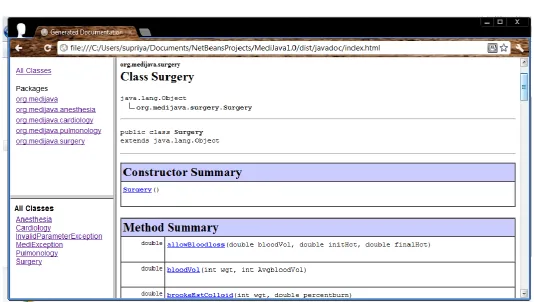
Library with 14 interface and 4 classes with 47 methods has been created but the code is not included in the paper but the method declaration of the interfaces and classes of the library are given below.The library is made available to developers as . jar file.
3.2.1 Classes and Interfaces of the MediJava Library
3.2.1.1 Interfaces and Class for Anesthesia package:
interface Anes_Card_Ped_Pulm :
double oxyIndexOI(double FIO2,double meanAirwayPressure,double PaO2);
interface Anes_EmMed_Ped_Pulm :
double aAGrExpectedAaG(double Age);
double aAGrMeasuredAaG(double pCO2,double respQuot,double percentInspiredO2,double paO2,int elevation,int patientTemp);
interface Anes_Cardiac :
double cardiacOutputCaO2(double hgb,double o2sat,double paO2);
double cardiacOutputCvO2(double hgb,double o2vsat,double pvo2);
double cardiacOutputCo(double o2consumption,double CaO2,double CvO2);
double pressureAdjustedHeartRatePAdjHR(double HR,double CVP,double MAP);
double systolicPressureVariationSPV(double SysMax, double SysMin);
interface Pulm_Anes :
double ventIndexVI(double rr,double pip,double peep,double CO2);
The class Anesthesia implements the methods of
Anes_Card_Ped_Pul, Anes_EmMed_Ped_Pul, Anes_Cardiac, Pul_Anes.
3.2.1.2 Interfaces and Class of Cardiology package:
double intervalCorrectQTICorrected(double QTInterval,double RRInterval);
double veryLowDensitylipoVLDL(double Triglycerides);
interface Anes_Pul_Card
double respQuotientR(double VCO2,double VO2);
double respQuotientVCO2(double VExp,double FECO2,double FICO2);
double respQuotientVO2(double VExp,double FIO2,double FEO2);
double oxyConsumpVO2(double VExp,double FIO2,double FEO2);
interface Card_Neuro
double CardVascularDiseaseRiskFactors(boolean sex,int age,double SysBP,double TotalChol,double HDLChol, boolean
hypertnsnmedicatn,boolean Cig,boolean DM);
double CardVascularDiseaseRisk(boolean sex,int Age,double SysBP,double TotalChol,double HDLChol,boolean
hypertnsnmedicatn,boolean Smoker,boolean diabetes);
The class Cardiology defines the following method-
public double pulPresVariatPPV(double PMax,double PMin)
The class Cardiology implements the methods of
Anes_Card,Anes_Pul_Card,Card_Emerg,Card_Neuro.
3.2.1.3 Interfaces and Class of Pulmonology package:
Interface Anes_Card_Pulmo
double modsCalcpaO2FIO2(double paO2,double FIO2) throws InvalidFIO2Exception
HmthrxDmtr);
interface pulmo_Ped
double pftPrdctValusforBoysMCalc(double Hight,double Age);
The class Pulmonology defines the following method-
public int CURB_65PneumoniaSeverityScore(int confabbrevMentalTestScore,int ureaBUN,int RespRate,
int diastolic,int systeolic,int Age)
The class Pulmonology implements the methods of
Anes_Card_Pulmo, Pulo_Card, Pulmo_Nephro, Pulmo_EmMed.
3.2.1.4 Interface and Class of Surgery package:
interface Sur_Nepro_EmMed
double brookeEstLctdRingers(int wgt,double percentburn)throws InvalidPercentBurnException;
double brookeEstColloid(int wgt,double percentburn)throws InvalidPercentBurnException;
double D5W();
double dextran40inSaline(int wgt);
double dextranFreshFrozenPlasma(int wgt);
double evanEstNormalSaline(int wgt,double percentburn);
double evanEstColloid(int wgt,double percentburn);
double modifiedBrookeCrystalloidEstLctdRingers(int wgt,double percentburn);
double slaterEstLctdRingers();
double slaterEstFreshFrozenPlasma(int wgt);
double parklandEstTotalCrystalloid24Hours(int wgt,double PercentNonsuperficialBurnArea);
double parklandEstRate8Hr(double parklandEstTotalCrystalloid24Hours);
double parklandEstRate16Hr(double parklandEstRate8Hr);
interface Anes_Sur_EmMed
double bloodVol(int wgt,int AvgbloodVol);
double allowBloodloss(double bloodVol,double initHct, double finalHct);
interface Sur_Cardio
double valveArea(double CardOutput,int Flowtime,int Heartrate,double ValveFactor,double Valvegradient);
The class Surgery implements the methods of Sur_Nephro_EmMed, Anes_Sur_EmMed and Sur_Cardio.
3.3 Documentation of Medi Java Library
To test the library a java application has been created using Net Beans IDE [10] which comprise the fields like Cardiology, Surgery, Anesthesia, and Pulmonology. The Snapshot of one of the interface is given below which test the
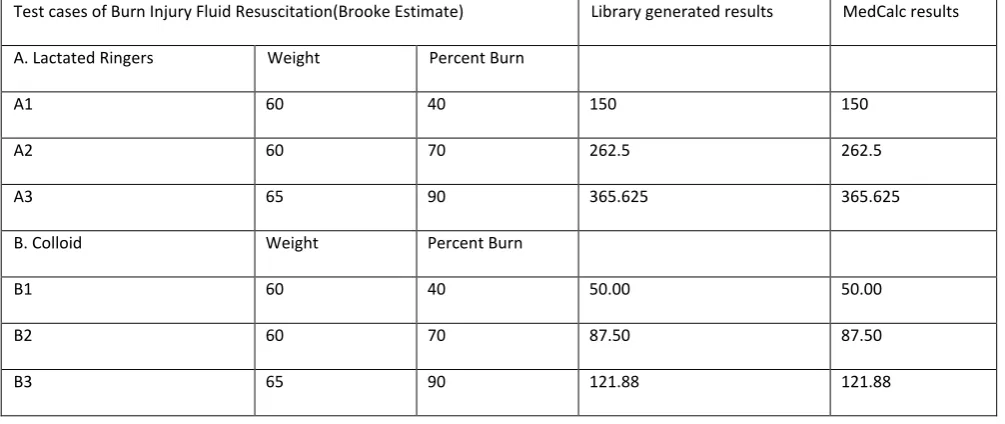
been executed with some test cases and the result has been verified with MedCalc3000.
Total 47 test cases has been designed out of which one test case is given below in Table 1.
Fig 3 : Interface of burn injury fluid resuscitation (Brooke Estimate)
Table 1 : Test Case with verified result
4. DISCUSSION
The project Medi Java is still undergoing, the results shown in the paper is just a small portion of the entire project. In this paper only four specialization has been covered namely Anesthesia, Surgery, Pulmonology and Cardiology
4.1 Need
Lack of standard library for medical science has lowered the speed of development for Medical Science Software’s; also the lack of such library has increased the cost of development.
Test cases of Burn Injury Fluid Resuscitation(Brooke Estimate) Library generated results MedCalc results
A. Lactated Ringers Weight Percent Burn
A1 60 40 150 150
A2 60 70 262.5 262.5
A3 65 90 365.625 365.625
B. Colloid Weight Percent Burn
B1 60 40 50.00 50.00
B2 60 70 87.50 87.50
4.2 Scope
Medi Java Library is an open source library, so there is tremendous amount of scope for further development and growth of the library
4.3 Limitation
The medical science is a very fast area of study, encompassing even one speciality will take much effort, however an initiative has been taken, to show the possibility of such library for medical science software developers.
5. CONCLUSION
Lack of standard library for medical science has lowered the speed of development for Medical Science Software’s; also the lack of such library has increased the cost of development. The medical science is a very vast area of study, encompassing even one specialty will take much effort, and however an initiative has been taken, to show the possibility of such library for medical science software developers. The major challenge in the development of the library is to extract information from Medical Science Professionals for the design of methods for the Medical Equations and Clinical Criteria. Also creating library for medical science specialties not only signify about creation of methods for medical equations and clinical criterion. The present work has only considered medical equations and clinical criteria of only four specialization of medical science. There are total 31 specialties and in each specialty there are medical equations, clinical criteria, decision tree. The library can be designed for all specialties. Medi Java Library is an open source library, so there is tremendous amount of scope for further development and growth of the library. The study has not considered library for embedded system for medical equipments. The device programming will be considered as a continuation of Medi Java Project.
6. ACKNOWLEDGMENT
I would like to acknowledge Prof. John Hancock, Visiting Scientist at University of Cambridge, United Kingdom for assuring me for assessment and looking at the scope of the library and making suggestions for additions. Prof. Andreas Parlic, Senior Scientist, University of California, San Diego (UCSD) for providing feedback and Prof. Louis Leff, Clinical Professor of Medicine , University of Pittsburgh School of Medicine for providing single user licence of his Medcalc3000, even before payment for the software. Apart from that I would like to acknowledge Prof. Lefteris G. Gortzis, Adjunct Professor University of Patras, School of Medicine for showing his interest in my project. Dr K Narain, Scientist,RMRC-ICMR for his support.
[4] Lee, Hyunsoo Kim, Jeongil Kim,Jangwoo Lee. StarUML 5.0 User Guide [Internet] , 2005[Updated 2005; cited
May 2012] Available from:
http://staruml.sourceforge.net/docs/user-guide%28en %29/toc.html
[5] Scott W. Ambler. The element of UMLTM 2.0 Style. Cambridge,USA: Cambridge University Press; 2005.P.60.
[6] Herbert Schildt.Java The Complete Refference.7th Edition.NewYork.McGrew-Hill publication ISBN: 978000 36774, p.75-80.
[7] Charlie Abela. Introduction to NetBeans Europe: University of Malta Press.
[8].Elias M. Awad. System Analysis and Design. 2nd Edition. India: Galgotia Publications pvt.ltd;2008,ISBN: 978-817 515 6180, p .40-48,201-202.
[9] Webopedia: Online Computer Dictionary for Computer and Internet. IT Business Edge Network. [Internet]. QuinStreetInc. 2012.[updated 2011Oct 22; cited 2012
June 12].Available
from:www.webopedia.com/TERM/documentation.html