VOL. 10
Remote Electronic Data Processing-Past, Present, Future
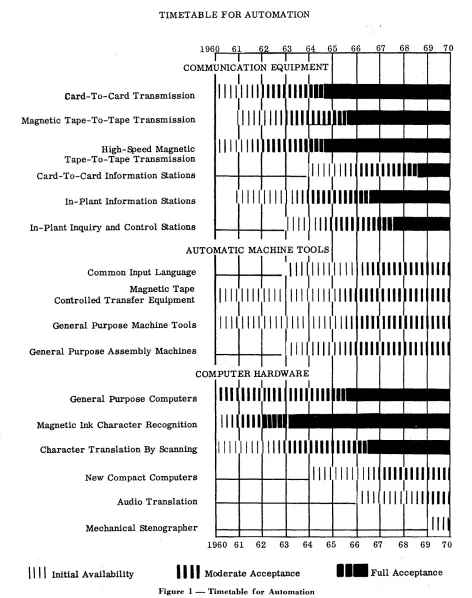
Automation-A National Resource, Not a Cause for Fear
2
· ' _ . ( ',f
f '
COMPUTER
OPPORTU N ITI ES
Our continuing growth is creating new positions
New employees will receive a minimum of
for qualified programmers ..• a growth accel-
two months advanced training in the PHILCO
erated by recognition of individual achievement
2000 system. Upon completion of the training
••. a growth YOU can share. Persons who have
program they should be available for
assign--written and debugged a variety of scientific
ment to a major metropolitan area. A relocation
and/or commercial programs on a large-scale
allowance is provided by the company.
binary computer are needed.
If
you are a mathematician, physicist or
elec-PHILCO offers a carefully expanding organi-
tronic engineer we invite you to investigate the
zation, educational program leading to ad-
opportunities as a Customer Service
Repre-vanced degrees, excellent facilities, equipment
sentative.lnquiries are also invited from
experi-and atmosphere conducive ,to high
levels>'of:c;~~;'\·'~nced'ComputerSales Representatives,
Sys-achievement.
terns
A~alystsandField Engineers.
APPLY
Mr. John Felos
Professional Employment Mgr. PHILCO COMPUTER DIV. Willow Grove, Pa.
PHILCO
(".", ".tfi.'''· " ,'." <.: '" .",. ®9tl
"" .... ".,".'"
'.@i' :"'.".'~n'~·'<"II!."::" .(.he [ " - / /1"-. __ _~ .' " 'ai1n.oaJ,' . '. 'r-Lll
It. ,
I/u:;' 'wona G~~
: .... : "
... -.. ,
•. ,
.. ,
.. , ..
~
.. ,.,.,;; .: .. "
.• ' .... "' ...
~.
'."
;'.~./fi ':~::
~_. __ J ,t ".:.," 1 .~.~' ... ~' •••• : . : - - , ' •• " " ~~ .... .,,~ •• ~
COMPUTERS and AUTOMATION for January, 1961
,-,0.,
Pem
Tl
with com: vice! whie a pI tory Contn Con pp Pub
N.1
T man and in t
proe tute peo} heti, LUnd /. com
! '
r
r
Iro1
lIenl oi tl MeGT< Teel Inc.,
N.
inde T pedi ence brar neer are: try,
010g
AI
be p tion artie Auton Mar men ingt 5, n
T to tl acti' ADl pha futu incl Auton sity vol. T pub sub,' prol mat reet "Re effic Noi Lin arne Furst( and ven set,
'I
cha tior esse Pre
EX(l
pro cha Pre Ind tiar ject
diel
Id, in ternal ic de-xt in-etism,
and 'ation, nand
Logi-;!s, an
Com-luded. terna- lathe-:., 120 /1960, dtions :scrip-cation lds of
~,
in- Aero-.tomic :
Phy-[n ad-:s are rman,
)f the 19side ation. :ssible ntrib-ers of
Func-'lters/ Cliffs, . $12.00
ill for .puter
oper-latical apters
)f
In-Unit, and Logic. Issary, letails
com-w in
>erga-New
o
pp, :d to gram-;hton,here 'Some
:ode";
ocode Fore-.erdal Ir
ap-1961 :0. 11,
Pub.
, 1961
I ·
.. ,
'l
(
CHARACTERISTICS
General-General purpose, stored program • Medium to high speed • Binary, synchro-nous, serial by character, parallel by bit • Alphanumeric six-bit characters, FIELDATA Code.
Operation Time per Word (including two access times)-Addition, 22 to 26 usecs • Multiplication and division, 238 to 242 usecs· Transfer of control, 16 usecs· Mem-ory cycle, 12 usecs
Internal- Word length, 38 binary digits, including sign and parity • Arithmetic, signed magnitude, fixed point· FIELD A T A Instruction Code, 40 orders • Index regis-ters, four (expandable to seven) • Memory capacity, 4096 words (expandable to 28,672 words)
InpLit-Output-Control panel • keyboard and paper tape equipment· magnetic tape • line printer • punched card equipment • up to 54 I/O devices with up to seven oper-ating simultaneously • real-time 1/0-up to seven real-time input sources and seven real-time output sinks operating simultaneously with I/O equipments • FIELDATA language code and interface Physical-Central Processor Weight, 609 Ibs.· Volume, 17.8 cu. ft.· Environmental
conditions, -350
C to +550
C, 0 to 97% relative humidity
Power Requirements-2.5 kilowatts (60 or 400 cycles)
A tactical computer for the
Army's FIELDATA family of
data processing devices·
Basicpac is a rugged, mobile, solid state data processing system being
developed by Philco in conjunction with the U.S. Army Signal Corps,
for use in forward area tactical situations. Basicpac will be a very
im-portant part of an integrated automatic data processing system for the
entire field army ... for such uses as logistics, administration,
intelli-gence, command support and fire support.
Basicpac can be transported and operated in an S-109 shelter
mounted on a 2Y2-ton truck or operated from a fixed installation. This
unique system is designed to meet all military specifications for shelter
mounted, air and truck transportable equipment and will be· highly
reliable, easily operated and maintained under extreme field
condi-tions. Incorporated throughout the design are the latest technological
advances in solid state circuitry and semiconductor components. This
assures a compact, flexible and highly mobile data processing system
completely adaptable to all the environmental and climatic extremes
experienced by the military.
Basicpac will be delivered in December to the U.S. Army Signal
Research and Development Laboratory for final acceptance testing.
A more informative brochure, plus technical assistance in adapting
Basicpac to your requirement, are available. Write today.
COMPUTERS
and
AUTOMATION
COMPUTERS AND DATA PROCESSORS,
APPLICATIONS, AND IMPLICATIONS,
AND THEIR CONSTRUCTION,
INCLUDING AUTOMATION
Volume
10Number
1 & IBJANUARY,
1961
Esta blished
September
1951EDMUND C. BERKELEY Editor
NEIL D. MACDONALD Assistant Editor
MOSES M. BERLIN Assistant Editor
PATRICK
J.
MCGOVERN Assistant EditorCONTRIBUTING EDITORS ANDREW D. BOOTH
NED CHAPIN JOHN W. CARR, III
ALSTO~ti' HOUSEHOLDER
ADVISORY COMMITTEE MORTON M. ASTRAHAN
HOWARD T. ENGSTROM GEORGE E. FORSYTHE
RICHARD W. HAMMING ALSTON S. HOUSEHOLDER
HERBERT F. MITCHELL, JR. SAMUEL B. WILLIAMS
SALES AND SERVICE DIRECTOR WENTWORTH F. GREEN
439 So. Western Ave. OR 815 Washington St. Los Angeles 5, Calif. Newtonville 60, Mass.
DUnkirk 7-8135 DEcatur 2-5453 ADVERTISING REPRESENTATIVES
Los Angeles 5 WENTWORTH F. GREEN 439 SQ. Western Ave. DUnkirk 7-8135
Chicago l O R E X GAY
18 E. Division St. MIchigan 2-0778
San Francisco 5 A. S. BABCOCK 605 Market St. YUkon 2-3954
Elsewhere
WENTWORTH F. GREEN
439 So. Western Ave. OR 815 \'\'ashington St. Los Angeles 5, Calif. Newtonville 60, Mass.
DUnkirk 7-8135 DEcatur 2-5453
COMPUTERS and AUTOMATION is published 13 times a year (monthly except two issue:; in June) at R 15 Washington St., Newtonville 60, Mass., by Berkeley Enterprises, Inc. Printed in U.S.A.
SUBSCRIPTION RATES: (United States) $7.50· for 1 year, ·l14.50 for 2 years; (Canada) $8.00 for 1 year, $15.50 for 2 years; (Foreign) $8.50 for 1 year, $16.50 for 2 years. Address all Editorial and Subscription Mail to Berkeley Enterprises, Inc., 81) Washington St., Newtonville 60, Mass.
ENTERED AS SECOND CLASS MATTER at the Post Office at Boston, Mass.
POSTMASTER: Please send all Forms 3579 to Berkeley Enter-prises, Inc., 815 Washington St., Newt~nville 60, Mass. Copyright, 1960, by Berkeley Enterprises, Inc.
CHANGE of ADDRESS: If your address changes, please send us both your new address and your old address (as it appears on the magazine address imprint), and allow three weeks for the change to be made. \,
4
Vol.
10~No. IB
News of Computers and Data Processors:
ACROSS THE EDITOR'S DESK
inserted between pages 8 and 9 and between pages 16 and 17
1960·
ANNUAL INDEX
FRONT COVER
inserted between pages 8 and 9 and between pages 16 and 17
\V orId's Highest Voltage Transmission, Aided by Data Collection and Control 1, 20 ARTICLES
Remote Electronic Data Processing - Past, Present, and Future - Some Remarks, M. M. ASTRAHAN . 6 Automation - A National Resource, Not a Cause for
Fear, JOHN DIEBOLD 9 Automating the Consolidation and Sorting of Packages,
RICHARD L. SPEAKER. 17 READERS' AND EDITOR'S FORUM
Calendar of Coming Events. 16 Computers for the Transportation Problem and the
Traveling Salesman Problem,
M. MACHACEK, I.
J.
SELIGSOHN . 20 Optimiza tion of Business Operations - Discussion,DANIEL TEICHROEW, DR. W. W. LEUTERT 21 REFERENCE INFORMATION
Books and Other Publications, M. M. BERLIN . 22 INDEX OF NOTICES
Advertising Index Back CQpies .
. GIQssary of Computer Terms. Manuscripts
Referencc·and Survey Information Who's Who Entry Form.
8 see Nov., page 28 see Nov., page 29 see Def., page 41 se~.AU:g., page 2
. s~e NQ*-·~;.page 29
COMPUTERS and AUTOM-A TION for J.an.uary, 1961
.:'.';",
~
comb probl quire sumil bers for a route mate] houn this t Mr show a mil carre, toria] tori a] of th Fir putin meth limin criter many
OPl
Th
tion, "Opt lieve, that 1
ming opere
decisi
genel
a val
perie rate; peop
He same
He s math shou] salesl that ment de: solve ment
Nc
but j
sente math prese in tb
math
vera I
book rhich even )Ook. nally
I do re to com-:sohn
tech-ltion
--
Inmpu-mple lrply, hand semI-s
alI-f my nt to
com-lman
and
k of idely
pro- effi- ,orta-cited nent
hort-But
:Ie is 'hich
l on lcek. tate,
Ie of was t-cut
npu-the l be
lpar-1901
\
RCA
announces ...
ANew Direction in Lease Plans
for Electronic Data Processing Equipment
RCA now offers a choice of
jour
new lease plans
that permit you to rent RCA Electronic Data
Processing Equipment, and all the guidance and
service that goes with it,
on a basis geared to your
own particular usage requirements.
This major
departure from customary leasing practice is
an-other RCA innovation ... an indication of RCA's
responsiveness to the customer's needs.
DETERMINE YOUR REQUIREMENTS ..• CHOOSE YOUR CONTRACT!
+
IF YOU REQUIRE ONLY EIGHT HOURS A DAY OF COM-PUTING TIME, RCA offers you a contract at a rental which fits your situation precisely ... and you may designate the shift you wish to operate.+
FOR MAXIMUM ADAPTABILITY TO WORK SCHEDULES, the Random Use Contract allows you to scheduleEDP operations at periods most convenient to you. A total of 200 hours of basic use-time per month is included in the charges.
+
FOR EXTENDED USE, where you require up to three full shifts, a basic monthly charge is made. The period covered in the contract is 24 hours a day for a 5 day week and the operating period can be enlarged to provide you with up to 16 additional hours per day for the 2 remaining days.CPMPUTERS and AUTOMATION for January, 1961
+
WHEN YOUR COMPUTER REQUIREMENTS GROW TO THE LEVEL OF THREE-SHIFT DAILY AND WEEKEND USE, - RCA's Unlimited Availability Contract may be utilized to provide all this service for a basic monthly charge. Use the equipment as much as you want!RCA RELIABILITY ... PROTECTS EQUIPMENT PERFORMANCE
Because of the high degree of reliability built into
each RCA EDP System, all of the above lease
agreements include primary shift maintenance
of
the equipment. Since RCA's Electronic Data
Proc-essing Systems have this unique built-in
reli-ability, maintenance and service are kept to a
mini-mum, you receive the advantage of a more
attractive rate. Maintenance service beyond the
primary shift is available at a flat rate per
man-hour, as needed.
Take advantage of RCA's new contract
arrange-ments to keep your paperwork at a minimum, your
EDP quality at a maximum! For full details and
rates, write Electronic Data Processing Division,
Radio Corporation of America, Camden 2, N.
J.
a
The Most Trusted Name~iJ
in Electronics~ ® RADIO CORPORATION OF AMERICA
• • • • .. o f
Remote Electronic Data Processing- Past, Present,
and Future-Some Remarks
M. M. Astrahan
Advance Systems Development Division International Business Machines Corp.
San Jose, Callf.
Punched Paper Tape Data
The history of remote electronic data processing systems (or TELE-PROCESSING@ systems, as IBM calls its own contributions to this field) can be said to begin with the transmission of machine data punched in paper tape over teletype lines. Paper tape had been used previously for message communi-cations, but it was not until about 1950 that it began
to be used for entry into remote data processing sys-tems. Machines made possible the interconversion of punched-card and patape information, thus per-mitting the use of tape in standard punched card accounting systems and computers with punched card input. Such systems are still in usc.
Computers with paper tape input can, of course, accept the tape directly. Paper tape is often produced as a byproduct of typing or accounting machine op-erations and this information may be transmitted to a remote location for further processing. The products of such processing are generally summary reports, but copies of working documents such as invoices or pay checks can be, and sometimes are, produced remotely.
Verification
Because people and transmission lines both intro-duce errors occasionally, data must be verified and edited upon receipt at the central processor. One of the initial problems of remote EDP was that errors made in transmission were difficult to detect and cor-rect at the receiver. Therefore special precautions had to be evolved. Necessary accuracy is attained by techniques or combinations of techniques such as control totals for batches of information, and the numbering of messages. The transmission of ordinary five-channel paper tape is inherently uncheckable on a character-by-character basis, since all code combina--tions are normally used. But it is possible to generate
and transmit check digits for batches of data. These check digits can then be verified by suitable equip-ment at the receiving end.
Punched Card Data
Direct transmission of punched card information over leased telephone channels became possible with the advent of the IBM Card Transceiver in 1954. Each character transmitted (at the rate of 11 standard IBM cards per minute) was checked by means of a four-out-of-eight code, and a retransmission was re-quested when an error occurred. This IBM-card
in-6
formation from remote terminals could be entered automatically and reliably into large-scale electronic processors. Today Card Transceivers are widely used, particularly in the central processing of orders for goods from remote locations.
More recent arrivals on the remote data processing scene include the latest version of IBM's Card Trans-ceiver, which is enabled by American Telephone and Telegraph's Dataphone service to make use of the common toll network. Dataphones-serving to couple digital transmitting and receiving devices by means of the telephone network-cover the range of rates from manual keying up to the full capacity of a standard voice channel, about 250 8-bit characters per second for leased channels. Systems are likewise available for transmission from magnetic tape to magnetic tape or for the transmission of data directly from one computer memory to another. A manually operated terminal for transmission of punched cards and keyed numbers over the telephone network is also available, as is a range of modulation-demodulation equipment for use on private telephone or microwave channels.
Immediate Service Data Transmission In contrast to paper-tape and card transmission systems, which normally handle batches of data, immediate-service systems process individual transac-tions. In such systems, an inquiry from a remote source enters the processor directly and the output response, if any, is transmitted directly back to the point of inquiry. The earliest example of such a system is perhaps American Airlines' Reservisor, in-stalled by the Teleregister Corporation in 1953. Res-ervisor kept an inventory of seats available on all American Airlines flights and could process directly "inquiry," "buy," and "sell" messages transmitted from agents' terminals over teletype channels. Very high reliability was achieved by means of conservative design and complete duplication of central equip-ment. Descendants of the original Reservisor system, and similar systems, are still in operation today. In all reservation systems the operator sets up variable data, such as dates and number in party, on a key-board. By means of a code plate or slide projection system, schedules may be selected and displayed. When the customer has chosen a flight, the terminal oper-ator keys in the appropriate information for trans-mission to the central processor.
COMPUTERS and AUTOMATION for January, 1961
J
Post utiliz
Th catiOl the ti order moti( recen are n on ar parce Gene ware] Th have of di distri An sortal perlo and i able. veyor ator, speci, semb order matic PIe and 1 adhel instal tippi1 made becal was I tion schen
Ba: order tion: how what
of th data the
r
shape systel Ar \.ion impr' and 101
this I
Mil~
ing, com} was
. area
~rting
Code i. ward ,ctual
path
t and
from i, but ns of oper-ation
con-rs of ce of This lates. Con-ieved
con-ower nues.
size luire-,here
con-ltion
and inte-: per-laced rting
leter-y
be-: the size, d be
~r-all
i big lited than ttage
ut is rters : per sible best
r in-i ad-eing ypes rally ; sig-been : an-'cels. n in
1%}
f
k
•
General Electric Computer Department
Embarks on Vigorous New Program
in Industrial and Commercial Computers
It is estimated that the next 2 years will see a 33
%
increase in non-military
use of computer equipment. We are meeting these projected needs with a
vigorous program of design, applications and sales. The first steps are
1) G.E.'s new 225 computer system for large and small scale application;
2) a significant expansion of our sales structure right now.
We are now conducting a successful operation, and anticipate tremendous
growth and capture of an even larger share of the market. Since we have
set out to establish leadership and accelerate growth, the men we add to
our staff must be of the highest competence. For these men, the market
situation in which we are operating means that there will be plenty of
technical challenge and, right with it, room for rapid personal advancement
as we expand.
A SUbstantial range of opportunities is now available in Phoenix, Arizona and Palo Alto, California.
Phoenix
Computer Systems Design Engineers
EEs and MEs - plus experience in computer or electronic systems de-sign. Advanced systems engineering on large and small commercial sys-tems as well as industrial and proc-ess control systems:
Logic and Circuit Design Advanced Systems Evaluation
and Analysis
Peripheral Equipment Design Component Engineering
Palo Alto
Applied Research
. . . at the Computer Laboratory on projects centering on: Thin Macnetic Film Parametric Devices
Pattern and Character Recognition Advanced Logic and Circuit Design Magnetics and Optics
Phoenix
Computer Applications
Degree required plus 2-3 years com-puter programming experience. Equally important as the engineer-ing effort, the application programs offer a wide scope of opportunity to Programmers and Operations Re-search personnel. Openings available in the following areas:
Programming Research Applied Industrial Programming Business Applications
Computer Techniques and Simulation Scientific Programming Operations Research
on Multicomputer Systems
Truinin~ in Phoenix; Assign-ments throughout the U.
s.
Applications Consultants
A 13S in Business Administration, Math and/or Engineering is re-quired, plus 2-3 years experience in computer programming and systems analysis. Customer consultation on systems analysis and implementa-tion - pre and post order, program-ming training, new applications of integrated business data processing systems.
Phoenix
Additional Openings In:
Computer Sales Product Planning Product Service Engineering Drafting Quality Control
- -
If your experience and interests match any of the-above openings, please write in confidence to Mr. J. E. Torrey, Room 21-MA.
COMPUTER DEPARTMENT
GENERAL. ELECTRIC
P. O. Drawer 270 Phoenix, Arizona
COMPUTERS and AUTOMATION for January, 1961
•
Remote Real. Time Control
:More complex than batch-processing or immediate-service systems are real-time-control systems. In the latter systems, information from remote sources is periodically or even continuously fed to the the cen-tral processor, which in turn transmits responses that may call for further information or give directions to equipment at the source or in still other locations.
The first, and still the largest, real-time-control digital remote data processing system is the SAGE Air Defense System, in which radar data from a num-ber of outposts is automatically encoded, and trans-mitted over special telephone channels to the com-puter center. At this center the data is automatically entered into a processor along with additional back-ground information, such as weather and flight plans. Relative to certain industrial process control systems, SAGE might be termed semi-automatic; the air
situa-tion is filtered and displayed to human controllers who must finally identify unknown aircraft and
de-termine the appropriate measures to be taken. Once dispatched, however, certain weapons, such as the BOMARC missile, do receive automatic guidance control from the system.
Today, military communication-based EDP sys-tems serve tactical (SAGE and FIELDAT A), or lo-gistic (COMLOGNET), purposes. In the near future we can expect to see the use of computer-controlled switching centers extended to a wide range of infor-mation-handling and communications functions.
Factory Control
The size and complexity of many modern indus-trial installations means that an individual plant can often make efficient use of an entire remote data processing system. Indeed, factory data-gathering sys-tems can already transmit a great variety of personnel, production, and inventory information to a central point, where it may receive batch or immediate-service processing. In-plant real-time-control systems -stored program systems for the continuous control of complicated production processes-have been much in the news recently. Such systems, most notably in service in the petroleum refining and chemical manu-facturing industries, are already in use. They are
bound to grow rapidly more diverse in abilities and common in application.
Airline Reservation Control
Dramatic in scope, the IBM SABRE system, to be installed for American Airlines next year, is repre-sentative of the next generation of commercial IBlVI TELE-PROCESSING systems. By means of SABRE, more than a thousand American Airlines terminals throughout the country will communicate directly with a pair of computers in New York City. The sys-tem will handle complete passenger records and seat inventories for up to a year of scheduled flights. All centrally stored records will be available to any oper-ator, generally within three seconds. SABRE will also handle interline communication and automatic fol-low-up for flights on other lines.
Future Indications
The ultimate extensions of "terminal-based" sys-tems like SABRE have been the subject of much spec-ulation. Among the objectives that no longer seem entirely out of range are unified data systems which would largely replace paper for the storage and trans-mission of information. It appears inevitable that digital data, prose communications, and images will all be transmitted electronically, both within and be-tween organizations. Central to the attainment of the new systems are the development of very large low-cost files for digital and image storage, low-cost wide-band,vidth facilities for transmission, and low-cost terminals for coupling to the system. Already in sight, if not yet at hand, these advances in tech-nology will make possible an enormous growth of centralized data processing services. Such services may some day soon enable a terminal in a small com-pany to share the full power of a large system, or make possible the elimination of cash and checks for most monetary transactions. Process control systems, teaching terminals and information searching serv-ices will eventually find their place in the unified systems as well.
This, in brief, is the challenge to the information processing industry today. In the light of this chal-lenge, the accomplishments of the past decade are no less, and no more, than an admirable prologue.
ADVERTISING INDEX
Following is the index of advertisements. Each item con-tains: Name and address of the advertiser / page number where the advertisement appears / name of agency if any.
Bryant Computer Products, a Division of Ex-Cell-O Corp.,
Walled Lake, Mich. / Page 24 / La Rue Cleveland, Inc.
General Electric Co. Computer Dept., Phoenix, Ariz. /
Page 7 / Deutsch & Shea, Inc.
International Business Machines Corp., Data Processing
Div., 112' E. Bost Rd., White Plains, N. Y. / Pages
12, 13 / Marsteller, Rickard, Gebhardt & Reed, Inc.
8
Lockheed Missile & Space Div., 962 W. El Camino Real,
Sunnyvale, Calif. / Page 22 / Hal Stebbins, Inc.
Philco Corp., Government & Industrial Group, Computer
Div., 3900 Welsh Rd., Willow Grove, Pa. / Pages 2, 3
/ Maxwell Associates, Inc.
R.C.A., Electronic Data Processing Div., Camden, N.
J. /
Pages 5, 23 / Al Paul Lefton Co. Inc.
Technical Operations, Inc., 3520 Prospect St., N.W.,
Washington 7, D. C. / Page 15 / Dawson MacLeod &
Stivers
COMPUTERS and AUTOMATION for January, 1961
As cerne more will
form~
rdon crew shovt "Don ployr men
TIl
appo "I've put I
Jw
the t
au tor up tc matil but] have it's s(
techr kept of th bene ing c hand
I t~ off tl
to fir ing
F
parts Fo only hors( cong As a
high engil Tl port: why solid way can 1
Tl been the
ts
e
NEWS'
of
Computers
and
Data Processors
~~ACROSS
THE EDITOR'S DESK"
COMPUTERS AND AUTOMATION
Vohime 10
Number 1B
JANUARY
2,1961
Established September 1951
Published by Berkeley Enterprises, Inc., 815 Washington
st.,
Newtonville 60, Mass.
COMPUTER
HANDLING SATELLITE WEATHER DATA
Bendix Computer Division
Los Angeles 45, Calif.
The recent U.S. Weather Bureau facsimile
transmission of information abstracted from
the Tiros
II
satellite cloud pictures is the
first use of satellite data for weather
fore-casting. Meteorological data in an area
ex-tending from the Mississippi Valley to beyond
the Middle Atlantic, and from Southeast
Cana-da to North Carolina, was transmitted to
avi-ation forecast centers.
One of the keys to tne successful use of
satellite pictures for weather forecasting was
the development of a set of grids constructed
on a Bendix Corp. G-15 general-purpose
digi-tal computer. The grids consist of a network
of lines representing imaginary Lines on the
earth's surface. They allow meteorologists
to locate storm centers over the Midwestern
U.S., for example, even though the surface of
the earth is itself invisible to the
space-borne weather-eye satellite. The grids serve
the further purpose of aiding in the
estab-lishment of the relative sizes of features in
the pictures.
The. earth is not a flat plane at high
altitudes; extreme perspective effects are
present in most cloud pictures. Since this
effect is a function of altitude, a library
of perspective map grids was prepared on the
Bendix G-15 computer for altitudes from 200
to 500 miles, at 25 mile increments.
To
~acilitatereal-time processing, the
space-oriented cloud picture is projected on
the perspective map grid corresponding to the
COMPUTERS and AUTOMATION for January, 1961
altitude the picture was taken at. A
rec-tangular grid (the plane counterpart of the
perspective grid) is superimposed at its
cor-rect geographical location and oriented in
azimuth. Aided by information on the
satel-lite orbit and attitude, meteorologists can
establish approximate pOints of reference on
the earth.
This computer accessory eliminated
hun-dreds of man-hours involved in the manual
plotting and drafting of the perspective
grids. The extensive and accurate library
of maps permit meteorologists greater
free-dom in the selection and in the use of grids.
For weather forecasting purposes, the
meteorologicai features seen in the
tele-metered pictures must be represented on a
final map which will permit the putting
to-gether of images and ready definition of the
actual geographic location. To accomplish
this, the computer was programmed to prepare
a set of special oblique Mercator maps based
on the Tiros orbit. After significant
ation is transferred to this map, the
inform-ation is reduced to codes for teletype
handl-ing and to conventional representations for
facsimile transmission to weather centers
participating in the Tiros experiment.
Pictures of cloud cover over large areas
of oceans, deserts and polar regions which
are completely unrepresented by observation
networks can provide meteorologists with cloud
patterns indicating the birth or existence of
hurricanes, cyclones, and other weather
dis-turbances. The real-time processing of
satel-lite pictorial information permit weathermen
to have world-wide meteorological data at
their fingertips for immediate analysis in
preparing weather forecasts.
ACROSS THE EDITOR'S DESK
WORLD'S FIRST 750 KILOVOLT TRANSMISSION LINE,
WITH COMPUTER CONTROL, PUT INTO ACTION
&eneral Electric Company
Schenectady 5, N.Y.
Project EHV (Extra-High-Voltage) was
re-cently energized with a new world record of
approximately three-quarters of a million
volts. The outdoor laboratory, located near
Pittsfield, Massachusetts, will operate for
the next few years at a range of 460 to 750
KV.
The north section of the two-section,
4.3-mile prototype system received the record
voltage that puts the United States ahead of
foreign countries as the world leader in
extra-high-voltage transmission. The highest
oper-ating transmission voltage in Russia is
500,000 volts. A 0.6-mile experimental line
near Leningrad is reportedly testing at
600,000 volts.
Project EHV will help solve numerous
problems encountered by electric utilities
who plan extra-high-voltage lines to answer
America's demands .for increased power at
con-tinued economical rates.
Extra-high-voltage may be a sensible
eco-nomical way to help supply America's need for
twice as much power within the next 10 years.
One 750,000-volt line will transmit over 36
times as much power as one 115,000-volt line.
Savings in costs of construction costs,
rights-of-way, towers, conductors, and apparatus
re-sult. This saviny will help utilities offer
continued economical rates in the face of
rising costs.
The new techniques used at Project EIN
were determined by extensive analytical
stud-ies, computer and model investigations and
laboratory work. The techniques will be
veri-fied under actual field operations. If the
technology needs correction or refinement, it
will be more economical to find out on an
ex-perimental line, such as Project EHV, than on
a utility's fully constructed, operational
system.
Six companies and 15 G.E. product
depart-ments have contributed to the newly-completed
northern section of the $7,500,000 project,
which is coordinated by the company's Power
Transformer Department, Pittsfield. Six
other companies are supplying material for
the southern section, due to be completed in
mid-1961.
Assistance is being rendered by an
Ad-visory Council, composed of executives and
engineers from 15 United States and Canadian
2B
utilities, and a Consulting Engineers
Commit-tee, numbering engineers from 14 consulting
engineering firms.
Approximately 270 measurements are being
performed:
133 electrical of 13 typesj 71
mechanical of 11 typesj and 63 meteorological
of 23 types. Being measured are radio and
television influence, voltage surges and
current, axial tension, maximum angle of
swing, amplitude and frequency of aeolian
vi-brations, temperature, wind velocity and
di-rection, lightning and corona loss.
Lightning rods, 40-feet high, mounted
atop the transmission towers will attract
nearby lightning strokes that would otherwise
narrowly miss the line. Later, an impulse
generator will send man-made 3,000,000-volt
lightning bolts to the line.
Instruments will feed information to a
computer.
It will gather and record
measure-ments at 20-minute intervals in fair weather
and at two-minute intervals in foul weather.
This averages out to 10 readings per hour, 24
hours a day, 7 days per week for a total of
more than 10 million annual readings. At
Project EHV's terminal building the data-1s
recorded on paper tape, converted to magnetic
tape and processed in an IBM 705 computer to
provide technical information in the form
re-quired for analysis.
The project draws power from a nearby
Western Massachusetts Electric Company
115,000-volt line. Disconnect switches
com-pletely isolate the station when necessary,
while coupling capacitors provide potential
for relaying and metering the voltage to a
40,000 kva regulating transformer that covers.
in 72 steps the entire voltage range under
study.
ELECTRONICS AND MICROFILM COMBINE
IN RAPID-ACCESS CATALOG APPLICATION
Ferranti Electric Inc.
95 Madison Ave.
Hempstead, L.I.,N.Y.
An automatic catalog based on microfilm
and electronics has been developed by this
company for a wholesale drug distributor, and
was recently installed.
This type of unit may find wide
applica-tions in fields of order-entering, pricing,
and inquiry-answering, where these and other
functions normally require reference to
volu-minous catalogs.
COMPUTERS and AUTOMATION for January, 1961
wa
Co
du
Al\
pa
th
te
co
th
th
ill of
ta
co
ch
te
pe
se
pI
ell
pa
bi
ab
Ie
o~
a~
me::
rE
PJ
PI
l-lS
)e
Ie
1-
:-1
ACROSS THE EDITOR'S DESK
The unit is a self-contained device
oper-ated from an external standard keyboard, such
as a typewriter or a card-punch keyboard.
The catalog is filmed on 16 mm. film.
The film loop is driven by a drive unit
cap-able of almost instantaneous stop. The film
is projected upon a special viewing screen
in the unit.
For a catalog of 400 pages (25,000 items
arranged in alphabetical order), it is merely
necessary to key the first 3 letters of the
item required and, in an average time of 1.5
seconds, the catalog page containing the
re-quired item is projected on the screen.
CO~WUTERIZED
AUTOMATION MAKES A PARKING
GARAGE A
ONE-~~NOPERATION
W. L. Crow Construction Co.
New York, N.Y.
"Not a building but a machine," is the
phrase used to describe the eight-story
com-pletely automatic garage being erected at 315
West 42 St., New York, N.Y.
The structure has electronic controls
operated by only one man -- and all he has to
do is put a key in a slot and collect the
parking fee.
It will have a capacity of 270
autos; it will park or return anyone of them
in less than a minute. The revolutionary
pro-cess touches only the bottoms of an auto's
rubber tires. It was developed by Speed-Park
Inc., the inventor, M. Alimaniestianu, is a
COMPUTERS and AUTOMATION for January, 1961
Roumanian engineer and president of
Speed-Park.
The precIsIon of construction and the
close tolerances required to achieve such
automation are what lead to calling the
auto-matic garage a machine rather than a building.
The structure is standardized and
prefabricat-ed on a unit stall basis to provide maximum
utilization of space and maximum economy of
construction. Each stall is 20 x 8 x
7~feet.
There are no lights or windows in the car
storage area.
The all-steel structure, 58 x 200 feet,
is really three Meccano-type structures side
by side, with an alley between running the
full length and height of the building. A
traveling elevator tower, 85 feet tall, the
full height of the building, runs on rails in
each alley.
The electronic system begins to operate
the instant a car enters the garage from the
43rd Street end. An electric eye measures
its height and rejects it if it is more than
seven feet high.
If it is less than seven
feet high, but more than five feet six inches,
it can be routed only to one of the higher
stalls on the first or eighth floors. An
electronic lock "freezes" the control panel
circuits for the small stalls so the
atten-dant cannot make a mistake.
If these tests are met, the car is driven
onto a set of bars, spaced ten inches apart,
alongside the entrance to one of the
eleva-tors. Guard rails rise at the side and rear
of the car after the driver has left the car;
"fingers" slide out from the elevator into
the slots between the bars on which the car
stands, lift it up and draw it into the
ele-vator. While the tower moves along the rails
to stop opposite the stall in which the car
is to be parked, the elevator rises
simultane-ously to the height of the selected floor.
When it stops, the fingers lift the auto out
of the elevator and set it onto the grids
that form the floor of the stall. The entire
operation is similar to that of a fork-lift
truck.
When the driver returns, he hands in the
key that was given him as his check; the
attendant puts the key into its slot; and the
car is "unparked" automatically. Meanwhile,
the electronic computer, which has "memorized"
the day and time the car was parked, figures
out the fee and flashes the amount on a
con-sole panel.
ACROSS THE EDITOR'S DESK
DIGIT CHECKING VERIFIER TO PREVENT ERROR
BEFORE ENTERING ACCOUNT NUMBERS
INTO PAPER TAPE
Burroughs Corp.
Detroit, Mich.
This company has introduced a new
elec-tronic device -- the A570 check digit
veri-fier -- which virtually eliminates human
error in encoding account and other reference
numbers into punched paper tape.
About the size of a portable radio, the
verifier is actually a solid-state electronic
computer.
It is designed to operate
cable-connected to Burroughs accounting machines
that produce tapes for subsequent data
pro-cessing; it will sell for $1,350.
A mathematical computation which the
ma-chine performs instantaneously upon account
numbers to be entered into tape ensures the
accuracy of each entry.
In the past, mistakes made in entering
account and other reference numbers into tape
have been difficult to trace. Often they
re-quire long hours of searching to discover
ex-actly on which account the errors were made.
The verifier virtually eliminates the
chance of wrong account numbers being entered
by an operator. This is the way it works.
The "check digit" is a single digit
associ-ated with a regular account number.
It is
arrived at by figuring the so-called
"double-add-double" calculation upon the account
num-ber.
For example, take the account number
4321; digits in the account number are
alter-nately doubled, from right to left,
result-ing in the number 4622. These four digits
are then added to produce a total of 14.
This sum is then subtracted from the next
power of ten
~-in this case 20 --
result-ing in the number 6; this is the "check
digit".
The operator enters both the customer
account number - 4321 -- and the check digit
-- 6 -- into the accounting machine.
This
data is immediately channeled through the
verifier, which performs the
double-add-double calculation and the subsequent
sub-traction.
If the result of this calculation fails
to agree with the check digit, the machine
locks and signals the operator that an error
has been made before the account number is
punched into the tape.
4B
Variations on the double-add-double
cal-culation may naturally be programmed to arrive
at different check digits, but the principle
remains the same.
The calculations performed by the
veri-fier make it very unlikely for an operator to
enter a wrong account number.
The
mathemati-cal probability of an incorrect entry
result-ing in a correct "check digit" is very small.
COMPUTERS and AUTOMATION for January, 1961
Ie
an
tr
in
mo
re
tr
rna
in
is
ta
to
re
th
id
in
ba
in
pr
ne
rna
is
ev
th
KE
(
pI V4 p: R~
t:
s]
pi
b:
ml
w
I
D
c
)n,
ANNUAL INDEX
for
VOLUME 9,
of
1960
COMPUTERS AND AUTOMATION
The index this year for Volume 9 is much larger than any annual index which we have yet published. The number of entries this year is over 1000. We have tried
to index every report printed in the regular monthly
issues (not numbered B) and the intervening monthly issues (numbered B). Each item has been indexed by
titlc, author, and one or more key topics.
Issues Included. This index includes the 23 issues
of "Computers and Automation" published in 1960 as
Volume 9 according to the following list:
No.1, January;
No.2, February, and No. 2B, February 2, published together;
No.3, March, and 3B, March 2, published together; and so on, to
No. 12, December, and No. 12B, December 2, published together;
- except that for June, the regular June issue, No. 6
("The Computer Directory and Buyers' Guide, 1960") and the intervening June 2 issue, No. 6B ("Across the Editor's Desk") were published separately.
Entry. The last part of each entry gives: volume / number (month of issue), page number.
Corrections. If any reader finds any errors or
omissions in this index, we shall be very glad to
pub-lish corrections.
~: Abbott, Charles G., "Buy, Lease, Share a
Comput-er - Or Utilize a SComput-ervice Bureau? ", 9/2 (Feb.), 15 Academic Press, "Journal of Mathematical Analysis
and Applications, Starting 1960, " 9/3B (Mar.), 7B
Academy of science, "A National Academy of Science, " by E.F. Cooley, 9/4 (Apr.), 13
Accounting, "Fully Automated Accounting Applied in the Largest Philadelphia Bank, " by Burroughs Corp. , 9/12B (Dec.), 7B
Accounting machines, "Magnetic Tape Stripes for New Ledger Sheets for Automatic Accounting Machines, "
by Minnesota Mining & Mfg. Co., 9/6B (June), 5B
"Across the Editor's Desk, " 9/2B (Feb.), 1B; 9/3B (Mar.), 1B; 9/4B (Apr.), 1B; 9/5B (May), 1B; 9/6B (June), 1B; 9/7B (July), 1B; 9/8B (Aug.), 1B; 9/9B (Sept.), 1B; 9/10B (Oct.), 1B; 9/11B (Nov.), 1B, 9/12B (Dec.), 1B
COMPUTERS and AUTOMATION for January, 1961
Adding, "Punched Tape as a Byproduct of Adding, " by Victor Adding Machine Co., 9/7B (July), 9B Administration, "Power Network Administration"
(in Readers' and Editor's Forum), 9/2 (Feb.), 6
"Advertising Agency Application of Electronic
Com-puters, " by Young & Rubicam, 9/8B (Aug.), 12B
Aerial photos, "Detailed Aerial Photos at Night Possible With Infrared Scanning, "by HRB-Singer, Inc., 9/4B (Apr.), 9B
Agayan, L., "A Midget Computer, " 9/7 (July), 17 Aids, "Conceptual Aids: The Need for Them in
De-veloping Data Processing Systems, " by Ned Chapin, 9/8 (Aug.), 9
"AlEE Panel Scans Subject of Adapting Human Brain, Nervous System Principles to Machines, " by Amer. Inst. of Electrical Engineers, 9/2B (Feb.), 4B
Air-borne system, "Helicopter Air-Borne Electronic Air Defense System" by Hughes Aircraft Co., 9/5B (May), 2B
Airforce control, "Military Airforce Control for Maxi-mum Deterrence, " by Lt. Col. Donald S. Davis, USAF, 9/4 (Apr.), 8
Air France, "Airlines Reservations System for Air France, " by International Telephone and Telegraph Corp., 9/4B (Apr.), 7B
Air line flight planning, "Japan Air Lines Orders Ben-dix G-15 Data Processing System for Use in Flight Planning, " by Bendix Computer Div., Bendix Corp. 9/8B (Aug.), 4B
Airlines, "Electronic Computer Becomes Autopilot for a Jetliner, "by Sperry Phoenix Co., Div. of Sperry Rand Corp., 9/12B (Dec.), 4B
"Airlines Reservations System for Air France, " by International Telephone and Telegraph Corp. , 9/4B (Apr.), 7B
Air-space navigation, "New Air-Space Navigation System, " by Intern. Bus. Mach. Corp., Federal Systems Div. Lab., 9/7B (July), 12B
Air traffic control, "$1. 3 Million for Programming for
Automatic Air Traffic Control, " by System Devt. Corp., 9/9B (Sept.), 9B
"All Harris Trust and Savings Bank Checking Accounts on Computer, " by Remington Rand, Div. of Sperry Rand Corp., 9/4B (Apr.), 7B
Alloyd Electronics Corp., "Molecular Electronic Fab-rication, " 9/10B (Oct.), 2B
"Alwac Computer Division of EITronics Expanding -Correction, " by Phil Jarvie, 9/9 (Sept.), 24
1960 ANNUAL INDEX
American Inst. of Elec. Engrs., "AlEE Panel Scans Subject of Adapting Human Brain, Nervous Sys-tem Principles to Machines, " 9/2B (Feb.), 4B; "Computers Linked in Study of Atlas Missile
Flight, " 9/2B (Feb.), 3B;
"Digital Computer Aids Train Movement on Single Track Line, " 9/2B (Feb.), 5B
American Management Assocn., "Organization and Management of the Data Processing Function -Announcement of Seminar, March 7-9, 1960," 9/3B (Mar.), 6B
American Mathematical Society, "Structure of Lan-guage and Its Mathematical Aspects - Meeting, " by Mrs. Robert Drew Bear, 9/4B (Apr.), 2B American Society of Mechanical Engineers,
"Engineer-ing in a World of Change, " 9/2B (Feb.), 4B; "Simulation of Human Arteries and Brains, " 9/7B
(July), 5B
Ampex Data Products Co., "Magnetic Tape Recorder from Nose Cone that Reenetered Atmosphere, " 9/8B (Aug.), 4B
Analog, "Dreaming - An Analog in a Computer of an
Aspect of Dreaming, " by Leon Davidson, 9/4 (Apr.), 13
Analog computers, "Device Providing High-Speed Repetitive Operation for Analog Computers, " by Electronic Associates, 9/3B (Mar.), 3B Analog signal, "Conversion from Analog Signal to
Digital Code 5 to 30 Million Times Per Second, " by Epsco, Inc., 9/9B (Sept.), 4B
"Animal Medicine Manufacturing, "by Floyd J. Ritchie, 9/10 (Oct.), 15
"Announce Joint Effort in Computer Control Over Power Plans, " by Republic Flow Meters Co. , and The Thompson-Rarno-Wooldridge Products Co., 9/5B (May), 5B
"Announcement Re 'Across the Editor's Desk', " 9/2B (Feb.), 1B
"Announcement Re Working Group for Better Educa-tion, " 9/2 (Feb.), 9
"Annual Index to 'Computers and Automation' Jan., 1959 to Dec., 1959," 9/1 (Jan.), 26
"Annual Meeting of the Association for Computing Machinery, Milwaukee, August 23-26, 1960," 9/6B (June), 9B
"The Appetite for Instant News - Election Predic-tions, " by Stephen E. Wright, 9/10 (Oct.), 11 Applications of computers: "Advertising Agency
Application of Electronic Computers," by
2C
Young and Rubicam, 9/8B (Aug.), 12B;
"Computer Applications List - Four More Applica-tions, " by Richard M. Greene, Jr., 9/3 (Mar.), 22;
"Over 300 Areas of Application of Computers, " by Neil Macdonald, 9/1 (Jan.), 13;
"Some Applications of Computers, " by Service Bureau Corp., 9/10 (Oct.), 13;
"Some Important Applications of Computers, " 9/10 (Oct.), 9;
"Three Important Applications of Computers, " by P. A. Walsh, 9/10 (Oct.), 10
Arab Republic, "12 Million Agricultural Census Cards from the United Arab Republic to be Fed into Italian Computers, "by Dr. P. V. Sukhatme, 9/10B (Oct.), lIB
Archibald, William D., "Joint Automatic Control Con-ference, Cambridge, Mass., Sept. 7 -9, 1960," 9/7B (July), 9B
Area chart, "Computer-Developed Area Chart, " by General Electric Co., 9/5B (May), 9B
"Arithmetical Section of the Univac Advanced Navy Computer" (in Readers' and Editor's Forum), 9/10 (Oct.), 1, 30
"The Armed Services Technical Information Agency Becomes Automated to Solve Retrieval Problems, " by Office of Technical Services, Dept. of Commerce, 9!4B (Apr.), 1B
Armour Research Foundation, Ill. Inst. of Techn., "Electronic Map Preparer, " 9/10B (Oct.), 12B Armstrong, Mrs. D. P., and E. D. Morgan, "Ten
Years of Computer Experience and the 1960 Census, ". 9/3 (Mar.), 6
Arteries, ttSimulation of Human Arteries and Brains, " by American Society of Mechanical Engineers, 9/7B (July), 5B
Articles - SEE: "Survey of Recent Articles"
"Association for Computing Machinery, Annual Meeting, Milwaukee, August 23-26, 1960," 9/6B (June), 9B "Association for Computing Machinery - Elections, "
9/7B (July), 5B
Association for Computing Machinery, "The Social Responsibilities of Computer People - Reports and Discussions at the Meeting of the Association for Computing Machinery": Part 1, 9/10 (Oct.), 30; Part 2, 9/11 (Nov.), 20
Association for Computing Machinery, Washington Chapter, "Computer Experts Conduct Post-Mortem on Election Eve Contest of the Electric Brains, " 9/12B (Dec.), lIB
Astronomical measurements, "World's Largest Radio Telescope to Improve Accuracy of Astronomical Measurements 10 Times," by Developmental En-gineering Corp., 9/9B (Sept.), lOB
Atchley, Dana W., Jr., "Contact at Ten Million Miles, " 9/7B (July), 4B
Atom, "Calculation of Atom Arrangements by a Model," by General Electric Research Lab., 9/3B (Mar.), 1B Audio Devices, Inc., "Magnetic Tape Sales Not Affected
by New General Electric Recording Process Says Audio Devices, " 9/2B (Feb.), 6B
Auerbach Electronics Corp., "Numerical Control Sys-tem Uses Computer-Type Logic to Control High-Speed Punch Press, " 9/3B (Mar.), 7B
Auerbach,!. L., "15 National Information-Processing Societies to Convene Second World Conference September, 1962," 9/8B (Sept.), lOB;
"International Computer Federation Formed by Twelve Nations, " 9/3B (Mar.), 6B
"Auto-Control System for Philco Computer, " by Philco Corp., 9/9B (Sept.), 2B
"Automated Post Office at Providence, R. I., " 9/12B (Dec.), 3B
COMPUTERS and AUTOMATION for January, 1961
Te
"T
Te
"T
Te
Th
"T
"T
Th
Th
"'! Ti
"'!
Tc "'1
TI
TI
TI
TI
TI
TI
e->y
i-"
or
th-o
nt
ing
IE
II
,
)ns
"
lics,
r. ),
1
1960 ANNUAL INDEX
"Automatic Credit Economy in Brave New World, "by Neil Dean, 9/12B (Dec.), 5B
Automatic data processing, "Teaching Automatic Data Processing to South American Executives, " by John Diebold Group, 9/4B (Apr.), 1B
"Automatic Degausser of Magnetic Tape on Reels, " by Consolidated Electrodynamics, 9/5B (May), 8B "Automatic Digital Recording and Control System, "
by Computer Systems, Inc., 9/8B (Aug.), 6B Automatic Electric Co., "Wire Spring Relay With 51
Poles, " 9/6B (June), 9B
"Automatic Electronic Control of Temperature in Soviet Rubber and Plastic Manufacture, " by U. S. S. R. Embassy, 9/10B (Oct.), lOB
"Automatic Programming Assembly System for Michi-gan Bell Telephone Co., " by Burroughs Corp., ElectroData Div., 9/4B (Apr.), 7B
"Automatic Programming of Digital Computers -National Information Centre, Great Britain, " by Richard Goodman, 9/2B (Feb.), 8B
"Automatic Reading of Letter Addresses on Envelopes," by Post Office Dept., 9/11B (Nov.), lIB
"Automation - Its Evolution and Future Direction, " by James T. Culbertson: Part 1, 9/11 (Nov.), 14; Part 2, 9/12 (Dec.), 34
"Automation and Labor" (in Readers' and Editor's Forum), 9/1 (Jan.), 6
"Automation of Mail Handling, " by U. S. Post Office Dcpt., 9/10B (Oct.), 8B
Automation Management, Inc., "New Post Office System Reduces Sorting Time up to 58%, " 9/3B (Mar.), 5B
Autopilot, "Electronic Computer Becomes Autopilot for a Jetliner, " by Sperry Phoenix Co., Div. of Sperry Rand Corp., 9/12B (Dec.), 4B
Avco Corp., Crosley Div., "Factor of 10 Saving in Long-Distance Volume Communication, " 9/6B (June), 3B
!!:
Bail, Charles A., "Low Cost Bookkeeping forSmall Machines, " 9/10 (Oct.), 14
Baird-Atomic, Inc., "Daedalus: 'Complete the Square' Computer,1\ 9/8B (Aug.), 8B
Ball, Alfred J., "Two Major standardization Prog-grams for the Office Equipment Industry, " 9/10B (Oct.), 8B
Banking: "All Harris Trust and Savings Bank Check-ing Accounts on Computer, " by RemCheck-ington Rand, Div. of Sperry Rand Corp., 9/4B (Apr.), 7B; "Detroit Research Institute's National Conference
on Banking Automation, " 9/4B (Apr.), 3B; "Fully Automated Accounting Applied in the
Larg-est Philadelphia Bank, " by Burroughs Corp., 9/12B (Dec.), 7B;
"New Data Processing Unit Will Handle 720, 000 Savings Accounts, " by The Philadelphia Saving Fund Society, 9/11B (Nov.), 3B;
"New Signature Scrambling Device to Block Bank Passbook Forgery, " by Dr. H. J. Wall, 9/11B (Nov.), 8B;
"Processing an Average of 90,000 Check and De-posit Transactions Daily, " by S. J. Kramer, 9/1 (Jan.), 10
COMPUTERS and AUTOMATION for January, 1961
Barracks, Cmdr. R. A., "Computer for the Pacific Missile Range, " 9/3B (Mar.), 4B
"Baseball Strategy Calculated by Computer, " 9/10B (Oct.), 9B
Battelle Memorial Inst., "Simulation of Equipment
Re-quiring Constant Human Attention - So As to Study
the Human Being, " 9/10B (Oct.), lIB
Bear, Mrs. Robert Drew, "Structure of Language and
Its Mathematical Aspects - Meeting, " 9/4B (Apr.),
2B
Beckman Instruments, Inc., Systems Div., "High-Speed Common-Language Communication Between Satellites and Earth Stations, " 9/9B (Sept.), 5B Beck's, Inc., ItCode and Switching Drums Using
Em-bedded Circuits, " 9/5B (May), 12B
Bell Telephone Laboratories, "The Ferreed: Micro-second Memory Drives Metallic Contacts, " 9/5B (May), lOB
Bell Telephone System, "Dying Letters on the Tele-phone Dial, " 9/9B (Sept.), 4B
"Bendix Aviation Corporation to Bendix Corporation, " by Bendix Corp., 9/7 (July), 4B
Bendix Computer Div., Bendix Corp., "The Bendix G-20 Computer, " 9/4B (Apr.), 4B;
"Japan Air Lines Orders Bendix G-15 Data Pro-cessing System for Use in Flight Planning, " 9/8B (Aug.), 4B;
"Solving 46 Simultaneous Equations for Structural Analysis, and More, " 9/6B (June), lOB
Bendix Corp., "Bendix Aviation Corporation to Bendix Corporation, " 9/7B (July), 4B;
"Searching of Chemical Patents by Electronics, " 9/4B (Apr.), lOB
"The Bendix G-20 Computer, " by Bendix Computer Div., Bendix Corp., 9/4B (Apr.), 4B
Bergerac, "Computer Bergerac, "by Milton Weiss, 9/5 (May), 20
Berkeley, Edmund C., "The Social Responsibilities of Computer People and Peace Engineering, " 9/11 (Nov.), 20;
"What Can the Working Group Do? ", 9/2 (Feb.), 9 Berlin, M. M., ''Books and Other Publications"
-SEE: "Books and Other Publications";
"Survey of Recent Articles" - SEE: "Survey of
Recent Articles"
Bernhard, Arnold & Co., "Significant Earnings Gains
Expected for Office Equipment Industry in 1960, " 9/4B (Apr.), 2B
Bernouilli-Disk, "Contract for New Bernouilli-Disk Memory Device, " by Laboratory for Electronics, 9/2B (Feb.), 7B
Better education - SEE: "Education"
"Better Education - Topics and Arcas for Work, " 9/8 (Aug.), 12
Billings, Hank, "Computer at thc Missouri School of Mines and Metallurgy, " 9/4B (Apr.), 4B
Biology: "Electrical Techniques in Medicine and Bio-logy - 13th Annual Conference, " by Inst. of Radio Engineers, 9/10B (Oct.), 4B;
"Use of Computers in Biology and Medicine is Dis-cussed, " 9/11B (Nov.), lIB
"Bionics Symposium, Sept. 13-14, Dayton, Ohio," by Wright Air Development Div., Wright-Patterson