warwick.ac.uk/lib-publications
Manuscript version: Author’s Accepted Manuscript
The version presented in WRAP is the author’s accepted manuscript and may differ from the
published version or Version of Record.
Persistent WRAP URL:
http://wrap.warwick.ac.uk/128168
How to cite:
Please refer to published version for the most recent bibliographic citation information.
If a published version is known of, the repository item page linked to above, will contain
details on accessing it.
Copyright and reuse:
The Warwick Research Archive Portal (WRAP) makes this work by researchers of the
University of Warwick available open access under the following conditions.
Copyright © and all moral rights to the version of the paper presented here belong to the
individual author(s) and/or other copyright owners. To the extent reasonable and
practicable the material made available in WRAP has been checked for eligibility before
being made available.
Copies of full items can be used for personal research or study, educational, or not-for-profit
purposes without prior permission or charge. Provided that the authors, title and full
bibliographic details are credited, a hyperlink and/or URL is given for the original metadata
page and the content is not changed in any way.
Publisher’s statement:
Please refer to the repository item page, publisher’s statement section, for further
information.
Covert sensing using floodlight illumination
Christos N. Gagatsos,1 Boulat A. Bash,2 Animesh Datta,3 Zheshen Zhang,4, 1 and Saikat Guha1, 2
1College of Optical Sciences, University of Arizona,
1630 E. University Blvd., Tucson, Arizona 85719, USA
2
Department of Electrical and Computer Engineering, University of Arizona, 1230 E Speedway Blvd., Tucson, Arizona 85719, USA
3
Department of Physics, University of Warwick, Coventry, CV4 7AL, UK
4
Department of Materials Science and Engineering, University of Arizona, 1235 E. James E. Rogers Way, Tucson, Arizona 85721, USA
We propose a scheme for covert active sensing using floodlight illumination from a THz-bandwidth amplified spontaneous emission (ASE) source and heterodyne detection. We evaluate the quantum-estimation-theoretic performance limit of covert sensing, wherein a transmitter’s attempt to sense a target phase is kept undetectable to a quantum-equipped passive adversary, by hiding the signal photons under the thermal noise floor. Despite the quantum state of each mode of the ASE source being mixed (thermal), and hence inferior compared to the pure coherent state of a laser mode, the thousand-times higher optical bandwidth of the ASE source results in achieving a substantially superior performance compared to a narrowband laser source by allowing the probe light to be spread over many more orthogonal temporal modes within a given integration time. Even though our analysis is restricted to single-mode phase sensing, this system could be applicable extendible for various practical optical sensing applications.
Introduction. Quantum technologies and in par-ticular quantum and quantum-enhanced sensing [1] have high-impact near-term applications that include microscopy [2, 3], vibrometry [4], ranging [5], astron-omy [6], and medical imaging [7]. Moreover, they have contributed to fundamental discoveries such as gravitational waves detection [8]. In particular, the problem of high-precision estimation of a small unknown phase modulation has attracted a lot of attention in the quantum sensing literature, because of its applicability to many of the aforesaid real-life optical imaging and sensing problems. The quantum-physical modeling of a typical sensor results in the quantum state ρ(θ) of a single mode of the target-modulated light encoding a parameter of interestθ. We will be interested in scenarios where n ≈ W T
independent temporal modes are modulated identi-cally by a static target resulting in a target-return state of the form,ρ(θ)⊗n, whereW (Hz) is the op-tical bandwidth of the opop-tical source, and T (s) is the interrogation time. One desires to find the op-timal measurement on this target-return light that generates an estimate ˆθn with the minimum possible deviation from the true value, often quantified as the variance, or the mean squared error (MSE),h(θ−θˆn)2. The quantum Cram´er-Rao bound (QCRB) [9] gives a lower bound on the MSE attainable over all measure-ments generating an unbiased estimate ofθ, which is given by: h(θ−θˆn)2i ≥1/(nF), where F is the quantum Fisher information (QFI) ofθ, calculated on
ρ(θ). The bound gets asymptotically tight asn→ ∞.
In this Letter, we discuss the notion of quantum-secure covert sensing, inspired by recent work on covert communications [10–13]. The task is to mini-mize the MSE of sensing an unknown carrier-phase modulationθ by using active illumination, while en-suring that an all-powerful non-line-of-sight passive adversary Willie who is able to observe the entire electromagnetic background around the sensor’s field of operation equipped with all measurements allowed by quantum physics, and who has knowledge of the exact probing interval and the true value ofθ, cannot reliably distinguish between the two equally-likely hypotheses: H0(the target is not being probed), and
H1 (the target is being probed). A sensing scheme
is -covert if we can ensure Willie’s detection error probability to satisfy, 1/2−≤P(det)e ≤1/2, >0, i.e., his ability to distinguish the two hypotheses is
-close to that of flipping a coin. Our goal is to find— with the optimal choice of an optical transmitter and receiver—the minimum MSE that can be attained as a function ofn(which is proportional to the integra-tion timeT for a given optical bandwidthW), while ensuring -covert operation. We note that passive sensing—i.e., sensing a self-luminous or naturally-illuminated scene—is by definition the most covert form of sensing. The quintessential example of pas-sive sensing is human vision. Paspas-sive sensing can however be impractical when the illumination levels are so weak that the signal-to-noise ratio at the re-ceiver is insufficient to obtain the desired accuracy within the integration time, or if the target is hidden
𝐶𝐶1(𝜂𝜂1,�𝑛𝑛𝐵𝐵1) 𝜃𝜃 𝐶𝐶2(𝜂𝜂2,�𝑛𝑛𝐵𝐵2)
Het. W
Measurement
[image:3.612.73.291.90.191.2]A ASE 𝜏𝜏
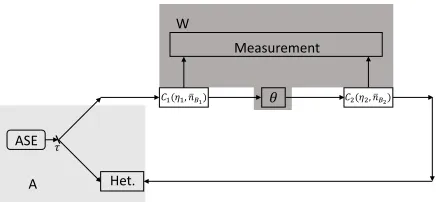
FIG. 1. Alice splits the output of the source on a highly-unbalanced beam splitter with controllable transimissiv-ity τ. She sends the weaker of the two beams along a forward propagation path, a single-mode bosonic channel
C1(η1,n¯B1) of transmissivity η1 and additive thermal
noise of mean photon number ¯nB1 per mode. The
prop-agated light, after accruing an unknown target phaseθ
propagates back to Alice on a single-mode bosonic chan-nelC1(η2,n¯B2). The brighter of the two beams at the
transmitter is held locally for use as local oscillator to heterodyne detect the target-return light. All the lost photons on both the forward and return path channels are given to Willie, who is allowed to make an arbitrary quantum measurement.
from direct sight. In this paper, we focus on covert sensing using active illumination [14] and consider the problem of phase estimation in the presence of loss and noise.
Problem setup.Figure 1 is a schematic of the prob-lem setup. Alice (the sensor) generates an n-mode optical probe, each mode of which traverses the for-ward propagation path to the target, modeled by a single-mode bosonic channelC1(η1,n¯B1) of transmis-sivityη1 and additive thermal noise of mean photon
number ¯nB1 per mode. Each mode of the output light illuminates the same (unknown) target phase
θ. The target-modulated light propagates through the return channelC2(η2,¯nB2) back to Alice. All the lost photons on both the forward and return path channels are given to Willie, who is allowed to make an arbitrary measurement on this 2n-mode optical state in order to do his hypothesis test to determine whether Alice is sensing or not. The problem is to quantify the minimum MSE attainable as a function ofn, with optimal choices of Alice’s probe state, re-ceiver, and the transmitted mean photon number per mode ¯nS so as to ensure-covertness no matter what measurement Willie uses. We assume the for-ward and return path transmissivitiesη1andη2 to
be known to Alice, and different in general, to ac-count for bi-static sensor configurations with unequal path lengths. We also allow for different thermal
noise temperatures for the forward and return path channels, to account for scenarios such as one of the two paths being actively jammed.
Main results.For ourachievability results, we will consider two sensor probes: (1) a laser-light (coherent-state) transmitter and heterodyne detection, and (2) a broadband amplified spontaneous emission (ASE) noise source (see Fig. 1), whose output is split on a highly unbalanced beam splitter which produces a phase-insensitive classically-correlated two-mode output. The weaker of the two outputs is used to probe the target, while the brighter beam is kept locally at the transmitter to be used as local oscillator to heterodyne detect the target-return light. Our two main results are:
Result 1. Alice can achieve an MSE,h(θ−θˆn)2i=
O(1/√n). Attempting to have the MSE diminish any faster as a function of nmust result in detection by Willie with high probability.
Result 2. The MSE when Alice uses a coherent state probe state scales ash(θ−θˆn)2i=ccoh/(
√
n), >0, while when she uses the ASE source h(θ−θˆn)2i=
cASE/(
√
n), >0. The per-mode performance of the coherent state probe is better than the ASE source probe, i.e., ccoh≤cASE. However, the ASE source can achieve a much lower MSE for a given integration time T, sincen≈W T and optical bandwidthW of the ASE source is larger by 2-3 orders of magnitude.
Covert sensing with a coherent state probe. Let us summarize the main results from [15]. The model is depicted in Fig. 2 withηeff=ηand ¯nBeff= ¯nB. Over
n modes, Alice transmits a mean photon number of hNSi= n¯nS, where ¯nS is the mean transmitted
photon number per mode. We make the assump-tion that the total variance, h∆N2
Si = O(n). Let
us begin by stating the converse: Alice’s sensing attempt is either detected by Willie with arbitrar-ily low detection probability, or the MSE of Alice’s estimation is tightly lower bounded by 1/√n, i.e.,
h(θ−θˆn)2i= Ω(1/
√
n) [15]. This notation implies that if Alice tries to get her MSE to surpass the 1/√nscaling (e.g., by increasing her transmit power), Willie will detect her sensing attempt with high prob-ability. Now, we state the achievability: Suppose that Willie can perform any measurement permitted by physics on the 2noptical modes he collects. Alice can lower bound Willie’s detection error probabil-ity P(det)e ≥1/2−, for any >0 while achieving the MSE h(θ−θˆn)2i=O(1/
√
n) using an n-mode coherent-state probe. For a coherent probe state
⊗n
ASE
𝐶𝐶eff(𝜂𝜂eff,�𝑛𝑛eff) 𝜃𝜃
[image:4.612.73.287.88.161.2]Het. 𝜏𝜏
FIG. 2. For the setup of Fig. 1, Alice sees one effective thermal channel Ceff. This setup was used in [15] for
covert sensing with a coherent state probe.
from the distributionp(α) =e−|α|2/n¯S/πn¯
S, Willie’s
detection error probability is shown to satisfy [15]:
P(det)e ≥ 1 2 −
(1−η)¯nS
√ n
4pη¯nB(1 +η)
.
Alice can choose
¯
nS=
4pηn¯B(1 +ηn¯B)
√
n(1−η)
to ensure -covertness [15]. Using the aforesaid co-herent state probe and ideal heterodyne detection measurement, Alice can achieve the MSE [15]:
h(θ−θˆn)2i ≈
chet
√n,
where
chet=
(1−η)(1 + ¯nB(1−η))
8ηpηn¯B(1 +η¯nB)
.
Using a coherent state probe, but no restriction on the receiver, the MSE achieved is at best two times lower than that is achieved with a heterodyne receiver [15]. In other words, with Alice’s optimal receiver,
h(θ−θˆn)2i ≥
ccoh
√n,
where
ccoh=
(1−η)(1 + 2¯nB(1−η))
16ηpηn¯B(1 +ηn¯B)
.
Covert sensing with ASE floodlight illumina-tion. Let us first consider the achievability. Since all states and channels involved are Gaussian, we will work with the symplectic formalism. Further, all the first moments of the states involved are zero. The ASE source, after being split on an un-balanced beam-splitter, emits a two-mode zero-mean Gaussian state with covariance matrix (CM) given by [16]:
VASE=
AASE 02×2
02×2 AASE
, (1)
where
AASE=
¯
nS+12
√
¯
nSn¯LO
√
¯
nSn¯LO ¯nLO+12
. (2)
Here, ¯nS is the mean transmit photon number per
mode, and ¯nLO n¯S is the mean photon number
per mode of Alice’s local oscillator (LO) for her het-erodyne detection receiver. If Alice is probing the target, Willie gets a state with the following CM (see App. Sec. 2),
VW =
BW CW
CT
W BW
, (3)
where
BW =
w11 −w12cosθ
−w12cosθ w22
,and (4)
CW =
0 w12sinθ
−w12sinθ 0
, (5)
where w11 = (1−η2)η1n¯S+ (1−η1)(1−η2)¯nB1+
η2¯nB2 + 1/2, w12 = p
(1−η2)η1(1−η1)(¯nB1 − ¯
nS), w22=η1n¯B1+ (1−η1)¯nS+ 1/2.When Alice is not sensing, Willie’s CM is given by (see App. Sec.
2)VW(0) =VW(¯nS = 0), where w (0)
ij =wij(¯nS = 0). We assume ¯nS n¯B1 and ¯nS ¯nB2, as this is in-tuitively needed for remaining covert. Willie must discriminate between the state ˆρ1 with CMVW (Al-ice is sensing) and the state ˆρ0 with CMV
(0)
W (Alice is not sensing). After transmission ofnmodes over the probing interval, Willie’s average probability of discrimination error is
P(w)e ≥ 1 2
1−1
2kρˆ
⊗n
0 −ρˆ
⊗n
1 k1
.
See also App. Sec. 1 for a brief discussion on de-tectability. The trace distance kρˆ0−ρˆ1k1 between
states ˆρ0 and ˆρ1 is upper-bounded by the quantum
relative entropy (QRE) D( ˆρ0kρˆ1) = tr ( ˆρ0ln ˆρ0)−
tr ( ˆρ0ln ˆρ1) using quantum Pinsker’s inequality, i.e.,
kρˆ0−ρˆ1k1≤
p
2D( ˆρ0kρˆ1) which implies that
P(w)e ≥ 1 2 −
r 1 8D( ˆρ
⊗n
0 kρˆ
⊗n
1 ). (6)
Thus, ensuring thatD( ˆρ⊗0nkρˆ⊗1n)≤82 ensures that P(w)e ≥ 12− overn channel uses. QRE is additive for tensor product states, therefore D( ˆρ⊗0nkρˆ⊗1n) =
nD( ˆρ0kρˆ1). By expanding the QRE in Taylor
se-ries with respect to ¯nS at ¯nS = 0 and by
upper bound D( ˆρ0kρˆ1) by its second order term
c2=f(η1, η2,n¯B1,¯nB2)>0. For the aforesaid anal-ysis on the QRE, see App. Sec. 4. Consequently Willie’s error probability will be lower bounded as,
P(w)e ≥ 1 2 −
√ c2
4
√
nn¯S. (7)
Thus, if Alice sets
¯
nS=
4 √
c2
1
√
n, (8)
she can ensure -covertness, i.e., P(w)e ≥ 12 −. As shown in Fig. 2, Alice sees one effective thermal channel (see App. Sec. 5), with ηeff = η1η2 and
¯
nBeff = [¯nB1(1−η1)η2+ ¯nB2(1−η2)]/(1−η1η2), which simplifies the analysis on Alice’s measurement. We consider heterodyne detection and in App. Sec. 6 we prove that the heterodyne output comprises of a pair of quadrature measurements with Gaussian distribu-tionsN µi, σ2i
, i= 1,2, of meansµi and variances
σ2
i. N cosθ,[1 + ¯nBeff(1−ηeff)]/(2ηeff¯nS) + cos
2θ
and N sinθ,[1 + ¯nBeff(1−ηeff)]/(2ηeffn¯S) + sin
2θ . The variances σ2
1,2are taken in the limit ¯nLO→ ∞,
i.e., a very bright local oscillator. By consideringn
modes, taking into account that independent Gaus-sian variables are additive, substituting ¯nS from Eq. (8) and assuming thatn1, we get σ12≈σ22=σhet2
(App. Sec. 6) where
σ2het= ˜chet
√n, (9)
and ˜chet= [1 + ¯nBeff(1−ηeff)]
√
c2/(8ηeff). Therefore,
h(θ−θˆhet,n)2i ≈ ˜
chet
√n =O
1
√ n
. (10)
For a justification of the approximation in Eq. (10), refer to [15] (Appendix C therein) and App. Sec. 7. In the same limit ¯nLO → ∞, the QFI for the
parameterθ for Alice is given by (see App. Sec. 8):
FA=
4¯nSηeff
1 + 2¯nBeff(1−ηeff)
. (11)
Therefore, by imposing the covertness condition Eq. (8) we get the QCRB for the ASE source,
h(θ−θˆn)2i ≥
cASE
√n (12)
wherecASE= [1+2¯nBeff(1−ηeff)]
√
c2/(16ηeff).
There-fore, with the ASE source, from Eqs. (10) and (12), heterodyne detection yields an MSE that is at most
twice compared to what is attainable by the optimal quantum receiver.
Let us discuss briefly the converse, i.e, the state-ment that regardless of then-mode probe state em-ployed by Alice, the sensing attempt is either de-tected with arbitrarily low detection probability, or the MSE of Alice’s estimator is tightly lower bounded ash(θ−θˆn)2i= Ω(1/
√
n). Since for the converse a specific probe state is not fixed and having proved that Alice sees only one effective thermal channel with (ηeff, n¯Beff), the converse proved in [15] using the methods and results from [17, 18] is still valid.
Laser light vs. ASE source probe.Let us compare the quantum limits corresponding to the ASE and the coherent state sources. In [15], it was found that for a coherent state probe, h(θ−θˆn)2i ≥ Fcoh−1 =
ccoh/(
√
n), where ccoh = (1−ηeff)[1 + 2¯nBeff(1−
ηeff)]/[16ηeff
p
ηeffn¯Beff(1 +ηeffn¯Beff)] andFcohis the QFI for coherent state probe and for the effective single thermal channel Alice sees. When the ratio
µ = FA−1/Fcoh−1 is µ < 1, the ASE source can out-perform the coherent state probe. For n = W T
channel uses, where the optical bandwidth W de-pends on the source and probing time T is fixed, the ratio is µ = µc/
√
µw, where µc = cASE/ccoh
and µw =WASE/Wcoh. If ¯nB1 = ¯nB2, as expected in most situations since thermal equilibrium across the forward and return paths is not an onerous as-sumption, we getµc= 1 which is its minimum value (App. Sec. 4), i.e., the per-mode performance for the two sources is identical. Therefore, we have
µ = pWcoh/WASE < 1 since the bandwidth of a
typical laser source is in the GHz regime while that of an ASE source is in the THz regime. We thus conclude that the ASE source would outperform a coherent state probe because of its larger bandwidth, under identical thermal environments.
Performance evaluation. Let us consider sensing over a mono-static free-space channel of line-of-sight range L, with an ASE source of center wavelength
λ. We employ a single spatial mode (the fun-damental Gaussian mode) probe. Assuming vac-uum propagation (ignoring turbulence and atmo-spheric extinction), and Gaussian-attenuation aper-tures (for simplifying the expressions without los-ing the essence of the problem), we get the trans-missivities of both the forward and return paths as
L=1km L=3km L=5km
1012 1013 1014 1015 1016
10-4 1016 1036 1056 1076
Frequency(Hz)
[image:6.612.77.297.87.231.2]cASE
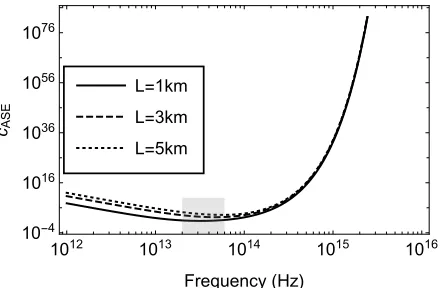
FIG. 3. Plot ofcASE as a function of center frequency of
transmissionf, for three different values of target range,
L. We used rt = 4 cm, rT = 10 cm, and = 10−3.
Shaded area is where the minima appear.
cw ASE source of optical bandwidthW illuminates the target forT seconds, which results inn≈W T
temporal modes to probe the target.
In Fig. 3, we plotcASEof Eq. (12) as a function of
the center frequencyf =hc/λof the source, where
h is Planck constant and c is the speed of light. We assume Planck law limited thermal noise, with
¯
nB1 = ¯nB2= ¯nB = [exp(hc/(λkBT0))−1]
−1, where
kB is the Boltzmann constant andT0= 300K is the
ambient temperature. Longer wavelengths (smaller frequencies) have more noise (larger ¯nB) to hide the probe, which tends to makecASE smaller. On the
other hand, longer wavelengths (smaller frequencies) have more diffraction limited loss (smallerη), giving more photons to Willie, which tends to makecASE
higher. So, there is a trade-off in the choice of the center frequency, and we see that the minimum of
cASE happens in the mid to long wave infrared
(ML-IR) region. We numerically evaluate the optimal wavelengthλwhich minimizescASE. For= 10−3,
probing timeT = 1s, and for a source with bandwidth
W = 3THz we find the right hand side of Eq. (12), which we denote as B, the MSE lower bound. For
L= 1km: λ= 9.40µm, B = 0.00322, for L= 3km:
λ= 6.35µm, B = 0.09927, and for L = 5km: λ = 5.38µm, B = 0.81438.
Sources in the ML-IR region with W = 3THz and wavelength 3µm ≤ λ ≤ 4.4µm and λ = 4,4.6,8.7,10.2µm such as [19][20], forL= 1km and
T = 1s give B = 0.00327 and B = 0.08423 for wavelengths 8.7µm and 3µm respectively, which cor-respond to the extrema of the performance for the
aforementioned parameters, wavelength range and values.
Conclusions.Our work introduces to the greater communities of optical sensing, strategic security, and fundamental quantum optics, the concept of quantum-secure covert (low probability of detect) sensing. Our analytical analysis has shown that using floodlight illumination from an ASE source, covert phase sensing is possible and experimentally feasible. In fact, the ASE source enhances covert sensing performance by exploiting its large optical bandwidth W, i.e., the number of available orthog-onal modes n =W T can significantly increase for a given time T. An open question is to consider sensing multiple parameters, e.g., covert sensing of phase and loss (ranging) or multiple phases that could be the pixels of an image. We leave these questions for future work. Our setup is experimentally feasible. The ASE source is divided into two arms by a highly reflective fiber coupler, so that ¯nS 1 and ¯nLO 1. The sensing arm
is frequency shifted prior to being sent to a very noisy environment and then is phase shifted by a weakly reflecting object. The LO is stored locally in a spool of optical fibers for later heterodyne measurement. Note that for sources with smaller wavelengths than those in [19, 20], one could inject artificial noise to get a reasonable MSE lower bound for a proof of concept experiment. Our present work indicates covert sensing is experimentally feasible and applicable to practical optical sensing tasks. A thorough analysis of modeling, experimental demonstration, and application development, are left for follow up works.
[1] V. Giovannetti, S. Lloyd, and L. Maccone, Phys. Rev. Lett. 96, 010401 (2006).
[2] T. Ono, R. Okamoto, and S. Takeuchi, Nature Communications4(2013), 10.1038/ncomms3426. [3] Y. Israel, S. Rosen, and Y. Silberberg, Phys. Rev.
Lett.112, 103604 (2014).
[4] C. Rembe, L. Kadner, and M. Giesen, Re-view of Scientific Instruments 87, 102503 (2016), https://doi.org/10.1063/1.4964625.
[5] J. G. Rarity, P. R. Tapster, J. G. Walker, and S. Seward, Appl. Opt.29, 2939 (1990).
[6] M. Tsang, New Journal of Physics19, 023054 (2017). [7] M. W. Dale and G. W. Morley, arXiv preprint
arXiv:1705.01994 (2017).
[8] B. P. Abbottet al.(LIGO Scientific Collaboration and Virgo Collaboration), Phys. Rev. Lett. 116, 061102 (2016).
[9] R. Demkowicz-Dobrza´nski, M. Jarzyna, and J. Ko lody´nski, Progress in Optics60, 345 (2015), arXiv:1405.7703.
[10] B. A. Bash, D. Goeckel, and D. Towsley, Limits of Reliable Communication with Low Probability of Detection on AWGN Channels, Tech. Rep. UM-CS-2012-003 (University of Massachusetts, 2012). [11] P. H. Che, M. Bakshi, and S. Jaggi, “Reliable
de-niable communication: Hiding messages in noise,” arXiv:1304.6693 (2013).
[12] L. Wang, G. W. Wornell, and L. Zheng, IEEE Trans. Inf. Theory62, 3493 (2016).
[13] B. A. Bash, A. H. Gheorghe, M. Patel, J. L. Habif, D. Goeckel, D. Towsley, and S. Guha, Nat Commun 6(2015), 10.1038/NCOMMS9626.
[14] B. A. Bash and S. Guha, “Covert sensor,” (2018), United States Patent Application number 15/875,904.
[15] B. A. Bash, C. N. Gagatsos, A. Datta, and S. Guha, in 2017 IEEE International Symposium on Information Theory (ISIT)(2017) pp. 3210–3214, arXiv:1701.06206v1.
[16] Q. Zhuang, Z. Zhang, J. Dove, F. N. C. Wong, and J. H. Shapiro, Phys. Rev. A94, 012322 (2016), arXiv:1510.08737 [quant-ph].
[17] R. M. Escher, R. L. M. Filho, and L. Davidovich, Nature Physics7, 406 (2011).
[18] C. N. Gagatsos, B. A. Bash, S. Guha, and A. Datta, Phys. Rev. A96, 062306 (2017).
[19] T. W. Neely, T. A. Johnson, and S. A. Diddams, Opt. Lett.36, 4020 (2011).
[20] Personal communication with Dr. Bob Shine, DRS Daylight solutions, concerning the Aries-2 laser spec-ifications.
[21] C. Weedbrook, S. Pirandola, R. Garc´ıa-Patr´on, N. J. Cerf, T. C. Ralph, J. H. Shapiro, and S. Lloyd, Rev. Mod. Phys.84, 621 (2012).
[22] S. Pirandola, R. Laurenza, C. Ottaviani, and
L. Banchi, Nature Communications8, 15043 (2017). [23] F. Topsoe, Inequality Theory and Applications 7
(2004).
[24] F. Caruso, J. Eisert, V. Giovannetti, and A. S. Holevo, New Journal of Physics10, 083030 (2008). [25] P. Marian and T. A. Marian, Phys. Rev. A 86,
022340 (2012).
APPENDIX
We give information on the derivations used in the main paper. Specifically, we discuss detectability, we derive the covariance matrices for the global output, for Alice, and for Willie. We calculate the quantum relative entropy (QRE) for Willie’s part between the states which correspond toAlice is sensing andAlice is not sensing scenarios and we discuss the Taylor expansion of the QRE. We prove that Alice sees only one effective thermal channel. We give explicit calculations for the heterodyne detection. Finally, we derive the quantum Fisher information for when Alice is sensing the unknown phase.
1. Detectability
The adversary performs a binary hypothesis test on his sample to determine whether the target is being interrogated or not. Performance of the hypothesis test is typically measured by its detection error probability denoted asP(det)e here since we speak generally, but it is P(w)e in the main paper when we talk about the
ASE source. We have,P(det)e = PFA+2PMD, where equal prior probabilities on sensor’s interrogation state are
assumed,PFA is the probability of false alarm andPMDis the probability of missed detection. The sensor
desires to remain covert by ensuring thatP(det)e ≥ 12−for an arbitrary small >0 regardless of adversary’s
measurement choice (sinceP(det)e = 12 for a random guess). By decreasing the power used in a probe, the
sensor can decrease the effectiveness of the adversary’s hypothesis test at the expense of the increased mean squared error (MSE) of the estimate.
2. Alice’s and Willie’s covariance matrices
We give the full expressions of: the final covariance matrix (CM) of the global state, i.e, the final state that contains both Alice’s and Willie’s modes (4 modes in total, therefore the dimensions of the CM is 8×8), and the CM of each one Alice and Willie. We remind the reader that the first moments are zero. We also provide a guide on how these CM were derived.
We use the symplectic formalism [21], where under a symplectic matrix S, a CMV0 is evolved to the
CM V = SV0ST. All CM are in the qqpp representation, meaning that for a 2N ×2N CM the upper
left block contains information only on position, the lower right block concerns only momentum, and the off-diagonal blocks contain information on position-momentum correlations. The phase space vector is
r = (r1, . . . r2N) T
= (q1, . . . qN, p1. . . pN) T
. In our set up, we assume that the first two modes belong to Willie, while the last two modes belong to Alice. We have worked with~= 1, therefore the CM for vacuum
isI/2, whereI is the identity matrix.
Since initially Alice’s and Willie’s systems are uncorrelated, in theqqpp representation the initial, global CM is
VAW0 =
¯
nB2+
1
2 0 0 0 0 0 0 0
0 n¯B1+
1
2 0 0 0 0 0 0
0 0 n¯S+12
√
¯
nSn¯LO 0 0 0 0
0 0 √n¯S¯nLO n¯LO+12 0 0 0 0
0 0 0 0 n¯B2+
1
2 0 0 0
0 0 0 0 0 ¯nB1+
1
2 0 0
0 0 0 0 0 0 n¯S+12
√
¯
nSn¯LO
0 0 0 0 0 0 √n¯Sn¯LO n¯LO+12
(A1)
Our setup consists of three symplectic transformations, which are depicted in Fig. 4 and in order of action are the following. A beam splitterB23(η1) with transmissivity η1 acting on modes 2 and 3, a phase shift
R3(θ) acting on mode 3, and a beam splitter B13(η2) with transmissivityη2acting on modes 1 and 3. By
𝜂𝜂
2
�𝜌𝜌
𝑡𝑡ℎ
2�𝜌𝜌
𝑡𝑡ℎ
1�𝜌𝜌
𝑠𝑠
A
W
𝜂𝜂
1
𝜃𝜃
Heterodyne Measurement
[image:9.612.127.486.94.302.2]ASE
𝜏𝜏
FIG. 4. A layout of the setup, equivalent to the one of the main paper, however more explanatory regarding the transformations. Light gray area (A) belongs to Alice, while darker gray area (W) belongs to Willie.
job. Let us demonstrate an example. The beam splitterB23(η1) will act on the sub-matrices V (pos1)
AW0 and
V(mom1)
AW0 ofVAW0 with elementsV ij
AW0, i, j= 2,3 andV ij
AW0, i, j= 6,7 respectively, i.e., to the momentum and position coordinates with indices 2,3. The symplectic matrixB23(η1) is,
B23(η1) =
B23(pos)(η1) 02×2
02×2 B (mom) 23 (η1)
!
, (A2)
where
B23(pos)(η1) =B (mom) 23 (η1) =
√
η1
√
1−η1
−√1−η1
√ η1
. (A3)
Therefore we apply the transformationV1=B23(η1)
V(pos1) AW0 ⊕V
(mom1) AW0
BT
23(η1) where all involved matrices
are block diagonal and therefore the resulting matrix will also be block-diagonal. Then inVAW0, we substitute theV(pos1)
AW0 andV
(mom1)
AW0 blocks with the resulting blocks ofV1. The rest ofVAW0 elements remain unchanged. Subsequently, we apply the phase shift which corresponds to the symplectic matrix,
R3(θ) =
1 0 0 0 0 0 0 0
0 1 0 0 0 0 0 0
0 0 cosθ 0 0 0 −sinθ 0
0 0 0 1 0 0 0 0
0 0 0 0 1 0 0 0
0 0 0 0 0 1 0 0
0 0 sinθ 0 0 0 cosθ 0
0 0 0 0 0 0 0 1
(A4)
or one can again simplify calculations by noticing which modes the phase shift affects. Finally, the beam splitterB13(η2) is applied on the resulting CM. The final, global CM is
V =
B C CT B
where,
B=
BW BAW
BAW BA
(A6)
and
C=
CW CAW
−CT
AW CA
(A7)
with
BW =
(1−η2)η1n¯S+ (1−η1)(1−η2)¯nB1+η2n¯B2+
1 2
p
(1−η2)η1(1−η1)(¯nB1−n¯S) cosθ p
(1−η2)η1(1−η1)(¯nB1−n¯S) cosθ η1n¯B1+ (1−η1)¯nS+
1 2
, (A8)
BAW = p
η2(1−η2)[η1¯nS+ (1−η1)¯nB1−n¯B2] p
(1−η2)η1n¯S¯nLOcosθ
p
η2η1(1−η1)(¯nB1−n¯S) cosθ
p
(1−η1)¯nSNLO
, (A9)
BA=
(1−η1)η2¯nB1+ (1−η2)¯nB2+η1η2¯nS+
1 2
√
η1η2n¯S¯nLOcosθ
√
η1η2¯nSn¯LOcosθ ¯nLO+12
, (A10)
CW =
0 −p
(1−η2)η1(1−η1)(¯nB1−n¯S) sinθ p
(1−η2)η1(1−η1)(¯nB1−¯nS) sinθ 0
, (A11)
CAW =
0 −p
(1−η2)η1n¯Sn¯LOsinθ
p
η2η1(1−η1)(¯nB1−n¯S) sinθ 0
, (A12)
CA=
0 −√η2η1n¯Sn¯LOsinθ
√
η2η1n¯S¯nLOsinθ 0
. (A13)
By tracing out, i.e, by keeping the corresponding sub-matrices, we can find the covariance matricesVA for Alice andVW for Willie,
VA=
BA CA
CAT BA
=
a11 −a12cosθ 0 a12sinθ
−a12cosθ a22 −a12sinθ 0
0 −a12sinθ a11 −a12cosθ
a12sinθ 0 −a12cosθ a22
, (A14)
VW =
BW CW
CT
W BW
=
w11 −w12cosθ 0 w12sinθ
−w12cosθ w22 −w12sinθ 0
0 −w12sinθ w11 −w12cosθ
w12sinθ 0 −w12cosθ w22
, (A15)
where
a11= (1−η1)η2¯nB1+ (1−η2)¯nB2+η1η2¯nS+ 1
2, (A16)
a12=−
√
η1η2n¯S¯nLOcosθ, (A17)
a22= ¯nLO+
1
2, (A18)
w11= (1−η2)η1¯nS+ (1−η1)(1−η2)¯nB1+η2n¯B2+ 1
2, (A19)
w12=
p
(1−η2)η1(1−η1)(¯nB1−n¯S), (A20)
w22=η1n¯B1+ (1−η1)¯nS+ 1
3. The quantum relative entropy
To calculate the quantum relative entropy (QRE) D( ˆρ0kρˆ1) = tr ( ˆρ0ln ˆρ0)−tr ( ˆρ0ln ˆρ1) between two
Gaussian states ˆρ0 and ˆρ1, we need to find the symplectic eigenvalues and symplectic eigenvectors of one of
the the two covariance matrices and the symplectic eigenvalues of the other [22] (section Methods therein). Let ˆρ0, ˆρ1to have a covariance matrixV0,V1respectively. The covariance matrixV1is for the case where
Alice is sensing, i.e, (¯nS6= 0), while the covariance matrix V0 is for the case where Alice is not sensing, i.e.,
(¯nS= 0), therefore V0=VW(¯nS= 0) andV1=VW(¯nS6= 0), whereVW is Willie’s covariance matrix given in Eq. (A15). That means Willie’s CM matrix elements for ¯nS= 0, i.e, the matrix elements ofV0, are
w(0)11 = (1−η1)(1−η2)¯nB1+η2n¯B2+ 1
2, (A22)
w(0)12 =p(1−η2)η1(1−η1)¯nB1, (A23)
w(0)22 =η1n¯B1+ 1
2 (A24)
andV0will have the same structure as VW in Eq. (A15). The QRE is,
D( ˆρ0kρˆ1) =−Σ(V0, V0) + Σ(V0, V1). (A25)
In Eq. (A25), the first term is the von Neumann entropy (with a minus in front) of a Gaussian state with CMV0 and zero first moments, which for our case is,
Σ(V0, V0) =
1 2
2
X
k=1
1 + 2u(0)k ln
u(0)k +1 2
+1−2u(0)k ln
u(0)k −1
2
, (A26)
where u(0)k , k= 1,2 are the symplectic eigenvalues ofV0 given by
u(0)1 =1 2
w(0)11 +w(0)22 + q
4w(0)212 + (w(0)11 −w22(0))2
(A27)
u(0)2 =1 2
w(0)11 +w(0)22 −
q
4w(0)212 + (w(0)11 −w22(0))2
. (A28)
The second term in Eq. (A25), for the case at hand is given by
Σ(V0, V1) =
1 2
2
X
k=1
(1 + 2dk) ln
uk+ 1 2
+ (1−2dk) ln
uk− 1 2
, (A29)
whereuk are the symplectic eigenvalues ofV1anddkare the diagonal elements (which are doubly degenerate in our case, just as the symplectic spectrum of a CM) ofV00 =MTV
0M, whereM is the symplectic eigenvectors’
matrix ofV1. The symplectic eigenvalues ofV1 are found to be
u1=
1 2
w11+w22+
q 4w2
12+ (w11−w22)2
(A30)
u2=
1 2
w11+w22−
q 4w2
12+ (w11−w22)2
(A31)
and the symplectic eigenvectors’ matrix ofV1 is a beam splitter followed by a 2-mode phase rotation,
M =R
θ
2+π,−
θ
2
B(τ) =
−√τcosθ
2
√
1−τsinθ
2
√ τsinθ
2 −
√
1−τsinθ
2
√
1−τcosθ2 √τcosθ2 √1−τsinθ2 √τsinθ2
−√τsinθ2 √1−τsinθ2 −√τcosθ2 √1−τcosθ2
−√1−τsinθ
2 −
√ τsinθ
2
√
1−τcosθ
2
√ τcosθ
2
where
τ= w11−w22 2p4w2
12+ (w11−w22)2
+1
2. (A33)
The matrix M can be easily checked to satisfyM V1MT = diag(u0, u1, u0, u1) andMΩMT = Ω, where,
Ω =
02×2 I2×2
−I2×2 02×2
, (A34)
meaning thatM is a valid symplectic matrix that diagonalizes (in the symplectic sense) the matrixV1. The
diagonal elements ofV00 are,
d1=
w11(0)+w(0)22
2 +
1
2p4w2
12+ (w11−w22)2
4w12w
(0)
12 + (w11−w22)(w (0) 11 −w
(0) 22)
(A35)
d2=
w11(0)+w(0)22
2 −
1
2p4w2
12+ (w11−w22)2
4w12w
(0)
12 + (w11−w22)(w (0) 11 −w
(0) 22)
. (A36)
Given the expressions (A27), (A28), (A30), (A31), (A35), (A36), the relative entropy is now known as a function of theV0 andV1 matrix elements through Eqs. (A25), (A26), and (A29) (see also Mathematica file
QRE.nb).
4. Taylor expansion of the relative entropy
We expand the QRE (A25) in Taylor series with respect to ¯nSat ¯nS= 0
D( ˆρ0kρˆ1)≡D(¯nS) =D(0) +
∂D(¯nS)
∂n¯S
n¯
S=0 + 1
2!
∂2D(¯n S)
∂n¯2 S
n¯
S=0 + 1
3!
∂3D(¯n S)
∂n¯3 S
n¯
S=0
+. . . (A37)
The 0th term in (A37) is zero becauseD(0) =D( ˆρ0kρˆ0) = 0. The 1st order term is zero, as the QRE has a
minimum atD( ˆρ0kρˆ1) = 0, and the 2nd order term is non-negative as the QRED( ˆρ0kρˆ1)≥0, i.e., it has a
global minimum at zero. Note that Σ(V0, V0) of the QRE (A25) has not a dependence on ¯nS, therefore one is
concerned only with the term Σ(V0, V1) when taking derivatives on the QRE with respect to ¯nS.
Having expressed the QRE as a function of the CM elements and consequently as a function of (η1, η2,¯nB1,n¯B2), it is straightforward to derive the 2
nd and 3rd order derivatives. Below, we give a guide on
how to derive that the 2ndderivative (at ¯nS= 0) is non-negative, thatµc≥1, and that the 3rd derivative (at ¯
nS= 0) is negative. The main tool is to upper and lower bound the ln(.) [23] with
2x
x+ 2 ≤ln (1 +x)≤
x
2
x+ 2
x+ 1, x≥0. (A38)
The expression of the 2nd derivative has the form
c2=
∂2D(¯n S)
∂n¯2 S
¯n
S=0
=T1+T2ln (1 +x), (A39)
where T1, T2 >0, and x > 0 are functions of (η1, η2,n¯B1,n¯B2). Since T2 >0, we use the lower bound of (A38),c2≥T1+T2x2+2x , from which expression it can shown thatc2≥0.
To prove thatµc=cASE/ccoh≥1⇒cASE−ccoh≥0, wherecASE= [1 + 2¯nBeff(1−ηeff)]
√
c2/(16ηeff), we
use a similar technique. We eliminate the ln(.) inc2using again the lower bound of (A38, a technique which
The 3rd derivative of the QRE has the form,
c3=
∂3D(¯n S)
∂n¯3 S
n¯
S=0
=P1+P2+P3ln (1 +x), (A40)
whereP1,P2,P3, andx >0 are functions of (η1, η2,¯nB1,n¯B2). In this case,P3 can be positive or negative. Therefore, one has to take cases when eliminating the ln(.), which again gives a sufficient, but not necessary, condition. WhenP3>0, we use the upper bound of (A38), c3≤P1+P2+P3x2xx+2+1, while whenP3<0, we
use the lower bound of (A38),c3≤P1+P2+P3x2+2x . For both cases it can shown thatc3≤0.
The case where ¯nB1 = ¯nB2= ¯nB yields simple results,
D( ˆρ0kρˆ1)(¯nB)=ηeffn¯Bln
η
eff¯nB
1 +ηeff¯nB
1 + (1−ηeff)¯nS+ηeffn¯B
(1−ηeff)¯nS+ηeffn¯B
+ ln
1 + (1−η
eff)¯nS+ηeffn¯B
(1−ηeff)¯nS+ηeff¯nB
,(A41)
c2 (¯nB)=
(1−ηeff)2
ηeffn¯B(1 +ηeffn¯B)
>0, (A42)
λc = 1, (A43)
c3 (¯nB)=−
2(1−ηeff)3(1 + 2ηeff¯nB)
η2 eff¯n
2
B(1 +ηeffn¯B)2
<0. (A44)
Details can be found in Mathematica file QRE.nb.
5. Effective channel
A covariance matrixV1under a thermal channelC(¯nB, η) [24] is transformed as
V2=XV1XT +Y, (A45)
where,
X =√ηI (A46)
Y = (1−η)
¯
nB−
1 2
I. (A47)
Alice’s sensing arm goes through a thermal channel C1(¯nB1, η1), a phase shift R(θ) which is a symplectic orthogonal matrix, and another thermal channel C2(¯nB2, η2). Therefore, the sensing arm will see the transformation,
˜
X =X2R(θ)X1 (A48)
˜
Y =X2R(θ)Y1RT(θ)X2T +Y2, (A49)
Where X1, Y1 andX2, Y2 correspond toC1 and C2 respectively. Using Eqs. (A46), (A47), and since the
matricesX1, X2, Y1, Y2 are proportional to the identity matrixI they commute withR(θ), Eqs. (A48) and
(A49) give,
˜
X =√ηeffI (A50)
˜
Y = (1−ηeff)
¯
nBeff+ 1 2
I, (A51)
where,
ηeff =η1η2 (A52)
¯
nBeff =
(1−η1)η2n¯B1+ (1−η2)¯nB2 1−η1η2
Therefore, Alice’s sensing arm sees only one effective thermal channel with transmittance ηeff, mean thermal
photon number ¯nBeff, and a phase shiftR(θ). The phase shiftR(θ) can be put before or after the thermal channel as it commutes with ˜X and ˜Y andR(θ) is orthogonal. The matrix elementsa11and a12in Alice’s
CM can now be written,
a11= (1−ηeff)¯nBeff+ηeffn¯S+ 1
2, (A54)
a12=−
√
ηeffn¯S¯nLOcosθ. (A55)
6. Heterodyne detection
We will consider dual homodyne detection on Alice’s system as in Fig. 5, which is an implementation of heterodyne detection. We want to calculate the mean valuesµ13,µ42 and the variancesσ132 ,σ
2 42of the
Gaussian distributionsN(µ13, σ213), N(µ42, σ422 ) respectively. The aforementioned Gaussian distributions
correspond to the observables ˆn1−ˆn3and ˆn4−nˆ2 in the following manner,
µ13=hnˆ1−nˆ3i (A56)
µ42=hnˆ4−nˆ2i (A57)
σ213=h(ˆn1−nˆ3)2i=hnˆ21i − hnˆ1i2+hnˆ23i − hnˆ3i2−2 (hnˆ1ˆn3i − hnˆ1ihnˆ3i) (A58)
σ242=h(ˆn4−nˆ4)2i=hnˆ24i − hnˆ4i2+hnˆ22i − hnˆ2i2−2 (hnˆ4ˆn2i − hnˆ4ihnˆ2i). (A59)
Therefore, we need to calculate the expectation values in Eqs. (A56), (A57), (A58), and (A59). To this end, we calculate the evolution of the CM for the setup of Fig. 5. The CMVinjust before the heterodyne detection
is given by the Eq. (A14) and by taking into account that the CM for vacuum isI/2,
Vin=
1
2 0 0 0 0 0 0 0
0 a11 −a12cosθ 0 0 0 a12sinθ 0
0 −a12cosθ a22 0 0 −a12sinθ 0 0
0 0 0 12 0 0 0 0
0 0 0 0 12 0 0 0
0 0 −a12sinθ 0 0 a11 −a12cosθ 0
0 a12sinθ 0 0 0 −a12cosθ a22 0
0 0 0 0 0 0 0 12
. (A60)
After the application of all symplectic matrices as described in Fig. 5, the CM just before the photon number resolution detectors is,
Vhet=
A B BT A
, (A61)
A=
A11 A12 A13 A14
A12 A22 A23 A24
A13 A23 A33 A34
A14 A24 A34 A44
, (A62)
B=
0 B12 B13 B14
−B12 0 B23 B24
−B13 −B23 0 B34
−B14 −B24 −B34 0
A11=
1
4(1 +a11+a22−2a12cosθ) (A64)
A12=
1
8[1−2a11+ 2a12(cosθ−sinθ)] (A65)
A13=
a11−a22
4 (A66)
A14=
1
8[1−2a11+ 2a12(cosθ+ sinθ)] (A67)
A22=
1
4(1 +a11+a22+ 2a12sinθ) (A68)
A23=
1
8[1−2a11−2a12(cosθ+ sinθ)] (A69)
A24=
a11−a22
4 (A70)
A33=
1
4(1 +a11+a22+ 2a12cosθ) (A71)
A34=
1
8[1−2a11−2a12(cosθ−sinθ)] (A72)
A44=
1
4(1 +a11+a22−2a12sinθ), (A73)
B12=−
1
8[1−2a22+ 2a12(cosθ−sinθ)] (A74)
B13=−
1
2a12sinθ (A75)
B14=
1
8[1−2a22+ 2a12(cosθ+ sinθ)] (A76)
B23=−
1
8[1−2a22−2a12(cosθ+ sinθ)] (A77)
B24=−
1
2a12cosθ (A78)
B34=−
1
8[1−2a22−2a12(cosθ−sinθ)]. (A79)
Using the the CM of Eq. (A61), we can construct the Wigner function,
W(r) = 1 (2π)4√detV
het
Z
d2rexp
−1
2r T
Vhet−1r
(A80)
wherer= (q1, . . . , q4, p1, . . . , p4) is the phase space vector (qi, pi refer to position and momentum respectively of thei-th mode, also note that we work with~= 1), andd2r=dq1. . . dq4dp1. . . dp4. Utilizing the Wigner
function we can calculate mean values in the symmetric ordering,
h: ˆninˆj :i= Z
d2rW(r)(q
2
i +p2i)(qj2+p2j)
4 . (A81)
Utilizing Wick-Isserlis theorem and the commutation relation [ˆai,ˆa†j] =δij, for example,
h: ˆniˆnj:i=hnˆiˆnji+ 1 2hnˆii+
1 2hnˆji −
1
ASE
𝐶𝐶eff(𝜂𝜂eff,�𝑛𝑛eff)
𝜃𝜃
LO
0
0
+
−
+
−
𝜋𝜋/2(1) (2)
(3)
(4)
[image:16.612.72.539.79.229.2]𝜏𝜏
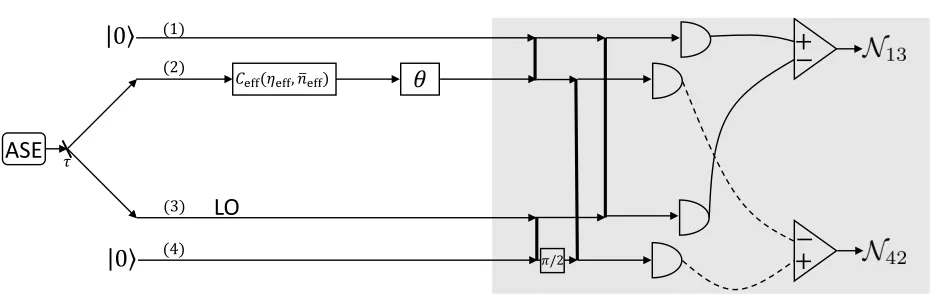
FIG. 5. The heterodyne detection takes place in the gray area. Bold vertical lines represent balanced beam splitters. Alice splits her local oscillator and the sensing arm into two equal beams each. On the lower local oscillator a phase
π/2 is applied. Then, modes (1) and (2) of the sensing arm are mixed with the modes (3) and (4) respectively. Finally, a homodyne is performed on the couples of modes (1),(3) and (2),(4) using photon number resolution detectors.
we find
hnˆ1i=
1
4(a11+a22−2a12cosθ−1) (A83)
hnˆ2i=
1
4(a11+a22+ 2a12sinθ−1) (A84)
hnˆ3i=
1
4(a11+a22+ 2a12cosθ−1) (A85)
hnˆ4i=
1
4(a11+a22−2a12sinθ−1) (A86)
hnˆ21i=1
8(a11+a22−2a12cosθ−1)(a11+a22−2a12cosθ+ 1) (A87)
hnˆ22i=1
8(a11+a22+ 2a12sinθ−1)(a11+a22+ 2a12sinθ+ 1) (A88)
hnˆ23i=1
8(a11+a22+ 2a12cosθ−1)(a11+a22+ 2a12cosθ+ 1) (A89)
hnˆ24i=1
8(a11+a22−2a12sinθ−1)(a11+a22−2a12sinθ+ 1) (A90)
hnˆ1nˆ3i=
1
16[1 + 2(a11−1)a11+ 2(a22−1)a22−4a
2
12cos 2θ] (A91)
hnˆ4nˆ2i=
1
16[1 + 2(a11−1)a11+ 2(a22−1)a22+ 4a
2
12cos 2θ]. (A92)
From Eqs. (A18), (A54), (A55), (A56), (A57), (A58), (A59), and (A83) to (A92), we find
µ13=
√
ηeffn¯Sn¯LOcosθ (A93)
µ42=
√
ηeffn¯Sn¯LOsinθ (A94)
σ213=1
2[¯nLO+ ¯neff(1−ηeff) + ¯neff(1−ηeff)¯nLO+ ¯nSηeff] + ¯nLO¯nSηeffcos
2θ (A95)
σ242=1
2[¯nLO+ ¯neff(1−ηeff) + ¯neff(1−ηeff)¯nLO+ ¯nSηeff] + ¯nLO¯nSηeffsin
We normalize the mean values withk=√ηeffn¯Sn¯LO and consequently the variances withk2, and by taking
the limit of a very strong local oscillator we get,
µ1=
µ13
k = cosθ (A97)
µ2=
µ42
k = sinθ (A98)
σ21= lim
¯
nLO→∞
σ13
k2 =σ
2+ cos2θ (A99)
σ22= lim ¯
nLO→∞
σ42
k2 =σ 2+ sin2
θ, (A100)
where
σ2= 1 + (1−ηeff)¯nBeff 2ηeff¯nS
. (A101)
Alice is trying to determine the mean values of the distributionsN(cosθ, σ2+ cos2θ) andN(sinθ, σ2+ sin2θ) by using the channelntimes, i.e, by performing nmeasurements. Then the distributions of the mean values will beN(cosθ, σ2/n+ cos2θ/n) andN(sinθ, σ2/n+ sin2θ/n), were we have used the fact that independent
Gaussian variables are additive. We set,
σhet2 =σ
2
n =
1 + (1−ηeff)¯nBeff 2nηeffn¯S
(A102)
and by imposing the covertness condition ¯nS= (4)/[
√ c2
√
n] we get,
σhet2 =
˜
chet
√n, (A103)
where ˜chet= [1 + ¯nBeff(1−ηeff)]
√
c2/(8ηeff). Therefore the two distributions now areN(cosθ,c˜het/(
√ n) + cos2θ/n) and N(sinθ,˜c
het/(
√
n) + sin2θ/n). In the limit of n 1 (a limit which is justified by the large bandwidth of the ASE source), since sin2θ ≤1 and cos2θ ≤1 the term that scales as 1/n will be
insignificant, therefore the approach in Sec. 7 and in [15] (Appendix C therein) applies here as well and we conclude that the mean square error of the estimator ˆθhet,n= arctan (sinθ+σhet2 )/(cosθ+σhet2 )
scales as
h(θ−θˆhet,n)2i=O(1/
√ n).
7. Proof thatD(θ−θˆhet)2 E
≤σ2het+O
1 n D
(θ−θˆhet)2 E
≤σ2
het+O n1 D
(θ−θˆhet)2 E
≤σ2het+O
1 n
Consider the following estimator forθ,
ˆ
θhet= tan−1
sin(θ) + 1
n
Pn
i=1Z (Q,N)
i
cos(θ) +1
n
Pn
i=1Z (I,N)
i !
(A104)
= tan−1
sin(θ) +Z(Q)
cos(θ) +Z(I)
, (A105)
where the random variables representing in-phase (I) and quadrature (Q) noise Z(I), Z(Q) respectively,
obey the Gaussian distributions Z(I) ∼ N(0, σ2
het) and Z(Q) ∼ N(0, σ2het), Z(I,N) ∼ N(0, σ2+ cos2θ) and
Z(Q,N) ∼ N(0, σ2+ sin2θ). The distributions are indeed Gaussian forn1 and by applying the central
limit theorem. The varianceσ2
het is given in Eq. (A103). The MSE is:
D
(θ−θˆhet)2
E =
*
θ−tan−1
sin(θ) +Z(Q)
cos(θ) +Z(I)
2+
(A106)
= *
θ−tan−1
sin(θ) +Rcos(ϕ)
cos(θ) +Rsin(ϕ)
2+
where in (A107) we use circular symmetry of the two-dimensional added white Gaussian noise (AWGN) to change from the rectangular to polar coordinate system. Thus, the radius is distributed as a Rayleigh random variableR∼Rayleigh(σ2
het) while the angle is distributed uniformlyϕ∼ U([0,2π]). Now, the Taylor series
expansion of tan−1cos(sin(θθ)+)+rrcos(sin(ϕϕ))aroundr= 0 is:
tan−1
sin(θ) +rcos(ϕ) cos(θ) +rsin(ϕ)
=θ+rcos(θ+ϕ)−r
2
2 sin(2(θ+ϕ))−
r3
3 cos(3(θ+ϕ)) +
r4
4 sin(4(θ+ϕ))
+r
5
5 cos(5(θ+ϕ))−
r6
6 sin(6(θ+ϕ))−
r7
7 cos(7(θ+ϕ)) +
r8
8 sin(8(θ+ϕ))
+. . . (A108)
≤θ+rcos(θ+ϕ) +
∞
X
i=2
ri
i (A109)
=θ+rcos(θ+ϕ)−(log(1−r) +r) provided 0≤r <1, (A110)
where the upper bound in (A109) is because sin(x),cos(x)∈[−1,1]. While this demonstrates the convergence of the Taylor series forr <1, the nth root test shows that the Taylor series in (A108) does not converge for
r >1 (the series converges forr= 1 by the alternating series test, however, this is a zero-probability event). However, since tan−1(x)∈
−π
2,
π
2
andθ∈ −π
2,
π
2
, for any randϕ,
tan−1
sin(θ) +rcos(ϕ) cos(θ) +rsin(ϕ)
−θ
≤π. (A111)
Therefore, using the Taylor series expansion of log(1 −x) around x = 0 in (A110), and (A111), it is straightforward to show there exist constantsa∈(0,1) and b >0 such that:
tan−1
sin(θ) +rcos(ϕ) cos(θ) +rsin(ϕ)
−θ
≤
rcos(θ+ϕ) +br2 ifr≤a
π otherwise (A112)
We can use (A112) to upper bound the MSE,
D
(θ−θˆhet)2
E
≤ 1
2π
Z 2π
0
Z a
0
(rcos(θ+ϕ) +br2)2re
−x2/2σhet2
σ2 het
dr+
Z ∞
a
π2re
−x2/2σhet2
σ2 het
dr
!
dϕ (A113)
=σhet2 + 8b2σhet4 −1
2e
− a2
2σ2
het 2a4b2+a2(1 + 8c2σ2
het) + 2σ 2
het(1 + 8c 2σ2
het)−2π 2
(A114)
=σhet2 +O(σ4het) (A115)
=σhet2 +O
1
n
. (A116)
8. Quantum Fisher information
The final CM describing Alice’s state is
VA=
a11 −a12cosθ 0 a12sinθ
−a12cosθ a22 −a12sinθ 0
0 −a12sinθ a11 −a12cosθ
a12sinθ 0 −a12cosθ a22
(A117)
The QFI for the parameterθ can be calculated using the formalism developed in [25, 26]. One first must derive the quantum fidelity
F(ω) =r 1
√
Γ +√Λ−
q
(√Γ +√Λ)2−∆
between the two-mode states with CMVA≡VA(θ) andVA(θ+ω) and zero first moments. Equation (A118) is based on the symplectic invariants,
∆ = det (VA(θ) +VA(θ+ω))≥1 (A119)
Γ = 16 det
ΩVA(θ)ΩVA(θ+ω)−
I4×4
4
≥∆ (A120)
Λ = 16 det
VA(θ) +
i
2Ω
det
VA(θ+ω) +
i
2Ω
≥0 (A121)
where,
Ω =
02×2 I2×2
−I2×2 02×2
. (A122)
The QFI for the parameterθ FA0 is given by the second derivative,
FA0 =−4
d2F(ω)
dω2
ω=0
= 8a
2 12
4(a11a22−a212)−1
= 8a
2 12
4√detVA−1
. (A123)
Substituting Eqs. (A16), (A17), (A18), (A52), and (A53) into Eq. (A123) we get
FA0 =
4¯nLOn¯Sηeff
¯
nLO+ (1−ηeff)¯nBeff(1 + 2¯nLO) +ηeff¯nS
(A124)
and by taking the limit ¯nLO→ ∞we get,
FA= lim
¯
nLO→∞
FA0 =
4¯nSηeff
1 + 2¯nBeff(1−ηeff)
![FIG. 2. For the setup of Fig. 1, Alice sees one effectivethermal channel Ceff. This setup was used in [15] forcovert sensing with a coherent state probe.](https://thumb-us.123doks.com/thumbv2/123dok_us/9423510.445804/4.612.73.287.88.161/setup-alice-eectivethermal-channel-ce-forcovert-sensing-coherent.webp)