© 2019, IRJET | Impact Factor value: 7.211 | ISO 9001:2008 Certified Journal
| Page 4387
PERFORMANCE ANALYSIS FOR
5G WIRELESS COMMUNICATIONS USING MASSIVE MIMO ANTENNAS
K.Vinoth
1, S.Purushothaman
2, R.Baskar
3, C.Gomathi
41
PG Student, Department of ECE, PGPCET, Namakkal
2, 3,4Assistant Professor, Department of ECE, PGPCET, Namakkal
---
ABSTRACT: After about a decade of intense research,
spurred by both economic and operational
considerations, and by environmental concerns, energy efficiency and data transfer has now become a key pillar in the design of communication networks. With millions more base stations and billions of connected devices, the need for energy-efficient and high speed data rate system design and operation will be even more compelling. To improve the data rate and cellular energy efficiency we analyze a combination of two densification approaches, namely Massive Multiple-Input Multiple-Output (MIMO) base stations antennas and small-cell access points. we present resource-aware energy-saving technique with a low-complexity algorithm based on classical regularized zero-forcing (RZF) beam forming is proposed and compared with the optimal solution and we analyze spectrum of 5g wireless communication by using the IDMA modulation scheme and bit error rate performance analysis, and comparison with OFDM Schemes .The main work is to reducing the energy efficiency and radiated power and analyze the performance for better data rate with high throughput and efficiency. Comparison of the data rate transmission and energy variations with various frequency levels by using the massive mimo
antennas (Microtik Radio Frequency device )
Furthermore, we provide promising simulation results showing how the total power consumption can be greatly improved by combining massive MIMO and small cells and BER comparison of IDMA with OFDMA
INDEX TERMS: Energy efficiency, Data Rate, IDMA, OFDMA, 5G, resource allocation, dense networks, massive
MIMO, small cells networks, mmWaves, RZF
Beamforming, Base stations, small cell access points.
I.INTRODUCTION
Today’s mobile users want faster data speeds and more reliable service. The next generation of wireless network promises to deliver that, and much more. With 5G, users should be able to download a high-definition film in u second (a task that could take 10 minutes on 4G LTE). And wireless engineers say these networks will boost the development of
other new technologies, too, such as autonomous vehicles, virtual reality, and the Internet of Things. As the number of mobile users and their demand for da 5G must handle far more traffic at much higher speeds than the base stations that make up today’s cellular network To achieve this, wireless engineers are designing a suite of brand-new technologies. Together, these technologies deliver data with less than a millisecond of delay (compared to about 70 ms on today’s 4G networks) and bring download speeds of 20 gigabits per second (compared to 1 Gb/s on 4G) to users. At the moment, it’s not yet clear which technologies will do the most for 5G in the long run, but a few early favorites have emerged. The f runners include millimeter waves, small cells, massive MIMO, full duplex, and beamforming.
ENERGY consumption has become a primary concern in the design and operation of next generation wireless communication systems. Indeed, while for more than a century communication networks have been mainly designed with the aim of optimizing performance metrics such as the data-rate, throughput, latency, etc., The vision is to have a connected society in which sensors, cars, drones, medical and wearable devices will all use cellular networks to connect with one another, interacting with human end-users to provide a series of innovative services such as smart homes, smart cities, smart cars, telesurgery, and advanced security. Clearly, in order to serve such a massive number of terminals, future networks will have to dramatically increase the provided capacity compared to present standards. It is estimated that the traffic volume in 5G networks will reach tens of Exabyte’s (10006 Bytes) per month. In order to avert the energy crunch, new approaches to wireless network design and operation are needed. The key point on which there is general consensus in the wireless academic and industry communities, is that the 1000_ capacity increase must be achieved at a similar or lower power consumption as today’s networks [6], [7]
II. SYSTEM MODEL 1) 5G Technology Key Factors:
© 2019, IRJET | Impact Factor value: 7.211 | ISO 9001:2008 Certified Journal
| Page 4388
2) Network Planning and Deployment:In order to hope with the many number of connected devices, several potentially disruptive technologies have been proposed for the planning, deployment, and operation of 5G networks. From that several technologies we use optimal soft cell coordination using Massive MIMO BS and Soft Cell Access points
Figure: 1 Performance Analysis factors in 5G 3) Low Complexity Algorithm:
This section derives algorithms for solving the optimization problem (7). The QoS constraints in (7) are complicated functions of the beamforming vectors, making the problem non-convex in its original formulation.
4) Spectrum analysis using IDMA, OFDMA:
In this section that we analyzethe available modulation schemes beginning from the present, evolving into the future. Section IV characterizes the mm wave, outlining on its objectives’ and obstacles’.
5) Massive MIMO Antenna Model Analysis:
This part Examines the massive MIMO with example of Microtik SX-T Radio Frequency Antenna model with varies range of frequency level and various transmission and receiving data rates
III. SYSTEM ANALYSIS
1) 5G TECHNOLOGY KEY FACTORS:
A) Millimeter Waves:
Millimeter waves are broadcast at frequencies between 30 and 300 gigahertz, compared to the bands below 6 GHz
that were used for mo devices in the past. They are called millimeter waves because they vary in length from 1 to 10 mm, compared to the radio waves that serv smartphones, which measure tens of centimeters in length. Until now, only operators of satellites and radar systems used millimeter waves for real-world applications. Now, some cellular provider begun to use them to send data between stationary points, such as two base stations. But using millimeter waves to connect mobile users nearby base station is an entirely new approach. There is one major drawback to millimeter waves, though—they can’t easily travel through buildings or obstacles and they can be absorb foliage and rain. That’s why 5G networks will likely augment traditional cellular towers with another new technology, called small cells.
B) Small Cells:
Small cells are portable miniature base stations that require minimal power to operate and can be placed every meters or so throughout cities. To prevent signals from being dropped, carriers could install thousands of these in a city to form a dense network that acts like a relay team, receiving signals from other base stations and send to users at any location. While traditional cell networks have also come to rely on an increasing number of base stations, achieving 5G performance will require an even greater infrastructure. Luckily, antennas on small cells can be much smaller the traditional antennas if they are transmitting tiny millimeter waves. This size difference makes it even easier to stick cells on light poles a buildings.In addition to broadcasting over millimeter waves, 5G base stations will also have many more antennas than the base stations of today’s networks—to take advantage of another new technology: massive MIMO. C) Massive MIMO:
© 2019, IRJET | Impact Factor value: 7.211 | ISO 9001:2008 Certified Journal
| Page 4389
D) Beamforming:Beamforming is a traffic-signaling system for cellular base stations that identifies the most efficient data-deliver to a particular user, and it reduces interference for nearby users in the process. Depending on the situation and technology, there are several ways for 5G networks to implement it. Beamforming can help massive MIMO arrays make more efficient use of the spectrum around them. The prima challenge for massive MIMO is to reduce interference while transmitting more information from many more any once. At massive MIMO base stations, signal-processing algorithms plot the best transmission route through the each user. Then they can send individual data packets in many different directions, bouncing them off buildings and other objects in a coordinated pattern. By choreographing the packets’ movements and arrival time, beamforming allows many users and antennas on a m MIMO array to exchange much more information at once.Besides boosting data rates by broadcasting over millimeter waves and beefing up spectrum efficiency with massive MIMO, wireless engine are also trying to achieve the high throughput and low latency required for 5G through a technology called full duplex, which modifies the antennas deliver and receive data.
E) Full Duplex:
Today's base stations and cellphones rely on transceivers that must take turns if transmitting and receiving info over the same frequency, or operate on different frequencies if a user wishes to transmit and receive information at same time. With 5G, a transceiver will be able to transmit and receive data at the same time, on the same frequency. This technique is known as full duplex, and it could double the capacity of wireless networks at their most fundamental physical Picture two people talking at the same time but still able to understand one another—which means their converge could take half as long and their next discussion could start sooner. Some militaries already use full duplex technology that relies on bulky equipment. To achieve full duplex in personal devices, researcher design a circuit that can route incoming and outgoing signals so they don’t collide while an antenna is transmitting and receiving data at time.
2)NETWORK PLANNING AND DEPLOYMENT:
In order to cope with the sheer number of connected devices, several potentially disruptive technologies have been proposed for the planning, deployment, and operation of 5G networks. From that several technologies we use optimal soft cell coordination using Massive MIMO BS and Soft Cell Access points
Optimal Soft Cell Co-Ordination Method:
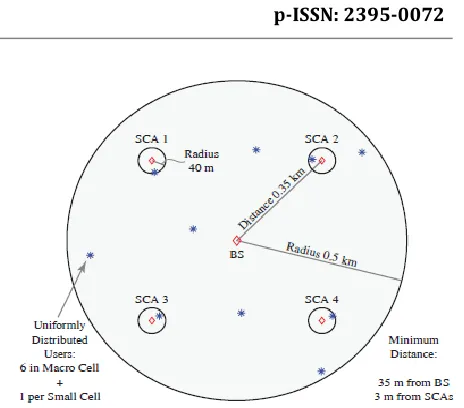
We consider a single-cell downlink scenario where a macro BS equipped with NBS antennas should deliver information to K single-antenna users. In addition, there are S > 0 SCAs that form an overlay layer and are arbitrarily deployed. The SCAs are equipped with NSCA antennas each, typically 1 < NSCA, < 4, and characterized by strict power constraints that limit their coverage area (see below). In comparison, the BS has generous power constraints that can support high QoS targets in a large coverage area. The number of antennas, NBS, is anything from 8 to several hundred the latter means that NBS >>K and is known as massive MIMO. This scenario is illustrated in Fig. 2.
The channels to user k are modeled as block fading. We consider a single flat-fading subcarrier where the channels are represented in the baseband by a & for the BS and jth SCA, respectively. These are
assumed to be perfectly known at both sides of each channel; extensions with robustness to channel uncertainty can be obtained as in [8]. The received signal at user k
where x0 , xj are the transmitted signals at the BS and jth
SCA, respectively. The term is the circularly symmetric complex Gaussian receiver noise with zero-mean and variance , measured in mill watt (mW).
The BS and SCAs are connected to a backhaul network that enables joint spatial soft-cell resource allocation but only linear non-coherent transmissions; that is, each user can be served by multiple transmitters but the information symbols will be coded and emitted independently. We call it spatial multiflow transmission [9] and it enables users barely covered by a SCA to receive extra signals from the BS or other SCAs.
© 2019, IRJET | Impact Factor value: 7.211 | ISO 9001:2008 Certified Journal
| Page 4390
The information symbols from the BS and the jth SCA touser k are denoted xk,0 and xk,j , respectively, and originate
from independent Gaussian codebooks with unit power (in mW); that is, xk,j ~ CN(0; 1) for j = 0,….,S. These symbols are
multiplied with the beamforming vectors wk,0=CNbs*1 and Wk,j
( CNSCA*1 to obtain the transmitted signals
The beamforming vectors are the optimization variables in this paper. Note that wk;j 6= 0 only for transmitters j that serve user k. This transmitter assignment is obtain automatically and optimally from the optimization problem solved herein.
3) LOW COMPLEXITY ALGORITHM FOR RESOURCE ALLOCATION:
[image:4.612.335.567.64.268.2]This complexity is relatively modest, but the algorithm becomes infeasible for real-time implementation when NBS and S grow large. In addition, Theorem 1 provides a centralized algorithm that requires all channel knowledge to be gathered at the BS Theorem 1 should be seen as the ultimate benchmark when evaluating low-complexity algorithm.
Fig. 3. The single-cell scenario analyzed in Section IV. The BS and SCAs are fixed, while the 10 users are randomly distributed as described above
This algorithm applies the heuristic RZF beamforming (see e.g., [2]) to transform (7) into the power allocation problem which has the same low complexity irrespectively of the number of antennas. The algorithm is non-iterative, but some scalar parameters are exchanged between the BS and SCAs to enable coordination. In practice, only users in the vicinity of an SCA are affected by it, thus only a few parameters are exchanged per SCA while all other parameters are set to zero.
4) SPECTRUM ANALYSIS USING IDMA, OFDMA:
[image:4.612.330.566.551.694.2]Due to its good performance and low complexity, IDMA is believed to be an important technique for future radio access (FRA). However, its performances are highly affected by the interleaver design. In this paper we propose two contributions to improve the performance of the IDMA. First, we propose a new interleaver design, called "NLM interleaver", which improves the computational complexity, reduces the bandwidth consumption and the memory requirements of the system.
© 2019, IRJET | Impact Factor value: 7.211 | ISO 9001:2008 Certified Journal
| Page 4391
It also provides infinite sets and quasi-orthogonal spreadingcodes and interleavers based on only one parameter. Second, we propose a new user grouping algorithm based on the correlation function to improve the resources (codes and interleavers). In fact, all users are divided into several equal-size groups where each group's data are transmitted at the same time, with the same frequencies and the same interleaver. The simulation results indicate that the proposed scheme achieves better performances compared to the existing algorithms. Various multiple access techniques are proposed to satisfy 4G requirements. Among these techniques, we can find MCCDMA (Multicarrier-CDMA), OFDMA (Orthogonal FDMA), SC-FDMA (Single Carrier FDMA), and IDMA (Interleave Division Multiple Access). They deliver high data rates transmission and reliable coverage for broadband wireless access with high efficiency (6)
Benefits of IDMA:
Interleaving in IDMA does not incur rate loss, but spreading in CDMA incurs rate loss.The optimal approach is to consider two constraints jointly. A sub-optimal approach is to handle one constraint at a time using an iterative process. Complexity: 6 additions and 6 multiplications per chip per iteration per user. Complexity (per user) is independent of user number K. Comparison: To achieve good performance, the cost for MMSE -CDMA multi-user detection is O(K2) due to matrix operations.
[image:5.612.316.569.275.617.2]5) MASSIVE MIMO ANTENNA MODEL ANALYSIS:
Fig:5 Microtik-SXT-Board View
This RouterBOARD model has a built-in 802.11a/n 5GHz wireless device based on the AR9280 Atheros chipset. It doesn't support turbo mode. There is no antenna connector, as the wireless part is directly connected to the built-in antenna. The SXT 5HnD has a built in dual polarization PCB type antenna... SXT is a low cost, high speed MIMO 5GHz outdoor wireless device, available as a High Power or Lite version. SXT Lite5 provides the best price-performance ratio on the Wireless CPE market. Unit is equipped with powerful 600MHz CPU, 64MB RAM, 16dBi dual polarization antenna, poe, power supply and mounting kit. SXT-5HPnDr2 is the high power version (30dBm TX power).
Antenna Specifications:
IV. NUMERICAL EVALUATION AND SIMULATION RESULTS:
ENERGY EFFICIENCY SIMULATION :
[image:5.612.40.291.471.706.2]© 2019, IRJET | Impact Factor value: 7.211 | ISO 9001:2008 Certified Journal
| Page 4392
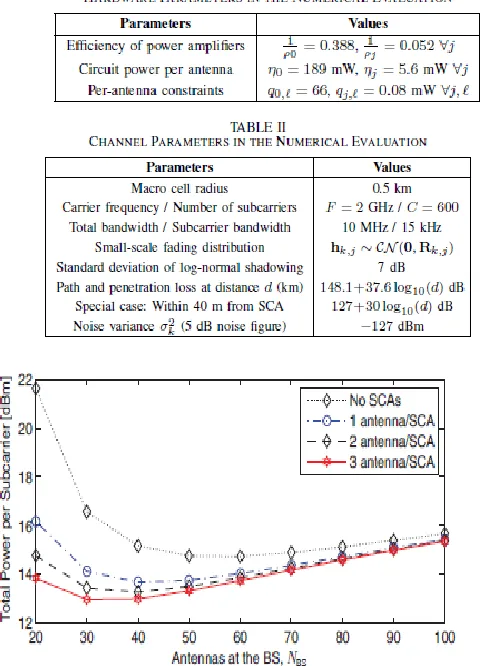
antennas at the BS and SCAs: NBS belongs to {20; 30; : : : ;100}
Fig. 6. Average total power consumption in the scenario of Fig. 3. Weconsider different NBS and NSCA, while the QoS constraints are 2 bits/s/Hz.
.
Fig. 5. Average total power consumption in the scenario of Fig. 3 with NBS = 50 and NSCA = 2. We consider different QoS constraints and beamforming.
As in the previous figure, we observe great improvements in energy efficiency by offloading users to the SCAs. The proposed Multiflow-RZF beamforming gives promising results for practical applications, because a majority of the energy efficiency improvements is achievable by judicious low-complexity beamforming techniques.
[image:6.612.40.280.151.484.2]BER COMPARISION USING IDMA Interleaver:
Fig:6 BER Performance comparison of NLM interleaver and Random Interleaver in IDMA system without grouping
Fig:7. BER Performance comparison between G-CDMAIDMA, SCMA, OFDMA, and SC-FDMA
V. CONCLUSION:
[image:6.612.330.566.239.409.2]© 2019, IRJET | Impact Factor value: 7.211 | ISO 9001:2008 Certified Journal
| Page 4393
can be improved by employing massive MIMO at the BSs oroverlaying current infrastructure by a layer of SCAs. This paper analyzed acombination of these concepts based on soft-cell coordination, where each user can be served by non-coherent beamforming from multiple transmitters, Spectrum Analysing using IDMA interleaver Scheme. We proved that the power minimizing spatial multiflow transmission under QoS constraints is achieved by solving a convex optimization problem and BER Comparision of the 5G with IDMA Method.Finally We analyse the overall Performance Parameters with promising simulation results and also sample Massive MIMO antenna was Analyzed with various frequency Levels and various Traffic Data rates.
VI.FUTURE REASEARCH CHALLANGES
After having reviewed the state-of-the-art of the main 5G energy-efficient techniques, a natural question is: what are the next steps to be taken towards an energy efficient 5G? We review some of them in the following.
A. The need for a holistic approach:
A holistic approach is thus necessary, in which all energy-efficient techniques are combined. Indeed, as previously discussed, some works in this special issue go in this direction combining multiple energy-efficient techniques together.
B. Dealing with interference:
Unfortunately, 5G networks will be interference-limited, since orthogonal transmission schemes and/or linear interference neutralization techniques are not practical due to the massive amount of nodes to be served. Thus, the potentialities of fractional programming must be extended. A promising answer is represented by the framework of sequential fractional programming, which provides a systematic approach to extend fractional programming to interference-limited networks with affordable complexity
C. Dealing with randomness:
A second approach lies in the use of learning techniques, which deal with randomness by letting the devices learn from past observations of their surroundings and respond as appropriate in a self-organizing fashion. However, also in this case, very little research effort has been directed towards understanding the impact of this technique on energy-efficient network design.
D. Emerging techniques and new energy models:
In addition, new emerging technologies can also be used for energy-efficient purposes. In particular, caching and mobile computing have shown significant potential as far as
reducing energy consumption is concerned. By an intelligent distribution of frequently accessed content over the network nodes, caching alleviates the need for backhaul transmissions, which results in relevant energy consumption reductions..
VII.REFERENCES
[1] A Survey of Energy-Efficient Techniques for 5G Networks and Challenges Ahead Stefano Buzzi, Senior Member, IEEE, Chih-Lin I, Senior Member, IEEE, Thierry E. Klein, Member, IEEE, H. Vincent Poor, Fellow, IEEE, Chenyang Yang, Senior Member, IEEE, and Alessio Zappone, Member, IEEE.
[2] Optimization-in-the-Loop for Energy-Efficient 5G F. Malandrino_, C. Casetti_, C.-F. Chiasserini_, G. Landiy .
[3] An Energy-Efficient User-Centric Approach High-Capacity 5G Heterogeneous Cellular Networks Abdulziz M. Ghaleb, Ali Mohammed Mansoor and Rodina Ahmad
Dep. of Software Engineering.
4] Massive MIMO and Small Cells: Improving Energy Efficiency by Optimal Soft-Cell Coordination Emil Bj¨ornson_y, Marios Kountourisz, and M´erouane Debbah_Alcatel-Lucent Chair on Flexible Radio, SUPELEC, Gif-sur-Yvette, France
[5] International Journal of Communication Networks and Information Security (IJCNIS) Vol. 7, No. 3, December 2015 Improved IDMA for Multiple Access of 5G Brahim Akbil, Driss About ajdine LRIT Laboratory,
[6] 27 Jan 2017 | 19:00 GMT Everything You Need to Know About 5G Millimeter waves, massive MIMO, full duplex, beamforming, and small cells are just a few of the technology could enable ultrafast 5G networks By Amy Nordrum, Kristen Clark and IEEE Spectrum Staff
[7] Configure RouterOS according to the manual: http://wiki.mikrotik.com/wiki/Category:Manual.
[8] Interleave Division Multiple Access (IDMA) Lihai Liu, Raymond Leung and Li Ping Department of Electronic and EngineeringCity University of Hong Kong
[9] GreenTouch Foundation, “Reducing the net energy consumption in communications networks by up to 98% by 2020,” Tech. Rep., 2015.
[10] D. J. Goodman and N. B. Mandayam, “Power control for wireless data,” IEEE Personal Communications, vol. 7, pp. 48–54, 2000.
[11] C. U. Saraydar, N. B. Mandayam, and D. J. Goodman, “Pricing and power control in a multicell wireless data network,” IEEE Journal on Selected Areas in Communications, vol. 19, no. 10, pp. 1883–1892, October 2001.
© 2019, IRJET | Impact Factor value: 7.211 | ISO 9001:2008 Certified Journal
| Page 4394
Transactions on Communications, vol. 53, no. 11, pp. 1885–1894, November 2005.
[13] A. Zappone and E. Jorswieck, “Energy efficiency in wireless networks via fractional programming theory,” Foundations and Trends in Communications and Information Theory, vol. 11, no. 3-4, pp. 185–396, 2015.
[14] Z. Niu, Y. Wu, J. Gong, and Z. Yang, “Cell zooming for cost-efficient green cellular networks,” IEEE Communications Magazine, vol. 48, no. 11, pp. 74–79, November 2010.
[15] E. Oh, K. Son, and B. Krishnamachari, “Dynamic base station switching-on/off strategies for green cellular networks,” IEEE Transactions on Wireless Communications, vol. 12, no. 5, pp. 2126–2136, 2013.
[16] C. Han, T. Harrold, S. Armour, I. Krikidis, S. Videv, P. M. Grant, H. Haas, J. S. Thompson, I. Ku, C.-X. Wang et al., “Green radio: radio techniques to enable energy-efficient wireless networks,” IEEE Communications Magazine, vol. 49, no. 6, pp. 46–54, 2011.
[17] P. Rost, C. Bernardos, A. Domenico, M. Girolamo, M. Lalam, A. Maeder, D. Sabella, and D. W¨ubben, “Cloud technologies for flexible 5G radio access networks,” IEEE Communications Magazine, vol. 52, no. 5, pp. 68–76, 2014.
[18] C. Isheden, Z. Chong, E. A. Jorswieck, and G. Fettweis, “Framework for link-level energy efficiency optimization with informed transmitter,” IEEE Transactions on Wireless Communications, vol. 11, no. 8, pp. 2946–2957, August 2012.
[19] F. R. Yu, X. Zhang, and V. C. Leung, Green Communications and Networking. CRC Press, 2012.
[20] E. Hossain, V. K. Bhargava, and G. Fettweis, Eds., Green Radio Communication Networks. Cambridge University Press, 2012.
[21] G. Miao, N. Himayat, G. Y. Li, and S. Talwar, “Distributed interference aware energy-efficient power optimization,” IEEE Transactions on Wireless Communications, vol. 10, no. 4, pp. 1323–1333, April 2011.
[22] D. W. K. Ng, E. S. Lo, and R. Schober, “Energy-efficient resource allocation in multi-cell OFDMA systems with limited backhaul capacity,”
IEEE Transactions on Wireless Communications, vol. 11, no. 10, pp. 3618–3631, October 2012.
[23] L. Venturino, A. Zappone, C. Risi, and S. Buzzi, “Energy-efficient scheduling and power allocation in downlink OFDMA networks with base station coordination,” IEEE Transactions on Wireless Communications, vol. 14, no. 1, pp. 1–14, January 2015.
[24] J. Xu and L. Qiu, “Energy efficiency optimization for MIMO broadcast channels,” IEEE Transactions on Wireless Communications, vol. 12, no. 2, pp. 690–701, February 2013.
[25] A. Zappone, P. Cao, and E. A. Jorswieck, “Energy efficiency optimization in relay-assisted MIMO systems with
perfect and statistical CSI,” IEEE Transactions on Signal Processing, vol. 62, no. 2, pp. 443–457, January 2014.
[26] O. Onireti, F. Heliot, and M. A. Imran, “On the energy efficiency spectral efficiency trade-off of distributed MIMO systems,” IEEE Transactions on Communications, vol. 61, no. 9, pp. 3741–3753, September 2013.
[27] K. T. K. Cheung, S. Yang, and L. Hanzo, “Achieving maximum energy efficiency in multi-relay OFDMA cellular networks: A fractional programming approach,” IEEE Transactions on Communications, vol. 61, no. 7, pp. 2746– 2757, 2013.
[28] C. Sun and C. Yang, “Energy efficiency analysis of one-way and two way relay systems,” EURASIP Journal on Wireless Communications and Networking, pp. 1–18, February 2012.
[29] B. Matthiesen, A. Zappone, and E. A. Jorswieck, “Design of 3-way relay channels for throughput and energy efficiency,” IEEE Transactions
on Wireless Communications, vol. 14, no. 8, pp. 4454 4468, August 2014.
[30] Y. Wang, W. Xu, K. Yang, and J. Lin, “Optimal energy-efficient power allocation for OFDM-based cognitive radio networks,” IEEE Communications Letters, vol. 16, no. 9, pp. 1420–1423, 2012.
[31] F. Rusek, D. Persson, B. Lau, E. Larsson, T. Marzetta, O. Edfors, and F. Tufvesson, “Scaling up MIMO: Opportunities and challenges with very large arrays,” IEEE Signal Process. Mag., vol. 30, no. 1, pp. 40– 60, 2013.
[32] J. Hoydis, S. ten Brink, and M. Debbah, “Massive MIMO in the UL/DL of cellular networks: How many antennas do we need?” IEEE J. Sel. Areas Commun., vol. 31, no. 2, pp. 160–171, 2013.
[33] S. Parkvall, E. Dahlman, G. J¨ongren, S. Landstr¨om, and L. Lindbom, “Heterogeneous network deployments in LTE – the soft-cell approach,” Ericsson Review, no. 2, 2011.
[34] J. Hoydis, M. Kobayashi, and M. Debbah, “Green small-cell networks,” IEEE Veh. Technol. Mag., vol. 6, no. 1, pp. 37–43, 2011.
[35] S. Cui, A. Goldsmith, and A. Bahai, “Energy-constrained modulation optimization,” IEEE Trans. Wireless Commun., vol. 4, no. 5, pp. 2349– 2360, 2005. [36] G. Auer and et al., D2.3: Energy efficiency analysis of the reference systems, areas of improvements and target breakdown. INFSO-ICT- 247733 EARTH, ver. 2.0, 2012.
[37] D. Ng, E. Lo, and R. Schober, “Energy-efficient resource allocation in OFDMA systems with large numbers of base station antennas,” IEEE Trans. Wireless Commun., vol. 11, no. 9, pp. 3292–3304, 2012.
© 2019, IRJET | Impact Factor value: 7.211 | ISO 9001:2008 Certified Journal
| Page 4395
[39] H. Holma and A. Toskala, LTE Advanced: 3GPPSolution for IMTAdvanced, 1st ed. Wiley, 2012.
[40] E. Bj¨ornson, N. Jald´en, M. Bengtsson, and B. Ottersten, “Optimality properties, distributed strategies, and measurement-based evaluation of coordinated multicell OFDMA transmission,” IEEE Trans. Signal Process., vol. 59, no. 12, pp. 6086–6101, 2011.
[41] R. Kumar and J. Gurugubelli, “How green the LTE technology can be?” in Proc. Wireless VITAE, 2011.
[42] M. Bengtsson and B. Ottersten, “Optimal and suboptimal transmit beamforming,” in Handbook of Antennas in Wireless Communications, L. C. Godara, Ed. CRC Press, 2001.
![Table I characterize the power consumption and is based on [6, Table 7] and [11]. Table II for all channel model parameters](https://thumb-us.123doks.com/thumbv2/123dok_us/9336313.435663/5.612.40.291.471.706/table-characterize-power-consumption-table-table-channel-parameters.webp)