warwick.ac.uk/lib-publications
Manuscript version: Author’s Accepted ManuscriptThe version presented in WRAP is the author’s accepted manuscript and may differ from the published version or Version of Record.
Persistent WRAP URL:
http://wrap.warwick.ac.uk/110778
How to cite:
Please refer to published version for the most recent bibliographic citation information. If a published version is known of, the repository item page linked to above, will contain details on accessing it.
Copyright and reuse:
The Warwick Research Archive Portal (WRAP) makes this work by researchers of the University of Warwick available open access under the following conditions.
© 2018 Elsevier. Licensed under the Creative Commons Attribution-NonCommercial-NoDerivatives 4.0 International http://creativecommons.org/licenses/by-nc-nd/4.0/.
Publisher’s statement:
Please refer to the repository item page, publisher’s statement section, for further information.
1 Wolf howls encode both sender- and context-specific information
1
Stuart K Watson1 *, Simon W Townsend1,2,3 * and Friederike Range4,5
2
3
1Department of Comparative Linguistics, University of Zurich, Zurich, Switzerland
4
2 Department of Psychology, University of Warwick, Warwick, U.K.
5
3 Institute of Evolutionary Biology and Environmental Studies, University of Zurich, Zurich,
6
Switzerland 7
4 Wolf Science Center, Domestication Lab, Konrad Lorenz Institute of Ethology, University
8
of Veterinary Medicine Vienna, Savoyenstraße 1a, A-1160 Vienna, Austria 9
5 Comparative Cognition Unit, Messerli Research Institute, University of Veterinary
10
Medicine Vienna, Medical University of Vienna and University of Vienna, Vienna, Austria 11
12 13 14
Received 11 December 2017 15
Initial acceptance 21 February 2018 16
Final acceptance 15 August 2018 17
MS number 17-00974R 18
19
*Joint first author 20
21
Correspondence: S. K. Watson and S. W. Townsend, Department of Comparative 22
Linguistics, Plattenstrasse 54, CH-8032 Zürich, Switzerland. 23
E-mail address: [email protected] (S. K. Watson), [email protected] (S. W. 24
Townsend) 25
26
27
2 Abstract
29
Loud, long-distance calls serve varied functions across animal species including marking 30
territory, attracting mates and signalling one´s identity. Here, we examined the types of sender- 31
and context-specific information encoded in the howls of captive timber wolves, Canis lupus. 32
We analysed 913 howls from nine individuals across three packs and investigated whether 33
howl structure varied consistently as a function of phenotypic factors (age class, sex, pack and 34
identity of the caller) in addition to the context in which the call was produced: specifically, 35
whether the call was produced in a ‘spontaneous’ context just after sunrise or was ‘elicited’ by 36
the absence of a group member. Calls were correctly classified by individual identity and 37
production context, but not by any other factors. Principal components analyses indicated that 38
individual differences were primarily associated with frequency-based measures, whereas 39
acoustic variation between production contexts was associated with a variety of frequency-, 40
intensity- and energy-based measures. Recognition of individual differences in vocalizations 41
is likely to be important for navigating social relationships in wolves and further work is 42
required to determine which life history factors may shape these individual differences. 43
Differences resulting from production context are suggestive that these howl variants may 44
serve different functions. The extent to which these individual and contextual differences are 45
understood by receivers remains an open question. 46
3 Given their often obvious and striking nature, the long-distance vocalizations of animals have 48
received considerable empirical research interest over the years (Hauser, 1996; Bradbury & 49
Vehrencamp, 1998; Gustison & Townsend, 2015). From the infrasonic rumbles of African 50
elephants, Loxodonta africana, to the songs of whales or birds, long-distance or ‘loud calls’ 51
have been shown to serve a range of mating and territorial functions. For example, the loud 52
calls of gibbons (Hylobytes spp.) play a role in negotiating and advertising territory among 53
male–female pairs (Geissman, 2002), while the songs of many bird species are important in 54
attracting females and even stimulating ovulation (Catchpole & Slater, 2003). The loud calls 55
of social mammals, such as lions, Panthero leo, and chimpanzees, Pan troglodytes, have also 56
been shown to serve multiple adaptive functions, such as signalling territories while 57
maintaining contact and mediating cohesion with group members (Grinnell & McComb, 2001; 58
Notman & Rendall, 2005). Analysis of the acoustic structure of these vocalizations and 59
subsequent playbacks have helped shed further light on how exactly these calls have their 60
effects. For example, the loud roars of red deer, Cervus elaphus, have long been known to 61
represent sexually selected signals, being produced more frequently during the rutting or 62
mating season (Clutton-Brock & Albon, 1979). Through applying a source-filter framework to 63
the analysis of their roars it has additionally been shown that honest, accurate information on 64
body size is cued through filter-related acoustic parameters, or formants, with larger males 65
having more dispersed formant frequencies in their roars (Fitch & Reby, 2001). What is more, 66
both males and females attend to this information and use it to modify their mating/fighting-67
based decisions with males avoiding and females approaching larger-sounding roars (Reby et 68
al., 2003, Charlton et al., 2007). 69
A number of studies have now shown that long-distance vocalizations have the 70
potential to cue an array of sender-specific, phenotypic information including the caller’s 71
4 chacma baboons, Papio ursinus: Fischer, Hammerschmidt, Cheney & Seyfarth, 2001; 73
Dolphins: Sayigh et al., 2007; chickens, Gallus gallus domesticus: Kent, 1987; meerkats, 74
Suricata suricatta: Townsend & Manser, 2011), sex (Rendall et al., 2004; Charlton et al., 75
2009b), age (Charlton et al., 2009b) and group membership (Vehrencamp et al., 2003; 76
Crockford et al., 2004). In addition to this, some species also encode more dynamic 77
motivational, behavioural and/or contextual information in their loud calls. Encoding of 78
contextual information in animal vocalizations, such as black-capped chickadees, Poecile 79
atricapillus, expressing information about the size of a predator in their alarm calls (Templeton, 80
Greene & Davis, 2005), has received considerable research attention over the years, partly due 81
to its ostensible similarity to the highly context-specific nature of human language and the 82
potential implications for understanding its evolutionary origins (Townsend & Manser, 2013; 83
cf. Wheeler & Fischer, 2012). Furthermore, the capacity for both sender- and context-specific 84
information to be encoded in a single call type has additionally been demonstrated (Briefer, 85
Vannoni & McElligott, 2010; Cornec et al., 2015; Lemasson et al., 2009; Theis et al., 2007; 86
Volodin et al., 2016). For example, male giant pandas, Ailuropoda melanoleuca, dynamically 87
modulate the fundamental frequency (rate of vocal-fold vibration in the larynx) of their bleats 88
to reflect their motivational state, increasing it when alone in order to broadcast their quality to 89
potential mates (Charlton et al., 2015), whereas other acoustic features signal the size and sex 90
of the individual (Charlton et al., 2009a). Indeed, the multi-encoding of static and dynamic 91
features in a single call may, alongside sequentially combining vocalizations (e.g. Outtarra, 92
Lemasson & Zuberbuhler, 2009), represent an additional mechanism by which animals can 93
maximize the expressive power of a limited vocal repertoire (Manser, Seyfarth & Cheney, 94
2002). Here, we follow up existing work investigating whether this capacity is present in howls, 95
5 As with other social mammal loud calls, wolf howls are thought to function to mediate 97
spacing within their groups (Mech & Boitani, 2010; Mazinni et al., 2013). This is likely to 98
facilitate contact not only between separated group members but also between groups (Mech 99
& Boitani, 2010, Zaccaroni et al., 2012; Nowak et al., 2007). Recent research has begun to 100
shed light on the proximate mechanisms by which these effects come about, demonstrating, for 101
example, that the acoustic structure of howls can be used to accurately predict individuality 102
(Palacios et al., 2007; Root-Gutteridge et al., 2014) and group membership (Zaccaroni et al., 103
2012). Interestingly, previous work has also suggested that wolves produce howls in subtly 104
different contexts: howls occur at increased rates spontaneously after sunrise (Gazzola et al., 105
2002; Harrington & Mech, 1982) and when faced with the temporary absence of group 106
members (hereafter ‘elicited’ howls), both in the wild (Mech & Boitani, 2010; Nowak et al., 107
2007) and in captivity (Mazzini et al., 2013). Furthermore, individuals have also been shown 108
to howl more often when separated from closely affiliated individuals (Mazzini et al., 2013). 109
However, until now it was unknown whether calls produced in these different contexts also 110
systematically differ in their acoustic structure. We therefore extended this body of work using 111
a substantial data set to investigate whether, in addition to more static, individual-specific 112
information types, wolf howls can also encode external, context-specific information. 113
Specifically, we examined the influence of various phenotypic attributes of callers and 114
accompanying behavioural contexts on the acoustic structure of timber wolf howls. In line with 115
the findings discussed above, we investigated the extent to which howls vary between 116
individuals (Palacios et al., 2007; Root-Gutteridge et al., 2014) and packs (Mech & Boitani, 117
2010; Zaccaroni et al., 2012). Furthermore, in light of the consistent differences in size between 118
the sexes (females are on average a third smaller than males, MacNulty et al, 2009) and the 119
impact this has on vocal tract anatomy (Taylor & Reby, 2010), we expected to find sex-specific 120
6 of adult (24+ months) individuals would differ from those of juveniles (5–24 months) due to 122
differences in size resulting from maturation. Regarding context, we determined whether howls 123
produced in a spontaneous (just after sunrise) or elicited (by the temporary absence of a pack 124
mate taken for a walk by care staff) context were acoustically distinct from one another. 125
126
Methods 127
Study Site and Subjects 128
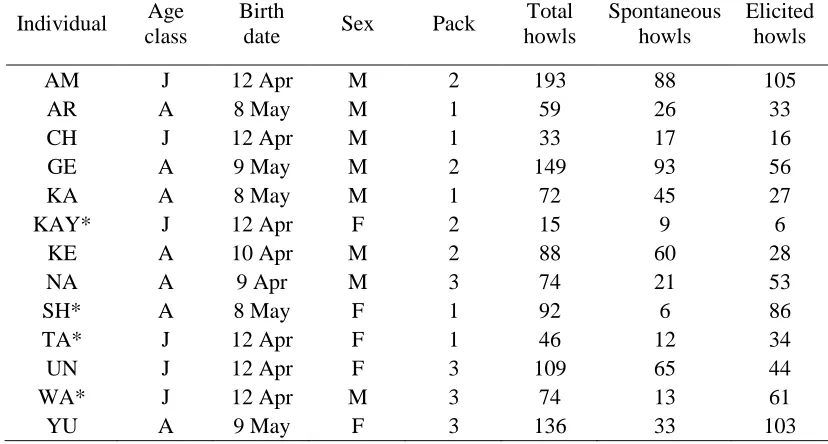
All howls were recorded at the Wolf Science Center (WSC) in Ernstbrunn, Austria. Thirteen 129
wolves, kept in three different packs, were subject to behavioural observations and acoustic 130
recording (Table 1). All individuals were born in captivity from lineages originating in North 131
America but came from different locations in North America and Europe. All were hand-raised 132
in peer groups at the Wolf Science Center after being separated from their mothers in the first 133
10 days after birth (for details see Range & Viranyi, 2014). Puppies were bottle-fed and, after 134
3–4 weeks, hand-fed with solid food. All individuals had continuous access to humans for the 135
first 5 months of their life. After 5 months, the wolves were integrated into established packs 136
of the previous generations. We broadly defined two age categories in line with accepted 137
definitions from the literature (Mech & Boitani, 2010). Adults were classified as individuals 138
that were at least 2 years of age. Juveniles were classified as individuals that were between 5 139
months and 2 years of age. The wolves participated in training and/or cognitive and behavioural 140
experiments at least once a day and, hence, still had frequent social contact with humans (Range 141
& Viranyi, 2011). The enclosures of each of the three packs range over 4000–8000 m2. They 142
are equipped with trees, bushes, logs and shelters and water for drinking is permanently 143
available. The wolves receive a diet of meat and dry food. All raising and keeping procedures 144
of wolves at the Wolf Science Center are in line with the animal protection law in Austria 145
7 such sociocognitive studies is required in Austria. The relevant committee that allows research 147
on animals without special permission is Tierversuchskommission am Bundesministerium für 148
Wissenschaft und Forschung (Austria). 149
150
Data Collection 151
Wolf howls were recorded with a directional microphone (ME66/K6 and a MZW66 pro 152
windscreen, frequency response 40–20 000 Hz ± 2.5 dB; Sennheiser, Old Lyme, CT, U.S.A.) 153
attached to a solid-state recorder (Marantz PMD 661), sampled at a frequency of 44.1 kHz. 154
All howls were recorded at a distance of 1–10 m. Comments by the observer documenting 155
the howling individual or the context were simultaneously recorded with a second speaker 156
microphone (Sony FV100). Given that wild and captive observations both suggest that 157
howling is most intense between mid-summer and mid-spring (Joslin, 1967; Harrington & 158
Mech, 1982; Gazzola et al., 2002; Nowak et al., 2007) all recordings were performed over 159
this period (June 2012–March 2013). Specifically, howl recordings were conducted during 160
two different observational contexts to assess whether there were acoustic differences 161
between the calls: (1) morning sessions which started at dawn and ended 2 h later (hereafter 162
‘spontaneous’ calls) and (2) leash walk sessions which took place each week and involved 163
several individuals from the different packs being leash walked by an animal trainer at the 164
WSC (hereafter ‘elicited’ calls). Morning recording sessions were performed on at least 5 165
days of the week. Leash walk recording sessions were performed as and when they were 166
scheduled at the WSC, resulting in approximately three to four sessions per week. The 167
remaining individuals in the enclosure were observed and all howls recorded, beginning when 168
the individual on the walk was out of visual contact with the pack and ending when it returned. 169
8 Acoustic analysis
171
Recorded howls were uploaded from a solid-state recorder (Marantz PMD 661) to a PC 172
notebook (IBM T41–Intel Centrino). All sound files were visually and audibly assessed to 173
identify and select single howls with a high signal to noise ratio for analysis (see Fig. 1). Only 174
howls that did not occur as part of a chorus were used for analysis since it was not possible to 175
extract acoustic measures from overlapping calls. Ongoing work is investigating how the 176
acoustic features of chorus howls and single howls vary. From these selected howls, a number 177
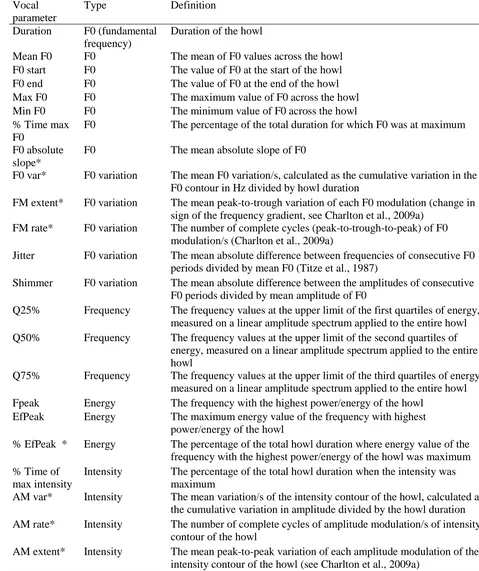
of spectral and temporal acoustic parameters were extracted (see Table 2) using a custom-built 178
script in Praat (version 5.5.53, praat.org, Reby & McComb, 2003). Source-related vocal 179
parameters were measured by extracting the fundamental frequency (F0) contour of each call 180
using a cross-correlation method ([Sound: To Pitch (cc) command] time step = 0.005 s, pitch 181
floor = 20 Hz, pitch ceiling = 1200 Hz). To check whether the F0 contour was accurately 182
tracked by Praat, the extracted F0 contour was visually compared to the F0 contour visualized 183
in the spectrogram (e.g. Fig. 1). To filter out background noise, frequencies from 0 to 150 Hz 184
were filtered from each howl, as all howls in a random sample of 30 howls had a minimum F0 185
of over 200 Hz. When inspecting analysis outputs, we noted sporadically high F0 measures. 186
Detailed visual inspection of these calls indicated this was also due to miscellaneous 187
background noise (e.g. birdsong) in higher frequency ranges. The exception to this was 188
individual ‘YU’ who genuinely produced high-pitched howls. Consequently, for all other 189
individuals we applied a filter that constrained F0 measures to a maximum of 1200 Hz. For 190
147 of the 913 calls analysed, the automated script was unable to extract a measure for peak 191
frequency. Visual inspection of a subset of these howls suggested no obvious signal to noise 192
ratio issues with the recordings. Hence, to avoid having to exclude these from the final analyses, 193
we manually extracted peak frequency from the calls (by examining a spectral slice of the 194
9 of the behavioural contexts than acoustic measurements were used for analysis (N = 15). 196
Consequently, these individuals were excluded from the analysis reported here (Mundry & 197
Sommer, 2007). Interobserver reliability was carried out by running identical acoustic analyses 198
on a random selection of calls (N = 20). We found strong interobserver reliability, with an 199
agreement of over 90%. 200
201
Statistical analysis 202
All acoustic parameters were initially assessed for multicollinearity to obtain a set of 203
uncorrelated acoustic parameters. Multicollinearity is known to misleadingly inflate the 204
standard errors of tested coefficients (Graham, 2003; Farrar & Robert, 1967). Q–Q plots were 205
used to assess whether the data were normally distributed. For variables that were not normally 206
distributed and could be improved by a log transformation, this was carried out. Other variables 207
were not transformed. Variables with a variance inflation factor (VIF) greater than 10 were 208
excluded from all analyses (Table 2). 209
To test whether the acoustic structure of single howls predictably differed between 210
different classes of phenotypic factors (age class, ID, sex, pack membership) and between call 211
production contexts, we used permuted discriminant function analyses (pDFA) with 1000 212
permutations (Mundry & Sommer, 2007). This was a necessary alternative to conventional 213
DFA allowing us to control for the statistical conflict of using multiple data points per 214
individual and estimate the significance of the number of correctly cross-validated single 215
howls. A further advantage of the pDFA method is that it can handle unbalanced data sets, as 216
is the case here, where there are different numbers of data points per factor level. When the 217
individuals included in a specific data set contributed to only one class of the tested phenotypic 218
factor (pack membership) a nested pDFA was performed. For data sets where all individuals 219
10 pDFA was performed (Mundry & Sommer, 2007). In nested pDFAs where one of the levels of 221
a test factor is nested within levels of another factor, it is possible to classify this as a restriction 222
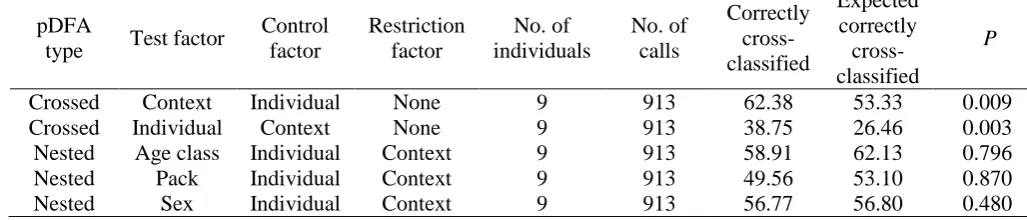
factor, causing permutations to only take place within that factor. Table 3 shows how each 223
model was specified and the type of test used. Since preliminary work suggested an influence 224
of context on howl structure (Hegland, 2014), where applicable, context of call production 225
(spontaneous versus elicited) was used as a restriction factor. Where pDFAs reported 226
statistically significant levels of call discrimination, we explored which acoustic factors 227
contribute towards this by using principal components analyses (PCA). We retained principal 228
components with eigenvalues greater than one (Kaiser’s criterion) and factors were interpreted 229
as loading highly if they had a correlation coefficient greater than 0.4 with the corresponding 230
principal component (Budaev, 2010). For examining context-based differences, we then fitted 231
a generalized linear mixed-effects model (GLMM) with each of the principal components as 232
fixed effects, individual as a random effect and production context as the outcome variable. 233
The purpose of this GLMM was to determine which principal components varied significantly 234
between production contexts, and accordingly which corresponding factors were likely to 235
contribute towards context-based discrimination of howls. 236
All statistical analyses were conducted in R version 3.42 (R Development Core Team, 237
2011) with RStudio v. 1.1.383, using the software package ‘MASS’ (Ripley et al. 2013). Scripts 238
for carrying out pDFAs were provided by R. Mundry. All R scripts and data used to run this 239
analysis are located at www.osf.io/5ptxf/ 240
241
Results 242
We analysed 913 single howls from nine different individuals over a period of 10 243
months. Of these howls, 448 were recorded during morning observation sessions (spontaneous 244
11 wolf as well as their sex, age class and the pack membership are listed in Table 1. The pDFAs 246
found that calls could be correctly categorized at significantly above chance level by individual 247
identity (correct: 38.75%; expected: 26.46; P = 0.003) and context of call production (correct: 248
62.38%; expected: 53.33; P = 0.009), but not by age class, pack or sex (see Table 3). Because 249
one individual (‘YU’) was well known at the study site for producing atypical howls at a very 250
high frequency, we wanted to be sure that this individual was not driving our pDFAs’ ability 251
to discriminate between individuals. Consequently, we reran the identity and context pDFAs 252
without including howls from this individual but found that it was still able to correctly classify 253
howls at above chance level (identity: correct: 30.5%; expected: 21.2%; P = 0.011; context: 254
correct: 59.6%; expected: 52.5%; P = 0.006). Because there was no significant effect of age 255
class upon howl acoustic structure, adult and juvenile calls were pooled for all other analyses. 256
To determine which variables contributed most towards individual differences in 257
howls, we took the median of each acoustic measure for each individual and conducted a PCA 258
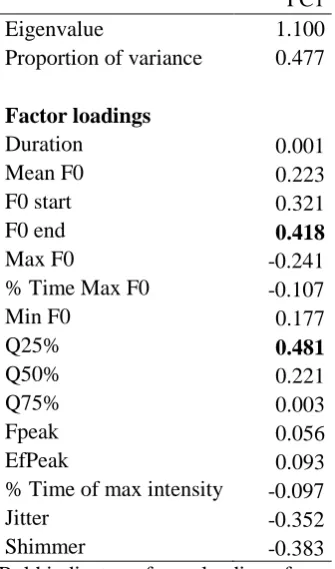
on these data. The PCA produced nine principal components, the first of which had an 259
eigenvalue greater than one, accounting for 47.7% of the variance (Table 4). 260
To examine which acoustic variables contributed towards discrimination between 261
spontaneous and elicited contexts, we ran a PCA on the data used by the corresponding pDFA. 262
This resulted in 15 principal components, the first six of which had eigenvalues greater than 263
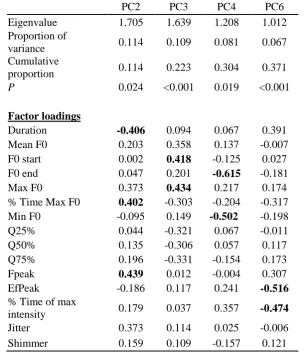
one and which cumulatively explained 70% of the variance. A GLMM determined that, of 264
these six principal components, PC2, PC3, PC4 and PC6 varied significantly between elicited 265
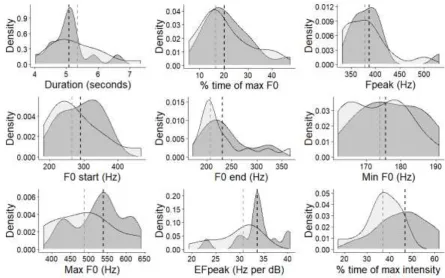
and spontaneous contexts (P < 0.05). Factor loadings greater than 0.4 were not clustered around 266
frequency-, intensity- or energy-based variables (Table 5, Fig. 2). 267
12 Discussion
269 270
We analysed the acoustic structure of a large number of howls (913) from nine captive wolves 271
to determine the types of phenotypic and contextual (whether the call was spontaneous or 272
elicited) information that are encoded. We found that calls could be classified statistically 273
according to the identity of the caller (but not their age class, sex or pack) and the context in 274
which the call was produced. 275
Our findings confirm recent studies suggesting that wolf howls are individually 276
distinctive (Palacios et al., 2007; Root-Gutteridge et al., 2014) with variance in acoustic 277
structure between individuals probably attributable to interindividual anatomical differences 278
(Yin and McCowen, 2004; Townsend et al., 2014; Charlton et al., 2009a). Interestingly, despite 279
being statistically significant, the percentage with which the pDFA was able to correctly 280
classify howls according to identity was lower (ca. 38%) than previous work reporting 281
individual differences in wolf howls (e.g. 72% in Iberian wolves, Palacios et al., 2007). This 282
may, to an extent, be due to differences in statistical approach: a conventional DFA, as used by 283
Palacios et al. (2007), correctly classified our howl sample at 45% (expected: ca. 10%). 284
However, because our howls were produced in different contexts it was necessary to 285
simultaneously control for this, something traditional DFAs cannot do. While recognition of 286
individual differences in vocalizations is taxonomically widespread (birds: Godard, 1991; 287
primates: Keenan et al., 2016; elephants: McComb et al., 2000; cetaceans: Bruck, 2013), it is 288
yet to be demonstrated in wolves and this is crucial to understanding the relevance of detected 289
individual signatures in howls. Habituation/discrimination playback experiments whereby 290
subjects are habituated to the howls of one individual and then exposed to the howls of a 291
different individual (discrimination phase) could be one viable approach to test this. 292
It was somewhat surprising that howls did not differ according to age class or sex, since 293
13 wolves are known to differ in terms of gross anatomy (MacNulty et al., 2009) and probably 295
also in underlying physiology (Dabbs & Mallinger, 1999, Deaux et al., 2016). The apparent 296
absence of a sex effect may therefore be due to our relatively small and unbalanced sample size 297
in this respect, consisting of seven males and just two females from whom we recorded enough 298
howls to be used for analysis. Similarly, we had six adults and just three juveniles in the final 299
sample. It may therefore be that we lacked the statistical power to identify the effects of these 300
factors. Alternatively, in the case of age class, given that juveniles were towards the younger 301
end of their age category (and therefore probably smaller; see Table 1) it may be that the 302
acoustic structure of calls crystallizes during early adolescence with little appreciable further 303
change into adulthood (despite further physical changes). However, to confirm this, it would 304
be necessary to carry out a fully longitudinal design in which calls were collected from the 305
same individuals during both adolescence and adulthood. 306
In contrast to previous work (Zaccaroni et al., 2012), we found no evidence for group-307
specific differences in howl structure. However, this finding should be interpreted cautiously 308
as, although we had access to a large number of howls, these were derived from only a small 309
number of individuals per group (black pack N = 3, red pack N = 3 and green pack N = 3). 310
Hence the absence of evidence for group signatures may well be a by-product of insufficient 311
statistical power to detect group differences. It is also worth noting that so called ‘dialects’ in 312
animal vocalizations are often, although not exclusively (Elowson & Snowdon, 1994; 313
Crockford et al., 2004; Watson et al., 2015), a consequence of genetic relatedness leading to 314
greater within-group vocal tract similarities than between groups and, as such, more similar 315
calls (Gouzoules & Gouzoules, 1990; Townsend et al., 2010; Kershenbaum et al., 2016). The 316
packs at the WSC, on the other hand, are artificially composed. While in some packs a few 317
animals are related to one another, in other packs none of the animals are related and some 318
14 variation is likely to be as great within packs as between them. Furthermore, if wild populations 320
of wolves typically deploy kin-based social learning of call structures (e.g. matriline-based 321
vocal learning in killer whales, Orcinus orca: Miller & Bain, 2000), or directed social learning 322
dependent on a critical period (e.g. song learning in zebra finches, Taeniopygia guttata: George 323
et al., 1995), this would not be expressed in our sample as they were hand-raised in peer groups 324
(with animals from unrelated litters) that were later split to form different packs. 325
Lastly, our data indicate that there is a degree of flexibility in howl acoustic structure: 326
howls systematically varied according to the motivational or behavioural context in which they 327
were produced, namely a difference between spontaneous howls given shortly after sunrise and 328
those elicited by the absence of a group member. Interestingly, previous work has also shown 329
that the production of elicited calls is under flexible control of the caller, given that they are 330
produced more frequently when the absent group mate is closely affiliated with the caller 331
(Mazzini et al., 2013). Data from a range of species have demonstrated that both long- and 332
short-distance calls can and do convey rich information sets associated with the ongoing 333
behavioural context (see Townsend & Manser, 2013 for a review). For example, the screams 334
of chimpanzees differ systematically based on the severity of aggression experienced 335
(Slocombe & Zuberbuhler, 2007) and playback experiments have demonstrated that these 336
differences are salient to receivers (Slocombe et al., 2009). Furthermore, dog growls or the 337
groans of fallow deer, Dama dama, have also been shown to be influenced by either the valence 338
of the context (play versus aggression) or the presence of specific individuals, respectively 339
(Farago et al., 2010; Yin & McCowan, 2004; Charlton & Reby, 2011). While context-specific 340
howls have been previously posited (Harrington, 1987; Palacios et al., 2007), to our knowledge 341
this is the first systematic observational evidence that wolves utilize distinctive howl variants 342
15 According to our PCA, individual differences in call structure were associated with End 344
F0, a fundamental frequency-based measure. This is in line with the vocalizations of other 345
species, such as pandas, where fundamental frequency conveys information about individual 346
level attributes such as age and size (Charlton et al., 2009b). With regard to contextual 347
differences in howl acoustics, a number of frequency-, energy- and amplitude-based parameters 348
loaded highly in PCs that differed significantly between elicited and spontaneous contexts 349
(Tables 4, 5). However, caution should be taken when interpreting energy-based measures such 350
as Fpeak and EfPeak, which loaded highly for context differences, as these are known to be 351
sensitive to changes in recording distance to subject (Zollinger et al., 2012). In this study, 352
spontaneous and elicited howls were always recorded at 1–10 m, but, owing to the long-term 353
nature of the data, we do not have sufficient information to determine whether there were 354
systematic differences in recording distance between contexts. Nevertheless, the lack of 355
clustering around a category (e.g. energy) of variable in our results suggests that there is no 356
single acoustic feature differentiating calls produced in different contexts, but rather that the 357
‘holistic’ structure of wolf howls has the capacity to encode, through a variety of acoustic 358
features, information regarding the individual’s motivational or behavioural states. 359
From a proximate perspective, differences in howl structure resulting from production 360
context are likely to be a product of differing arousal levels experienced by the signaller 361
(Charlton & Reby, 2011) driving concomitant changes in spectral and temporal parameters 362
(Owren, Amoss & Rendall, 2011; but see Mazinni et al., 2013). However, these data can also 363
help shed more general light on exactly how wolf howls can serve multiple recruitment and 364
territorial functions. Specifically, our findings suggest that subtle differences in acoustic 365
structure could potentially help receivers differentiate between howls directed at recruiting 366
individuals back to the pack (elicited) versus those signalling territory and mediating intergroup 367
16 determine whether these acoustic differences are indeed meaningful to receivers by examining 369
whether they elicit differential behavioural responses. 370
Our results indicate that wolf howls encode information on both the identity of the caller 371
and the behavioural context of production. They support recent work demonstrating that social 372
carnivore vocal systems display an intriguing degree of complexity and hence represent a 373
relevant model group for understanding the evolution and emergence of vocal complexity 374
(Holekamp et al., 1999; Manser et al., 2014; Kershenbaum et al., 2016). Naturally, for each of 375
the information sets detected, rigorous experimental verification is central to test whether these 376
information sets are not just anatomical artefacts but are meaningful and relevant to receivers 377
(see Townsend et al., 2010), reducing their uncertainty regarding the identity of the signaller 378
and the behavioural context in which the call was produced (Seyfarth & Cheney, 2010). 379
380
Conflicts of interest 381
The authors have no conflicts of interest to declare. 382
383
384
Acknowledgments 385
The Wolf Science Center was established by Zsofia Virányi, Kurt Kotrschal and Friederike 386
Range and we thank all the helpers who made this possible hence indirectly supporting this 387
research. We thank the WSC staff for logistical support during the study and Roger Mundry 388
for providing the R pDFA script. Particular thanks to Mauro Hegland for his help with data 389
collection and logistical support. The project was supported by funding from the European 390
Research Council under the European Union's Seventh Framework Programme (FP/2007-391
2013)/ERC Grant Agreement to FR. [311870]. SWT was supported by the University of 392
Zurich and SNF grant PP00P3-163850. We further thank many private sponsors including 393
Royal Canin for financial support and the Game Park Ernstbrunn for hosting the Wolf 394
Science Center. We are grateful to two anonymous referees for their helpful feedback on 395
previous versions of the manuscript. 396
397 398
References 399
17 Bradbury, J. W., & Vehrencamp, S. L. 1998. Principles of animal communication. Sunderland, 401
MA: Sinauer. 402
Briefer, E., & McElligott, A. G. (2011). Indicators of age, body size and sex in goat kid calls 403
revealed using the source–filter theory. Applied Animal Behaviour Science, 133(3), 404
175-185. 405
Bruck, J. N. (2013). Decades-long social memory in bottlenose dolphins. Proceedings of the 406
Royal Society of London B: Biological Sciences, 280(1768), 20131726. 407
Budaev, S. V. (2010). Using principal components and factor analysis in animal behaviour 408
research: caveats and guidelines. Ethology, 116(5), 472-480. 409
Catchpole, C. K., & Slater, P. J. (2003). Bird song: biological themes and variations. 410
Cambridge, U.K.: Cambridge University Press. 411
Charlton, B. D., & Reby, D. (2011). Context-related acoustic variation in male fallow deer 412
(Dama dama) groans. PLoS One, 6(6), e21066. 413
Charlton, B. D., Keating, J. L., Rengui, L., Huang, Y., & Swaisgood, R. R. (2015). The acoustic 414
structure of male giant panda bleats varies according to intersexual context. The Journal 415
of the Acoustical Society of America, 138(3), 1305-1312. 416
Charlton, B. D., Reby, D., & McComb, K. (2007). Female red deer prefer the roars of larger 417
males. Biology Letters, 3(4), 382-385. 418
Charlton, B. D., Zhihe, Z., & Snyder, R. J. (2009a). Vocal cues to identity and relatedness in 419
giant pandas (Ailuropoda melanoleuca). The Journal of the Acoustical Society of 420
America, 126(5), 2721-2732. 421
Charlton, B. D., Zhihe, Z., & Snyder, R. J. (2009b). The information content of giant panda, 422
Ailuropoda melanoleuca, bleats: acoustic cues to sex, age and size. Animal 423
18 Clutton-Brock, T. H., & Albon, S. D. (1979). The roaring of red deer and the evolution of 425
honest advertisement. Behaviour, 69(3), 145-170. 426
Cornec, C., Hingrat, Y., Robert, A., & Rybak, F. (2015). The meaning of boom calls in a 427
lekking bird: identity or quality information? Animal behaviour, 109, 249-264. 428
Crockford, C., Herbinger, I., Vigilant, L., & Boesch, C. (2004). Wild Chimpanzees Produce 429
Group‐ Specific Calls: a Case for Vocal Learning? Ethology, 110(3), 221-243. 430
Dabbs Jr, J. M., & Mallinger, A. (1999). High testosterone levels predict low voice pitch among 431
men. Personality and individual differences, 27(4), 801-804. 432
Déaux, E. C., Clarke, J. A., & Charrier, I. (2016). Dingo Howls: The Content and Efficacy of 433
a Long‐ Range Vocal Signal. Ethology, 122(8), 649-659. 434
Elowson, A. M., & Snowdon, C. T. (1994). Pygmy marmosets, Cebuella pygmaea, modify 435
vocal structure in response to changed social environment. Animal Behaviour, 47(6), 436
1267-1277. 437
Faragó, T., Pongrácz, P., Range, F., Virányi, Z., & Miklósi, Á. (2010). ‘The bone is mine’: 438
affective and referential aspects of dog growls. Animal Behaviour, 79(4), 917-925. 439
Farrar, D. E., & Glauber, R. R. (1967). Multicollinearity in regression analysis: the problem 440
revisited. The Review of Economic and Statistics, 92-107. 441
Fischer, J., Hammerschmidt, K., & Todt, D. (1998). Local variation in Barbary macaque shrill 442
barks. Animal Behaviour, 56(3), 623-629. 443
Fischer, J., Hammerschmidt, K., Cheney, D. L., & Seyfarth, R. M. (2001). Acoustic features 444
of female chacma baboon barks. Ethology, 107(1), 33-54. 445
Fischer, J., Metz, M., Cheney, D. L., & Seyfarth, R. M. (2001). Baboon responses to graded 446
bark variants. Animal Behaviour, 61(5), 925-931. 447
Fitch, W. T., & Reby, D. (2001). The descended larynx is not uniquely human. Proceedings of 448
19 Gazzola, A., Avanzinelli, E., Mauri, L., Scandura, M., & Apollonio, M. (2002). Temporal 450
changes of howling in south European wolf packs. Italian Journal of Zoology, 69(2), 451
157-161. 452
Geissmann, T. (2002). Duet-splitting and the evolution of gibbon songs. Biological 453
Reviews, 77(1), 57-76. 454
George, J. M., Jin, H., Woods, W. S., & Clayton, D. F. (1995). Characterization of a novel 455
protein regulated during the critical period for song learning in the zebra 456
finch. Neuron, 15(2), 361-372. 457
Godard, R. (1991). Long-term memory of individual neighbours in a migratory 458
songbird. Nature, 350(6315), 228. 459
Gouzoules, H., & Gouzoules, S. (1990). Matrilineal signatures in the recruitment screams of 460
pigtail macaques, Macaca nemestrina. Behaviour, 115(3), 327-347. 461
Graham, M. H. (2003). Confronting multicollinearity in ecological multiple regression. 462
Ecology, 84(11), 2809-2815. 463
Grinnell, J., & McComb, K. (2001). Roaring and social communication in African lions: the 464
limitations imposed by listeners. Animal Behaviour, 62(1), 93-98. 465
Gustison, M. L., & Townsend, S. W. (2015). A survey of the context and structure of high-and 466
low-amplitude calls in mammals. Animal Behaviour, 105, 281-288. 467
Harrington, F. H. (1987). Aggressive howling in wolves. Animal Behaviour, 35(1), 7-12. 468
Harrington, F. H., & Mech, L. D. (1982). An analysis of howling response parameters useful 469
for wolf pack censusing. The Journal of Wildlife Management, 686-693. 470
Harrington, F. H., Asa, C. S., Mech, L., & Boitani, L. (2003). Wolf communication. In L. D. 471
Mech & L. Boitani (Eds). Wolves: Behavior, ecology, and conservation, (pp. 66-103). 472
Chicago, IL: University of Chicago Press. 473
20 Hegland, M. (2014). The social information content and vocal flexibility of howls in timber 475
wolves. (MSc thesis). Zurich, Switzerland: University of Zurich. 476
Holekamp, K. E., Boydston, E. E., Szykman, M., Graham, I., Nutt, K. J., Birch, S., ... & Singh, 477
M. (1999). Vocal recognition in the spotted hyaena and its possible implications 478
regarding the evolution of intelligence. Animal Behaviour, 58(2), 383-395. 479
Joslin, P. W. (1967). Movements and Home Sites of Timber Wolves in Alǵonquin 480
Park. American Zoologist, 7(2), 279-288. 481
Keenan, S., Mathevon, N., Stevens, J. M., Guéry, J. P., Zuberbühler, K., & Levréro, F. (2016). 482
Enduring voice recognition in bonobos. Scientific Reports, 6, 22046. 483
Kent, J. P. (1987). Experiments on the relationship between the hen and chick (Gallus gallus): 484
the role of the auditory mode in recognition and the effects of maternal 485
separation. Behaviour, 102(1), 1-13. 486
Kershenbaum, A., Root-Gutteridge, H., Habib, B., Koler-Matznick, J., Mitchell, B., Palacios, 487
V., & Waller, S. (2016). Disentangling canid howls across multiple species and 488
subspecies: Structure in a complex communication channel. Behavioural 489
Processes, 124, 149-157. 490
Lemasson, A., Boutin, A., Boivin, S., Blois-Heulin, C., & Hausberger, M. (2009). Horse 491
(Equus caballus) whinnies: a source of social information. Animal Cognition, 12(5), 492
693-704. 493
MacNulty, D. R., Smith, D. W., Mech, L. D., & Eberly, L. E. (2009). Body size and predatory 494
performance in wolves: is bigger better?. Journal of Animal Ecology, 78(3), 532-539. 495
Manser, M. B., Jansen, D. A., Graw, B., Hollén, L. I., Bousquet, C. A., Furrer, R. D., & le 496
Roux, A. (2014). Vocal complexity in meerkats and other mongoose species. Advances 497
21 Manser, M. B., Seyfarth, R. M., & Cheney, D. L. (2002). Suricate alarm calls signal predator 499
class and urgency. Trends in Cognitive Sciences, 6(2), 55-57. 500
Mazzini, F., Townsend, S. W., Virányi, Z., & Range, F. (2013). Wolf howling is mediated by 501
relationship quality rather than underlying emotional stress. Current Biology, 23(17), 502
1677-1680. 503
McComb, K., Moss, C., Sayialel, S., & Baker, L. (2000). Unusually extensive networks of 504
vocal recognition in African elephants. Animal Behaviour, 59(6), 1103-1109. 505
Mech, L. D., & Boitani, L. (Eds.). (2010). Wolves: behavior, ecology, and conservation. 506
Chicago, IL: University of Chicago Press. 507
Miller, P. J., & Bain, D. E. (2000). Within-pod variation in the sound production of a pod of 508
killer whales, Orcinus orca. Animal Behaviour, 60(5), 617-628. 509
Mundry, R., & Sommer, C. (2007). Discriminant function analysis with nonindependent data: 510
consequences and an alternative. Animal Behaviour, 74(4), 965-976. 511
Notman, H., & Rendall, D. (2005). Contextual variation in chimpanzee pant hoots and its 512
implications for referential communication. Animal Behaviour, 70(1), 177-190. 513
Nowak, S., Jędrzejewski, W., Schmidt, K., Theuerkauf, J., Mysłajek, R. W., & Jędrzejewska, 514
B. (2007). Howling activity of free-ranging wolves (Canis lupus) in the Białowieża 515
Primeval Forest and the Western Beskidy Mountains (Poland). Journal of 516
Ethology, 25(3), 231-237. 517
Ouattara, K., Lemasson, A., & Zuberbühler, K. (2009). Campbell's monkeys concatenate 518
vocalizations into context-specific call sequences. Proceedings of the National 519
Academy of Sciences, 106(51), 22026-22031. 520
Owren, M. J., Amoss, R. T., & Rendall, D. (2011). Two organizing principles of vocal 521
production: Implications for nonhuman and human primates. American Journal of 522
22 Palacios, V., Font, E., & Márquez, R. (2007). Iberian wolf howls: acoustic structure, individual 524
variation, and a comparison with North American populations. Journal of 525
Mammalogy, 88(3), 606-613. 526
Range, F., & Virányi, Z. (2011). Development of gaze following abilities in wolves (Canis 527
lupus). PLoS One, 6(2), e16888. 528
Range, F., & Virányi, Z. (2014). Wolves are better imitators of conspecifics than dogs. PLoS 529
One, 9(1), e86559. 530
Reby, D., & McComb, K. (2003). Anatomical constraints generate honesty: acoustic cues to 531
age and weight in the roars of red deer stags. Animal Behaviour, 65(3), 519-530. 532
Reby, D., McComb, K., Cargnelutti, B., Darwin, C., Fitch, W. T., & Clutton-Brock, T. (2005). 533
Red deer stags use formants as assessment cues during intrasexual agonistic 534
interactions. Proceedings of the Royal Society of London B: Biological 535
Sciences, 272(1566), 941-947. 536
Rendall, D., Owren, M. J., Weerts, E., & Hienz, R. D. (2004). Sex differences in the acoustic 537
structure of vowel-like grunt vocalizations in baboons and their perceptual 538
discrimination by baboon listeners. The Journal of the Acoustical Society of 539
America, 115(1), 411-421. 540
Ripley, B., Venables, B., Bates, D. M., Hornik, K., Gebhardt, A., Firth, D., & Ripley, M. B. 541
(2013). Package ‘mass’. http://cran.r-projectorg/web/packages/MASS/. 542
Root-Gutteridge, H., Bencsik, M., Chebli, M., Gentle, L. K., Terrell-Nield, C., Bourit, A., & 543
Yarnell, R. W. (2014). Identifying individual wild Eastern grey wolves (Canis lupus 544
lycaon) using fundamental frequency and amplitude of howls. Bioacoustics, 23(1), 55-545
66. 546
Sayigh, L. S., Esch, H. C., Wells, R. S., & Janik, V. M. (2007). Facts about signature whistles 547
23 Seyfarth, Robert M, and Dorothy L Cheney. 2010. Primate vocal communication. In M. Platt 549
& A. A. Ghazanfar (Eds). Primate neuroethology (pp. 84-97). Oxford, U.K. Oxford 550
University Press. 551
Slocombe, K. E., & Zuberbühler, K. (2007). Chimpanzees modify recruitment screams as a 552
function of audience composition. Proceedings of the National Academy of 553
Sciences, 104(43), 17228-17233. 554
Slocombe, K. E., Townsend, S. W., & Zuberbühler, K. (2009). Wild chimpanzees (Pan 555
troglodytes schweinfurthii) distinguish between different scream types: evidence from 556
a playback study. Animal cognition, 12(3), 441-449. 557
Taylor, A. M., & Reby, D. (2010). The contribution of source–filter theory to mammal vocal 558
communication research. Journal of Zoology, 280(3), 221-236. 559
Team, R. (2015). RStudio: integrated development for R. Boston, MA: RStudio, Inc. 560
http://www. rstudio. com. 561
Templeton, C. N., Greene, E., & Davis, K. (2005). Allometry of alarm calls: black-capped 562
chickadees encode information about predator size. Science, 308(5730), 1934-1937. 563
Theis, K. R., Greene, K. M., Benson-Amram, S. R., & Holekamp, K. E. (2007). Sources of 564
variation in the long-distance vocalizations of spotted hyenas. Behaviour, 144(5), 557-565
584. 566
Townsend, S. W., & Manser, M. B. (2011). The function of nonlinear phenomena in meerkat 567
alarm calls. Biology letters, 7(1), 47-49. 568
Townsend, S. W., & Manser, M. B. (2013). Functionally referential communication in 569
mammals: the past, present and the future. Ethology, 119(1), 1-11. 570
Townsend, S. W., Charlton, B. D., & Manser, M. B. (2014). Acoustic cues to identity and 571
24 Townsend, S. W., Hollén, L. I., & Manser, M. B. (2010). Meerkat close calls encode group-573
specific signatures, but receivers fail to discriminate. Animal Behaviour, 80(1), 133-574
138. 575
Vehrencamp, S. L., Ritter, A. F., Keever, M., & Bradbury, J. W. (2003). Responses to playback 576
of local vs. distant contact calls in the orange‐ fronted conure, Aratinga 577
canicularis. Ethology, 109(1), 37-54. 578
Volodin, I. A., Sibiryakova, O. V., & Volodina, E. V. (2016). Sex and age-class differences in 579
calls of Siberian wapiti Cervus elaphus sibiricus. Mammalian Biology-Zeitschrift für 580
Säugetierkunde, 81(1), 10-20. 581
Watson, S. K., Townsend, S. W., Schel, A. M., Wilke, C., Wallace, E. K., Cheng, L., ... & 582
Slocombe, K. E. (2015). Vocal learning in the functionally referential food grunts of 583
chimpanzees. Current Biology, 25(4), 495-499. 584
Wheeler, B. C., & Fischer, J. (2012). Functionally referential signals: a promising paradigm 585
whose time has passed. Evolutionary Anthropology: Issues, News, and Reviews, 21(5), 586
195-205. 587
Yin, S., & McCowan, B. (2004). Barking in domestic dogs: context specificity and individual 588
identification. Animal Behaviour, 68(2), 343-355. 589
Zaccaroni, M., Passilongo, D., Buccianti, A., Dessi-Fulgheri, F., Facchini, C., Gazzola, A., ... 590
& Apollonio, M. (2012). Group specific vocal signature in free-ranging wolf 591
packs. Ethology Ecology & Evolution, 24(4), 322-331. 592
Zollinger, S. A., Podos, J., Nemeth, E., Goller, F., & Brumm, H. (2012). On the relationship 593
between, and measurement of, amplitude and frequency in birdsong. Animal 594
25
Tables
596
Table 1. Study subjects (N = 13) with details on their age class, sex, pack and the number of howls 597
collected in each context 598
Individual Age class
Birth
date Sex Pack
Total howls
Spontaneous howls
Elicited howls
AM J 12 Apr M 2 193 88 105
AR A 8 May M 1 59 26 33
CH J 12 Apr M 1 33 17 16
GE A 9 May M 2 149 93 56
KA A 8 May M 1 72 45 27
KAY* J 12 Apr F 2 15 9 6
KE A 10 Apr M 2 88 60 28
NA A 9 Apr M 3 74 21 53
SH* A 8 May F 1 92 6 86
TA* J 12 Apr F 1 46 12 34
UN J 12 Apr F 3 109 65 44
WA* J 12 Apr M 3 74 13 61
YU A 9 May F 3 136 33 103
A = Adult, J = Juvenile. M = Male, F = Female. Asterisks indicate individuals with fewer calls than 599
26 Table 2. List of acoustic measures extracted and used in analysis
601
Vocal parameter
Type Definition
Duration F0 (fundamental frequency)
Duration of the howl
Mean F0 F0 The mean of F0 values across the howl F0 start F0 The value of F0 at the start of the howl F0 end F0 The value of F0 at the end of the howl Max F0 F0 The maximum value of F0 across the howl Min F0 F0 The minimum value of F0 across the howl % Time max
F0
F0 The percentage of the total duration for which F0 was at maximum F0 absolute
slope*
F0 The mean absolute slope of F0
F0 var* F0 variation The mean F0 variation/s, calculated as the cumulative variation in the F0 contour in Hz divided by howl duration
FM extent* F0 variation The mean peak-to-trough variation of each F0 modulation (change in sign of the frequency gradient, see Charlton et al., 2009a)
FM rate* F0 variation The number of complete cycles (peak-to-trough-to-peak) of F0 modulation/s (Charlton et al., 2009a)
Jitter F0 variation The mean absolute difference between frequencies of consecutive F0 periods divided by mean F0 (Titze et al., 1987)
Shimmer F0 variation The mean absolute difference between the amplitudes of consecutive F0 periods divided by mean amplitude of F0
Q25% Frequency The frequency values at the upper limit of the first quartiles of energy, measured on a linear amplitude spectrum applied to the entire howl Q50% Frequency The frequency values at the upper limit of the second quartiles of
energy, measured on a linear amplitude spectrum applied to the entire howl
Q75% Frequency The frequency values at the upper limit of the third quartiles of energy, measured on a linear amplitude spectrum applied to the entire howl Fpeak Energy The frequency with the highest power/energy of the howl
EfPeak Energy The maximum energy value of the frequency with highest power/energy of the howl
% EfPeak * Energy The percentage of the total howl duration where energy value of the frequency with the highest power/energy of the howl was maximum % Time of
max intensity
Intensity The percentage of the total howl duration when the intensity was maximum
AM var* Intensity The mean variation/s of the intensity contour of the howl, calculated as the cumulative variation in amplitude divided by the howl duration AM rate* Intensity The number of complete cycles of amplitude modulation/s of intensity
contour of the howl
AM extent* Intensity The mean peak-to-peak variation of each amplitude modulation of the intensity contour of the howl (see Charlton et al., 2009a)
27 603
Table 3. Summary of pDFA details and outputs 604
pDFA
type Test factor
Control factor
Restriction factor
No. of individuals
No. of calls
Correctly cross-classified
Expected correctly
cross-classified
P
Crossed Context Individual None 9 913 62.38 53.33 0.009
Crossed Individual Context None 9 913 38.75 26.46 0.003
Nested Age class Individual Context 9 913 58.91 62.13 0.796
Nested Pack Individual Context 9 913 49.56 53.10 0.870
Nested Sex Individual Context 9 913 56.77 56.80 0.480
28 Table 4. Summary of outputs for individual identity PCA
606
PC1
Eigenvalue 1.100
Proportion of variance 0.477
Factor loadings
Duration 0.001
Mean F0 0.223
F0 start 0.321
F0 end 0.418
Max F0 -0.241
% Time Max F0 -0.107
Min F0 0.177
Q25% 0.481
Q50% 0.221
Q75% 0.003
Fpeak 0.056
EfPeak 0.093
% Time of max intensity -0.097
Jitter -0.352
Shimmer -0.383
Bold indicates a factor loading of over 0.4. 607
29 Table 5. Summary of output for principal components that varied significantly between contexts 609
PC2 PC3 PC4 PC6
Eigenvalue 1.705 1.639 1.208 1.012
Proportion of
variance 0.114 0.109 0.081 0.067
Cumulative
proportion 0.114 0.223 0.304 0.371
P 0.024 <0.001 0.019 <0.001
Factor loadings
Duration -0.406 0.094 0.067 0.391
Mean F0 0.203 0.358 0.137 -0.007
F0 start 0.002 0.418 -0.125 0.027
F0 end 0.047 0.201 -0.615 -0.181
Max F0 0.373 0.434 0.217 0.174
% Time Max F0 0.402 -0.303 -0.204 -0.317
Min F0 -0.095 0.149 -0.502 -0.198
Q25% 0.044 -0.321 0.067 -0.011
Q50% 0.135 -0.306 0.057 0.117
Q75% 0.196 -0.331 -0.154 0.173
Fpeak 0.439 0.012 -0.004 0.307
EfPeak -0.186 0.117 0.241 -0.516
% Time of max
intensity 0.179 0.037 0.357 -0.474
Jitter 0.373 0.114 0.025 -0.006
Shimmer 0.159 0.109 -0.157 0.121
Bold indicates a factor loading of over 0.4. P refers to the outcome of GLMM described above. 610
30
Figures
612
613
Figure 1. Example of a single howl spectral visualization. The fundamental frequency is the lowest 614
thick band. Other measures extracted can be found in Table 2. 615
616
[image:31.595.74.514.94.333.2]617
Figure 2. Density distributions for variables that had a loading greater than 0.4 in the context PCA. 618
[image:31.595.72.518.424.702.2]