. . . --.~-. - - - . - - - ... .
DATAMATIEJN@
November
r f " " " '
-L·
. ,
I
I.
november
!
ID~ IDrn·~·
~®
",tl
r
"
dec.~
: PAYS .
: $10
00:
I...
U .Totalr.. , ...
I • • • • • • • • • • • • • • • • • • • • • • • • • • • •®@@
PAYS:
***$7"
~
~
*
*
01
total
. ~
.-Only Ampex
gives you a complete family of
interface interchangeable
single-capstan
tape transports.
Now one source meets all your data transfer requirements:
Ampex. Only Ampex gives you a family of servo-driven single-capstan digital transports with a complete range of drive speeds and data transfer rates-from
o
to 120 KC. All units are interfaceinterchangeable. This allows you to easily pick the drive to match the requirements, and change the drive if requirements change. Also, you can select exactly what you need: just a transport, or the transport with electronics and control, or a system comprising several transports with time-shared data electronics and control.
© AMPEX CORP. 1965
Ampex transports meet or exceed the reliability of the equipment they serve. You get at least 2,000 hours mean-time-between-failure and at least one billion start/stop operations before start/stop mechanism replacement parts may be needed. Also, the single-capstan design eliminates problem parts and tape path adjustments. Result: more uptime, greater accuracy, performance to specification, all at lower cost.
Write for complete details. Ampex Corporation, Redwood City, California.
CIRCLE 1 ON READER CARD
What are your EDP system needs? TM-7 for up to 45 ips, 36 KC
TM-9 up to 75 ips, 60 KC
TM-11 up to
120
ips,96
KCTM-12 up to
150
ips,120
KC. All with servo-driven single-capstan drives.All generating tapes up to 800 cpi, fully IBM/ASCII compatible.
AMPEX
(J
.".
'.
3C SALES omcn· NEEDHAM MASS rOREST HILLS. NY. LEVITTOWN PA SYRACUSE NY. SILVER SPRING, MO" HOUSTON. TEXAS HUNTSVillE. ALA, ORLANOO flA, DES PLAINES, ILL.; OElROJ1 MICH CENTERVILLE. OHIO LOS ANGElES, CAlIF.; PALO ALTO CALIF. KENT. WASH ALBUQUERQUE. N M.
November 1965
MI~RO~IR~UIT
DDP-124
24-bit word DDP~ 124 features monolithic integrated circuit p-PACtm construction; fast, reliable, and flexible logic configuration - binary, parallel, sign/magnitude, single address with indexing, powerful command structure_ Over 285,000 computations per second. MEMORY: 8192 words (expandable to 32,768) directly addressable; cycle time 1.75 fLsecs. INPUT-OUTPUT: Typewriter, paper tape reader and punch. (Strong optional I/O capability and broad range of peripheral equipment.) SOFJWARE: FORTRAN II and IV, assembler, executive, utility and service routines. Fully program compatible with DDP-24 and DDP-224 general purpose computers. Write for complete speci-fications.
$65,000
COMPUTER CONTROL'
COMPANY, INC.
OLD CONNECTICUT PATH, FRAMINGHAM, MASSACHUSETTS 01702
---
..
~---r
II
Take board --:---__________________ ______________
•
S,
""'re, solder, do
d
.
___________________________ _
ca~aCltors
and resistors
~
0
es, tranSIstors, .
__ .
W,th Cordvvoodin
.' lit
t~em
together
and
a
pile
of
COh
g, tvvlstediJalr ""iring
°i
Bunectors
Wh
h
A
low
speed, high
cos'
at . aile You got?
Micro/ago
* •
t,
aiternatllle
to
c
Integrated circuitry.
CO its
k for Integrated Ircu
° hOld's Trademar
:.J
FAIRCHILD SEMICONDUCTOR / A DIVISION OF FAIRCHILD CAMERA AND INSTRUMENT CORPORATION. 313 FAIRCHILD DRIVE, MOUNTAIN VIEW, CALIFORNIA, (415) 962·5011 • TWX: 910·379·6435 .
I
I
I
I
[JOO OOJCB CB[JQ[P[JS3
[JO [jJ(D CBLJO[P[J (B(DS3'oQ
[]Y;j~
fjfJ&7J
0)
7](}[;@
~
0l1@fi@£i!jJ
Looking for a best buy in a table top tape reader system? Well, here's the one that fills the bill for features and flexibility, along with a down-to-earth price.
The 1291 is a completely self-contained unit, but with the capability for easy -integration into larger systems. You'll find self-illuminated manual controls, complete tacilities for exter-nal control, a unique reel servo system with built-in rewind, and a full set of output timing and blanking signals.
Flexibility? This is a unit with the power and card space that allows an almost unlimited variety of optional functions ... gated and buf-fered outputs (which can easily be set to spe-cial voltage levels), parity checking, detection of special tape codes for command signals, and sequential Dataphone outputs.
Operating at speeds up to 25 cps, the 1291 reads 8 level paper or mylar tape asynchron-ously. Moving parts have been minimized, assuring maintenance-free long life. And you'll get more than 10,000 passes with no tape damage from sensing pins that exert less than 25 grams of pressure on the tape.
The price? Only $596.00. And if you want the full story, just send in the coupon.
NAVIGATION COMPUTER CORPORATION
Valley Forge Industrial Park - Norristown, Pennsylvania Dept. D A·O 11- TWX 215·666·0729 - Phone 215·666·6531
Valley Forge Industrial Park Norristown, Pennsylvania
SOUNDS LIKE A BEST BUY! Please rush me the full story on the 129.1 Tape Reader System.
Name ... -Title ... _ _ _ _ _ _ _ _ _ _ _ _ _ _ _ _ Company _______________________ _
Address __________________________ _
City _ _ _ _ _ _ _ _ _ _ _ _ _ _ _ State_..,..-________________ Zip ______ _
Dept. DA·O 11,
1 _ _ _ _
-CIRCLE 8 ON READER CARD
4
I
I
I
I
I
november
1965
volume 11 number 11
President Publisher
Editor
DATAMATIEIN.
FRANK D. THOMPSON GARDNER, F. LANDON
ROBERT B. FOREST
Managing Editor & Art Director CLEVE MARIE BOUTELL
Associate Editors
Assistant Editor Eastern Editor European Editor Contributing Editors
Washington Reporter Editorial J..dviser Technical Consultants
Production Manager Circulation Mgr.
Eastern Distrid Managers
New England District Manager
& Vice President Midwest District Manager
EDWARD K. YASAKI WILLIAM J. ROLPH HEID,E E. HESS ANGELINE PANTAGES CHARLES WHITE HOWARD BROMBERG ROBERT V. HEAD JAMES McCROHAN ROBERT L. PATRICK DANIEL D. McCRACKEN LOWELL AMDAHL MARILEE PITMAN ALGENE TRAINA
JAMES M. MORRIS WARREN A. TIBBETTS FELIX CHARNEY 1.e1 E • .c.cth St., New York N.Y. 10017 [212) MUrray Hill 7-5180 WARREN A. TIBBETTS 112 West Haven Rd., Manchester, N.H., [603) NAtional 5-9498 JOHN BRENNAN 20' West Wacker Drive, Chicago, III. 60606 , [312) Financial 6-1026
Western District Manager HAMILTON S. STYRON
& Vice President 1830 W. Olympic Blvd., Los Angeles, CaL, 90006 [213) 385-0474, EDITORIAL OFFICES
1830 WEST OLYMPIC BLVD. LOS ANGELES, CALIF. 90006
Circulation audited by
Business Publications Audit American Business Press, Inc, Member,
Microfilm copies of DATAMATION may be obtained from University Microfilms, Inc., 313 No, First St.,· Ann Arbor, Michigan. DATAMATION is published monthly on or about the tenth day of every month by F. D. Thompson Publications, Inc., Frank D. Thompson, President. Executive, Circulation and Advertising offices, 141 East 44th Street, New York, New York 10017 (MUrray Hill 7-5180). Editorial offices, 1830 W. Olympic Blvd., Los Angeles, California 90006. Published at Chicago, III. DATAMATION is circulated without charge by name and title to individuals who qualify by our standards and are employed by manufacturers or users of automatic information-handling equipment in all branches of business, industry, government and the military. Available to others by subscription at the rate of $15.00 a,nnuallYi single issues (when available) $1.50, Annual rate for students: $7,50, Foreign sub-scriptions are on a paid basis only at a rate of $25,00 annually, No subscription agency is authorized by us to solicit or take orders for subscriptions, Controlled circulation paid at Columbus, 0, Form 3579 to be sent to F. D. Thompson Publications, ,-"" Inc., 205 W. Wacker Dr., Chicago, III. 60606. Copyright 1965, F. D. Thompson(
PU,blications, Inc. . \ ,
Printed by Beslow ASSOCiates, Inc. ....
,-THIS ISSUE 60,202 COPIES
CRTRMRTIDN
\"
/
New from Raytheon ...
o
the first self-contained
remote
display console
• !
I
available
,~
I
J
at an
economical price ...
$6000*
'It's no longer necessary to buy -
or rent -
expen-sive multi-display control units to serve locations
that only need 1 or 2 remote display stations.
The Raytheon Display Console, model 402, is
the only low-cost equipment with its own control
unit combined into the same package. And, because
the 402 connects directly to a telephone dataset,
there's no need for a separate interfacing console.
Character generator, buffer memory, keyboard,
tele-phone interface and power supply are all combined
in one desk-top sized package which can be remotely
connected to any general purpose digital computer.
The 402 can be' easily moved from one location
to another. Connect, and it's ready for quick ..
response, on-line communication with regional
offices, warehouses, or ticket offices. Ideally suited
for remote computer time sharing applications.
If
your problem is one of providing real-time
access to computer-stored information from remote
locations, send today for information about the new
model 402 Display Console and 'other units in
Raytheon's DIDS (Digital Information Display
System) family. Write: Manager of Industrial
Sales, Dept. D 115, Raytheon Company,
Way-land, Massachusetts
01778.
Or phone: (617)
358-2721
ext.
2911.
*Rental prices available on request
CIRCLE 9 ON READER CARD
6
AN OFF-BIT HISTORY OF MAGNETIC TAPE ... #9 of a series
by
Computape*
There were mutterings at the Round Table that Merlin the Magician was growing absent minded, not to say daft. The Knight of the Silver Spoon was sure of it. And the Knight of the Iguana agreed.
"Absent minded am I? Ready for Medicare am I?" cackled Merlin. "I'll show them I"
And so he collared the noble Galahad. "Watch this, Gal old boyl" he crowed.
And without so much as an abracadabra - 10 I The two were suddenly in a strange room, where a damsel pecked absently at a typewriter and musicians played Greensleeves' from the balcony.
"And what do you think those are?" Merlin whispered to Galahad, pointing a warty finger at a bank of com-puters that had suddenly materialized along the far wall.
"Computers," Galahad replied promptly. "As for the tape, it's heavy duty Computape. Magnetic. 556, or 800,
*Reg. T.M. Computron Inc.
© Computron Inc. 1965
or 1000 bits per inch with no dropout, if I recalL" Merlin sighed. "Then I've shown you this before?" "At least 25 times," said Galahad. "But fear not, Merlin. None shall ever be the wiser."
And none ever was. After all, would you have the heart to tell on a poor old man?
Galahadn't either.
One of a series of documentaries made possible by COMPUTRON INC., a cor:npany even more interested in making history than fracturing it. Our Computape is so carefully made that it delivers 556, 800 or 1,000 bits per inch - with no dropout. Available with 7, 8, g, 10, 16 channel or full-width certification to meet your systems requirements.
Now - if Computape can write that kind of computer tape history - shouldn't you be using it?
(+)
CDMPUTRDN INC.
MEMBER OF THE !ID[il~W GROUP
122 CALVARY 'STREET, WALTHAM, MASSACHUSETTS
COMPUTAPE - product of the first company to manufacture magnetic tape for computersand instrumentation, exclusively.
CIRCLE 10 ON READER CARD
DRTRMRTION
.'<.
r
.1
.J
I
®
o
november
24
AUTOMATED SECONDARY STORAGE MANAGEMENT, byMacKenzie.
Author explains the operation of the basic control mechanism employedF.
B. in the B 5500 computing system to invoke the store management process, often called "single level store," and reports observations which demonstrate its effectiveness.1965
volume 11 number 11
automatIc
information
processIng
0
for business
industry &Science
November 1965
29 INTEGRATED CIRCUITS FOR COMMERCIAL COMPUTERS, by
Wil-liam
H.
Richmond.
Tracing the development of IC's, the author contrasts the monolithic and hybrid varieties, covers factors affecting their costs, delves into their use as memory elements, and describes circuits for "fourth-generation" computers.33 THE TWO SIDES OF TIME-SHARING, by
Martin Greenberger.
Author discusses the system (hardware) and user aspects of this subject, in terms of both present and future capabilities, based on the facilities· at MIT's Project MAC.41 DATA BASE SYMPOSIUM, by
Robert
v.
Head.
Problems and techniques in the handling of data bases were discussed recently by a small gathering at a meeting sponsored by SDC, ESD and ARPA.45 BROOKS BILL BECOMES LAW, by
Phil Hirsch.
Just before adjournment, Congress passed H.R. 4845, providing a new purchasing agent for the edp industry'sbest customer. The effects of this Act, and when they may come about, are analyzed.
50 FROM "PROGRAMMED INSTRUCTION: A PROGRAMMED TEXT," by
T.D.
C.
Kuch.
An excerpt from a book that mayor may not be released soon, telling the reader nearly everything he needs to know about this new instruction method.53 THE FALL JOINT COMPUTER CONFERENCE. A special section highlights the technical sessions, exhibitors and products, special events and innovative format of the upcoming conference in Las Vegas, as well as a show guide.
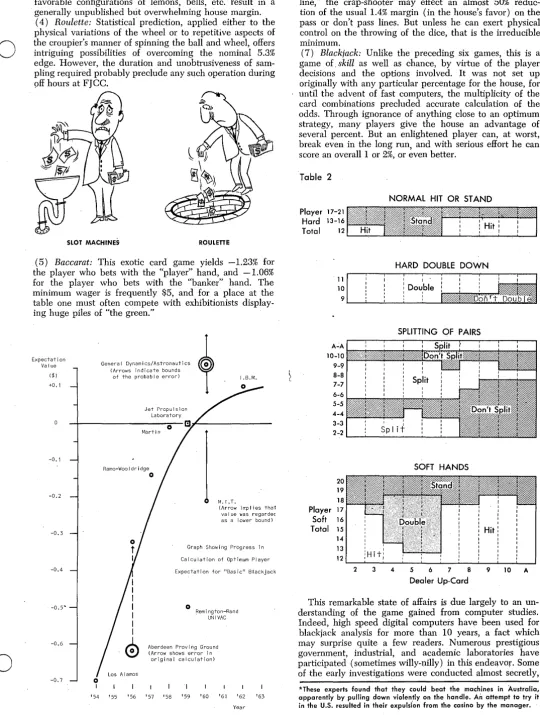
62 CASINOS, CARDS & COMPUTERS,
by Dr.
Allan
N.
Wilson.
In addition to a table summarizing the player's mathematical "expectation" at each of the popular games, and choice words about them, a casino habitue reveals winning strategies at blackjack, or twenty-one. The latter is referred to as the only game of skill as well as chance.141 LANGUAGE OBJECTIVES OF THE LATE
60's
by
Angeline Pantages.
10 12 17 21 23
88
93 103 115 123 161 167 169 172
"Do I hear PL/II? II ... do I hear III?" Surprising what you'll hear at a joint meeting of SHARE and JUG, recently held back east, when users and manufacturers squared away.
Calendar
Letters to the Editor
Datamation in Business & Science Washington Report
CONTROL DATA 3300 Time Sharing System shown here includes the following peripheral devices:
915 Page Reader, 405 Card Reader, 415 Card Punch, 852 Disk Storage Drive, 210 Entry and Display Station, and Tape Transports
November 1965
what say?
"X=ZY+12 COS (CM-3)""FISCAL BUDGET 1962 ... $3,765,574.32"
0 ' SALES A3646 ... $12,000 ... 6-10-65"
"SHIPPED 5-5-65 .. ,9 GROSS" "E=MC:2"
"INVENTORY J-67443-A .•. 12 UNITS"
tell it to the
new
CONTROL DATA:
3300/3500
time-sharing systems
for
business/scientific
computing
CONTROL DATA 3300/3500 Computer Systems introduce time-sharing tailored to your individual data processing or computational requirements, with new flexibility ideal for a whole spectrum of medium to high performance needs. Here is power to make business more scien-tific - scientific problem-solving more businesslike. And with the comprehen-sive range of Control Data peripherals available to you (many of them shown here) information can be input and out-put in any preferred format, from widely separated locations. 3300/3500 Systems talk the language of research-produc-tion control-engineering-accounting -business management-you name it. And, falk the language of ordinary indi-viduals, through people-oriented peri-pherals, newest breed of Control Data I/O devices that permit scores of people to use 3300/3500 Computer power simul-taneously as if the system were totally dedicated to each user. 3300/3500
Com-puters offer a choice of several power configurations . . . automatic program relocation features ... main core memory of over one million characters ... 1.25 or 0.8 'microsecond central memory cycle · .. new and powerful commercial data processing instructions .. ~ improved per-formance from eXisting software library · .. new time-sharing software systems. We can provide complete documenta-tion, hardware and software demonstra-tion, and practically immediate delivery!
a-nd talk about price/performance
· .. better than anyth ing yet, even from Control Data: If you're paying $10,000 or more monthly it's well worth looking into the CONTROL DATA 3300/3500 Time-Sharing Systems. They're no mere ex-perimental beginnings, but the first con-crete and proven time-sharing systems in their price/power class. For informa-tion contact our Representative in. your area; or write our M,inneapolis address.
The biggest computers for the biggest installations come from
Visit our Exhibit at the Fall Joint Computer Conference, Las Vegas, Nov. 30· Dec. 2
CIRCLE 11 ON READER CARD
CONTROL DATA
CORPORATION
8100 34th AVE. SO, MINNEAPOLIS, MINN. 55440
How do )Jou put
35,000
Ills.
pressure on a square inch'!·
Good question. But even if you try - with a heavy computer, for instance - you can't dent new G-E Perma-Kleen Floor Tile. The impact resistance is 17X tons per square inch I Even makes the girls happier ... they can quit worrying about making dents with those stiletto spiked heels. And it never needs waxing. Just dry or damp mopping keeps it clean and fresh as new, with no computer down-time. Shouldn't your computer room floor be as
up-to-date as the equipment on it? Certainly. For full moneysaving details, write: General Electric Company, Dept. 3, Coshocton, Ohio 43812.
GEN ERAL. ELECTRIC
LAMINATED PRODUCTS DEPARTMENT
G·E Perma·Kleen Tile on free·access floor system Installation In Daytona Beach. Florida.
CIRCLE 12 ON READER CARD
10
DDD
DDDDDDD
• The fall symposium of the Digital Equipment Computer Users Society will be held Nov. 29, Tresidder Union Hall, Stanford Univ., Stanford, Calif.
• American U niv. is sponsoring the following courses: "The Computer Im-pact on the Law," Nov. 30-Dec. 3, Twin Bridges Marriott Motor Hotel, Washington, D.C.; "Managerial Im-plications of Electronics in Publish-ing," Jan. 17 -20, International Inn, Washington, D.C.; "The Challenge of Cybernetics to Education," Jan. 26-28, Twin Bridges Marriott. Fees: $150-175.
• Brandon Applied Systems, Inc. of-fers the following courses: "Computer Selection," Nov. 30, N.Y.; "Computer Systems Analysis Techniques," Dec. 1, 2, N.Y.; "Management Standards for Data Processing," Dec. 6, 7; "Appre-ciation Course in Data Processing," Dec. 8, 9; "Computer Selection," Dec. 10, London.
• Scientific Data Systems Users Group meeting will be Dec. 3-4, Dunes Hotel, Las Vegas, N ev.
• C-E-I-R is sponsoring a seminar, "Programming Languages," Dec. 6-8, Hotel del Coronado, San Diego, Calif. Fee: $175.
• Seminars will be held at the Die-bold Group's Management Science Training Institute, New York: "Prob-lems of Mounting a Computer Utility Business," Dec. 9, "Software-Pur-chase or In-House," Dec. 14.
• Lecture series, "Computers and the World of the Future," is being offered by California State Polytechnic Institute, Theater Building, Pomona,. Jan. 13, April 21. .
• ARINC Research Corp. ·will present
an Integral Electronics course, Jan. 17-21, Airport-Marina Hotel, Los Angeles, Calif. Fee: $450.
• "Methods of Operations Research" is being offered by the Univ. of Miami, Fla., Jan 31-Feb. 4. Fee: $175.
o
while it writes while it reads.
It writes while it reads
The new
Bryant PhD-I70 gives I, 2, 3, or 4 channels of
indepen-dent read-write access to 21 million bytes.· Simultaneously.
That's quite a challen.ge to your creativity. This multiple channel
drum can also be interfaced with any system now in use or under
consideration. And its simultaneous service rate reduces waiting lines.
Look at the time saving and increased throughput for computers. Look
at the cost saving. Look
for increased up-time.
The PhD-I70 is quite a
combination.
~RYANV
COMPUTER PRODUCTS
A Division of EX-CELL-O Corporation
850 Ladd Road. Walled Lake. Michigan 48088
See the PhD in operation
at the F.
1.
C. C.-Booth 146
RELIABILITY
MONROE DATALOG@
HIGH SPEED PRINTERS
AT NEW LOW PRICESI
Check the new low prices on these two printers:
The
Me
10-40, which prints 1040 lines per minute and has 4, 8, 120r 16 columns of printinc with 15 characters (0 through 9 plus 5 symbuls) in each column. Prints legibly, reliably.The MC13-BO, which pri,lts 1380 lines per minute and delivers 4, 8, 12 or 16 columns of printing with 10 characters (0 through 9) in each column. Prints legibly, reliably.
Both are priced at: 4 column capacity 8 column capacity 12 column capacity 16 column capacity
$1790 1890 1980 2480 Quantity discounts are available-and the cost of any unit is $100 less than quoted above if it is to be used only with 3M Action paper.
Both models h'ave parallel input, ac-cept any 4 line code, any logic level, flat pack or roll record, and have low audi-ble noise level. (No extra charge for any of these.) Options inclu de hig h order zero suppression or high speed (250 micro-seconds transfer time) buffer registers. Both 'models have cam driven ham-mers and clear, legible printouts. Neither model has hot and cold, sometimes run-ning, solenoids. Both models have reliability.
The MC 10-40 and MC 13-80 are both covered by a one year warranty which includes parts and on-site maintenance.
For a published price schedule and specifications, write 'or call Monroe DATALOG Division of Litton Industries, ,343 San some, San Francisco. (415) 397-2813.
MONROE DATA LOG
rn
A DIVISION OF LITTON INDUSTRIES
CIRCLE 14 ON READER CARD
12
0 0 0 0 0 0
0 0 0 0
0 0 0
0 0
data transmission
Sir:
Justin Perlman's "Centralization vs. Decentralization" in your September issue (p. 24) is an excellent article. You have performed a valuable serv-ice by presenting this current per-spective on a dynamic subject of con-tinuing importance.
I think, however, that Mr. Perlman unduly complicates the question by equating centralization with stand-ardization and decentralization with destandardization. With the current capability of medium and large-scale computers to control and execute multi-batch type programs in a real-time environment, this need not be the choice. It is entirely possible (tech-nically) to furnish high-speed termi-nal devices to branch or divisiotermi-nal personnel (communicating with a re-mote central site computer) which can be used by those personnel as though they did, in fact, have their own computer. The implication is in-escapable that they can also do their own systems work and programming with a minimum of concern for those areas of interface with corporate sys-tem requirements.
This does not mean, on the other hand, that there is a lessened need for explicit corporate systems objectives and corporate organization and staf-fing to gain these objectives. But it does mean that the operating divi-sions can continue to master their own fate. Divisional or branch manage-ment is usually best qualified to define and solve their own problems and can do so in a free-handed way using a central computer facility without the rigours of standard operating, report-ing, and control procedures levied on them by a corporate systems staff.
Special staffing at the central com-puter site is required to make it pos-sible for the remote user to operate independently. Some functions of this staff would be to define facilities available to each user under various conditions, to establish some stand-ards of use, to furnish specially skilled consultants to the user for advanced languages such as', FORTRAN and
COBOL, operations research,
communi-cations, and operating systems. In additi,on, many companies will want
to supplement divisional systems and programming personnel with skilled men who are thoroughly familiar with the total central computer hardware and software specifications.
U sage of this type, it seems to me, offers an additional alternative to those presented by Mr. Perlman-Le., centralize the computer function and standardize those systems where the divisions feed data to corporate re-porting, but give decentralized usage to the branch or division through high-speed terminals and let them de-standardize their systems and proce-dures as their own unique require-ments dictate.
All the advantages claimed for centralization by Mr. Perlman are still valid and most of the disadvantages are dissolved.
H. GLEN HANEY
Univac Division,
Sperry Rand Corporation Hartford, Connecticut
Author replies: There is indeed a place for remote independent operation of a central computer, and it is an important place. It is not a panacea, however.
One of the prime points made in the article is that centralization vs. decentralization is not a simple question - and typically requires a unique solution for each user. The type of hardware solution Mr. Haney proposes is very attractive and will work where the conditions
are right. Where distances involved are short and/or input-output (transmission) volume is low the hardware economics may be quite fa-vorable. Where I/O volume is' high and dis-tances are long, the economic analysis may look substantially different. A number of hardware operational questions exist too-e.g., if tape master files are utilized, where and how will they be located and how will they be operated? The aspects of centralization vs. decentrali-zation not directly connected with the hard-ware (and particularly the non-economic as-pects) are somewhat more difficult· to analyze in the general case. In many situations they are more important than the hardware eco-nomics and the technical feasibility of the hard-ware operating plan. It would require a num-ber of pages to do this justice here. As a brief st'atement, I think it is well to reflect on the sizable number of efforts in a variety of com-panies to achieve the type of information-han-dling operation Mr. Haney describes. Most often these efforts have not been successful. I will concede, of course, that higher-capability data transmission and multi-processing hardware are becoming available, but this is not solely a hardware-oriented question.
As stated in the article, "overall manage-ment of the company can be centralized, in-formation-handling management can be cen-tralized, computer hardware can be cencen-tralized, and no one of the possibilities necessarily,
dictates the others." Read decentralization in place of centralization and the statement is
DATAMATION
, T
i
equally true. The proper mix for a specific situation is a custom solution.
marketing in u.k. Sir:
OThe World Report in September (p. 75) refers to relationships between IBM United Kingdom Ltd. and a new organization known as Centre-File Ltd. Your report states that the two organizations "are understood to have reached some verbal agreement about situations where they are com-peting."
This statement is wholly without foundation; no arrangements whatso-ever have been made with this or any other competitive organization rela-tive to current or future marketing practices or plans, or other competi-tive situations.
D.
J.
SCHERERIBM World Trade Corporation New York, New York
australian communication Sir:
In Dr. G. N. Lance's paper "Austra-lian Computing Network" (March, p. 33), he says:
"Data transmission has been con-sidered, but rejected for the time being. In Australia, the Postmaster-General's communication network is not developed to quite such a high standard as in some other countries, and the use of ordinary telephone cables for phase modulated transmis-sion is not currently possible. Coaxial cables and/ or microwave links are available but it is too. costly to use them over the distances involved." I feel this does not present a complete picture of the data transmission capa-bilities of the Post Office telecom-munication system and may therefore be misleading.
The P. M. G. Research Laborato-ries have carried out quite extensive data transmission trials on the Austra-lian telecommunications network. These trials have revealed error rate figures comparable to those published for North American, European, Jap-anese and other networks, indicating a similar standard of performance. This is not surprising since the Aus-tralian communications net.work is planned and executed to the interna-tional standards of C.C.I.T.T. (Inter-national Consultative Committee for Telegraphy and Telephony).
In the data transmission field the
O
Post Office' is at present providing data channels for, phase-modulated data transmission over thousands of miles. Some of these facilities are . linked to the outside world via the Pacific Ocean telepholle cables. TheNovember 1965
lor your
COMPUTER
SPEECHMAKE0
8Provides Direct Audio Response to Digital Interrogation,
- Vocabulary to 63 Words
(to 189 for special applications) - Standard Binary Input
- 200 cps to 8 kc Frequency Response - 1.6 Second Word or Phrase Length - Long Life - No Contact Heads
For the first time, a complete audio response system with a vocabulary of up to 63 words or phrases from standard digital input. The Speech-maker provides a complete add-on system for direct computer-to-man communications and is designed for compatibility with most standard
telephone and ,audio equipment.
Messages up to 1.6 seconds long are pre-recorded on a unique photo-graphic film memory drum and selected at random by a decoding matrix. Modulated light sensing techniques eliminate signal deteriora-tion associated with magnetic recording techniques. Mechanical components, including precision pre-loaded ball bearings, are designed to give years of service with minimum maintenance requirements.
If your data processing requirements include an automatic audio response to digital interrogation-contact us, we have just what you're looking for!
Additional Speechmaker models are available for switch, relay or other signal selection.
549 PLEASANTVILLE ROAD • BRIARCLIFF MANOR, N. Y. • 914·769·7900
CIRCLE lS ON READER CARD
World's Fastest,
Low-Cost
Digital Printer
Apply several drops of oil to the
drive-motor shaft-ends
~achyear (or
every fifty-million lines). 'Brush out
any accumulated dust or lint. 'Clean
the air filter 'periodically.
That's the extent of maintenance
for a Franklin Model 1000 . . . the
only digital printer that offers a
printing rate of 40 lines per second
(or less) at low, low, OEM prices.
REQUEST BULLETIN 2301
East Fourth S,t . • Bridgeport, Pa. 19405
A Division of the Anelex Corporation CIRCLE 16 ON READER CARD
14
LETTERS
global circuits thus provided, of which the Australian portion is very signifi-cant, are carrying phase-modulated data signals at 1200 bauds. Some of the circuits are now being phase and amplitude equalised for four-level phase-modulated data transmission at 2400 bits per second, again on a global basis. I feel thus obliged to correct any impression that "the use of ordinary telephone cables for phase-modulated transmission is not cur-rently possible."
Dr. Lance also comments that data transmission facilities over coaxial cables and/or microwave links are too costly over the distances involved. I would like. to point out that the de-partment naturally chooses the most economical transmission media in each case, and that its charges to its cus-tomers are not directly related to the transmission media used in specific cases. In the case of long distance data circuits different types of transmission media would normally be encountered over different sections of the circuit, but the amount of coaxial cable and/ or microwave equipment used would . not be reHected into the charges to
the customer.
P. R. BRETT
Research Laboratories
Postmaster-General's Department Commonwealth of Australia/Mel-bourne
we goofed
Sir:
Under "Rumors and Raw Random Data". (August, p. 19), you stated that Control Data Corp. was "ship-ping out the 3600 from its Los
An-geles service bureau and phasing out the 1604 there." Please let me correct this information.
Control Data's 3600 has been and still is located in Goleta/Santa Bar-bara, Calif. The only machine that was removed from the L.A. Data Cen-ter was a 1604A. As you may know, we also have a 6600 in our L.A, Data Center.
A. T. BASSETT, JR.
Control Data Corporation Data Centers Division Los Angeles, California
rehabilitating mag tape
Sir:
The article on tape rehabilitation (August, p. 51) was both informative and thought provoking. It showed that Mr. DeJianne, while showing a grasp of the basic principles involved, is
re-'markably inaccurate when comparing costs of in-house vs. outside service. He estimates that cost of outside service for 3,000 reels of tape would be $31,500-43,500. In actual fact, ~
these figures are at least $10,000,,--,,' overstated. (Prices of $7-9 are now readily obtainable) . .
Then figuring to his in-house costs, he generously admits to not consid-ering tape drive rental, which runs around $10,000/annum.
On the other hand, no mention is made of other costs such as Hoor
space, utilities, employee overhead, supervision, operating, supplies, etc. . . . The truth is that outside service costs are generally very close to in-house costs, and most managers are willing to pa y the small difference (if any) to have the job done by specialists.
DON DESBOROUGH
Tape Certifiers Inc. Gardena, California
time-sharing hysteria
Sir:
I am amazed at the way in which the edp community has overwhelm-ingly and almost irreversibly com-mitted itself emotionally and profes-sionally to time-sharing. Many nor-mally hard-nosed manufacturers, pro-grammers, engineers, salesmen, ana-lysts, scientists, users, educators, and stock market traders seem not at all to be concerned, as they are for other proposals, with whether the promoter-scientists of time-sharing are system-atically, scientifically, and economi-cally exploring it; or whether the probable outcome will be worth the investment; or whether time-sharing is good or bad and for what pur-poses. All they seem to be concerned with is, which kind to design, build, or buy.
It would be illuminating to obtain some understanding of the causes of this mob behavior. Is it the prestige of MIT and Project MAC? Had. Lick-lider at ARPA not funded Project
MAC at MIT but at some other place, would we not now have this irrational, bandwagon behavior? This is a socio-psychological phenomenon that should be studied by specialists in group be-havior.
Only at one other period in my professional career did I observe equally puzzling mob behavior. In 1950, the electronics community over-whelmingly committed itself emotion-
r-ally and professionr-ally to transistors
\..j
as a replacement for vacuum tubes on no more substantial grounds than that the Bell Telephone Laboratories had developed some three-terminal
gATAMATICN
..
' /
solid-state devices that could amplify electrical" signals. Normally hard-nosed manufacturers, engineers, salesmen, scientists, users, educators, and" stock market traders were not at all
con-O
cerned with whether reliable transis-tors could be manufactured in quan-tity with desirable characteristics. All they seemed to care about was which kind of those available would replace their tubes. In fact, for several years after this widespread commitment and conviction, transistors were largely worthless. Yet so great was the de-termination that Uncle Sam poured tens of millions of dollars into the effort to make good transistors. And it was so! The enormous expenditure turned out to be worth it; the faithful were redeemed.But surely the electronics commu-nity did not know, when they joined the mob, that the taxpayers would bail them out if they were wrong; nor could they know that to bail them out would be technically feasible, however much" money was expended. Why, then, did the electronics com-munity go overboard on transistors, so prematurely? There was no com-pelling national emergency that would force them to disregard their normal rules of conduct. I used to think that it was the prestige of the Bell Tele-phone Laboratories and their Nobel Prize winners that represented the Temple and its Clergy to these true believers.
I suppose that the transistor story provides defenders of the time-shar-ing faith with "evidence" and hope that they too will be redeemed; that the edp community and especially Uncle Sam will continue to pour what-ever time, energy, resources, and money it takes to make it so. But I would like to remind the faithful of an ancient Jewish dictum: For ex-ample is no proof!
Perhaps the behavioral scientists undertaking to study the present time-sharing syndrome could learn some-thing about the matter by also study-ing the transistor syndrome of the fifties.
LOUIS FEIN
Palo Alto, California
P. S. I wish to emphasize that I am not disparaging either the interest 9r the work of those seriously engaged in the important field of time-sharing, as I did not disparage those in the
50's seriously engaged in the
impor-tant field of transistors. These men
O
have my admiration and respect as do other men working seriously in other fields. What I do disparage and do not understand are premature com-mitments made by normally sophisti-cated and cautious communities. ""November 1965
CIRCLE 17 ON READER CARD
From ASI's continuing program of new product ~evelopment
It's all in a day's work .... for ASI's 6020
What is extra output from your computer worth to you? ... completion of projects on or ahead of schedule? . . . cutting down engineer's overtime? . . . reducing waiting time between problems? All this is our way of saying that you get more machine productivity per dollar when you get an ADVANCE Series 6020. Com-pared with competitive machines in the same cost range, the 6020 turns out 50% more work.
It begins with ADVANCE 6020 features such as high speed computation, a versatile input/output system, completely modular expansion both within the central processor and with peripheral equipment. In addition
the software system features the fastest FORTRAN compiler in its class. At 1500 statements per minute' your problem is entered in record time ... as much as four times faster than other computers. This combina-tion assures that your 6020 will return 12 hours work in an 8 hour day.
This extra workload capability already is working, or very soon will be installed, at facilities such as Chem-strand, Division of Monsanto Chemical; Gulf Oil; Uni-versity of Chicago; Sun Oil Company, and others. Contact ASI today for further information. We invite you to put.a stop watch on us with your problem.
ADVANCED SCIENTIFIC INSTRUMENTS
DIVISION OF ELECTRO-MECHANICAL RESEARCH, iNC.
8001 Bloomington Freeway, Minneapolis, Minn. 55420
CIRCLE 18 ON REAQEILCARD
16 DATAMATION
c
!
,
puter
ialists
RAMMERS
Impilers me Simulators
andling Systems nation Systems
Support
~search Applications
ICATIONS ENGINEERS on
:;
:; to Engineering Analysis and Design Id Applications
~SIGN (EE's Preferred)
!uipment "
Interface
VlMAN
:;ERING CORPORATION and· New York
lportunity Employer
o
F=lTF=I M F=lTI C No
o
o
DATAMATION
:HHH:~!iji.7
.~~!!!~i
BUSINESS
&
SCIENCE
WILL SERVICE BUREAUS
OF THE WORLD UNITE?
If
a service bureau wants to get in on CEIR's
franchise plan, one requirement is that its
prospective growth rate be greater than that of the
service bureau industry -- 100% every five years.
CEIR unfolded more of its program to about 40
independents in a meeting last month, but major
questions that have to be left to individual talks
include fees and npotential hardware discounts. n
Though interested centers were dismayed that there
may be more than one franchise to a territory, the
company emphasizes that they won't be competitive,
since
specialti~sdiffer. An economic model has given
CEIR92 market (application and/or geographic) areas
to shoot for with their program during the first
18 months.
Elsewhere, in the service center world, ITT is
reported girding for growth of its dp center operation
by forming a wholly owned subsidiary devoted to it.
One center will open soon on Wall Street, with a
1460 on-line to the" Paramus complex, and another
for
L~A.is on the books.
THE WONDERFUL
WORLD OF PL/I
At the recent SHARE-Jug conference, IBM announced
that it has defined a JOSS-like -- not Quiktran-like
-- subset of PL/I with appropriate terminal
extensions, is looking at terminal control facilities
with PL/I for implementation on extensions to
Operating System 360, and is investigating list
processing and graphic facilities for the language.
More, PL/I will be used to produce major parts of
normally released IBM processors starting in '67, and
it's expected that the PL/I·nHn compiler, to be
delivered 3rd quarter '66, will be written and
compiled by itself.
THE JAMES
GENE~URPOSE
COMPUTER
The cheap terminal that will permit everyone to use
a computer has been under our very noses, says
Peter James of Photo Magnetic Systems, Inc.
Just
take a touchtone phone, put a PMS decal overlay
(one per application) on it, maybe add some low-cost
PMS peripherals, like a tape printer and crt display,
dial the right number, and we're told you'll be able
to do everything from remote payroll and inventory
accounting, teaching, keypunching, and graphic
plotting to controlling building heating systems, and
robots.
PMS, a small R&D firm for the last 10
Oyears, now has 60 men developing and patenting I/O
devices and applications packages, looking for the
first 5,000 subscribers in the D.C. area, leasing
telephone lines in volume, and setting up
manufacturing facilities and their first data center
18
IS THIS THE SYSTEM
FOR YOUP*
Stores up to 524,000 18-bit words . . . Adapts to any computer with direct mem-ory access ... Offers phase modulation recording with internal parity generation and checking ... Is word addressable with 8.5msec average access (sequential words at 17/Lsec) . . . Has proven error rate less than
1 in 1011 ... Costs less than 10¢ per word,. complete.
*/f
not, ask us
to
design one
that
is.
DRUM MEMORIES
FREE BROCHURE
. Complete basic specifications of VRC Drum Memories and Modules, plus general design data and descriptions of special Systems.
Box 20d Precision Park, North Springfield, Vermont
CIRCLE 19 ON READER CARD
c
DATAMATION
I'm satisfied
v.
('How about you
,-./
My name is Gary· Andersen, B.E.E., U. After graduation, I went to work for a puter manufacturer. It was interesting a work; and I gained experience in circuit c
ation, and production computers in gene]
After three years, I took a serious look a1 growth and wasn't happy with what I sa
Growth careers n(J
Development Engineer - Memory Sys1
B.S.E.E., M.S.E.E., 1-3 years experience in c of position that started Gary Andersen on hi
Development Engineer - Mass Memor
B.S.E.E., M.S.E.E., 3-5 years of digital circu perienced engineer to contribute to the late:
Development Engineer - Integrated C
B.S.E.E., M.S.E.E., 2-3 years of circuit and memory systems preferred. An excellent ch:
Senior Development Engineer - Higll
B.S.E.E., or M.S.E.E., for the engineer with opportunity to lead a group of the country's
Mechanical Engineer - Military Prodl
B.S.M.E., M.S.M.E., knowledge of Mil Specs Military Products Division offers an excellel some military design experience .
Research Scientist - R&D
M.S. or Ph.D. in physics ·or physical electrO! electromagnetic and magneto-optic propertiE film memories.
If you're not satisfied with your pre~
are waiting for an earthquake to sta ladder of recognition and advanceme to John
A.
Mitchell, Fabri-Tek Incorp sior Blvd., Hopkins, Minnesota 5534~our 'climb to success? If you fit any of there could be a reserved seat wait in,
o
) 0
BUSINESS 8t SCIENCE C I
===================================:::J
SYSTEM/360
DELIVERIES DELAYED
PROFITABLE TOGETHERNESS
RUMORS AND
RAW RANDOM DATA
November 1965
in Silver Spring, Md.
-~all at the same time.
With about 300 System/360's now delivered, IBM has
notified some customers they will have to wait a
while.
Production rates for the rest of this year and
next will be n85 to
90%~of target goals, which will
mean delays for some users of two to four months.
The delivery slowdown will apparently affect models
pretty much across the line,with blame for the
bottleneck being put on the difficulties of producing
large enough quantities of circuitry and components.
A software hous8 which refuses to play the game
according to the stodgy rules of the leaders is making
headway anyway.
It's Advanced Computer Techniques,
NYC, which decides if a prospective employee is a
nnice guyn compatible with other employees
--before worrying about his technical skill.
In the process of gathering a group of friendly
programmers, ACT president Charles Lecht has never
had an employee resign or ask for a raise; has fired
only one.
More important: he's rarely missed a
deadline, never exceeded his bid price, and surprised
one client by beating the deadline and turning back
money_
To emphasize proposal content and not the
trappings,Lecht has been known to ride up to a
bidders' conference on a motorcycle alongside
competitors wearing Homburgs and driving Cadillacs.
He turns down more business than he seeks and has
a proposal,success rate of better than 98%.
The result of all this nonconformity: ACT has grown
since '62 from a one-man shop to a firm with 50
full-time professionals located at New York and
Washington offices and in France, Italy, and Kwajelein
in the S. Pacific. And the company, privately held,
is making dough.
Who says nice guys finish last?
Eastern Airlines.and IBM are developing an.airborne
computer which will record and analyze in-flight
engine
perfo~mance,predict component failure.
Though
this particular system will record on pUnched cards,
airline visionaries see the day when malfunctions
will be directly communicated to ground stations via
satellite •••
Reportedly, the next Keydata system
will be an 1108 instead of a 494 ••• At
a
recent
ADAPSO meeting, Computer Systems Institute of
Pittsburgh reported that eight students have
completed its programmer-trairiing course for the
blind. Most already have jobs, are Said to be doing
as well or better than their colleagues.
Braille
devices have been developed specially for the purpose
A profitable flurry of activity at Burroughs in
the last few weeks has seen the order for a B 8500
by U.S. Steel confirmed, a D .830 (about the same thing
but with different configurations) for TWA about to
come in, and five more orders for the B 5500 •••
B 2000 announcement is not expected until next year •••
Look for Digitek to go' public shortly after the
first of the year •••
20
For Digital Computers ...
A NEW MEMO PAD
The GRAFACON* MODEL 1010 is the first commercially available low-cost, two-dimensional digital graphical input system that lets. you communicate with a digital computer directly in the natural graphical language of the problem at hand. Write on the MODEL 1010 horizontal tablet as naturally as you would write or sketch in a notebook ... to update, compare, trans-form, revise, review, preview or annotate graphical information stored in the sys-tem, or monitor, filter, guide and assist the .semi-automatic processing of graphi- .
cal information. .
The 10" x 10" horizontal writing surface (printed-circuit. tablet with capacitive coupled encoding) contains one million points, each of which can communicate unambiguously with the computer in the formulation of graphical input state-ments. The MODEL 1010 has excellent linearity and 100 lines/ inch resolution in both x and y.
To illustrate ...
An application for highway route location problems.TraCings of the ground elevation contours and the tentative routes provide graphic input to a computer for CRT display of pro-files and calculation of cut and fill volumes. . The planner can evaluate alternatives
'2'
directly, working in his graphic language. This unique input system permits greater freedom of expreSsion in direct man-machine communication than heretofore possible. It finds a large spectrum of ap-plications in digital computer installations ON-LINE and OFF-LINE in conjunction with magnetic tape, paper tape ahd punched card systems.FJCC ATTENDEES: See the GRAFACON MODEL 1010 ON-LINE in our Booth 502-503. You will also be able to see and use TELEPUTERt, BBN'snew remote I/O system with CRT display, which proVides a multiple station time shared system using low-bandwidth data links.
;ICJ
..
1.;/
DATA EQUIPMENT COMPANYDIVIS!bN BOLT BERANEK AND NEWMAN INC
2i26 S. Lyon Street, Santa Ana, Caiif. 92705 Tel: (714) 546-5300 • TWX: 714-546-0437
tUcensed by THE BUNKER-RAMO Corporation, Canoga Park, California. *Ucensed by THE RAND CORPORATION, Santa Monica, California
CIRCLE 20 ON READER CARD
CFlTRMFlTION
)
o
BROOKS BILL PASSES
SENATE IN SURPRISE MOVE
MORE CASH FOR
COLLEGE
COMPUT~ITTYCOMPUTER PROGRAMS
COVERED IN COPYRIGHT
LAW REVISION
November 1965
REPORT
The Brooks Bill, H.R. 4845, which would centralize
most governmentdp procurements within the General
Services Administration, passed the Senate at
9:30 p.m. on the last day of the 1965 Congressional
session. By voice vote, the Senators agreed
unanimously to adopt, without amendment, the House
bill, which in the previous Congress had failed to
make it past the Senate Government Operations
Committee.
This time, an unnamed but "high" source
prevailed upon committee members -- by.a
last-minute individual poll, not in a formal meeting
--to report the bill out --to the Senate floor.
Chances
of a Presidential veto are considered to be -- ahem
minimal.
(For a more complete report, see p. 45.)
Thanks to the bounty of the 89th Congress; the
National Science Foundation has jinglirig in its
pockets $9 million with which, in fiscal 1966, it
expects to fund 27 computer procurements by the
nation's universities and colleges.
This almost
doubles its $5 million appropriatiQn for these grants
in both '65 and '64.
(The NSF also received a little
over a million dollars, about the same as last year;
with which to sponsor researchYTojects in computer
science.) NSF awards have been a
p~imemeans of
getting computers onto the nation's campuses for use
by faculties and students.
Counting this year, over a
hundred edp facilities grants will have been made
by the foundation since 1958.
Not
tha~the adademics have been overly
venturesome in their proposals. An NSF program
administrator noted, "We've been somewhat surprised by
the conservative approach to equipment selection
taken by many schools.
Frankly we had hoped they'd
be more willing to experiment.
That, after all, is
one of the purposes of our program." Another
semi-gripe by NSF: reluctance of some manufacturers to
grant meaningful educational discounts.
Computer
demand, meanwhile, continues to outrace supply.
A
comprehensive report on "Digital Computer Needs in
Universities and Colleges," prepared for NSF by a
National Academy of Science committee headed by the
Univ. of Michigan's Dr.
J.
Barkley Rosser, is dUe
for early release.
It's expected the report will
set forth the case for heightened federal, local and
private support of university computing facilities,
from the 1964 level of $120 million-to as much as
$240 million in '68.
The copyright law revision now making its way slowly
through Congress establishes that computer programs
are to be considered "literary workS." While this
phrase will gratify programming aesthetes, it may
- .
(Continued on page 133)
Nowyou can buy
6,800,000
multiply-adds per second
for only
$545,000
and get this valuable SDS 9300 computer absolutely free!
Unless you're doing digital correlation and filtering,
you may not appreciate this amazing bargain offer.
But
if
you are, you probably knowthat to get over
6 million multiply-adds per second out of a general
purpose computer would cost you about 5 million
dollars.
.
'
Up to now.
Now an SDS Correlation and Filtering Unit
(CFE-l) hooked to an SDS 9300 computer can
achieve multiply-add times of 146 nanoseconds
(6,800,000 multiply-adds per second).
This will cost you around $545,000 ($145,000 for
the CFE-l with 12 multiply-add units, and $400,000
or so for the 9300 with assorted peripherals).
If
you don't need all that capacity you can spend
less, get fewer multiply-add units and
a smaller computer. The basic CFE-l
consists of a control unit and one
multiply-add unit and costs $35,000.
Additional multiply-add units (up to
a total of 12) cost $10,000 each.
Besides the '9300, the CFE-l works
with the smaller SDS 930 and 925.
The basic CFE-l performs a
mul-tiply-add operation in one computer
memory cycle - 12 times as fast as
the computer could do it alone. With
12 multiply-add units it makes the computer 144 times,
as fast.
The CFE-l works automatically and independently,
with its own direct path to memory. This leaves the
CPU free to do other work simultaneously.
So if you're analyzing and interpreting sample data,
involving auto-correlation, cross-correlation and
fil-tering, you can buy ample capacity to do your job at
about 1/1 Oth what it would have cost you up to now.
And get a free general purpose computer thrown in.
Scientific Data Systems
1649 Seventeenth Street, Santa Monica, California Offices in principal cities throughout the world. CIRCLE 21 ON READER CARD
22 OFlTRMRTION
/
DATAMATION
D . . .
c·
O~EDITOR'S
READOUT
.
.. '
) 0
November 1965
GOTHIC
COMPUTER
ARCHITECTURE:
A GUEST EDITORIAL
Two decades of stored program electronic computing. One-and-a-half decades of serious computer marketing efforts. One decade of quantity installations of computers. It's a new and booming business by any standard. Year by year, per-formance per dollar and equipment dependability have steadily improved. Some users have become computer sophisticates, while other users have been provided aids that permit them to remain unsophisticated.
But what about the computer itself? It has managed to remain relatively un-changed in an organization or «architecture" sense; the Princeton-class computer
(von Neumann, et al) has survived with modest embellishments.
The big changes have been in memory and circuit components, and in features like fully buffered I/O channels and interrupts. Time-sharing and multiproces-sing have had early achievements with relatively minor hardware concessions.
It's the age of the user and the software designer, the age of a "let's learn to use what we have" philosophy .
Throughout the brief history of computers there has been a steady flow of achievement and optimism from the research laboratories. Occasional develop-ments such as transistors and magnetic core memories have had tremendous impact on computers, if not computer architecture. Some other highly publicized developments such as cryogenics, tunnel diodes and thin magnetic films, have matured slowly or have failed to become fully competitive. Now monolithic integrated circuits are here, probably maturing at a rate much faster than that predicted. Other microelectronic techniques which support their use are also evolving rapidly.
The potential implications of the use of monolithic integrated circuits in com-puters are widespread. At an equivalent component level, an order of magnitude improvement in cost, volume and reliability is in the offi~g. This is not to say that a computer at one-tenth the cost, one-tenth the volume, and ten times the reliability of present-day computers should be the objective of the use of mono-lithics. For example, cost improvements per equivalent circuit component can greatly exceed an order of magnitude if complex functional circuits are placed on one circuit chip. Circuit redundancy can' also be utilized, permitting the design of super-reliable computers.
Since'integrated circuit technology is well suited to memory functions as well as to register and control logic functions, the conceptual relationship of memory and processor should be reconsidered, perhaps along the lines of processor array structures.
But there has been a serious lag in the experimentation with new computer organization techniques and design tradeoffs which would utilize advanced monolithic integrated circuits to their best advantage. Compu'ter architects ap-pear to be in a Gothic period similar to that of the Middle Ages for mortar and stone, said to be the consequence of a period of security and complacency. Today's serious computer design efforts appear to be largely directed to the incorporation of stained glass and flying buttresses, rather than a fundamental review of design concepts. -LOWELL AMDAHL