1
PATHWAYS FOR DIVERSIFYING JUDICIAL APPOINTMENTS
by
MARK BUTLER1
Judicial diversity is an issue that has long been identified as one that needs to be addressed in a number of modern societies, including in the US, Canada and Australia. For example, there is much media coverage on the US judicial appointments statistics under the Obama administration, which identifies greater diversification in the US judicial system.2 There are many arguments in favour of judicial diversification, including the idea that a diverse judiciary has a greater capacity to be sensitive to the needs and experiences of the diverse users of the legal system, that it ensures that selection is made from the widest talent pool available and thus enhances the quality of the system as a whole, and that having a judiciary that is representative of society heightens public confidence in the system. Interestingly, many academics, including Moran3 identify that when judicial diversification is considered then the “… two strands of diversity, gender and ethnicity have dominated these debates. More recently the diversity agenda has been expanding to include disability and faith. One dimension of diversity notable by its absence is sexuality”. In this respect the UK’s Judicial Diversity Statistics follow on trend, but have yet to include disability and faith statistics.
To that end this article will evaluate where the UK judiciary currently finds itself from a diversity perspective, as represented by the Judicial Diversity Statistics 2015, whilst also analysing the initiatives being introduced that have the intention of enhancing diversification.
Judicial Diversity Statistics 2015
The 2015 Diversity Statistics make for some interesting reading, not only from what they do indicate, but also from what they do not, which raises questions concerning whether the Statistics could be enriched in order to give a more precise picture on whether there is a trend toward judicial diversification.
Kilgannon-Avant4 (see article above) recently considered the statistics and reported that an improved situation from a judicial diversity perspective prevails.. In particular, it is observed that the
1 Dr Mark Butler, Lecturer in Law, Lancaster University.
2 For example, under the Obama administration it has been highlighted that 7 States and 17 district courts now have their first female judges, it is the first time in history that the Supreme Court has had three women sitting on the Supreme Court, as well as further successes in the appointment of minorities, including African
Americans and Hispanics.
3 Moran, ‘Judicial Diversity and the Challenge of Sexuality: Some Preliminary Findings’ (2006) Sydney Law Review 565.
2 participation of females in both tribunals and courts across the previous four years5, with a majority (55%) of Tribunal judges under the age of 50 being female6, has the potential to have a positive impact on female participation in higher judicial offices if suitable career progression comes to fruition. Kilgannon-Avant also noted that the percentage of BME judges has remained fairly constant in both the Tribunal and Court system, there being 9.5% declaring as BME within Tribunals, and 5.9% within Courts7, although the voluntary nature of the declaring is highlighted as a potential limitation on the accuracy of these statistics. So, putting these findings in context, who are our current judicial office holders?
[image:2.596.65.543.283.707.2]Who are the current Judicial Office Holders?
(i) CourtsTable 1: Comparing the Court office holder diversity statistics of 2013/14 with the 2014/15 statistics
Total in post
2013/14 – 2014/15 Female 2013/14-2014/15 BME 2013/14-2014/15
Heads of Division 5 → 5
= 0 0 → 0 = 0 0% → 0% = 0% 0 → 0 = 0 0% → 0% = 0%
Lord Justices of Appeal 38 → 38
= 0 7 → 8 = +118.4% → 21.1% = +2.7% 0 → 0 = 0 0% → 0% = 0%
High Court Judges 106 → 106
= 0 19 → 21 = +2 17.9% → 19.8% = +1.9% 3 → 3 = 0 3.3% → 3.3% = 0%
Judge Advocates, Deputy
Judge Advocates 12 → 12 = 0 2 → 2 = 0 16.7% → 16.7% = 0% 0 → 0 = 0 0% → 0% = 0%
Masters, Registrars, Costs Judges and District
Judges (Principal Registry of the Family
Division)
39 → 35
= -4 11 → 9 = -2 28.2% → 25.7% = - 2.7% 0 → 0 = 0 0% → 0% = 0
Deputy Masters, Deputy Registrars, Deputy Costs Judges and Deputy District Judges (PRFD)
60 → 55
= -5 23 → 22 = -1 38.3% → 40% = +1.7% 2 → 1 = -1 6.1% → 3.3% = -2.8%
Circuit Judges 640 → 640
= 0 131 → 146 = +15 20.5% → 22.8% = +2.3% 14 → 17 = +3 2.4% → 3.0%
Recorders 1126 → 1031
= -95 186 → 164 = -22 16.5% → 15.9% = -0.6% 66 → 60 = -6 7.5% → 7.5% = 0%
District Judges (County
Courts) 438 → 441 = +3 122 → 136 = +14 27.9% → 30.8% = +2.9% 29 → 32 = +3 7.0% → 7.7% = +0.7%
Deputy District Judges
(County Courts) 721 → 622 = -99 261 → 230 = -31 36.2% → 37% = +0.8% 36 → 32 = -4 6.1% → 6.3% = +0.2%
District Judges
(Magistrates' Courts) 142 → 138 = -4 44 → 43 = -1 31% → 31.1% = +0.1% 4 → 5 = +1 3.5% → 4.4% = +0.9%
Deputy District Judges 125 → 115 39 → 36 = -3 10 → 9 = -1
5 Ibid, at p.?
3
(Magistrates' Courts) = -10 31.2% → 31.3% = +0.1% 10.9% → 10.7% = -0.2%
Total 3,452 → 3,238
= -214 845 → 817 = -28 24.5% → 25.2% = +0.7% 164 → 159 = -5 5.8% → 5.9% = +0.1%
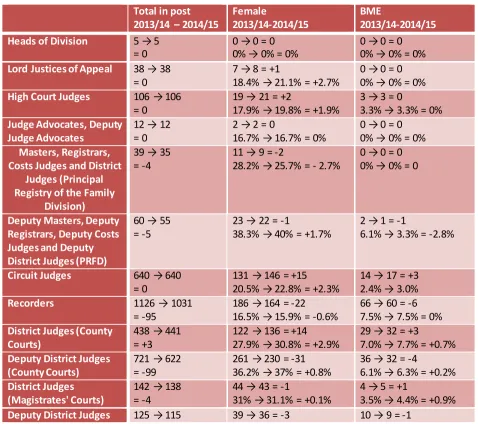
The headline percentage contained within the Judicial Office Statistics Bulletin is that there has been an increase in female judicial office holders in the Courts, rising from 24.5% to 25.2%. However, if one digs further down into the statistics there are other signals of judicial diversification from a gender perspective worth highlighting, including an increase in female:
• District Judges (County Courts): +2.9% (+14 persons, despite only a +3 increase); • Lord Justice of Appeals: +2.7% (+1 person); and,
• Circuit Judges: +2.3% (+15 persons). •
There are also some negative results in relation to gender diversity. In the categories of Masters, Registrars, Costs Judges and District Judges (Principal Registry of the Family Division) and Recorders there were percentage drops of -2.7% (reduction of 2) -0.6% (reduction of 22) respectively, although these must be measured against the drops in judicial office numbers as a whole.
Similarly, there are some positives and negatives that can be derived from the Court statistics relating to BME office holders. Most notably is the increase in BME’s holding office as a District Judge (Magistrates’ Courts), which saw a numerical increase despite a decrease in overall numbers (+1, which equated to 0.9% increase). There was also success in relation to the office of Circuit Judge, where there was a numerical increase (+3) and percentage increase (3%) of BME judges.
The most stark highlights, giving rise to concern, from these statistics is that there remains no female or BME Heads of Division, and only one female judge, but no BME’s, sitting in the Supreme Court. Table 1 also paints a very poor picture in terms of BME representation in the Higher Courts as a whole, with only 3 BME judicial office holders over the first 5 headings.
These statistics show that there are some successes and that diversification, at least from an office holder perspective, is improving, but there are still problems at the upper end of the judicial career ladder.
(ii) Tribunals
Table 2: Comparing the Tribunal office holder diversity statistics of 2013/14 with the 2014/15 statistics
Total in post 2013/14
– 2014/15 Female 2013/14-2014/15 BME 2013/14-2014/15 First-tier Tribunal 4,215 → 3,969
= -246 1,873 → 1,795 = -78 44.4% → 45.2% = +0.7% 581 → 537 = -44 15.1% → 15.2% = +0.1%
[image:3.596.69.536.72.144.2]4 28.4% → 31.8% = +3.4% 10.9% → 10.4% = -0.5%
Employment Tribunal
– England and Wales 1,498 → 1,200 = -298 701 → 624 = -125 46.8% → 48.0% = +1.2% 138 → 119 = -19 9.8% → 10.6% = +0.8%
Employment Tribunal
– Scotland 209 → 200 = -9 96 → 95 = -1 45.9% → 47.5% = +1.6% 3 → 2 = -1 1.6% → 1.1% = -0.5%
Employment Appeal
Tribunal 28 → 23 = -5 9 → 8 = -1 32.1% → 34.8% = +2.7% 4 → 4 = 0 14.3% → 17.4% = +3.1%
Total 6,084 → 5,543
= -541 2,717 → 2,522 = -195 44.7% → 45.5% = +0.8% 740 → 677 = -63 13.2% → 13.5% = +0.3%
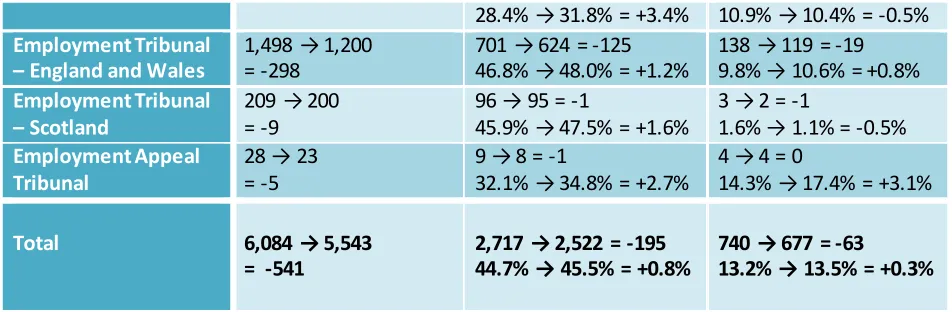
Despite the Judicial Office Statistics Bulletin’s headline that the percentage of female judges increased in Tribunals from 1 April 2014 to 1 April 2015 from 43.0% to 43.8%, the statistics are actually better than this, with there being an increase from 44.7% to 45.5%.8
In terms of gender diversity, the Tribunal figures are positive. Each of the headings recorded a positive percentage increase, the most notable of which was the increase in the Upper Tribunal, where there was a 3.4% increase.
The percentage of BME judges in Tribunal remained fairly static, with one exception, that being in the Employment Appeal Tribunal, which recorded an increase of 3.1%; however, this is due to the number of BME judges remaining static against an overall decrease of 5.
When one compares the Tribunal statistics with the Court statistics there is a marked difference in diversification from a gender and BME perspective, with both gender and BME percentage representation in Tribunals being close to double that of the Courts, suggesting that the Court system as whole lags behind on this front.
Judicial Diversity: which way next?
From the statistical analysis given, judicial diversity appears to be an on-going priority, with both the Judicial Diversity Taskforce9 and the Judicial Diversity Forum having been created with a view to enhancing and implementing measures that would further diversify the body of office holders. Although these bodies have now been amalgamated, the final annual report of the Judicial Diversity Taskforce, published June 2015, was of interest, primarily for the recommendations that it suggested, including10:
[image:4.596.66.542.72.228.2]
8 The bulletin appears to have based its percentage increase on judicial appointments, which are contained in Table 3 below.
5 1. Systematic and consistent monitoring and evaluation of what works and what does not.11 It is important that initiatives are introduced and maintained for a purpose, otherwise much needed resources will be wasted on initiatives that do not serve their purpose. This links back to a suggestion made above, in relation to a need to be consistent between the tables, but also to ensure that data is collected on leaving the judicial system, as this could potentially identify a blockage in the system;
.
2. Engagement with schools and colleges to ensure that students in under-represented groups are aware of a judicial career.12 Career aspirations are developed within an individual from an early age. Without such engagement it is easy to appreciate that those from under-represented groups may be dissuaded from such a career, whether this is based on statistical evidence or anecdotal evidence suggested that a career in the judiciary is a closed group;
.
3. Putting in place a supportive system for suitable and talented candidates from under-represented groups.13 This has great potential to firstly engage with candidates who would not ordinarily consider a judicial career, but also have potential to remove some of the perceived barriers to progression;14 and,
4. Making judicial posts available through flexible working arrangements.15 This is an interesting suggestion, and one that appears to have had success in the general workforce. Opening up judicial posts for flexible working arrangements could further remove barriers to participation, and one, that if implemented, has huge potential.
In total, the taskforce produced 53 Recommendations. Although, the success of the initiatives remain to be tested, and this is likely to be a focus on research in the coming years, by producing such Recommendations, and showing a commitment toward implementation at least shows the driving impetus behind the diversification agenda.
Concluding thoughts…where the pathway ends
There are some positive trends that come out of the 2015 Judicial Diversity Statistics, although there are limitations, especially given that statistics in relation to leaving office as well as appointments (at least on the Court side) are not available. The statistics that are available paint a positive picture at least in terms of upward trends in percentage participation by female and BME judges; however, much of this good work is done in the lower courts, with a barrier to progression to the higher courts seemingly existing.
11 Judicial Diversity Taskforce, Recommendation 8. 12 Judicial Diversity Taskforce, Recommendation 9. 13 Judicial Diversity Taskforce, Recommendation 13.
6 There are a number of initiatives being introduced with a view toward further diversification of the judiciary, which will take time to see whether theirs aims come to fruition in terms of results. In conclusion, there is potential for the judiciary to continue on this upward trend towards diversification, the concept of diversity used is somewhat limited; it is unclear why the idea of diversification is limited to gender and BME’s, which brings this paper full circle. Furthermore, there is a clear need for expansion of the data collected to identify other characteristics, including those with disabilities and sexual orientation. As this data may identify other barriers that the current data will never identify.
~ENDS~