warwick.ac.uk/lib-publications
Original citation:
Francis, Leslie J. and Crea, G.. (2017) Openness to mystical experience and psychological type : a study among Italians. Mental Health, Religion and Culture, 20 (4). 384-397 .
Permanent WRAP URL:
http://wrap.warwick.ac.uk/88592
Copyright and reuse:
The Warwick Research Archive Portal (WRAP) makes this work by researchers of the University of Warwick available open access under the following conditions. Copyright © and all moral rights to the version of the paper presented here belong to the individual author(s) and/or other copyright owners. To the extent reasonable and practicable the material made available in WRAP has been checked for eligibility before being made available.
Copies of full items can be used for personal research or study, educational, or not-for profit purposes without prior permission or charge. Provided that the authors, title and full bibliographic details are credited, a hyperlink and/or URL is given for the original metadata page and the content is not changed in any way.
Publisher’s statement:
This is an Accepted Manuscript of an article published by Taylor & Francis in Mental Health, Religion and Culture on 19 September 2017, available online:
https://doi.org/10.1080/13674676.2017.1328402
A note on versions:
The version presented here may differ from the published version or, version of record, if you wish to cite this item you are advised to consult the publisher’s version. Please see the ‘permanent WRAP url’ above for details on accessing the published version and note that access may require a subscription.
C:\Users\lyslbp\AppData\Local\Microsoft\Windows\Temporary Internet Files\Content.Outlook\OANR45ZE\ces-240517-wrap_-openness_to_mystical_experience_and_psychological_type_revised_3_may_2017_final.docx 25/05/2017
Openness to mystical experience and psychological type: A study among Italians
Leslie J. Francis*
University of Warwick, UK
Giuseppe Crea
Salesian Pontifical University, Rome, Italy
Author note:
*Corresponding author: Leslie J Francis
Warwick Religions & Education Research Unit Centre for Education Studies
The University of Warwick
Coventry CV4 7AL United Kingdom Tel: +44 (0)24 7652 2539 Fax: +44 (0)24 7657 2638
Abstract
This study examines Ross’ thesis that intuitive types are more open than sensing types to
mystical experience among a sample of 1,155 Italians who completed the Francis
Psychological Type Scales alongside the Mystical Orientation Scale. The data supported
Ross’ thesis. Intuitive types recorded a significantly higher mean score than sensing types on
the index of mystical orientation. Ranking the sixteen complete types according to their mean
mystical orientation scores located INFPs with the highest scores and ISTJs with the lowest
scores.
Introduction
The connection between personality and religious experience has been of interest to
the empirical psychology of religion since the early days of the emerging discipline (see
Argyle, 1958). The empirical investigation of this problem has been consistently hampered
by lack of consensus regarding appropriate models and measures of personality and
appropriate models and measures of religious experience through which the problem could be
operationalised. One systematic approach to this problem has adopted the model of
personality proposed by psychological type theory and the model of religious experience
proposed by the investigation of mysticism. The present study stands within that tradition.
Psychological type theory
Alongside studies employing the Big Five Factor model of personality proposed by
Costa and McCrae (1985) in the USA and the Major Three Dimensions model of personality
proposed by Eysenck and Eysenck (1975) in the UK, psychological type theory has regained
visibility in the empirical psychology of religion within recent years (for reviews see Francis,
2009; Ross, 2011). A special issue of Research in the Social Scientific Study of Religion
(Village, 2011) and two special issues of Mental Health, Religion & Culture (Lewis, 2012,
2015) have played their part in stimulating this growing visibility. Psychological type theory
is distinguished from the models proposed by Costa and McCrae (1985) and by Eysenck and
Eysenck (1975) in two important ways. Psychological type is rooted in psychological theory
rather than in statistical modelling; psychological type conceives individual differences in
terms of discrete categories rather than in terms of continua. Both of these characteristics
remain controversial within the psychological literature (see Bayne, 1995, 2004, 2005).
The understanding of human mental functioning on which psychological type theory
builds distinguishes between two core psychological processes, the irrational or perceiving
ordering, the irrational process (perceiving) is concerned with the ways in which people
gather information, while the rational process (judging) is concerned with the ways in which
people evaluate information. Each of these two core psychological processes is expressed
through two contrasting functions (Jung, 1971). In its current developed form psychological
type theory also distinguishes between two orientations or directions of psychological energy
and between two attitudes toward the external world.
In terms of the perceiving process, sensing types focus on the realities of a situation as
perceived by the senses. They are concerned with the actual, the real and the practical. They
tend to be down to earth and matter of fact. Intuitive types focus on the possibilities of a
situation, perceiving meanings and relationships. In terms of the judging process, thinking
types focus on the abstract, logical and systematic aspects of a situation, thereby privileging
consistency. They evaluate through the mind. Feeling types focus on the interpersonal values
and the relational aspects of a situation, thereby privileging consideration and sensitivity to
the human consequences. They evaluate through the heart. In terms of the orientations,
introverts are energised by the inner world of ideas and can be drained by too much
engagement with the outer world of people and events. Extraverts are energised by the outer
world and by interaction with people and events. They can be drained or immobilised by too
much solitude and isolation. In terms of the attitudes toward the external world, perceiving
types engage their preferred perceiving function (sensing or intuition) in the outer world and
consequently present an open, flexible, spontaneous approach to the outer world. Judging
types engage their preferred judging function (thinking or feeling) in the outer world and
consequently present an organised, planned and disciplined approach to the outer world.
While the two perceiving functions, the two judging functions, the two orientations,
and the two attitudes toward the external world form the conceptual foundations for the
a range of useful ways including the following. The notion of dominant type preference
suggests four clear main strengths in terms of dominant sensing, dominant intuition,
dominant thinking, and dominant feeling. The notion of dominant type preference being
complemented by auxiliary preferences (drawn from the other process) suggests eight
dominant auxiliary pairings. Bringing all four components of type theory into play suggests
sixteen complete types.
Psychological type theory has been made accessible for empirical research through the
development of a number of psychometric instruments. Three of these instruments have
become particularly visible within the empirical psychology of religion, namely the Keirsey
Temperament Sorter (Keirsey & Bates, 1978), the Myers-Briggs Type Indicator (Myers &
McCaulley, 1985), and the Francis Psychological Type Scales (Francis, 2005). While each of
these instruments has been designed to assess the same fundamental constructs, each has been
shaped with distinctive strengths within different contexts: the Keirsey Temperament Sorter
has been designed as a convenient tool for self-assessment, the Myers-Briggs Type Indicator
has been designed as especially useful in clinical and assessment contexts, and the Francis
Psychological Type Scales have been designed especially for inclusion in survey-type
research. The Francis Psychological Type Scales have been used in a range of recent
empirical studies within the broad field of the psychology of religion, including work
reported by Baker (2015), Baker and Robbins (2012), Francis and Crea (2015), Francis and
Datoo (2012), Francis, Fisher, and Annis (2015), Francis, Littler, and Robbins (2012),
Francis, Robbins, and Jones (2012), Francis, Robbins, and Powell (2015), Francis, Stone, and
Robbins (2015), Lankshear and Francis (2015), Lewis, Varvatsoulias, and Williams (2012),
Muskett and Village (2015), Payne and Lewis (2015), Powell, Robbins, and Francis (2012),
Ross and Francis (2015), Village (2012a, 2012b, 2015), Village, Baker, and Howat (2012),
Walker (2012, 2015), and Williams, Francis, Billington, and Robbins (2012).
Psychological type theory and religiosity
Because the model of personality proposed by psychological type is grounded in
theory it is reasonable to extrapolate from the basic theory potential connections between
personality and individual differences in religious expression, experience, and belief. On this
basis, Ross (1992) argued that the perceiving process (distinguishing between sensing and
intuition) is of central importance. In an initial empirical investigation of this hypothesis,
Ross, Weiss, and Jackson (1996) found that intuitive types were more comfortable than
sensing types with complexity of religious beliefs, while sensing types were more definite
than intuitive types regarding what counted as religious to them. Sensing types drew firmer
boundaries between what they regarded as secular and what they regarded as sacred. Intuitive
types were more open to religious change, seeing new insights as important for a healthy
religious life, while sensing types were more likely to see changes in personal faith as a sign
of religious weakness. In a second study, Francis and Ross (1997) explored the differences
between sensing types and intuitive types with regard to preference in Christian spirituality.
They found that intuitive types showed a higher appreciation than sensing types for
experiential spirituality (like witnessing a fine sunset or being inspired by a star filled sky),
while sensing types showed a higher appreciation than intuitive types for institutional
expressions of spirituality (like church attendance and personal prayer).
Empirical findings like those reported by Ross, Weiss, and Jackson (1996), and
Francis and Ross (1997), lead to the clear hypothesis that intuitive types may show a higher
appreciation or a greater openness to mystical experience in comparison with sensing types.
This is a clear hypothesis that can be tested by means of drawing on well-defined
conceptualisations. The theoretical framework proposed by Stace (1960) formed the basis for
the Hood Mysticism Scale (Hood, 1975). The theoretical framework proposed by Happold
(1963) formed the basis for the Francis-Louden Mystical Orientation Scale (Francis &
Louden, 2000a). The present study is set within the framework proposed by Happold (1963)
as operationalised by the Francis-Louden Mystical Orientation Scale (MOS), an instrument
that has been used in a range of studies, including work reported by Bourke, Francis and
Robbins (2004), Francis, Village, Robbins, and Ineson (2007), Edwards and Lowis (2008a,
2008b), Francis and Littler (2012), Francis, Littler, and Robbins (2012), and Francis,
Robbins, and Cargas (2012). A shorter instrument derived from the MOS (Francis & Louden,
2000a), the Short Index of Mystical Orientation (SIMO), was proposed by Francis and
Louden (2004) and has been used by Francis and Thomas (1996), Francis and Louden
(2000b), and Francis (2002).
Happold’s (1963) definition of mysticism embraced seven key characteristics, the first
four of which were taken directly from James (1982): ineffability, noesis, transiency,
passivity, consciousness of the oneness of everything, sense of timelessness, and true ego (or
self). The MOS proposes three indicators of each of these seven characteristics in order to
construct a 21-item measure. Ineffability concerns the private or incommunicable quality of
mystical experience. Noesis concerns the insights into knowledge and truth conveyed by
mystical experience. Transiency concerns the brief, inconsistent passing, and intermittent
nature of mystical experience. Passivity concerns the undeserved and gratuitous nature of
mystical experience. Consciousness of the oneness of everything concerns the sense in which
existence is perceived as a unity by mystical experience. Sense of timelessness concerns how
mystical experience appears to have a timeless quality and to occupy an entirely different
dimension from that of any known sense of time. True ego concerns how mystical experience
reported an alpha coefficient of internal consistency reliability of .94 for this instrument
(Cronbach, 1951).
Psychological type and mystical orientation
So far six studies, all conducted within England and Wales, have examined the
association between scores recoded on the MOS or the SIMO and individual differences
recorded on the Jungian perceiving process. Two of these studies employed the SIMO.
Francis and Louden (2000b) administered the SIMO together with the Keirsey Temperament
Sorter (Keirsey, 1998) to a sample of 100 student and adult churchgoers. These data
supported Ross’ hypothesis with significantly higher scores of mystical orientation reported
among intuitive types (M = 30.6, SD = 7.5) than among sensing types (M = 25.6, SD = 8.7).
Francis (2002) administered the SIMO together with the Myers-Briggs Type Indicator
(Myers & McCaulley, 1985) to a sample of 543 participants attending workshops concerned
with personality and spirituality. These data did not support Ross’ hypothesis with no
significant differences reported between intuitive types (M = 30.2, SD = 7.6) and sensing
types (M = 29.0, SD = 7.7).
The other four studies employed the MOS together with the Francis Psychological
Type Scales (FPTS; Francis, 2005). Francis, Village, Robbins, and Ineson (2007)
administered the MOS and FPTS to a sample of 318 guests who had stayed at a Benedictine
Abbey. These data supported Ross’ (1992) hypothesis with significantly higher scores of
mystical orientation reported among intuitive types (M = 77.9, SD = 17.4) than among
sensing types (M = 71.4, SD = 18.3). Francis, Robbins, and Cargas (2012) administered the
MOS and FPTS to a sample of 580 participants from a range of religious and spiritual
traditions attending the Parliament of the World’s Religions in Barcelona, 2004. These data
supported Ross’ hypothesis with significantly higher scores of mystical orientation reported
15.8). Francis, Littler, and Robbins (2012) administered the MOS and the FPTS to a sample
of 232 Anglican clergymen serving in the Church in Wales. These data supported Ross’
hypothesis with significantly higher scores of mystical orientation among intuitive types (M =
65.1, SD = 15.8) than among sensing types (M = 59.8, SD = 15.1). Ross and Francis (2015)
administered the MOS and the FPTS to a sample of 149 adolescents between the ages of 16
and 18 years. These data supported Ross’ hypothesis with significantly higher scores of
mystical orientation among intuitive types (M = 49.7, SD = 18.6) than among sensing types
(M = 42.7, SD = 15.3).
While five of these six studies support Ross’ (1992) hypothesis that intuitive types are
more open to mystical orientation than sensing types, other information concerning the
connection between psychological type and mystical orientation also emerges from these
studies. Three of the studies found higher mystical orientation scores among feeling types
than among thinking types (Francis & Louden, 2000b; Francis, 2002; Francis, Robbins, &
Cargas, 2012). Two of the studies found higher mystical orientation scores among perceiving
types than among judging types (Francis, Robbins, & Cargas, 2012; Francis & Littler, 2012).
Research question
A limitation with the research programme designed to test Ross’ hypothesis regarding
the association between psychological type and openness to mystical orientation is that all six
studies have been confined to one geographical location, historically shaped by an Anglican
or Reformed Christian tradition. The aim of the present study is to build on the research
tradition within a very different geographical location shaped by the Catholic Christian
tradition. A second limitation with the six studies is that only one of them exceeded a sample
size of 500 and that makes it difficult for type-based analyses that can extend from the basis
comparisons between the dichotomous pairs on which type theory is constructed to examine
the sixteen complete types. The aim of the present study is to build on the research tradition
with a sample of over 1,000 participants.
Method
Procedure
Participants were drawn from all over Italy (North, Central, and South) by a team of
trainee psychologists operating under the supervision of a senior psychologist within the
Institute of Psychology at the Salesian University in Rome. Participation was anonymous,
and no monetary reward was offered or given. The informed consent procedure required
written consent prior to participation, as agreed with the Institutional Review Board of the
Salesian University. Questionnaires were administered, mainly at home, in the presence of a
trainee psychologist. A total of 1,155 individuals submitted thoroughly completed
questionnaires.
Measures
Mystical orientation was assessed by an Italian translation of the revised form of the
Francis-Louden Mystical Orientation Scale (MOS; Francis & Louden, 2000a). This is a
21-item measure containing three 21-items to access each of the seven key characteristics of
mysticism identified by Happold (1963): ineffability, noesis, transiency, passivity,
consciousness of the oneness of everything, sense of timelessness, and true ego. The revised
form of this instrument expresses these characteristics of mysticism in ways independent of
traditional ‘religious’ language. Respondents were asked to assess ‘how important each
experience is to your life’, using a five-point scale anchored by: 1 = low importance; 2 =
some importance; 3 = medium importance; 4 = quite high importance; 5 = high importance.
Psychological type was assessed by an Italian translation of the Francis Psychological
Type Scales (FPTS; Francis, 2005). This 40-item instrument comprises four sets of 10
(extraversion or introversion), perceiving process (sensing or intuition), judging process
(thinking or feeling), and attitude toward the outer world (judging or perceiving). A number
of studies have demonstrated this instrument to function well in church-related contexts. For
example, Francis, Craig, and Hall (2008) reported alpha coefficients of .83 for the EI scale,
.76 for the SN scale, .73 for the TF scale, and .79 for the JP scale. Participants were asked for
each pair of characteristics to check the ‘box next to that characteristic which is closer to the
real you, even if you feel both characteristics apply to you. Tick the characteristics that reflect
the real you, even if other people see you differently’.
Participants
The participants (N = 1,115) comprised 538 men and 617 women ranging in age from
14 to 80 years (M = 30.69, SD = 15.13); 247 were in their teens, 493 in their twenties, 199 in
their thirties or forties, and 216 were aged fifty or over; 878 were from Central Italy, 69 from
North Italy, and 208 from South Italy. In terms of religious worship attendance, 366 never
attended services, 342 attended services at least once a month (of whom 276 attended
weekly), and the remaining 447 attended less frequently than once a month. In terms of
personal prayer, 402 never prayed, 311 prayed occasionally, 61 prayed at least once a month,
104 prayed at least once a week, and 277 prayed almost every day.
Analysis
The research literature concerning the empirical investigation of psychological type
has developed a highly distinctive method for analyzing, handling, and displaying statistical
data in the form of ‘type tables’. This convention has been adopted in the following
presentation in order to integrate these new data within the established literature and to
provide all the detail necessary for secondary analysis and further interpretation within the
rich theoretical framework afforded by psychological type. Type tables have been designed to
dichotomous preferences, about the six sets of pairs and temperaments, about the dominant
types, and about the introverted and extraverted Jungian types. Commentary on this table
will, however, be restricted to those aspects of the data strictly relevant to the research
question.
Results
- insert table 1 about here -
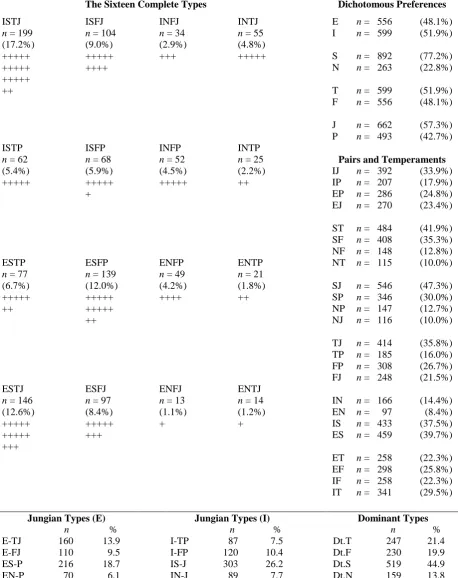
The type distribution for the sample of 1,155 Italian participants is presented in table
1 in the conventional format. In terms of the dichotomous preferences, these data identify a
close balance in preferences between introversion (52%) and extraversion (48%), a close
balance in preferences between thinking (52%) and feeling (48%), a preference for judging
(57%) over perceiving (43%), and a strong preference for sensing (77%) over intuition
(23%). In terms of dominant type preferences, the most frequently occurring type was
dominant sensing (45%), followed by dominant thinking (21%), dominant feeling (20%) and
dominant intuition (14%). In terms of the sixteen complete types, the most frequently
occurring types were ISTJ (17%), ESTJ (13%), and ESFP (12%).
- insert table 2 about here -
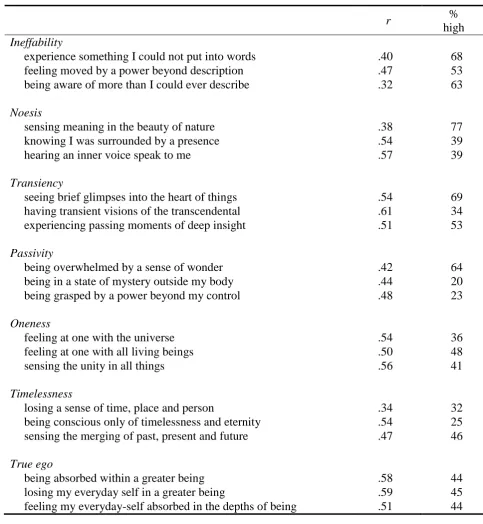
The second step in the data analysis comprised an evaluation of the measure of
mystical orientation. Table 2 presents the 21 items of the Francis-Louden Mystical
Orientation Scale, together with the item rest-of-test correlations and the proportions of the
respondents who rated the importance of the experience for their own faith as four or as five
on the five-point scale. The scale achieved the satisfactory alpha coefficient of .89. All the 21
items contributed positively to the homogeneity of the scale, with item rest-of-test
correlations ranging between .32 and .61.
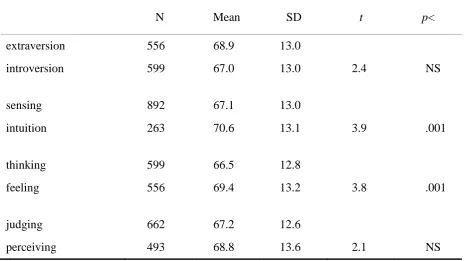
The third step in data analysis explored the connection between psychological type
and scores recorded on the Mystical Orientation Scale in terms of the four dichotomous type
preferences. The data presented in table 3 supported Ross’ hypothesis with significantly
higher mean scores of mystical orientation reported among intuitive types (M = 70.6, SD =
13.1) than among sensing types (M = 67.1, SD = 13.0). These data also demonstrate that there
are significantly higher mean scores of mystical orientation reported among feeling types (M
= 69.4, SD = 13.2) than among thinking types (M = 66.5, SD = 12.8), but no significant
differences in the mean scores of mystical orientation recorded by introverts and extraverts,
or by perceiving types and judging types.
- insert tables 4 and 5 about here -
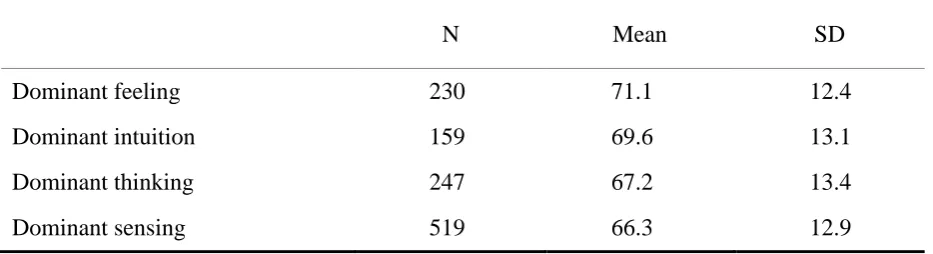
Table 4 explores the association between mean mystical orientation scores and the
four dominant type preferences. These data show the highest mean scores among dominant
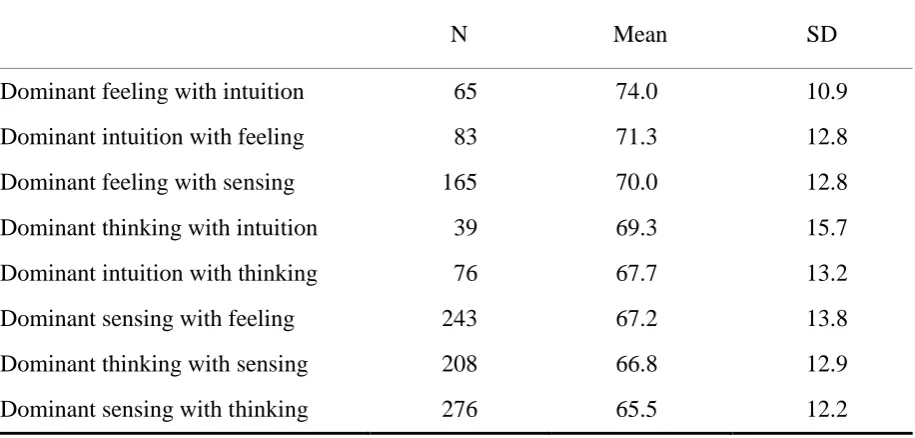
feeling types and the lowest among dominant sensing types. Table 5 takes the analyses one
step further by exploring the association between mean mystical orientation scores and the
eight dominant auxiliary preferences. These data show the linkage between intuition and
feeling with openness to mystical experience, with the two highest mean scores being
recorded by dominant feeling with auxiliary intuition and by dominant intuition with
auxiliary feeling.
- insert table 6 about here -
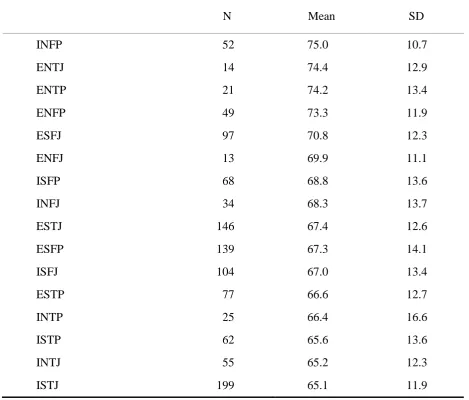
Table 6 completes the picture by rank ordering mean scores of mystical orientation
against the sixteen complete types. According to this table the highest mean scores are
recorded by INFPs and the lowest by ISTJs.
Discussion and conclusion
The present study has built on previous research by means of careful and deliberate
in mystical orientation are related to the perceiving process (sensing and intuition). Now in
five studies the measures have been held constant (the Francis-Louden Mystical Orientation
Scale and the Francis Psychological Type Scales) and the samples have been varied to
include 318 guests who had stayed at a Benedictine Abbey (representing Christians from a
range of denominations), 580 participants attending the 2004 Parliament of the World’s
Religions (representing a wide range of spiritual and religious traditions), 232 Anglican
clergymen (representing religious professionals within one tradition), 149 religious studies
students (representing a mix of adolescents actively engaged with public worship attendance
and adolescents not so engaged), and 1,155 Italians (ranging in age from 14 to 80 years).
Data from all five studies confirmed Ross’ (1992) thesis by demonstrating significantly
higher mystical orientation scores among intuitive types than among sensing types.
As well as providing further evidence in support of the general thesis that
significantly higher mystical orientation scores are recorded by intuitive types than by
sensing types, the present study adds to knowledge by demonstrating for the first time that
this association holds true outside the culture of England and Wales shaped by and Anglican
or Reformed Christian tradition. The present study was conducted among participants in
Italy, a culture shaped by the Catholic tradition.
The findings from this study also prompt some further interrogation of Ross’ (1992)
thesis. Of the seven studies that have set out to test Ross’ thesis, using either the MOS or the
SIMO, four of these studies have also reported a significant linkage between mystical
orientation scores and the judging process, with higher scores being recorded by feeling types
than by thinking types. The further analyses facilitated by the larger sample of participants
for the present study have demonstrated: that, in terms of the four dominant types, dominant
feeling types record the highest mean scores on the index of mystical orientation; that, in
dominant intuition with auxiliary feeling record the highest mean scores on the index of
mystical orientation; and that in terms of the sixteen complete types INFPs appear in top
place for the ranking of mean scores on the index of orientation.
In other words, Ross’ application of theory to explaining individual differences in
openness to mystical experience may not be as simple as it at first appeared. A richer
understanding of the connection between psychological type and openness to mystical
experience needs to embrace both the perceiving process and the judging process,
recognising that the combination between intuition and feeling may release greater openness
to mystical experience.
Moreover, the location of INFPs as those most open to mystical experience draws
attention to the distinctive characteristics of this type where dominant introverted feeling is
complemented by auxiliary extraverted intuition. In the brief description of the sixteen
complete types, Myers (1998, p. 7) characterises INFPs in the following way:
Quiet observers, idealistic, loyal. Important that outer life be congruent with inner
values. Curious, quick to see possibilities, often serve as catalysts to implement ideas.
Adaptable, flexible and accepting unless a value is threatened. Want to understand
people and ways of fulfilling human potential. Little concern for possessions or
surroundings.
The next step in progressing this body of research now needs to step entirely outside
the Christian and part-Christian contexts to explore whether the same associations between
psychological type and openness to mystical experience pertain in contexts shaped by other
References
Argyle, M. (1958). Religious behaviour. London: Routledge and Kegan Paul.
doi.org/10.4324/9780203001271
Baker, M. J. (2015). Psychological type differences between churchgoers and church-leavers.
Mental Health, Religion & Culture, 18, 622-634.
doi.org/10.1080/13674676.2014.961247
Baker, M. J., & Robbins, M. (2012). American on-line atheists and psychological type.
Mental Health, Religion & Culture, 14, 1077-1084.
doi.org/10.1080/13674676.2012.707433
Bayne, R. (1995). The Myers-Briggs Type Indicator: A critical review and practical guide.
London: Chapman and Hall.
Bayne, R. (2004). Psychological types at work: An MBTI perspective. London: Thomson.
Bayne, R. (2005). Ideas and evidence: Critical reflections on MBTI theory and practice.
Gainesville, FL: CAPT.
Bourke, R., Francis, L. J., & Robbins, M. (2004). Mystical orientation among church
musicians. Transpersonal Psychology Review, 2, 14-19.
Costa, P. T., & McCrae, R. R. (1985). The NEO Personality Inventory. Odessa, FL:
Psychological Assessment Resources.
Cronbach, L. J. (1951). Coefficient alpha and the internal structure of tests. Psychometrika,
16, 297-334. doi.org/10.1007/BF02310555
Edwards, A. C., & Lowis, M. J. (2008a). Construction and validation of a scale to assess
attitudes to mysticism: The need for a new scale for research in the psychology of
Edwards, A. C., & Lowis, M. J. (2008b). Attitudes to mysticism: Relationship with
personality in Western and Eastern mystical traditions. Spirituality and Health
International, 9, 145-160. doi.org/10.1002/shi.342
Eysenck, H. J., & Eysenck, S. B. G. (1975). Manual of the Eysenck Personality
Questionnaire (adult and junior). London: Hodder and Stoughton.
Francis, L. J. (2002). Psychological type and mystical orientation: Anticipating individual
differences within congregational life. Pastoral Sciences, 21, 77-99.
Francis, L. J. (2005). Faith and psychology: Personality, religion and the individual. London:
Darton, Longman and Todd.
Francis, L. J. (2009). Psychological type theory and religious and spiritual experiences. In M.
De Souza, L. J. Francis, J. O’Higgins-Norman, & D. G. Scott (Eds.), International
Handbook of education for spirituality, care and wellbeing (pp. 125-146). Dordrecht:
Springer. doi.org/10.1007/978-1-4020-9018-9_8
Francis, L. J., Craig, C. L., & Hall, G. (2008). Psychological type and attitude toward Celtic
Christianity among committed churchgoers in the United Kingdom: An empirical
study. Journal of Contemporary Religion, 23, 181-191.
doi.org/10.1080/13537900802024543
Francis, L. J., & Crea, G (2015). Work-related psychological health and psychological type:
A study among Catholic priests in Italy. Mental Health, Religion & Culture, 18,
593-604. doi.org/10.1080/13674676.2014.963996
Francis, L. J., & Datoo, F. A. (2012). Inside the mosque: A study in psychological type
profiling. Mental Health, Religion & Culture, 15, 1037-1046.
Francis, L. J., Fisher, J. W., & Annis, J. (2015). Spiritual wellbeing and psychological type: A
study among visitors to a medieval cathedral in Wales. Mental Health, Religion &
Culture, 18, 675-692. doi.org/10.1080/13674676.2014.964002
Francis, L. J, & Littler, K. (2012). Mystical orientation and psychological health: A study
employing Eysenck’s dimensional model of personality among clergymen in the
Church in Wales. Welsh Journal of Psychology, 1, 4-10.
Francis, L. J., & Littler, K., & Robbins, M. (2012). Mystical orientation and the perceiving
process: A study among Anglican clergymen. Mental Health, Religion & Culture, 15,
945-953. doi.org/10.1080/13674676.2012.676257
Francis, L. J., & Louden, S. H. (2000a). The Francis-Louden Mystical Orientation Scale
(MOS): A study among Roman Catholic priests. Research in the Social Scientific
Study of Religion, 11, 99-116.
Francis, L. J., & Louden, S. H. (2000b). Mystical orientation and psychological type: A study
among student and adult churchgoers. Transpersonal Psychology Review, 4 (1),
36-42.
Francis, L. J., & Louden, S. H. (2004). A Short Index of Mystical Orientation (SIMO): A
study among Roman Catholic priests. Pastoral Psychology, 53, 49-51.
doi.org/10.1023/B:PASP.0000039325.40451.65
Francis, L. J., Robbins, M., & Cargas, S. (2012). The perceiving process and mystical
orientation: An empirical study in psychological type theory among participants at the
Parliament of the World’s Religions. Studies in Spirituality, 22, 341-352.
Francis, L. J., Robbins, M., & Jones, S. H. (2012). The psychological type profile of
clergywomen in ordained local ministry in the Church of England: Pioneers or
custodians? Mental Health, Religion & Culture, 15, 945-953.
Francis, L. J., Robbins, M., & Powell, R. (2015). The psychological type profile of Christians
participating in fellowship groups or in small groups: Insights from the Australian
National Church Life Survey. Mental Health, Religion & Culture, 18, 635-640.
doi.org/10.1080/13674676.2014.964000
Francis, L. J., & Ross, C. F. J. (1997). The perceiving function and Christian spirituality:
Distinguishing between sensing and intuition. Pastoral Sciences, 16, 93-103.
Francis, L. J., Stone, C., & Robbins, M. (2015). Do different psychological types look for
different things in sermons? A research note. Mental Health, Religion & Culture, 18,
712-714. doi.org/10.1080/13674676.2014.964001
Francis, L. J., & Thomas, T. H. (1996). Mystical orientation and personality among Anglican
clergy. Pastoral Psychology, 45, 99-105. doi.org/10.1007/BF02260016
Francis, L. J., Village, A., Robbins, M., & Ineson, K. (2007). Mystical orientation and
psychological type: An empirical study among guests staying at a Benedictine Abbey.
Studies in Spirituality, 17, 207-223. doi.org/10.2143/SIS.17.0.2024649
Happold, F. C. (1963). Mysticism: A study and an anthology. Harmondsworth: Penguin.
Hood, R. W. (1975). The construction and preliminary validation of a measure of reported
mystical experience. Journal for the Scientific Study of Religion, 14, 29-41.
doi.org/10.2307/1384454
James, W. (1982). The varieties of religious experience. Harmondsworth: Penguin.
Jung, C. G. (1971). Psychological types: The collected works (volume 6). London:
Routledge and Kegan Paul.
Keirsey, D. (1998). Please Understand Me: 2. Del Mar, CA: Prometheus Nemesis.
Lankshear, D. W., & Francis, L. J. (2015). Inside Southwark Cathedral: A study in
psychological-type profiling. Mental Health, Religion & Culture, 18, 664-674.
doi.org/10.1080/13674676.2014.961705
Lewis, C. A. (2012). Psychological type, religion, and culture: Theoretical and empirical
perspectives. Mental Health, Religion & Culture, 15, 817-821.
doi.org/10.1080/13674676.2012.721534
Lewis, C. A. (2015). Psychological type, religion, and culture: Further empirical perspectives.
Mental Health, Religion & Culture, 18, 531-534.
doi.org/10.1080/13674676.2015.1103520
Lewis, C. A., Varvatsoulias, G., & Williams, E. (2012). The psychological type profile of
practising Greek Orthodox Christians in London. Mental Health, Religion & Culture,
14, 979-986. doi.org/10.1080/13674676.2012.720753
Muskett, J. A., & Village, A. (2015). Created to be guardians? Psychological type profiles of
members of cathedral Friends associations in England. Mental Health, Religion &
Culture, 18, 641-654. doi.org/10.1080/13674676.2014.961249
Myers, I. B. (1998). Introduction to type: A guide to understanding your results on the
Myers-Briggs Type Indicator (fifth edition, European English version). Oxford: Oxford
Psychologists Press.
Myers, I. B., & McCaulley, M. H. (1985). Manual: A guide to the development and use of the
Myers-Briggs Type Indicator. Palo Alto, CA: Consulting Psychologists Press.
Payne, V. J., & Lewis, C. A. (2015). Confirming the psychological type profile of Anglican
clergymen in Wales: A ministry for sensing types. Mental Health, Religion &
Powell, R., Robbins, M., & Francis, L. J. (2012). The psychological type profile of lay church
leaders in Australia. Mental Health, Religion & Culture, 15, 905-918.
doi.org/10.1080/13674676.2012.686478
Randall, K. (2015). Early and late responders to questionnaires: Clues from psychological
type. Mental Health, Religion & Culture, 18, 566-575.
doi.org/10.1080/13674676.2014.961248
Robbins, M., Francis, L. J., & Powell, R. (2012a). Work-related psychological health among
clergywomen in Australia. Mental Health, Religion & Culture, 15, 933-944.
doi.org/10.1080/13674676.2012.698044
Robbins, M., Francis, L. J., & Powell, R. (2012b). Congregational bonding social capital and
psychological type: An empirical enquiry among Australian churchgoers. Mental
Health, Religion & Culture, 15, 1009-1022.doi.org/10.1080/13674676.2012.676264
Robbins, M., & Powell, R. (2015). Psychological type profile of Protestant church leaders in
Australia: Are clergymen and clergywomen different? Mental Health, Religion &
Culture, 18, 576-585. doi.org/10.1080/13674676.2014.963997
Ross, C. F. J. (1992). The intuitive function and religious orientation. Journal of Analytical
Psychology, 37, 83-103. doi.org/10.1111/j.1465-5922.1992.00083.x
Ross, C. F. J. (2011). Jungian typology and religion: A perspective from North America.
Research in the Social Scientific Study of Religion, 22, 165-191.
doi.org/10.1163/ej.9789004207271.i-360.30
Ross, C. F. J., & Francis, L. J. (2015). The perceiving process and mystical orientation: A
study in psychological type theory among 16- to 18-year-old students. Mental Health,
Ross, C. F. J., Weiss, D., & Jackson, L. M. (1996). The relation of Jungian psychological
type to religious attitudes and practices. International Journal for the Psychology of
Religion, 6, 263-279. doi.org/10.1207/s15327582ijpr0604_3
Stace, W. T. (1960). Mysticism and philosophy. Philadelphia, PA: Lippincott.
Village, A. (2011). Introduction to special section: Psychological type and Christian ministry.
Research in the Social Scientific Study of Religion, 22, 157-164.
doi.org/10.1163/ej.9789004207271.i-360.28
Village, A. (2012a). Biblical literalism among Anglican clergy: What is the role of
psychological type? Mental Health, Religion & Culture, 14, 969-978.
doi.org/10.1080/13674676.2012.686479
Village, A. (2012b). Psychological type profiles of biblical scholars: An empirical enquiry
among members of the Society of Biblical Literature. Mental Health, Religion &
Culture, 14, 1047-1053. doi.org/10.1080/13674676.2012.681484
Village, A. (2015). Psychological type functions and biblical scholarship: An empirical
enquiry among members of the Society of Biblical Literature. Mental Health,
Religion & Culture, 18, 605-621. doi.org/10.1080/13674676.2014.961246
Village, A., Baker, S., & Howatt, S. (2012). Psychological type profiles of churchgoers in
England. Mental Health, Religion & Culture, 14, 987-995.
doi.org/10.1080/13674676.2012.686479
Walker, D. S. (2012). O Come all ye thinking types: The wider appeal of the cathedral carol
service. Mental Health, Religion & Culture, 15, 987-995.
doi.org/10.1080/13674676.2012.707436
Walker, D. S. (2015). Unsettling the guardian: Quest religiosity and psychological type
among Anglican churchgoers. Mental Health, Religion & Culture, 18, 655-663.
Williams, E., Francis, L. J., Billington, U., & Robbins, M. (2012). The psychological type
profile of practising British Druids compared with Anglican churchgoers. Mental
Table 1
Type distribution for Italian participants
The Sixteen Complete Types Dichotomous Preferences
ISTJ ISFJ INFJ INTJ E n = 556 (48.1%)
n = 199 n = 104 n = 34 n = 55 I n = 599 (51.9%)
(17.2%) (9.0%) (2.9%) (4.8%)
+++++ +++++ +++ +++++ S n = 892 (77.2%)
+++++ ++++ N n = 263 (22.8%)
+++++
++ T n = 599 (51.9%)
F n = 556 (48.1%)
J n = 662 (57.3%)
P n = 493 (42.7%)
ISTP ISFP INFP INTP
n = 62 n = 68 n = 52 n = 25 Pairs and Temperaments
(5.4%) (5.9%) (4.5%) (2.2%) IJ n = 392 (33.9%)
+++++ +++++ +++++ ++ IP n = 207 (17.9%)
+ EP n = 286 (24.8%)
EJ n = 270 (23.4%)
ST n = 484 (41.9%)
SF n = 408 (35.3%)
NF n = 148 (12.8%)
ESTP ESFP ENFP ENTP NT n = 115 (10.0%)
n = 77 n = 139 n = 49 n = 21
(6.7%) (12.0%) (4.2%) (1.8%) SJ n = 546 (47.3%)
+++++ +++++ ++++ ++ SP n = 346 (30.0%)
++ +++++ NP n = 147 (12.7%)
++ NJ n = 116 (10.0%)
TJ n = 414 (35.8%)
TP n = 185 (16.0%)
FP n = 308 (26.7%)
FJ n = 248 (21.5%)
ESTJ ESFJ ENFJ ENTJ
n = 146 n = 97 n = 13 n = 14 IN n = 166 (14.4%)
(12.6%) (8.4%) (1.1%) (1.2%) EN n = 97 (8.4%)
+++++ +++++ + + IS n = 433 (37.5%)
+++++ +++ ES n = 459 (39.7%)
+++
ET n = 258 (22.3%)
EF n = 298 (25.8%)
IF n = 258 (22.3%)
IT n = 341 (29.5%)
Jungian Types (E) Jungian Types (I) Dominant Types
n % n % n %
E-TJ 160 13.9 I-TP 87 7.5 Dt.T 247 21.4
E-FJ 110 9.5 I-FP 120 10.4 Dt.F 230 19.9
ES-P 216 18.7 IS-J 303 26.2 Dt.S 519 44.9
EN-P 70 6.1 IN-J 89 7.7 Dt.N 159 13.8
Table 2
Mystical Orientation Scale: Correlation coefficients for each item with the rest of test and
item endorsement
r %
high Ineffability
experience something I could not put into words .40 68
feeling moved by a power beyond description .47 53
being aware of more than I could ever describe .32 63
Noesis
sensing meaning in the beauty of nature .38 77
knowing I was surrounded by a presence .54 39
hearing an inner voice speak to me .57 39
Transiency
seeing brief glimpses into the heart of things .54 69
having transient visions of the transcendental .61 34
experiencing passing moments of deep insight .51 53
Passivity
being overwhelmed by a sense of wonder .42 64
being in a state of mystery outside my body .44 20
being grasped by a power beyond my control .48 23
Oneness
feeling at one with the universe .54 36
feeling at one with all living beings .50 48
sensing the unity in all things .56 41
Timelessness
losing a sense of time, place and person .34 32
being conscious only of timelessness and eternity .54 25
sensing the merging of past, present and future .47 46
True ego
being absorbed within a greater being .58 44
losing my everyday self in a greater being .59 45
feeling my everyday-self absorbed in the depths of being .51 44
Note: r = correlation between individual item and sum of other items
% high = sum of high importance and quite high importance
Table 3
Mean mystical orientation scores by dichotomous type preference
Note: Probability level set out at one percent
N Mean SD t p<
extraversion 556 68.9 13.0
introversion 599 67.0 13.0 2.4 NS
sensing 892 67.1 13.0
intuition 263 70.6 13.1 3.9 .001
thinking 599 66.5 12.8
feeling 556 69.4 13.2 3.8 .001
judging 662 67.2 12.6
Table 4
Mean mystical orientation scores by dominant type
F (df 3, 1151) = 8.5, p < .001
N Mean SD
Dominant feeling 230 71.1 12.4
Dominant intuition 159 69.6 13.1
Dominant thinking 247 67.2 13.4
Table 5
Mean mystical orientation scores by dominant with auxiliary type
F (df 7, 1147) = 5.2, p < .001
N Mean SD
Dominant feeling with intuition 65 74.0 10.9
Dominant intuition with feeling 83 71.3 12.8
Dominant feeling with sensing 165 70.0 12.8
Dominant thinking with intuition 39 69.3 15.7
Dominant intuition with thinking 76 67.7 13.2
Dominant sensing with feeling 243 67.2 13.8
Dominant thinking with sensing 208 66.8 12.9
Table 6
Mean mystical orientation scores by complete type
F (df 15, 1139) = 3.7, p < .001
N Mean SD
INFP 52 75.0 10.7
ENTJ 14 74.4 12.9
ENTP 21 74.2 13.4
ENFP 49 73.3 11.9
ESFJ 97 70.8 12.3
ENFJ 13 69.9 11.1
ISFP 68 68.8 13.6
INFJ 34 68.3 13.7
ESTJ 146 67.4 12.6
ESFP 139 67.3 14.1
ISFJ 104 67.0 13.4
ESTP 77 66.6 12.7
INTP 25 66.4 16.6
ISTP 62 65.6 13.6
INTJ 55 65.2 12.3