© 2019, IRJET | Impact Factor value: 7.211 | ISO 9001:2008 Certified Journal | Page 54
Evaluation of Classification Algorithms with Solutions to Class
Imbalance Problem on Bank Marketing Dataset using WEKA
Archit Verma
11
M.Tech , Computer Science and Engineering, from United College of Engineering and Research, Prayagraj
Uttar Pradesh, India
---***---Abstract –
Data Mining is the non-trivial extraction of information from data that are implicit, previously unknown, and potentially useful .Classification is a supervised learning technique in data mining. Classification algorithm predicts the categorical class label of a data instance, so as to classify it into one of the predetermined classes. Here we will consider class imbalance problem and solutions for handling class imbalance problem , that is faced by the classification algorithm. Class imbalance problem occurs when one of the two classes in the dataset has a very small number of samples compared to the other class , in such datasets the prediction result is biased towards majority class ,but the class of interest is the minority class. We will use Bank Marketing Dataset for our evaluation that is a class imbalance dataset. We will use WEKA for evaluation of various classification algorithms. WEKA is a machine learning tool written in Java. The algorithms we will consider are Decision Tree(C 4.5), Naïve Bayes, Multilayer Neural Network, Support Vector Machine(with SMO as optimization technique) , Logistic Regression, and Random Forest. The approach to handle class imbalance problem discussed by us is sampling based approach. All these algorithms without and with solutions to class imbalance problems will be evaluated on evaluation metrics such as Precision ,Recall,F1-Score, ROC and AUCPR each of minority class. WEKA provides us facility to artificially balance class imbalanced dataset by applying sampling filters in preprocessing tab.Key Words: Data Mining, Classification, Class Imbalance Problem ,Minority Class, Decision Tree(C 4.5) ,Naïve Bayes,
Multilayer Neural Network, Support Vector
Machine(SMO),Logistic Regression, Random Forest, Random Under-Sampling of majority class, Random Over-Sampling of minority class, SMOTE, Precision, Recall, F1-Score, ROC, AUCPR, WEKA, SpreadSubsample filter ,Resample filter and SMOTE filter
1. INTRODUCTION
Data Mining is a non-trivial process of identifying patterns in data that are true on new data, previously unknown, potentially useful, and ultimately understandable.[11][12] It is also referred to as knowledge discovery from data. Classification is a supervised learning technique, it is used to predict the categorical class label of a given data instance , so as to classify it into one of the predetermined classes.It is a two step process, in first step classification algorithm uses
training dataset to build a classifier, and then in second step this classifier is used to predict the class label of a given unlabeled data instance.
The classification algorithms we will consider here are Decision Tree (C 4.5),Naïve Bayes, Multilayer Neural Network,Support Vector Machine ,Logistic Regression and Random Forest .
We will analyze a research problem in data mining classification algorithm , that is class imbalance problem, which happens when one of the two classes has very less number of samples compared to the other class and the class of interest is the minority class. In this case the prediction is biased towards the majority class. We will discuss sampling based approach to handle class imbalance problem. We will evaluate classification algorithm without and with applying solutions to class imbalance problem using WEKA, on bank marketing dataset.The data in this dataset is related with direct marketing campaigns of a Portuguese banking institution.[6] The classification goal is to predict if the client will subscribe a term deposit. This is a class imbalance dataset, in which ‘yes’ is the label of the minority class. Sampling based approach discussed and evaluated by us is, random under-sampling of majority class, random over-sampling of minority class, and Synthetic Minority Over-Sampling Technique(SMOTE).
2. CLASSIFICATION ALGORITHM
2.1. DECISION TREE
© 2019, IRJET | Impact Factor value: 7.211 | ISO 9001:2008 Certified Journal | Page 55
2.2. Naïve Bayes
Naive bayes classification algorithm is based on baye’s theorem of posterior probability. This algorithm works by predicting probability that a given data instance belongs to a particular class .The probability that a given data vector is in class C , is called posterior probability and is denoted by P(C|X).Finally Maximum a posteriori hypothesis is applied.[7]
2.3. MULTILAYER NEURAL NETWORK
Neural network is a set of connected nodes that is an input/output units, and each connection has a weight associated with it .The network learns by adjusting its weight according to training data vectors. The networks adjusts its weight so as to minimize the mean squared error between predicted class label and actual class label, for this it employs gradient descent method. The weights are adjusted by backpropagation algorithm.
The network has three layers input layer, hidden layer and output layer. The nodes in hidden layer and output layer has sigmoid function.[7]
2.4. SUPPORT VECTOR MACHINE
Support vector machine SVM is a supervised learning based, non-probabilistic algorithm for classification. A support vector machine constructs a hyperplane which can be used for classification. This algorithm can also work on non-linear classification by mapping data points to a higher dimension by kernel technique. New data instance is then mapped into that same space and predicted to belong to a class based on which side of the gap they fall.
The weights vector in the hyperplane can be adjusted so that the hyperplanes defining the "sides" of the margin can written as:
1
.
:
1
x
w
w
0
H
i
for yi =+1 (1)
1
.
:
2
x
w
w
0
H
i
for yi =-1 (2)Optimization technique is used for maximizing
||
||
2
w
that isdistance between H1and H2, the combined inequality
1
)
.
(
x
iw
w
0y
i
can be written in constrained (convex) quadratic optimization problem. Hyperplane with larger margin is found to be more accurate than hyperplane with lower margin.
WEKA uses Sequential minimal optimization(SMO) as optimization technique.[7]
2.5. LOGISTIC REGRESSION
[4]Logistic Regression is a classification technique that works on the association between categorical dependent variable and a set of independent variables. Dependent variable has only two values, such as 0/1 or Yes/No. It is used to predict this binary outcome. Logistic regression works by estimating the parameters of a logistic model. In the logistic model, the log-odds for the value labeled ”1” is a linear combination of one or more independent variables.
(3) (4) (5)
(6) The cost function of logistic regression of m samples is given by the following equation
(7)
where (8) Then βi are updated by gradient descent rule .
2.6. ENSEMBLE BASED CLASSIFIERS
[1]An ensemble for classification is a composite model, made up of a combination of classifiers.
The individual classifiers vote, and a class label prediction is returned by the ensemble based on the collection of votes. Ensembles tend to be more accurate than their component classifiers. The general ensemble methods are Bagging, boosting , and random forests.
The term bagging refers to bootstrap aggregation.
For a dataset, D, of d number of tuples , bagging proceeds as follows. For iteration I (i=1,2,..., k),a training set, Di , is
formed by sampling d tuples with replacement from the initial set of tuples , D.
Each training set is a bootstrap sample. Because sampling with replacement is used, some of the original tuples of D may not come in Di , whereas some may occur more than
once. A classifier model, Mi , is generated for each training
set, Di . Now if we want to classify an unknown tuple, X, each
classifier, Mi , returns its predicted class, which gives one
vote. The bagged classifier, M*, counts the votes and assigns the class with the majority votes to X.
In boosting, we assign weight to each training tuple. Then k classifiers is iteratively learned sequently one after the other.
After a classifier, Mi , is learned, the weights are updated to
allow the next classifier,Mi+1, to be attentive towards the training
tuples that were misclassified by Mi . The concluding boosted
classifier, M*, combines the votes of each Mi’s, where the
weight of each classifier’s vote is computed in terms of its accuracy.
© 2019, IRJET | Impact Factor value: 7.211 | ISO 9001:2008 Certified Journal | Page 56 constructing a number of decision trees at training time and
outputting the class that is the majority of the classes outputted from individual trees. Random decision forests correct the decision trees problem of overfitting to their training dataset. The individual decision trees are created from the tuples obtained by random sample with replacement of tuples in the training dataset(also called bootstrap aggregating or bagging) and random selection of attributes at each split .[7]
3. DATESET
For our evaluation purpose we will use, a class imbalance dataset. Bank Marketing Dataset is one such dataset.
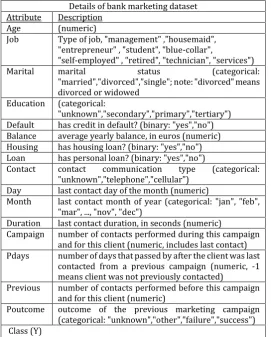
This dataset is available at https://www.openml.org/d/1461 The data is related with direct marketing campaigns of a Portuguese banking institution. The marketing campaigns were based on phone calls. Often, more than one contact to the same client was required, in order to access if the product (bank term deposit) would be (or not) subscribed. The classification goal is to predict if the client will subscribe a term deposit (variable y).[6]
[image:3.595.26.298.418.756.2]The number of instance in minority class is 5289(yes) and number of instances in majority class is 39922(no).
Table -1: Attribute Description of Bank Marketing Dataset
Details of bank marketing dataset Attribute Description
Age (numeric)
Job Type of job, "management" ,"housemaid", "entrepreneur" , "student", "blue-collar", "self-employed" , "retired", "technician", "services")
Marital marital status (categorical:
"married","divorced","single"; note: "divorced" means divorced or widowed
Education (categorical:
"unknown","secondary","primary","tertiary") Default has credit in default? (binary: "yes","no") Balance average yearly balance, in euros (numeric) Housing has housing loan? (binary: "yes","no") Loan has personal loan? (binary: "yes","no")
Contact contact communication type (categorical: "unknown","telephone","cellular")
Day last contact day of the month (numeric)
Month last contact month of year (categorical: "jan", "feb", "mar", ..., "nov", "dec")
Duration last contact duration, in seconds (numeric)
Campaign number of contacts performed during this campaign and for this client (numeric, includes last contact) Pdays number of days that passed by after the client was last
contacted from a previous campaign (numeric, -1 means client was not previously contacted)
Previous number of contacts performed before this campaign and for this client (numeric)
Poutcome outcome of the previous marketing campaign (categorical: "unknown","other","failure","success") Class (Y)
Has the client subscribed a term deposit? (binary: "yes","no")
4. CLASS IMBALANCE PROBLEM
[3][9]There can be an imbalance dataset provided for classification. By imbalance dataset we mean that one of the two class has very less number of samples compared to number of samples in the other class,|C2| << |C1|.Then C2 is
called the minority class, and C1 is called the majority class.
The minority class is of our interest. The machine learning algorithm always performs well if it is given balanced dataset, but this is not always the case , as an example the dataset for fraud detection ,will have less number of fraud transactions than genuine transaction. Anomaly detection, medical diagnostic and fault monitoring are other examples. The prediction in case of unbalanced dataset is biased towards majority class. The approach to solve this problem is sampling based approach.
4.1. SAMPLING BASED APPROACH
[3][9]This is also known as data level approach. It works by artificially balancing the instances of class in the dataset. To artificially balance the class we apply resampling technique, such as random under sampling the majority class, randomoversampling of minority class
, and
Synthetic Minority Over-Sampling Technique(SMOTE).4.1.1. RANDOM UNDERSAMPLING OF MAJORITY
CLASS
[3][9]In this approach we try to balance the class distribution in the dataset by randomly throwing away some data samples from majority class. Although it balances class distribution, but it leads to losing some important characteristics in dataset, due to removal of some samples, this is a disadvantage of this approach.
4.1.2. RANDOM OVERSAMPLING OF MINORITY
CLASS
[3][9]In this approach we balance the class distribution by the random replication of minority class instances,to increase their number. There is no information loss in this case. The problem with this approach is that it leads to overfitting.
4.1.3. SYNTHETIC MINORITY OVERSAMPLING
TECHNIQUE (SMOTE)
© 2019, IRJET | Impact Factor value: 7.211 | ISO 9001:2008 Certified Journal | Page 57 that has being created out of existing minority class
instances. In order to create the new synthetic minority class instances, SMOTE first selects an instance of minority class at random say ‘x’ and proceeds by finding its k nearest minority class neighbors. The synthetic instance is then created by choosing one of the k nearestneighbors say ‘y’ at random and connecting ‘x’ and ‘y’ to form a line segment in the feature space. The syntheticinstance say ‘z’ isgenerated as a convex combination of the two chosen instances ‘x’ and ‘y’.
z.attribute=x.attribute+(y.attribute-x.attribute)*rand(0,1).
5. EVALUATION METRICES
[1]In holdout method for evaluation we split the data set into two sets, training dataset and test dataset. The splitting is generally two-third training and one-third test. We use training data set to build the classifier and then we use this classifier for prediction on test dataset.
When we are evaluating classification algorithm on class imbalance datasets, evaluation metrics like precision, recall,f1-score,ROC and AUCPR of minority class becomes important.
TP: True Positive , FP: False Positive, TN: True Negative, FN: False Negative
Precision: It is the measure of exactness, which is the percentage of tuples in test dataset that are labeled as positive, are actually positive.
(9)
Recall: It is the measure of completeness, which is the percentage of positive tuples in test dataset that the classifier labeled as positive.
(10)
F1-Score: It is the harmonic mean of precision and recall.
(11)
ROC Area:
Receiver operating characteristic curves are a visual tool that helps us in comparison of two classification models. An ROC curve for a given model brings out the trade-off between the true positive rate (TPR) and the false positive rate (FPR).For a given test set and a model, TPR is the proportion of positive tuples that the models labels correctly, FPR is the proportion of negative tuples that aremislabeled as positive. So
FN
TP
TP
TPR
which issensitivity. Furthermore,
TN
FP
FP
FPR
. Any increasein TPR occurs at the cost of an increase in FPR. The area under the ROC curve is a measure of the accuracy of the model.
AUCPR: It is the area under precision-recall curve. This measure is generally used to measure the accuracy of the classification model on class imbalance dataset.
6. WEKA
[10][13]Waikato Environment for Knowledge Analysis (WEKA) is software for machine learning written in Java, developed at the University of Waikato. This is free software and is licensed under the GNU General Public License.
WEKA provides us with many data mining algorithms and visualization tools for data analysis and predictive modeling. Its graphical user interfaces makes easy for user to run these algorithms on training datasets. WEKA supports several standard data mining tasks , that are, data preprocessing, classification, regression, clustering, association, attribute selection and visualization. The classification algorithms that we will consider here are: Decision Tree (C 4.5) by J48 inside trees,Naive Bayes inside Bayes, Multilayer Neural Network by Multilayer Perceptron inside functions, SVM by SMO(PolyKernel) inside functions, Logistic Regression by Logistic inside functions
and Random Forest inside trees. WEKA outputs precision, recall,f1-score,ROC area,AUCPR of
all classes separately and combined weighted average also. The input datasets are provided in ARFF file format. ARFF stands for Attribute-Relation File Format.
For handling class imbalance problem we use filters in preprocess tab, we choose supervised instance filters.
For random under sampling of majority class we use (weka.filters.supervised.instance.SpreadSubsample) which produces a random subsample of a dataset. The original dataset must fit entirely in memory. This filter allows you to specify the maximum "spread" between the rarest and most common class. We set distributionSpread=1,which denotes uniform distribution spread .After applying the filter to dataset the produced dataset contains 5289 instances of minority class and 5289 instances of majority class.
© 2019, IRJET | Impact Factor value: 7.211 | ISO 9001:2008 Certified Journal | Page 58 we set noReplacement=false. After applying the filter the
sampled dataset produced has 22605 instances of minority class and 22605 instances of majority class.
For Synthetic Minority Over-sampling Technique we use (weka.filters.supervised.instance.SMOTE) which resamples a dataset by applying the Synthetic Minority Oversampling TEchnique (SMOTE). The original dataset must fit entirely in memory. The amount of SMOTE and number of nearest neighbors may be specified. In our dataset we set ClassValue=0 to auto-detect the non-empty minority class ,nearestNeighbors=5 and apply SMOTE filter three times in first time we put percentage=100 which increases number of instances of minority class from 5289 to 10578,second time we again apply SMOTE filter with percentage=100 which increase minority class instance from 10578 to 21156,third time we again apply SMOTE filter with percentage=88.7 which increases minority class instance from 21156 to 39921,and finally our dataset becomes balanced for classification with 39922 instances of majority class and 39921 instances of minority class. For testing purpose we split the dataset as 66% training and 34% test dataset.
[image:5.595.301.570.155.582.2]Finally the classification algorithms in WEKA is executed on these sampled dataset as input and finally readings of Precision,Recall,F1-Score, ROC and AUCPR of minority class outputted by WEKA are noted down, and graphically shown.
Table -2: Dataset preprocessed before evaluation
Instances of
Majority Class Instances of Minority Class Without Handling Class
imbalance problem(No Filter Applied)
39922 5289
Random Under Sampling of Majority Class (Filter Applied:
SpreadSubsample)
5289 5289
Random Over Sampling of Minority Class
(Filter Applied: Resample)
22605 22605
SMOTE
(Filter Applied: SMOTE) 39922 39921
7. RESULT OF EVALUATION FROM WEKA
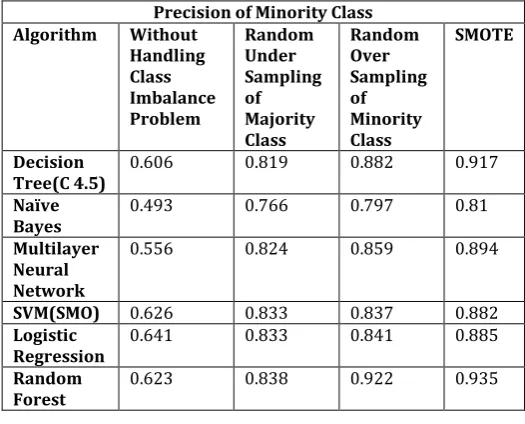
Table -3: Precision of Minority class of Class Imbalance Dataset
Precision of Minority Class
Algorithm Without
Handling Class Imbalance Problem
Random Under Sampling of Majority Class
Random Over Sampling of Minority Class
SMOTE
Decision
Tree(C 4.5) 0.606 0.819 0.882 0.917
Naïve
Bayes 0.493 0.766 0.797 0.81
Multilayer Neural Network
0.556 0.824 0.859 0.894
SVM(SMO) 0.626 0.833 0.837 0.882
Logistic
Regression 0.641 0.833 0.841 0.885
Random
Forest 0.623 0.838 0.922 0.935
Chart -1: Precision of minority class of Bank Marketing Dataset
Table -4: Recall of Minority class of Class Imbalance Dataset
Recall of Minority Class
Algorithm Without
Handling Class Imbalance Problem
Random Under Sampling of Majority Class
Random Over Sampling of Minority Class
SMOTE
Decision
Tree(C 4.5) 0.477 0.892 0.958 0.935
[image:5.595.302.565.160.372.2]© 2019, IRJET | Impact Factor value: 7.211 | ISO 9001:2008 Certified Journal | Page 59
Multilayer Neural Network
0.421 0.811 0.921 0.924
SVM(SMO) 0.18 0.826 0.834 0.905
Logistic
Regression 0.345 0.826 0.823 0.9
Random
Forest 0.411 0.902 0.987 0.947
Chart -2: Recall of Bank Marketing Dataset
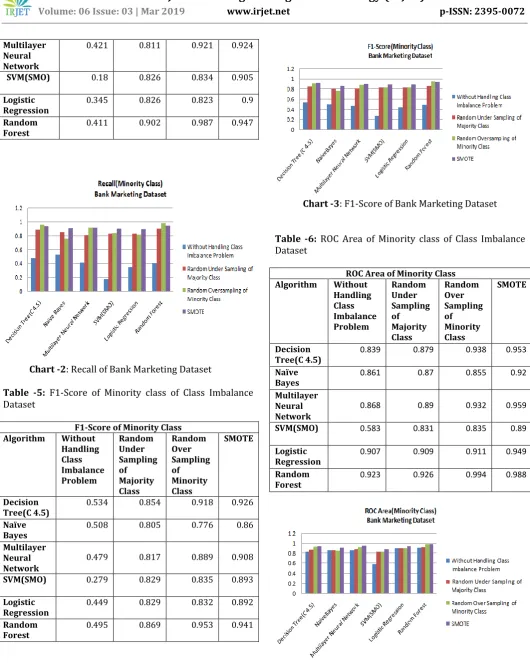
Table -5: F1-Score of Minority class of Class Imbalance Dataset
F1-Score of Minority Class
Algorithm Without
Handling Class Imbalance Problem
Random Under Sampling of Majority Class
Random Over Sampling of Minority Class
SMOTE
Decision
Tree(C 4.5) 0.534 0.854 0.918 0.926
Naïve
Bayes 0.508 0.805 0.776 0.86
Multilayer Neural Network
0.479 0.817 0.889 0.908
SVM(SMO) 0.279 0.829 0.835 0.893
Logistic
Regression 0.449 0.829 0.832 0.892
Random
Forest 0.495 0.869 0.953 0.941
Chart -3: F1-Score of Bank Marketing Dataset
Table -6: ROC Area of Minority class of Class Imbalance Dataset
ROC Area of Minority Class
Algorithm Without
Handling Class Imbalance Problem
Random Under Sampling of Majority Class
Random Over Sampling of Minority Class
SMOTE
Decision
Tree(C 4.5) 0.839 0.879 0.938 0.953
Naïve
Bayes 0.861 0.87 0.855 0.92
Multilayer Neural
Network 0.868 0.89 0.932 0.959
SVM(SMO) 0.583 0.831 0.835 0.89
Logistic
Regression 0.907 0.909 0.911 0.949
Random
Forest 0.923 0.926 0.994 0.988
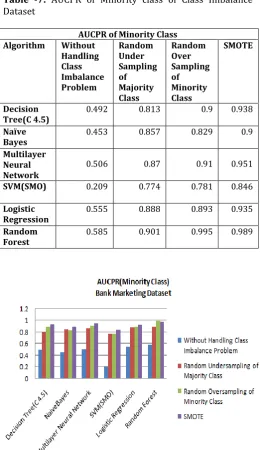
[image:6.595.33.564.60.724.2]© 2019, IRJET | Impact Factor value: 7.211 | ISO 9001:2008 Certified Journal | Page 60 Table -7: AUCPR of Minority class of Class Imbalance
Dataset
AUCPR of Minority Class
Algorithm Without
Handling Class Imbalance Problem
Random Under Sampling of Majority Class
Random Over Sampling of Minority Class
SMOTE
Decision
Tree(C 4.5) 0.492 0.813 0.9 0.938
Naïve
Bayes 0.453 0.857 0.829 0.9
Multilayer Neural Network
0.506 0.87 0.91 0.951
SVM(SMO) 0.209 0.774 0.781 0.846
Logistic
Regression 0.555 0.888 0.893 0.935
Random
Forest 0.585 0.901 0.995 0.989
Chart -5: AUCPR of Bank Marketing Dataset
8. IMPORTANT POINTS FROM EVALUATION
RESULTS OF WEKA
1.)From chart-1 of precision of minority class we see that sampling based technique improves precision of minority class, we see that Classification Algorithm(Decision Tree(C 4.5), Naïve Bayes , Multilayer Neural Network, Support Vector Machine (SMO), Logistic Regression and Random Forest) gives the highest precision with SMOTE compared to other sampling technique.
2.) From chart-2 of recall of minority class we see that sampling based technique improves recall of minority class , we see that Classification Algorithm(Naïve Bayes , Multilayer Neural Network, Support Vector Machine (SMO), and
Logistic Regression) with SMOTE gives the highest recall while (Decision Tree(C 4.5), Random Forest) gives highest recall with random over sampling of minority class. 3.) From chart-3 of f1-score of minority class we see that sampling based technique improves f1-score of minority class , we see that Classification Algorithm(Decision Tree(C 4.5),Naïve Bayes , Multilayer Neural Network, Support Vector Machine (SMO), and Logistic Regression) with SMOTE gives highest score,while Random Forest gives highest f1-score with random over sampling of minority class. 4.)From chart-4 of ROC Area of minority class we see that sampling based technique improves ROC of minority class , we see that Classification Algorithm(Decision Tree(C 4.5),Naïve Bayes , Multilayer Neural Network, Support Vector Machine (SMO), and Logistic Regression) with SMOTE gives highest ROC ,while Random Forest gives highest ROC with random over sampling of minority class.
5.)From chart-5 of AUCPR of minority class we see that sampling based technique improves AUCPR of minority class , we see that Classification Algorithm(Decision Tree(C 4.5),Naïve Bayes , Multilayer Neural Network, and Support Vector Machine (SMO) and Logistic Regression) with SMOTE gives highest AUCPR, while Random Forest gives highest AUCPR with random over sampling of minority class.
9. CONCLUSIONS
Classification is a supervised learning technique in data mining. It predicts the categorical class label of a data instance, so as to classify it into one of the predetermined classes. Class imbalance problem is one of the most important research problem in classification, in which the class of interest is the minority class, and has very less samples compared to the majority class. This leads classifier prediction to be biased towards majority class, so solutions needs to be found out to handle this problem. Here we have evaluated solutions to class imbalance problem on bank marketing dataset using WEKA.
We have used WEKA to preprocess dataset so as to balance class distribution, using filters.
For random under-sampling of majority class we have used “SpreadSubsample” filter , for random over-sampling of minority class we have used “Resample” filter and for synthetic minority over-sampling technique we have used “SMOTE” filter. From evaluation results of WEKA we see that sampling based technique increases precision, recall, f1-score,ROC area and AUCPR of minority class of various classification algorithms.
[image:7.595.33.294.106.557.2]© 2019, IRJET | Impact Factor value: 7.211 | ISO 9001:2008 Certified Journal | Page 61 has increased precision,recall,f1-score, and AUCPR of
minority class at a considerable level.
Our evaluation results of WEKA for precision metric shows that Classification Algorithm(Decision Tree(C 4.5),Naïve Bayes , Multilayer Neural Network, and Support Vector Machine (SMO) ,Logistic Regression and Random Forest) with SMOTE gives highest value.
Our evaluation results of WEKA for recall metric shows that Classification Algorithm(Naïve Bayes , Multilayer Neural Network, and Support Vector Machine (SMO) ,Logistic Regression) with SMOTE gives highest value, while (Decision Tree(C 4.5) and Random Forest) gives highest value with random over sampling of minority class.
Our evaluation results of WEKA for metrics F1-Score, ROC area, and AUCPR of minority class shows that for Classification Algorithm(Decision Tree(C 4.5),Naïve Bayes , Multilayer Neural Network, and Support Vector Machine (SMO) and Logistic Regression) with SMOTE gives highest value, while Random Forest gives highest value with random over sampling of minority class.
REFERENCES
[1] Book, Jiawei Han, Micheline Kamber Data Mining
Concepts and Techniques 2nd edition
[2] Mr.Rushi Longadge, Ms. Snehlata S. Dongre, Dr. Latesh
Malik, ”Class Imbalance Problem in Data Mining: Review”, International Journal of Computer Science and Network (IJCSN) Volume 2, Issue 1, February 2013
[3] http://www.chioka.in/class-imbalance-problem/ [4]
https://medium.com/deep-math-machine-learning- ai/chapter-2-0-logistic-regression-with-math-e9cbb3ec6077
[5] Nitesh V. Chawla “Data Mining For Imbalanced Datasets” [6] https://www.openml.org/d/1461
[7] Archit Verma, ”Study and Evaluation of Classification
Algorithms in Data Mining”, International Research Journal of Engineering and Technology (IRJET) Volume: 05 Issue: 08, August 2018
[8] Justice Asare-Frempong,Manoj Jayabalan, “Predicting
Customer Response to Bank Direct Telemarketing Campaign”, 2017 IEEE The International Conference on Engineering Technologies and Technopreneurship
[9] https://www.analyticsvidhya.com/blog/2017/03/imba
lanced-classification-problem/
[10] https://en.wikipedia.org/wiki/Weka_(machine_learning
)
[11] Book,Pang-Ning Tan, Michael Steinbach, Anuj Karpatne
and Vipin Kumar ,”Introduction to Data Mining, Pearson Education”, 2016
[12] http://www2.cs.uregina.ca/~dbd/cs831/notes/kdd/1_
kdd.html
[13] Remco R. Bouckaert, Eibe Frank, Mark Hall, Richard
Kirkby, Peter Reutemann, Alex Seewald, David Scuse WEKA “Manual for Version 3-8-2”.
[14] M. Purnachary,B. Srinivasa S P Kumar, Humera Shaziya
“Performance Analysis of Bayes Classification Algorithms in WEKA Tool using Bank Marketing Dataset” International Journal of Engineering Research in Computer Science and Engineering (IJERCSE) Vol 5, Issue 2, February 2018
BIOGRAPHY
Archit Verma