Preparation and Characterization of
Poly(divinylbenzene) Microcapsules Containing
Octadecane
Preeyaporn Chaiyasat*, Amorn Chaiyasat**, Waraporn Boontung, Supaporn Promdsorn, Sutanya Thipsit
Department of Chemistry, Faculty of Science and Technology, Rajamangala University of Technology Thanyaburi, Thanyaburi, Thailand
Email: *[email protected]; **[email protected] Received March 17th, 2011; revised April 6th, 2011; accepted April 12th, 2011
ABSTRACT
Poly (divinylbenzene)(PDVB) microcapsules containing octadecane (OD)(PDVB/OD) used as heat storage material were synthesized by suspension polymerization at 70˚C using benzoyl peroxide and polyvinyl alcohol as initiator and stabilizer, respectively. Thermal properties and stability of PDVB/OD microcapsules were determined using differential
scanning calorimeter (DSC) and thermogravimetric analyzer. The morphology and structure of microcapsules were
characterized by optical microscope, scanning electron microscope and fourier transform infrared spectrophotometer. From DSC analysis, the melting temperature of encapsulated OD (28˚C) was almost the same as that of bulk OD (30˚C)
while it was quite different in the case of the solidification temperature (19˚Cand 25˚Cfor encapsulated and bulk OD, respectively). The latent heats of melting (184.0 J/g-OD) and solidification (183.2 J/g-OD) of encapsulated OD were
reduced from those of bulk OD (241.7 and 247.0 J/g, respectively). However, the prepared PDVB/OD microcapsules
are able to be used for heat storage applications.
Keywords: Microencapsulation, Microcapsule, Heat Storage Material, Octadecane, Suspension Polymerization, Poly
(Divinylbenzene)
1. Introduction
The utilization of a latent heat storage system using heat storage materials or phase change materials (PCMs) is an effective method of advanced energy technologies, pre-serving available energy and improving its consumption. The heat storage materials are able to change the status with a convinced temperature range. They can absorb and emit the energy when the temperatures of the materi-als overpass the temperature of phase change during heating and cooling processes, respectively [1-10]. The thermal energy storage systems typically select the ap-plication temperatures approach phase transition tem-peratures of PCMs. Paraffin waxes (the linear chain hy-drocarbons or n-alkanes) such as tetradecane (TD), hexa-decane (HD), octahexa-decane (OD), nonahexa-decane (ND), and eicosane are useful as one group of numerous numbers of heat storage materials that melt and solidify at a wide range of temperatures, making them attractive for many applications [11]. These PCMs are nontoxic, non-corrosi-
ve, chemically inert, easily obtained, and have no un-pleasant odor. They have different phase change tem-peratures, melting (Tm) and solidification (Ts), depending
OD core with melamine-formaldehyde shell [17], resor-cinol-modified melamine-formaldehyde shell [18] were reported. The encapsulation ofn-TD core with urea-for- maldehyde polymer shell were also carried out by in situ
polymerization [19]. Three types of paraffin waxes (n-HD, n-OD and n-ND) were encapsulated through complex coacervation of natural and biodegradable polymers, gum arabic-gelatin mixture [20]. Paraffin waxes encapsulated with styrene and methyl methacrylate copolymer were prepared by suspension polymerization [21]. The prepa-ration of polystyrene (PS) microcapsules containing n-HD using casein instead of commercial stabilizer to emulsify the mixture of core materials, monomers and initiators during the suspension polymerization were also reported [22]. For textile applications, melamine formal-dehyde microcapsules containing eicosane were prepared
by in situ polymerization [23,24] and PS microcapsules
containing paraffin wax were synthesized by suspension like polymerization [25]. Polymethylmethacrylate micro- capsules containing n-octaco-sane [26] and heptadecane [27] were prepared by emulsion polymerization. The capsules of PS as the shell and n-OD as the core were prepared by miniemulsion polymerization [28]. Micro-encapsulated n-OD with polyurea shells having different soft segments was synthesized with interfacial polycon-densation [29]. To improve the shell strength, crosslinked polydivinylbenzene (PDVB) microcapsule particles with encapsulated n-HD prepared by micro-suspension po-lymerization utilizing the Shirasu Porous Glass membrane emulsification technique for the preparation of compara-tively monodisperse DVB/HD droplets were prepared [30-32]. OD is an attractive PCM giving good capability of heat absorption and emission in appropriate phase change temperature range (23 - 28˚C) comfortable for the human body. Moreover, its latent heat (241.2 J/g) is higher than that of the other PCMS with similar phase change temperature range [33]. As seen from the litera-
tures above, a numerous of different polymers were used to prepare microencapsulated PCMs but there is no any report study on microencapsulation of OD with PDVB (the high mechanical properties polymer) shell (PDVB/OD capsules). Therefore, in this work, OD and PDVB were chosen to use as heat storage material and particle shell, respectively, of the microcapsules prepared by suspension polymerization. The morphology, chemi-cal structure, thermal stability and thermal properties of PDVB/OD capsules were characterized by scanning electron microscope (SEM), optical microscope (OM), fourier transform infrared spectrophotometer (FT-IR), thermogravimetric analyzer (TGA) and differential scan-ning calorimeter (DSC), respectively.
2. Experimental
2.1. Materials
DVB (Aldrich; purity, 80%) was washed with 1N sodium hydroxide (NaOH) and distilled water to remove polym-erization inhibitors before use. Poly (vinyl alcohol) (PVA) (Aldrich; degree of saponification, 87 - 90%) was used as received. Reagent-grade benzoyl peroxide (BPO) was purified by recrystallization. OD (Merck; 99.5%) was used as received.
2.2. Microcapsules Preparation
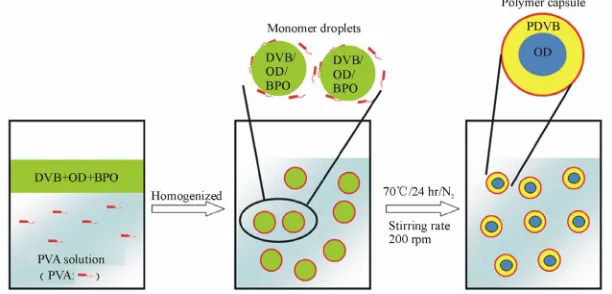
[image:2.595.144.450.555.702.2]The microcapsules of PDVB/OD were prepared by sus-pension polymerization as the procedure shown in Fig-ure 1. The homogeneous organic phase of DVB and OD at the ratio of 50:50% wt/wt (approximately 10% wt of aqueous solution) were mixed with BPO (8% wt of mo-nomer) and then added to the aqueous phase containing PVA (1.5 g of PVA in 150 g of water). Emulsification was carried out by high shear rate at the speed of 5,000 rpm for 5 min resulting in the organic phase drop lets dispersed in the aqueous phase. The resulting emul- sions were transferred to the reactor and polymerized at
70˚C for 24 h under N2 atmosphere.
2.3. Characterization of Microcapsules
The particle diameters of microcapsules were obtained from OM (SK-100EB & SK-100ET, Seek, Seek Inter Corporation Ltd., Thailand) photos calculated from 200 particles by VIS Plus software. An OM and SEM (JSM-6510, JEOL, JEOL Ltd., Japan) were used to in-vestigate the morphology of the surface and the inner structure of the microcapsules. For SEM observation, one drop of the microcapsule dispersion was placed on a nickel SEM stub and dried before Au-coated. Thermal stability of OD, PDVB and microcapsules was studied with TGA (TGA/SDTA 851e, Mettler-Toledo, Met-tler-Toledo Ltd., Switzerland) using heating rate of 20˚C/min. The chemical structure of the polymer was determined by FT-IR spectroscopy (PerkinElmer System 2000, PerkinElmer, USA). The dispersion sample was filtered and then kept in vacuum oven overnight. The dried sample was ground with dried potassium bromide (KBr) powder and compressed into a disc. The pure OD was directly mixed with KBr before measurement.
2.4. Thermal Properties Measurement
The latent heats of solidification (Hs), melting (Hm), Ts,
and Tm of OD encapsulated in microcapsule particles in
aqueous solution (solid content: ca 10%) were measured in an aluminum pan with a DSC (DSC 822, Metler-Tole- do, Mettler-Toledo Ltd., Switzerland) under a N2 flow
with the scanning temperature range and rate of 0 - 40˚C and 5˚C/min, respectively. To compare Hs and Hm of the
encapsulated OD having different wt% in the capsule particles and also pure OD, the Hs and Hmvalues were
used in the unit of joule per 1 g of encapsulated OD (J/g-OD). They were calculated from the cooling/heating peak area of DSC thermogram and OD content obtained from TGA analysis using the following equation (1).
J/g-OD = (A/B) × 100 (1)
where
A = Hs or Hm of encapsulated OD in microcapsule
dis-persion obtained from DSC thermogram (J/g-sample) B = % OD in microcapsule dispersion obtained from TGA thermogram
3. Results and Discussion
3.1. Microcapsule Formation
The preparation process of the PDVB capsules contain-ing OD as heat storage material by suspension polymeri-zation was shown in Figure 1. Aqueous phase containing PVA as stabilizer was added with oil phase consisting of OD, DVB and BPO. PVA molecules strongly adsorb
onto the oil-water interface and stabilize the oil droplets generated by high shear rate. The polymerization took place within the oil droplets after the temperature reached to 70˚C. OD is well miscible with DVB mono-mer in the early stage of polymono-merization resulting in ho-mogeneous phase in monomer droplets. When the PDVB was formed, the oil phase became gradually less com-patible until reach the critical chain length of PDVB, phase separation occurred. Because the interfacial ten-sion of PDVB-water is lower than that of OD-water, the PDVB move to the interface of oil droplets to form the polymer shell. At the end of polymerization, the polymer capsules of OD core encapsulated by PDVB shell were obtained. When the dispersions were kept for a while, all of the PDVB/OD capsules floated on the top of the dis-persion solution because the total density of the capsules is lower than that of water. This indicates that the PDVB/OD capsules were successfully prepared.
3.2. Morphology of Microcapsule and Particle Size
The PDVB/OD microcapsules were observed by OM and SEM as shown in Figure 2. The SEM photograph indi-cates that most of the particle shapes were spherical with smooth outer surface even the microcapsule sizes were polydisperse consistent with the result from the optical micrograph. This is general characteristic of the polymer particles obtained from conventional suspension polym-erization. Moreover, the OD core was completely en-capsulated with PDVB shell as shown in the optical mi-crograph. The average diameter of the microcapsules is approximately 28 µm, measured from the optical micro-graphs calculated from 200 particles by VIS plus 3.0 software. Because quite small microcapsules were ob-tained, PDVB/OD capsules therefore afford a large sur-face area per unit volume. This is the reason why the microcapsules containing the heat storage material are more attractive than the pure one.
3.3. Chemical Structure Characterization of Microcapsule
Figure 2. SEM photo (a) and optical micrograph (b) of PDVB/OD prepared by suspension polymerization.
Figure 3. FT-IR spectra of OD (a), PDVB (b) and PDVB/OD capsule (c).
peaks at 1500, 1600 cm–1 are associated with benzene ring C = C stretching vibration. The aliphatic C-H stret-ching vibration is observed at 2920 cm–1 whereas 3030 cm–1 showed the characteristic peaks of aromatic C-H stretching vibration. All the above characteristic peaks of bulk OD and PDVB are able to observe in the spectrum of the PDVB/OD microcapsules (Figure 3(c)), and no new peak is observed. This result indicates that the OD was incorporated in the PDVB.
3.4. Thermal Stability of PDVB/OD Capsule
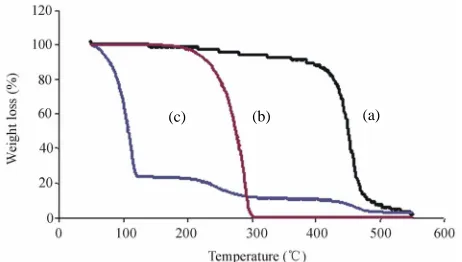
The TGA thermograms of bulk OD, PDVB and PDVB/OD capsule were shown in Figure 4 and Table 1. The decomposition of OD started at approximately 165˚C and completely lost its weight at 305˚C while the decomposition temperature range of PDVB is 330˚C to 495˚C. The TGA curves of OD and PDVB were sharp and showed only one step. In the case of PDVB/OD capsules TGA curve, it was mainly consisted of three steps: 50 - 124, 180 - 295 and 350 - 480˚C corresponding to the decomposition of water, OD and PDVB respec- tively. In comparison with OD, the decomposition tem-
(a)
Figure 4. TGA thermograms of (a) PDVB; (b) OD and (c) PDVB/OD microcapsule.
perature of encapsulated OD was slightly higher than that of bulk OD due to the encapsulation.
3.5. Thermal Properties of Microcapsule
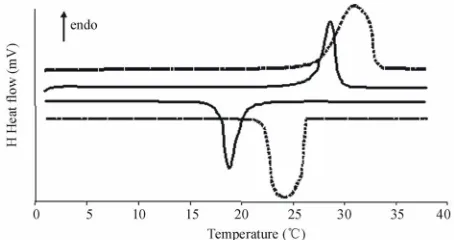
The thermal properties of the OD encapsulated in PDVB microcapsules were measured using DSC. The Hm (184.0
J/g-OD) and Hs (183.2 J/g-OD) of encapsulated OD were
lower than those of the bulk OD (241.0 and 247.0 J/g of (b)
[image:4.595.309.540.456.587.2]Table 1. TGA data of OD, PDVB and PDVB/OD micro-capsule.
Degradation interval (˚C) Weight loss (%)
OD 162-305 100
PDVB 330-495 92
PDVB/OD 50 - 124 (1st step) 76
180 - 295 (2nd step) 12 350 - 480 (3rd step) 10
Hm and Hs, respectively) as shown in Figure 5. This
seems to be general case for PCMs microcapsules con-sistent with the other reports [17,18,22,26,27,29-32,34,35]. The possible reason of the reduction of Hm and Hs of
en-capsulated PCMs is that the phase separation between the polymer shell and PCM core was incomplete as in the case of PDVB/HD microcapsules prepared by suspension polymerization [32]. The capsules may have some unex-hausted monomers or oligomer incorporated at the inter-face between polymer shell and PCM core as in the case of PS/HD microcapsules prepared by suspension polym-erization [22]. They may act as the compatibilizer and help the miscibility between polymer and PCM material leading to the decreasing of the phase separation in oil phase. However, to overcome this problem, the copoly-merization with more hydrophilic monomers is the good idea as copolymerization of PDVB with methyl acrylate, ethyl acrylate and butyl acrylate [32]. In the case of phase transition temperature, Tm of encapsulated OD
(28.3˚C) was almost the same as that of bulk OD (30˚C). In contrast, Ts was shifted to the lower temperature
com-paring to bulk OD. This occurrence is namely super-cooling. Supercooling leads to the reduction of the Ts
resulting in the releasing of latent heat at a lower tem-perature or a wider temtem-perature range. This effect may limits to the applications. To prevent supercooling, the nucleating agents were incorporated in the PCMs core. However, increasing nucleating agent content decreased the latent heat [36,37]. At the present, there is still no good solution to overcome this problem. As the total surface area of the microcapsules increased comparing to bulk OD, these PDVB/OD capsules are quite acceptable for energy storage applications even having a slightly lower latent heats.
4. Conclusions
[image:5.595.58.284.115.191.2]PDVB/OD microcapsules were successfully prepared by suspension polymerization. The optical micrographs sho- wed that OD had been completely encapsulated inside the PDVB microcapsules with average size of 28 µm. The regular spherical particles with smooth outer surface were observed by SEM. All the characteristic peaks of OD and PDVB were observed in the FT-IR spectrum of
Figure 5. DSC thermograms of encapsulated OD in PDVB/OD capsule (solid line) and bulk OD (dotted line) (scanning rate 5˚C/min).
the PDVB/OD capsules without any new peaks. The la-tent heats, Hm and Hs, of OD in the capsule were slightly
lower than those in bulk OD. As a result, the prepared PDVB/OD microcapsules are able to be used for heat storage applications because of their large surface area and still remain good thermal properties of encapsulated OD.
5. Acknowledgements
This work was supported by The National Research Council, Thailand (No. 23666).
REFERENCES
[1] M. Kenisarin and K. Mahkamov, “Solar Energy Storage Using Phase Change Materials,” Renewable and Sus-tainable Energy Reviews, Vol. 11, No. 9, 2007, pp. 1913- 1965. doi:10.1016/j.rser.2006.05.005
[2] P. Zhang, Z. W. Ma and R. Z. Wang, “An Overview of Phase Change Material Slurries: MPCS and CHS,” Re-newable and Sustainable Energy Reviews, Vol. 14, No. 2, February 2010, pp. 598-614.
doi:10.1016/j.rser.2009.08.015
[3] F. Agyenim, N. Hewitt, P. Eames and M. Smyth, “A Re-view of Materials, Heat Transfer and Phase Change Problem Formulation for Latent Heat Thermal Energy Storage Systems (LHTESS),” Renewable and Sustainable Energy Reviews, Vol.14, No. 2, February 2010, pp. 615- 628.
[4] N. Zhu, Z. Ma and S. Wang, “Dynamic Characteristics and Energy Performance of Buildings Using Phase Change Materials: A Review,” Energy Convers Manage, Vol. 50,No. 12, September 2009, pp. 3169-3181. doi:10.1016/j.enconman.2009.08.019
[5] A. Sharma, V. V. Tyagi, C. R. Chen and D. Buddhi, “Re-view on Thermal Energy Storage with Phase Change Materials and Applications,” Renewable and Sustainable Energy Reviews, Vol. 13, No. 2, February 2009, pp. 318-345. doi:10.1016/j.rser.2007.10.005
Vol. 13, No. 9, June 2009, pp. 2225-2244. doi:10.1016/j.rser.2009.06.024
[7] S. Mondal, “Phase Change Materials for Smart Tex-tiles-An Overview,” Applied Thermal Engineering, Vol. 28, No. 11-12, August 2008, pp. 1536-1550.
doi:10.1016/j.applthermaleng.2007.08.009
[8] V. T. Tyagi and D. Buddhi, “PCM Thermal Storage in Buildings: A State of Art,” Renewable and Sustainable Energy Reviews, Vol. 11, No. 6, August 2007, pp. 1146- 1166. doi:10.1016/j.rser.2005.10.002
[9] A. M. Khudhair and M. M. Farid, “A Review on Energy Conservation in Building Applications with Thermal Storage by Latent Heat Using Phase Change Materials,” Energy Conversion Management, Vol. 45, No. 2, May 2004, pp. 263-275.doi:10.1016/S0196-8904(03)00131-6
[10] G. Sun and Z. Zhang, “Mechanical Strength of Micro-capsules Made of Different Wall Materials,” Interna-tional Journal of Pharmaceutics, Vol. 242, January 2002, pp. 307-311. doi:10.1016/S0378-5173(02)00193-X
[11] M. M. Farid, A. M. Khudhair, S. A. K. Razack and S. Al-Hallaj, “A Review on Phase Change Energy Storage: Materials and Applications,” Energy Conversion Man-agement, Vol. 45, No. 9-10, September 2004, pp. 1597- 1615. doi:10.1016/j.enconman.2003.09.015
[12] N. Sarier and E. Onder, “Thermal Characteristics of Po-lyurethane Foams Incorporated with Phase Change Mate-rials,” Thermochimica Acta, Vol. 454, No. 2, March 2007, pp. 90-98. doi:10.1016/j.tca.2006.12.024
[13] M. N. A. Hawlader, M. S. Uddin and M. M. Khin, “Mi-croencapsulated PCM Thermal-Energy Storage System,” Applied Energy, Vol. 74, No. 1-2, January 2003, pp. 195-202. doi:10.1016/S0306-2619(02)00146-0
[14] X. Wang, J. Niu, Y. Zhang, X. Wang, B. Chen and R. Zeng, “Heat Transfer of Microencapsulated PCM Slurry Flow in a Circular Tube,” AIChE journal, Vol. 54, No. 4, 2008, pp. 1110-1120.doi:10.1002/aic.11431
[15] W. L. Wang, X. X. Yang, Y. T. Fang, J. Ding and J. Y. Yan, “Preparation and Thermal Properties of Polyethyl-ene Glycol/Expanded Graphite Blends for Energy Stor-age,” Applied Energy, Vol. 86, No. 9, September 2009, pp. 1479-1483. doi:10.1016/j.apenergy.2008.12.004
[16] A. M. Borreguero, M. Carmona, M. L. Sánchez, J. L. Valverde and J. F. Rodríguez, “Improvement of the Thermal Behaviour of Gypsum Blocks by the Incorpora-tion of Microcapsules Containing Pcms Obtained by Suspension Polimeryzation with an Optimal Core/Coating Mass Ratio,” Applied Thermal Engineering, January 2010. doi:10.1016/j.applthermaleng.2010.1001.1032
[17] X. X. Zhang, Y. F. Fan, X. M. Tao and K. L. Yick, “Fab-rication and Properties of Microcapsules and Nanocap-sules Containing N-octadecane,” Materials Chemistry and Physics, Vol. 88, June 2004, pp. 300-307.
doi:10.1016/j.matchemphys.2004.06.043
[18] H. Z. Zhang and X. D. Wang, “Fabrication and Perform-ances of Microencapsulated Phase Change Materials Based on N-Octadecane Core and Resorcinol-Modified Melamine–Formaldehyde Shell,” Colloids and Surfaces A:
Physicochemical and Engineering Aspects, Vol. 332, No. 2-3, 15 January 2009, pp. 129-138.
doi:10.1016/j.colsurfa.2008.09.013
[19] G. Fang, H. Li, F. Yang, X. Liu and S. Wu, “Preparation and Characterization of Nano-encapsulated N-tetradecane as Phase Change Material for Thermal Energy Storage,” Chemical Engineering Journal, Vol. 153, No. 1-3, No-vember 2009, pp. 217-221.
doi:10.1016/j.cej.2009.06.019
[20] E. Onder, N. Sarier and E. Cimena, “Encapsulation of Phase Change Materials by Complex Coacervation to Im- prove Thermal Performances of Woven Fabrics,” Ther-mochimica Acta, Vol. 467,No. 1-2, January 2008, pp. 63- 72. doi:10.1016/j.tca.2007.11.007
[21] L. Sánchez-Silva, J. F. Rodríguez, A. Romero, A. M. Borreguero, M. Carmona and P. Sánchez, “Microencap-sulation of PCMs with a Styrene-Methyl Methacrylate Copolymer Shell by Suspension-Like Polymerisation,” Chemical Engineering Journal, Vol. 157, No. 1, 15 Feb-ruary 2010, pp. 216-222.
[22] Y. Ai, Y. Jin, J. Sun and D. Wei, “Microencapsulation of N-hexadecane as Phase Change Material by Suspension Polymerization,” E-Polymers, No. 098, September 2007, pp. 1-9.
[23] Y. Shin, D.-I. Yoo, K. Son, “Development of Thermo-regulating Textile Materials with Microencapsulated Phase Change Materials (PCM). II. Preparation and Ap-plication of PCM Microcapsules,” Journal of Applied Polymer Science, Vol. 96, No. 5, 2005, pp. 2005-2010. doi:10.1002/app.21438
[24] Y. Shin, D. Yoo and K. Son, “Development of Thermo-regulating Textile Materials with Microencapsulated Phase Change Materials (PCM). IV. Performance Proper-ties and Hand of Fabrics Treated with PCM Microcap-sules,” Journal of Applied Polymer Science, Vol. 97, No. 3, 2005, pp. 910-915. doi:10.1002/app.21846
[25] P. Sánchez, M. V. Sánchez-Fernandez, A. Romero, J. F. Rodríguez and L. Sánchez-Silva, “Development of Thermo-Regulating Textiles Using Paraffin Wax Micro-capsules,” Thermochimica Acta, Vol. 498, No. 1-2, Janu-ary 2010, pp. 16-21. doi:10.1016/j.tca.2009.09.005
[26] A. Sarı, C. Alkan, A. Karaipekli and O. Uzun, “Microen-capsulated N-Octacosane as Phase Change Material for Thermal Energy Storage,” Solar Energy, Vol. 83, No. 10, October 2009, pp. 1757-1763.
[27] A. Sarı, C. Alkan and A. Karaipekli, “Preparation, Char-acterization and Thermal Properties of PMMA/N-Hepta-decane Microcapsules as Novel Solid- Liquid MicroPCM for Thermal Energy Storage,” Applied Energy, Vol. 87, No. 5, May 2010, pp. 1529-1534.
[28] Y. T. Fang, S. Y. Kuang, X. N. Gao and Z. G. Zhang, “Preparation and Characterization of Novel Nanoencap-sulated Phase Change Materials,” Energy Conversion and Management, Vol. 49, No. 12, December 2008, pp. 3704- 3707. doi:10.1016/j.enconman.2008.06.027
Containing Different Soft Segments for Heat Energy Sto-rage and Thermal Regulation,” Solar Energy Materials & Solar Cells, Vol. 93, No. 8, August 2009, pp. 1366-1376. doi:10.1016/j.solmat.2009.02.021
[30] P. Chaiyasat, T. Suzuki, H. Minami and M. Okubo, “Thermal Properties of Hexadecane Encapsulated in Poly (Divinylbenzene) Particles,” Journal of Applied Polymer Science, Vol. 112, No. 6, 2009, pp. 3257-3266.
doi:10.1002/app.29648
[31] P. Chaiyasat, Y. Ogino, T. Suzuki and M. Okubo, “Influ-ence of Water Domain Formed in Hexadecane Core In-side Cross-linked Capsule Particle on Thermal Properties for Heat Storage Application,” Colloid Polymer Science, Vol. 286, No. 6-7, 2008, pp. 753-759.
doi:10.1007/s00396-007-1831-5
[32] P. Chaiyasat, Y. Ogino, T. Suzuki, H. Minami and M. Okubo, “Preparation of Divinylbenzene Copolymer Parti-cles with Encapsulated Hexadecane for Heat Storage Ap-plication,” Colloid Polymer Science, Vol. 286, No. 2, 2008, pp. 217-223. doi:10.1007/s00396-007-1764-z
[33] J. Su, L. Ren and L. Wang, “Synthesis of Polyurethane MicroPCMs Containing N-Octadecane by Interfacial Po-lycondensation: Influence of Styrene-Maleic Anhydride
as a Surfactant,” Colloids and Surfaces A: Physicochemi-cal and Engineering Aspects, Vol. 299, No. 1-3, 2007, pp. 268-275. doi:10.1016/j.colsurfa.2006.11.051
[34] J. S. Cho, A. Kwon and C. G. Cho, “Microencapsulation of Octadecane as a Phase-change Materials by Interfacial Polymerization in an Emulsion System,” Colloid Polymer Science, Vol. 280, No. 3, September 2002, pp. 260-266. doi:10.1007/s00396-001-0603-x
[35] X. X. Zhang, X. M. Tao, K. L. Yick and X. C. Wang, “Structure and Thermal Stability of Microencapsulated Phase-change Materials,” Colloid Polymer Science, Vol. 282, No. 4, 2004, pp. 330-336.
doi:10.1007/s00396-003-0925-y
[36] X. X. Zhang, Y. F. Fan, X. M. Tao and K. L. Yick, “Crystallization and Prevention of Supercooling of Mi-croencapsulated N-alkanes,” Journal of Colloid and In-terface Science, Vol. 281, No. 2, 15 January 2005, pp. 299-306.