ISSN Online: 2164-2834 ISSN Print: 2164-2818
DOI: 10.4236/ojml.2019.92013 Apr. 30, 2019 129 Open Journal of Modern Linguistics
Blended Learning-Effectiveness and
Application in Teaching and Learning Foreign
Languages
Joel Laffita Rivera
Faculty of Applied Communication (FAC), Multimedia University, Cyberjaya, Malaysia
Abstract
The present research paper is designed to investigate the importance of the application of Blended Learning (BL) in education as a method for teaching and learning Foreign Languages Subjects (FLs) at university level. The study has used the mixed-method approach for the collection of data and its analy-sis. The study discloses: The research-design; Foreign Language-framework; Teaching and learning-roleplay-reflection and Methodology-schemes. Al-though the employment of BL is very important in teaching and learning practices; the paper-results concluded that there is a need to provide metho-dologies and computer training sessions to the FL teachers for effective em-ployment of BL in foreign languages classes. Consequently to this the study aimed to deliver an applicable script through which Spanish language teach-ers and foreign language teachteach-ers obtain pedagogical-and computer know-ledge-inputs to setup foreign languages classes through Blended Learning.
Keywords
Blended Learning, Spanish as Second Foreign Language, Teaching, Learning, Online Tools, Applied-Didactic, Classroom Management
1. Introduction
Teaching and learning a foreign language is not an easy task to accomplish as it takes into account the challenges of all kinds that both teachers and students have to face from the beginning of the teaching and learning process of this ho-norable discipline. Many are the encounters related to education, culture, reli-gion and language background to be cited. However, when it comes to teach and learn a foreign language subject it is possible to overcome most of these
chal-How to cite this paper: Rivera, J. L. (2019). Blended Learning-Effectiveness and Appli-cation in Teaching and Learning Foreign Languages. Open Journal of Modern Lin-guistics, 9, 129-144.
https://doi.org/10.4236/ojml.2019.92013
Received: March 20, 2019 Accepted: April 27, 2019 Published: April 30, 2019
Copyright © 2019 by author(s) and Scientific Research Publishing Inc. This work is licensed under the Creative Commons Attribution International License (CC BY 4.0).
DOI: 10.4236/ojml.2019.92013 130 Open Journal of Modern Linguistics lenges as a result of the application of the Blended Learning, for instance, the hundreds of YouTube videos put at our disposal in Internet. These online- communication-tools cover much of the FL topics to be taught in a FL class and make possible to conduct the teaching and learning of this subject by using the BL Method. According to (Skrypnyk et al., 2015)1 BL is defined as a Tech-Instructive Approach and its main objective is to use the technological advances of the Dig-ital Era to benefit the Education sector in general. The term Blended learning is used to describe the way that e-learning is combined with traditional classroom methods and creates a hybrid teaching methodology. in other words, the best from the Old and the New as one. The blended technology with traditional teaching methods offers more opportunities for teachers to use several different and effective teaching methods. Different learning styles can be accommodated allowing that way to answer one of the most difficult classroom-setting issue. Even though the application of BL represents a much greater change in basic technique than simply adding computers to classrooms; the self-learning, com-prehension, and retention of information among the second language learners can be improved through the use of BL. As said by (Beetham & Sharpe, 2013)2 the use of technologies offers the opportunity to manage the teaching and learn-ing process of a foreign language smoothly. Today, information and communi-cation technologies are probably the most used technologies for foreign language teaching. By taking into account this Introduction-View the following headings and sub-headings are addressed.
2. Literature Review
Blended learning plays a significant role to enhance foreign language skills. The implication of blended learning has been proved effective in improving foreign language skills, but there is lack of willingness of teachers to adopt this technol-ogy in their teaching style. Asiri et al. (2012)3 has identified certain barriers, which are mostly faced by the administration of universities during or after the application of blended learning processes or e-learning system. The association between blended learning and the students’ achievements in the classroom has been investigated by Al-Qahtani and Higgins (2013)4. The findings have statisti-cally significant difference between the implementation of blended learning processes and students’ achievements. E-learning tends to represent broader domain of development and research activities into the application of technolo-gies to education (Conole & Oliver, 2006)5. It provides multimedia support to 1Skrypnyk, O., Joks, S., Kovanovic, V., Dawson, S., Gasevic, D., & Siemens, G. (2015). The History and State of Blended Learning. Alberta: Athabasca University.
2Beetham, H., & Sharpe, R. (2013). Rethinking Pedagogy for a Digital Age: Designing for 21st Cen-tury Learning. Abingdon-on-Thames: Routledge.
3Asiri, M. J. S., bt Mahmud, R., Bakar, K. A., & bin Mohd Ayub, A. F. (2012). Factors Influencing the Use of Learning Management System in Saudi Arabian Higher Education: A Theoretical Framework. Higher Education Studies, 2, 125.https://doi.org/10.5539/hes.v2n2p125
4Al-Qahtani, A. A., & Higgins, S. E. (2013). Effects of Traditional, Blended and e-Learning on Stu-dents’ Achievement in Higher Education. Journal of Computer Assisted Learning, 29, 220-234.
DOI: 10.4236/ojml.2019.92013 131 Open Journal of Modern Linguistics the educational process using modern information and communication tech-nologies usually implemented through computer networks. According to
West-berry (2009)6, BL enhances higher cognitive skills, promotes reflection, and gives
equal opportunities to learners. It also provides cost-efficient, collaborative learning and encourages learners to communicate with instructors and peers and develops learners’ skills (Lai & Kritsonis, 2006)7. The environment provided in BL environment is more suitable to academic institutions and perceived as broader and more inclusive than distance learning and computer-assisted lan-guage learning. Lopez-Perez et al. (2011)8 argued that BL was capable of im-proving the learning outcomes. The results stated that the attrition rates of stu-dents were decreased and their understanding was increased as a result of using online learning materials. Some of the advantages associated with BL included easy access to knowledge, improve pedagogy, cost-effectiveness, ease of revision of learning content, and personal presence. BL improved vocabulary of ELE learners cooperative learning increased the student involvement in learning. The learners show a mayor motivation and interest when they meet face-to-face and during class discussions with their peers in BL setting. BL tends to open new po-tentials for self-learning, lifelong learning, and raising students’ achievement. A study conducted by Banados (2006)9confirmed that successful implementation of BL in learning language may result in remarkable improvement in speaking skills along with important improvements in all skills.
3. The Study Design
The study has applied mixed research methods that include quantitative and qu-alitative techniques. It has focused on collecting, analyzing, and mixing both quantitative and qualitative data in a single study or series of studies. However, the study has used mixed approach because both quantitative and qualitative re-search work together offer the best understanding that can answer the rere-search question. It tends to offer all possibilities offered by the approach to answer the research problem that help in the development of confidence in the study re-sults. The study has recruited foreign language teachers from Multimedia Uni-versity (MMU) Cyberjaya and Melaka campuses and Aula Cervantes de Kuala Lumpur, Malaysia. Teachers from these universities were given a questionnaire to get filled. The questionnaire was comprised of two sections. The first section 5Conole, G., & Oliver, M. (2006). Contemporary Perspectives in E-Learning Research: Themes, Me-thods and Impact on Practice. London: Routledge.https://doi.org/10.4324/9780203966266.
6Westberry, N. (2009). An Activity Theory Analysis of Social Epistemologies in Tertiary-Leve e-Learning Environments. Unpublished Doctoral Dissertation, Hamilton: University of Waikato. 7Lai, C., & Kritsonis, W. (2006). The Advantages and Disadvantages of Computer Technology in Second Language Acquisition. National Journal for Publishing and Mentoring Doctoral Student Re-search, 3, 1-6.
8Lopez-Perez, M. V., Perez-Lopez, M. C., & Rodriguez-Ariza, L. (2011). Blended Learning in Higher Education: Students’ Perceptions and Their Relation to Outcomes. Computers and Education, 56, 818-826.https://doi.org/10.1016/j.compedu.2010.10.023
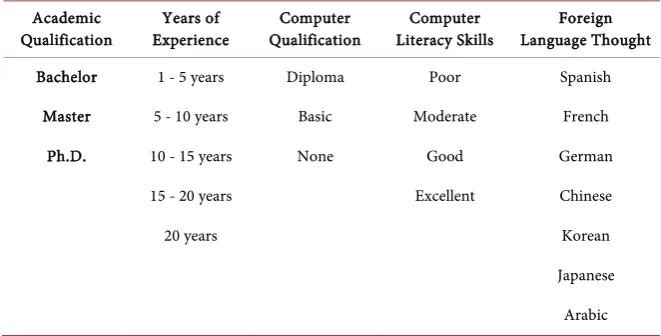
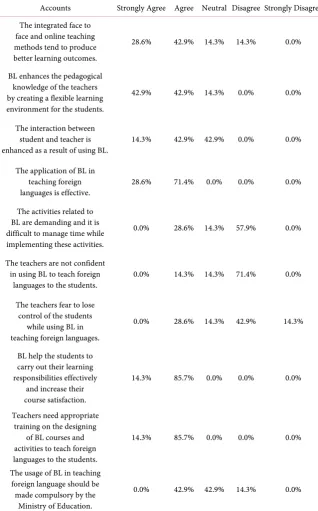
DOI: 10.4236/ojml.2019.92013 132 Open Journal of Modern Linguistics collected background information and the second section consisted of 10 state-ments. See Table 1 Demographic Details and Table 2 Likert Scale Questionary. The data was collected via google forms-questionnaire that helped in assessing the current foreign languages practices by using BL at these universities. As a BL method combines traditional and modern methods with the use of technology for teaching and learning FL; all the statements in the questionnaire were set to measure the attitude of FL teachers towards BL from the standpoints of its educa-tion-impact concerning to set up learning outcome of FL subjcets; the improvement
Table 1. Demographic details.
Academic
Qualification Experience Years of Qualification Computer Literacy Skills Computer Language Thought Foreign
Bachelor 1 - 5 years Diploma Poor Spanish
Master 5 - 10 years Basic Moderate French
Ph.D. 10 - 15 years None Good German
15 - 20 years Excellent Chinese
20 years Korean
Japanese
Arabic
Table 2. Likert scale questionary.
The integrated face to face and online teaching methods tend to produce better learning outcomes.
BL enhances the pedagogical knowledge of the teachers by creating a flexible learning environment for the students.
The interaction between student and teacher is enhanced as a result of using BL. The application of BL in teaching foreign languages is effective.
The activities related to BL are demanding and it is difficult to manage time while implementing these activities.
The teachers are not confident in using BL to teach foreign languages to the students. The teachers fear to lose control of the students while using BL in teaching foreign languages.
BL help the students to carry out their learning responsibilities effectively and increase their course satisfaction.
Teachers need appropriate training on the designing of BL courses and activities to teach foreign languages to the students.
The usage of BL in teaching foreign language should be made compulsory by the Ministry of Education.
DOI: 10.4236/ojml.2019.92013 133 Open Journal of Modern Linguistics of the pedagogical knowledge of FL teachers when using it; the BL facilitation in communication between teachers and students; the BL effectiveness in the ac-quisition of the L2; the BL use to manage the timely; to evaluate the level of self-assured of FL teachers; the BL influence on the wellbeing of students; the need of BL training assistance and the stand of FL teachers in relation to BL Higher Education-measures. The responses of teachers were scored on the basis of 5 point Likert scale (strongly agree, agree, neutral, disagree and strongly dis-agree). After recording the responses, the completed online-questionnaire was collected and coded for statistical analysis.
4. Foreign Language Reference-Spanish
Español Como Lengua Extranjera (ELE) is the term used to refer to various systems used by different learning institutions that teach the Spanish lan-guage to speakers of other lanlan-guages. There are many Institutions such as Official Language Schools, public and private schools, The Cervantes Institute and The Foundation for the Development of and Research into Spanish Culture (FIDESCU) for teaching and learning Spanish as Second Foreign Language. Nevertheless, when it comes to teach and learn Spanish as Second Foreign Lan-guage there are aspects of this particular lanLan-guage that needs to be known. For example, Español or Castellano as it is known is one of the easiest foreign lan-guages to learn. The simple phonetics of Spanish language makes it easier to learn and speak irrespective of its grammar complexity (Rivera, 2019)10. In this aspect the use of BL in Spanish language classes benefits the acqisition of the L2. BL allows the beginner students to acquire and develop cognitive skills and language competences in a short period of time. The acquisition of vocabulary related to (greetings/introductions/responding/farewells/the Spanish alphabet-letters reading names) ext. it can be done by making a click. At present, there is not necessity for a Spanish language teacher to teach these aspects of the Spanish language and others by using the traditional method (teacher as center of the learning process). According to (Center for Research on Learning, 2011)11 the development of strategies for learning foreign language involves a set of opera-tions and plans that assist in obtaining, storing, retrieving, and using important information. Furthermore, foreign language learners are motivated to under-stand and learn new information through their intentional behavior and thoughts. Reiterating the words “obtaining, storing, retrieving, and using im-portant information” I would say that the use of BL will facilitates the ways to do as appropriate. And about “behavior” the way students behave in relation to the Second Language Acquisition (SLA), they cannot be segregated from the pre-ferred way to study and learn. In other words, it is undeniable that the use of technologies has become a fundamental part of their lives and the preferred way 10Rivera, J. (2019). Applied Linguistic-Tú and Usted Spanish Personal Subject Pronouns. Open Jour-nal of Modern Linguistics, 9, 12-24. https://doi.org/10.4236/ojml.2019.91002
11Center for Research on Learning (2011). Learning Strategies.
DOI: 10.4236/ojml.2019.92013 134 Open Journal of Modern Linguistics to manage it in many areas, including school.
5. BL-T & L Roleplay Reflection
According to (Motteram, 2013)12, the digital technologies help teachers working with learners, and assist learners to work independently to perform necessary “language” that makes their language development possible. The use of BL in teaching and learning foreign languages at university has to be in line with the learning style of the 21st Century (Kramsch, 2014)13. In this regard working with university students for example, it is not the same thing as the school students because these students are one step away from becoming future professionals. In relation to this particular point the employing of BL as teaching and learning approach plays an essential role in cultivating the sense of self-responsibility among students, one of the qualities that the employers look at the most nowa-days. As students are now center of teaching and learning process. The students play a major role of coordinator, builder as well as customer. As coordinators, students are responsible for their own language development. Consistent with this aspect, students have to deal with time management and completion of as-signed tasks and the use of computer tools help to determine the level of discip-line with which students assume their specific role. This is something very out-standing in providing good education to university students. In the Digital Era, teacher is no longer the center of teaching and learning process. Teacher func-tions as a facilitator, observant, and supervisor in particular, while using BL to conduct foreign language classes. As facilitator, the priority of a teacher is to equip the students with appropriate online didactic material, accompanied by clear instructions on what to. It will require knowledge of the subject to teach through the selection of appropriate online materials that match the language learning level of the students. The knowledge of the computer tool is used as channel to transfer the online language learning content. As a supervisor, the teacher monitors the language development of the students by providing useful strategies to facilitate communication and comprehension of the language taught. This will also require knowledge, the methodological capabilities of the lecturers, and the management and use of the class time and space. Moreover, as an observant, the main concern of a teacher is to pick up the mistakes of the students so that the corrections can be done as required. We are living in a Digital Age where updating our teaching and learning language methods so that they can be relevance to it; it must be a priority. We cannot ignore the learning style of the students these days and therefore the benefits of using the Blended Learning method. Even though this method has had its criticisms; it is quite effective from the perspective of developing the self-learning, which will produce self-confident; self-discipline and self-direct students. Consequently, if 12Motteram, G. (2013). Developing and Extending Our Understanding of Language Learning and Technology.
13Kramsch, C. (2014). Teaching Foreign Languages in an Era of Globalization: Introduction. The
Modern Language Journal, 98, 296-311. https://doi.org/10.1111/j.1540-4781.2014.12057.x
DOI: 10.4236/ojml.2019.92013 135 Open Journal of Modern Linguistics these are the qualities that we want our graduates university students to have!!! it seems to be that we have before our eyes one of the most appropriate method for teaching a foreign language subject at university level.
6. Study Oriented-Approach
According to what is approved by the Common European Framework of Refer-ence for Languages or the CEFR (Consejo de Europa, 2001)14 there are six grades as well as six exams (A1, A2, B1, B2, C1 and C2). Based on this mandate from the CEFR the Syllabus-Learning Outcome (LO) for a foreign language course should be setup. Although every Education Institution has its own procedure to do as appropriate; the CEFR provides the International Standards Assignments Setting for FL subjects, including Spanish. Teaching Spanish as second foreign language either in Spain and Latin America or abroad, requires having know-ledge of the language and methodological capabilities. Furthermore if the course includes the use of BL, then, the knowledge of computer-tools is required as well. I do say this because learning outcomes are statements of what students know, and can do as a result of their respective courses of study. This state-ment clear indicates the role to play by the teachers who are in charge of deli-vering the course-teaching-learning materials. That academic and proved statement (LO) also defines present and future outputs of any kind of study course. For this reason this research article is providing insights into a various facets of teaching and learning Spanish as Second Foreign Language with em-phasis on BL-Benefit/Apllication. This method can be adaptable to other foreign language subjects.
7. Course Name: Spanish for Beginners A1
Objective & Learning Outcome: This course is designed for equipping stu-dents with the communication and linguistic skills, specifically related to speak-ing and writspeak-ing. At the end of the course students will be able to:
- Apply basic verbal communication;
- Demonstrate comprehension of basic verbal communication;
- Construct simple phrases/sentences and memos;
- Demonstrate comprehension of basic reading texts.
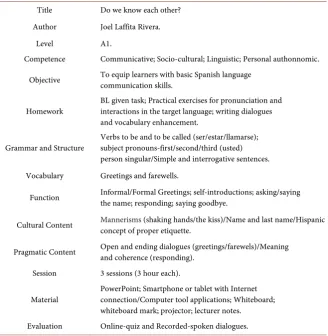
Based on what it is stated in the learning outcome the following didactic unit (Table 3 Lessons 1 & 2) is made up. A didactic unit is a kind of lesson plan, teacher details and describes each lesson of the course. In order to guide class instructions the teacher will develop this didactic unit, regarding skills, compe-tences, time managing (how many time devote do each activity) and the expla-nations given to the students. Writing it, the teacher has to take into account what students have to learn during the course, how classes will be planned, and the different needs that students can present.
DOI: 10.4236/ojml.2019.92013 136 Open Journal of Modern Linguistics
Table 3. Didactic unit-lessons 1 & 2.
Title Do we know each other?
Author Joel Laffita Rivera.
Level A1.
Competence Communicative; Socio-cultural; Linguistic; Personal authonnomic.
Objective To equip learners with basic Spanish language communication skills.
Homework BL given task; Practical exercises for pronunciation and interactions in the target language; writing dialogues and vocabulary enhancement.
Grammar and Structure Verbs to be and to be called (ser/estar/llamarse); subject pronouns-first/second/third (usted) person singular/Simple and interrogative sentences. Vocabulary Greetings and farewells.
Function Informal/Formal Greetings; self-introductions; asking/saying the name; responding; saying goodbye.
Cultural Content Mannerisms concept of proper etiquette. (shaking hands/the kiss)/Name and last name/Hispanic
Pragmatic Content Open and ending dialogues (greetings/farewels)/Meaning and coherence (responding).
Session 3 sessions (3 hour each).
Material PowerPoint; Smartphone or tablet with Internet connection/Computer tool applications; Whiteboard; whiteboard mark; projector; lecturer notes.
Evaluation Online-quiz and Recorded-spoken dialogues.
8. Computer Tool Applications
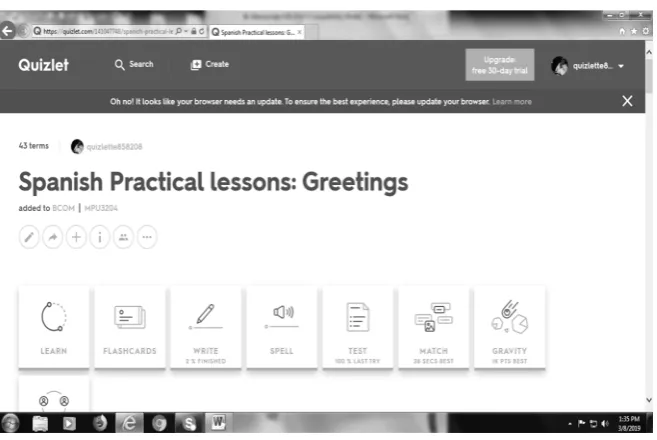
DOI: 10.4236/ojml.2019.92013 137 Open Journal of Modern Linguistics search in the field of second language acquisition. According to analytical data Khoot counts with a community of monthly users of 50 million up to 2017. And Quizlet, what about Quizlet? This computer tool is a mobile and web-based study application that allows students to study information via learning tools and games. Quizlet trains students via flashcards and various games and tests. Thus, Quizlet is very convenient for “language setup tests-content” in particular. This computer tool allows FL teacher to do that according to the teacher’ exper-tise. Based on data provided Quizlet is currently used by two-thirds of high school students and half of university students in the United States. From my own professional experience in using these computer tool applications in teach-ing Spanish language; I would say that FL teachers can create wonderful thteach-ings and make the students feel that way too. See the captured of Figure 1 EDpuzzel and Figure 2 Kahoot and Figure 3 Quizlet. Internet Links related to these com-puter tool applications will be provided as attached in the sub-heading-Internet Accredited Sources.
Figure 1. EDpuzzel.
DOI: 10.4236/ojml.2019.92013 138 Open Journal of Modern Linguistics
Figure 3. Quizlet.
9. BL Class Management
Activity 1-BL Given task. This activity is given to studentsin the class. It has to be accompanied by clear instructions on what students need to do in relation to the lesson-topic and the appropriate computer tool application-link and lec-turer-note-link. The main focus of that lesson has to be on its communicatie ob-jective. In a BL class the use of time and space is important. So, making clear to students the time they have to accomplish the goal. Arrange the classroom space so that they can communicate/discuss the lesson-subject-matter one with each other. Do not interrupt this learning process unless it is needed.
Activity 2-Class Discussion. This activity is to reinforce the knowledge ac-quired by students during the BL given task. The classroom space & time is used to practice the pronunciation of the vocabulary learnt and to conduct individual and group interactions in Spanish language. During this activity make sure as a Spanish language teacher that students get a comprehension of the pronuncia-tion and grammar used in the vocabulary learnt.
Activity 3-Vocabulary Enhancement. This activity is based on the lecturer’ notes. Its purpose is to provide students “helpful Spanish Phrases” to enhance and empower the communicative-competence.
Activity 4-Testing Knowledge. This activity is a quiz-based lesson topic which requires the use of computer tools. In this case we use “Kahoot”. It can be given to students as homework or for doing it in the class. It provides the way to get leraner’ learning-retention-feebacks. This will help to identify students’ weak-ness whether is individual or groups.
10. BL Classroom Setting Disadvantages
Inter-DOI: 10.4236/ojml.2019.92013 139 Open Journal of Modern Linguistics net-websites have on the others to do advertises, the Internet connection-mostly technical issues and speed, computer tools-cognitive-skills and the attitude of students towards BL.
- Distraction by non-relevant online content;
- Interruptions in the Internet connection;
- Problems with hardware-online tools;
- Insufficient knowledge about the use of computer-tools;
- Lack of discipline to carry out the BL given tasks in or out the class.
11. Objective of the Research
The study aim has been to provide an appropriate manuscript through which Spanish language teachers and foreign language teachers gain pedagogical and computer knowledge-inputs to setput foreign languages classes trough Blended Learning. The study has collected significant background information to mate-rialize its contextual headings and sub-headings-finding in regard to the objec-tive of the research article. Subsequently to these accounts the results and dis-cussion and conclusion, as follow.
12. Results and Discussion
DOI: 10.4236/ojml.2019.92013 140 Open Journal of Modern Linguistics
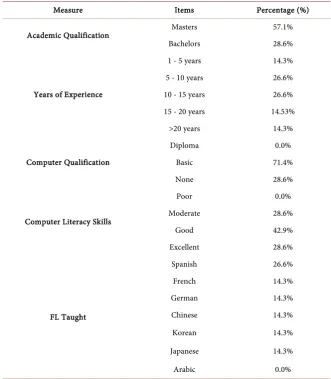
Table 4. Demographic details statistics.
Measure Items Percentage (%)
Academic Qualification Masters 57.1%
Bachelors 28.6%
Years of Experience
1 - 5 years 14.3%
5 - 10 years 26.6%
10 - 15 years 26.6%
15 - 20 years 14.53%
>20 years 14.3%
Computer Qualification
Diploma 0.0%
Basic 71.4%
None 28.6%
Computer Literacy Skills
Poor 0.0%
Moderate 28.6%
Good 42.9%
Excellent 28.6%
FL Taught
Spanish 26.6%
French 14.3%
German 14.3%
Chinese 14.3%
Korean 14.3%
Japanese 14.3%
Arabic 0.0%
71.4% agree and 28.6% strongly agree and 0.0% neutral, disagree, strongly dis-agree. (5th statement) 57.1% disagree, 28.6% agree, 14.3% neutral and 0.0% strongly agree and strongly disagree. (6th statement) 71.4% disagree, 14.3% neu-tral, 14.3% agree and 0.0% strongly agree and strongly disagree. (7th statement) 42.9% disagree, 14.3% neutral, 28.6% agree, 14.3% strongly disagree and 0.0% strongly agree. (8th statement) 85.7% agree, 14.3% strongly agree and 0.0% neu-tral, strongly agree, strongly disagree. (9th statement) 85.7% agree, 14.3% strongly agree and 0.0% neutral, agree, strongly disagree (10th statement) 42.9% agree, 42.9% neutral, 14.3% disagree and 0.0% strongly agree, strongly disagree. See Table 5 Likert Scale Questionary Statistics.
DOI: 10.4236/ojml.2019.92013 141 Open Journal of Modern Linguistics
Table 5. Likert scale questionary statistics.
Accounts Strongly Agree Agree Neutral Disagree Strongly Disagree The integrated face to
face and online teaching methods tend to produce better learning outcomes.
28.6% 42.9% 14.3% 14.3% 0.0%
BL enhances the pedagogical knowledge of the teachers by creating a flexible learning environment for the students.
42.9% 42.9% 14.3% 0.0% 0.0%
The interaction between student and teacher is
enhanced as a result of using BL. 14.3% 42.9% 42.9% 0.0% 0.0%
The application of BL in teaching foreign
languages is effective. 28.6% 71.4% 0.0% 0.0% 0.0%
The activities related to BL are demanding and it is difficult to manage time while implementing these activities.
0.0% 28.6% 14.3% 57.9% 0.0%
The teachers are not confident in using BL to teach foreign
languages to the students. 0.0% 14.3% 14.3% 71.4% 0.0%
The teachers fear to lose control of the students
while using BL in teaching foreign languages.
0.0% 28.6% 14.3% 42.9% 14.3%
BL help the students to carry out their learning responsibilities effectively
and increase their course satisfaction.
14.3% 85.7% 0.0% 0.0% 0.0%
Teachers need appropriate training on the designing
of BL courses and activities to teach foreign languages to the students.
14.3% 85.7% 0.0% 0.0% 0.0%
The usage of BL in teaching foreign language should be made compulsory by the
Ministry of Education.
0.0% 42.9% 42.9% 14.3% 0.0%
DOI: 10.4236/ojml.2019.92013 142 Open Journal of Modern Linguistics achieve it than using BL as method. Thus, this study intends to emphasize the significant of applying BL in teaching and learning foreign languages, mainly at university level.
13. Conclusion
On examining the data provided throughout the headings and sub-headings in this research article, one could conclude that the manuscript contains significant literature sources corresponding to the main objective of the research article. The data presented in the manuscript contextualize clearly the subject-matter in regards to the teaching and learning of foreign languages through BL. The find-ing of the study is value and supported by the professional view of its author and the view of other researcher-works. Although, FL teachers are well-aware about the benefits of BL in teaching and learning practices, the results of this research article have drawn the need to provide methodologies and computer training sessions to the FL teachers for effective employment of BL in foreign languages classes. This manuscript is adding new values to the use of computer-language-field, which is a contribution to the continued enhancement and development of the teaching and learning of foreign languages, especially in the Digital Age.
Acknowledgements
The author is very thankful to all the associated personnel in any reference that contributed in/for the purpose of this research.
Funding
The research is not funded through any source.
Conflicts of Interest
The research holds no conflict of interest.
References
Al-Qahtani, A. A., & Higgins, S. E. (2013). Effects of Traditional, Blended and e-Learning on Students’ Achievement in Higher Education. Journal of Computer Assisted Learn-ing, 29, 220-234. https://doi.org/10.1111/j.1365-2729.2012.00490.x
Asiri, M. J. S., bt Mahmud, R., Bakar, K. A., & bin Mohd Ayub, A. F. (2012). Factors In-fluencing the Use of Learning Management System in Saudi Arabian Higher Educa-tion: A Theoretical Framework. Higher Education Studies, 2, 125.
https://doi.org/10.5539/hes.v2n2p125
Banados, E. (2006). A Blended Learning Pedagogical Model for Teaching and Learning EFL Successfully through an Online Interactive Multimedia Environment. CALICO Journal, 23, 533-550. https://doi.org/10.1558/cj.v23i3.533-550
Beetham, H., & Sharpe, R. (2013). Rethinking Pedagogy for a Digital Age: Designing for 21st Century Learning. Abingdon-on-Thames: Routledge.
Center for Instructional Technology (2015).
DOI: 10.4236/ojml.2019.92013 143 Open Journal of Modern Linguistics http://www.kucrl.org/sim/strategies.shtml
Conole, G., & Oliver, M. (2006). Contemporary Perspectives in E-Learning Research: Themes, Methods and Impact on Practice. London: Routledge.
https://doi.org/10.4324/9780203966266
Consejo de Europa (2001). Marco Común Europeo de Referencia para las Lenguas: Aprendizaje, enseñanza, evaluación. https://www.examenglish.com/CEFR/cefr_es.php Kramsch, C. (2014). Teaching Foreign Languages in an Era of Globalization:
Introduc-tion. The Modern Language Journal, 98, 296-311. https://doi.org/10.1111/j.1540-4781.2014.12057.x
Lai, C., & Kritsonis, W. (2006). The Advantages and Disadvantages of Computer Tech-nology in Second Language Acquisition. National Journal for Publishing and Mentor-ing Doctoral Student Research, 3, 1-6.
Lopez-Perez, M. V., Perez-Lopez, M. C., & Rodriguez-Ariza, L. (2011). Blended Learning in Higher Education: Students’ Perceptions and Their Relation to Outcomes. Comput-ers and Education, 56, 818-826. https://doi.org/10.1016/j.compedu.2010.10.023 Motteram, G. (2013). Developing and Extending Our Understanding of Language
Learn-ing and Technology.
Rivera, J. (2019) Applied Linguistic-Tú and Usted Spanish Personal Subject Pronouns. Open Journal of Modern Linguistics, 9, 12-24. https://doi.org/10.4236/ojml.2019.91002 Skrypnyk, O., Joks, S., Kovanovic, V., Dawson, S., Gasevic, D., & Siemens, G. (2015). The
History and State of Blended Learning. Alberta: Athabasca University.
Westberry, N. (2009). An Activity Theory Analysis of Social Epistemologies in Ter-tiary-Level e-Learning Environments. Unpublished Doctoral Dissertation, Hamilton: University of Waikato.
Additional References
Allen, K. H. (2013). The How of Blended Instruction: Current Practices of North Carolina Teachers in One-to-One Schools. Cullowhee, NC: Western Carolina University. Al-Rabadi, R. Y., & Bataineh, R. F. (2015). Learning Strategies in Literature-Based
In-struction: A Qualitative Study of Jordanian University Students. Journal of Teaching and Teacher Education (University of Bahrain), 3, 101-110.
https://doi.org/10.12785/jtte/030109
Bijeikiene, V., Rasinskiene, S., & Zutkiene, L. (2011). Teachers’ Attitudes towards the Use of Blended Learning in General English Classroom. Studies about Languages, 18, 122-127. https://doi.org/10.5755/j01.sal.0.18.420
Carmen Losada Aldrey, M. (2005). Las nuevas tecnologías y la enseñanza-aprendizaje del español lengua extranjera. In M. Cal, P. Núñez, & I. M. Palacios (Eds.), Nuevas tecnologías en Lingüística, Traducción, y Ensenyanza de lenguas (pp. 181-202). (In Spanish)
Chamot, A., Meloni, C., Gonglewski, M., Bartoshesky, A., & Keatley, C. (2007). Develop-ing.
Comas-Quinn, A. (2011). Learning to Teach Online or Learning to Become an Online Teacher: An Exploration of Teachers’ Experiences in a Blended Learning Course. Re-call, 23, 218-232. https://doi.org/10.1017/S0958344011000152
Harb, I. (2013). The Effectiveness of Blended Learning Program on Developing and Re-tention of Palestinian Tenth Graders’ Writing Skill. Magazine Skill, 2, 208-221. https://doi.org/10.11648/j.edu.20130206.12
DOI: 10.4236/ojml.2019.92013 144 Open Journal of Modern Linguistics on Language Learners’ Reactions to Blended Learning. Calico Journal, 27, 328-348. https://doi.org/10.11139/cj.27.2.328-348
Larsen, L. J. E. (2012). Teacher and Student Perspectives on a Blended Learning Intensive English Program Writing Course. Ames, IA: Iowa State University.
National Capital Language Resource Center. Autonomy in Language Learners: Learning Strategies Instructions in Higher Education.
Perera, I. (2010). What Will Users Expect from Virtual Learning Methods? A Conceptual Model to Analyze Future Leaning Method Enhancements. US-China Education Re-view, 7, 76-82.
Internet Accredited Sources
http://englishagenda.britishcouncil.org/sites/default/files/attachments/british_council_in novations_in_learning_technologies_for_elt.pdf
https://blended.online.ucf.edu/about/what-is-blended-learning https://create.kahoot.it/register
https://edpuzzle.com
https://elearningindustry.com/history-of-blended-learning https://en.wikipedia.org/wiki/Blended_learning
https://quizlet.com
https://www.britishcouncil.org/voices-magazine/the-benefits-new-technology-language-l earning
https://www.mindflash.com/elearning/what-is-blended-learning