Running head: Understanding Suicidality 1
Running head:
Understanding Suicidality
Understanding the Relationship between Suicidality, Current Depressed Mood, Personality and Cognitive Factors
Dr Shri Cameron1, Professor Verity J Brown1, Dr Barbara Dritschel1, Professor Kevin Power2, Malcolm Cook3
1University of St Andrews,
2Head of Clinical Psychological Therapies, Tayside, 3University of Huddersfield
Word count (exc. figures/tables): 4,990
*Requests for reprints should be addressed to Professor Verity J Brown, Vice Principal (Enterprise and Engagement), Office of the Principal, College Gate, North Street, St Andrews, Fife, Scotland, KY16 9AJ, Email: [email protected] Tel: +44(0)1334 462554
Acknowledgements
Running head: UNDERSTANDING SUICIDALITY 1
Abstract
Objectives: Links between suicidality and depressed mood are well-established. There is,
however, little information about the emotional regulation processes that underlie the
relationship between suicidality and current low mood, and how these processes differ between
groups of never-suicidal, suicidal-ideators and suicide attempters. As suicidality and depression
are heterogeneous constructs, this study aimed to conduct within and between group
comparisons of known suicide risk factors that are associated with emotion regulation
(neuroticism; trait aggression; brooding; impulsivity and overgeneral autobiographical
memories).
Design: Correlational design using between and within group comparisons from self-report
measures.
Methods: Inter- and intra-group differences were identified using Pearson’s correlation
co-efficients and tests of difference. An analysis of indirect effects was used to investigate whether
the relationship between suicidality and current low mood was mediated by neuroticism, trait
aggression, brooding, impulsivity and overgeneral autobiographical memories, and if this
relationship varied according to group type.
Results: Brooding appeared to be a consistent feature of all three groups and was closely related
to current low mood. Compared to the never-suicidal group, the relationship between suicide
attempts and current low mood showed greater associations with brooding, trait aggression and
overgeneral autobiographical memories. Compared to the never-suicidal group, the suicide
ideation group showed stronger associations with neuroticism and impulsivity but these factors
Conclusion: These results suggest a need for larger studies to focus on heterogeneity within
suicidal populations and consider how different combinations of risk factors may heighten
or reduce suicide risk. (245)
Keywords: Suicide, Trait Aggression, Impulsivity,
Practitioner Points
It is well-known that the severity and intensity of suicide and depressed
presentations vary because of underlying dispositional and contextual factors
(Fried & Nesse, 2015) which, in turn, affect how events are interpreted and
responded to. Despite this, there is little research about how these mechanisms
operate in different types of suicide groups, and their influence on the relationship
between suicidality and current low mood.
Understanding inter-relationships that affect current low mood is of clinical
significance because past suicidal history and deteriorations in already negative
mood are linked to repeated suicide attempts and completion.
Our findings show that ruminative brooding, defined as a tendency to repeatedly
think about emotional aspects of an event, consistently correlate with current low
mood across different types of suicidal groups (never-suicidal, suicidal ideators
and attempters), and across analyses.
Findings also show that suicidal ideation and attempt groups were associated with
specific personality characteristics that increased the propensity of emotional
responding and interpretation compared to the never-suicidal group. The
relationship between suicide attempt and current low mood had a higher
propensity to be influenced by trait aggression, brooding and overgenerality
compared to the never-suicidal group. In contrast, although the suicidal ideation
group correlated more strongly with neuroticism and impulsivity, these factors did
In terms of clinical practise, these findings imply that specific styles of
interpretation and thinking may maintain the relationship between suicidality and
current low mood. Given the cross-sectional nature of the study, however, it is not
possible to imply causality. Nevertheless, the findings obtained provide some
support for transdiagnostic models of cognitive-behavioural processes that could
Understanding the Relationship between Suicidality, Current Low
Mood, Personality and Cognitive Factors
Individual variations in emotional regulation can increase, or decrease, the propensity of
depression (Aldao, Nolen-Hoeksema, & Schweizer, 2010). Likewise, predisposing, precipitating
and perpetuating factors can increase, or decrease, symptom severity and intensity, creating
heterogeneity within suicidal and depressed groups (Fried & Nesse, 2015). To understand what
maintains the relationship between suicidality and current low mood, we need to investigate
internal (e.g. inhibitory control, recall style, thinking style, emotional reactivity and sensitivity)
and external processes (behaviour) involved in emotion regulation (Sheppes, Suri, & Gross,
2015). Few studies, however, examine how variations in risk factors influence the relationship
between suicidality and current low mood. Understanding current low mood is of clinical
significance because deteriorations in current low mood are shown to increase probability of
reattempting or completing suicide following a previous incident (Antypa, Van der Does, &
Penninx, 2010; Appleby, Dennehy, Thomas, Faragher, & Lewis, 1999; Hawton & Fagg, 1988;
ISD-Scotland, 2012; Wolfsdorf, Freeman, D'Eramo, Oveholser, & Spirito, 2003).
Moreover, despite numerous suicide risk factors being identified, it is still difficult to
predict a suicidal crisis (Fawcett et al., 1990a; Goldstein, Black, Nasrallah, & Winokur, 1991).
This suggests that a deeper understanding is required regarding the interactions between risk
factors and their influence on different types of suicide groups. There is evidence to suggest that
exploring levels of suicidality reveals similarities and differences between suicide groups that
2012). This is also consistent with the Cognitive Model of Suicide (Wenzel and Beck, 2008)
which proposes that underlying dispositional vulnerabilities affect individual levels of distress
tolerance (Anestis, Bagge, Tull, & Joiner, 2011). Having more vulnerabilities is thought to lower
the distress tolerance threshold which, in turn, increases the likelihood of mood-disturbance or
suicide-related cognitions.
Emotional regulation, however, is difficult to assess because of its multi-faceted nature.
There is, nevertheless, growing evidence to suggest that emotional regulation difficulties are
associated with increased emotional reactivity and sensitivity (Jollant, Lawrence, Olie,
Guillaume, & Courtet, 2011; Nock, Wedig, Holmberg, & Hooley, 2008), which are
sub-components of Neuroticism. Neuroticism measures how individuals interpret and respond to
stressful situations (Bolger & Schilling, 1991; Eysenck, 1967; Vaughan-Johnston, Quickert, &
MacDonald, 2017), which differs from depressed mood (Bowen, Wang, Balbuena, Houmphan,
& Baetz, 2013). Neuroticism is evident across cultures (Terracciano & McCrae, 2006) and the
lifespan (Gale, Booth, Mõttus, Kuh, & Deary, 2013; Van Os & Jones, 1999), with high ratings
corresponding to overly emotional responses to everyday stressors (Suls, Green, & Hillis, 1998),
possibly because distressing events are appraised as intolerable (de Bruin, Rassin, & Muris,
2007) and difficult to manage (Larsen & Ketelaar, 1991).
Trait aggression also refers to a specific form of emotional responding; an increased
propensity to perceive and respond to situations in an overly angry or hostile manner. As such,
both personality characteristics have the potential to influence perception, emotional processing
Links between suicidality, depressed mood, neuroticism and trait aggression are well-established
within the literature (Doihara et al., 2008; Wenzel & Beck, 2008) and there is evidence to
suggest that these personality constructs can amplify emotional responding when combined with
other risk factors, such as brooding, impulsivity and overgenerality (Dutton & Karakanta, 2013;
Gvion & Apter, 2011; Wenzel & Beck, 2008).
Combining neuroticism with ruminative thinking, a tendency to repeatedly think
passively about historical events, is shown to increase negative self-schematic information
(Ciesla, Felton, & Roberts, 2011) and cognitive reactivity when faced with challenges (Nolan,
Roberts, & Gotlib, 1998). While interactions between neuroticism and impulsivity also enhance
negative affect, this seems to be due to a reliance on short-term, rather than longer-term,
solutions (Carver & Miller, 2006; Fetterman, Robinson, Ode, & Gordon, 2010).
Similarly, for some individuals, aggressive behaviour could be the precursory indicator,
and the primary source of difficulty, that maintains depressive episodes (Praag, 1998, 2001).
While the relationship between suicidality, depression and anger is well-known (Cautin,
Overholser, & Goetz, 2001) there is limited evidence about the factors that maintain this
relationship. Studies, for instance, indicate that sad and angry ruminations overlap (Peled &
Moretti, 2010), with the latter maintaining an internal state of anger (Berkowitz, 1993; Rusting &
Nolen-Hoeksema, 1998b). It is not clear, though, whether these overlaps are associated with trait
aggression and how the emotional content produced by such ruminations affects suicide risk.
There is also debate over the inter-relationship between trait aggression and impulsivity, with
Currier, 2009; Mann, Waternaux, Haas, & Malone, 1999; Seroczynski, Bergeman, & Coccaro,
1999) and others arguing that each trait represents a distinct dimension (Critchfield, Levy, &
Clarkin, 2004).
Suicidality and depression are also associated with a tendency to recall overgeneralized
autobiographical memories (Williams & Broadbent, 1986). Instead of recalling discrete personal
memories (e.g. ‘last Sunday, I had a fight with my partner’), this means that memories are
recalled for non-descript time-periods (e.g. ‘my partner and I always fight’). While this retrieval
style could provide perceived functional benefits, by passively avoiding distressing emotions
(Williams et al., 2007), a reliance on this retrieval style has drawbacks in terms of reducing
social problem solving skills in suicidal groups and decreasing imaginability for future events
(Williams, Ellis, Tyers, & Healy, 1996), which may increase suicide risk.
Given that that multiple factors are associated with suicidality and low mood, the first
aim was to investigate between and within group comparisons of known risk factors
(neuroticism, trait aggression, rumination, impulsivity and overgenerality) to determine whether
the inter-relationships between risk factors differed according to group type. The second aim was
to compare risk profiles of suicidal ideators and attempters to a never-suicidal group using
neuroticism, trait aggression, rumination, impulsivity and overgenerality as potential mediators
of the suicidality-current depressed mood relationship. Given the cross-sectional nature of this
study, causality is not assumed. Instead, we have used the Cognitive Model of Suicide ((Wenzel
Methods
Participants
Never-suicidal (NS) and suicide-ideation (SI) groups were recruited from local
communities through posters placed on noticeboards (GP surgeries, Universities, bus stations),
and university bulletins. Participants in the NS group were recruited as part of a larger study that
investigated the impact of personality and mood on autobiographical memories. This was stated
in the NS group advertisement. Due to ethical concerns about recruiting active suicide ideators,
advertisements for the SI group only invited individuals with historical suicidal ideation to take
part and advised that no questions would be asked about historical suicidal thoughts. Telephone
and e-mail contact details were provided.
The inclusion criteria, specified in adverts, stated participants aged 55 and under, with a
good understanding of English and without a diagnosed neuropsychological condition (e.g.,
epilepsy or brain-injury), intellectual disability or substance misuse history were eligible to take
part. Suicide ideation was determined by endorsing either one or both items on the Beck’s
Depression Inventory ‘I would kill myself if I had the chance’ and the Eysenck Personality
Questionnaire (Eysenck & Eysenck, 1975) ‘Have you ever wished you were dead?. These
questions reflect best practise guidelines and are considered to be valid and reliable estimates of
suicidal ideation (Centre for Suicide Research, 2014, LivingWorks Education, 2013, National
Risk Management Programme, 2007). Based on responses given, ninety participants were
assigned to the NS group having self-reported never experiencing suicidal ideation or attempting
on reports of historical suicidal ideation but no reports of suicide attempt history (17 males and
13 females). Ages ranged from 18-55, with the mean age range for both groups being 18-25.
The Suicide Attempt (SA) group was recruited from an Accident and Emergency
department (NHS Tayside) within 24 hours of admission following a probable suicide attempt2. Lead clinicians assessed individuals to identify participants meeting the inclusion criteria
following the completion of routine assessments (toxicology and neurological assessments).
During the testing period (Spring-Summer of 2010 and 2011), one hundred and eight
individuals, who were admitted into a local Accident and Emergency department met the
inclusion criteria. From this group, eighty three agreed to participate providing a 76% response
rate (36 males and 47 females: mean age range: 18-25).
Descriptive statistics, from which the SA sample was drawn, suggest that suicidal intent
was highest in individuals aged 30-35 followed by 24-29 year olds. Individuals in the 54-59 age
banding, followed by 30-35 year olds, were most likely to engage in severe attempts, as assessed
severity (tension, depression, anger, vigor, fatigue and confusion) based on how participants feel Measures
The Eysenck Personality Questionnaire -EPQ-R (Eysenck & Eysenck, 1975): The
neuroticism subscale is a psychometrically reliable and valid trait measure of emotional
reactivity and sensitivity (Francis, Brown, & Philipchalk, 1992). Responses are yes/no answers
with higher scores indicating higher levels of neuroticism (α = .78).
The Aggression Questionnaire -AQ (Buss & Perry, 1992): The AG contains 29 items (α
=.89) which reliably assesses trait aggression across domains of physical, verbal, hostility and
anger ((Harris, 1997)) using a 5-point scale. Higher scores correspond to higher levels of trait
aggression. Though some aggression questionnaires show overlaps between related constructs
(Miller & Lynam, 2006), this measure is considered to be free of such biases (Critchfield et al.,
2004; Hennig, Reuter, Netter, Burk, & Landt, 2005).
The Ruminative Response Scale (Nolen-Hoeksema & Morrow, 1991): The RRS assesses
a pervasive tendency to repeatedly think about past events in either a brooding or reflective style.
Brooding (α = .75) refers to a tendency to focus on emotional aspects of an event whereas
reflective rumination (α = .87) refers to a focus on situational components. Despite overlaps
between related constructs, rumination is a distinctive thinking style (Nolen-Hoeksema &
Watkins, 2011). The depression subscale from the RRS was excluded because of overlaps with
low mood. Brooding and reflective rumination (5 items each), were analysed separately.
“right now” using a five-point scale rating. Given the focus of the study, only the 17-item
depression sub-scale was used. The PoMs has been frequently used in suicide groups (Keilp et
al., 2010; Nakao, Yamanaka, & Kuboki, 2002; Salkovskis, Atha, & Storer, 1990).
Barratt’s Impulsivity Scale (Barratt, 1994): The BIS contains 30 items (α = .86) which
assess behavioural, motor and non-planning impulsivity with ratings based on a 4-point-scale.
As with other measures, this questionnaire was selected to assess related but discrete constructs
(García-Forero, Gallardo-Pujol, Maydeu-Olivares, & Andrés-Pueyo, 2009; Gvion & Apter,
2011).
Autobiographical memory test (AMT: (Williams & Broadbent, 1986):
Cue word selection: Williams et al. (2007) suggest that using identical cue-words in
different studies may undermine the generality of findings. We, therefore, used twelve different
cue-words, representing categories of happy, sad, angry and neutral emotions, from a list created
by Paivio, Yuille, and Madigan (1968). Each category of emotion was represented by three
cue-words3.
Instructions: Participants were asked to recall a specific memory, which happened in the
last one to five years, in response to each cue-word. This was to ensure that recalled memories
were embedded into the autobiographical memory hierarchy (Singer & Bonalume, 2010) and
prevented the age of the memory acting as a confounding factor (Piolino et al., 2010). Instructions
stated that the memory did not need to be salient and that while responses would be timed, the
to disclose and an inability to recall. Only six participants chose the former because the
memory felt too personal.
A specific memory was defined as an event which lasted no longer than 24 hours whereas an
overgeneral memory referred to a memory for a non-descript time period which lasted longer
than 24 hours. An example using a neutral cue word (‘house’), was given before commencing
the test to ensure instructions were understood. Cue-words were read aloud in the same order
(happy, grief, destroy, doctor, furious, love, sadness, world, unhappy, rage, bouquet,
happiness), with a single prompt provided if an overgeneralized memory was recalled.
Recall and coding: Fourteen percent of transcripts were rated by three researchers, two of
whom were blind to the study aims, using pre-defined definitions of specific and overgeneral
memories. Inter-rater reliability was good for specific (α = .84) and overgeneral memories (α =
.77). An omission was recorded if a semantic association was described (e.g. ‘My sister went to
the hospital’) or if no narrative was provided. Percentages of overgeneralized memories recalled
were used to standardize responses (Anderson, Goddard, & Powell, 2010).
Procedure
Following ethical approvals (IRAS and LECs), the researcher met with potential NS or SI
participants in the same University room to provide further details and verbally assess the
inclusion criteria. Hard copies of the information sheet and consent form were provided, which
participants signed to indicate consent. Participants then provided demographic information
recording of age to ensure that completed measures could not be traced back to participants using
a combination of age, date of birth, date of admission or testing.
Following this, participants were given a packet of questionnaires that were completed in
one sitting. The AMT was administered next, which was audio recorded with consent. After the
debriefing, there was another opportunity to ask questions. The debriefing for the SI group
involved checking for signs of current suicide risk by an appropriately trained researcher
(primary author). None were reported. Nevertheless, all participants were made aware of local
and national supports (G.P, helplines and counselling services).
Referrals for the SA group were verbally passed to the researcher by the clinician
following ward-rounds (typically mid-morning) if interest was expressed. The researcher
contacted interested participants to provide verbal and written details about the study, giving an
opportunity to ask questions, before they signed the consent form. Potential participants in the
SA group were also advised that taking part in this study would not affect their medical/
psychiatric care, subject to duty of care principles. As with other groups, participants were given
a packet of questionnaires, which they completed in one sitting, with the AMT being
administered next. Verbal and written debriefings were provided on completion of the study.
Results
A series of ANOVAs were performed to determine interactions between group type and
gender. No statistically significant effects were observed for brooding, F (2, 85) = .22, p = .80,
(2, 85) = .07, p = .93, impulsivity F (2, 85) = .80, p = .45 or current low mood F (2, 85) = .48, p
= .62.
Intra and intergroup differences.
Between groups differences were identified using tests of difference. Inter-relationships
within group were analysed using Pearson’s correlations. Though other correlations are reported,
the primary focus was on the inter-relationships with current low mood.
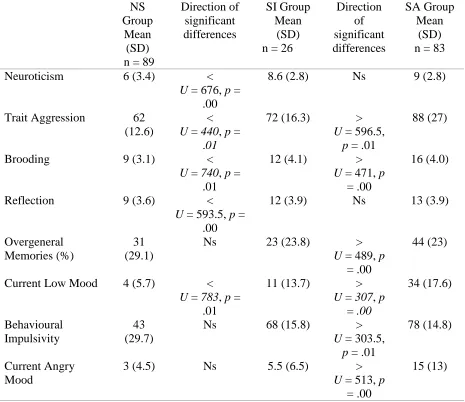
As expected, the SI group rated higher on most measures compared to the NS group, with
the exception of behavioural impulsivity, current angry mood and overgeneralized recall ratings,
which remained similar across both groups (Table 1). Similarly, compared to the SI group, the SA
group rated higher on most factors, with the exception of neuroticism and reflection. Results are
reported at the two-tailed level following the application of a Bonferoni correction (.017).
PLEASE INSERT TABLE 1 HERE
Never-suicidal (NS) group.
In the NS group, positive inter-correlations were observed between current low mood and
neuroticism (r = .36, p = .00) as well as current low mood and brooding (r = .35, p = .00). While
brooding correlated with neuroticism (r = .34, p = .00) and impulsivity (r = .22, p = .04),
reflective rumination only correlated with impulsivity (r = .27, p = .01). No significant
were no significant associations between trait aggression, overgeneralized memories and the rest
of the variables under investigation.
Suicidal ideation group.
The main correlations of interest, in the SI group, related to the relationship between low
mood and ruminative brooding (r = .56, p = .00). Ruminative brooding, in turn, correlated with
neuroticism (r = .54, p = .00).
Recent suicide attempt group.
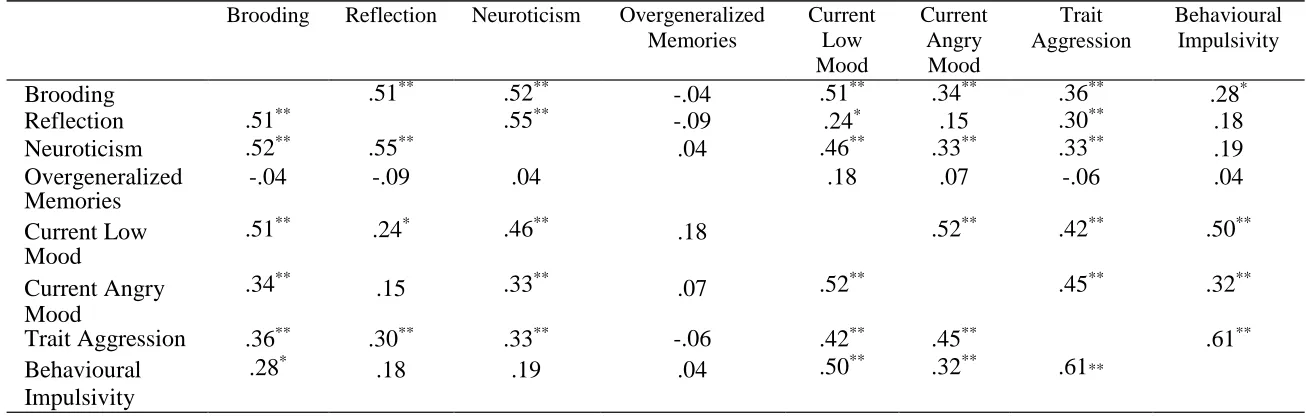
In the SA group, a number of statistically significant inter-correlations were observed
between current low mood and brooding, impulsivity, neuroticism and trait aggression,
respectively (Table 2).
PLEASE INSERT TABLE 2 HERE
Indirect effects.
The mediation analysis involved concurrently testing multiple mediating pathways with
group type as the multi-categorical X variable and current low mood as the Y variable using the
MEDIATE macro for IBM SPSS v.21 (Hayes & Preacher, 2012). The NS group was selected as
the comparative reference group. Bias corrected percentile based bootstraps, based on 1000
repetitions, are reported to provide more conservative and accurate estimates of the indirect
effects observed. The R2 statistics provide a stable and reliable measure of effect size (Fairchild,
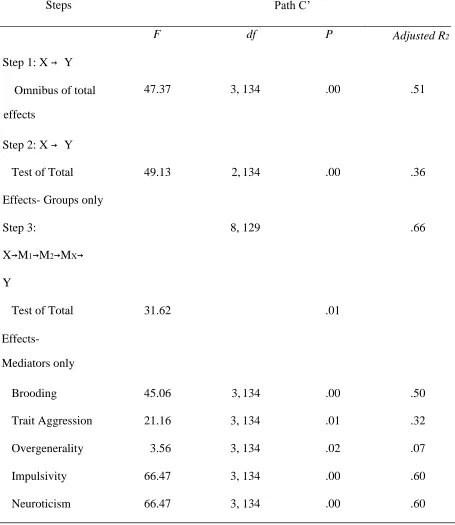
PLEASE INSERT TABLE 3 HERE
A significant association between suicidality and current low mood was observed, with the
inclusion of group type improving the overall fitness of the model (Table 3). Findings indicate
that, compared to the NS group, the SA group appeared to more strongly associated with current
low mood (8 =1.03, p = .00). The relationship between SI and current low mood did not
statistically differ from the relationship between NS and current low mood. When group type and
mediators were included into the analysis, only path c’ for the SA group remained statistically
significant (8 = .50, p = .015), even after applying a Bonferroni correction at the .017 level.
Individual group effects.
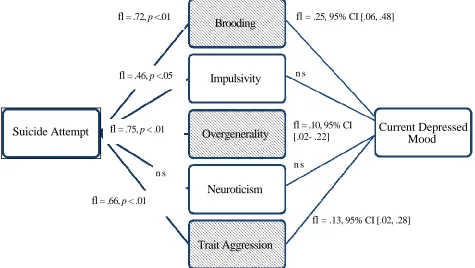
Compared to the NS reference group, the relationship between SA and current low mood
appeared to be indirectly influenced by ruminative brooding, trait aggression and overgenerality
(Figure 1).
PLEASE INSERT FIGURE 1 HERE
Interrelationships between impulsivity, neuroticism and current low mood did not
significantly differ from those observed in the NS group in either SI or SA groups (Figure 2). In
terms of individual paths, while impulsivity positively correlated with the SA group, the
association between impulsivity and the SI group appeared to be stronger (Figures 1 & 2).
Compared to the NS group, the SI group also showed a stronger relationship with neuroticism
PLEASE INSERT FIGURE 2 HERE
Reliability and validity.
Current low mood was replaced with current angry mood to assess whether findings were
generalizable to negative mood. Findings indicate that path c’ remained significant after
including mediators but did not reach significance levels when group type was added to the
analysis, F (2,129) =.65, p = .52, R2 =.006. The data was also re-analysed, excluding the SI
group, to assess whether group size affected findings. Results show that while individual paths
for the SA group appeared to be strengthened, the overall model fit, determined by the omnibus
of total effects, reduced, F (2,166) = 172.6, p = .00, R2 = .46.
Given the small sample size, a post-hoc power analysis was conducted. Options to
calculate power for complex indirect models are limited because calculations need to account for
variations in sample size, strength of indirect effects and individual path affects (Ze-wei &
Wei-nan, 2014). Power was, therefore, determined by estimates for simple mediation models or
dichotomous X models using beta values (Fritz & MacKinnon, 2007).
From these estimates, brooding was thought to reach a power level of .8 whereas the
indirect effects of trait aggression and overgenerality were estimated to be slightly
under-powered, reaching the .61 level (Ze-wei & Wei-nan, 2014). These differences in power could
also be due to the fact that brooding was observed to have a larger effect on the relationship
not calculated for the SI group because no statistically significant indirect relationships were
observed. A number of other precautions have also been taken to minimize type I and II errors.
These include reporting indirect effects from bias corrected percentile bootstraps, use of
Bonferroni corrections and cross validating findings with other sufficiently powered tests (e.g.
Discussion
This study investigated inter-relationships between known suicide risk factors
(neuroticism, trait aggression, brooding, impulsivity, overgenerality) and current low mood in
different suicide groups. Despite limitations, this study provides important contributions to the
existing literature. Overall, the data suggests that suicide groups are heterogeneous and that
interactions between risk factors could represent different internal processing styles that vary
between groups and may, hypothetically, influence emotion regulation. Findings are discussed in
turn and related to broader theoretical arguments using literature on suicidality and emotional
regulation.
Between group differences
While inter-relationships between neuroticism, rumination, impulsivity and low mood are
well-documented, inter-relationships between trait aggression, rumination, impulsivity and low
mood are not. Studies show that the interaction between neuroticism and rumination amplifies
emotional responses (Muris, Roelofs, Rassin, Franken, & Mayer, 2005) and reduces recall of
contended autobiographical memories (Teasdale & Green, 2004) which, in turn, may reduce
mood.
Depression, however, is also linked to aggression, rumination and impulsivity (Dutton &
Karakanta, 2013; Kendell, 1970; Maiuro, O'Sullivan, Michael, & Vitaliano, 1989; Van Praag,
2001). Rumination is thought to increase the likelihood of hostile event interpretation and when
combined with a lack of self-control, increase the propensity for reactive aggression (Wilkowski,
Pederson, Vasquez, & Miller, 2005; Rusting & Nolen-Hoeksema, 1998a) but not by all
(Lievaart, Huijding, van der Veen, Hovens, & Franken, 2017). Our findings add to this by
suggesting that the SI group had a higher propensity of interpreting, ruminating and responding
to events in an overly emotional manner, and rating their mood as lower, than the NS group.
Likewise, differences between SA and SI groups imply that the former were more likely to
interpret situations in an angry or hostile manner, recall overgeneralised memories, ruminate and
respond impulsively compared to the SI group.
Within group differences
Next, we investigated whether these patterns remained the same within individual groups.
In the NS group, inter-relationships between neuroticism, brooding and low mood remained
consistent with existing literature. Correlations for the SI group, however, implied that
neuroticism may indirectly affect the relationship between brooding and low mood. Between and
indirect analyses appear to provide further support for this. The multiple inter-relationships
observed in the SA group are consistent with those reported by emerging models of suicide.
These models suggest that suicidality is associated with multiple vulnerabilities that affect event
interpretation, thinking styles and emotional responses, and that the crossover from ideation to
attempt depends on distress tolerance and the presence of specific factors (e.g. impulsivity,
decreased imaginabilty for future events and prior suicidal behaviour) that decrease fear of dying
and activate suicide-related-cognitions (O’Connor, 2011; Wenzel & Beck, 2008). While
causality is not assumed, the data provides some support for these concepts.
The final analysis explored these inter-relationships in more depth. Findings suggest that
the relationship between the SA group and current low mood had a higher probability of being
indirectly influenced by trait aggression, brooding and overgeneralised recall compared to the NS
group. These findings are broadly consistent with the between group analysis, with the exception
of impulsivity. Impulsivity did not influence the relationship between suicidality and current low
mood and contrary to expectations, showed a stronger relationship with the SI group compared to
the SA group. Indirect paths in the SI group did not differ from the NS group.
While internally and externally directed aggression are shown to correlate with depressed
mood (Bridewell & Chang, 1997), Hirsch, Webb, and Jeglic (2012) suggest that suicidality only
correlates with inwardly-directed anger and that forgiveness moderates the relationship between
inward and outwardly directed aggression and suicidal behaviours. This is of particular interest
given that internally directed aggression is often associated with shame (Gilbert & Andrews,
1998; Lutwak, Panish, Ferrari, & Razzino, 2001) and suicide notes often reflect themes of
hostility, interpersonal difficulties and self-blame (Ho, Yip, Chiu, & Halliday, 1998; O'Connor,
Sheehy, & O'Connor, 1999).
Rumination is shown to strengthen the relationship between anger and low mood by
amplifying and maintaining an internal angry state (Rusting & Nolen-Hoeksema, 1998a). There
is also evidence to suggest that an abstract processing mode, via a combination of
overgeneralised recall and rumination, impairs social problem solving and disrupts emotional
processing which, in turn, creates a higher propensity for depressogenic thinking (Watkins, 2008;
processing mode also influences anger and angry memories. Their study shows that focusing on
why questions, from field and observer prospectives, led to higher levels of intrusions in the
following 24-hour period. Collectively, these studies imply that the relationship between recent
suicide attempts and current low mood may be associated with inwardly directed aggression
that could be amplified by an abstract processing style. Given that we did not assess inwardly or
outwardly-directed aggression, and the limitations of a correlational study, future studies could
explore how aggression affects cognitive processing, emotional regulation and suicidality
further.
Interestingly, across all analyses and groups, brooding and low mood appeared to
consistently correlate with each other. From a self-regulatory perspective, rumination provides a
specific function: to allow reflection on the dissonance between a desired goal and current mood
state (Carver & Scheier, 2002; Martin & Tesser, 1989). Once the dissonance is resolved, by
achieving or re-evaluating the goal, theoretically, the rumination should end. Under conditions of
low mood, however, rumination may increase the propensity for self-critical appraisals and
pessimistic problem solving approaches (Nolen-Hoeksema, Wisco, & Lyubomirsky, 2008).
Nolen-Hoeksema and Watkins (2011) suggest that rumination functions as a transdiagnostic risk
factor that interacts with contextual and/or dispositional factors to produce an initial state of
negative mood, which under conditions of stress or loss, is perpetuated by a cycle of negative
thinking. Likewise, Harvey et al. (2004) suggest that similar cognitive behavioural processes
could operate across disorders but still produce disorder-specific presentations due to interactions
between underlying processes and current contexts. These trans-diagnostic perspectives are also
From these perspectives, it may be that NS and SI group differ on specific dispositional
vulnerabilities, which increase the likelihood of emotionally responding to problems by focusing
on short-term solutions, as observed in between-group findings. Given that we chose to recruit
from a population that reported historical ideation, it may be that these specific appraisal
processes were not active or sufficiently distinct from the NS group or, it may be that the sample
was too small to observe meaningful differences. Similarly, it may be that specific dimensions of
impulsivity, not assessed here, correlate more strongly with SI and SA or it may be that the
sample size was too small to detect an effect. Future studies may wish to investigate these
inter-relationships further.
Limitations
Though the cross-sectional data limits what can be confidently interpreted,
conservative estimates and other statistical tests were used to improve reliability and validity.
A larger sample (approx. 396–512) is also required in order to conduct a sufficiently powered
indirect analysis of aggression and overgenerality relationships investigated here (Fritz &
MacKinnon, 2007; Thoemmes, MacKinnon, & Reiser, 2010). Caution is, therefore, advised
when interpreting the indirect effect of trait aggression and overgenerality as they could,
potentially, be underpowered. The recruitment strategy employed could also limit
interpretation. The use of different testing sites (i.e. campus vs. ward), for instance, may have
unintentionally biased responses; community advertisements with different aims may have led
to the recruitment of individuals that were interested in the study for different purposes, and
Whilst accepting these limitations, the sampling strategies had two aims. First, to provide
an ecologically valid representation of individuals that clinicians would routinely encountered.
As such, conceptually, prior to admission all three group members were community members,
irrespective of whether they had been known to psychiatric services. Ethically, asking
participants to attend the same testing site would have been impractical and may introduce other
biases.
The second aim was to recruit individuals who had, or had not, experienced
mood-disturbance and suicide-related cognitions. While other variables, not assessed here, could also
influence the investigated relationships (e.g. diagnoses, treatment or history), it would be
improbable to investigate all known factors. Instead, factor selection and analyses were guided
by a theoretical model (The Cognitive Model of Suicide). Detailed information, generated by a
structured clinical interview, was considered to be surplus to study requirements. Instead,
questions were limited to those relevant to the study (Nordgaard, Revsbech, Saebye, & Parnas,
2012), with the procedure adopted being similar to others (Miranda & Nolen-Hoeksema, 2007)
and reflecting best practise guidelines. Clinical interviews would also require additional ethical
clearance to manage disclosures or diagnoses. Concerns around advertising for the community
groups were balanced with considerations on how best to maximize recruit for both community
groups.
The current study adds to the current literature by suggesting that SI and SA groups are
associated with specific dispositional vulnerabilities that are associated with interpreting and
responding to events in an emotional manner. Secondly, that these dispositional vulnerabilities
appear to interact with a ruminative thinking style. In the SA group, it appears that the
relationship between trait aggression, brooding and overgeneralised recall is positively
associated with current low mood. In the SI group, no such association was observed with low
mood. While these results are limited, they do provide support for transdiagnostic models of
rumination and suicide. Future studies may wish to explore these assumptions further or
investigate the heterogeneity within suicide attempters or ideators in more depth. In terms of
clinical practise, it may be interesting to investigate whether targeting specific emotional
regulation strategies (i.e. event interpretation or repetitive thinking patterns) via compassion or
cognitive-focused therapies influences low mood symptoms in individuals who have recently
attempted suicide. Findings obtained also indicate a necessity for therapeutic interventions
immediately following a suicide attempt.
Footnotes
1. While these statistics are likely to be underestimation, as not all attempts result in
hospital admissions, there is some indication that individuals who attempt and those who
complete suicide should not be regarded as necessarily a different population (Beautrais, 2001).
2. Though suicide intent is associated with the use of more extreme methods of
attempting suicide, it is not always considered to be the most reliable indicator of an actual
attempt (Haw, Casey, Holmes, & Hawton, 2015; Kovacs & Garrison, 1985) as it could be
moderated by personal expectations (Brown, Henriques, Sosdjan, & Beck, 2004). The
variability of suicide intent also has an impact on how suicide rates are measured (Levinger,
Holden, & Ben-Dor, 2015). The term ‘probable suicide’, therefore, is used as a guesstimate of
an individual’s intention based on a suicide risk continuum as assessed by a structured clinical
risk assessment carried out by the clinician involved in the individual’s medical care (Katz,
Bolton, & Sareen, 2015).
3. In a pilot study, participants (n = 21; subsequently excluded from participation in this
or other related studies) were given 86 emotional words and asked to rate them based on how
well each word described happy, sad and angry emotions using a five-point scale. Higher scores
indicated stronger agreement. Participants were also asked to identify which words they
considered to be emotionally neutral. As the words were originally taken from Paivio et al.
(1968), they had been previously matched for concreteness, imaginability and vividness.
* refers to significance at the .05 level
Table 1
Descriptive Statistics for Personality, Mood and Memory Variables for NS, SI and SA groups
NS Group
Mean (SD) n = 89
Direction of significant differences SI Group Mean (SD) n = 26
Direction of significant differences SA Group Mean (SD) n = 83
Neuroticism 6 (3.4) <
U = 676, p = .00
8.6 (2.8) Ns 9 (2.8)
Trait Aggression 62
(12.6)
< U = 440, p =
.01
72 (16.3) >
U = 596.5, p = .01
88 (27)
Brooding 9 (3.1) <
U = 740, p = .01
12 (4.1) >
U = 471, p = .00
16 (4.0)
Reflection 9 (3.6) <
U = 593.5, p = .00
12 (3.9) Ns 13 (3.9)
Overgeneral Memories (%)
31 (29.1)
Ns 23 (23.8) >
U = 489, p = .00
44 (23)
Current Low Mood 4 (5.7) <
U = 783, p = .01
11 (13.7) >
U = 307, p = .00
34 (17.6)
Behavioural Impulsivity
43 (29.7)
Ns 68 (15.8) >
U = 303.5, p = .01
78 (14.8)
Current Angry Mood
3 (4.5) Ns 5.5 (6.5) >
U = 513, p = .00
Table 2
Pearson’s Correlation for the recent suicide attempt group (n = 78), 2 tailed
Brooding Reflection Neuroticism Overgeneralized Memories
Current Low Mood
Current Angry Mood
Trait Aggression
Behavioural Impulsivity
Brooding .51** .52** -.04 .51** .34** .36** .28*
Reflection .51** .55** -.09 .24* .15 .30** .18
Neuroticism .52** .55** .04 .46** .33** .33** .19
Overgeneralized -.04 -.09 .04 .18 .07 -.06 .04
Memories
Current Low .51** .24* .46** .18 .52** .42** .50**
Mood
Current Angry .34** .15 .33** .07 .52** .45** .32**
Mood
Trait Aggression .36** .30** .33** -.06 .42** .45** .61**
Behavioural .28* .18 .19 .04 .50** .32** .61**
Table 3
Summary of Indirect Path Analysis
Steps Path C’
Step 1: X → Y
F df P Adjusted R2
Omnibus of total
effects
47.37 3, 134 .00 .51
Step 2: X → Y
Test of Total 49.13 2,134 .00 .36
Effects- Groups only
Step 3: 8, 129 .66
X→M1→M2→MX→
Y
Test of Total 31.62 .01
Effects-
Mediators only
Brooding 45.06 3,134 .00 .50
Trait Aggression 21.16 3, 134 .01 .32
Overgenerality 3.56 3, 134 .02 .07
Impulsivity 66.47 3, 134 .00 .60
fl = .72, p <.01
Brooding fl = .25, 95% CI [.06, .48]
fl = .46, p <.05 n s
Suicide Attempt fl = .75, p < .01
n s
Overgenerality
Neuroticism
fl = .66, p < .01
Trait Aggression
fl = .13, 95% CI [.02, .28] Impulsivity
fl = .10, 95% CI [.02- .22]
n s
[image:33.612.69.544.211.479.2]Current Depressed Mood Figure 1
Direct and Indirect Relationships between Recent Suicide Attempts and Current Low Mood
Trait Aggression
β = .66, p < .01
Brooding
Overgenerality n s
n s
n s
n s
n s n s
n s
β = 1.09, p < .01
Suicide Ideation
β = .60, p < .01
Current Depressed Mood Impulsivity
[image:34.612.69.543.193.482.2]Neuroticism Figure 2
Direct and Indirect Relationships between Suicidal Ideation and Current Low Mood Compared
References
Aldao, A., Nolen-Hoeksema, S., & Schweizer, S. (2010). Emotion-regulation strategies across psychopathology: A meta-analytic review. Clinical Psychology Review, 30(2), 217-237. doi:http://dx.doi.org/10.1016/j.cpr.2009.11.004
Anderson, R., Goddard, L., & Powell, J. H. (2010). Reduced specificity of autobiographical memory as a moderator of the relationship between daily hassles and depression.
Cognition and Emotion, 24(4), 702-709. doi:doi:10.1080/02699930802598029
Anestis, M. D., Bagge, C. L., Tull, M. T., & Joiner, T. E. (2011). Clarifying the role of emotion dysregulation in the interpersonal-psychological theory of suicidal behavior in an undergraduate sample. Journal of Psychiatric Research, 45(5), 603-611.
Antypa, N., Van der Does, A. J. W., & Penninx, B. W. J. H. (2010). Cognitive reactivity: Investigation of a potentially treatable marker of suicide risk in depression. Journal of Affective Disorders, 122(1), 46-52.
Appleby, L., Dennehy, A., Thomas, C., Faragher, E., & Lewis, G. (1999). Aftercare and
clinical characteristics of people with mental illness who commit suicide: a case-control study. Lancet, 353, 1397-1400. doi:DOI:10.1016/S0140-6736(98)10014-4
Barratt, E. S. (1994). Impulsivity and aggression In J. Monahan & H. J. Steadman (Eds.),
Violence and Mental Disorder: Developments in Risk Assessment. Chicago: University of Chicago Press.
Beautrais, A. L. (2001). Suicides and serious suicide attempts: two populations or one?
Psychological Medicine, 31, 837-845.
Berkowitz, L. (1993). Aggression: Its causes, consequences and control. New York: McGraw Hill.
Bolger, N., & Schilling, E. A. (1991). Personality and the Problems of Everyday Life: The Role of Neuroticism In Exposure and Reactivity to Daily Stressors. Journal of Personality, 59(3), 355-386. doi:10.1111/j.1467-6494.1991.tb00253.x
Bowen, R. C., Wang, Y., Balbuena, L., Houmphan, A., & Baetz, M. (2013). The relationship between mood instability and depression: Implications for studying and treating depression. Medical Hypotheses, 81(3), 459-462.
doi:http://dx.doi.org/10.1016/j.mehy.2013.06.010
Bridewell, W. B., & Chang, E. C. (1997). Distinguishing between anxiety, depression, and hostility: Relations to anger-in, anger-out, and anger control. Personality and Individual Differences, 22(4), 587-590. doi:10.1016/S0191-8869(96)00224-3
Brown, G. K., Henriques, G. R., Sosdjan, D., & Beck, A. T. (2004). Suicide intent and accurate expectations of lethality: Predictors of medical lethality of suicide attempts. Journal of Consulting and Clinical Psychology, 72(6), 1170-1174.
doi:10.1037/0022-006X.72.6.1170
Bushman, B., Bonacci, A. M., Pederson, W. C., Vasquez, E. A., & Miller, N. (2005). Chewing on it can eat you up; Effects of Rumination on triggered displaced Aggression. Journal of Personality and Social Psychology, 88(Journal Article), 969-983.
Carver, C. S., Johnson, S. L., & Joormann, J. (2008). Serotonergic Function, Two-Mode Models of Self-Regulation, and Vulnerability to Depression: What Depression Has in Common With Impulsive Aggression. Psychological Bulletin, 134(6), 912-943.
Carver, C. S., & Miller, C. J. (2006). Relations of serotonin function to personality: Current views and a key methodological issue. Psychiatry Research, 144(1), 1-15.
doi:http://dx.doi.org/10.1016/j.psychres.2006.03.013
Carver, C. S., & Scheier, M. F. (2002). Control Processes and self organization as
complementary principles underlying behavior. Personality and Social Psychology Review, 6, 304.
Cautin, R. L., Overholser, J. C., & Goetz, P. (2001). Assessment of mode of anger expression in adolescent psychiatric inpatients. Adolescence, 36(141), 163-170.
Centre for Suicide Research, U. o. O. (2014). Assessment of suicide risk in people with depression.
Ciesla, J. A., Felton, J. W., & Roberts, J. E. (2011). Testing the cognitive catalyst model of depression: Does rumination amplify the impact of cognitive diatheses in response to stress? Cognition & Emotion, 25(8), 1349-1357. doi:10.1080/02699931.2010.543330 Critchfield, K. L., Levy, K. N., & Clarkin, J. F. (2004). The relationship between impulsivity,
aggression, and impulsive-aggression in borderline personality: an empirical analysis of self-report measures. Journal of Personality Disorders, 18(6), 555-570.
de Bruin, G. O., Rassin, E., & Muris, P. (2007). The prediction of worry in non-clinical
individuals: The role of intolerance of uncertainty, meta-worry and neuroticism. Journal of Psychoapthology and Behavioral Assessment, 29, 93-100. doi:10.1007/s10862-006-9029-6
Doihara, C., Kawanishi, C., Yamada, T., Sato, R., Hasegawa, H., Furuno, T., . . . Hirayasu, Y. (2008). Trait aggression in suicide attempters: A pilot study. Psychiatry and Clinical Neurosciences, 62(3), 352-354.
Dutton, D. G., & Karakanta, C. (2013). Depression as a risk marker for aggression: A critical review. Aggression and Violent Behavior, 18(2), 310-319.
doi:http://dx.doi.org/10.1016/j.avb.2012.12.002
Education, L. (2013). Evidence in support of the ASIST program ASIST: Livingworks USA. Eysenck, H. (1967). The Biological Basis of Personality. Springfield, Illinois: Thomas.
Eysenck, H., & Eysenck, S. (1975). Manual of the Eysenck Personality Questionnaire. London: Hodder & Stoughton.
Fairchild, A. J., MacKinnon, D. P., Taborga, M. P., & Taylor, A. B. (2009). R(2) effect-size measures for mediation analysis. Behavior Research Methods, 41(2), 486-498. doi:10.3758/BRM.41.2.486
Fawcett, J., Scheftner, W. A., Fogg, L., Clark, D. C., Young, M. A., Hedeker, D., & Gibbons, R. (1990a). Time-related predictors of suicide in major affective disorder. Am J Psychiatry, 147(9), 1189-1194.
Fawcett, J., Scheftner, W. A., Fogg, L., Clark, D. C., Young, M. A., Hedeker, D., & Gibbons, R. (1990b). Time-related predictors of suicide in major affective disorder. American Journal of Psychiatry, 147(9), 1189-1194.
Francis, L. J., Brown, L. B., & Philipchalk, R. (1992). The development of an abbreviated form of the Revised Eysenck Personality Questionnaire (EPQR-A): Its use among students in England, Canada, the USA and Australia. Personality and Individual Differences, 13, 443-449.
Fried, E. I., & Nesse, R. M. (2015). Depression is not a consistent syndrome: an investigation of unique symptom patterns in the STAR* D study. Journal of Affective Disorders, 172, 96-102.
Fritz, M. S., & MacKinnon, D. P. (2007). Required Sample Size to Detect the Mediated Effect.
Psychological science, 18(3), 233-239. doi:10.1111/j.1467-9280.2007.01882.x
Gale, C. R., Booth, T., Mõttus, R., Kuh, D., & Deary, I. J. (2013). Neuroticism and Extraversion in youth predict mental wellbeing and life satisfaction 40 years later. Journal of research in Personality, 47(6), 687-697. doi:http://dx.doi.org/10.1016/j.jrp.2013.06.005
García-Forero, C., Gallardo-Pujol, D., Maydeu-Olivares, A., & Andrés-Pueyo, A. (2009). Disentangling impulsiveness, aggressiveness and impulsive aggression: An empirical approach using self-report measures. Psychiatry Research, 168, 40-49.
doi:10.1016/j.psychres.2008.04.002
Gilbert, P., & Andrews, B. (1998). Shame. Shame: Interpersonal Behavior, Psychopathology, and Culture: Interpersonal Behavior, Psychopathology, and Culture, 1.
Goldstein, R. B., Black, D. W., Nasrallah, A., & Winokur, G. (1991). The prediction of suicide: Sensitivity, specificity, and predictive value of a multivariate model applied to suicide among 1906 patients with affective disorders. Archives of General Psychiatry, 48, 418-422.
Gvion, Y., & Apter, A. (2011). Aggression, Impulsivity, and Suicide Behavior: A Review of the Literature. Archives of Suicide Research, 15, 93–112.
doi:10.1080/13811118.2011.565265
Harris, J. A. (1997). A further evaluation of The Aggression Questionnaire: Issues of validity and reliability. Behaviour Research and Therapy, 35(11), 1047-1053.
doi:http://dx.doi.org/10.1016/S0005-7967(97)00064-8
Haw, C., Casey, D., Holmes, J., & Hawton, K. (2015). Suicidal Intent and Method of Self-Harm: A Large-scale Study of Self-Harm Patients Presenting to a General Hospital.
Suicide and Life-Threatening Behavior, 45(6), 732-746. doi:10.1111/sltb.12168
Hawton, K., & Fagg, J. (1988). Suicide, and other causes of death, following attempted suicide.
The British Journal of Psychiatry, 152(3), 359-366.
Hayes, A. F., & Preacher, K. J. (2012). Statistical mediation analysis with a multicategorical independent variable. Manuscript submitted for publication.
Hennig, J., Reuter, M., Netter, P., Burk, C., & Landt, O. (2005). Two types of aggression are differentially related to serotonergic activity and the A779C TPH polymorphism.
Behavioral Neuroscience, 119(1), 16-24.
Hirsch, J. K., Webb, J. R., & Jeglic, E. L. (2012). Forgiveness as a moderator of the association between anger expression and suicidal behaviour. Mental Health, Religion & Culture, 15(3), 279-300. doi:10.1080/13674676.2011.571666
Ho, T. P., Yip, P. S., Chiu, C. W., & Halliday, P. (1998). Suicide notes: what do they tell us?
ISD-Scotland. (2012). Scottish Suicide Database 2012 report: 2009-2010 data. National Services Scotland Retrieved from http://www.isdscotland.org/Health-Topics/Public-Health/Publications/2012-12-18/2012-12-18-ScotSID-2012-Report.pdf.
Jollant, F., Lawrence, N. L., Olie, E., Guillaume, S., & Courtet, P. (2011). The suicidal mind and brain: a review of neuropsychological and neuroimaging studies. World J Biol
Psychiatry, 12(5), 319-339. doi:10.3109/15622975.2011.556200
Katz, C., Bolton, J., & Sareen, J. (2015). The prevalence rates of suicide are likely underestimated worldwide: why it matters. Social Psychiatry and Psychiatric Epidemiology, 1-3. doi:10.1007/s00127-015-1158-3
Keilp, J., Oquendo, M., Stanley, B., Burke, A., Cooper, T., Malone, K., & Mann, J. (2010). Future Suicide Attempt and Responses to Serotonergic Challenge.
Neuropsychopharmacology, 35, 1063-1072. doi:DOI: 10.1038/npp.2008.28 Kendell, R. E. (1970). Relationship between aggression and depression: Epidemiological
implications of a hypothesis. Archives of General Psychiatry, 22(4), 308-318.
Kovacs, M., & Garrison, B. (1985). Hopelessness and eventual suicide: a 10-year prospective study of patients hospitalized with suicidal ideation. American Journal of Psychiatry, 1(42), 559-563.
Larsen, R. J., & Ketelaar, T. (1991). Personality and susceptability to positive and negative mood states. Journal of Personality and Social Psychology, 61(1), 132-140.
Levinger, S., Holden, R. R., & Ben-Dor, D. H. (2015). Examining the Importance of Mental Pain and Physical Dissociation and the Fluid Nature of Suicidality in Young Suicide
Attempters. OMEGA-Journal of Death and Dying, 0030222815575899.
Lievaart, M., Huijding, J., van der Veen, F. M., Hovens, J. E., & Franken, I. H. A. (2017). The impact of angry rumination on anger-primed cognitive control. Journal of Behavior Therapy and Experimental Psychiatry, 54, 135-142.
doi:http://dx.doi.org/10.1016/j.jbtep.2016.07.016
Lutwak, N., Panish, J. B., Ferrari, J. R., & Razzino, B. E. (2001). Shame and guilt and their relationship to positive expectations and anger expressiveness. Adolescence, 36(144), 641.
Maiuro, R. D., O'Sullivan, M. J., Michael, M. C., & Vitaliano, P. P. (1989). Anger, hostility, and depression in assaultive vs. suicide-attempting males. Journal of Clinical Psychology, 45(4), 531-541.
Mann, J. J., & Currier, D. (2009). Biological predictors of suicidal behavior in mood disorders. In D. Wasserman & C. Wasserman (Eds.), Oxford Textbook of Suicide Prevention. A Global Perspective. Oxford: Oxford University Press.
Mann, J. J., Waternaux, C., Haas, G. L., & Malone, K. M. (1999). Toward a clinical model of suicidal behavior in psychiatric patients. American Journal of Psychiatry, 156(2), 181-189.
Martin, L. L., & Tesser, A. (1989). Toward a motivational and structural theory of ruminative thought. In J. S. Uleman & J. A. Bargh (Eds.), Unintended thought (pp. 306-326). New York: Guildford Press.
Miller, J. D., & Lynam, D. R. (2006). Reactive and proactive aggression: Similarities and differences. Personality and Individual Differences, 41(8), 1469-1480.
Miranda, R., & Nolen-Hoeksema, S. (2007). Brooding and reflection: Rumination predicts suicidal ideation at 1-year follow-up in a community sample. Behavior Research and Therapy, 45, 3088-3095.
Muris, P., Roelofs, J., Rassin, E., Franken, I., & Mayer, B. (2005). Mediating effects of rumination and worry on the links between neuroticism, anxiety and depression.
Personality and Individual Differences, 39(6), 1105-1111. doi:http://dx.doi.org/10.1016/j.paid.2005.04.005
Nakao, M., Yamanaka, G., & Kuboki, T. (2002). Suicidal ideation and somatic symptoms of patients with mind/body distress in a Japanese psychosomatic clinic. Suicide and Life-Threatening Behavior, 32, 80-90. doi:DOI: 10.1521/suli.32.1.80.22179
Nock, M. K., Wedig, M. M., Holmberg, E. B., & Hooley, J. M. (2008). The Emotion Reactivity Scale: Development, Evaluation, and Relation to Self-Injurious Thoughts and Behaviors.
Behavior Therapy, 39(2), 107-116. doi:http://dx.doi.org/10.1016/j.beth.2007.05.005 Nolan, S. A., Roberts, J. E., & Gotlib, I. H. (1998). Neuroticism and rumination response style as
predictors of change in depressive symptomatology. Cognitive Therapy and Research, 22(5), 445-455.
Nolen-Hoeksema, S., & Morrow, J. (1991). A prospective study of depression and post traumatic stress symptoms following a natural disaster: The 1989 Loma Prieta earthquake. Journal of Personality and Social Psychology, 61, 115-121. doi:doi:10.1037/0022-3514.61.1.115 Nolen-Hoeksema, S., & Watkins, E. R. (2011). A heuristic for developing transdiagnostic
models of psychopathology explaining multifinality and divergent trajectories.
Perspectives on Psychological Science, 6(6), 589-609. doi:10.1177/1745691611419672 Nolen-Hoeksema, S., Wisco, B. E., & Lyubomirsky, S. (2008). Rethinking Rumination.
Perspectives on Psychological Science, 3(5), 400-424.
Nordgaard, J., Revsbech, R., Saebye, D., & Parnas, J. (2012). Assessing the diagnostic validity of a structured psychiatric interview in a first-admission hospital sample. World
Psychiatry, 11(3), 181-185.
O'Connor, R. C., Sheehy, N. P., & O'Connor, D. B. (1999). A thematic analysis of suicide notes.
Crisis: The Journal of Crisis Intervention and Suicide Prevention, 20(3), 106-114. O’Connor, R. C. (2011). The integrated motivational-volitional model of suicidal behavior.
Crisis, 32(6), 295-298. doi:10.1027/0227-5910/a000120
Paivio, A., Yuille, J., & Madigan, S. (1968). Concreteness, imagery and meaningfulness values for 925 nouns. Journal of Experimental Psychology, 76(1: Part 2), 1-25.
doi:doi:10.1037/h0025327
Peled, M., & Moretti, M. (2010). Ruminating on Rumination: are Rumination on Anger and Sadness Differentially Related to Aggression and Depressed Mood? Journal of
Psychopathology and Behavioral Assessment, 32(1), 108-117. doi:10.1007/s10862-009-9136-2
Piolino, P., Coste, C., Martinelli, P., Macé, A. L., Quinette, P., Guillery-Girard, B., & Belleville, S. (2010). Reduced specificity of autobiographical memory and aging: do the executive and feature binding functions of working memory have a role? Neuropsychologia, 48(2), 429-440. doi:doi:10.1016/j.neuropsychologia.2009.09.035
Praag, H. M. V. (2001). Anxiety/ Aggression driven depression: A Paradigm of
Functionalisation and Verticalization of Psychiatric Diagnosis. Programme of Neuro-Psychopharmacological and Biological Psychology, 25, 893-924.
Programme, N. R. M. (2007). Best Practice in Managing Risk: Principles and Evidence for Best Practice in the Assessment and Management of Risk to Self and Others in Mental Health Services. Retrieved from
https://www.gov.uk/government/uploads/system/uploads/attachment data/file/478595/be st-practice-managing-risk-cover-webtagged.pdf.
Rajappa, K., Gallagher, M., & Miranda, R. (2012). Emotion dysregulation and vulnerability to suicidal ideation and attempts. Cognitive Therapy and Research, 36(6), 833-839. Robinson, M. D., Schmeichel, B. J., & Inzlicht, M. (2007). Personality, Affective Processing,
and Self-Regulation: Toward Process-Based Views of Extraversion, Neuroticism, and Agreeableness. Social and Personality Psychology Compass, 1(1), 223-235.
Rusting, C., & Nolen-Hoeksema, S. (1998a). Regulating responses to anger: Effects of
rumination and distraction on angry mood. Journal of Personality and Social Psychology, 74(Journal Article), 790-803.
Rusting, C., & Nolen-Hoeksema, S. (1998b). Regulating responses to anger: Effects of
rumination and distraction on angry mood. Journal of Personality and Social Psychology, 74, 790-803.
Salkovskis, P. M., Atha, C., & Storer, D. (1990). Cognitive-behavioural problem solving in the treatment of patients who repeatedly attempt suicide. A controlled trial. The British Journal of Psychiatry, 157, 871-876. doi:DOI: 10.1192/bjp.157.6.871
Seroczynski, A. D., Bergeman, C. S., & Coccaro, E. F. (1999). Etiology of the
impulsivity/aggression relationship: genes or environment? Psychiatry Research, 86, 41-57.
Sheppes, G., Suri, G., & Gross, J. J. (2015). Emotion regulation and psychopathology. Annual Review of Clinical Psychology, 11, 379-405. doi:10.1146/annurev-clinpsy-032814-112739
Singer, J. A., & Bonalume, L. (2010). Toward the Scientific Study of Autobiographical Memory Narratives in Psychotherapy. Pragmatic Case Studies in Psychotherapy, 6, 215-222. Suls, J., Green, P., & Hillis, S. (1998). Emotional Reactivity to Everday Problems, Affective
Inertia and Neuroticism. Personality and Social Psychology Bulletin, 24(2), 127-136. doi:doi: 10.1177/0146167298242002
Teasdale, J. D., & Green, H. A. C. (2004). Ruminative self-focus and autobiographical memory.
Personality and Individual Differences, 36(8), 1933-1943. doi:http://dx.doi.org/10.1016/j.paid.2003.08.022
Terracciano, A., & McCrae, R. R. (2006). Cross-Cultural Studies of Personality Traits and their Relevance to Psychiatry. Epidemiologia e psichiatria sociale, 15(3), 176-184.
Thoemmes, F., MacKinnon, D. P., & Reiser, M. R. (2010). POWER ANALYSIS FOR COMPLEX MEDIATIONAL DESIGNS USING MONTE CARLO METHODS.
Structural equation modeling : a multidisciplinary journal, 17(3), 510-534. doi:10.1080/10705511.2010.489379
Van Praag, H. M. (2001). Anxiety/aggression-driven depression: A paradigm of
functionalization and verticalization of psychiatric diagnosis. Progress in Neuro-Psychopharmacology and Biological Psychiatry, 25(4), 893-924.
Vaughan-Johnston, T. I., Quickert, R. E., & MacDonald, T. K. (2017). Psychological flexibility under fire: Testing the incremental validity of experiential avoidance. Personality and Individual Differences, 105, 335-349. doi:http://dx.doi.org/10.1016/j.paid.2016.10.011 Watkins, E. (2008). Constructive and Unconstructive Repetitive Thoughts. Psychological
Bulletin, 134(2), 163-206.
Watkins, E., & Teasdale, J. D. (2004). Adaptive and Maladaptive self-focus in depression.
Journal of Affective Disorders, 82(Journal Article), 1-8.
Wenzel, A., & Beck, A. T. (2008). A cognitive model of suicidal behavior: Theory and treatment. Applied and Preventive Psychology, 12(4), 189-201.
Wilkowski, B. M., Robinson, M. D., & Troop-Gordon, W. (2010). How does cognitive control reduce anger and aggression? The role of conflict monitoring and forgiveness processes.
Journal of Personality and Social Psychology, 98(5), 830-840. doi:10.1037/a0018962 Williams, J. M. G., Barnhofer, T., Crane, C., Hermans, D., Raes, F., Watkins, E., & Dalgleish,
T. (2007). Autobiographical Memory Specificity and Emotional Disorder.
Psychological Bulletin, 133, 122-148.
Williams, J. M. G., & Broadbent, K. (1986). Autobiographical Memory in Suicide Attempters.
Journal of Abnormal Psychology, 95, 144-149. doi:doi:10.1037/0021-843X.95.2.144 Williams, M. G., Ellis, N. C., Tyers, C., & Healy, H. (1996). The specificity of autobiographical
memory and imagineablity of the future. Memory and cognition, 24, 116-125.
Wimalaweera, S. W., & Moulds, M. L. (2008). Processing memories of anger-eliciting events: The effect of asking ‘why’ from a distance. Behaviour Research and Therapy, 46(3), 402-409. doi:http://dx.doi.org/10.1016/j.brat.2007.12.006
Wolfsdorf, B. A., Freeman, J., D'Eramo, K., Oveholser, J., & Spirito, A. (2003). Mood states: depression, anger, and anxiety. In A. Spirito & J. C. Overholser (Eds.), Evaluating and Treating Adolescent Suicide Attempters: From Research to Practice. New York: Academic Press.