ISSN Print: 2151-4755
DOI: 10.4236/ce.2019.107122 Jul. 31, 2019 1713 Creative Education
The Interaction between Learners and
Learner-Facilitator in an Online Learning
Environment
Ronit Hesrcu-Kluska
Department of Natural Science and Environmental Education, ORANIM Academic College of Education, Tivon, Israel
Abstract
We live in an online computerized world; the online environment reaches every part of the modern life and therefore studying and learning as well. As the concept of learning in an online environment increasing, some questions are raising: Does online learning change the learner’s interaction? Does on-line learning change the learner- facilitator interaction? This Autoethnogra-phy study is trying to shed some light on these two types of relations, from an individual learner point of view. The study raises the need to pay attention to the interactions between learners and the learners-teacher/facilitator as an online course being planned and pay attention to these interactions as the on-line course develops, especially at learning in a collaborative learning group. That type of learning requires an interaction between the students, though online learning seems to ignore the need for learners’ collaboration. Moreo-ver, the interaction between learners and the facilitator in an online course often attend to a more technical point of view. This Autoethnography study shows that although we live in a computerized world, learning in an online environment is not self-evident, and we need to thoroughly consider how on-line courses should be built and whether they can fully replace traditional courses. In addition, an indirect finding emerged in this study, which is the complexity of the online student-facilitator interaction from the education-al-pedagogical point of view. Since this study is autoethnographic it reflects an individual learner’s perspective, allowing to examine these interactions through particular lens. Therefore, each participator may reach different findings regarding his or her personal experience as a learner in an online learning environment.
Keywords
Collaborative Learning, Online Learning, Distance Learning, Autoethnography How to cite this paper: Hesrcu-Kluska, R.
(2019). The Interaction between Learners and Learner-Facilitator in an Online Learning Environment. Creative Education, 10, 1713-1730.
https://doi.org/10.4236/ce.2019.107122
Received: January 1, 2019 Accepted: July 28, 2019 Published: July 31, 2019
Copyright © 2019 by author(s) and Scientific Research Publishing Inc. This work is licensed under the Creative Commons Attribution International License (CC BY 4.0).
http://creativecommons.org/licenses/by/4.0/
DOI: 10.4236/ce.2019.107122 1714 Creative Education
1. Introduction
Collaborative learning in an online environment is a learning setting that has entered the field of teaching as the Internet and its usage developed.
The Internet has greatly expanded the use of distance learning methods and has enabled either a variety of pedagogical method, or a new use and meaning to well-known methods.
Though the collaborative learning has risen as a pedagogical method long before the establishment of the internet, it seems that the attitude, “the roles” did not change. The learners must behave as a group and maintain the principles of colla-borative learning in the traditional method, and only thus will they reach interac-tion and cooperainterac-tion between participants (Royer, 1997; Ragoonaden, 2000).
The method of distance learning in the online environment has many advan-tages, most of which lie in the fact that it enables learning even when there is no physical ability to reach an academic institution. However, there are a number of drawbacks associated with this method, for example, the problems arising from asynchronous learning, which can reduce the motivation of learners and even cause contempt for learning the method (Konak, Kulturel-Konak, & Cheung, 2018; Ragoonaden, 2000; Jaggars & Xu, 2016; Petersen, 2016).
The difficulty of distance learning is also due to the loss of eye contact and the visual innuendos that are common in the traditional classroom (Harasim, 1987; Gunawardena, 1995; Somaratne, 2015). The use of the lecturer’s voice or the students’ in the traditional classroom also contains information that is lost in an online learning environment (Harasim, 1987). In order to overcome some of these difficulties it is important to create a sense of community and interaction between learners (Gunawardena, 1995; Somaratne, 2015).
The concept of Social Presence as a situation in which two or more people feel socially close to each other even though both are physically distant from one another. Creating a sense of closeness in the online medium is needed to com-pensate for the lack of eye contact and physical reality.
Distance learning becomes more complex when learners are exposed to new cultures, new learning environments, and interacting with a wider and more di-verse range of learners.
This study will examine the impact of the annual course, the advanced teach-ing environment and the multi-participant and multicultural environment on the learner in the course. The impact of multicultural learning on students will be examined, the students’ feelings in a multi-participant course discussed, as well as the group’s ability to function as an active and cooperative learning group over time. We will examine whether a lengthy course, of one year, can change the learner’s world view throughout the course and influence it. And whether the changes in perception of the teacher-in-training during the course have an impact on the teacher’s attitudes in the future and do these changes in perception have the ability to improve their pedagogical performance?
teach-DOI: 10.4236/ce.2019.107122 1715 Creative Education er-in-training’s perception as it applies to their future function as teachers. Does the ability exist to expose the teacher-in-training, at the stage of forming their identity as future teachers, to different cultures, to advanced teaching methods, and thus to influence their establishment as educators?
1.1. What Is an E-Learning Environment?
Communication between computers began in the 1960s with the beginning of the ARPANET network, which is a name that consists of the acronym Advanced Research Projects Agency Network (Harasim, Hiltz, Telese, & Turoff, 1995; Ha-rasim, 1987; HaHa-rasim, 2018). People who worked at terminals were connected to a central computer and sent each other short messages, at first, and later e-mail messages. At first, users were in physical proximity to the main computer and later ARPANET became a network connecting computers from different coun-tries. At the end of the 1970s, institutions of higher education joined the emerg-ing communications network, which led to an increase in the network’s uses and the significance of the connection between researchers from institutions around the world. During the 1980s the network changed its name to The Internet (Hunter, 1992; Harasim et al., 1995; Harasim, Calvert, & Groeneboer, 1996).
In the late 1960s, the first attempt was made to use the computer as a teach-ing tool by Stanford University. Students with low socioeconomic backgrounds studied computer-assisted mathematics (CAI-Computer Assisted Instruction) (Hunter 1992). During the 1970s, the use of e-mail enabled university research-ers to share information and conduct joint research, and later, students in uni-versity courses could exchange information (Harasim et al., 1995). The use of computers was instrumental in teaching, and it was reported that the time taken to learn was reduced as a result of computer use in mathematics studies (Kulik, Kulik, & Cohen, 1980). With the development of the World Wide Web in the early 1990s (Schatz & Hardin, 1994; Crossman, 1996), the learning environments underwent rapid evolution into Internet and WWW systems. These systems have revolutionized the use of computer communication as a means of transfer-ring and stotransfer-ring information because the creation and distribution of informa-tion has become simple and easy to use, and in effect, an internainforma-tional standard (Goldberg et al., 1996; Campbell, Hurley, Jones, & Stephens, 1995; Crossman, 1996).
DOI: 10.4236/ce.2019.107122 1716 Creative Education only when there is a connection between prior knowledge and acquired know-ledge. Learning environments should, therefore, contain tools for organizing learning, searching and locating, creating new content and presenting it (Gillani & Relan, 1996; Othman, Ayop, & Karim, 2015; Resta, Searson, Patru, Knezek, & Voogt, 2011).
The Web’s linked environment makes it easier to connect students to the learning community, to distance learning, more so than in the past, and to reach anywhere in the world (Goldberg et al., 1996). The Web environment is easy to use and is becoming increasingly popular (Goldberg et al., 1996; Shneiderman, Borkowski, Alavi, & Norman, 1998).
1.2. Difficulties with Online Learning Processes
Many students need physical feedback, but physical feedback does not exist in online learning (Hiltz, 1992; Wigand, 2018). The physical connection with other learners in the traditional classroom often leads to competition among learners which also does not exist in the online environment. The learner finds himself isolated and the immediate feedback he is used to receiving from a teacher does not exist in learning based partly on asynchronous communication. The use of technology is also an additional difficulty for the learner as well as for the teach-er. Students must have high motivation and personal responsibility, develop high personal initiative, have reasonable personal assessment, not require con-stant reinforcement, and be willing to communicate with the other learners in order to facilitate the group learning process (Harasim et al., 1995; Beigi & Liu, 2018; Beigi, Shu, Zhang, & Liu, 2018). Access to technology is one of the most difficult problems to face in online learning environments (Harasim et al., 1995; Palloff & Pratt, 2002; Poë, 2015). The apparent ease with which technology is used by some is not shared by all (Hiltz, 1992; Islam, Beer, & Slack, 2015).
1.3. Collaborative Learning
Collaborative learning is the interaction between participants in a coordinated effort to solve a problem (Dillenbourg, Baker, Blaye, & O’malley, 1995; Dillen-bourg & Schneider 1995; Shonfeld & Gibson, 2018). Collaborative learning is expressed in the implementation of educational tasks that include exchanging information and sharing among a number of learners. Online learning enables us to overcome logistical obstacles that include the need for face-to-face en-counters which facilitates and supports collaborative learning. Cooperative learning changes the relationship between the learners and between the learner and the teacher. The teacher goes from being an authority figure to an adviser and source of knowledge (Harasim et al., 1995; Harasim et al., 1996; Ma-gen-Nagar & Shonfeld, 2018; Duchastel & Turcotte, 1996; Shonfeld & Gibson, 2018).
DOI: 10.4236/ce.2019.107122 1717 Creative Education developed (OCL), sharing skills and knowledge building has been developed based on online collaborative learning (Harasim, 2012). Education systems in different countries combine these skills in teaching and learning, and place a strong emphasis on assimilation (Melamed et al., 2010; Shoenfeld et al., 2010; Mendez & Rona, 2010). Online collaborative learning is not trivial and does not suit all learners intuitively because collaborative learning in an online environ-ment involves interaction between learners, accessibility and communication that the Web requires. Therefore, it is important to train teachers in the modern era to work collaboratively, and to build a curriculum that includes developing cooperative learning that prepares the students for 21st century reality (Kritz,
Bachar, &Shonfeld, 2018).
1.4. Autoethnography
The main studies in the qualitative-ethnographic approach are based on the phenomenological perspective (Karnieli, 2006; Denzin, 2013; Ngunjiri, Chang, & Hernandez, 2016). This approach is based on a theoretical orientation that fo-cuses on the essence of the experience of the various participants (Moustakas, 1994; Adams, Ellis, & Jones, 2017). This approach enables starting to research without the need for a clear and defined theory. The theory is constructed as a result of the process of learning and discovery of the subjects being studied, and the manner in which the participants experience the circumstance and interpret it. Hence its name: Grounded Theory (Karnieli, 2006).
This type of research focuses on the way in which the events are perceived and interpreted by the individuals being studied and by the members of the group to which they belong (Holstein & Gubrium, 1994; Denzin, 2013; Chang, Ngunjiri, & Hernandez, 2016).
There is no search for one “true” reality, or neutral and objective facts. A base assumption of this approach is that knowledge lies in the meaning people give to their lives and that this affects their behavioral patterns and beliefs. Phenome-nological perception is of great importance when the teacher wishes to learn about the processes of instructing, learning and education in educational institu-tions. This understanding may help to develop curricula and teaching methods adapted to diverse student populations (Karnieli, 2006).
This research-educational approach is especially important in multicultural and heterogeneous societies, such as Israeli society, where the diverse population originates in different cultures, sometimes with a limited common denominator (Karnieli, 2006). Teachers use instruction as a source of research aimed at pro-moting their professional development (Schon, 1992), using past experience as a basis for future learning through reflective transformation, a state of versatility throughout the process.
DOI: 10.4236/ce.2019.107122 1718 Creative Education
2. The Research Process
The autoethnographic research process is based on a faithful description of real-ity, the naturalistic approach (Karnieli, 2000; Gibbs, 2018; Chang et al., 2016). Research is usually done in place of events.
Practically speaking, the process of inquiry and learning is based on the acqui-sition of important teacher skills, such as:
Asking questions—improving the ability to identify problems, phenomena or situations in which the information is incomplete. The ability is to present ques-tions relating to an important issue in the field.
Collecting data and information—after formulating the questions or defining the topics that the teacher wishes to research and delve into in order to obtain reliable information, a plan must be devised by which the information will be collected. Its goal is to obtain reliable answers and create a rich knowledge base. At this stage the teacher deals with the issue: what is the relevant material in the professional literature that will enrich their knowledge; how to observe the processes, interactions, and phenomena that they are involved in, and to derive information from them; what to observe in order to gather information and un-derstand processes in the classroom and school. In the case at hand, data collec-tion is done from the blogs written and all the correspondence of the group on the site while performing the requirements of the course.
Extracting Knowledge—after collecting the data on the subject that was stu-died, and after reading professional literature in the field, the process of extract-ing knowledge is carried out. In this situation one must identify the questions that emphasize how the social, educational and personal experience is con-structed in the examined reality, how and why it bears meaning and what its im-plications are.
Evaluation and Control—one must keep in mind that due to the researcher’s involvement in the creation of the database for which they are the investigating teacher, and have formulated viewpoints and opinions, the process of collecting information and its organization may be biased and even erroneous. Therefore, the investigating teacher must examine their views on the issues they wish to in-vestigate and be aware of the influence of these issues on their attitudes and personal perceptions (Gibbs, 2018).
3. Findings
3.1. Reasons for Choosing the Online Course
Throughout our academic studies, we can choose some of the courses that we study. The choice of one course or another is not random, yet can a student pause and ask, why was this course chosen?
The blogs that flowed the process of choosing and learning an online course are the pillars this study is based on.
From: Blog No. 1—
DOI: 10.4236/ce.2019.107122 1719 Creative Education technologicaltools andtolearn to workandstudy innew areas. Additionally, thedesiretoexperiencethistypeofcoursewhichincludesgroupworkofan un-familiarnature.”
Choosing to learn a specific course is a routine procedure, perhaps even a technical one. The effort of trying to recall the exact moment I decided on this online course did not help and I found myself unable to recall that moment or thought. I started reading my first blog, I discovered that while was pondering what to write, I had in fact listed the reasons that led me to choose a different sort of course, and the wish to learn and experiment with new and unfamiliar teaching and learning tools.
Blog No. 2—
“Workingandlearninginanewenvironment, onlineandtechnological envi-ronmentintriguesme, thoughisnotsimpleforme, itisachallenge.”
After reading the second blog it seems that apparently, under the surface there were other reasons to choose this course. Less formal reasons, along with the ob-vious rational explanation for this seminar: “Onlinelessonsarea pedagogictool that I am still learning to use and utilize, and it has great promise and great hope.” From the text, curiosity emerges which is reinforced at the end of this blog: “Forme, thiscourseisachallenge.” However, alongside these feelings, for the first time, the definition of the difficulty arises, which will be discussed at length, later.
Blog No. 3—
“The firstonline lessonhad just ended. I waited andI expected somuch, I wantedtobeexposedtothisneweducationaltool, butunfortunately, Icouldnot takemoreofanactiveroleinthelesson sincethecourseincludesmany partici-pants, allof whomentered the siteat the sametime, that caused manyonline communication disturbances. Therefore many students, including me, were constantlybeingdisconnected. Myfirstimpressionandfeelingsfromthatonline lessonareobviously complex. Ihope tobe ableto participatein amoreactive way nexttime so I could improve my use of thiseducational tool better next time.”
Blog No. 4—
“Anewlesson, anewhope, Ienteredthegrouptaskwehadduringthelesson andhereIam ‘playing’ withanewtool.”
3.2. Interaction between Students
DOI: 10.4236/ce.2019.107122 1720 Creative Education Blog No. 1—
“Inthistypeof course, whichcontains groupworkof anew andunfamiliar kind, Icouldnotchoosemyteammates, Ihavenevermetthemandyetthe co-operationandcoordinationbetweenusmustbecomplete.”
Blog No. 2—
“In order to participate in class while studying a “regular” or “traditional” course, everycollegeor universitystudenthastoget toclass, thatmeanstoget outofyourhomeoratleastfromtheroomatthedormitory. Thus, createa de-finedtimewhichislearningtime, bynotbeingavailableforgeographicreasons. Atonline learning, the studentcanparticipatein class fromany possible loca-tion. Iamathome. Inthefamilylivingroomwheretheonlycomputerisinthe house, butIamnotactuallyathome. Iaminclass. Whenstudyingonline, itisa realchallengetomaketimeforlearning. Thesynchronousonlinelessonrequires to make timefor it, as I am not away from home, time isan unavailable re-source... Timeformyself.
In partnership and shared learning “togetherness” is not always active, often the partnership and the “togetherness” seems passive. The active part is each in-dividual learner, in front of the screen, in front of the materials on the site.
Blog No. 4—
“AftertheclassItriedtobuildapreliminaryformaswewereaskedto, later onIenteredtheformspresentedbytherestofthestudygroup, anddiscovered that forthefirsttime, Ifeltthegroupisworkingtogether.
Forthefirsttime, thegroupmemberscontribute to eachother, atrue colla-borativelearningwasformed. Browsingthroughtheirworkandthedissections wehadoneachform, taughtmesomuch... itwasapositiveexperience.”
After the first stage of virtual connection between the group students in an online course, the next stage was a face-to-face encounter of all the course stu-dents. The blog describes the face-to-face meetings as naturally and ongoing. The regular and “traditional” situation suddenly became more significant and changed the interaction between the members of the group.
Blog No. 6—
“The face-to-face meeting, for me it was the pinnacle of the course. First, meetingthepeoplebehindthescreenandsecondlytheamazingcommunication thatwas createdbetweenus. From themoment westarted talking, wedid not stop.... untilmy facilitatorkeptmentioningthattherewasajointtask to com-plete. Thetasksin themeetingweremeanttoconnectus, butwedidnotneed them at all. Itfelt like areturning to a ‘normal’ and natural communications betweenpeople, whichtiedupthebondsthatwerealreadyformed.
DOI: 10.4236/ce.2019.107122 1721 Creative Education Blog No. 7—
“The Flipped Classroom task. Our group has begun our weekly task, The FlippedClassroomtaskbuttheteammembersarehavingahardtime. Onlyhalf ofthegrouphasenteredthesharedfileandcontributed.
Thereis asenseofdecline inthegroup. No oneisinvestingand it’sapity. Maybethey’reinvestingindividually, butnotwithinthegroup ...Itseemsthatall thatweaccomplishedattheface-to-facemeetingisgone…”
Blog No. 8—
“... Ihavediscoveredthatotherstudygroups arehaving difficultiesaswell. I found myself begging group members to workand collaborate as astudy group. Intheface-to-facemeetingourpartnershipmaterialized, butnowthereis adecline. Itseemsthestudygroup isfallingapart…”
3.3. Writing a Personal Blog
The blogs are the source of our findings in autoethnographic research.
The personal blog allows us to study the interactions from the student spear, since the student write it and that place the student at the center (see Figure 1).
Although blogs and posts are a common and accepted form of expression nowadays, writing a blog is not necessarily a daily routine for every student.
Blog No. 1—
“I am writing a blog describing my experience as a student in this online course. Ihaveneverwrittenablogorapostbefore. Idonotreallyknowwhatto write, butIunderstandthattheblogshouldreflecthowIfeel, howdoIseethis courseanditisallaboutme…”
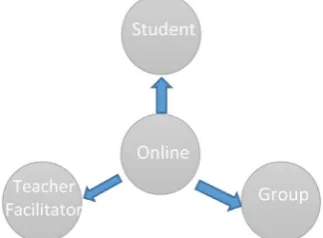
As shown in Figure 1, the visual metaphoric extends the triangle of levels of engaging into a triangle with a fourth and centered focus. This figure represents the student place in these relations as it takes place when writing a blog. The student becomes the center of focus that all is related to.
3.4. Coping with an Online Course
[image:9.595.296.453.589.704.2]We live in a technological age, an era when computers have long been present in all aspects of our lives, including pedagogy from elementary schools to academic studies, perhaps even mainly in academic studies at colleges and universities.
DOI: 10.4236/ce.2019.107122 1722 Creative Education Online courses full or partial are available at every teaching college, but what does the learner feel during the online course? What difficulties arise from the blogs that the students experience?
Blog No. 1—
“Iamusingthe onlinelearningplatforms, butitiscleartomethatIamnot making the most outthem. Teachers and pedagogic researchers are trying to developnewlearningtoolsinorderto improvelearning, especiallyforstudents whoexperiencedifficulties. Newapplicationsareconstantlycomingoutinorder tomakelearningeasierforthosewhohavedifficulties.”
Blog No. 2—
“The firstonlinelesson. From my experiencewith computerized online les-sons whichdisconnected manytimesduringthe lessonandtherewerequite a fewdifficultiesinsynchronizingthepictureandaudio, Ienteredthesiteearlyon thecomputerandonthe mobilephonetoseethateverything wasfine. Unfor-tunately, everythingthat workedwellbeforethe lessondid notfunctioninreal time. IhadmanydifficultiesconnectingeventhoughIenteredthesiteaheadof time. BythetimeIwasabletoreconnect, Ihadmissedsomeoftheinstructions andfeltlikesomeonewhocametotheshowaquarterofanhourafteritbegan. I wasgladthataftermanyattemptsandstrugglesImanagedtojoin, butthesense of joy immediately changed into confusion and loss, “What are they talking about?”, “Whathavetheydoneuntilnow?” “WhatdidImiss?”, “HowdoIcatch upasquicklyaspossibletomissaslittleaspossible?”
Thegreatexcitement gaveway todisappointmentandsadness. The Internet disconnectedoften. Attimesthepicturegotstuck. AttimesIcouldnothearthe instructor. IamawarethatonlinelessonsareatechnologicaltoolthatIamstill learningto use and utilize. I waited so long, I expectedso much, I wantedso much forit to gosmoothly. I wasexposedto new tools, althoughI could not takemoreofanactiveroleinthelesson. Thecourseincludesmanyparticipants, allofwhomenterthesiteatthesametime, whichisobviouslycomplex.
Blog No. 7—
“WhenIreadthearticle, Irealizedthattherearepeopleforwhomthisisan environment which promotes closeness that overcomes obstacles to physical distanceandenables communicationwithpeoplewhowould neverhavefound an avenue in the real world. Creating a reality that does not really exist and enablingpeoplewhocouldnotmeetinrealityaplacetomeet. Itisclearto me thatthereare advantagesof learningthroughavatars, though probablynotfor everyone. Ifeelalieninthisenvironment.”
Blog No. 11—
“...WehadfinishedtheFlippedClassroomtask. Alotoftechnological difficul-tiesaffectedthewayweworked.
There were a lot of organizational problems and a lack of familiarity with technologicalaidsinthistask.”
Blog No. 12—
DOI: 10.4236/ce.2019.107122 1723 Creative Education thoughthemanydifficultiesincommunication, Internetcrashes, voiceand im-ageissueshavebeenverydifficult.”
In dealing with an online course, the student’s proficiency in technology is re-flected, as well as preliminary assessments of the technological support system, the technical support unit for the course. Unlike in traditional courses, a lack of understanding on the part of the student, or alternatively a discrepancy between the number of users and the preliminary assessments, can derail the studies and the lesson if not the entire course.
As shown in Figure 2, the visual metaphoric extends the triangle of levels of engaging into a triangle with a fourth and centered focus. Any Internet malfunc-tion, problem with bandwidth, “outage”, high-speed internet connection or ab-sence of connection can cause an inability to sustain a lesson or activity (see Figure 2).
This figure represents the internet-technical-online place in these relations as it takes place when studding an online course. The online ability become the center of focus that all is related to.
3.5. Student-Facilitator Interaction
Designing a course, whether computerized or not, is based on the concept of re-lations between the lecturer/facilitator of the course and the students.
That relation should not be taken for granted since they influence the student motivation. That relation should be thought of when the course is an online one. Since the very basic interaction, the face to face interaction, that domain the in-teraction in the” traditional” classroom, does not exist in an online course.
The main audiences at teacher colleges are students, doing undergraduate studies, in their twenties, who were born into a computerized technological world. The Internet as a tool in the service of humankind was in its infancy when they were apparently in their infancy and therefore grew up “with screens”. Since the facilitator usually older then the students, the computerized technological world may be challenging. Moreover, the facilitator is no longer “the one that knows it all”.
Blog No. 2—
[image:11.595.293.455.585.704.2]“Myfeelingstowardstheupcomingonlinelessonareverydiverse. Ifeelexcited,
DOI: 10.4236/ce.2019.107122 1724 Creative Education andyettherearequiteafewfears. LastyearIfirstgottoknowthecomputerized Blackboardandnow I’m learningto use anew tool... The synchronousonline lessonrequiresthisunavailableresource. Time. Thus, withonlinelearningIam learningandIamathome. Inthefamilylivingroom, wheretheonlycomputer inthehouseislocated. Iamhomeandyet, notactuallyathome. Iaminclass. I explainedtomychildrenthecomplexityofthesituationandpreparedthemfor mybeinginthelivingroom. The course facilitator has difficulties as well. I do not know if he has any kids, but he is also not fully into the lesson.”
Blog No. 5—
“Googletoolonlinelesson. Ihavediscoveredagreattool. IsawGoogleDocs formsinthepastsenttomychildrenbytheirteachers, butIdidnotknowhow tocreateone... IfeltIwasdiscoveringagreatnewtool.
Itisagreattoolforgatheringinformationanddata. I’msureI’llusethetool. TodayIcould ‘feel’ thatmyfacilitator, knowsthistoolverywell. Icouldfeelhis confidencewhenhetalkstous. itremindedme of a traditionalclass.”
Blog No. 6—
“Socialmediaonlinelesson. IdonothaveFacebookandI’mnotamemberof anysocialmedianetwork. Iunderstoodthat thiswasgoingtobeaproblem. A fundamentalproblem: IunderstandthisisunusualandeveryonehasFacebook. Duringthe onlinelessonabalanced assessmentof the advantagesandrisksof the networks were presented but I still choose to stay away. This is going to complicate my task. I asked my facilitator what can I do? I do not seems he knowshowtohelpme, thoughhereallywantto.”
Blog No. 9—
“Aface-to-facemeeting, forme, itwasthepinnacleofthecourse. Theplenary lecture raised questionsand thoughts about our associationsand how similar anddifferentthey areatthe sametimebecauseofculturaldifferencesand geo-graphicallocation. IwasamazedthatitcorrelatedpreciselywithwhatIfeltlater inthemeetingwithmy groupmembers. Meetingmyfacilitatorfaceto facefor thefirsttimewassoexiting. Everythinguntilnowseemslike, wekneweach oth-erbutwedidnotdosomuch.”
Blog No. 10—
“…Forme, thevirtualworldisanewworld. WhenIreadthearticle, Irealized thattherearepeopleforwhomthisisanenvironmentwhichpromotescloseness thatovercomesobstaclestophysicaldistance…Creatingarealitythatdoesnot reallyexistandenablingpeoplewhocouldnotmeetinrealityaplacetomeet. I feelalieninthisenvironment. I’malsouncomfortable, robotic, nothuman, some ofthe charactersareexaggeratedthefacilitator createdan avataras well, itfelt justasmuchrobotic.”
Blog No. 11—
DOI: 10.4236/ce.2019.107122 1725 Creative Education As shown in Figure 3, the extends the triangle of levels of engaging into a tri-angle with a fourth and centered focus.
This Figure represents the teacher—facilitator place in these relations as it takes place when in an online course. The ability to communicate though it is not face-to-face as in “traditional” course becomes the center of focus in main-taining connections with the students as a group and as individuals.
4. Discussion and Conclusions
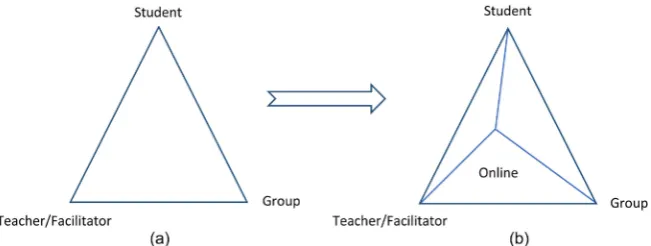
The revolution of the 21st century is undoubtedly the revolution of technology, information and social media, its great influence on our lives is evident every-where we turn, but its impact on education is still developing. Creating informa-tion and sharing informainforma-tion on online platforms influences our everyday activ-ities and as a result education and teaching processes. In traditional learning, the inter-personal encounters between the learners and the teacher/lecturer/ facili-tator, as well as the interpersonal encounters within the group of learners, creates a dynamic between the lecturer and the learners as individuals and the interaction in a group of learners (see Figure 4).
This dynamic is different in online learning, as emerges from the blogs. It seems that to a certain extent, the triangle that scheme the traditional learning, is lacking the fourth vertex represents the online learning. Therefore, the tetrahe-dral scheme (see Figure 5) extends the triangle into a third dimension scheme represents all fourth vertex- Student (learner), group, teacher (Facilitator) and online learning.
The blogs reflect that at an online course, the teacher-student-group of stu-dents as well as the dynamics among the stustu-dents themselves showed depen-dence on the time passed from the beginning of the course.
The initial teacher-student-group affinity created immediately after the intro-duction stage, at the beginning of the course. As time went by, the interactions decreased, and the group resembled a random collection of individuals rather than a “team”. The only observed change in the interactions decrease showed after the “face-to-face” meeting.
[image:13.595.293.451.572.696.2]It seems that human “traditional” interaction requires body language and eye
Figure 3. The teacher- facilitator place as the center of connections with the students as a
DOI: 10.4236/ce.2019.107122 1726 Creative Education
Figure 4. The lecturer (Facilitator)-student (learner)-group dynamic in traditional
learn-ing.
Figure 5. The extension of the triangle scheme to the tetrahedral. (a) The lecturer
(Facili-tator)-student (learner)-group dynamic in traditional learning; (b) The student (learn-er)-online-group-teacher (Facilitator) dynamic in online learning.
contact these do not “transfer” through text messages on screens. Therefore, on-line courses based on onon-line text meetings are lack of these normative human needs that bond people.
In dealing with an online computerized course, not only are the dynamic is different, but also the student’s technological abilities. Moreover, a student that was not “born to the age of the Internet and social networks”, may interact dif-ferently in this type of course for the technical and technological reason. The teacher/facilitator should be aware of that, consciously or sub consciously, and therefore respect to that manner during planing the course structure, the as-signments, the contents and the methods of evaluation in the course.
DOI: 10.4236/ce.2019.107122 1727 Creative Education It is now clear to me that this study has changed my automatic reasoning and approach as an educator to online collaborative courses.
Conflicts of Interest
The authors declare no conflicts of interest regarding the publication of this pa-per.
References
Adams, T. E., Ellis, C., & Jones, S. H. (2017). Autoethnography. In The International En-cyclopedia of Communication Research Methods (pp. 1-11). Hoboken, NJ:John Wiley & Sons. https://doi.org/10.1002/9781118901731.iecrm0011
Beigi, G., & Liu, H. (2018). Privacy in Social Media: Identification, Mitigation and Appli-cations. ArXiv preprint arXiv: 1808.02191.
Beigi, G., Shu, K., Zhang, Y., & Liu, H. (2018). Securing Social Media User Data: An Ad-versarial Approach. In Proceedings of the 29th on Hypertext and Social Media (pp. 165-173). New York: ACM. https://doi.org/10.1145/3209542.3209552
Campbell, J., Hurley, S., Jones, S., & Stephens, N. (1995). Constructing Educational Courseware Using NCSA Mosaic and the World-Wide Web. Computer Networks and ISDN Systems, 27, 887-896.https://doi.org/10.1016/0169-7552(95)00027-5
Chang, H., Ngunjiri, F., & Hernandez, K. A. C. (2016). Collaborative Autoethnography. London: Routledge.
Crossman M. D. (1996). The Evolution of the World Wide Web as an Emerging Instruc-tional Technology Tool. In H. B. Khan (Ed.), Web Based Instruction (pp. 19-23). En-glewood Cliffs, NJ: Educational Technology Publications.
Denzin, N. K. (2013). Interpretive Autoethnography (vol. 17). Thousand Oaks, CA: Sage Publications.
Dillenbourg, P., & Schneider, D. (1995). The Mechanisms of Collaborative Learning. Ge-neva, Switzerland: University of Geneva.
Dillenbourg, P., Baker, M., Blaye, A., & O’malley, C. (1995). The Evolution of Research on Collaborative Learning. In E. Spada, & P. Reiman (Eds.), Learning in Humans and Machine: Towards an Interdisciplinary Learning Science (pp. 189-211). Oxford: El-sevier.
Duchastel P., & Turcotte, S. (1996). Online Learning and Teaching in an Informa-tion-Rich Context, Computer Research Institute of Montreal, Canada.
http://www.iif.hu/inet_96/c4/c4_1.htm
Gibbs, G. R. (2018). Analyzing Qualitative Data (vol. 6). Thousand Oaks, CA: Sage Publi-cations.
Gillani, B.B., & Relan, A. (1996). Incorporating Interactivity and Multimedia into Web-Based Instruction. In H. B. Khan (Ed.), Web Based Instruction (pp. 231-237). En-glewood Cliffs, NJ: Educational Technology Publications.
Goldberg M., Salari S., & Swoboda, P. (1996). World Wide Web Course Toll: An Envi-ronment for Building WWW-Based Courses. Computer Networks and ISDN Systems, 28, 1219-1231. http://homebrew1.cs.ubc.ca/webct/papers/p29/index.html
Gunawardena, C. N. (1995). Social Presence Theory and Implication for Interaction and Collaborative Learning in Computer Conferences. International Journal of Educational Telecommunications, 1, 147-166.
Comput-DOI: 10.4236/ce.2019.107122 1728 Creative Education
er-Mediated Graduate Courses. Canadian Journal of Educational Communications, 16,
117-135.https://doi.org/10.21432/T2TK6K
Harasim, L. (2012). Learning Theory and Online Technologies. New York: Routledge.
https://doi.org/10.4324/9780203846933
Harasim, L. (2018). Learning about Learning Online. In B. H. Khan, J. R. Corbeil, & M. E. Corbeil (Eds.), Responsible Analytics and Data Mining in Education: Global Perspec-tives on Quality, Support, and Decision Making. Milton Park, Abingdon-on-Thames: Taylor & Francis Group.https://doi.org/10.4324/9780203728703-9
Harasim, L., Calvert, T., & Groeneboer, C. (1996). Virtual-U: A Web-Based System to Support Collaborative Learning. In H. B. Khan (Ed.), Web Based Instruction (pp. 149-158). Englewood Cliffs, NJ: Educational Technology Publications.
Harasim, L., Hiltz, S. R., Telese, L., & Turoff, M. (1995). Learning Networks, a Field Guide to Teaching and Learning Online. Cambridge, MA: The MIT Press.
Hiltz, S. R. (1992). The Virtual Classroom: Learning without Limits via Computer Net-works. Norwood, NJ:Ablex Publishing Corporation.
Holstein, J. A., & Gubrium, J. F. (1994). Phenomenology, Ethnomethodology, and Inter-pretive Practice. In: N. K. Denzin, & Y. S. Lincoln (Eds.), Handbook of Qualitative Re-search (pp. 262-272). Thousand Oaks, CA: Sage Publications.
Hunter, B. (1992). Linking for learning: Computer-and-Communications Network Sup-port for Nationwide Innovations in Education. Journal of Science Education and Technology, 1, 23-24.https://doi.org/10.1007/BF00700241
Islam, N., Beer, M., & Slack, F. (2015). E-Learning Challenges Faced by Academics in Higher Education. Journal of Education and Training Studies, 3, 102-112.
https://doi.org/10.11114/jets.v3i5.947
Jaggars, S., & Xu, D. (2016). How Do Online Course Design Features Influence Student Performance? Computers & Education, 95, 270-284.
https://doi.org/10.1016/j.compedu.2016.01.014
Karnieli, M. (2000). Invest in Your Children’s Education the Way You Invest in Your Goats: Systemic Educational Intervention in a Traditional Bedouin Community—From Theory into Practice. Educational Action Research, 8, 15-41.
https://doi.org/10.1080/09650790000200106
Karnieli, M. (2006). The Diamond Workshop: A Story of Ultra-Orthodox Female Prin-cipals. In I. Oplatka, & R. Hertz-Lazarowitz (Eds.), Women Principals in a Multicultur-al Society: New Insights into Feminist EducationMulticultur-al Leadership (pp. 103-121). Leiden, Netherlands:Sense Publishers.
Konak, A., Kulturel-Konak, S., & Cheung, G. W. (2018). Teamwork Attitudes, Interest and Self-Efficacy between Online and Face-to-Face Information Technology Students.
Team Performance Management: An International Journal. https://doi.org/10.1108/TPM-05-2018-0035
Kritz, M., Bachar, E., &Shonfeld, M. (2018). An Online Collaborative Learning Model in a Multicultural Environment. In M. Shonfeld, & D. Gibson (Eds.), Collaborative Learning in a Global World (pp. 111). Charlotte, NC: Information Age Publishing. Kulik, J. A., Kulik, C. C., & Cohen, P. A. (1980). Effectiveness of Computer Based College
Teaching: A Meta-Analysis of Finding, Review of Educational Research, 50, 525-544.
https://doi.org/10.3102/00346543050004525
DOI: 10.4236/ce.2019.107122 1729 Creative Education
Melamed, U., Peled, R., Mor, N., Shonfeld, M., Harel, S., & Ben Shimon, I. (2010). Pre-paring Teachers Colleges to Education in the 21st Century. The Ministry of Education. Mendez, R. I. C. H. A. R. D., & Rona, A. L. D. O. (2010). The Relationship between
In-dustrial Placements and Final Degree Results: A Study of Engineering Placement Stu-dents. Learning and Teaching in Higher Education, 4, 46-61.
Moustakas, C. (1994). PhenomenologicalResearchMethods. Thousand Oaks, CA: Sage Publications.https://doi.org/10.4135/9781412995658
Ngunjiri, F. W., Chang, H., & Hernandez, K. A. C. (2016). Using Collaborative Autoeth-nography to Advance Theory on Women and Leadership. In J. Storberg-Walker, & P. Haber-Curran (Eds.), Theorizing Women & Leadership: New Insights & Contributions from Multiple Perspectives (vol. 103, pp. 87-96).Charlotte, NC: Information Age Pub-lishing.
Othman, A., Ayop, S. K., & Karim, M. M. A. (2015). The Development and Evaluation of a Blog as the Virtual Interaction Medium for Physics Teachers (38-48). EDUCATUM Journal of Science, Mathematics and Technology (EJSMT), 2, 37-47.
Palloff, R. M., & Pratt, K. (2002). Lessons from the Cyberspace Classroom: The Realities of Online Teaching.Hoboken, NJ: John Wiley & Sons.
Petersen, C. (2016). What Does Recent Pedagogical Research Tell Us about eLearning Good Practice? Minnesota eLearning Summit.
Poë, J. C. (2015). Active Learning Pedagogies for the Future of Global Chemistry Educa-tion. In J. Garcia-Martınez, & E. Serrano-Torregrosa (Eds.), Chemistry Education: Best Practices, Opportunities and Trends. Weinheim, Deutschland: Wiley-VCH Verlag GmbH & Co. KGaA. https://doi.org/10.1002/9783527679300.ch11
Ragoonaden, K. (2000). Collaborative Learning via the Internet.
http://ifets.ieee.org/periodical/vol_3_2000/d11.html
Relan, A., & Gillani, B. B. (1996). Web Based Instruction and the Traditional Classroom: Similarities and Differences. In H. K. Badrul (Ed.), Web Based Instruction (pp. 41-46). Englewood Cliffs, NJ: Educational Technology Publications.
Resta, P., Searson, M., Patru, M., Knezek, G., &Voogt, J. (2011). Building a Global Com-munity of Policy-Makers, Researchers and Teachers to Move Education Systems into the Digital Age. Edusummit Report, International Summit on Education. Paris: Unes-co.
Royer, R. (1997). Learning and Leading with Technology.
http://www.amalnet.k12.il/sites/hadshanut/shitotho/had00040.html
Schatz, B. R., & Hardin J. B. (1994). NCSA Mosaic and the World Wide Web: Global Hypermedia Protocos for the Internet. Science, 265, 895-901.
https://doi.org/10.1126/science.265.5174.895
Schon, D. (1992). EducatingtheReflectivePractitioner. San-Francisco, CA: Jossey-Bass. Shneiderman, B., Borkowski, Y., Alavi, M., & Norman, K. (1998). Emergent Patterns of
Teaching /Learning in Electronic Classrooms. Educational Technology Research and Development, 46, 23-42. https://doi.org/10.1007/BF02299671
http://ftp.cs.umd.edu/pub/hcil/Reports-Abstracts-Bibliography/98-04HTML/98-04.ht ml
Shonfeld, M., & Gibson, D. (2018). Introduction to Collaborative Learning in a Global World. In Collaborative Learning in a Global World. Charlotte, NC: Information Age Publishing.
Inter-DOI: 10.4236/ce.2019.107122 1730 Creative Education national Conference (pp. 2386-2389). Association for the Advancement of Computing in Education (AACE).
Somaratne, P. N. (2015). A Review on User Experiences of Collaborative Online Learn-ing. American Scientific Research Journal for Engineering, Technology, and Sciences, 13, 102-109.
Vygotsky, L. S. (1978). Mind in Society: The Development of Higher Psychological Processes. Cambridge, MA: MIT Press.
Vygotsky, L., & Cole, M. (2018). Lev Vygotsky: Learning and Social Constructivism.
Learning Theories for Early Years Practice, 58.
Wigand, R. T. (2018). Virtual Organization and Online Games. InK. Lakkaraju, G. Suk-thankar, & R. T. Wigand (Eds.), Social Interactions in Virtual Worlds: An Interdiscip-linary Perspective. Cambridge: Cambridge University Press.