arXiv:hep-th/0502003v3 1 Jul 2005
Ishwaree P. Neupane1,2, ∗ and David L. Wiltshire1, † 1
Department of Physics and Astronomy, University of Canterbury, Private Bag 4800, Christchurch, New Zealand and
2
Central Department of Physics, Tribhuvan University, Kirtipur, Kathmandu, Nepal
It is demonstrated by explicit solutions of the 4 +n–dimensional vacuum Einstein equations that accelerating cosmologies in the Einstein conformal frame can be obtained by a time–dependent com-pactification of string/M–theory, even in the case that internal dimensions are Ricci–flat, provided one includes one or more geometric twists. Such acceleration is transient. When both compact hyperbolic internal spaces and geometric twists are included, however, the period of accelerated expansion may be made arbitrarily large.
PACS numbers: 98.80.Cq, 11.25.Mj, 11.25.Yb. [arXiv: hep-th/0502003 ]
The observation that the present expansion of the uni-verse is accelerating [1] has proved a challenge to fun-damental theories such as string/M–theory, and its low– energy supergravity limits. Fundamental scalar fields are abundant in such higher–dimensional gravity theories, and potentially provide a natural source for the grav-itationally repulsive “dark energy” that could explain the present cosmic acceleration, or alternatively at much higher energy scales the very early period of cosmic in-flation. However, the constraints imposed by string/M– theory on particular scalar fields, such as the moduli cor-responding to 6 or 7 extra compactified dimensions, are such that realistic scenarios giving accelerating cosmolo-gies are very difficult to arrive at.
Indeed for many years, it was assumed that cosmic acceleration was ruled out for supergravity compactifica-tions on the basis of a “no go” theorem [2], which forbids accelerating cosmologies in the presence of static extra dimensions in supergravity compactifications, assuming that one wishes to stay within the realm of classical su-pergravity rather than resorting to the addition of “quan-tum correction” terms to the action. Recently Townsend and Wohlfarth [3] demonstrated, however, that it was possible to circumvent the no–go theorem in a time– dependent supergravity compactification using compact extra dimensions with negative curvature. Many addi-tional examples [4]–[10] were subsequently found.
The advent of time–dependent compactifications is an important one, as it has the potential to offer a resolution to the dilemma posed by the observed cosmic accelera-tion within a natural theoretical framework. Nonetheless, a number of substantial problems remain in the models studied to date. In this Letter we will present new so-lutions arising from compactifications with a geometri-cal twist, which we believe overcome these problems to give time–dependent supergravity compactifications with
∗E-mail: [email protected] †E-mail: [email protected]
compelling physical features.
Let us turn to the open issues in time–dependent cos-mological compactifications. Firstly, in the Townsend– Wohlfarth (henceforth TW) model [3] the no–go theo-rem was only circumvented by the choice of negatively curved internal spaces, which are made compact by pe-riodic identification. While such spaces have particular features, such as the absence of massless Kaluza–Klein vectors which may have some phenomenological appeal, the restriction on the curvature is a severe one, especially given the view that Ricci–flat internal space compactifi-cations are among the most natural in string theory.
The second important issue is the question of the length of the period of accelerated expansion. The TW model and its successors incorporate scalar fields whose potential energy does not admit a local minimum with positive vacuum energy. A consequence of this is that the period of acceleration is transient, corresponding to just a few e–foldings. Again if one is to apply the model to describe the present cosmic evolution, then this is not a major difficulty but does place some constraints on the parameters involved. However, if rather than a model of the present accelerated cosmological evolution a model of very early universe inflation via time–dependent com-pactifications was desired, then this would be a signifi-cant problem.
compact-ification potential, for example, by allowing the presence of a local de Sitter minimum [8], in the examples studied to date there is not enough parameter freedom to allow significant periods of accelerated expansion.
Here we will explicitly consider cosmologies that arise in models of gravity which correspond to the dimensional reduction to 4 dimensions of the Einstein equations in 10, 11 or generally 4 +ndimensions, where some of the extra dimensions form product spaceswith a geometrical twist. In particular, consider a (4+n)–dimensional metric ansatzwithn=p+ 3 internal dimensions,
ds24+n = e−2Φds2(M4) +r12e2φ1ds2(Mpǫ1) + r2
2 e 2φ2ds2(
M2ǫ
2) +r
2 3 e
2φ3dz+̟
ǫ2 2
,(1) where φi =φi(u), the parameters ri define appropriate curvature radii, ds2(M
4) is the metric of the physical
large dimensions in the form ds2(M
4) =−a2δ(u)du2+a2(u)dΩ2k,3, (2)
andδ is a constant, the choice of which fixes the nature of the time coordinate, u. The internal space Mp is a p–dimensional space of constant curvature of signǫ1 = 0,±1, and the remaining 3 internal dimensions form a twisted product space,M2⋉
M1, as follows ds2(
M2+1)= dx
2+ sin2xdy2, ̟
+1=fcosxdy ,
ds2(
M20) = dx2+ dy2, ̟ 0=
f
2(xdy−ydx), ds2(M2−1)= dx2+ sinh2xdy2, ̟−1=fcoshxdy,
(3) when ǫ2 = +1,0,−1 respectively,f being the twist pa-rameter. One chooses the Einstein conformal frame in four dimensions by setting Φ =pφ1/2 +φ2+φ3/2, and
so Newton’s constant is time–independent.
To demonstrate the novel features introduced by a ge-ometric twist, we will begin by presenting a special exact solution in the case that the physical universe is spa-tially flat, k = 0, and bothMp and M2 are Ricci–flat,
i.e.,ǫ1= 0 andǫ2= 0, but with non–zero twist,f. This solution to the (p+7)–dimensional vacuum Einstein equa-tions is most readily written down in the gauge,δ = 3, used in Ref. [3]. In particular, we find
a(u) =a0e[(3q+4)c+pc1]qu/8cosh χ(u
−u0)q/4
,
φ2=− φ3
q =
1 2ln
cosh χ(u−u0) +1
4(p c1+ 3qc)u, φ1=
2
pln
f r
3a0 3
χr22
−c1u, (4)
where
χ≡ 12
q
6pq c c1+ 3q(3q+ 4)c2−p[(4−q)p+ 8]c2 1/q.
(5)
and u0, c and c1 are integration constants. We have ignored constants which can be absorbed into theri. The parameterq denotes the number of twists, and for the metric (1)–(3) we takeq= 1 in (4), (5).
For reality of χ we require α1−c < c1 < α1+c, where
α1± ≡ [3± sgn(c)2p
6(3 + 7/p)]/(3p+ 8) when q = 1. It is readily seen that the scale factor of the physical universe is monotonic for all values of c1 in this inter-val. We therefore restrict our attention to solutions with
c >0 which correspond to universes which expand asu
increases. Thevalue ofu0 is merely a gauge choice and so we setu0= 0.
In terms of the physical cosmic time, (i.e., proper time of co–moving observers), t = ±Ru
d¯u a3(¯u), both the
early and late time behaviour of the cosmic scale fac-tor isa∼t1/3. This is similar to the TW solution with
two minor differences. Firstly, here thet→ ∞limit cor-responds to u → ∞, whereas in the TW solution this limit corresponds to u → 0−. Secondly, the TW
solu-tion decelerates slightly less quickly at late times, with
a∼tn/(n+2). Otherwise, the solution is physically very
similar to the TW solution. In particular, since the ac-celeration parameter (forq= 1) is given by
a5¨a = 1 4χ
2 1
−32tanh 2χu
−321 7c+p c1
4χtanhχu+ 7c+p c1 (6) where an overdot denotes differentiation w.r.t. cosmic time,t, it follows that solutions will exhibit a period of transient acceleration provided thatα2−c < c1 < α2+c, whereα2±≡[1±2p
3(3 + 7/p)]/(5p+ 12). Acceleration occurs on the intervalu−< u < u+, where
tanh(χu±)
≡−(7c+p c1)±2
p
7c2+ 2p c c
1−p(5p+ 12)c12
6χ .
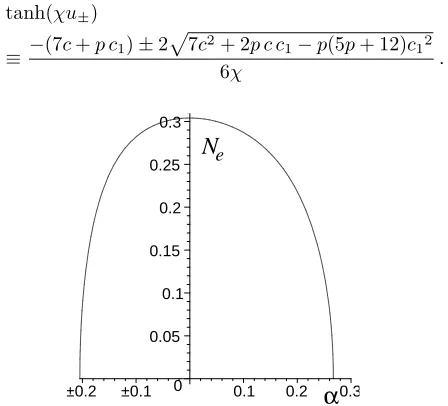
0 0.05 0.1 0.15 0.2 0.25 0.3
–0.2 –0.1 0.1 0.2 0.3
N
α
[image:2.612.333.557.452.655.2]e
FIG. 1: The number of e–folds during acceleration epoch
Ne= q
8ln
1+tanh
χu+
1+tanhχu−
κ−11−tanh
χu−
1−tanhχu+
κ+1
whereκ≡[(3q+4)c+pc1]/(2χ), as a function of the parameter
The number of e–folds during the period of accelera-tion, Ne ≡ln a(u+)−lna(u−) is plotted in Fig. 1. It
reaches a maximumNe= 0.3041 atc1= 0 independently ofp, which corresponds to the special case in which the internal spaceMpis static with constantφ
1. (Thep= 0
solution is formally equivalent to (4)–(5) with c1 = 0 and no φ1.) In the general case φ2 slowly increases —
giving a slow “decompactification” as in the TW model [3] — whileφ3 decreases, andφ1 decreases (increases) if c1u >0 (c1u <0).
The number of e–folds in the examples is possibly too low to be consistent with observational bounds, especially when one notes that any additional matter obeying the strong energy condition would have a decelerating effect that may decrease the period of transient acceleration. However, the number of e–folds can be increased by in-creasing the dimension of the twisted space. In particu-lar, consider the casen =p+ 2q+ 1 when the internal space is now the product of a p–dimensional torus Mp, (i.e.,ǫ1= 0), and the (2q+ 1)–dimensional twisted space
ds2T1,···,1=r
2 2e2φ2
q X i=1
dx2i + dyi2
+r2 3e2φ3
" dz+f
2 q X i=1
(xidyi−yidxi) #2
, (7)
which has topology (T2 × · · · ×T2)⋉S1. Eqns (4)–
(5) with q arbitrary in fact represent the solution to the (4 +p+ 2q+ 1)–dimensional vacuum Einstein equa-tions with this more general metric ansatz, where now Φ = pφ1/2 +qφ2+φ3/2. For small values q > 1 the
qualitative features are the same as theq= 1 case, with transient acceleration and a maximum number of e–folds at c1 = 0, independently ofp. For example, the maxi-mum number of e–folds for q = 2, 3, 4 are respectively
Ne= 0.3689, 0.4019, 0.4221, a marginal increase. Next we turn our attention to solutions with a period of acceleration which is not merely transient. In addition to a twist, we will take the curvature of the internal space to be non–zero. To this end, it is convenient to setδ= 0, so that the metric (2) takes the standard Friedmann– Robertson–Walker form, andubecomes the cosmic time,
t. For the metric (1), with arbitraryǫi, the field equations may be written in the form
¨
Φ + 3H˙Φ−2K−3¨a
a = 0,
¨
Φ + 3H˙Φ−2 a˙
a
2
−¨aa−2ak2 = 0, (8)
¨
φi+ 3Hφ˙i−δ1Vi−δ2VF = 0, i= 1,2,3 where δ1 = 2/p, δ2 = 0 (for i= 1), δ1 = 1, δ2 = 2 (for
i = 2), δ1 = 0, δ2 = −2 (for i = 3), H ≡ a/a˙ is the Hubble parameter, k is the spatial curvature, and the
kinetic and potential terms are respectively
K=p(p4+2)φ˙12+ 2 ˙φ22+34φ˙ 2
3+pφ˙1φ˙2+ ˙φ2φ˙3+p2φ˙3φ˙1, V =V1+V2+VF = Λ1e−(p+2)φ1−2φ2−φ3
+ Λ2e−pφ1−4φ2−φ3+F2e−pφ1−6φ2+φ3, (9)
where Λ1 = −p(p−1)ǫ1/(2r21), Λ2 = −ǫ2/r22 and F ≡
(f /2)(r3/r2
2). Even with ǫi = 0, the volume modulus
field has a non-zero (positive) potential, and so the cos-mological solutions withf >0 circumvent the no-go the-orem [2], while retainingRicci-flat internal spaces. Many additional examples are given in [11].
In terms of alternative canonically normalized scalars, which may be defined by ϕ1 ≡ −
q p+5
p+4φ3, ϕ2 ≡
√
p(p+4) 2
φ1+p+41 φ3
, ϕ3 ≡ p2φ1 + 2φ2+ 12φ3,
the field equations are ¨
ϕi+ 3Hϕ˙i+ dV
dϕi
= 0, (10)
˙
H+K−ka−2 = 0, (11)
along with the Friedmann (constraint) equation
H2= 1
3(K+V)−ka−
2, (12)
whereK=1 2
P3
iϕ˙i2. The resulting scalar potential is V = Λ1e−ϕ2/β−ϕ3+ Λ2e−2ϕ3+F2e−
√ 5−β2ϕ
1+βϕ2−3ϕ3
(13) where β ≡ √p/√p+ 4 < 1. As above we will confine our attention to k = 0 cosmologies. Solutions with no twist, F2 = 0, and compact hyperbolic product spaces,
i.e., Λi >0, have been previously discussed [8], and give transient acceleration without a local minimum in the potential. However, if there is a non–trivial twist and at least one of Λi is positive, then it may be possible to find models with a large number of e-foldings. Indeed, if we choose Λi such that the potential (13) is strictly non-negative then it always has a minimum with respect to a subset of theϕi directions.
Even withk = 0 the general solution to (10)–(13) is highly non–trivial. To demonstrate the general physical effects, we will take Λ2= 0, so thatM2is a 2-torus, and
specialize to the case in whichd= 11 (orp= 4) andϕ3= b1= const. An explicit exact solution can then be found in terms of a new logarithmic time variableτ, defined by
τ =Rt
d¯texp
−ϕ2(¯t)/√2, orϕ2 =√2 ln(dt/dτ). The
explicit solution is then (lna)′= √1
12
p
V0 ξ+ξ−1, ϕ′2= 12
p
V0 ξ−ξ−1,
ϕ1=ϕ2+ √
2b0
3 , ξ≡
√ 6−1 √
5 tanh
r 5V0
8 (τ−τ0), (14)
where′≡d/dτ,τ
0is a constant,
and b0 is fixed onceb1 is chosen. At late times we find
a∝t2, with the corresponding value ofω <−2/3, where ω ≡ (K−V)/(K+V). In the limit ϕ1 → ϕ2 we find φ1 → −φ2/2 and φ3 → −2φ2. Thus two of the extra
dimensions associated with the spaceM2may grow with
time while other dimensions shrink (or vice versa). The potentialV has a minimum with respect toϕ2at ϕ(0)2 =ϕ1+ (√2/3) ln(2Λ1/F2) + 2√2b0/3, with
V(ϕ0) = 274Λ1F4e−7b0
1/3
e−√2ϕ1 =V,
ϕ
2ϕ2(ϕ0). (16)
Since the minimum has the curious feature, special to po-tentials with Λ2= 0, thatV,ϕ2ϕ2(ϕ0) =V(ϕ0), particle–
like states will have a mass m2 = V(ϕ
0). If this value
were to be assigned to the vacuum energy at the present epoch, i.e.,V(ϕ0)∼10−120in Planck units, then both the
vacuum energy and scalar excitations about the vacuum are ultra–light. The degree to which the model would need to be fine–tuned to achieve such an outcome re-mains to be investigated.
Another alternative would be to takeV(ϕ0) to have the
vastly higher energy scale associated with the epoch of inflation in the very early universe. Let us assume thatϕ1
starts initially atϕ1=ϕ(0)1 , and that Λ1andF both are
of order unity (in Planck units), then whenϕ1∼ϕ(0)1 +47
the number of e–folds is Ne∼65. The actual relation betweenNeand the shift inϕ1can be different, however,
depending upon the precise values of the compactification scale,√Λ1, and the twist parameter,F.
A point also worth emphasizing is that, especially in a flat universe, the de Sitter stage can be transient. If this is the case in our model, we must allow also ϕ3 to roll
witht. Different choices of vacua could lead to different asymptotic expansion. More specifically, for the poten-tial (13), whenk= 0 andp= 4 the late time behaviour of the scale factor is characterized bya(t)∝tγ, where
γ=
13/19 (Λ2= 0, Λ16= 0, F26= 0)
3/5 (Λ1= 0, Λ26= 0, F26= 0)
3/4 (F2= 0, Λ
i6= 0) 7/9 (Λi6= 0, F26= 0).
(17)
It is expected the contribution of dust or radiation could modify the above asymptotic behaviour.
Let us summarize why we believe that exponential potentials arising from compactifications of supergrav-ity models on a twisted product space of time-varying volume are a potentially significant source for dynami-cal dark energy at the present epoch. Firstly, Townsend and Wohlfarth [3] argued that the no–go theorem for ac-celerating cosmologies in supergravity compactifications could only be circumvented by including compact hyper-bolic internal spaces, and would not work in the Ricci–flat cases. We have shown on the contrary that the no–go the-orem is also circumvented by twisted Ricci–flat spaces by explicit construction of exact solutions with the internal
spaceTp×(T2×· · ·×T2)⋉S1. Since Ricci–flat spaces are
natural in the string/M–theory context, this is an impor-tant development. Secondly, we have demonstrated that it is possible to construct a metastable de Sitter vacuum in the general framework of [8] by incorporating one or more geometric twists in the internal space.
As mentioned above, some of the extra dimensions may eventually grow large, though slowly, without bound and decompactify, a feature that our transient solutions share with those of the TW model. One might argue that pro-vided that the relative size of the extra dimensions and their rate of change remain sufficiently small as to be consistent with observation over any epoch of physical relevance, then the eschatological consequences of such “decompactifications” are no more severe than those of a universe whose ordinary three dimensions accelerate forever. Nonetheless, given that the natural endpoint of the solutions is a fundamentally higher–dimensional run-away epoch [12], it is clear that we would have additional cosmic coincidence constraints in explaining why the uni-verse appears to have three large spatial dimensions at the present epoch. However, before arriving at any such conclusions it is important to include additional matter, such as pressureless dust. Matter obeying the strong en-ergy condition will certainly affect the length of any tran-sient acceleration, and may also change the evolution of the scalar fields.
Finally, we remark that geometric twists add richness to string/M–theory cosmology, and may potentially lead to the realization of new cosmological scenarios.
Acknowledgements: This work was supported in part by the Mardsen Fund of the Royal Society of New Zealand. I.P.N. thanks CERN-TH for hospitality while part of this work was done.
[1] C.L. Bennettet al., Astrophys. J. Suppl.148, 1 (2003). [2] G. W. Gibbons, inSupersymmetry, Supergravity and
Re-lated Topics, eds. F. del Aguila, J. A. de Azcarraga and L. E. Ibanez, (World Scientific, Singapore, 1985), pp. 123–146; J. M. Maldacena and C. Nunez, Int. J. Mod. Phys. A16, 822 (2001).
[3] P. K. Townsend and M.N.R. Wohlfarth, Phys. Rev. Lett. 91(2003) 061302.
[4] C.-M. Chen, P.-M. Ho, I. P. Neupane, and J. E. Wang, JHEP0307, 017 (2003).
[5] N. Ohta, Phys. Rev. Lett. 91, 061303 (2003).
[6] M. N. R. Wohlfarth, Phys. Lett. B563, 1 (2003); S. Roy, Phys. Lett. B567, 322 (2003).
[7] R. Emparan and J. Garriga, JHEP0305(2003) 028. [8] C.-M. Chen, P.-M. Ho, I. P. Neupane, N. Ohta and
J. E. Wang, JHEP0310, 058 (2003).
[10] E. Bergshoeff, A. Collinucci, U. Gran, M. Nielsen and D. Roest, Class. Quantum Grav.21, 1947 (2004). [11] I. P. Neupane and D. L. Wiltshire, hep-th/0504135.