ISSN Online: 2160-8717 ISSN Print: 2160-8709
DOI: 10.4236/ojst.2019.93008 Mar. 18, 2019 75 Open Journal of Stomatology
Effect of Thermocycle Aging on Color Stability
of Monolithic Zirconia
Merve Koseoglu
1*, Berkman Albayrak
2, Pinar Gül
3, Funda Bayindir
41Department of Prosthetic Dentistry, Faculty of Dentistry, University of Sakarya, Sakarya, Turkey
2Department of Prosthodontics, Faculty of Dentistry, University of Atatürk, Erzurum, Turkey 3Department of Restorative Dentistry, Faculty of Dentistry, University of Atatürk, Erzurum, Turkey
4Department of Prosthetic Dentistry, Faculty of Dentistry, University of Atatürk, Erzurum, Turkey
Abstract
Background: The color stability of dental restorative materials is important for long-term clinical success. Objectives: The objective of this study was to examine the effect of thermocycling on the color and translucency stability of monolithic zirconia. Materials and methods: A total of 80 disc-shaped spe-cimens (1 cm diameter) were produced from monolithic zirconia material, Katana High Translucent (Kuraray Noritake Dental, Kurashiki, Japan). The specimens were prepared in four different thicknesses: 0.5 mm, 1 mm, 1.5 mm and 2 mm. Before thermocycling, color measurements of the specimens were made by a spectrophotometer (Spectro Shade TM MICRO; MHT Optic Research AG, Milan, Italy). After the thermal aging procedure, the color measurement was repeated. Data obtained from the study were analyzed with descriptive statistics, correlation analysis, one-way ANOVA and Tukey’s tests. Results: After thermocycling, the L*, a*, b* values decreased at all thicknesses. The maximum change in the L*, a* and b* values was observed in 0.5-mm-thick specimens, while the least change was observed in 2-mm-thick specimens. The amount of color change in the specimens after thermocycling was found to be the highest in 0.5-mm-thick specimens (ΔE = 0.91 ± 0.02), and the lowest in 2-mm-thick specimens (ΔE = 0.85 ± 0.01). While a statistically significant color change (ΔE) was observed in 0.5-mm-thick specimens (p < 0.05), a sta-tistically insignificant color change (ΔE) was observed (p > 0.05) in 1-mm, 1.5-mm, and 2-mm-thick specimens. After thermocycling, the translucency parameter (TP) values decreased at all thicknesses. The highest change in the TP values was observed in 0.5-mm-thickspecimens (1.09 ± 0.03), while the lowest change was observed in 2-mm-thickspecimens (0.40 ± 0.04). While a statistically significant change in the TP values was observed in 0.5-mm-thick specimens (p < 0.05), there was a statistically insignificant change in the TP How to cite this paper: Koseoglu, M.,
Albayrak, B., Gül, P. and Bayindir, F. (2019) Effect of Thermocycle Aging on Color Stability of Monolithic Zirconia. Open Journal of Stomatology, 9, 75-85. https://doi.org/10.4236/ojst.2019.93008
Received: January 3, 2019 Accepted: March 15, 2019 Published: March 18, 2019
Copyright © 2019 by author(s) and Scientific Research Publishing Inc. This work is licensed under the Creative Commons Attribution International License (CC BY 4.0).
DOI: 10.4236/ojst.2019.93008 76 Open Journal of Stomatology values of 1-mm, 1.5-mm and 2-mm-thick specimens (p > 0.05). Conclusion: Although the color and translucency values after thermocycling exhibited sta-tistically significant changes in the 0.5 mm thickness group, a stasta-tistically sig-nificant difference was not observed in the other thickness groups.
Keywords
Monolithic Zirconia, Color, Translucency, Thermocycling
1. Introduction
Monolithic zirconia restorations have many advantages such as enabling for mi-nimal invasive tooth preparation, causing mimi-nimal wear on the opposing teeth and exhibiting high flexural strength. Besides, these restorations can be pro-duced in the laboratory with computer-assisted manufacturing (CAD/CAM) systems in a short time without adding any porcelain [1]-[6]. In recent years thanks to the production and the use of high translucent monolithic zirconia materials, the esthetic success of restorations has increased [7].
One of the main goals in prosthetic dentistry is obtaining high esthetics by producing dental restorations that mimic the color and translucency of natural teeth. For long-term clinical success, the color stability of dental restorative ma-terials is as important as their mechanical properties. The esthetic success of restorations mimicking natural tooth color depends on the color stability of the material used [8] [9].
Dental restorations are always subjected to various stresses/forces in the oral environment [10]. Temperature changes occur with the effect of food, drinks and breathing; pH changes occur due to the chemical content of foods in the mouth [11]. These oral environmental factors may affect the physical and chem-ical structure of the restorative materials. With laboratory tests, it is possible to have foresight about the long-term clinical behaviors of dental restorative mate-rials [12].
Thermocycling of test specimens has been proposed as an effective method, in order to mimic the natural aging process of dental restorations and imitate oral conditions in laboratory environment [13] [14]. Thermocycling is one of the most commonly used artificial aging methods in dentistry [15].
Previous studies investigated the effect of monolithic zirconia thickness on the optical properties [16] [17] [18] [19]. Also, some studies investigated color sta-bility of monolithic zirconia restorations [20] [21] [22] [23] [24]. However, in-formation regarding the effect of thermocycling on the optical properties of high translucent monolithic zirconia ceramic with different thicknesses is lacking.
DOI: 10.4236/ojst.2019.93008 77 Open Journal of Stomatology differences using CIE L*a*b* formulae allowed for comparisons in previous stu-dies [21] [22] [23] [24]. Also, the translucency parameter that (TP) was used in order to determine the translucency values of objects is defined as the color dif-ference of an object on the white (w) and a black (b) background [26] [27]. The degree of color change in the CIE L*a*b* system is denoted by ΔE. In the present study, perceptibility threshold was set at ΔEab = 1.2 units, and the clinical
accep-tability threshold was set at ΔEab = 2.7 units [28].
Dental shade-matching instruments have been used to overcome imperfec-tions and inconsistencies of traditional shade matching [29]. Spectrophotome-ters are accurate, useful and flexible instruments for color matching in dentistry [29] [30]. This device can measure the amount of light energy reflected from an object at 1 to 25 nm intervals along the visible spectrum [31] [32]. They also al-low colors to be classified numerically in an easier and more precise way, so that transfer process and communication can be improved [33] [34].
The purpose of this study was to investigate the effect of different thicknesses and thermocycling on color and translucency of monolithic zirconia. The null hypothes was that, thermocycling and differences in thickness had significant effect on color and translucency of monolithic zirconia at clinically perceptible level.
2. Methodology
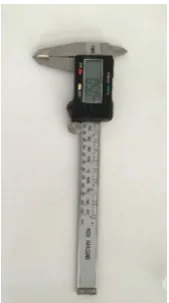
[image:3.595.331.416.556.708.2]This study was conducted in Ataturk University, Faculty of Dentistry, Erzurum, Turkey in March 2018. In the present study, the specimens were produced with the CAD/CAM system from high translucent monolithic zirconia (Katana High Translucent; Kuraray Noritake Dental, Kurashiki, Japan), with thicknesses of 0.5 mm, 1 mm, 1.5 mm and 2 mm. Disc shaped specimens were 1 mm in di-ameter. There were 20 specimens in each group. The specimens were sintered in a furnace (Protherm Furnaces; Alser Teknik Seramik, Turkey) for 2 hours at 1550˚C. After cooling the specimens at the room temperature, the surface fi-nishing process was carried out under water with sandpaper #180. The thick-nesses of the specimens were measured by a digital caliper (Absolute Digimatic Caliper, Mitutoyo Corporation, Aurora, IL, USA) (Figure 1).
DOI: 10.4236/ojst.2019.93008 78 Open Journal of Stomatology Following the manufacturer’s instructions, spectrophotometer (Spectro Shade, MHT Optic Research AG, Niederhasli, Switzerland) was calibrated before each measurement. After numbering 80 specimens, CIE L*a*b* values were measured for each specimen by the spectrophotometer. For each specimen, measurements were performed from three different points on the black (b), white (w) and gray (g) backgrounds and the average values were obtained (Figure 2).
L, a, b values of the specimens were measured by spectrophotometer on white (w) and black (b) backgrounds. The translucency parameter (TP) was calculated by this formula:
TP = [(Lb − Lw)2 + (ab − aw)2 + (bb − bw)2]1/2
After the first measurements, thermocycling were applied to monolithic zir-conia specimens in a specially designed device which consists of 4 tanks with deionized water at standard temperatures [11] [35]. All specimen groups were subjected to 5000 thermocycles. The specimens were immersed for 15 seconds in each tank according to the following sequence: 5˚C to 37˚C to 55˚C to 37˚C ac-cording to ISO 11405 standards [21].
The translucency parameter (TP) values of the specimens which were sub-jected to thermocycling were recalculated. The ΔE formula was used to assess the effect of thermocycling on the color stability of the specimens with different thicknesses.
ΔE = [(ΔL*)2 + (Δa*)2 + (Δb*)2]1/2
The statistical analyses of the study were performed by using IBM SPSS 20.0 package program. Descriptive statistics were used to determine the mean L*, a*,
[image:4.595.317.432.552.706.2]b* values of the monolithic zirconia material at different thicknesses. The Pear-son correlation test was performed to determine the relationship between the thicknesses of the specimens, and L*, a*, b* and TP values. For repeated mea-surements, in the comparison of the specimens subjected to thermocycling in terms of TP, ΔL, Δa, Δb and ΔE variables according to the thickness, the one-way ANOVA analysis was performed. Tukey’s test was performed to com-pare the different monolithic zirconia thicknesses. The results for p < 0.05 were considered statistically significant.
DOI: 10.4236/ojst.2019.93008 79 Open Journal of Stomatology
3. Result
L, a, b values of monolithic zirconia specimens before thermocycling (L1, a1, b1)
and after thermocycling (L2, a2, b2) are presented in Table 1. After
thermocycl-ing, the L* values decreased, a* and b* values increased at all thicknesses. As the
material thickness increased, while * 1 L, *
2 L , *
1 b , *
2
b values decreased, the * 1 a , *
2
a values increased (p < 0.01).
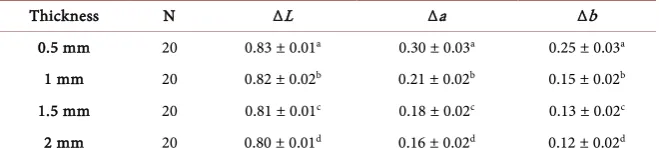
Changes in the L* values (ΔL), a* values (Δa) and b* values (Δb) of the speci-mens with thermocycling are presented in Table 2. While the maximum ΔL (0.83 ± 0.01), Δa (0.30 ± 0.02), Δb (0.25 ± 0.03) values were observed in 0.5-mm-thick specimens. Minimum ΔL (0.80 ± 0.01), Δa (0.16 ± 0.01) and Δb (0.12 ± 0.02) values were observed in 2-mm-thick specimens. As the thickness increased, the ΔL, Δa and Δb values decreased (p < 0.01).
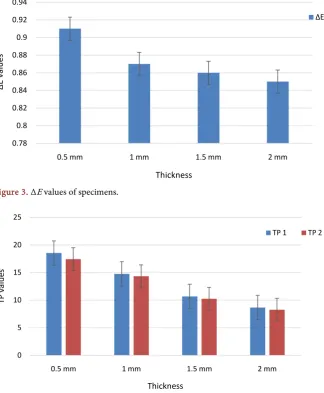
TP values of the specimens before (TP1) and after (TP2) thermocycling are
presented in Figure 3. Mean TP1 and TP2 values of the specimens decreased as
thickness increased (p < 0.01). Mean TP1 and TP2 values of the specimens were
statistically different from each other at all thicknesses (p < 0.001).
After thermocycling, the TP values decreased at all thicknesses (p < 0.05). Maximum change in the TP values was observed in 0.5-mm-thick specimens (1.09 ± 0.03), while the minimum change was observed in 2-mm-thick speci-mens (0.40 ± 0.04). As the thickness increased, the change in the TP values de-creased (p < 0.05). While there was a statistically significant difference (p < 0.05) between the change in the TP values of 0.5-mm-thick specimens and the change in the TP values of 1-mm, 1.5-mm, and 2-mm-thick specimens, there was not a statistically significant difference between the change in the TP values of the specimens with thicknesses of 1 mm, 1.5 mm and 2 mm (p > 0.05).
[image:5.595.210.540.630.708.2]Color change (ΔE) values of the specimens with thermocycling are presented in Figure 4. After thermocycling the maximum color change was observed in
Table 1. L*, a* and b* values of specimens before (L1, a1, b1) and after (L2, a2, b2) thermo-cycling.
Thickness N L1 L2 a1 a2 b1 b2
0.5 mm 20 76.06 ± 0.49 75.23 ± 0.03 −1.23 ± 0.03 −0.93 ± 0.01 22.04 ± 0.14 22.29 ± 0.01 1 mm 20 75.25 ± 0.20 74.63 ± 0.02 −0.59 ± 0.05 −0.38 ± 0.01 21.06 ± 0.13 21.20 ± 0.02 1.5 mm 20 74.04 ± 0.19 73.58 ± 0.18 0.14 ± 0.02 0.32 ± 0.01 20.52 ± 0.25 20.65 ± 0.01 2 mm 20 73.21 ± 0.10 72.83 ± 0.01 0.62 ± 0.02 0.78 ± 0.02 20.28 ± 0.35 20.40 ± 0.02
Table 2. ΔL, Δa, Δb values of specimens.
Thickness N ΔL Δa Δb
0.5 mm 20 0.83 ± 0.01a 0.30 ± 0.03a 0.25 ± 0.03a
1 mm 20 0.82 ± 0.02b 0.21 ± 0.02b 0.15 ± 0.02b
1.5 mm 20 0.81 ± 0.01c 0.18 ± 0.02c 0.13 ± 0.02c
2 mm 20 0.80 ± 0.01d 0.16 ± 0.02d 0.12 ± 0.02d
DOI: 10.4236/ojst.2019.93008 80 Open Journal of Stomatology Figure 3. ΔE values of specimens.
Figure 4. TP values before (TP1) and after (TP2) thermocycle.
0.5-mm-thick specimens (ΔE = 0.91 ± 0.02), while the minimum color change was observed in 2 mm-thick-specimens (ΔE = 0.85 ± 0.02). At all thicknesses, a color change was observed below 1.2 ΔE units, which is the perceptibility thre-shold. ΔE decreased, as the thickness increased (p < 0.01). A statistically signifi-cant difference was occured between the mean ΔE values of the groups (p < 0.001). While there was a difference between 0.5-mm-thick specimens and other thicknesses (p < 0.05), there was not a difference between 1-mm, 1.5-mm and 2-mm-thick specimens (p > 0.05).
4. Discussion
The null hypothesis which was that, thermocycling and differences in thickness had significant effect on color and translucency stability of monolithic zirconia at clinically perceptible level, was rejected. Because, in this study, color changes after thermocycling was observed less than perceptibility level (1.2 ΔE units) at all thicknesses groups.
0.78 0.8 0.82 0.84 0.86 0.88 0.9 0.92 0.94
0.5 mm 1 mm 1.5 mm 2 mm
Δ
E va
lu
es
Thickness
ΔE
0 5 10 15 20 25
0.5 mm 1 mm 1.5 mm 2 mm
TP
va
lu
es
Thickness
DOI: 10.4236/ojst.2019.93008 81 Open Journal of Stomatology Color and translucency have a significant effect on the esthetic success of the restorations [36]. In this study, the changes in translucency and color of the ma-terial were evaluated. Color measurements were performed according to the CIE Lab system by referencing to the study of Hamza et al. [22]. In the present study, by referencing to the studies on the subject [37] [38], 2 ΔE units were defined as clinically perceivable, while 3.7 ΔE units as clinically acceptable color change.
The reproduction of color and translucency of natural teeth would be one of the main goal for esthetic dental restorations. Color stability of a restoration throughout the functional lifetime is as important as the mechanical properties of the material. Color changes of a restorative material over time may limit the longevity and quality of restorations [8] [9].
Many studies in the literature have examined the effect of the thickness of monolithic zirconia on its optical properties. In all of these studies, it was stated that as the thickness of monolithic zirconia increases, the translucency of the material decreases [16] [17] [18] [19]. Moreover, it was argued that the translu-cency of the monolithic zirconia produced by different manufacturers is differ-ent [18] [19]. In the presdiffer-ent study, similarly to the studies in the literature [16] [17] [18] [19], the translucency decreased as the thickness of the material in-creased (p < 0.001).
In their study, Abdelbary et al. [23] investigated the effect of accelerated aging on the translucency of monolithic zirconia. As a result of their study, they stated that aging processes affected the TP values of monolithic zirconia specimens. When they compared the TP values before aging, they found out that there wasn’t a statistically significant difference between the TP values of 0.5-mm and 0.8-mm-thick specimens, while there was a statistically significant difference between the TP values of the specimens with thicknesses of 0.8 mm, 1 mm and 1.2 mm. The researchers stated that as the thickness of monolithic zirconia in-creased, the TP values decreased. After the aging process, the TP values of 0.5 mm-thick-specimens exhibited statistically significant changes whereas the TP values of 0.8-mm, 1-mm and 1.2-mm-thick specimens exhibited statistically in-significant change.
Fathy et al. [24] in which they investigated the effect of hydrothermal aging on the translucency of monolithic and core zirconia, measured the TP values of 1-mm-thick monolithic zirconia specimens by performing color measurements before and after hydrothermal aging. They stated that TP values of monolithic zirconia specimens before and after aging were statistically significantly higher than the TP values of core zirconia. They indicated that after aging the TP values decreased in monolithic and core zirconia, and this change was statistically sig-nificant in both groups.
DOI: 10.4236/ojst.2019.93008 82 Open Journal of Stomatology In the present study, similarly to the studies of Abdelbary et al. [23] and Fathy
et al. [24] the TP values of the monolithic zirconia specimens subjected to ther-mocycling decreased. While there was a statistically significant difference be-tween 0.5-mm-thick specimens and specimens of other thicknesses (p < 0.05), there was not a statistically significant difference between the TP values of 1-mm, 1.5-mm and 2-mm-thick specimens (p > 0.05). As a result of the study, similarly to many studies in the literature [16] [17] [18] [19], it was observed that the TP values decreased (p < 0.001) as the thickness of the material increased.
In the present study, similarly to the study of Hamza et al. [22] while the maxi-mum amount of color change after thermocycling was observed in 0.5-mm-thick specimens (ΔE = 0.91 ± 0.02), the minimum amount of color change was ob-served in 2-mm-thick specimens (ΔE = 0.85 ± 0.02). At all thicknesses, a color change below the clinically perceptible threshold was observed.
Under clinical conditions, various dental ceramic materials are used in the mouth. One of the limitations of this study is the use of only one type of mono-lithic zirconia material. Under clinical conditions, the color and translucency of the restoration can be affected by the color of the underlying dental tissue and resin cement. In this study, not assessing the effect of the resin cement and den-tal tissue on the color was another limitation. Furthermore, under clinical condi-tions, a single surface of the restoration is exposed to fluids in the mouth. In this case, the change in color values obtained as a result of the study may vary from the values of color change obtained in the clinic. In the study, however, both surfaces of the specimens were subjected to the thermocycling procedure. Another limitation of the study was that before and after thermocycling the surface rough-ness of the specimens was not assessed. It is assumed that the change in surface roughness can affect the color changes of the specimens. It is suggested to eva-lute the effect of the lower dental tissue, resin cement color and surface rough-ness on the final color and translucency of different types of dental ceramics in further studies.
5. Conclusions
Within the limitations of this study, the following could be concluded:
1) TP, L*, a*, b* values of the monolithic zirconia specimens decreased after thermocycling, at all thicknesses.
2) After thermocycling, color change (ΔE) which was below the clinically de-tectable color change limit, was observed at all thicknesses.
3) TP and ΔE values of specimens were differed according to thicknesses.
Conflicts of Interest
The authors declare no conflicts of interest regarding the publication of this paper.
References
DOI: 10.4236/ojst.2019.93008 83 Open Journal of Stomatology https://doi.org/10.14219/jada.2014.52
[2] Griffin, J.D. (2013) Tooth in a Bag: Same-Day Monolithic Zirconia Crown. Denti-stry Today, 32, 124-131.
[3] Sripetchdanond, J. and Leevailoj C. (2014) Wear of Human Enamel Opposing Mo-nolithic Zirconia, Glass Ceramic, and Composite Resin: An in Vitro Study.Journal of Prosthetic Dentistry, 112, 1141-1150.
https://doi.org/10.1016/j.prosdent.2014.05.006
[4] Zhang, Y., Lee, J.J.W., Srikanth, R. and Lawn, B.R. (2013) Edge Chipping and Flex-ural Resistance of Monolithic Ceramics.Dental Materials, 29, 1201-1208.
https://doi.org/10.1016/j.dental.2013.09.004
[5] Flinn, B.D., Raigrodski, A.J. and Mancl, L.A. (2017) Influence of Aging on Flexural Strength of Translucent Zirconia for Monolithic Restorations.Journal of Prosthetic Dentistry, 117, 303-309.https://doi.org/10.1016/j.prosdent.2016.06.010
[6] Millar, B.J. (2017) An Assessment of Burs Designed to Cut Zirconia. Open Journal of Stomatology, 7, 277-282. https://doi.org/10.4236/ojst.2017.75021
[7] Zhang, Y. (2014) Making Yttria-Stabilized Tetragonal Zirconia Translucent. Dental Materials, 30, 1195-1203.https://doi.org/10.1016/j.dental.2014.08.375
[8] Acar, O., Yilmaz, B. and Altintas, S.H. (2016) Color Stainability of CAD/CAM and Nanocomposite Resin Materials. Journal of Prosthetic Dentistry, 115, 71-75.
https://doi.org/10.1016/j.prosdent.2015.06.014
[9] de Oliveira, A.L.B.M., Botta, A.C., Campos, J.Á.D.B. and Garcia, P.P.N.S. (2014) Ef-fects of Immersion Media and Repolishing on Color Stability and Superficial Mor-phology of Nanofilled Composite Resin. Microscopy and Microanalysis, 20, 1234-1239.https://doi.org/10.1017/S1431927614001299
[10] Geis-Gerstorfer, J. (1994) In Vitro Corrosion Measurements of Dental Alloys. Journal of Dentistry, 22, 247-251.https://doi.org/10.1016/0300-5712(94)90124-4 [11] Gale, M.S. and Darvell, B.W. (1999) Thermal Cycling Procedures for Laboratory
Testing of Dental Restorations. Journal of Dentistry, 27, 89-99.
https://doi.org/10.1016/S0300-5712(98)00037-2
[12] Tekbas Atay, M., Oguz Ahmet, B.S. and Sayın Ozel, G. (2017) Ağız Ortamının Simülasyonu Açısından Termal ve Loading Siklusun Önemi.The Journal of Dental Facultyof Atatürk University, 14, 88-93.
[13] Abdalla, A.I., El Zohairy, A.A., Aboushelib, M.M. and Feilzer, A.J. (2007) Influence of Thermal and Mechanical Load Cycling on the Microtensile Bond Strength of Self-Etching Adhesives.American Journal of Dentistry, 20, 250-254.
[14] Amaral, F.L.D., Colucci, V. and de Souza-Gabriel, A.E. (2008) Adhesion to Er:YAG Laser-Prepared Dentin after Long-Term Water Storage and Thermocycling. Opera-tive Dentistry, 33, 51-58.https://doi.org/10.2341/07-30
[15] El-Araby, A.M. and Talic, Y.F. (2007) The Effect of Thermocycling on the Adhesion of Self-Etching Adhesives on Dental Enamel and Dentin. The Journal of Contem-porary Dental Practice, 8, 17-24.
[16] Ilie, N. and Stawarczyk, B. (2015) Quantification of the amount of Blue Light Pass-ing through Monolithic Zirconia with Respect to Thickness and Polymerization Conditions. Journal of Prosthetic Dentistry, 113, 114-121.
https://doi.org/10.1016/j.prosdent.2014.08.013
DOI: 10.4236/ojst.2019.93008 84 Open Journal of Stomatology https://doi.org/10.4047/jap.2016.8.1.37
[18] Sulaiman, T.A., Abdulmajeed, A.A. and Donovan, T.E. (2015) Optical Properties and Light Irradiance of Monolithic Zirconia at Variable Thicknesses. Dental Mate-rials Journal, 31, 1180-1187. https://doi.org/10.1016/j.dental.2015.06.016
[19] Wang, F., Takahashi, H. and Iwasaki, N. (2013) Translucency of Dental Ceramics with Different Thicknesses. Journal of Prosthetic Dentistry, 110, 14-20.
https://doi.org/10.1016/S0022-3913(13)60333-9
[20] Subaşı, M.G., Alp, G., Johnston, W.M. and Yilmaz, B. (2018) Effect of Thickness on Optical Properties of Monolithic CAD-CAM Ceramics. Journal of Prosthetic Denti-stry, 71, 38-42. https://doi.org/10.1016/j.jdent.2018.01.010
[21] Papageorgiou-Kyrana, A., Kokoti, M., Kontonasaki, E. and Koidis, P. (2018) Evalu-ation of Color Stability of Preshaded and Liquid-Shaded Monolithic Zirconia. Journal of Prosthetic Dentistry, 119, 467-472.
https://doi.org/10.1016/j.prosdent.2017.04.015
[22] Hamza, T.A., Alameldin, A.A., Elkouedi, A.Y. and Wee, A.G. (2017) Effect of Ar-tificial Accelerated Aging on Surface Roughness and Color Stability of Different Ceramic Restorations. Stomatological Disease and Science, 1, 8-13.
https://doi.org/10.20517/2573-0002.2016.05
[23] Abdelbary, O., Wahsh, M., Sherif, A. and Salah, T. (2016) Effect of Accelerated Ag-ing on Translucency of Monolithic Zirconia. Future Dental Journal, 2, 65-69. https://doi.org/10.1016/j.fdj.2016.11.001
[24] Fathy, S.M., El-Fallal, A.A., El-Negoly, S.A. and El Bedawy, A.B. (2015). Translu-cency of Monolithic and Core Zirconia after Hydrothermal Aging. Acta Odontolo-gica Scandinavica, 1, 86-92. https://doi.org/10.3109/23337931.2015.1102639
[25] Billmeyer, F. and Saltzman, M. (2000) Principles of Color Technology. 3rd Edition, John Wiley & Sons, New York.
[26] Johnston, W.M., Ma, T. and Kienle, B.H. (1995) Translucency Parameter of Colo-rants for Maxillofacial Prostheses. International Journal of Prosthodontic, 8, 13-15. [27] Johnston, W.M. and Reisbick, M.H. (1997) Color and Translucency Changes during
and after Curing of Esthetic Restorative Materials. Dental Materials Journal, 13, 89-97. https://doi.org/10.1016/S0109-5641(97)80017-6
[28] Paravina, R.D., Ghinea, R. and Herrera, L.J. (2015) Color Difference Thresholds in Dentistry. Journal of Esthetic and Restorative Dentistry, 27, 1-9.
https://doi.org/10.1111/jerd.12149
[29] Chu, S.J., Trushkowsky, R.D. and Paravina, R.D. (2010) Dental Color Matching In-struments and Systems. Review of Clinical and Research Aspects. Journal of Denti-stry, 38, 2-16. https://doi.org/10.1016/j.jdent.2010.07.001
[30] Paul, S.J., Peter, A., Rodoni, L. and Pietrobon, N. (2004) Conventional Visual vs Spectrophotometric Shade Taking for Porcelain-Fused-to-Metal Crowns: A Clinical Comparison. International Journal of Periodontics & Restorative, 24, 222-231. https://doi.org/10.1016/j.prosdent.2004.07.004
[31] Khurana, R., Tredwin, C.J., Weisbloom, M. and Moles, D.R. (2007) A Clinical Evaluation of the Individual Repeatability of Three Commercially Available Colour Measuring Devices. British Dental Journal, 203, 675-680.
https://doi.org/10.1038/bdj.2007.1108
Den-DOI: 10.4236/ojst.2019.93008 85 Open Journal of Stomatology tistry, 101, 92-100. https://doi.org/10.1016/S0022-3913(09)60001-9
[33] Kim-Pusateri, S., Brewer, J.D., Davis, E.L. and Wee, A.G. (2009) Reliability and Ac-curacy of Four Dental Shade-Matching Devices. Journal of Prosthetic Dentistry, 101, 193-199. https://doi.org/10.1016/S0022-3913(09)60028-7
[34] Della Bona, A., Barrett, A.A., Rosa, V. and Pinzetta, C. (2009) Visual and Instru-mental Agreement in Dental Shade Selection: Three Distinct Observer Populations and Shade Matching Protocols. Dental Materials, 25, 276-281.
https://doi.org/10.1016/j.dental.2008.09.006
[35] Helvatjoglou-Antoniades, M., Theodoridou-Pahini, S., Papadogiannis, Y. and Kare-zis, A. (2000) Microleakage of Bonded Amalgam Restorations: Effect of Thermal Cycling. Operative Dentistry, 25, 316-323.
[36] Kim, H.K., Kim, S.H., Lee, J.B. and Ha, S.R. (2016) Effects of Surface Treatments on the Translucency, Opalescence, and Surface Texture of Dental Monolithic Zirconia Ceramics. Journal of Prosthetic Dentistry, 115, 773-779.
https://doi.org/10.1016/j.prosdent.2015.11.020
[37] Paravina, R.D., Ontiveros, J.C. and Powers, J.M. (2004) Accelerated Aging Effects on Color and Translucency of Bleaching-Shade Composites. Journal of Esthetic and Restorative Dentistry, 16, 117-126.
https://doi.org/10.1111/j.1708-8240.2004.tb00018.x