Pectin-Based Biodegradable Hydrogels with
Potential Biomedical Applications as Drug
Delivery Systems
Mohammad Sadeghi
Department of Chemistry, Science Faculty, Islamic Azad University, Arak Branch, Arak, Iran Email: [email protected]
Received October 28th 2010; November 23rd 2010; November 30th 2010.
ABSTRACT
In this work, synthesis and swelling behavior of a superabsorbent hydrogel based on Pectin (Pc) and polyacrylonitrile (PAN) were investigated. A mechanism for hydrogel formation was proposed and the structure of the product was es-tablished using FTIR spectroscopy. The Pc-poly (sodium acrylate-co-acrylamide) hydrogel exhibited a pH-responsive swelling-deswelling behavior at pH’s 2 and 8. This on-off switching behavior provides the hydrogel with the potential to control delivery of bioactive agents. Release profiles of ibuprofen (IBU), a poor water-soluble drug, from the hy-drogels were studied under both simulated gastric and intestinal pH conditions.
Keywords: Pectin, Polyacrylonitrile, Hydrogel, Ibuprofen, Drug Delivery
1. Introduction
Pectin is a naturally occurring biopolymer that is finding increasing applications in the pharmaceutical and biotechnology industry. It has been used successfully for many years in the food and beverage industry as a thickening agent, a gelling agent and a colloidal stabilizer. Pectin also has several unique properties that have enabled it to be used as a matrix for the entrapment and/or delivery of a variety of drugs, proteins and cells. Furthermore, crosslinked polymers from Pectin can form hydrogels that are able to absorb and retain hundreds of times their weight of water and are known as superabsor- bents [1]. The properties of these hydrogels have attracted the attention of many researchers and technologists and have found wide-spread applications in many fields, such as drug delivery systems, agriculture, separation processes [2-5]. The combination of the hydrophilic acrylic polymer properties with the biodegradable character of Pectin based blends, will lead to interesting hydrogels with po-tential applications as biomaterials exhibiting different properties depending on the composition and on the type of interactions within the network, attending to chemical crosslinking and hydrogen bonding interactions [6]. This work deals with the development of new biodegradable hydrogels developed by the polymerization of AN and
some formulations with sodium hydroxide as crosslinker, in the presence of Pectin.
2. Experimental
2.1. Hydrogel Preparation
A one step preparative method was used for synthesis of Pc-poly(sodium acrylate-co-acrylamide)hydrogel, Pc-poly (NaAA-co-AAm), hydrogel. Pectin (1.33 g) was added to 35 mL of doubly distilled water in a three-neck reactor equipped with a mechanical stirrer (Heidolph RZR 2021, three blade propeller type). The reactor was immersed in a thermostated water bath. After complete dissolution of the Pectin, sodium hydroxide (10.0 wt %) was added to the Pectin solution at desired temperature (alkalization temperature, 80˚C). The mixture was allowed to stir for certain times (alkalization times, 120 min). The various amount of polyacrylonitrile (1.0 g) was dispersed in the reaction mixture to saponify for certain times and tem-peratures (alkaline time and temperature). During the saponification NH3 gas was evolved and a color change
pieces and poured in ethanol (200 mL) to dewater for 5 h. The hardened particles were filtered and dried in oven (50˚C, 10 h). After grinding, the powdered superabsor-bent hydrogel was stored away from moisture, heat and light.
2.2. Drug Loading Efficiency and In Vitro Drug Release
Powdered samples (1 g ± 0.0001), with average particle sizes between 40-60 mesh (250-420 µm), were accu-rately weighted and immersed in an alkaline solution of ibuprofen (IBU, 0.54g dissolved in 50 mL distilled water) at 0˚C for 25 h. The swollen hydrogels loaded with drug were placed in a vacuum oven and dried under vacuum at 37˚C. The loading amount of drug in the hydrogels was calculated from the decrease in the concentration of the IBU solution which was determined using a UV spec-trophotometer (UV-1201, Shimadzu, Kyoto, Japan). The loading efficiency of the Pectin-based hydrogels was calculated as the ratio of the final to the initial IBU con-centration.
In vitro release was carried out in duplicate by incu-bating 0.01±0.0001 g of the IBU-loaded hydrogels into a cellophane membrane dialysis bag (D9402,
SIGMA-ALDRICH) in 50 mL of buffer solution (either pH 1.2 or 7.4) at 37˚C. At specific time intervals, 1 mL aliquots of sample was withdrawn and after suitable dilu-tion the concentradilu-tion of drug released was measured by UV spectrophotometer. The drug release percent was calculated twice using the following equation:
Released drug (%) =Rt/L×100 (1)
where L and Rt represent the initial amount of drug
loaded and the final amount of drug released at time t.
3. Results and Discussion
3.1. Mechanism of Hydrogel Formation
A general reaction mechanism for Pc-poly(NaAA-co- AAm) hydrogel formation is shown in Scheme 1. In the first step, Pectin hydroxyl groups were converted to cor-responding alkoxides using sodium hydroxide. These macroalkoxides initiated a crosslinking reaction between adjacent polyacrylonitrile pendant chains forming naphthyridine cyclic structures (including imine, -C=N-, conjugated bonds with deep red color). The intermediate was then hydrolyzed using residual sodium hydroxide aqueous solution to produce hydrophilic carboxamide and carboxylate groups (Scheme 1) with a resulting color change from red to light yellow. This sharp color change was used as an indication to halt the alkaline treatment. However, incompletely hydrolyzed structures may also give rise to a few crosslinking points result in a loosely
crosslinked network.
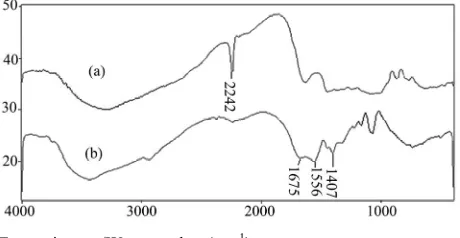
Infrared spectroscopy was carried out to confirm the chemical structure of the materials obtained. The FTIR spectra of Pc-PAN physical mixture and the resulted hy- drogel, Pc-poly(NaAA-co-AAm) are shown in Figure 1. The band observed at 2242 cm-1 was attributed to
stretching of cyanide (Figure 1a). The Pectin backbone with side chains with carboxamide and carboxylate fun- ctional groups were identified by three new peaks at 1407, 1556, and 1675 cm-1
(Figure 1b).
These peaks were attributed to C=O stretching in car- boxamide functional groups and symmetric and asym- metric stretching modes of carboxylate groups, respect- tively [7].
The in situ reaction was conducted with alkaline hy- drolysis in absence of the polysaccharide. The product obtained was soluble, indicating that crosslinks were not being formed without Pectin. This substantiated the fact that Pectin hydroxyls are involved in the crosslinking process leading to the formation of hydrogels.
3.2. PH-Reversibility for Pc-Poly (NaAA-co-AAm) Hydrogel
Since the hydrogels show different swelling behavior at various pHs, we investigated their pH-reversibility in solutions buffered at pH 2.0 and 8.0. A stepwise repro- ducible in swelling change of the hydrogel at 25 ˚C with alternating pH between 2.0 and 8.0 is seen in Figure 2.
At pH 8.0, the hydrogel swelled up to 157 g/g due to anion–anion repulsive electrostatic forces, while, at pH 2.0, it shrunk within a few minutes due to protonation of carboxylate groups. This sharp swelling–deswelling be- havior of the hydrogels makes them suitable candidates for controlled drug delivery systems. Such on-off swit- ching behavior as reversible swelling and deswelling has been reported for other ionic hydrogels [8-11].
[image:2.595.309.539.549.668.2]Transmittance/Wavenumber (cm-1)
Scheme 1. Proposed mechanism for crosslinking during the hydrolysis of nitrile groups of the Pc–PAN mixture to produce the Pc–poly (NaAA-co-AAm) hydrogel.
3.3. In vitro IBU Release in the Simulated Human Gastrointestinal System
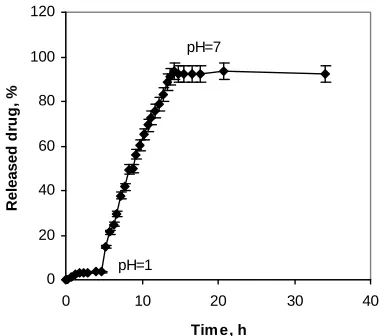
To determine the potential application of Pectin-based superabsorbent containing a pharmaceutically active compound, we have investigated the drug release behav-ior IBU form this system under physiological conditions. The percent of released drug from the polymeric carriers as a function of time is shown in Figure 3.
The concentration of IBU released at selected time in-tervals was determined by UV spectrophotometer. The IBU-loaded hydrogels with high degrees of drug loading (>80%) were prepared by the swelling-diffusion method. The amount of IBU released in a specified time from the Pectin-based hydrogel decreased as the pH of the disso-lution medium was lowered, indicating better release in a medium with a pH much higher than that of the stomach.
0 20 40 60 80 100 120 140 160 180
0 30 60 90 120 150 180 210
Swlling time, min
[image:4.595.69.280.86.252.2]S w el li n g cap aci ty , g /g
Figure 2. On-off switching behavior as reversible pulsatile swelling (pH 8.0) and deswelling (pH 2.0) of Pc-poly(NaAA-co-AAm) hydrogel. The time interval be-tween the pH changes was 30 min.
0 20 40 60 80 100 120
0 10 20 30 40
Tim e, h
[image:4.595.316.528.90.244.2]R e le a s e d dr ug, % pH=7 pH=1
Figure 3. Release of IBU from hydrogel carrier as a func-tion of time and pH at 37˚C.
carboxylic acid groups of backbone is low, thus de-creases gel swelling and minimizes release of IBU via diffusion. However, in alkaline media the presence of OH⎯ increases the electrostatic repulsion between car-boxylate groups, thus increases the gels swelling degree and so the release of IBU was increased [12-13]. The amounts of the loaded drug in superabsorbent hydrogels was significantly affected by the loading time (Figure 4). With increasing loading time, the amount of drug loaded is initially increased and then begins to level off.
4. Conclusion
The superabsorbent hydrogel, Pc-poly(NaAA-co-AAm), was synthesized through alkaline hydrolysis of Pc-PAN physical mixture. The reaction of Pectin alkoxide anions with nitrile groups of polyacrylonitrile, formed crosslinks
0 50 100 150 200 250 300 350 400 450 500
0 5 10 15 20 25 30
Time, h m g loa d e d dr ug/g hy dr oge l
Figure 4. The dependency of the drug loading amount to the loading time.
producing a three-dimensional network. No toxics mate- rial were used in the synthesis, this practical approach may be preferred to as a relatively "green process". This one-step preparative method conducted under normal atmospheric conditions in a short period of time. The dark red-yellow color change provided a visual indica- tion for the reactions progress. The superabsorbent hy- drogels exhibited high sensitivity to pH, so that, the re- versible swelling-deswelling behavior in solutions with acidic and basic pH, contributes to the suitability of these hydrogels as candidates for controlled drug delivery sys- tems. In vitro drug-release studies in different buffer so- lutions showed that the most important parameter affect- ing the drug-release behavior of hydrogels is the pH of the solution. The release value of Ibuprofen from hy- drogels at pH 7.4 was higher than that at pH 1.2 due to the electrostatic repulsion between carboxylate groups.
5. Acknowledgements
The author thanks the Research center of Islamic Azad University of Arak.
REFERENCES
[1] F. L. Buchholz and A. T. Graham “Modern Superabsor-
bent Polymer Technology,” Wiley, New York, 1997.
[2] Po R. “Water-absorbent Polymers, A Patent Survey,”
Journal of Macromolecular Science, Reviews in Macro-
molecular Chemistry & Physics, C34, 1994, pp. 607-661.
[3] J. Kost, “Encyclopedia of Controlled Drug Delivery,” E. Mathiowitz, Ed. Wiley, New York, 1999.
[4] A. S. Hoffman, “Polymeric Materials Encyclopedia,” J. C. Salamone; Ed., CRC Press, Boca Raton, FL. 5, 1996.
[5] N. A. Peppas and A. G. Mikes, “Hydrogels in Medicine and Pharmacy,” CRC Press Inc., Boca Raton, Florida.1,
27(1986).
[image:4.595.75.265.318.486.2]Cornell University Press, 1953.
[7] R. M. Silverstein and F. X. Webster, “Spectrometric Identification of Organic Compounds,” 6th Edition, Wiley: New York, 1998.
[8] A. Pourjavadi, M. Sadeghi and H. Hosseinzadeh (2004). Polymers for Advanced Technologies, 15: pp. 645-653. [9] A. M. Lowman and N. A. Peppas, “Hydrogels”, In: E.
Mathiowitz, Ed. Encyclopedia of Controlled Drug Deliv-ery, Wiley, New York, 1999, p. 139.
[10] Z. Mohamadnia, M. J. Zohuriaan-Mehr, K. Kabiri, A. Jamshidi and H. Mobedi, Journal of Bioactive and
Com-patible Polymers, Vol. 22, 2007, pp. 342.
[11] L. H. Gan, G. R. Deen, Y. Y. Gan and K. C. Tam,
Euro-pean Polymer Journal, Vol. 37, 2001, pp. 1473-1478.
[12] M. Mahkam, L. Doostie and S. O. R. Siadat (2006).
In-flammo Pharmacology Vol. 14, 2006, pp. 72-75.
[13] M. Mahkam and M. Allahverdipoor, Drug Targeting, Vol.