
Journal of the American Chemical Society
Orthogonal recognition processes
drive the assembly and replication of
a [2]rotaxane
Tamara Kosikova
a, Nurul Izzaty Hassan
ab, David B. Cordes
a,
Alexandra M. Z. Slawin
aand Douglas Philp
*aaSchool of Chemistry and EaStCHEM, University of St Andrews, North Haugh, St Andrews, KY16 9ST, United
Kingdom
bSchool of Chemical Sciences and Food Technology, Faculty of Science and Technology, Universiti Kebangsaan
Malaysia, 43600 Bangi, Selangor, Malaysia Corresponding author: [email protected]
Abstract
Introduction
Molecular recognition plays a pivotal role in the self-assembly1 and self-organization2 of both synthetic chemical systems and those found in Nature. The constitution of individual components within interconnected networks present in such systems governs their capacity to perform specific functions and to interact with other species in a recognition-mediated fashion. Small changes in the identity or orientation of recognition-enabling structural elements can have profound effects3 on the recognition processes within a network. Therefore, careful consideration has to be given to both the desirable function-encoding elements, as well as their relative position within a given molecular structure. Through controlled design, we can exploit the potential of molecular recognition and self-assembly as driving forces for the fabrication4 of complex systems in a pre-organized manner. In the past, molecular recognition has been employed successfully in the formation of numerous molecular assemblies5, mechanically-interlocked architectures6, nanoscale machines7 and systems capable of transferring structural information8 through self-replication. Specifically, we are interested in exploring the underlying requirements that give rise to chemical systems capable of exhibiting phenomena such as self-replication. A better understanding of the principles governing assembly and replication in chemical systems will allow us to probe the requirements for molecular evolution9 and emergence10 of complex function. The minimal requirements for non-enzymatic, recognition-mediated replication are well understood, with a number of small-molecule examples reported11 in the literature. However, the requirements for integrating self-replication with other recognition-mediated processes, such as those required for assembly of mechanically-interlocked architectures, remains a largely unexplored area. Previously, we have described12 a kinetic framework for integrating replication with the synthesis of a mechanically-interlocked architecture, namely a rotaxane. However, the experimental implementations of this design have not yet afforded a functional self-replicating rotaxane. Here, we propose an alternative kinetic model for the creation of a system where the assembly and replication of a [2]rotaxane is driven by two orthogonal recognition processes.
catalytic cycles. Both linear component L and pseudorotaxane complex [LM] can react with stoppering species S to afford thread T and rotaxane R, respectively. T and R can both establish autocatalytic cycles, proceeding via the formation of catalytically active ternary complex, [TLS] to make thread T
[image:3.612.137.470.235.640.2](Figure 1, top left) and quaternary complex, [RLMS], to create rotaxane R (Figure 1, bottom left). The rotaxane and thread templates also satisfy the structural and recognition requirements necessary for taking part in crosscatalytic cycles, proceeding through [RLS] and [TLMS] complexes (Figure 1, top right and bottom right, respectively). Overall, this interconnected replicating network can operate through two autocatalytic and two crosscatalytic cycles. We envisaged that implementation of orthogonal recognition processes would permit the formation of a system where all catalytic cycles are active.
Our design (Figure 2) of the key quaternary [RLMS] complex exploits H-bonding mediated recognition for both macrocycle binding and the complementary recognition units required for self-replication. Specifically, we exploited the recognition between a phenylacetic acid, located on the stoppering component S, and a 6-methyl-2-amidopyridine unit on linear component L (Figure 2a), which we have successfully employed8d,13 in several self-replicating systems in the past. Similarly, we have utilized a 1,3-dipolar cycloaddition reaction between a nitrone, here positioned on linear component L, and a maleimide on stoppering element S, as the means of irreversibly connecting the starting building blocks into a template Thread molecule (Figure 2b). From previous experience, we believed that a biphenyl spacer between the nitrone reactive site and the macrocycle binding site would be sufficient for isolating the macrocycle from the reactive site, thus preventing potential steric issues12, which would hinder the cycloaddition. The recognition event used to associate the macrocyclic and linear component in the pseudorotaxane complex [LM] is provided by H-bonding mediated recognition between an amide group on the linear component and complementary recognition units on the macrocycle. We utilized two structurally similar macrocycles for the formation of our rotaxane (Figure 2): macrocycle GM employed14 previously, containing a glycol spacer, and macrocycle PM15, incorporating a pyridine linker. Once the pseudorotaxane complex is formed, the irreversible reaction locks the macrocycle on the linear component through the stoppering approach, resulting in GM [2]Rotaxane and PM [2]Rotaxane (Figure 2b). Once the concentration of template present in the reaction mixture is sufficient to initiate a catalytic cycle, the reaction proceeds through the recognition-mediated replication channel (Figure 2c), with high diastereoselectivity.
Results and Discussion
We, and others, have established12,16 previously that various substituted diarylamides are capable of associating with macrocycle GM, demonstrating that the amide-containing linear component L is likely to be a suitable binding partner. Macrocycle PM contains a second pyridine ring with H-bond acceptor abilities, which we expected to bind more strongly, affording a system more selective towards the formation of a rotaxane. Initially, we performed 1H NMR spectroscopic binding studies examining the association between each macrocycle and a model compound N, equipped with a terminal –NO2 group in
carbonyl of the amide present in N. Macrocycle resonances arising from Hd and He are also shifted upfield (–0.66 and –0.56 ppm respectively)
[image:5.612.202.393.102.596.2]Figure 3. Partial 1H NMR (500.1 MHz, CDCl
3) of(a) compound N (RT), (b) equimolar mixture of N compoundand GM (233 K), (c)
GM (RT). Dashed lines are shown to connect resonances belonging to specific protons in bound and unbound states. Unassigned resonances arise from the unbound species.
The inequivalence of the resonances arising from the methylene protons in the CH2 group (Ha, Hb and Hc)
on the macrocycle in the pseudorotaxane is a result of the end-to-end asymmetry imposed on the macrocycle by complexation with the model linear compound N. Low temperature 1H NMR spectroscopy further allowed single-point determination of association constants with both macrocycles, affording Ka
values of 3750 M–1 for complex [NGM] and 5100 M–1 for complex [NPM] at 223 K. For pseudorotaxane [NPM], we confirmed the location of the macrocycle at the expected binding site on N by low temperature (223 K) 1H-1H ROESY experiments (for details, see SI), which showed rOe cross peaks between the resonances associated with the NH protons (H7’) of the macrocycle and the two phenyl rings (H3 and H5) on each side of the amide present in N, and the resonances arising from the macrocycle CH2
contains a nitrone and an amidopyridine, to which the macrocycles may potentially bind. The nitrone moiety in particular possesses a negatively charged oxygen atom with the potential17 to be a hydrogen bond acceptor in the presence of complementary recognition units. The low temperature 1H-1H ROESY NMR experiments, however, did not afford sharp resonances and calculation of association constants was therefore not possible from these data. Despite these limitations, there is clear evidence for association between L and M, suggesting that the system may be suitable for rotaxane formation.
In order to confirm successful formation of thread T and the two rotaxanes, GM [2]rotaxane (GM-R) and PM [2]rotaxane (PM-R), we synthesized these products on a preparative scale by low temperature reaction of linear component L and stopper S in the presence of excess macrocycle. All three components, T, GM-R and PM-R, were isolated successfully by reverse phase flash column chromatography. Initially, we confirmed the identity of our products by MALDI-TOF mass spectrometry and 1H and 13C NMR spectroscopy. In order to further confirm that GM-R and PM-R contained the macrocycles bound at the expected site, we obtained single crystals18 suitable for X-ray crystallographic analysis (for details, see ESI). The X-ray analyses confirmed the expected molecular structures in both
Figure 4. Stick (i) and space-fill (ii) representations of the X-ray crystal structure of (a) GM [2]rotaxane and (b) PM [2]rotaxane as determined by single-crystal X-ray crystallography. In the stick representations, carbon atoms are shown in grey, oxygen atoms in red, nitrogen atoms in blue and hydrogen atoms are shown in white. Most hydrogen atoms are omitted for clarity. Black circles in the rotaxane stick representations highlight the relative trans stereochemistry of the isoxazolidine ring protons. In the space fill representations, the thread component is colored grey and the macrocycle is colored either orange (GM) or blue (PM).
We conducted two-dimensional 1H-1H ROESY experiments at room temperature in order to establish the location of the macrocycle in both GM-R and PM-R on the linear component in solution. Figure 5 shows the rOe cross peaks observed in the 2D ROESY NMR spectrum of GM-R. Particularly diagnostic are the highlighted cross peaks associating the resonances arising from the macrocycle Ha, Hb and Hc protons with the resonances arising from the H1 and H3 protons on the linear component, confirming the expected location of GM macrocycle on the thread in solution. Similar results were obtained for the PM-R (for details, see ESI).
(a)
(b)
(i) (i)
Figure 5. Partial 1H-1H ROESY correlation (500.1 MHz, CDCl
3, RT, 500 ms mixing time) of GM [2]Rotaxane. Highlighted rOe cross
peaks represent the through space interactions between linear component and the macrocycle. Unassigned cross peaks represent intra-component interactions.
Having synthesized and fully characterized thread T and both rotaxanes GM-R and
PM-R successfully, we were ready to undertake a comprehensive kinetic analysis in order to ascertain which catalytic cycles (see Figure 1) are active in our rotaxane:thread system. Initially, we examined the formation of thread T in the absence of any added template. An equimolar mixture containing the desired components ([L] = [S] = 10 mM) was prepared in CDCl3 and the reaction progress at 5 °C was monitored
by 1H NMR (500.1 MHz) spectroscopy every 15 minutes over 8 hours. This low reaction temperature was selected for the kinetic experiments because it maximizes the strength of recognition-mediated processes within the system while simultaneously allowing accurate monitoring of the reaction progress on a reasonable timescale by 1H NMR spectroscopy. The reaction time course (Figure 6a) for this reaction was determined by examining the resonances for the three protons associated with the trans isoxazolidine ring of the cycloadduct relative to 2,4-dinitrotoluene as an internal standard. We found that, following an initial lag period, typical for self-replicating systems, the thread replicated very efficiently, exhibiting a clear sigmoidal rate profile where the thread concentration reached 9.1 mM after 4 hours (91% conversion). We determined the rate for this reaction (d[T]/dt) by computing the first derivative of a seventh-order polynomial fitted to the concentration vs time data. The trans diastereoisomer was formed exclusively, with the rate maximum observed after 63 minutes (4.1 mM h–1). Next, we examined the autocatalytic
ppm6.6 7.67.8 7.47.6 7.27.4 7.07.2 6.87.0 6.66.8
3.4 3.6 3.8 9.2 9.4 Ha Hc Hc' Hb Hb'
H2 H
formation of thread in the presence of instructing thread template. The required starting components ([L] = [S] = 10 mM) and pre-formed thread (10 mol%) were dissolved in CDCl3 and the reaction progress was
[image:10.612.187.415.201.540.2]followed by 1H NMR spectroscopy as described previously. Addition of pre-formed thread at t = 0 resulted in the disappearance of the lag period (Figure 6a), allowing the system to reach its maximum rate (6.0 mM h–1) from the beginning of the reaction (Figure 6b), thereby confirming the successful design of our self-replicating system19. With this information in hand, we analyzed thread formation in the presence of 10 mol% preformed GM-R and PM-R (Figure 6a).
Figure 6. (a) Concentration and (b) rate profile for the formation of Thread in the absence of template (black) and in the presence of pre-formed thread (grey), 10 mol% GM-R (orange) or 10 mol% PM-R (blue) as determined by 1H NMR spectroscopy (500.1 MHz,
CDCl3, 5 °C, all components at 10 mM). Concentration for each product was determined relative to 2,4-dinitrotoluene as an internal
standard.
Having explored the thread kinetic pathways fully, we next examined the individual, uninstructed kinetics of GM-R (Figure 7) and PM-R (Figure 8). The progress of the rotaxane kinetic experiments was again followed by 1H NMR spectroscopy, allowing us to deconvolute the individual proton resonances associated with the isoxazolidine ring of each thread and rotaxane product (for details, see ESI), which were formed with high diastereoselectivity for the trans cycloadducts.
Figure 7. Concentration and rate profiles for the formation of (a) Thread (circles) and (b) GM-R (squares) in the GM [2]rotaxane kinetic experiments carried out in the absence of template (black) and in the presence of pre-formed 10 mol% thread (grey) or 10 mol% GM-R (orange) as determined by 1H NMR spectroscopy (500.1 MHz, CDCl
3, 5 °C, all components at 10 mM). Concentration
for each product was determined relative to 2,4-dinitrotoluene as an internal standard.
[image:11.612.73.526.163.502.2]Figure 8. Concentration and rate profiles for the formation of (a) Thread (circles) and (b) PM-R (squares) in the PM [2]rotaxane kinetic experiments carried out in the absence of template (black) and in the presence of pre-formed 10 mol% thread (grey) or 10 mol% PM-R (blue) as determined by 1H NMR spectroscopy (500.1 MHz, CDCl
3, 5 °C, all components at 10 mM). Concentration for
each product was determined relative to 2,4-dinitrotoluene as an internal standard.
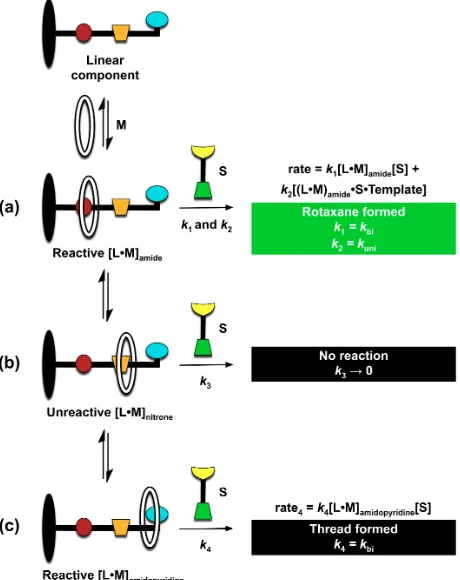
One plausible explanation for the low efficiency of rotaxane formation and thus the low R:T ratio is the insufficient proportion of each reactive pseudorotaxane complex [LM]amide (Figure 9a), containing the
macrocycle at the desired amide binding site, in each reaction as a result of the nitrone reactive site and amidopyridine recognition unit also associating with the macrocycles. The reactive pseudorotaxane
complex [LM]amide can react with stopper S through a bimolecular reaction (k1
=
kbi) and, in the presenceof template, also through a recognition-mediated unimolecular reaction (k2
=
kuni). By contrast, macrocyclebound at the nitrone reactive site results in formation of a pseudorotaxane [LM]nitrone (Figure 9b) that
sequesters the L and M components in a co-conformation that hinders formation of any product. By contrast, association of the macrocycle with the amidopyridine recognition site, required for recognition-mediated self-replication, affords a pseudorotaxane complex [LM]amidopyridine (Figure 9c) that can only
react through the bimolecular pathway (k4
=
kbi). Ultimately, the presence of these two additional sites onthe linear component, capable of associating with the macrocycle, results in a smaller proportion of the desired pseudorotaxane complex [LM]amide, and, thus, a lower apparent Ka for the pseudorotaxane
formation. The apparent Ka reflects binding of the macrocycle to three different binding sites. Similarly, the
observed unimolecular rate constant (kuni) associated with the template-mediated formation of each
[image:13.612.188.418.372.662.2]rotaxane is lower than it would be if the macrocycle was bound solely at the amide binding site.
In order to gain a better understanding of the effect of additional binding sites on this highly interconnected system, we performed fitting of all of the concentration-time data available from the related thread and rotaxane kinetic experiments to kinetic models encompassing all interactions and reactions. These models included the formation of the three different pseudorotaxane complexes, in each system. Exploiting an appropriate fitting procedure (for details, see ESI), we were able to extract normally inaccessible kinetic parameters, namely, the template-mediated unimolecular rate constants (kuni) and the
product duplex association constants (KDuplex) for the formation of Thread, GM-R and PM-R (Table 1). In
order to avoid fitting a larger number of constants than the data sets available, we implemented two assumptions throughout the fitting procedure: (i) kbi was assumed to be identical for all three templates
and (ii) only a single kuni was fitted for each template across the auto- and crosscatalytic kinetic
experiments forming a particular template. The latter assumption was based on the experimental observation of closely matched catalytic efficiencies determined during the kinetic experiments, and the fact that attempts to fit different unimolecular rate constants for the individual auto- and crosscatalytic pathways revealed little variation in the fitted values. Interestingly, the fitting revealed that kuni for the
formation of both rotaxanes are, as a result of the binding between each macrocycle and the linear component, almost four times smaller that the kuni of thread. This difference reflects a decrease in the
reactivity of the rotaxane-forming, catalytically-active quaternary complexes relative to the thread-forming ternary complexes. Using the fitted values of kbi and kuni, the effective molarity20 for the formation of each
template can be calculated. This parameter provides a measure of the efficiencies of the template-mediated catalytic pathways leading to the formation of thread and both rotaxanes, relative to the bimolecular pathways (EM = kuni/kbi). The apparent Ka values determined21 for the formation of [LGM]
and [LPM] pseudorotaxane complexes (Table 1) reflect the trend in association constants previously determined through low temperature experiments for [NM].
Table 1. Kinetic parameters and association constants determined for the (i) formation of thread, (ii) formation of GM-R and (iii) PM-R, through kinetic simulation and fitting of experimental kinetic data (at 278 K) using the SimFit software (Günter von Kiedrowski, University of Bochum, 2008). In all cases, the kbi and Ka Duplex were determined as 1.04×10⁻⁴ M–1s–1 and 10.3×10⁶ M– 1 for thread, GM-R and PM-R.
Analysis of the fitted kinetic parameters for thread and rotaxanes shows the detrimental effect of competitive macrocycle-binding sites on the apparent Ka for the formation of [LM] and the unimolecular
rate constant and consequently, the ratio of R:T formed in the system. In order to demonstrate how a similar system, integrating the formation of a rotaxane with self-replication, would work in the absence of competitive binding sites, we performed kinetic simulations. These simulations employed the parameters determined for PM-R system, which exhibits more efficient rotaxane formation than GM-R as a result of a
Thread GM-R PM-R
kunimolecular / 10–4 s–1 226 61.0 70.4
Effective Molarity / M 217 59 68
higher Ka for the [LM]. We specifically explored the effect of varying the strength of [LM] associations
constants from 102 to 105 M–1 on the ratio of rotaxane:thread under two different conditions: condition A employed kinetic parameters determined for our experimental system (kuni rotaxane < kuni thread);
condition B examined an ideal system with no competitive macrocycle-binding sites on the linear component (kuni rotaxane = kuni thread). Simulating condition B (Figure 10), where the effective molarity for
[image:15.612.207.403.212.376.2]thread and rotaxane are identical, allowed us to elucidate how the experimental system would behave in the absence of competitive binding sites – a situation where the ratio of products formed depends solely on the Ka governing the formation of [LM].
Figure 10. Outcome of kinetic simulations examining the effect of increasing Ka for the formation of pseudorotaxane
complex [LM] on the ratio of rotaxane:thread formed in: condition A (n) employing kinetic parameters determined for our experimental system (kuni rotaxane < kuni thread) and condition B () examining an ideal system with no competitive
macrocycle-binding sites on the linear component (kuni rotaxane = kuni thread). The blue rectangle represents the outcome of the simulation
employing kinetic parameters determined for T and PM-R. Simulations were performed using SimFit software package (Günter von Kiedrowski, University of Bochum, 2008).
The results of the simulation (Figure 10, condition A) revealed that an increase in the Ka for the
association between the linear component and macrocycle does not afford an R:T ratio greater than 8:1 in the condition employing experimental parameters, unless Ka > 105 M–1. While a considerable
improvement over the current product ratios, it is possible that a larger Ka value for the formation of
pseudorotaxane [LM] might also result in a concurrent increase in the strength of association for the macrocycle binding sites (see Figure 9), therefore, resulting in a lower R:T ratio than predicted from this simulation. Whilst the current experimental design, incorporating two additional competing macrocycle-binding sites, does not favor rotaxane formation, the same kinetic model can afford significantly higher
Conclusions
In conclusion, we have described a successful experimental implementation and full characterization of a reaction network integrating replication processes with the assembly of a [2]rotaxane. Through the application of orthogonal recognition processes, we were able to effectively direct formation of a replicating network where thread and rotaxane products are matched in catalytic efficiencies as templates, in both auto- and crosscatalytic cycles. However, interplay between the different recognition and reactive processes in the complex network, specifically the nitrone and amidopyridine moieties acting as competitive binding sites for the macrocyclic component, resulted in thread formation surpassing rotaxane formation in the current experimental system. Exploiting kinetic simulations, we demonstrated that orthogonal recognition processes are capable of driving autocatalytic rotaxane formation in the absence of competitive macrocycle binding sites. The realization of this goal is currently under investigation in our laboratory.
Acknowledgements
The financial support for this work was provided by EPSRC (Grant EP/K503162/1 and EP/E017851/1) and the Ministry for Higher Education Malaysia. The research data supporting this publication can be accessed at http://dx.doi.org/10.17630/d115d058-349e-4300-94e3-76a3181a9fc7.
Electronic Supplementary Information (ESI) available: experimental procedures, details of kinetic measurements, binding studies, computational modeling of the thread:rotaxane network, example fitting and simulation scripts.
References and Footnotes
(1) (a) Whitesides, G. M.; Boncheva, M. Proc. Natl. Acad. Sci. U. S. A.2002, 99, 4769. (b) Whitesides, G. M.; Grzybowski, B. Science2002, 295, 2418. (c) Greig, L. M.; Philp, D. Chem. Soc. Rev.2001, 30, 287. (d) Klug, A. Philos. Trans. R. Soc. Lond. B. Biol. Sci.1999, 354, 531. (e) Philp, D.; Stoddart, J. F. Angew. Chem. Int. Ed. Engl.1996, 35, 1154. (f) Whitesides, G. M.; Mathias, J. P.; Seto, C. T. Science1991, 254, 1312. (g) Kushner, D. J. Bacteriol. Rev.1969, 33, 302.
(2) (a) Lista, M.; Orentas, E.; Areephong, J.; Charbonnaz, P.; Wilson, A.; Zhao, Y.; Bolag, A.; Sforazzini, G.; Turdean, R.; Hayashi, H.; Domoto, Y.; Sobczuk, A.; Sakai, N.; Matile, S. Org. Biomol. Chem.2013,
11, 1754. (b) Salles, A. G.; Zarra, S.; Turner, R. M.; Nitschke, J. R. J. Am. Chem. Soc.2013, 135, 19143. (c) Northrop, B. H.; Zheng, Y.-R.; Chi, K.-W.; Stang, P. J. Acc. Chem. Res.2009, 42, 1554. (d) Halley, J. D.; Winkler, D. A. Complexity 2008, 14, 10. (e) Karsenti, E. Nat. Rev. Mol. Cell Biol. 2008, 9, 255. (f) Epstein, I. R.; Pojman, J. A.; Steinbock, O. Chaos 2006, 16, 037101. (g) Nédélec, F. J.; Surrey, T.; Maggs, A. C.; Leibler, S. Nature1997, 389, 305.
(3) (a) Pearson, R. J.; Kassianidis, E.; Slawin, A. M. Z.; Philp, D. Chem. Eur. J. 2006, 12, 6829. (b) Pearson, R. J.; Kassianidis, E.; Slawin, A. M. Z.; Philp, D. Org. Biomol. Chem.2004, 2, 3434.
(4) (a) Lehn, J.-M. Angew. Chem. Int. Ed.2013, 52, 2836. (b) Campbell, V.; Nitschke, J. R. Synlett2008,
Spek, A. L.; Sijbesma, R. P.; Meijer, E. W. Angew. Chem. Int. Ed. 1998, 37, 75. (f) Mao, C.; Sun, W.; Seeman, N. C. Nature 1997, 386, 137. (g) Mirkin, C. A.; Letsinger, R. L.; Mucic, R. C.; Storhoff, J. J.
Nature. 1996, 607. (h) Harada, A.; Li, J.; Kamachi, M. Nature1992, 356, 325.
(6) (a) Gil-Ramírez, G.; Leigh, D. A.; Stephens, A. J. Angew. Chem. Int. Ed.2015, 54, 6110. (b) Niess, F.; Duplan, V.; Diercks, C. S.; Sauvage, J.-P. Chem. Eur. J.2015, 21, 14393. (c) Durot, S.; Heitz, V.; Sour, A.; Sauvage, J.-P. Top. Curr. Chem. 2014, 354, 35. (d) Leigh, D. A.; Marcos, V.; Wilson, M. R. ACS Catal.
2014, 4, 4490. (e) Leigh, D. A.; Pritchard, R. G.; Stephens, A. J. Nat. Chem.2014, 6, 978. (f) Barin, G.; Coskun, A.; Fouda, M. M. G.; Stoddart, J. F. Chempluschem.2012, 77, 159. (g) Beves, J. E.; Blight, B. A.; Campbell, C. J.; Leigh, D. A.; McBurney, R. T. Angew. Chem. Int. Ed.2011, 50, 9260. (h) Stoddart, J. F. Chem. Soc. Rev.2009, 38, 1802. (i) Haussmann, P. C.; Stoddart, J. F. Chem. Rec. 2009, 9, 136. (j) Griffiths, K. E.; Stoddart, J. F. Pure Appl. Chem. 2008, 80, 485. (k) Stoddart, J. F.; Tseng, H.-R. Proc. Natl. Acad. Sci. U. S. A.2002, 99, 4797.
(7) (a) Kay, E. R.; Leigh, D. A. Angew. Chem. Int. Ed.2015, 54, 2. (b) de Bo, G.; Kuschel, S.; Leigh, D. A.; Lewandowski, B.; Papmeyer, M.; Ward, J. W. J. Am. Chem. Soc. 2014, 136, 5811. (c) Carlone, A.; Goldup, S. M.; Lebrasseur, N.; Leigh, D. A.; Wilson, A. J. Am. Chem. Soc.2012, 134, 8321. (d) Kay, E. R.; Leigh, D. A.; Zerbetto, F. Angew. Chem. Int. Ed.2007, 46, 72. (e) Vicario, J.; Katsonis, N.; Ramon, B. S.; Bastiaansen, C. W. M.; Broer, D. J.; Feringa, B. L. Nature2006, 440, 163. (f) Schalley, C. A.; Beizai, K.; Vögtle, F. Acc. Chem. Res. 2001, 34, 465. (g) Raehm, L.; Kern, J.-M.; Sauvage, J.-P. Chem. Eur. J.
1999, 5, 3310. (h) Gómez-López, M.; Preece, J. A.; Stoddart, J. F. Nanotechnology 1999, 7, 183. (i) Balzani, V.; Gomez-Lopez, M.; Stoddart, J. F. Acc. Chem. Res.1998, 31, 405.
(8) (a) Plöger, T. A.; von Kiedrowski, G. Org. Biomol. Chem.2014, 12, 6908. (b) Robertson, M. P.; Joyce, G. F. Chem. Biol.2014, 21, 238. (c) Carnall, J. M. A.; Waudby, C. A.; Belenguer, A. M.; Stuart, M. C. A.; Peyralans, J. J.-P.; Otto, S. Science2010, 327, 1502. (d) Kassianidis, E.; Philp, D. Angew. Chem. Int. Ed.
2006, 45, 6344. (e) Paul, N.; Joyce, G. F. Proc. Natl. Acad. Sci. U. S. A.2002, 99, 12733. (f) Allen, V. C.; Philp, D.; Spencer, N. Org. Lett. 2001, 3, 777. (g) Wang, B.; Sutherland, I. O. Chem. Commun. 1997, 1495. (h) Lee, D. H.; Granja, J. R.; Martinez, J. A.; Severin, K.; Ghadri, M. R. Nature. 1996, 525. (i) Terfort, A.; von Kiedrowski, G. Angew. Chem. Ed. Engl.1992, 31, 654. (j) Rotello, V.; Hong, J.-I.; Rebek, J. Jr. J. Am. Chem. Soc 1991, 113, 9422. (k) Tjivikua, T.; Ballester, P.; Rebek, J. Jr. J. Am. Chem. Soc.
1990, 112, 1249. (l) Zielinski, W. S.; Orgel, L. E. Nature1987, 327, 346. (m) von Kiedrowski, G. Angew. Chem. Int. Ed. Engl.1986, 25, 932.
(9) (a) Ruiz-Mirazo, K.; Briones, C.; de la Escosura, A. Chem. Rev.2014, 114, 285. (b) Root-Bernstein, R.
Acc. Chem. Res. 2012, 45, 2169. (c) Nitschke, J. R. Nature 2009, 462, 736. (d) Eschenmoser, A.
Tetrahedron2007, 63, 12821. (e) Stankiewicz, J.; Eckardt, L. H. Angew. Chem. Int. Ed.2006, 45, 342. (10) (a) Mahon, C. S.; Fulton, D. a. Nat. Chem.2014, 6, 665. (b) Giuseppone, N. Acc. Chem. Res.2012,
45, 2178. (c) Balazs, A. C.; Epstein, I. R. Science2009, 325, 1632. (d) Pross, A. Orig. Life Evol. Biosph.
2005, 35, 151. (e) Epstein, I. R.; Showalter, K. J. Chem. Phys.1996, 100, 13132.
(11) (a) Vidonne, A.; Philp, D. Eur. J. Org. Chem. 2009, 2009, 593. (b) Patzke, V.; von Kiedrowski, G.
ARKIVOC2007, 5, 293.
(12) Vidonne, A.; Philp, D. Tetrahedron2008, 64, 8464.
(13) Sadownik, J. W.; Philp, D. Angew. Chem. Int. Ed.2008, 47, 9965.
(14) (a) Liu, P.; Li, W.; Liu, L.; Wang, L.; Ma, J. J. Phys. Chem. A2014, 118, 9032. (b) Liu, L.; Liu, Y.; Liu, P.; Wu, J.; Guan, Y.; Hu, X.; Lin, C.; Yang, Y.; Sun, X.; Ma, J.; Wang, L. Chem. Sci.2013, 4, 1701. (c) Hassan, N. I.; del Amo, V.; Calder, E.; Philp, D. Org. Lett.2011, 13, 458. (d) Hsueh, S.-Y.; Kuo, C.-T.; Lu, T.-W.; Lai, C.-C.; Liu, Y.-H.; Hsu, H.-F.; Peng, S.-M.; Chen, C.-H.; Chiu, S.-H. Angew. Chem. Int. Ed.
2010, 49, 9170. (e) Hung, W.-C.; Wang, L.; Lai, C.-C.; Liu, Y.-H.; Peng, S.-M.; Chiu, S.-H. Tetrahedron Lett.2009, 50, 267. (f) Huang, Y. L.; Hung, W.-C.; Lai, C.-C.; Liu, Y.-H.; Peng, S.-M.; Chiu, S.-H. Angew. Chem. Int. Ed.2007, 46, 6629.
(15) Ho, T.-H.; Lai, C.-C,; Liu, Y.-H.; Peng, S.-M.; Chiu, S.-H. Chem. Eur. J. 2014, 20, 4563.
(16) Jager, R.; Baumann, S.; Fischer, M.; Safarowsky, O.; Niegerb, M.; Vogtle, F. Liebigs Ann. 1997, 2269.
(17) (a) D’Souza, D. M.; Leigh, D. A.; Mottier, L.; Mullen, K. M.; Paolucci, F.; Teat, S. J.; Zhang, S. J. Am. Chem. Soc. 2010, 132, 9465. (b) O’Neil, I. A.; Potter, A. J.; Southern, J. M.; Steiner, A.; Barkley, J. V.
Chem. Commun.1998, 2511.
(18)Suitable single crystals were grown as colorless needles by slow evaporation of acetonitrile/CDCl3
(19)The recognition-disabled, bimolecular reactions to form thread and both rotaxane from the linear component L and a p-methyl substituted maleimide (Sdis) showed low conversion and low diastereoselectivity (for details, see ESI).
(20) (a) Page, M. I.;, Jencks, W. P. Proc. Natl. Acad. Sci. U. S. A.1971, 68, 1678. (b)Page, M. I. Chem. Soc. Rev.1973, 2, 295. (c) Kirby, A. J. Adv. Phys. Org. Chem.1980, 17, 183.
(21) Throughout the fitting process, only a single Ka value was fitted for all three processes leading to the
formation of the different pseudorotaxane complexes: [LM]amide, [LM]nitrone, [LM]amidopyridine. While the Ka

![Figure 2. (a) Cartoon representation of the chemical building blocks employed in the design of a self-replicating [2]rotaxane](https://thumb-us.123doks.com/thumbv2/123dok_us/8936557.393137/5.612.202.393.102.596/figure-cartoon-representation-chemical-building-employed-replicating-rotaxane.webp)

![Figure 4. Stick (i) and space-fill (ii) representations of the X-ray crystal structure of (a) GM [2]rotaxane and (b) PM [2]rotaxane as determined by single-crystal X-ray crystallography](https://thumb-us.123doks.com/thumbv2/123dok_us/8936557.393137/8.612.89.526.72.354/figure-representations-structure-rotaxane-rotaxane-determined-crystal-crystallography.webp)
![Figure 5. Partial 1H-1H ROESY correlation (500.1 MHz, CDCl3, RT, 500 ms mixing time) of GM [2]Rotaxane](https://thumb-us.123doks.com/thumbv2/123dok_us/8936557.393137/9.612.83.531.69.383/figure-partial-roesy-correlation-mhz-cdcl-mixing-rotaxane.webp)

![Figure 7. Concentration and rate profiles for the formation of (a) Thread (circles) and (b) GM-R (squares) in the GM [2]rotaxane kinetic experiments carried out in the absence of template (black) and in the presence of pre-formed 10 mol% thread (grey) or 1](https://thumb-us.123doks.com/thumbv2/123dok_us/8936557.393137/11.612.73.526.163.502/figure-concentration-profiles-formation-rotaxane-experiments-template-presence.webp)
![Figure 10. Outcome of kinetic simulations examining the effect of increasing Ka for the formation of pseudorotaxane complex [LM] on the ratio of rotaxane:thread formed in: condition A (n) employing kinetic parameters determined for our experimental syste](https://thumb-us.123doks.com/thumbv2/123dok_us/8936557.393137/15.612.207.403.212.376/simulations-examining-increasing-pseudorotaxane-condition-parameters-determined-experimental.webp)
