ISSN Online: 2162-1993 ISSN Print: 2162-1985
DOI: 10.4236/oje.2019.910027 Sep. 30, 2019 413 Open Journal of Ecology
Preliminary Study of the Population Density of
Mona Monkeys (Cercopithecus mona) in Omo
Forest Reserve
Johnson Ikaa Uloko1, Gbolagade Akeem Lameed2
1Department of Wildlife and Range Management, Federal University of Agriculture, Makurdi, Nigeria 2Department of Wildlife and Ecotourism, University of Ibadan, Ibadan, Nigeria
Abstract
In the last 40 years, threats to the survival of wild primate population have greatly increased. Globally, primate population is severely threatened with ex-tinction especially due to habitat loss from conversion of forest areas to farm-land and/or unsustainable logging. There is paucity of information on the population density and abundance of Mona monkeys in Omo Forest Reserve. The population density and distribution of Mona monkeys were conducted in two forest blocks of Omo Forest Reserve (OFR). The objective of the study therefore, is to determine the population density and distribution of Mona monkey, and ascertain the presence of other primate species in sympatric re-lationship with the monkey. The line transect sampling method was used for the enumeration. Data were collected from seven (7) transects randomly se-lected from two forest blocks; the Elephant Sanctuary (4) and the Strict Na-ture Reserve (3). Other primate species were considered to be sympatric with Mona monkeys if they were encountered within 20 m proximity range with the target species. Data on threat of human activities were collected in Omo Forest Reserve based on four major categories (Hunting/Poaching, Logging, Farming, and Collection of Non-Timber Forest Products). Analysis was car-ried out using IBM SPSS Statistics 20 to determine population density esti-mate and the relative density in the two forest blocks. The field work took 30 days each, in September, 2015 and March 2016 that covered both seasons. Results revealed that a total number of 57 Mona monkeys with density of 0.44 km−2 in the entire reserve were sighted during the survey. The relative density across the two forest blocks surveyed in the forest reserve revealed that Mona monkeys were present in both the Elephant Sanctuary (ES) (n = 42) and Strict Nature Reserve (SNR) (n = 15) with density of 0.27 km−2 and 0.18 km−2, re-spectively. The species were observed to be more active during morning
sur-How to cite this paper: Uloko, J.I. and Lameed, G.A. (2019) Preliminary Study of the Population Density of Mona Monkeys (Cercopithecus mona) in Omo Forest Re-serve. Open Journal of Ecology, 9, 413-425.
https://doi.org/10.4236/oje.2019.910027
Received: July 5, 2019 Accepted: September 27, 2019 Published: September 30, 2019
Copyright © 2019 by author(s) and Scientific Research Publishing Inc. This work is licensed under the Creative Commons Attribution International License (CC BY 4.0).
DOI: 10.4236/oje.2019.910027 414 Open Journal of Ecology veys than in the evening surveys, with densities of 0.77 km−2 and 0.4 km−2 recorded, respectively. The mean encounter rates for the species were 3.31 km−1 and 1.5 km−1 for morning and evening surveys, respectively.
Keywords
Population Density, Mona Monkey, Primates, Sympatry, Anthropogenic Activities, Omo Forest Reserve
1. Introduction
Mona monkeys are small to medium sized old world monkeys that live in groups of more than 30 [1]. The Nigeria Mona monkeys are endemic to Nigeria and Cameroon and maintain the least concern category on the IUCN red list [2][3]. Nigeria has the last great community of Mona monkeys in Africa and the world at large [4] and as a result has become the centre of a number of researches. Knowledge on the species population in the country is limited and basically anecdotal. This species has not been studied extensively and available literatures are on its time budget [5], group size and composition [6][7][8] and [9] and its density in Afi Mountain [10]. There is a paucity of information on the popula-tion density of Mona monkeys in Omo Forest Reserve. This study therefore pro-vides baseline scientific information on the population density of Mona mon-keys in Omo Forest Reserve. Information on the density of Mona monmon-keys is very vital as it will guide natural resource managers in decision making and po-tential economic gains from ecotourism.
DOI: 10.4236/oje.2019.910027 415 Open Journal of Ecology A very dynamic habitat is not the only challenge primates have to confront; they are also hunted, mostly illegally, as bushmeat and pets by humans. Poach-ing feeds the bushmeat industry and it is arguably the foremost threat to primate existence [15][16]. In the west and central African forest zone, subsistence ing is increasingly supplemented by hunting for cash income. Commercial hunt-ing can relatively quickly deplete populations of large-bodied, slow-reproduchunt-ing game species, such as anthropoid primates, which are typically among the most commonly captured prey in the African forest zone [17]. Primates are also cap-tured live to supply the live pet trade. Mona monkeys are extensively poached, served at local restaurants and sometimes traded as pets in the southwestern part of Nigeria.
Omo Biosphere Reserve, which derives its name from River Omo that tra-verses it, is located north of Sunmoge in the Ijebu area of Ogun State, southwes-tern Nigeria. The reserve is very diverse having the richest species of butterflies in Africa, high richness of birds and mammal diversity [18]. A study by BRAAF (1999) asserts that there are four primate species in the reserve and these include Potto (Perrodictitus potto), Demidoff’s galago (Galagoides demidovii), Mona monkeys (Cercopithecus mona) and Red Capped Mangabey (Cerocebus torqu-atus). However, the study recorded the presence of the last three during the time of survey. Five hundred and four plant species were encountered during the bio-diversity inventory [19]. Of the 504 species, 245 species were trees, 71 shrubs, 118 herbs, 50 climbers and 20 climbing shrubs and Iianas. 29 species of orchids, 28 species of Pteridophytes, 27 species of Bryophytes, 17 species of fungi (mu-shroom) and 3 species of lichens were inventoried during the biodiversity sur-vey. The reserve has a wide range of forest habitat that is highly threatened by different levels of anthropogenic and natural activities. Timber exploitation, es-tablishment of monoculture stands of tree crops, clearance for cultivation and gap formation, created by wind throw, snapping, branch fall and standing dead trees, within the reserve have seriously altered the forest structure, species com-position and the habitat. The forest has been severely cleared for the Gmelina arborea plantation to supply the Iwopin pulp/paper factory. Also portions of the forest are also cleared for the cultivation of plantain, kola, cocoa and other cash crops. All of these results in habitat fragmentation which can limit the range of primates or cause a decline in the primate abundance.
DOI: 10.4236/oje.2019.910027 416 Open Journal of Ecology monitor wildlife population [20] [21] [22] but the distance sampling method (line transect survey) is widely used for estimating abundance of primate popu-lation [23][24].
2. Materials and Methods
2.1. Study Area
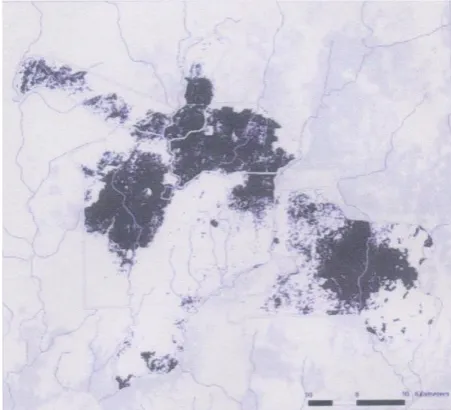
Omo Biosphere Reserve is located north of Sunmoge, between latitudes 6˚35' to 7˚05'N and 4˚19' to 4˚40'E in the Ijebu area of Ogun State in southwestern Nige-ria. The Reserve was constituted in 1925 as part of a bigger Shasha Forest Re-serve. Shasha was later split into Omo, Oluwa and Shasha Forest Reserves, the last two lying to the east and north-east of the present Omo. To the north and north-west of the Reserve are Ife and Ago-Owu, and Oshun Forest Reserves, re-spectively. The records of mammals from reconnaissance survey transect and other survey work are evidence (Figure 1). Omo covers about 130,500 hectares, which includes a 460 ha Strict Nature Reserve [25]. Omo Biosphere Reserve de-rives its name from the River Omo that transverses it.
The Reserve is in the mixed moist, semi-evergreen rainforest zone, in the Congolian sub-unit of the Guinea-Congolian Centre of Endemism or Phytocho-rion [18][26]. The Guinea-Congolian zone is extremely rich in species and has very high levels of endemism. The northern part of Omo Biosphere Reserve is, considering the north-south length, relatively dry forest. Five hundred and four plant species were encountered during a biodiversity inventory [19]. The most common tree species include Diospyros spp., Strombosia pustulata, Rinorea dentata Voacanga africana and Drypetes spp. Other tree species include Khaya ivorensis, Cordia millenii, Sterculia sp., Nauclea diderrichii, Mansonia altissima, Terminalia sp., Celtis sp., Brachystegia sp., Alstonia congensis and Milicia excelsa.
[image:4.595.247.500.479.681.2]DOI: 10.4236/oje.2019.910027 417 Open Journal of Ecology Forty-two mammals and 15 reptiles can be found in the reserve. There are 110 avian species in 38 families. The Accipitidae, Columbidae and Esterildidae con-tained more than 20% of all the species in the reserve. The Blue Headed Wood Dove is most abundant in the core while the Green Frutt Pigeon is most abun-dant in the taungya farms. Some of the wildlife species in the reserve include Forest Elephant (Loxodonta cyclotis), White throated monkey (Carcopithecus albogularis), Red-river hog (Potamochoerus porcus), Duiker (Cephlopus spp.), Small spotted genet cat (Genetta genetta), Civet cat (Viverra civetta), Brush-tailed porcupine (Atherurus africanus), Pangolin (Manis spp.).
2.2. Reconnaissance Survey
A reconnaissance survey was conducted to establish the distribution of primate species and to locate appropriate positions where transects would be laid. Infor-mation on population density was gathered from the forest guard and hunters. Existing trails were walked during the reconnaissance survey. The survey re-vealed that the distribution of primates within the reserve was more in the fo-rested areas of Erin camp where two species of primates were sighted. Another revelation was that primates were not present in areas with high anthropogenic activities. The survey noted the forest structure nature of streams and human disturbances in the forest. The vegetation type is typical of a rainforest as tree canopy is dense in the undisturbed region.
2.3. Methods of Data Collection
The line transects method was used in this study to obtain the relative density of primates [27]. The following assumptions were made while using the line tran-sect technique in surveying Mona monkeys
1) All Mona monkeys on the transect are certainly detected
2) Mona monkeys do not move away from transect before detection
3) The measurement of distances are exact and that the location of Mona monkeys are independent of transects [28]
Line transects, which is a distance sampling technique was used to collect dis-tance data for this survey. It is the main method of surveying diurnal primates because it is relatively simple, rapid, cost effective, accurate and quite precise [29].
2.4. Field Procedure for Ecological Data Collection
A total of seven line transects were used. Four (4) lines transect were laid in the Elephant sanctuary and three (3) were laid in the Strict Nature Reserve (SNR) which make up the forest blocks of Omo Biosphere reserve. Each transect was labelled with a special number. Transects were 2 km long and 1 km apart. The starting point for each transect was randomly selected and the coordinates was taken with a GPS.
DOI: 10.4236/oje.2019.910027 418 Open Journal of Ecology began 03:00 pm - 06:00 pm. Transects was walked at a speed of 1.5 kmh−1 as recommended by White and Edwards [30]. Ten minutes pause was taken after every 100 metre walk in order to increase the chances of detecting Mona mon-keys which may hide or flee when approached [31]. At the start of the transect walk all required fields on the data sheet such as, name of transects, coordinates and date of observation were recorded. During transect walk, any sighting of primates, their calls and their food crumbs was recorded. Parameters recorded include the name of the species, time the species was sighted, estimated number of individuals, perpendicular distance and sighting distance. Transect lines were surveyed twice (morning and evening) each and were repeated every two weeks for four weeks. A total of 56 km was walked during the survey. Primate species sighted within 20 m of Mona monkeys sighting were also recorded and individ-ual Mona monkey was considered a member of on group when it was sighted within 20 m of a troop [32]. Signs of human activities in these forests reserves were widespread and frequent. The distribution of signs of logging, farming, hunting and the gathering of non-timber forest products (NTFP) were recorded on transects. Surprisingly, the largest number of human signs per km were found on the western Omo transects. We also encountered more farms and set-tlements scattered through the forest in western Omo than in the other contin-ous forest areas. On the other hand, the highest frequency of signs was in Oluwa, where encountered more hunters on foot and bicycles in the forest. The average rate of encounter with human signs on all transects (1.29 per km) was very simi-lar to the rate of encounter with signs of mammals (1.35 per km). The field sur-vey took 30 days each in September, 2015 and March, 2016. Ten Game-guards and 5 forest guards were recruited for this survey.
2.5. Data Analysis
Data obtained during this study were analysed for density (km−2), Mean En-counter Rate (MER) and percentage sighting. T-test was used to compare the density and MER of the primate species encountered during the study. The software Microsoft Excel (2016) and IBM SPSS Statistics 20 were used to facili-tate all the computations and plotting needed in the analysis. The T-test estima-tor is given as follows
A B
A B
X X
t
SX X
− =
−
where,
2 2
A A
B
B B
A
S S n
S X
n
X − == +
3. Results
DOI: 10.4236/oje.2019.910027 419 Open Journal of Ecology
Table 1. Estimated density of Mona monkeys.
Species N MER Dkm−2
Mona monkey 57 3.11 0.44
Mona monkeys during the survey. The study shows that the density of Mona monkeys is 0.44 km−2. The mean encounter rates (MERs) for Mona monkeys is 3.11 km−1. The MER implies the likely number of individual species that can be sighted per kilometre during transect walk or survey in the area.
3.2. Densities of Mona Monkey during Morning and Evening Surveys
Table 1 and Table 2 present the results of sightings for Mona monkeys during morning and evening surveys. The results show that for Mona monkeys, the MERs was 3.31 km−1 and 1.5 km−1 with a corresponding density of 0.77 km−2 and 0.4 km−2 for morning and evening survey respectively.
3.3. Relative Density of Mona Monkeys across the Two Forest Blocks
The relative density of Mona monkeys across the study sites is presented in Ta-ble 3. Mona monkeys were sighted in both forest blocks, either in Elephant sanctuary (ES) and the strict nature reserve (SNR). A total of 42 sightings of Mona monkeys were recorded in the Elephant sanctuary. In the strict nature re-serve, a total of 15 sightings of Mona monkeys were recorded. The density of Mona monkeys in ES is 0.27 km−2 while in SNR, it is 0.18 km−2
4. Discussion
DOI: 10.4236/oje.2019.910027 420 Open Journal of Ecology
Table 2. Densities of the primate species during morning and evening surveys.
Species Evening Morning
N MER (nkm−1) Dkm−2 n MER (nkm−1) Dkm−2
[image:8.595.206.539.176.227.2]Mona monkeys 53 3.31 0.77 4 1.5 0.4
Table 3. Relative density of Mona monkeys across the ranges.
Range N MER (nkm−1) Dkm−2
Elephant Sanctuary 42 0.27 0.23
Strict Nature Reserve 15 0.17 0.18
Table 4. Areas of surveyed reserved and areas of natural forest in the reserve.
S/No Forest
Reserve Reserve Area (km2) Natural Forest Area (km2)
Percent of Reserve Under Natural forest
1 OMo 1,325 381.2 28.8
2 Oluwa 827 347.9 42.1
3 Shasha 309 240.8 77.8
4 Ago-owu 240 79.4 33.1
5 Ife 142 75.8 53.2
Table 5. Human activities records from recce transects.
Human
activities Western Omo Shasha R. Oni R Oluwa F.R.
No. no. per No per No No per No per No No per No per
Recce km Recce km Recce Recc
Farming 10 1.11 0.22 2 0.33 0.07 9 1.29 0.26
Hunting 15 1.67 0.33 3 0.50 0.10 17 2.43 0.49
Logging 33 3.67 0.73 13 2.17 0.43 19 2.71 0.54
NTFP 6 0.67 0.13 1 0.17 0.03 3 0.43 0.09
gathering
camps 7 0.78 0.16 2 0.33 0.07 2 0.29 0.06
TOTAL SIGNS 71 7.89 1.58 21 3.50 0.70 50 7.14 1.43
KEY: Farming = crops, clearing, bush burning, hunting = carbide, cartridge, gunshot, logging = loggers, trucks, recently felled trees, Non-timber forest products (NTFP) = gathering of chewing sticks, sanda sticks, and others: Camps = shelters, and signs of human occupation such as buckets, used toiletries and so on.
[image:8.595.209.540.261.386.2] [image:8.595.208.540.421.586.2]DOI: 10.4236/oje.2019.910027 421 Open Journal of Ecology
[image:9.595.260.484.273.443.2]Figure 2. Elephant dung, Omo Forest Reserve.
Figure 3. “Sanda” stick gathering and processing, Omo Forest Reserve.
[image:9.595.259.485.489.694.2]DOI: 10.4236/oje.2019.910027 422 Open Journal of Ecology
Figure 5. Degraded Gmelina plantation, Omo Forest Reserve.
Park. Moreover, the species is quite affected by habitat destruction and hunting for bushmeat, it appears that the species can adapt well to secondary habitats and as a result remains common in the ES section of Omo forest reserve [35].
5. Conclusion
communi-DOI: 10.4236/oje.2019.910027 423 Open Journal of Ecology ties and public awareness about the importance of wildlife conservation range management is fundamental to establishment, development and sustenance of any protective area/park to have meaningful economic value and maintenance of stable range resources of the reserve.
Conflicts of Interest
The authors declare no conflicts of interest regarding the publication of this pa-per.
References
[1] Groves, C.P. (2005) Mammal Species of the World. Johns Hopkins University Press, Baltimore, 3rd Edition, 157.
[2] Mendoza, M. and Palmqvist, P. (2006) Characterizing Adaptive Morphological Pat-terns Related to Diet of Bovidae (Mammalia Artiodactyla). Acta Zoologica Sinica, 52, 988-1008.
[3] IUCN (2015) IUCN Red List of Threatened Species. Version 2015.3.
http://www.iucnredlist.org
[4] Eisenberg, J.F. (1990) Mammals of Neotropics, the Northern Neotropic. University of Chicago Press, Chicago.
[5] Okekedunu, J.O., Ogunjemite, B.G., Adeyemo, I.A. and Olaniyi, O.E. (2014) Daily Activity Budget of Mona Monkey (Cercopithecus mona Schreeber) in Ibodi Mon-key Forest, Osun State, Nigeria. FUTA Journal of Research in Sciences,2, 218-227. [6] Struhsaker, P. (1969) Demersal Fish Resources: Composition, Distribution, and
Commercial Potential of the Continental Shelf Stocks off Southeastern United States. Fishery Industrial Research, 4, 261-300.
[7] Howard, R. (1977) Niche Separation among three Sympatric Species of Cercopi-thecus Monkeys. Ph.D. Dissertation, The University of Texas, Austin, TX. As in: Group Size and Group Composition of the Mona Monkey (Cercopithecus mona) on the Island of Grenada, West Indies. America Journal of Primatology, 43, 167-173.
[8] Whitesides, G.H. (1981) Community and Population Ecology of Non-Human Pri-mate in Douala-Edea Forest Reserve. MSc. Thesis, The John Hopkins, University of Baltimore, Baltimore.
[9] Gleen, D.M. (1990) Stand Development and Economic Analysis of Alternative Cut-ting Method in Northern Hardwoods: 32 Years Results. Northern Journal of Ap-plied Forestry, 7, 153-158. https://doi.org/10.1093/njaf/7.4.153
[10] Edet, D.I., Ajayi, S. and Ovat, O.I. (2014) Population Estimate of the Cross River Gorilla (Gorilla gorilla Diehli) Using a Sweep Survey of Nests in Afi Mountain Wildlife Sanctuary, Southern Nigeria. International Journal of Ecology and Ecoso-lution, 1, 23-28.
[11] Ogunjemite, B.G., Ajayi, B. and Agbelusi, E.A. (2007) Habitat Structure of Chim-panzee Communities in Nigeria: A Comparison of Sites. Acta Zoological Sinica, 53, 579-588.
[12] Ladipo, D. (2010) The State of Nigeria’s Forests. IITA Research for Development Review Bulletin, Issue 4.
DOI: 10.4236/oje.2019.910027 424 Open Journal of Ecology
https://doi.org/10.7312/fimb11454
[14] Johns, A.D. and Skorupa, J.P. (1987) Responses of Rain-Forest Primates to Habitat Disturbance: A Review. International Journal of Primatology,8, 157.
https://doi.org/10.1007/BF02735162
[15] Oates, J.F. (1996) Habitat Alteration, Hunting and the Conservation of Folivorous Primates in African Forests. Australian Journal of Ecology, 21, 1-9.
https://doi.org/10.1111/j.1442-9993.1996.tb00580.x
[16] Linder, J.M. and Oates, J.F. (2011) Differential Impact of Bushmeat Hunting on Monkey Species and Implications for Primate Conservation in Korup National Park, Cameroon. Biological Conservation, 144, 738-745.
https://doi.org/10.1016/j.biocon.2010.10.023
[17] Linder, J.M. (2008) The Impact of Hunting on Primates in Korup National Park, Cameroon: Implications for Primate Conservation. PhD Dissertation, City Univer-sity of New York, New York.
[18] Mackinnon, J. and Mackinnon, K. (1986) Review of the Protected Areas System in the Afrotropical Realm. IUCN.
[19] BRAAF (1999) Widespread Aerial Spraying of Insecticide and the Intrusion of Snakes and Crocodiles into Town Areas. Global Environmental Change, 9, 95-104. https://doi.org/10.1016/S0959-3780(98)00036-3
[20] Lancia, R.A., Nichols, J.D. and Pollock, K.H. (1994) Estimating the Number of An-imals in Wildlife Populations. In: Bookhout, T.A., Ed., Research and Management Techniques for Wildlife and Habitats, The Wildlife Society, Bethesda, 215-253. [21] Thompson, W.L., White, G.C. and Gowan, C. (1998) Monitoring Vertebrate
Popu-lations. Academic Press Inc., New York.
[22] Schwartz, C.J. and Seber, G.A.F. (1999) Estimating Animal Abundance: Review III.
Statistical Science,14, 427-456. https://doi.org/10.1214/ss/1009212521
[23] Buckland, S.T., Anderson, D.R., Burnham, K.P., Laake, J.L., Borchers, D.L. and Thomas, L. (2001) Introduction to Distance Sampling. Oxford University Press, Oxford.
[24] Buckland, S.T., Anderson, D.R., Burnham, K.P., Laake, J.L., Borchers, D.L. and Thomas, L. (2004) Advanced Distance Sampling. Oxford University Press, Oxford. [25] Okali, D.U.U. and Ola-Adams, B.A. (1987) Tree Population Changes in Treated
Rainforest at Omo Forest Reserve, South-Western Nigeria. Journal of Tropical Ecology, 3, 291-313. https://doi.org/10.1017/S0266467400002297
[26] White, F. (1983) The Vegetation of Africa: A Descriptive Memoir to Accompany the Unesco/AETFAT/UNSO Vegetation Map of Africa.
[27] Buckland, S.T., Anderson, D.R., Burnham, K.P. and Laake, J.L. (1993) Distance Sampling: Estimating Abundance of Biological Populations. Chapman and Hall, London.
[28] Plumptre, C.D., Ogunniyi, A.D. and Paton, J.C. (2013) Vaccination against Strep-tococcus pneumoniae Using Truncated Derivatives of Polyhistidine Triad Protein D. PLoS ONE, 8, e78916. https://doi.org/10.1371/journal.pone.0078916
[29] Burnham, K.P., Anderson, D.R. and Laake, J.L. (1980) Estimation of Density from Line Transect Sampling of Biological Populations. Wildlife Monographs, 72, 202. [30] White, L. and Edwards, A. (2000) Conservation Research in the African Rain
DOI: 10.4236/oje.2019.910027 425 Open Journal of Ecology Large Mammals of Arakhuan Range, Okomu National Park, Nigeria. Ethiopian Journal of Environmental Studies and Management,4, 25-37.
https://doi.org/10.4314/ejesm.v4i3.4
[32] Buckland, S.T., Laake, J.L. and Borchers, D.L. (2010) Double-Observer Line Tran-sect Methods: Levels of Independence. Biometrics, 66, 169-177.
https://doi.org/10.1111/j.1541-0420.2009.01239.x
[33] Newmark, W.D., Manyanza, D.N., Gamassa, D.G. and Sariko, H.I. (1994) The Con-flict between Wildlife and Local People Living Adjacent to Protected Areas in Tan-zania: Human Density as a Predictor. Conservation Biology, 8, 249-255.
https://doi.org/10.1046/j.1523-1739.1994.08010249.x
[34] Obasogie, F.O. and Ogunjemite, B.G. (2014) Population Status of White Throated Monkey (Cercopithecus erythrogaster pococki) in Okomu National Park of Nigeria.
International Journal of Science and Nature, 3, 63-69.
[35] Oates, J.F., Butynski, T.M., Kingdon, J., Bearder, S., Pimley, E. and De Jong, Y. (2008) Perodicticus potto IUCN Red List of Threatened Species.