Learning to Predict Problematic Situations in a Spoken Dialogue
System: Experiments with How May I Help You?
M a r i l y n W a l k e r , I r e n e L a n g k i l d e , J e r r y W r i g h t , A l i e n G o r i n , D i a n e L i t m a n A T & T L a b s - - R e s e a r c h
180 P a r k A v e n u e
F l o r h a m P a r k , N J 07932-0971 U S A
walker, jwright, algor, diane@research, art. corn, ilangkil@isi, edu
A b s t r a c t
Current spoken dialogue systems are deficient in their strategies for preventing, identifying and re- pairing problems that arise in the conversation. This paper reports results on learning to automatically identify and predict problematic human-computer dialogues in a corpus of 4774 dialogues collected with the
How May I Help You spoken dialogue system.
Our expectation is that the ability to predict prob- lematic dialogues will allow the system's dialogue manager to modify its behavior to repair problems, and even perhaps, to prevent them. We train a problematic dialogue classifier using automatically- obtainable features that can identify problematic dialogues significantly better (23%) than the base- line. A classifier trained with only automatic fea- tures from the first exchange in the dialogue can predict problematic dialogues 7% more accurately than the baseline, and one trained with automatic features from the first two exchanges can perform 14% better than the baseline.1 I n t r o d u c t i o n
Spoken dialogue systems promise efficient and nat- ural access to a large variety of information sources and services from any phone. Systems that sup- port short utterances to select a particular function (through a statement such as "Say credit card, col- lect or person-to-person") are saving companies mil- lions of dollars. Research prototypes exist for appli- cations such as personal email and calendars, travel and restaurant information, and personal banking (Baggia et al., 1998; Walker et al., 1998; Seneff et al., 1995; Sanderman et al., 1998; Chu-Carroll and Carpenter, 1999) inter alia. Yet there are still many research challenges: current systems are limited in the interaction they support and brittle in many re- spects. We show how spoken dialogue systems can
learn to support more natural interaction on the ba-
sis of their previous experience.One way that current spoken dialogue systems are quite limited is in their strategies for detecting and repairing problems that arise in conversation. If a problem can be detected, the system can either
transfer the call to a human operator or modify its dialogue strategy in an attempt to repair the prob- lem. We can train systems to improve their ability to detect problems by exploiting dialogues collected in interactions with human users. The initial segments of these dialogues can be used to predict that a prob- lem is likely to occur. We expect that the ability to predict that a dialogue is likely to be problematic will allow the system's dialogue manager to apply more sophisticated strategies to repairing problems, and even perhaps, to prevent them.
This paper reports experiments on predicting problems in spoken dialogue interaction by train- ing a problematic dialogue predictor on a corpus of 4774 dialogues collected in an experimental trial of AT~;T's How May I Help You (HMIHY) spoken dia- logue system (Gorin et al., 1997; Riccardi and Gorin, to appear; E. Ammicht and Alonso, 1999). In this trial, the HMIHY system was installed at an AT&T customer care center. HMIHY answered calls from live customer traffic and successfully automated a large number of customer requests. An example of a dialogue that HMIHY completed successfully is shown in Figure 13
St: AT&T How may I help you?
UI: I need to [ uh ] put a call on my calling card please $2: May I have your card number, please?
U 2 : 7 6 5 4 3 2 1 0 9 8 7 6 5 4
$3: What number would you like to call? U3:8 1 4 7 7 7 6 6 6 6
(misrecognized)
$4: May I have that number again? U 4 : 8 1 4 7 7 7 6 6 6 6$5: Thank you.
Figure 1: Sample TASKSUCCESS Dialogue We shall refer to the dialogues with a TASKSUC- CESS outcome, in which HMIHY successfully auto- mates the customer's call, as the TASKSUCCESS dia- logues. In addition to the TASKSUCCESS dialogues, there are several other call outcomes, to be described in detail below, which we consider problematic.
tThe phone numbers, card numbers, and pin numbers in the sample dialogues are artificial.
This paper reports results from a set of experi- ments t h a t test whether we can learn to automat- ically predict that a dialogue will be problematic on the basis of information the system has: (1) early on in the dialogue; and (2) in real time. We train an automatic classifer for predicting problem- atic dialogues from features that can be automat- ically extracted from the HMIHY corpus. T h e re- sults show that we can learn to predict problematic dialogues using fully automatic features with an ac- curacy ranging from 72% to 87%, depending on how much of the dialogue the system has seen so far. Section 2 describes HMIHY and the dialogue corpus which the experiments are based on. Section 3 de- tails the encoding of the dialogues and the methods used for utilizing the machine learning program RIP- PER to train an automatic problematic dialogue pre- dictor (Cohen, 1996). Section 4 presents the results and section 5 summarizes the paper and describes future work.
2 E x p e r i m e n t a l S y s t e m a n d D a t a
HMIHY is a spoken dialogue system based on the no- tion of call routing (Gorin et al., 1997; Chu-Carroll and Carpenter, 1999). In the HMIHY call rout- ing system, services that the user can access are classified into 14 categories, plus a category called
other for calls that cannot be automated and must
be transferred to a human operator (Gorin et al., 1997). ~ Each category describes a different task, such as person-to-person dialing, or receiving credit for a misdialed number. The system determines which task the caller is requesting on the basis of its understanding of the cMler's response to the open-ended system greeting A T ~ T, How May I Help
You?. Once the task has been determined, the infor-
mation needed for completing the caller's request is obtained using dialogue submodules that are specific for each task (Abella and Gorin, 1999).
In addition to the TASKSUCCESS dialogues in which H M I H Y successfully automates the cus- tomer's call, illustrated in Figure 1, and the calls that are transferred to a h u m a n operator, there are three other possible outcomes for a call, all of which are problematic. T h e first category, which we call HANGUP, results from a customer's decision to hang up on the system. A sample HANGUP dialogue is in Figure 2. A caller m a y hang up because s/he is frustrated with the system; our goal is to learn from the corpus which system behaviors led to the caller's frustration.
T h e second problematic category (WIZARD), re- suits from a h u m a n customer care agent's decision to take over the call from the system. Because HMIHY is experimental, each call was monitored by a human 2 One potential use of our results is to provide better rules for making the transfer decision.
SI: AT&T How may I help you? UI: I need credit please.
$2: Okay. What is the reason for the credit?
U2: Miss, uh, Miss, different area code than I needed. $3: Sorry. I need to know whether you need credit for a wrong number, bad connection or a call that was c u t
off.
U3: It is a wrong number. (impatient humming)
$4: What was the number that you dialed? USER HANGS UP
Figure 2: Sample HANGUP Dialogue
agent serving as a wizard who could override the system. There were a number of agents who partici- pated as wizards during the trial of H M I H Y and each wizard was simply told to take over the call if s/he perceived problems with the system's performance. The wizard's decision was logged by the experimen- tal setup, resulting in labelling the call as one that the wizard took over. s A dialogue where the wizard decided that the dialogue was problematic and took over the call is shown in Figure 3.
Sh AT&T H o w m a y I help you?
Uh (silence)
$2: Sorry. Please briefly tell m e h o w I m a y help you? U2: I'm trying to call 1 8 hundred call A T T. $3: Do you want to place a call?
U3: Through my calling card.
$4: May I have your card number, please?
U4: It's 8 7 6 5 4 3 2 1 0 and then my pin number is 8
7 6 5. (misrecognized)
$5: Sorry. Please enter or say your card number a g a i n .
WIZARD STEPS IN
Figure 3: Sample WIZARD Dialogue
The third problematic category, the TASKFAILURE dialogues, are cases where the system completed the call, but carried out a task t h a t was not the task that the customer was actually requesting. An ex- ample TASKFAILURE dialogue is given in Figure 4: HMIHY interpreted utterance U2 as a request to make a third-party call e.g. to bill it to my home
phone. HMIHY then asked the caller for the infor-
mation it needed to carry out this task, the caller complied, and the system completed the call.
The corpus of 4774 dialogues used in our exper- iments was collected in severM experimental trials of HMIHY on live customer traffic (Pdccardi and Gorin, to appear; E. Ammicht and Alonso, 1999), and is referred to as HM2 in (Riccardi and Gorin, to appear)). During the trial, all of the system behav- iors were automatically recorded in a log file, and later the dialogues were transcribed by humans and labelled with a semantic category representing the
s O f course we can o n l y infer w h a t m i g h t h a v e m o t i v a t e d t h e wizard to take o v e r the call, b u t we a s s u m e t h a t t h e w i z a r d
SI: AT&T How may I help you? UI:
(silence)
$2: Sorry. Please briefly tell me how I may help you? U2: I wanta find out how much my bill's worth. $3: What phone number would you like the call billed to?
U3: Urn the access number.
$4: Sorry. Could I have that phone number again? U 4 : 1 8 h u n d r e d 2 2 5 5 2 8 8 .
$5: What number would you like to call? U5:800 225 5288
(touchtone input)
$6: Thank you.Figure 4: Sample TASKFAILURE Dialogue
task t h a t the caller was asking H M I H Y to perform, on a per utterance basis. T h e logfiles also included labels indicating whether the wizard had taken over the call or the user had hung up.
3 T r a i n i n g a n A u t o m a t i c
P r o b l e m a t i c D i a l o g u e P r e d i c t o r Our e x p e r i m e n t s a p p l y the machine learning pro- g r a m R I P P E R (Cohen, 1996) to a u t o m a t i c a l l y induce a "problematic dialogue" classification model. RIP- PER takes as input the n a m e s of a set of
classes
to be learned, the n a m e s and ranges of values of a fixed setof features,
andtraining data specifying the class
and feature values for each e x a m p l e in a training set. Its o u t p u t is aclassification model for predicting the
class of future examples. In RIPPER, the classifica- tion model is learned using greedy search guided by an information gain metric, and is expressed as an ordered set of if-then rules.To a p p l y RIPPER, the dialogues in the corpus m u s t be encoded in t e r m s of a set of classes (the o u t p u t classification) and a set of input features t h a t are used as predictors for the classes. We start with the dialogue categories described above, but since our goal is to develop algorithms t h a t predict/identify p r o b l e m a t i c dialogues, we t r e a t HANGUP, WIZARD
and TASKFAILURE as equivalently problematic. Thus
we train the classifier to distinguish between two classes: TASKSUCCESS and PROBLEMATIC. Note t h a t our categorization is inherently noisy because we do not know the real reasons why a caller hangs up or a wizard takes over the call. T h e caller m a y hang up because she is frustrated with the system, or she m a y simply dislike a u t o m a t i o n , or her child m a y have s t a r t e d crying. Similarly, one wizard m a y have low confidence in the s y s t e m ' s ability to recover f r o m er- rors and use a conservative approach t h a t results in taking over m a n y calls, while another wizard m a y be m o r e willing to let the s y s t e m t r y to recover. Nev- ertheless we take these h u m a n actions as a h u m a n labelling of these calls as problematic. Given this classification, a p p r o x i m a t e l y 36% of the calls in the corpus of 4774 dialogues are PROBLEMATIC and 64%
are TASKSUCCESS.
Next, we encoded each dialogue in t e r m s of a set of 196 features t h a t were either a u t o m a t i c a l l y logged by one of the system modules, hand-labelled by hu- mans, or derived from raw features. We use the hand-labelled features to produce a TOPLINE, an es- t i m a t i o n of how well a classifier could do t h a t had access to perfect information. T h e entire feature set is s u m m a r i z e d in Figure 5.
• A c o u s t i c / A S R Features
- recog, recog-numwords, ASR-duration, dtmf- flag, rg-modality, rg-grammar
• N L U F e a t u r e s
- a confidence measure for all of the possible tasks that the user could be trying to do - salience-coverage, inconsistency, context-shift,
top-task, nexttop-task, top-confidence, dill- confidence
• D i a l o g u e M a n a g e r F e a t u r e s
- sys-label, utt-id, prompt, reprompt, confirma- tion, subdial
- running tallies: num-reprompts, num- confirms, num-subdials, reprompt%, confir- mation%, subdialogue%
• H a n d - L a b e l l e d F e a t u r e s
- tscript, human-label, age, gender, user- modality, clean-tscript, cltscript-numwords, rsuccess
• W h o l e - D i a l o g u e F e a t u r e s
num-utts, num-reprompts, percent-reprompts, num-confirms, percent-confirms, num- subdials, percent-subdials, dial-duration. Figure 5: Features for spoken dialogues.
There are 8 features t h a t describe the whole dia- logue, and 47 features for each of the first four ex- changes. We encode features for the first four ex- changes because we want to
predict
failures before they happen. Since 97% of the dialogues in our cor- pus are five exchanges or less, in m o s t cases, any potential problematic o u t c o m e will have occurred by the t i m e the s y s t e m has participated in five ex- changes. Because the s y s t e m needs to be able topredict whether the dialogue will be p r o b l e m a t i c us-
ing information it has available in the initial p a r t of the dialogue, we train classifiers t h a t only have ac- cess to input features from exchange 1, or only the features from exchange 1 and exchange 2. To see whether our results generalize, we also experiment with a subset of features t h a t are task-independent. We c o m p a r e results forpredicting
p r o b l e m a t i c din-logues, with results for
identifying
problematic di- alogues, when the classifier has access to features representing the whole dialogue.We utilized features logged by the system because they are produced automatically, and thus could be used during runtime to alter the course of the dia- logue. The system modules that we collected infor- mation from were the acoustic processer/automatic speech recognizer (ASR) (Riccardi and Gorin, to ap- pear), the natural language understanding (NLU) module (Gorin et al., 1997), and the dialogue man- ager (DM) (Abella and Gorin, 1999). Below we de- scribe each module and the features obtained from it.
ASR takes as input the acoustic signal and outputs a potentially errorful transcription of what it believes the caller said. The ASR features for each of the first four exchanges were the output of the speech recognizer
(recog),
the number of words in the recognizer output(recog-numwords),
the duration in seconds of the input to the recognizer
(asr-duration),
a flag for touchtone input(dtmf-flag),
the input modality expected by the recognizer(rg-modality)
(one of: none, speech, touchtone, speech+touchtone, touchtone- card, speech+touchtone-card, touchtone-date, speech+touchtone-date, or none-final-prompt), and the grammar used by the recognizer(rg-grammar).
The motivation for the ASR features is that any one of them may have impacted performance. For example, it is well known that longer utterances are less likely to be recognized correctly, thus
asr-
duration
could be a clue to incorrect recognition re- suits. In addition, the larger the grammar is, the more likely an ASR error is, so the name of the grammarvg-grammar
could be a predictor of incor- rect recognition.The natural language understanding (NLU) mod- ule takes as input a transcription of the user's utter- ance from ASR and produces 15 confidence scores representing the likelihood that the caller's task is one of the 15 task types. It also extracts other relevant information, such as phone or credit card numbers. Thus 15 of the NLU features for each ex- change represent the 15 confidence scores. There are also features that the NLU module calculates based on processing the utterance. These include an intra-utterance measure of the inconsistency be- tween tasks that the user appears to be requesting
(inconsistency),
a measure of the coverage of the utterance by salient grammar fragments(salience-
coverage),
a measure of the shift in context between utterances(context-shift),
the task with the highest confidence score(top-task),
the task with the second highest confidence score(nexttop-task),
the value of the highest confidence score(top-confidence),
and the difference in values between the top and next-to-top confidence scores
(diff-confidence).
The motivation for these NLU features is to make use of information that the NLU module has based on processing the output of ASR and the current dis- course context. For example, for utterances that fol- low the first utterance, the NLU module knows what task it believes the caller is trying to complete. If it appears that the caller has changed her mind, then the NLU module may have misunderstood a previ- ous utterance. The
context-shift
feature indicates the NLU module's belief that it may have made an error (or be making one now).The dialogue manager (DM) takes the output of NLU and the dialogue history and decides what it should say to the caller next. It decides whether it believes there is a single unambiguous task that the user is trying to accomplish, and how to resolve any ambiguity. The DM features for each of the first four exchanges are the task-type label which includes a label that indicates task ambiguity
(sys-label),
utter- ance id within the dialogue (implicit in the encod- ing), the name of the prompt played before the user utterance(prompt),
and whether that prompt was a reprompt(reprompt),
a confirmation(confirm),
or a subdialogue prompt(subdia O,
a superset of the re- prompts and confirmation prompts.The DM features are primarily motivated by pre- vious work. The task-type label feature is to cap- ture the fact that some tasks may be harder than others. The utterance id feature is motivated by the idea that the length of the dialogue may be impor- tant, possibly in combination with other features like task-type. The different prompt features for initial prompts, reprompts, confirmation prompts and sub- dialogue prompts are motivated by results indicating that reprompts and confirmation prompts are frus- trating for callers and that callers are likely to hy- perarticulate when they have to repeat themselves, which results in ASR errors (Shriberg et al., 1992; Levow, 1998).
The DM features also include running tallies for the number of reprompts
(num-reprompts),
number of confirmation prompts(num.confirms),
and num- ber of subdialogue prompts (num-subdials), that had been played up to each point in the diMogue, as well as running percentages(percent-reprompts, percent-
confirms, percent-subdials).
The use of running tal- lies and percentages is based on the assumption that these features are likely to produce generalized pre- dictors (Litman et al., 1999).The features obtained via hand-labelling were hu- man transcripts of each user utterance
(tscript), a
and a cleaned transcript with non-word noise infor- mation removed
(clean-tscript).
From these features we calculated two derived features. T h e first was the number of words in the cleaned transcript(cltscript
numwords),
again on the assumption that utterance length is strongly correlated with ASR and NLU er- rors. T h e second derived feature was based on cal- culating whether thehuman-label matches the
sys-
label from the dialogue manager
(rsuccess).
There were four values forrsuccess:
rcorrect, rmismatch, rpartial-match and rvacuous-match, indicating re- spectively correct understanding, incorrect under- standing, partial understanding, and the fact that there had been no input for ASR and NLU to oper- ate on, either because the user didn't say anything or because she used touch-tone.T h e whole-dialogue features derived from the per- utterance features were:
num-utts, num-reprompts,
percent-reprampts, hum.confirms, percent-confirms,
num-subdials, and
per-cent-subdials
for the whole di- alogue, and the duration of the entire dialogue in seconds(dial-duration).
In the experiments, the features in Figure 5 except the Hand-Labelled features are referred to as the AU- TOMATIC feature set. We examine how well we can identify or predict problematic dialogues using these features, compared to the full feature set including the Hand-Labelled features. As mentioned earlier, we wish to generalize our problematic dialogue pre- dictor to other systems. Thus we also discuss how well we can predict problematic dialogues using only features t h a t are both automatically acquirable dur- ing runtime and independent of the HMIHY task. T h e subset of features from Figure 5 that fit this qualification are in Figure 6. We refer to them as the AUTO, TASK-INDEP feature set.
T h e o u t p u t of each RIPPER. experiment is a clas- sification model learned from the training data. To evaluate these results, the error rates of the learned classification models are estimated using the resam- pling m e t h o d of
cross-validation.
In 5-fold cross- validation, the total set of examples is randomly di- vided into 5 disjoint test sets, and 5 runs of the learn- ing program are performed. Thus, each run uses the examples not in the test set for training and the re- maining examples for testing. An estimated error rate is obtained by averaging the error rate on the testing portion of the d a t a from each of the 5 runs. Since we intend to integrate the rules learned by RIPPER into the HMIHY system, we examine the precision and recall performance of specific hy- potheses. Because hypotheses from different cross- validation experiments cannot readily be combined together, we apply the hypothesis learned on one randomly selected training set (80% of the data) to t h a t set's respective test data. Thus the precision and recall results reported below are somewhat less• A c o u s t i c / A S R F e a t u r e s
- recog, recog-numwords, ASR-duration, dtmf- flag, rg-modality
• N L U F e a t u r e s
- salience-coverage, inconsistency, context-shift, top-confidence, dig-confidence
• D i a l o g u e M a n a g e r F e a t u r e s
- utt-id, reprompt, confirmation, subdial
- running tallies: num-reprompts, num- confirms, num-subdials, reprompt%, confir- mation%, subdialogue%
Figure 6: Automatic task independent
(AUTO,
TASK-INDEP) features available at runtime.
reliable than the error rates from cross-validation. 4
R e s u l t s
We present results for both predicting and identi- fying problematic dialogues. Because we are inter- ested in predicting t h a t a dialogue will be problem- atic at a point in the dialogue where the system can do something about it, we compare prediction ac- curacy after having only seen the first exchange of the diMogue with prediction accuracy after having seen the first two exchanges, with identification ac- curacy after having seen the whole dialogue. For each of these situations we also compare results for the AUTOMATIC and
AUTO,
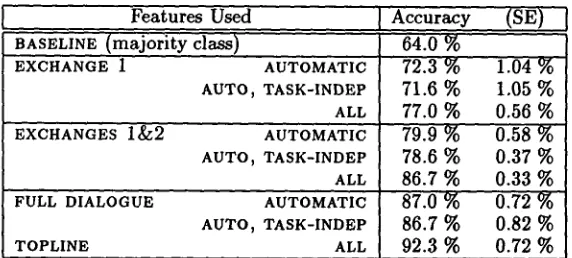
TASK-INDEP feature sets (as described earlier), with results for the whole fea- ture set including hand-labelled features. Table 1 summarizes the results.T h e baseline on the first line of Table 1 repre- sents the prediction accuracy from always guess- ing the majority class. Since 64% of the dialogues are TASKSUCCESS dialogues, we can achieve 64% ac- curacy from simply guessing TASKSUCCESS without having seen any of the dialogue yet.
T h e first EXCHANGE 1 row shows the results of using the AUTOMATIC features from only the
first
exchange to predict whether the dialogue outcome will be TASKSUCCESS or PROBLEMATIC. T h e results show t h a t the machine-learned classifier can predict problematic dialogues 8% better t h a n the baseline after having seen only the first user utterance. Using only task-independent automatic features (Figure 6) the EXCHANGE 1 classifier can still do nearly as well. T h e ALL rowfor
EXCHANGE 1 indicates t h a t even if we had access to h u m a n perceptual ability (the hand-labelled features) we would still only be able to distinguish between TASKSUCCESS and PROBLEM- ATIC dialogues with 77% accuracy after having seen the first exchange.Features Used BASELINE (majority class)
EXCHANGE 1 AUTOMATIC
AUTO, TASK-INDEP ALL EXCHANGES l & 2 AUTOMATIC AUTO, TASK-INDEP ALL
FULL DIALOGUE AUTOMATIC
AUTO, TASK-INDEP
TOPLINE ALL
]Accuracy (SE) 64.0 %
72.3 % 1.04 % 71.6 % 1.05 % 77.0 % 0.56 % 79.9 % 0.58 % 78.6 % 0.37 % 86.7 % 0.33 % 87.0 % 0.72 % 86.7 % 0.82 % 92.3 % 0.72 %
Table 1: Results for predicting and identifying problematic dialogues (SE --- Standard Error) The EXCHANGE l & 2 rows of Table 1 show the re-
suits using features from the first two exchanges in the dialogue to predict the outcome of the dialogue. 4 The additional exchange gives roughly an additional 7% boost in predictive accuracy using either of the AUTOMATIC feature sets. This is only 8% less than the accuracy we can achieve using these features af- ter having seen the whole dialogue (see below). The ALL row for EXCHANGE l & 2 shows that we could achieve over 86% accuracy if we had the ability to utilize the hand-labelled features.
The FULL DIALOGUE row in Table 1 for AUTO- MATIC and AUTO, TASK-INDEP features shows the ability of the classifier to identify problematic dia- logues, rather than predict them, using features for the whole dialogue. The ALL row for the FULL DI- ALOGUE shows that we could correctly identify over 92% of the outcomes accurately if we had the ability to utilize the hand-labelled features.
Note that the task-independent automatic fea- tures always perform within 2% error of the auto- matic features, and the hand-labelled features con- sistently perform with accuracies ranging from 6-8% greater.
The rules t h a t RIPPER learned on the basis of the Exchange 1 automatic features are below.
E x c h a n g e 1, A u t o m a t i c F e a t u r e s :
i f ( e l - t o p - c o n f i d e n c e _< .924) A ( e l - d t m f - f l a g = '1') t h e n
problematic,
if (el-cliff-confidence _< .916) A (el-asr-duration > 6.92) t h e n problematic,
default is tasksuccess.
According to these rules, a dialogue will be prob- lematic if the confidence score for the top-ranked 4Since 23% of the dialogues consisted of only two ex- changes, we exclude the second exchange features for those dialogues where the second exchange consists only of the sys- tem playing a closing prompt. We also excluded any features that indicated to the classifier that the second exchange was the last exchange in the dialogue.
task (given by the NLU module) is moderate or low and there was touchtone input in the user utterance. The second rule says that if the difference between the top confidence score and the second-ranked con- fidence score is moderate or low, and the duration of the user utterance is more than 7 seconds, predict PROBLEMATIC.
The performance of these rules is summarized in Table 2. These results show that given the first ex- change, this ruleset predicts that 22% of the dia- logues will be problematic, while 36% of them ac- tually will be. Of the dialogues that actually will be problematic, it can predict 41% of them. Once it predicts that a dialogue will be problematic, it is correct 69% of the time. As mentioned earlier, this reflects an overMl improvement in accuracy of 8% over the baseline.
The rules learned by training on the automatic task-independent features for exchanges 1 and 2 are given below. As in the first rule set, the features that the classifier appears to be exploiting are primarily those from the ASR and NLU modules.
Exchanges
l&2,
Automatic
Task-
Independent Features:
i f (e2-recog-numwords < 0) A (el-cliff-confidence < .95) t h e n
problematic.
if (el-salience-coverage < .889) A (e2-recog contains "I') A (e2-asr-duration > 7.48) t h e n problematic.
if (el-top-confidence < .924) A (e2-asr-duration >_ 5.36) A (el-asr-duration > 8.6) t h e n problematic.
if (e2-recog is blank) A (e2-asr-duration > 2.8) t h e n
problematic.
if (el-salience-coverage < .737) A (el-recog contains "help") A (el-asr-duration < 7.04) t h e n problematic.
if (el-cliff-confidence < .924) A (el-dtmf-flag = '1') A (el-asr-duration < 6.68) t h e n problematic.
default is tasksuccess.
[image:6.612.173.459.93.222.2]C l a s s Success Problematic
O c c u r r e d P r e d i c t e d R e c a l l P r e c i s i o n 6 4 . 1 % 78.3 % 89.44 % 73.14 % 35.9 % 21.7 % 41.47 % 68.78 %
Table 2: Precision and Recall with Exchange 1 Automatic Features
C l a s s Success Problematic
O c c u r r e d P r e d i c t e d R e c a l l P r e c i s i o n 6 4 . 1 % 75.3 % 91.42 % 7 7 . 8 1 % 35.9 % 24.7 %' 53.53 % 77.78 %
Table 3: Precision and Recall with Exchange l&2 Automatic, Task-Independent Features dialogues will be problematic, while 36% of them
actually will be. Of the problematic dialogues, it can predict 57% of them. Once it predicts that a dialogue will be problematic, it is correct 79% of the time. Compared with the classifier for the first utterance alone, this classifier has an improvement of 16% in recall and 10% in precision, for an overall improvement in accuracy of 7% over using the first exchange alone.
One observation from these hypotheses is the clas- sifier's preference for the asr-duration feature over the feature for the number of words recognized (recog-numwords). One would expect longer utter- ances to be more difficult, but the learned rulesets indicate t h a t duration is a better measure of utter- ance length than the number of words. Another ob- servation is the usefulness of the NLU confidence scores and the NLU salience-coverage in predicting problematic dialogues. These features seem to pro- vide good general indicators of the system's success in recognition and understanding. T h e fact t h a t the main focus of the rules is detecting ASR and NLU errors and that none of the DM behaviors are used as predictors also indicates that, in all likelihood, the DM is performing as well as it can, given the noisy input t h a t it is getting from ASR and NLU.
To identify potential improvements in the prob- lematic dialogue predictor, we analyzed which hand- labelled features made large performance improve- ments, under the assumption that future work can focus on developing automatic features that ap- proximate the information provided by these hand- labelled features. T h e analysis indicated that the vsuceess feature alone improves the performance of the TOPLINE from 88.5%, as reported in (Langkilde et al., 1999), to 92.3%. Using rsuccess as the only feature results in 73.75% accuracy for exchange 1, 81.9% accuracy for exchanges 18z2 and 85.3% accu- racy for the full dialogue. In addition, for Exchanges l&2, the accuracy of the AUTOMATIC, TASK-INDEP feature set plus the rsuccess feature is 86.5%, which is only 0.2% less than the accuracy of ALL the lea-
tures for Exchanges l&2 as shown in Table 1. T h e rules t h a t RIPPER learns for Exchanges 1&52 when the AUTOMATIC, TASK-INDEP feature set is aug- mented with the single hand-labelled rsuccess fea- ture is shown below.
E x c h a n g e s 1 ~ 2 , R s u c c e s s -b A u t o m a t i c T a s k - I n d e p e n d e n t F e a t u r e s :
ife2-salience-coverage ~ 0.651 A e2-asr-duration >_ 0.04 A e2-rsuccess=Rvacuous-match t h e n problematic, if e2-rsuccess=Rmismatch A el-top-confidence < 0.909 t h e n problematic,
if e2-rsuccess=Rmismatch A e2-context-shift < 0.014 A e2-salience-coverage ~ 0.2 A e2-recog-numwords < 12 ( t h e n problematic,
if e2-rsuccess=Rmismatch ^ el-rsuccess=Rmismatch t h e n
problematic,
if e2-rsuccess=Rmismatch A e2-top-confidence < 0.803 ^ e2-asr-duration >__ 2.68 ^ e2-asr-duration < 6.32 t h e n problematic,
if el-rsuccess=Rmismatch A el-diff-confidence > 0.83 t h e n problematic,
if e2-rsuccess=Rmismatch A e2-context-shift >_ 0.54 t h e n problematic,
ife2-asr-duration > 5.24 A e2-salience-coverage < 0.833 A e2-top-confidence < 0.801 A e2-recog-numwords < 7 A e2-asr-duration < 16.08 t h e n problematic,
if el-diff-confidence < 0.794 A el-asr-duration > 7.2 A el-inconsistency > 0.024 A el-inconsistency > 0.755 t h e n problematic,
default is tasksuccess
Note that the rsuccess feature is frequently used in the rules and that RIPPER learns rules t h a t combine the rsuccess feature with other features, such as the confidence, asr-duration, and salience-coverage fea- tures.
5
D i s c u s s i o n a n d F u t u r e W o r k
In summary, our results show that: (1) All feature sets significantly improve over the baseline; (2) Us- ing automatic features from the whole dialogue, we can identify problematic dialogues 23% b e t t e r than the baseline; (3) Just the first exchange provides sig-
[image:7.612.191.483.93.134.2]nificantly better prediction (8%) than the baseline; (4) The second exchange provides an additional sig- nificant (7%) improvement, (5) A classifier based on task-independent automatic features performs with less than 1% degradation in error rate relative to the automatic features. Even with current accuracy rates, the improved ability to predict problematic dialogues means that it may be possible to field the system without human agent oversight, and we ex- pect to be able to improve these results.
The research reported here is the first that we know of to automatically analyze a corpus of logs from a spoken dialogue system for the purpose of learning to predict problematic situations. Our work builds on earlier research on learning to identify di- alogues in which the user experienced poor speech recognizer performance (Litman et al., 1999). How- ever, that work was based on a much smaller set of experimental dialogues where the notion of a good or bad dialogue was automatically approximated rather than being labelled by humans. In addition, because that work was based on features synthesized over the entire dialogues, the hypotheses that were learned could not be used for prediction during runtime.
We are exploring several ways to improve the per- formance of and test the problematic dialogue pre- dictor. First, we noted above the extent to which the hand-labelled feature rsuccess improves classifier performance. In other work we report results from training an rsuccess classifier on a per-utterance level (Walker et al., 2000), where we show that we can achieve 85% accuracy using only fully automatic fea- tures. In future work we intend to use the (noisy) output from this classifier as input to our problem- atic dialogue classifier with the hope of improving the performance of the fully automatic feature sets. In addition, since it is more important to minimize errors in predicting PROBLEMATIC dialogues than er- rors in predicting TASKSUCCESS dialogues, we intend to experiment with RIPPER'S loss ratio parameter, which instructs RIPPER to achieve high accuracy for the PROBLEMATIC class, while potentially reducing overall accuracy. Finally, we plan to integrate the learned rulesets into the HMIHY dialogue system to improve the system's overall performance.
R e f e r e n c e s
A. Abella and A.L. Gorin. 1999. Construct algebra: An analytical method for dialog management. In
Proc. of the Association for Computational Lin- guistics.
P. Baggia, G. Castagneri, and M. Danieli. 1998. Field trials of the Italian Arise Train Timetable System. In Interactive Voice Technology for
Telecommunications Applications, IVTTA, pages
97-102.
J. Chu-Carroll and R. Carpenter. 1999. Vector- based natural language call routing. Computa-
tional Linguistics, 25-3:361-387.
W. Cohen. 1996. Learning trees and rules with set- valued features. In l~th Conference of the Amer- ican Association of Artificial Intelligence, AAAI.
A.L. Gorin E. Ammicht and T. Alonso. 1999. Knowledge collection for natural language spoken dialog systems. In Proc. of EUROSPEECH 99.
A.L. Gorin, G. Riccardi, and J.H. Wright. 1997. How may I Help You? Speech Communication,
23:113-127.
I. Langkilde, M. Walker, J. Wright, A. Gorin, and D. Litman. 1999. Automatic prediction of prob- lematic human-computer dialogues in How May I Help You? In Proc. IEEE Workshop on Auto- matic Speech Recognition and Understanding.
G. A. Levow. 1998. Characterizing and recogniz- ing spoken corrections in human-computer dia- logue. In Proc. of the 36th Annual Meeting of the Association of Computational Linguistics, COL-
ING/ACL 98, pages 736-742.
D. J. Litman, M. A. Walker, and M. J. Kearns. 1999. Automatic detection of poor speech recognition at the dialogue level. In Proc. of the 37th Annual Meeting of the Association of Computational Lin-
guistics, ACL99, pages 309-316.
G. Riccardi and A.L. Gorin. to appear. Spoken lan- guage adaptation over time and state in a natu- ral spoken dialog system. IEEE Transactions on Speech and Audio.
A. Sanderman, J. Sturm, E. den Os, L. Bores, and A. Cremers. 1998. Evaluation of the Dutch Train Timetable Information System developed in the ARISE project. In Interactive Voice Technology
for Telecommunications Applications, pages 91-
96.
S. Seneff, V. Zue, J. Polifroni, C. Pao, L. Hethering- ton, D. Goddeau, and J. Glass. 1995. The pre- liminary development of a displayless PEGASUS system. In ARPA SLT Workshop.
E. Shriberg, E. Wade, and P. Price. 1992. Human- machine problem solving using spoken language systems (SLS): Factors affecting performance and user satisfaction. In Proc. of the DARPA Speech
and NL Workshop, pages 49-54.
M. A. Walker, J. C. Fromer, and S. Narayanan. 1998. Learning optimal dialogue strategies: A ease study of a spoken dialogue agent for email.
In Proc. of the 36th Annual Meeting of the
Association of Computational Linguistics, COL-
ING/ACL 98, pages 1345-1352.