B a g g i n g and B o o s t i n g a Treebank Parser
J o h n C. H e n d e r s o n
T h e M I T R E C o r p o r a t i o n202 B u r l i n g t o n R o a d B e d f o r d , M A 0 1 7 3 0
j h n d r s n @ m i t r e . o r g
E r i c
B r i l l M i c r o s o f t R e s e a r c h1 M i c r o s o f t W a y R e d m o n d , W A 9 8 0 5 2
b r i l l @ m i c r o s o f t . c o m
A b s t r a c t
Bagging and boosting, two effective machine learn- ing techniques, are applied to natural language pars- ing. Experiments using these techniques with a trainable statistical parser are described. T h e best resulting system provides roughly as large of a gain in F-measure as doubling the corpus size. Error analysis of the result of the boosting technique re- veals some inconsistent annotations in the Penn Treebank, suggesting a semi-automatic m e t h o d for finding inconsistent treebank annotations.
1
I n t r o d u c t i o n
Henderson and Brill (1999) showed t h a t independent human research efforts produce parsers t h a t can be combined for an overall boost in accuracy. Finding an ensemble of parsers designed to complement each other is clearly desirable. T h e parsers would need to be the result of a unified research effort, though, in which the errors made by one parser are targeted with priority by the developer of another parser.
A set of five parsers which each achieve only 40% exact sentence accuracy would be extremely valu- able if they made errors in such a way t h a t at least two of the five were correct on any given sentence (and the others abstained or were wrong in different ways). 100% sentence accuracy could be achieved by selecting the hypothesis t h a t was proposed by the two parsers that agreed completely.
In this paper, the task of automatically creating complementary parsers is separated from the task of creating a single parser. This facilitates study of the ensemble creation techniques in isolation. The result is a method for increasing parsing performance by creating an ensemble of parsers, each produced from data using the same parser induction algorithm.
2
B a g g i n g a n d P a r s i n g
2.1 Background
The work of Efron and Tibshirani (1993) enabled Breiman's refinement and application of their tech- niques for machine learning (Breiman, 1996). His technique is called bagging, short for "bootstrap ag- gregating". In brief, bootstrap techniques and bag-
ging in particular reduce the systematic biases many estimation techniques introduce by aggregating es- timates made from randomly drawn representative resamplings of those datasets.
Bagging a t t e m p t s to find a set of classifiers which are consistent with the training data, different from each other, and distributed such that the aggregate sample distribution approaches the distribution of samples in the training set.
Algorithm: Bagging Predictors
(Breiman, 1996)
(1)
Given: training set • = { ( y i , x ~ ) , i E { 1 . . . m } } drawn from the set A of possible training sets where Yi is the label for example x~, classification induction algorithm q2 : A --* • with classification algorithm C e • and ¢ : X - - ~ Y .
1. Create k bootstrap replicates o f / : by sampling m items from E with replacement. Call them L 1 . . . L k .
2. For each j e { 1 . . . k } , Let Cj = ~ ( £ j ) be the classifier induced using Lj as the training set. 3. If Y is a discrete set, then for each x~ observed
in the test set, yi = m o d e ( ¢ j ( x i ) . . . Cj(x~)). y~ is the value predicted by the most predictors, the majority vote.
2.2 Bagging for Parsing
An algorithm t h a t applies the technique of bagging to parsing is given in Algorithm 2. Previous work on combining independent parsers is leveraged to pro- duce the combined parser. The rest of the algorithm is a straightforward transformation of bagging for classifiers. Exploratory work in this vein was de- scribed by HajiC et al. (1999).
Algorithm: Bagging A Parser
(2)
Given: A corpus (again as a f u n c t i o n ) C : S × T ~ N ,
S is the set of possible sentences, and T is the set of trees, with size m = [C] = ~ s , t C(s, t) and parser induction algorithm g.
distribution D ( s , t ) = C(s,t)/]C]. Each boot- strap replicate is a bag of samples, where each sample in a bag is drawn randomly with replace- ment from the bag corresponding to C.
2. Create parser f~ = g(Ci) for each i.
3. Given a novel sentence 8test E C t e s t , combine the collection of hypotheses ti = fi(Stest) us- ing the unweighted constituent voting scheme of Henderson and Brill (1999).
2.3 E x p e r i m e n t
T h e training set for these experiments was sections 01-21 of the Penn Treebank (Marcus et al., 1993). T h e test set was section 23. The parser induction algorithm used in all of the experiments in this pa- per was a distribution of Collins's model 2 parser (Collins, 1997). All comparisons made below refer to results we obtained using Collins's parser.
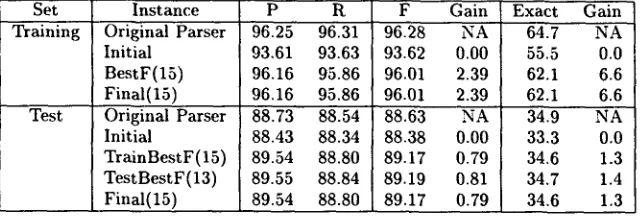
The results for bagging are shown in Figure 2 and Table 1. The row of figures are (from left-to-right) training set F-measure ~, test set F-measure, percent perfectly parsed sentences in training set, and per- cent perfectly parsed sentences in test set. An en- semble of bags was produced one bag at a time. In the table, the I n i t i a l row shows the performance achieved when the ensemble contained only one bag, F i n a l ( X ) shows the performance when the ensem- ble contained X bags, B e s t F gives the performance of the ensemble size that gave the best F-measure score. T r a i n B e s t F and T e s t B e s t F give the test set performance for the ensemble size that performed the best on the training and test sets, respectively.
On the training set all of the accuracy measures are improved over the original parser, and on the test set there is clear improvement in precision and recall. The improvement on exact sentence accuracy for the test set is significant, but only marginally so. The overall gain achieved on the test set by bag- ging was 0.8 units of F-measure, but because the entire corpus is not used in each bag the initial per- formance is approximately 0.2 units below the best previously reported result. The net gain using this technique is 0.6 units of F-measure.
3
Boosting
3.1 Background
The AdaBoost algorithm was presented by Fre- und and Schapire in 1996 (Freund and Schapire, 1996; Freund and Schapire, 1997) and has become a widely-known successful method in machine learn- ing. The AdaBoost algorithm imposes one con- straint on its underlying learner: it may abstain from making predictions about labels of some samples,
1This is the balanced version o f F - m e a s u r e , where precision
and recall are weighted equally.
50°-/o accuracy on the samples for which it commits to a decision. T h a t accuracy is measured accord- ing to the distribution describing the importance of samples that it is given. T h e learner must be able to get more correct samples t h a n incorrect samples by mass of importance on those that it labels. This statement of the restriction comes from Schapire and Singer's study (1998). It is called the weak learning criterion.
Schapire and Singer (1998) extended AdaBoost by describing how to choose the hypothesis mixing co- efficients in certain circumstances and how to incor- porate a general notion of confidence scores. They also provided a better characterization of its theo- retical performance. The version of AdaBoost used in their work is shown in Algorithm 3, as it is the version that most amenable to parsing.
Algorithm: A d a B o o s t
( F r e u n d and Schapire, 1997") (3) Given: Training set /: as in bagging, except yi E { - 1 , 1 } is the label for example xi. Initial uniform distribution D1 (i) = 1 / m . Number of iterations, T. Counter t = 1. tI,, ¢~, and ¢ are as in Bagging.
1. Create Lt by randomly choosing with replace- ment m samples from L: using distribution Dt. 2. Classifier induction: Ct ~- ~ ( L t )
3. Choose at E IR.
4. Adjust and normalize the distribution. Zt is a normalization coefficient.
1
D, + , ( i) = -~- Dt ( i ) exp(-c~tYiCt( xi ) )
5. Increment t. Quit if t > T. 6. Repeat from step 1. 7. The final hypothesis is
~)boost(:g) ~- sign Z ~ t ¢ , ( x )
t
The value of at should generally be chosen to min- imize
Z Dt (i) e x p ( - a ~ Yi Ct (x,)) i
in order to minimize the expected per-sample train- ing error of the ensemble, which Schapire and Singer show can be concisely expressed by I-] Zt. They also
give several examples for how to pick an appropriate a, and selection generally depends on the possible outputs of the underlying learner.
[image:2.612.325.551.372.682.2]Set Instance P R F Gain Exact Gain Training Original Parser 96.25 96.31 96.28 NA 64.7 NA
Initial 93.61 93.63 93.62 0.00 55.5 0.0
BestF(15) 96.16 95.86 96.01 2.39 62.1 6.6 Final(15) 96.16 95.86 96.01 2.39 62.1 6.6 Test Original Parser 88.73 88.54 88.63 NA 34.9 NA
Initial 88.43 88.34 88.38 0.00 33.3 0.0
TrainBestF(15) 89.54 88.80 89.17 0.79 34.6 1.3 TestBestF(13) 89.55 88.84 89.19 0.81 34.7 1.4 Final(15) 89.54 88.80 89.17 0.79 34.6 1.3
Table 1: Bagging the Treebank
mechanisms of a parser for Japanese. T h e creators of AdaBoost used it to perform text classification (Schapire and Singer, 2000). Abney et al. (1999) performed part-of-speech tagging and prepositional phrase a t t a c h m e n t using AdaBoost as a core compo- nent. T h e y found they could achieve accuracies on b o t h tasks t h a t were competitive with the state of the art. As a side effect, they found t h a t inspecting the samples t h a t were consistently given the m o s t weight during boosting revealed some faulty anno- tations in the corpus. In all of these systems, Ad- aBoost has been used as a traditional classification system.
3.2 Boosting for Parsing
Our goal is to recast boosting for parsing while con- sidering a parsing system as the embedded learner. T h e formulation is given in Algorithm 4. T h e in- tuition behind the additive form is t h a t the weight placed on a sentence should be the sum of the weight we would like to place on its constituents. T h e weight on constituents t h a t are predicted incorrectly are adjusted by a factor of 1 in contrast to a factor of ~ for those t h a t are predicted incorrectly.
Algorithm: Boosting A Parser (4)
Given corpus C with size m = IC I = ~ s . ~ C ( s , t ) and parser induction algorithm g. Initial uniform distribution Dl(i) = 1/m. N u m b e r of iterations, T. Counter t = 1.
1. Create Ct by randomly choosing with replace- ment m samples from C using distribution Dr. 2. Create parser ft ~ g(Ct).
3. Choose a t E R (described below).
4. Adjust and normalize the distribution. Zt is a normalization coefficient. For all i, let parse tree ~-~' ~-- ft(s,). Let ~(T,c) be a function indi- cating t h a t c is in parse tree r, and ITI is the number of constituents in tree T. T ( s ) is the set of constituents t h a t are found in the reference or hypothesized annotation for s.
Dt+l ( i ) :
1 - ,
c E T ( s i )
5. Increment t. Quit if t > T. 6. R e p e a t from step 1.
7. T h e final hypothesis is c o m p u t e d by combin- ing the individual constituents. Each parser Ct in the ensemble gets a vote with weight at for the constituents they predict. Precisely those constituents with weight strictly larger t h a n
1
~--~t a t are put into the final hypothesis.
A potential constituent can be considered correct if it is predicted in the hypothesis and it exists in the reference, or it is not predicted and it is not in the reference. Potential constituents t h a t do not ap- pear in the hypothesis or the reference should not make a big contribution to the accuracy c o m p u t a - tion. T h e r e are m a n y such potential constituents, and if we were maximizing a function t h a t t r e a t e d getting t h e m incorrect the same as getting a con- stituent t h a t a p p e a r s in the reference correct, we would most likely decide not to predict any con- stituents.
Our model of constituent accuracy is thus sim- ple. Each prediction correctly m a d e over T ( s ) will be given equal weight. T h a t is, correctly hypothesizing a constituent in the reference will give us one point, but a precision or recall error will cause us to miss one point. Constituent accuracy is then a / ( a + b + c ) , where a is the n u m b e r of constituents correctly hy- pothesized, b is the n u m b e r of precision errors and c is the n u m b e r of recall errors.
In Equation 1, a c o m p u t a t i o n of aca as described is shown.
O t c a =
D ( i )
i c6T(si)
D ( i )
i c C T ( s i )
Boosting algorithms were developed that at- t e m p t e d to maximize F-measure, precision, and re- call by varying the c o m p u t a t i o n of a, giving results too numerous to include here. T h e algorithm given here performed the best of the lot, but was only marginally better for some metrics.
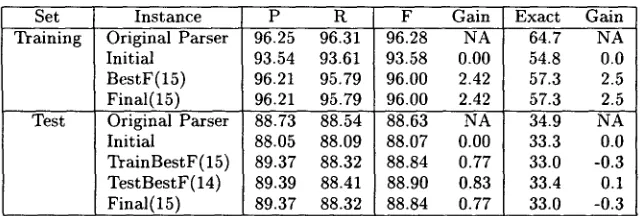
[image:3.612.179.499.87.195.2]Training Original Parser 96.25 96.31 96.28 NA 64.7 NA Initial 93.54 93.61 93.58 0.00 54.8 0.0 BestF(15) 96.21 95.79 96.00 2.42 57.3 2.5 Final(15) 96.21 95.79 96.00 2.42 57.3 2.5 Test Original Parser 88.73 88.54 88.63 NA 34.9 NA Initial 88.05 88.09 88.07 0.00 33.3 0.0 TrainBestF(15) 89.37 88.32 88.84 0.77 33.0 -0.3 TestBestF(14) 89.39 88.41 88.90 0.83 33.4 0.1 Final(15) 89.37 88.32 88.84 0.77 33.0 -0.3
Table 2: Boosting the Treebank
3.3 Experiment
T h e experimental results for boosting are shown in Figure 3 and Table 2. T h e r e is a large plateau in performance from iterations 5 through 12. Because of their low accuracy and high degree of specializa- tion, the parsers produced in these iterations had little weight during voting and had little effect on the cumulative decision making.
As in the bagging experiment, it a p p e a r s t h a t there would be more precision and recall gain to be had by creating a larger ensemble. In b o t h the bagging and boosting experiments time and resource constraints dictated our ensemble size.
In the table we see t h a t the boosting algorithm equaled bagging's test set gains in precision and re- call. The I n i t i a l performance for boosting was lower, though. We cannot explain this, and expect it is due to unfortunate resampling of the d a t a dur- ing the first iteration of boosting. Exact sentence accuracy, though, was not significantly improved on the test set.
Overall, we prefer bagging to boosting for this problem when raw performance is the goal. There are side effects of boosting t h a t are useful in other respects, though, which we explore in Section 4.2.
3.3.1
Weak Learning Criterion Violations
It was hypothesized in the course of investigating the failures of the boosting algorithm t h a t the parser in- duction system did not satisfy the weak learning cri- terion. It was noted t h a t the distribution of boosting weights were more skewed in later iterations. Inspec- tion of the sentences t h a t were getting much mass placed upon them revealed t h a t their weight was be- ing boosted in every iteration. T h e hypothesis was t h a t the parser was simply unable to learn them.39832 parsers were built to test this, one for each sentence in the training set. Each of these parsers was trained on only a single sentence 2 and evaluated on the same sentence. It was discovered t h a t a full 4764 (11.2%) of these sentences could not be parsed completely correctly by the parsing system.
2The sentence was replicated 10 times to avoid threshold- ing
effects
in the learner.3.3.2
Corpus Trimming
In order to evaluate how well boosting worked with a learner t h a t b e t t e r satisfied the weak learning cri- terion, the boosting experiment was run again on the Treebank minus the troublesome sentences de- scribed above. T h e results are in Table 3. This d a t a s e t produces a larger gain in comparison to the results using the entire Treebank. T h e initial ac- curacy, however, is lower. We hypothesize t h a t the boosting algorithm did perform b e t t e r here, but the parser induction system was learning useful informa- tion in those sentences t h a t it could not memorize (e.g. lexical information) t h a t was successfully ap- plied to the test set.
In this m a n n e r we m a n a g e d to clean our dataset to the point t h a t the parser could learn each sentence in isolation. T h e corpus-makers cannot necessarily be blamed for the sentences t h a t could not be m e m - orized. All t h a t can be said a b o u t those sentences is t h a t for b e t t e r or worse, the parser's model would not a c c o m m o d a t e them.
4
C o r p u s A n a l y s i s
4.1
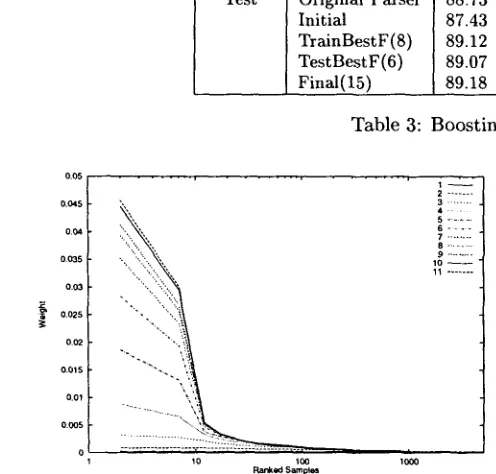
Noisy Corpus: Empirical Investigation
To acquire experimental evidence of noisy data, dis- tributions t h a t were used during boosting the sta- ble corpus were inspected. T h e distribution was ex- pected to be skewed if there was noise in the data, or be uniform with slight fluctuations if it fit the d a t a well. [image:4.612.158.479.92.200.2]Set Instance P R F Gain Exact Gain Training Original Parser 96.25 96.31 96.28 NA 64.7 NA Initial 94.60 94.68 94.64 0.00 62.2 0.0 BestF(8) 97.38 97.00 97.19 2.55 63.1 0.9 Final(15) 97.00 96.17 96.58 1.94 55.0 -7.2 Test Original Parser 88.73 88.54 88.63 NA 34.9 NA Initial 87.43 87.21 87.32 0.00 32.6 0.0 TrainBestF(8) 89.12 87.62 88.36 1.04 32.8 0.2 TestBestF(6) 89.07 87.77 88.42 1.10 32.9 0.4 Final(15) 89.18 87.19 88.18 0.86 31.7 -0.8
Table 3: Boosting the Stable Corpus
0.05
0.045
0.04
0035
0.03
~'
o.o2s I0,02
0.015
0.01
0.005
0
, , . . . , i " . 2 . . . 3 . . . 4 • 5 . . . 6 . . . . 7 . . . 8 . . . 9 . . . 10- -1 -1 . . .
i
Figure 1: Weight Change During Boosting
Notice first t h a t the left endpoints of the lines move from b o t t o m to top in order of boosting it- eration. T h e distribution becomes monotonically more skewed as boosting progresses. Secondly we see by the last iteration t h a t most of the weight is concentrated on less t h a n 100 samples. This g r a p h shows behavior consistent with noise in the corpus on which the boosting algorithm is focusing.
4.2 T r e e b a n k I n c o n s i s t e n c i e s
T h e r e are sentences in the corpus t h a t can be learned by the parser induction algorithm in isolation but not in concert because they contain conflicting in- formation. Finding these sentences leads to a b e t t e r understanding of the quality of our corpus, and gives an idea for where improvements in annotation qual- ity can be made. Abney et al. (1999) showed a similar corpus analysis technique for p a r t of speech tagging and prepositional phrase tagging, b u t for parsing we must remove errors introduced by the parser as we did in Section 3.3.2 before questioning the corpus quality. A particular class of errors, in- consistencies, can then be investigated. Inconsistent annotations are those t h a t a p p e a r plausible in iso- lation, but which conflict with annotation decisions m a d e elsewhere in the corpus.
In Figure 5 we show a set of trees selected from
within the top 100 m o s t heavily weighted trees at the end of 15 iterations of boosting the stable cor- pus.Collins's parser induction s y s t e m is able to learn to produce any one of these structures in isolation, b u t the presence of conflicting information in differ-
ent sentences prevents it from achieving 100% accu-
racy on the set.
5
Training Corpus Size Effects
We suspect our best parser diversification techniques gives performance gain a p p r o x i m a t e l y equal to dou- bling the size of the training set. While this cannot be directly tested without hiring more annotators, an expected p e r f o r m a n c e bound for a larger train- ing set can be produced by e x t r a p o l a t i n g from how well the parser performs using smaller training sets. T h e r e are two characteristics of training curves for large c o r p o r a t h a t can provide such a bound: train- ing curves generally increase monotonically in the absence of over-training, and their first derivatives generally decrease monotonically.
Set Sentences P R 50
100 500 1000 5000 10000 20000 39832 50 100 500 1000 5000 10000 20000 39832
F Exact 67.57 32.15 43.57 5.4 69,03 56.23 61.98 8,5 78,12 75.46 76.77 18,2 81.36 80.70 81.03 22.9 87.28 87.09 87.19 34.1 89.74 89.56 89.65 41.0 92.42 92.40 92.41 50.3 96.25 96.31 96.28 64.7 68.13 32.24 43.76 4.7 69.90 54.19 61.05 7.8 78.72 75.33 76.99 19.1 81.61 80.68 81.14 22.2 86.03 85.43 85.73 28.6 87.29 86.81 87.05 30.8 87.99 87.87 87.93 32.7 88.73 88.54 88.63 34.9
Table 4: Effects of Varying Training Corpus Size
[image:5.612.178.498.85.195.2] [image:5.612.83.331.146.383.2] [image:5.612.350.570.476.670.2]sentences) gives a test set F-measure gain of approx- imately 0.70.
Bagging achieved significant gains of approxi- mately 0.60 over the best reported previous F- measure without adding any new data. In this re- spect, these techniques show promise for making performance gains on large corpora without adding more data or new parsers.
6 C o n c l u s i o n
We have shown two methods, bagging and boosting, for automatically creating ensembles of parsers that produce better parses than any individual in the en- semble. Neither of the algorithms exploit any spe- cialized knowledge of the underlying parser induc- tion algorithm, and the data used in creating the ensembles has been restricted to a single common training set to avoid issues of training data quantity affecting the outcome.
Our best bagging system performed consistently well on all metrics, including exact sentence accu- racy. It resulted in a statistically significant F- measure gain of 0.6 over the performance of the base- line parser. That baseline system is the best known Treebank parser. This gain compares favorably with a bound on potential gain from increasing the corpus size.
Even though it is computationally expensive to create and evaluate a small (15-30) ensemble of parsers, the cost is far outweighed by the opportu- nity cost of hiring humans to annotate 40000 more sentences. The economic basis for using ensemble methods will continue to improve with the increasing value (performance per price) of modern hardware.
Our boosting system, although dominated by the bagging system, also performed significantly better than the best previously known individual parsing result. We have shown how to exploit the distri- bution created as a side-effect of the boosting al- gorithm to uncover inconsistencies in the training corpus. A semi-automated technique for doing this as well as examples from the Treebank that are in- consistently annotated were presented. Perhaps the biggest advantage of this technique is that it requires no a priori notion of how the inconsistencies can be characterized.
7 A c k n o w l e d g m e n t s
We would like to thank Michael Collins for enabling all of this research by providing us with his parser and helpful comments.
This work was funded by NSF grant IRI-9502312. The views expressed in this paper are those of the authors and do not necessarily reflect the views of the MITRE Corporation. This work was done while both authors were at Johns Hopkins University.
Steven Abney, Robert E. Schapire, and Yoram Singer. 1999. Boosting applied to tagging and P P attachment. In Proceedings of the Joint SIGDAT Conference on Empirical Methods in Natural Lan- guage Processing and Very Large Corpora, pages 38-45, College Park, Maryland.
L. Breiman. 1996. Bagging predictors. In Machine Learning, volume 24, pages 123-140.
Michael Collins. 1997. Three generative, lexicalised models for statistical parsing. In Proceedings of the Annual Meeting of the Association for Com- putational Linguistics, volume 35, Madrid. B. Efron and R. Tibshirani. 1993. An Introduction
to the Bootstrap. Chapman and Hall.
Y. Freund and R.E. Schapire. 1996. Experiments with a new boosting algorithm. In Proceedings of the International Conference on Machine Learn- ing.
Y. Freund and R.E. Schapire. 1997. A decision- theoretic generalization of on-line learning and an application to boosting. Journal of Computer and Systems Sciences, 55(1):119-139, Aug.
Jan Haji~, E. Brill, M. Collins, B. Hladka, D. Jones, C. Kuo, L. Ramshaw, O. Schwartz, C. Tillmann, and D. Zeman. 1999. Core natural language processing technology applicable to multiple lan- guages. Prague Bulletin of Mathematical Linguis- tics, 70.
Masahiko Haruno, Satoshi Shirai, and Yoshifumi Ooyama. 1998. Using decision trees to construct a practical parser. In Proceedings of the 36th Annual Meeting of the Association for Compu- tational Linguistics and 17th International Con- ference on Computational Linguistics, volume 1, pages 505-511, Montreal, Canada.
John C. Henderson and Eric Brill. 1999. Exploiting diversity in natural language processing: Combin- ing parsers. In Proceedings of the Fourth Confer- ence on Empirical Methods in Natural Language Processing, College Park, Maryland.
Mitchell P. Marcus, Beatrice Santorini, and Mary Ann Marcinkiewicz. 1993. Building a large annotated corpus of english: The Penn Treebank. Computational Linguistics, 19(2):313-330. Robert E. Schapire and Yoram Singer. 1998. Im-
proved boosting algorithms using confidence-rated predictions. In Proceedings of the Eleventh An- nual Conference on Computational Learning The- ory, pages 80-91.
\
j J
i
i £/
'...]~'.,..
b~
.=.
O O
O
b~
..=
/~ ~j
~_. ~g
0