RESEARCH ARTICLE
Behavioral and physiological traits of migrant and resident
white-crowned sparrows: a common garden approach
Marilyn Ramenofsky1,*, Andrew W. Campion1,2, Jonathan H. Pérez1, Jesse S. Krause1and Zoltán Németh1,3
ABSTRACT
To accommodate a migratory life history, migrants express a greater number of physiological and behavioral stages per annum than residents and are thus considered to have higher finite state diversity (FSD). To investigate the physiological mechanisms and constraints associated with migration, direct comparison of two subspecies of white-crowned sparrow–migrant,Zonotrichia leucophrys gambelii, and resident, Z. l. nuttalli – were made under common garden conditions of photoperiod and housing, as birds progressed from winter through the vernal life history stages. We tested the hypothesis that migrants (higher FSD) respond differently than residents (lower FSD) to the initial predictive cue, photoperiod, to initiate and integrate the progression of vernal stages of prenuptial molt, migration and development of breeding. If differences in vernal phenology were noted, then the basis for the distinctions was considered genetic. Results indicate that (1) residents had a lower threshold to vernal photoperiod with elevations of plasma androgen, growth and development of reproductive structures preceding those of migrants; (2) only migrants displayed prenuptial molt, preparations for migration and migratory restlessness; and (3) neither baseline nor stress-induced plasma corticosterone differed across subspecies, suggesting energetic demands of the common garden were insufficient to induce a differential adrenocortical response in either subspecies, highlighting the impact of environmental conditions on corticosterone secretion. Thus, in a common garden experiment, Z. l. gambelii responds differently to the initial predictive cue, photoperiod, to initiate and execute the vernal stages of molt, migration and development of breeding in comparison to the shared stage of breeding withZ. l. nuttalli, confirming a genetic basis for the subspecies differences.
KEY WORDS: Finite state diversity, Flight muscle hypertrophy, Migratory restlessness, Prenuptial molt, Androgens, Corticosterone
INTRODUCTION
Migration requires specialized traits of behavior and physiology that are rarely, or never, expressed together in resident species. In spring, most migrants express a sequence of events on the wintering grounds that include prenuptial molt, developmental phases for migration leading to hyperphagia, prominent fuel accumulation, increased hematocrit and flight muscle size, metabolic adjustments
to support power and endurance for sustained travel, and activation of the hypothalamic–pituitary–gonadal axis (HPG) for breeding, leading to gonadal recrudescence (Ketterson et al., 2015; Krause et al., 2015b; Morton, 2002; Piersma et al., 2005; Price et al., 2010; Ramenofsky and Wingfield, 2007; Salewski et al., 2009). Furthermore, long-distance migrants cover great distances and encounter a wider range of ecological conditions during their annual movements. By contrast, resident populations of migratory species remain within a more restricted area and are typically exposed to a narrower range of ecological conditions including temperature and availability of food (Alerstam et al., 2003; Gauthreaux, 1982; Mewaldt and King, 1977).
One approach to determine the physiological mechanisms and constraints associated with migration is to directly compare migratory and resident congeners. Migratory (Zonotrichia leucophrys gambelii) and resident (Z. l. nuttalli) white-crowned sparrows offer the unique opportunity for identifying distinctions and similarities into the evolutionary history of migration as well as the regulatory control of the physiological and behavioral traits attributed to the migrant. Historically, both subspecies are thought to have arisen from a migratory ancestor and may have been allopatric for at most 50,000 years (Rand, 1948; Winger et al., 2014). Thus, any distinctions observed between the subspecies represent a long history of separation, indicating that genetic differences in responses to environmental cues that regulate vernal phenology have likely evolved (Pulido, 2007). Here we present an experimental study to parse between genetic and environmental contributions to the migratory and resident life histories.
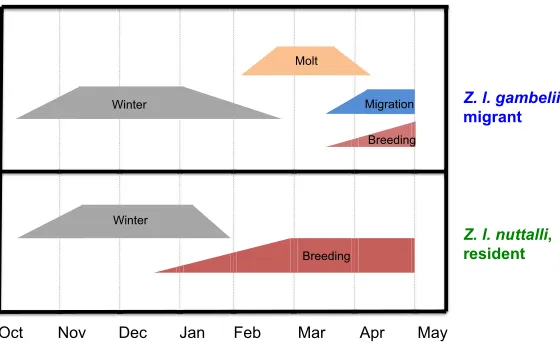
Comparisons of the subspecies were made under common garden conditions in which photoperiod and housing were identical for both. Populations selected for the study reside at the same latitude (38°N) for 7 months of the year once migrants arrive following autumn migration from the breeding grounds. During these months, residentZ. l. nuttalliconcentrate along the coastal zone of northern California while the migrantZ. l. gambelii is more prominent in the Central Valley and foothills of the Sierra Nevada Range of California. Despite exposure to identical photoperiod from October through April, two major differences exist: ecological conditions and respective life histories.Zonotrichia l. nuttalli expresses two life history stages – winter and breeding – while the migrant, Z. l. gambelii, experiences four –winter, prenuptial molt, vernal migration and preparations for the breeding stage (Fig. 1). Such distinctions provide a unique pallet for a comparative study of the role of the environment on life history events of the two subspecies. According to finite state machine theory (Jacobs and Wingfield, 2000; Wingfield, 2008), species with a greater number of life history stages per annum have higher finite stage diversity (FSD) than those with a fewer number of stages (Colwell, 1974; Jacobs and Wingfield, 2000; Wingfield, 2008; Wingfield et al., 1992a). Therefore, migratoryZ. l. gambeliiare identified as having higher FSD thanZ. l. nuttalli (Wingfield, 2008; Wingfield et al., 1999). Received 17 August 2016; Accepted 25 January 2017
1Department of Neurobiology Physiology Behavior, University of California, Davis, Davis, CA 95616, USA.2David Geffen School of Medicine, University of California, Los Angeles, Los Angeles, CA, 90095, USA.3MTA-DE‘Lendület’Behavioral Ecology Research Group, Department of Evolutionary Zoology, University of Debrecen, Egyetem tér 1., Debrecen 4032, Hungary.
*Author for correspondence ([email protected])
M.R., 0000-0002-3694-8464
Journal
of
Experimental
Given that all life history stages have a developmental, mature capability and termination phase, each require time to complete. One hypothesis is that organisms with greater FSD have less flexibility in timing and duration of each stage as scheduling is tight. However, with fewer stages,Z. l. nuttallihas more time if one stage is delayed in onset as there is adequate opportunity for its full expression (Wingfield, 2008). Given this, flexibility in timing onset of the developmental stages of the vernal events – breeding for Z. l. nuttalli and prenuptial molt, migration and breeding for Z. l. gambelii–would differ.
Accordingly, individuals with distinct life histories will respond differently to environmental cues. For example,Zonototrichiaspp., like many north temperate species, are known to be highly photoperiodic (Farner and Lewis, 1971; Lewis, 1975; Moore et al., 1982; Wingfield et al., 1996, 1997). Specifically, both subspecies held on short-day photoperiods require exposure to the increasing day lengths of spring for activation of the HPG to initiate development of migratory and breeding life history stages (Farner, 1950; Lewis, 1975; Mewaldt and King, 1977; Ramenofsky, 2011). It then follows that migrants with higher FSD should respond differently to the initial predictive cue, photoperiod, to regulate expression of the spring stages than residents with lower FSD. This response allows migrants such as Z. l. gambelii to synchronize timing and progression of seasonal events on the wintering grounds with a timely arrival at the distant breeding site. For the resident, Z. l. nuttalli, residing at only one location, responsiveness to initial predictive information is relevant to initiate development of the breeding stage but with much more flexibility as to when actual nesting begins (Davies et al., 2015; Visser et al., 2009; Wingfield and Silverin, 2009). Therefore, it is possible that Z. l. nuttalli, without the complications of a migratory life history stage, would be far less constrained to initiate development of the breeding stage than Z. l. gambelii (Davies et al., 2015; Visser et al., 2009; Wingfield and Silverin, 2009). If so,Z. l. nuttalli should begin development of the breeding stage earlier thanZ. l. gambeliiwhen both are held under common photoperiod and housing conditions. ForZ. l. gambelii, this results in a compressed progression through the spring stages to include prenuptial molt that precedes development and expression of the migratory traits. Taken together, we propose that the initiation of the spring events for the two subspecies will be distinct, with the goal to investigate the regulatory mechanisms involved in the precise timing and temporal progression of life history stages of the migratory subspecies.
Considering regulatory mechanisms that may be involved, Lofts and Murton (1968) suggested that the manner by which organisms perceive and respond to day length relates to specific patterns of migration and breeding. For example, species and population differences are based on the degree of sensitivity to day length, which influences the onset and termination of breeding. Species with greater sensitivity–lower thresholds–are those that respond to shorter day lengths, i.e. earlier in spring, before the vernal equinox, whereas those with higher thresholds require longer day lengths to induce an HPG response, allowing development of the spring migratory stage before the breeding stage.
Using an FSD framework, we pose the following hypothesis with four predictions to investigate potential distinctions in mechanisms regulating the development and expression of the vernal life history stages of the two subspecies. Migrants with higher FSD respond differently than residents with lower FSD to the initial predictive cue, photoperiod, to initiate and integrate the progression of vernal stages of prenuptial molt, migration and development of breeding. If the differences in vernal phenology are genetic, then in a common garden of environmental conditions, both subspecies will maintain their dissimilarities in timing and temporal progression of vernal events. By contrast, should environmental conditions dominate, then no distinctions across the shared stages will be apparent.
The four predictions are as follows. (1) Gonadal activity: residents will show a lower threshold of gonadal development to increasing spring photoperiods than migrants. Therefore, growth and development of reproductive organs, cloacal gland and testes of residents will be advanced over those of migrants. (2) Body condition: migrants, but not residents, will display molt, fattening, body mass increases, flight muscle hypertrophy and elevated hematocrit in preparation for migration. (3) Steroid hormones: as the life history stages of the subspecies diverge throughout the progression of the vernal events, the timing and magnitude of androgen and corticosterone secretions in residents will exceed those of migrants. (4) Migratory behavior: nocturnal migratory restlessness will be displayed only by migrants.
MATERIALS AND METHODS Field methods
Seed-baited potter traps and Japanese mist nets were used to capture adult maleZ. l. gambelii(N=12) on their wintering grounds in Yolo County, California (38°33′N, 121°44′W), and adult male Z. l. nuttalli (N=11) along coastal Sonoma County, California (38°31′N, 123°06′W), between November and December 2012. Oct Nov Dec Jan Feb Mar Apr May
Z. l. gambelii, migrant
Z. l. nuttalli, resident
Breeding Breeding Migration Molt
Winter
[image:2.612.51.331.57.231.2]Winter
Fig. 1. On an annual basis, the life history stages of the migrant, Zonotrichia leucophrys gambelii, and resident,Z. l. nuttalli, are best aligned starting in October, once migrants arrive on wintering grounds at the conclusion of autumn migration.At this time, both subspecies experience the development and expression of the wintering stage, after which they diverge with the development of the vernal stages that include breeding for the resident, and prenuptial molt, spring migration and breeding for the migrant. The present study ran for 5 months commencing in December and concluded at the beginning of May, so that only the developmental phase of breeding in the migrant was noted. Each stage is depicted as a trapezoid figure composed of a
developmental phase (left-pointing triangle of the trapezoid) in which the molecular and biochemical mechanisms are initiated so that once completed, organisms can fully express the behavior and physiology of the stage at mature capability (central rectangle), all of which are discontinued at termination (right-pointing triangle), allowing for the appearance of the next stage.
Journal
of
Experimental
Body size was assessed by measurements of the relaxed wing chord and tarsus length using calipers (to the nearest 0.1 mm). Sex was determined initially by wing length and confirmed subsequently by unilateral laparotomy.
Laboratory conditions
Birds were brought into captivity and held in quarantine for 1.5 weeks in flight aviaries, after which each subject was placed in individual registration cages (35×40×45 cm, width×length×height) equipped with a photo-detector (Alarm Entry Device, RadioShack Corporation; Forth Worth, TX, USA) positioned 0–10 cm above a central perch and 34 cm above the bottom of the cage. Once a bird crossed the infrared beam emitted from the detector, an electronic signal was transmitted to a Mini Mitter Acquisition System – Vital View (Sun River, OR, USA). Continuous 24-h locomotor activity was recorded in 15 min bins and analyzed in hourly intervals per week for each bird over the entire 5 month study. The photoperiod was adjusted to track natural day lengths of 38.5°N using a Paragon EL72PC digital timer with daily temperatures ranging from 18 to 23°C. Birds were supplied with foodad libitumin the form of commercial bird seed containing millet, cracked corn and sunflower seeds (Mazuri Small Bird Maintenance Diet, 56A6; www.mazuri.com) and Health Blue Grit (Seed Factory, Ceres, CA, USA). Fresh drinking and bath water were provided daily. Nocturnal locomotor activity is not expressed in total darkness (Coverdill et al., 2006; Ramenofsky et al., 2008); therefore, low intensity illumination (Limelite Nightlight, Austin Innovations, TX, USA, <1.0 lux at the source measured by a Greenlee Digital Light Meter (93-172, Rockford, IL, USA), was positioned centrally in the room and visible to all cages.
Captive methods (14 December to 2 May)
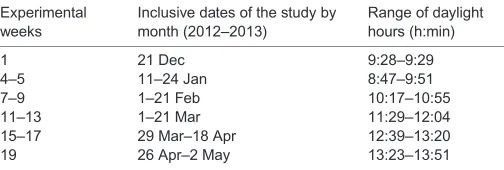
Once birds acclimated to individual cages, collection of morphological data commenced on 21 December (noted as week 1) and was repeated approximately twice monthly at the beginning and the middle of each month starting 3 h after sunrise (Table 1). First, body mass was determined to the nearest 0.1 g with a Pesola scale. Fat score was assessed visually by observing presence of lipid in the coelomic cavity and chorico-clavicular fossa with values that ranged from 0 (no observable fat) to 5 (bulging fat deposits) (Ramenofsky and Németh, 2014). Cloacal protuberance (CP) length was measured with calipers to the nearest 0.1 mm. Condition of the flight muscles ( pectoralis complex) was determined with a visual score of the muscle profile. Scores were based on four classes ranging from 0 to 3 following the methods of Bairlein (1994). Specifically, a score of 0 presents a sharp protruding edge of the keel
to touch and a notable concave muscle mass that is typical of emaciated birds. A score of 1 has a sharp keel edge but the muscle bulges out slightly. A score of 2 has muscle that is convex in shape but the keel edge can be felt between both left and right muscle masses. And with a score of 3, the fibers of the pectoralis rise above the keel that is now embedded in the bulging muscle.
Migratory restlessness
Migratory restlessness, also called Zugunruhe, is the elevated nocturnal locomotor activity expressed in captive birds during the migratory periods that corresponds with the migration of free-living congeners (Berthold and Querner, 1988; Farner et al., 1954; Ramenofsky et al., 2003). Extensive analyses of the 24 h locomotor recordings of both migrant and resident white-crowned sparrows have identified distinguishing features during the spring migratory stage: (1) maximal nocturnal activity exceeds that of the photophase (light phase) (Coverdill et al., 2006; Ramenofsky et al., 2008) and (2) expression of the intense nocturnal activity commences with onset of the scotophase (dark phase). In the present study, we used these criteria to verify that the elevated nocturnal locomotor activity was in fact expression of migratory restlessness in the spring migrants.
Molt
Presence of prenuptial molt was determined by scoring three body regions in both subspecies: crown, back (including nape, back and rump) and abdomen (including throat, breast, abdomen and flanks) following Ramenofsky and Németh (2014). Each region was given a score between 0 and 3 depending on the extent of molting feathers: 0, no molt (0%); 1, light molt (1–10% area); 2, moderate molt (11–50% area); and 3, heavy molt (51–100% area). Scores from each region were summed to generate a total molt score for each bi-weekly measurement.
Blood sampling
Blood samples for corticosterone (CORT) and androgens [testosterone and 5α-dihydrotestosterone (DHT)] were collected on five dates approximately once per month starting the week of 15 January (noted as week 4; Table 1). For CORT, collection of the first blood sample was completed within 3 min of entering the room and represented baseline-level circulating glucocorticoid prior to the disturbance. Testosterone and DHT were measured in a second blood sample taken within 10 min of the disturbance. The standard stress restraint protocol was used to measure the second or stress-induced CORT sample that was collected 30 min after the initial disturbance and considered the active response to the capture and handling procedure (Wingfield et al., 1992b). All samples were collected into heparinized micro-hematocrit tubes. Samples were centrifuged for 5 min to separate the red blood cells from plasma according to Fair et al. (2007), and hematocrit was measured for every capillary tube from the baseline samples and then averaged to yield a mean hematocrit value following methods of Krause et al. (2015b). Plasma was subsequently aspirated and stored at −30°C until assayed according to Ramenofsky and Németh (2014).
CORT, DHT and testosterone radioimmunoassays
[image:3.612.48.300.605.690.2]Thawed samples were treated with a 2000 CPM dose of each3H DHT and testosterone to determine percent recovery for each sample. Steroids were extracted with ethyl ether, dried under nitrogen, reconstituted in 5% ethyl acetate in iso-octane and added to diatomaceous earth/glycol (50/50 ethylene and propylene glycol) microcolumns for partial purification. DHT was collected first in 10% redistilled ethyl acetate in iso-octane followed by testosterone Table 1. Experimental weeks aligned with the dates, ranges of
increasing daylight hours, and the locomotor, physiological and morphological measures recorded throughout the 5 months of the study
Experimental weeks
Inclusive dates of the study by month (2012–2013)
Range of daylight hours (h:min)
1 21 Dec 9:28–9:29
4–5 11–24 Jan 8:47–9:51 7–9 1–21 Feb 10:17–10:55 11–13 1–21 Mar 11:29–12:04 15–17 29 Mar–18 Apr 12:39–13:20 19 26 Apr–2 May 13:23–13:51 24 h locomotor recordings were collected continuously, blood samples were taken on weeks 4, 8, 12, 17 and 19, and all other morphometrics were recorded biweekly. The range of natural daylight hours that subjects experienced were calculated from sunrise/sunset records excluding civil twilight (https://www.
timeanddate.com/sun/usa/davis).
Journal
of
Experimental
in 20% ethyl acetate in iso-octane (Wingfield and Farner, 1975). Samples were dried under a stream of N2and reconstituted in 550 µl PBSG. Procedures for the preparation and extraction of the corticosterone were identical to those described above except that 2000 CPM of3H CORT was added to each sample for recovery determination and the extracted and reconstituted samples were put directly into the radioimmunoassay (RIA) because the antibody shows no cross-reactivity with other glucocorticoids present in white-crowned sparrow plasma samples (Landys et al., 2004; Wingfield and Farner, 1975). All samples were run in duplicate in multiple RIAs using DHT and testosterone curves that ranged from 3.9 to 1000 pg and CORT from 7.8 to 2000 pg (Landys et al., 2004; Ramenofsky and Németh, 2014). Recoveries for each steroid ranged as follows: DHT, 47–87%; testosterone, 30–70%; and CORT, 67–89%. The sensitivity of each steroid (as determined by the water blanks) and inter-assay variation were 0.33 ng per tube and 10.9% for DHT, 0.24 ng and 15% for testosterone, and 1.04 ng and 5% for CORT. Samples were combined with Ultima Gold scintillation fluid and then counted for 6 min or to within 2% accuracy on a Beckman 6500 Scintillation Counter. Final concentrations of each sample were calculated in units of ng ml−1of plasma following corrections for plasma volume and recovery counts. Labeled testosterone [1,2,6,7,16,17-3H(N)] (NET553250UC) and DHT (5α Androstan-17β-OL-3-One) [1,2,4,5,6,7-3H(N)] (NET453250UC) were purchased from PerkinElmer (Waltham, MA, USA) and rabbit anti-testosterone-3 (20R-TR018w, Lot 01916) from Fitzgerald Industries International (Acton, MA, USA). 3H CORT was purchased from PerkinElmer (NET 399250UC) and CORT antibody from Esoterix (B3-163, Calabasas Hills, CA, USA).
Gonad inspection by unilateral laparotomy
To confirm gender and determine testis length, unilateral laparotomy was conducted at the conclusion of the study (week 19). Each bird was deeply anesthetized with 2–4% isoflurane in oxygen via a Summit anesthesia vaporizer (Bend, OR, USA). Next, a small incision between the last two ribs provided visual access to the gonad, where length was measured. The incision was sealed with Nexaband Liquid (Abbott Labs, Chicago, IL, USA). Upon recovery, an intramuscular injection of Meloxicam-Metacam (5 µg kg−1, Boehringer Ingelheim, Fremont, CA, USA) was administered at a dose of 0.1 mg ml−1in sterile normal saline (Vedco Inc., St Joseph, MO, USA) for analgesia. Birds were observed postoperatively over the next 7 days. All procedures and animal handling were done in accordance with the University of California Davis Institutional Animal Care and Use Committee (IACUC protocol 17144) and conducted under the scientific collecting permits issued by the California Department of Fish and Wildlife (11024) and the US Fish and Wildlife Department (MB11826A-5).
Statistical analyses
All analyses were performed either in R version 3.2.4 (R Foundation for Statistical Computing, Vienna, Austria) with the glmmadmb package (Fournier et al., 2012) or SPSS Statistics Software (version 22.0, IBM, Armonk, NY, USA). First, morphological, hematocrit and hormone values were analyzed by fitting linear mixed-effects models (LMM) with sampling week, subspecies and their interactions as main effects and bird ID as a random effect accounting for the repeated sampling design. Distributions of variables were tested for normality with the Shapiro–Wilk test initially or after plotting the residuals versus the predicted values. Records of body mass represent a change from the initial measurement of each bird recorded on the first date of the study from that collected on the subsequent dates. Categorical data
– scores of muscle profile– were tested with a generalized linear mixed-effects model for repeated measures using a Wald chi-square statistic. For comparisons of the nocturnal locomotor activity of migrants and residents throughout the study, activity of the first 7 h of the dark or scotophase were averaged by week for each individual prior to analysis. Activity was modeled using a generalized linear mixed-effects model using a negative binomial distribution (‘nbinom1’in glmmadmb) with a random effect of individual to account for repeated sampling. The model included fixed effects of subspecies, week and their interaction. To verify that the elevated nocturnal activity recorded in the migrants from experimental week 15 onwards represented migratory restlessness, comparisons of activity measured during the photo and scotophases were drawn both within and across subspecies before and after the appearance of heightened nocturnal restlessness with paired and unpaired parametric and nonparametric tests, Wilcoxon signed-rank or Mann–Whitney U-tests, as required. All post hoctests comparing the subspecies were conducted with either a Student’st-test or Mann–WhitneyU-test with Bonferroni corrections and level of significance across all tests was set atP<0.05.
RESULTS
Molt and body condition
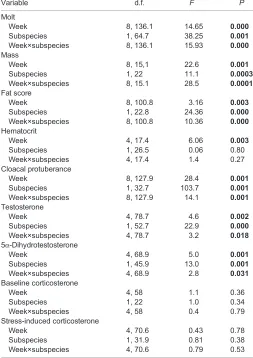
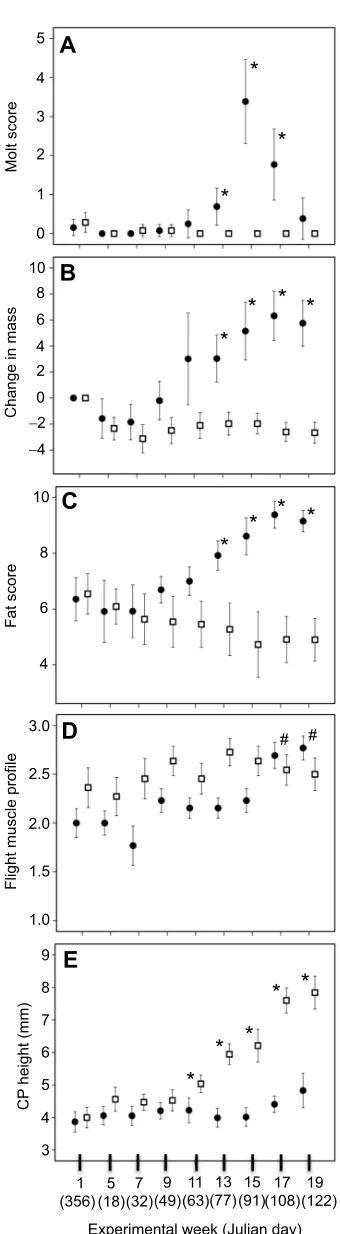
[image:4.612.311.564.371.729.2]Prenuptial molt was first noted during week 11 but only in migrants, and peaked by week 15 (P<0.05) and then subsided (Table 2,
Table 2. Mixed-effects model with repeated measures for effect of week and subspecies on morphological structures and plasma steroid hormones in migrant and resident white-crowned sparrows
Variable d.f. F P
Molt
Week 8, 136.1 14.65 0.000
Subspecies 1, 64.7 38.25 0.001
Week×subspecies 8, 136.1 15.93 0.000
Mass
Week 8, 15,1 22.6 0.001
Subspecies 1, 22 11.1 0.0003
Week×subspecies 8, 15.1 28.5 0.0001
Fat score
Week 8, 100.8 3.16 0.003
Subspecies 1, 22.8 24.36 0.000
Week×subspecies 8, 100.8 10.36 0.000
Hematocrit
Week 4, 17.4 6.06 0.003
Subspecies 1, 26.5 0.06 0.80 Week×subspecies 4, 17.4 1.4 0.27 Cloacal protuberance
Week 8, 127.9 28.4 0.001
Subspecies 1, 32.7 103.7 0.001
Week×subspecies 8, 127.9 14.1 0.001
Testosterone
Week 4, 78.7 4.6 0.002
Subspecies 1, 52.7 22.9 0.000
Week×subspecies 4, 78.7 3.2 0.018
5α-Dihydrotestosterone
Week 4, 68.9 5.0 0.001
Subspecies 1, 45.9 13.0 0.001
Week×subspecies 4, 68.9 2.8 0.031
Baseline corticosterone
Week 4, 58 1.1 0.36
Subspecies 1, 22 1.0 0.34 Week×subspecies 4, 58 0.4 0.79 Stress-induced corticosterone
Week 4, 70.6 0.43 0.78
Subspecies 1, 31.9 0.81 0.38 Week×subspecies 4, 70.6 0.79 0.53
Bold font denotes statistical significance.
Journal
of
Experimental
Fig. 2A). The three measures of body condition included changes in body mass, fat score and flight muscle profile. Mass and fat score increased in migrants over residents by week 13 (P<0.05; Tables 2, 3, Fig. 2B–D), but flight muscle score rose only in the migrants by week 17 (P<0.05; Fig. 2D).
Blood components and reproductive structures
Hematocrit increased in both subspecies without distinction between the subspecies (P>0.05; Table 2, Fig. 3A). Elevations of plasma testosterone were first noted inZ. l. nuttalliin week 8, with DHT rising 4 weeks later (Table 2, Fig. 3B,C).Zonotrichia l. gambelii showed no elevation of androgens until the end of the study (week 19), emphasizing the distinct pattern of androgen secretion, with residents showing earlier onset and greater magnitude increase. Changing in parallel with plasma steroids, CP of the residents started increasing by week 11 and continued throughout the remainder of the study, whereas the migrants initiated only a modicum of growth by week 19 (Table 2, Fig. 2E). Testis length assessed by laparotomy at the conclusion of the study (week 19) was greatest inZ. l. nuttalli (t-test: t1,22=−6.59, P<0.001; Table 4). There were no significant correlations of circulating levels of androgen with either morphological measure of CP height or testis length in either subspecies (P>0.14 in all cases). Neither measure of plasma CORT– baseline or stress-induced–changed throughout the study or differed across the subspecies (P>0.05; Fig. 3D,E).
Migratory behavior
Starting in week 1, low-level nocturnal locomotor activity was detected in both subspecies until week 15, when the frequency increased significantly in migrants, reaching a peak in week 17 (P<0.05; Table 4, Fig. 4A). To verify that this activity represented migratory restlessness, we used the criteria established previously for Z. l. gambelii (Agatsuma and Ramenofsky, 2006; Coverdill et al., 2011; Ramenofsky and Németh, 2014). Prior to week 15, the 24 h locomotor activity patterns of both subspecies were similar (Fig. 4B). Pair-wise comparisons of activity recorded during the scoto- and photophases were distinct (Z. l. gambelii,T=−4.1,n=11, P=−0.002;Z. l. nuttalli,T=−8.41,n=10,P=0.000). But from week 15, the nocturnal locomotor activity exceeded that of the photophase in Z. l. gambelii (Z=−2.12,P=0.03,n=12), whereas photophase activity exceeded that of the scotophase inZ. l. nuttalii (Z=−2.9, P=0.003,n=11; Fig. 4C). Furthermore, pair-wise comparisons of mean hourly activity across the last 3 h of the photophase and the
*
Experimental week (Julian day)
A
1 (356)
5 (18)
7 (32)
9 (49)
11 (63)
13 (77)
15 (91)
17 (108)
19 (122)
B
C
D
E
*
*
*
*
*
*
*
*
*
*
#
*
*
*
*
*
#
3 4 5 6 7 8 9
CP
height (mm)
1.0 1.5 2.0 2.5 3.0
Flight muscle profile
4 6 8 10
Fat score
−4
−2
0 2 4 6 8
Change in mass
10 0 1 2 3
Molt score
[image:5.612.88.258.63.680.2]4 5
Fig. 2. Morphological comparisons across subspecies.Measurements of prenuptial molt (A), change in body mass from day 1 of study (B), fat score (C), score of flight muscle profile (D) and cloacal protuberance (CP) height (E) in
[image:5.612.313.566.670.729.2]Z. l. gambelii(filled circles,n=12) andZ. l. nuttalli(open squares,n=11) starting on 21 December (Julian day 356) and noted as week 1, then repeated twice monthly at the beginning and the middle of each month. Data are means±2 s.e.m. Mixed-effects model with repeated measures for effect of week and subspecies. Asterisks indicate statistical significance (*P<0.05) between subspecies on date indicated;#indicates significant increases over weeks 13 and 15 withinZ. l. gambelii.
Table 3. Generalized linear mixed-effects model for the categorical measures of flight muscle profile in white-crowned sparrows
Variable d.f. χ2 P
Flight muscle profile
Week 8 22.2 0.005
Subspecies 1 15.8 0.000
Week×subspecies 8 17.2 0.028
Bold denotes statistical significance.
Journal
of
Experimental
first 3 h of the scotophase detected a significant increase at onset for Z. l. gambelii(T=25.6,P=0.002), without any change observed in Z. l. nuttalli(T=−2.77,P=0.11).
DISCUSSION
Comparisons of migratory and resident subspecies of white-crowned sparrow reveal insights into the physiological mechanisms and constraints associated with migration. With regards to finite state machine theory (Ramenofsky and Wingfield, 2006; Wingfield, 2005), this study focuses on prenuptial molt and developmental phases of migratory and breeding life history stages. Fig. 1, drawn from field studies ofZonotrichia, illustrates progression of the vernal stages during which both subspecies inhabit the same latitude. As straightforward as this figure appears, what has not been tested directly is how the two subspecies prepare for the vernal stages under common garden conditions using the initial predictive cue – photoperiod. Consistent with earlier studies that compared the effects of day length with short-day controls in both subspecies (Blanchard, 1941; Farner, 1974; Lewis, 1975; Mewaldt and King, 1977), our results provide support for the hypothesis that both migrants and residents respond to onset of spring photoperiods, but the timing of the response differs. Development of the breeding stage ofZ. l. nuttalliprecedes that of the migratory and breeding stages of Z. l. gambelii. By contrast, the local predictive cue, temperature, had minimal effect on photoperiodically induced gonadal growth in Z. l. gambelii, whereas both temperature and precipitation altered the rate of recrudescence inZ. l. nuttalli(Blanchard, 1941; Wingfield et al., 1992a, 1996). This suggests that local (environmental) conditions have a greater impact on the rate of progression of breeding cycles in resident subspecies with lower FSD. However, this resident/migrant distinction may not hold true for an altitudinal migrant such as the western song sparrow (Melospiza melodia morphna), which winters at low elevation (0–10 m) and breeds in the Cascade Mountains of Washington State (500–1220 m) (Perfito et al., 2005). Exposure to low mountain temperatures slowed the rate of gonadal growth in comparison to low elevation temperatures, demonstrating the influence of conditions on the breeding grounds for a short-distance migrant that has the option to retreat until conditions improve on the breeding grounds. This would not be the case for arctic breeders such asZ. l. gambelii.
Prenuptial molt
[image:6.612.89.259.55.635.2]The first stage to develop in migrants was prenuptial molt, without observable changes inZ. l. nuttalli(Fig. 2A). In juvenile Z. l. gambelii, this molt serves to replace brown and white crown Table 4. Generalized linear mixed-effects model with negative binomial distribution of nocturnal locomotor activity in migrant and resident white-crowned sparrows and comparison of testis lengths
Variable
Nocturnal locomotor activity
Estimate s.e. Z P
Intercept 4.73 0.17 27.05 <0.0001
Subspecies 0.08 0.25 0.35 0.73
Week 0.04 0.01 4.73 <0.0001
Week×subspecies −0.06 0.01 −4.82 <0.0001
Testis length (mm)
Subspecies N mean±s.d. t P
Z. l. gambelii 12 7.01±0.75 6.5 <0.001
Z. l. nuttalli 10 9.17±0.85
Bold font denotes statistical significance. Testis length measurements were recorded on the final day of the study, 2 May, Julian day 122.
4 (15)
8 (44)
12 (73)
17 (106)
19 (119)
*
*
*
*
*
A
B
C
D
E
Experimental week (Julian day) 15
20 25 30
Induced corticosterone
(ng ml
−
1) 1 2 3 4 0 0.5 1.0 1.5 0.2 0.4 0.6 0.8
5
α
-Dihydrotestosterone (ng ml
−
1) 48 50 52
Hematocrit
54 56
Baseline corticosterone
(ng ml
−
1) 5
T
e
stosterone (ng ml
−
[image:6.612.314.564.90.213.2]1) 2.0 2.5
Fig. 3. Comparisons of blood components across subspecies.
Measurements of hematocrit (A), plasma levels of 5α-dihydrotestosterone (B), testosterone (C), baseline levels of corticosterone collected within 3 min of disturbance (D), and stress-induced levels of corticosterone collected at 30 min post disturbance (E) measured monthly throughout the study inZ. l. gambelii( filled circles,n=12) andZ. l. nuttalli
(open squares,n=11). Mixed-effects model with repeated measures for effect of week and subspecies. Asterisks indicates statistical significance (*P<0.05) between subspecies on date indicated. Data are
means±s.e.m.
Journal
of
Experimental
feathers with adult black and white plumage. Birds also replace body feathers to support insulating properties and protection from the environmental wear and tear experienced throughout migration and breeding (Jenni, 1994; King, 1968). Increased vascularization of the feather follicles, protein synthesis, and alterations in concentrations of blood and bone components also accompany feather replacement (Wingfield and Silverin, 2010). Thus birds incur major costs of time and energy but the contributions supporting body condition for ensuing stages are critical. Lack of a complete prenuptial molt in Z. l. nuttallimay be a result of the energy or time required for the breeding stage outstripping the need for a plumage upgrade. Black-crown males hold larger territories, yet brown-crown birds pair and breed, suggesting that age-related morphology may not constrain breeding success (Ralph and Pearson, 1971). Regulation of prenuptial molt is not well understood (Wingfield and Silverin, 2002), but Moore et al. (1982) showed that Z. l. gambelii held on short photoperiods (8 h:16 h light:dark) failed to molt while those maintained on constant photoperiod of 12 h:12 h light:dark did. In the present study, molt was first observed when photoperiod reached 11 h:13 h light:dark (Table 1), which may pinpoint a threshold for molt initiation in Z. l. gambelii (Fig. 2A). Thus, prenuptial molt is important for bolstering body condition in migrants facing long-distance travel but
requires time for progression of the stage preceding full preparation for migration.
Body condition
A major component of migratory preparation includes a notable increase in food intake– hyperphagia– that results in increased body mass and fat deposition (Morton, 1967; Ramenofsky and Wingfield, 2007). Fat (lipid) is a primary fuel that migratory species use for long-distance flight (Jenni and Jenni-Eiermann, 1998; McWilliams et al., 2004; Price et al., 2010; Ramenofsky, 1990). As mass and fat score peaked, flight muscle profile notably increased in Z. l. gambelii(Fig. 2D). Such enlargement or hypertrophy is due to increased size of flight muscle fibers and lipid deposition supporting enhanced power and fuel for migration, yet mechanisms controlling its development are largely unknown (Bauchinger and Biebach, 2005; Cornelius et al., 2013; Dietz et al., 2007; Gaunt et al., 1990; Marsh, 1984). Results from a comparative study of resident and migratory dark-eyed juncos (Junco hyemalis) during spring identified differential expression of genes for metabolism and transport of lipids in flight muscle of migrants (Fudickar et al., 2016b). Further evidence for enhanced utilization of lipid by flight muscle in migrants comes from the seasonal upregulation of fatty acid transporters, phospholipid composition, as well as oxidative enzymes in flight muscle of migratory
white-Photoperiod
B
C
*
*
*
A
0 500 1000 1500 2000 2500 0 500 1000 1500 2000 2500
Locomotor activity/hour
Locomotor activity/hour
0 200 400 600 800 1000
Locomotor activity/hour
[image:7.612.78.532.58.386.2]1 2 3 4 5 6 7 8 9 10 11 12 13 14 15 16 17 Week
Fig. 4. Comparisons of locomotor activity across subspecies.Nocturnal locomotor activity (average electronic beam breaks/h/week) recorded inZ. l. gambelii
(filled circles,n=12) andZ. l. nuttalli(open circles,n=11) throughout the study (A). Generalized linear mixed-effects model using a negative binomial distribution, asterisk indicatesP<0.05 and represents a significant difference between the subspecies on the date indicated, bars represents mean±s.e.m. Two exemplars of the 24 h locomotor activity (average electronic beam break per hour) tested with either a pairedt-test or Wilcoxon signed-rank test illustrating the elevated activity during the photophase and reduced levels during the scotophase in both subspecies recorded on 1 April, Julian day 91, week 13, before the appearance of migratory restlessness (B), and 28 April, Julian day 118, week 17, illustrating expression of the onset of migratory restlessness at scotophase in the migrant only (C). Each symbol represents a mean±s.e.m., black-filled horizontal bars designate the scotophase.
Journal
of
Experimental
throated (Zonotrichia albicollis) and white-crowned sparrows (McFarlan et al., 2009; Price et al., 2010). Taken together, these findings provide support for enhanced body condition ( prediction 2) in migrants as birds prepare for spring departure.
Hematocrit
Measures of hematocrit provide information about the oxygen-carrying capacity of blood and can be considered an indicator of the responsiveness to metabolic requirements. Previous findings report similar patterns of hematocrit in free-living populations of Z. l. gambelii and Z. l. nuttalliuntil levels escalated in migrants upon arrival on breeding grounds in May (Krause et al., 2015b). This may be explained by the increased energetic demands associated with migration and preparations for breeding. Yet in captivity, the photoperiodically induced changes in hematocrit generated comparable levels in both subspecies regardless of whether breeding or migratory features were expressed. By contrast, Chilgren and deGraw (1977) found a negative relationship of hematocrit with molt intensity inZ. l. gambelii. It is possible that our blood sampling schedule was insufficient to observe the more discreet changes in hematocrit. Nevertheless, unlike the other measures of body condition, no distinction across the subspecies of hematocrit was identified.
Timing of development and expression of breeding
Previous ecological studies noted the earliest recorded dates for presence of sperm in the seminiferous tubules of the testis and actual matings forZ. l. nuttalliwas 4 March (Blanchard, 1941; Mewaldt and King, 1977). However, more recent observations pinpoint mid to late March (Krause et al., 2015b). Both gonadotropins and testosterone are required for spermatogenesis (Ubuka et al., 2014), and our results show that plasma testosterone increases in Z. l. nuttalliby week 8 and DHT increases 4 weeks later (Fig. 3B,C). Using these data as benchmarks and considering that spermatogenesis requires at least a month for full development of spermatids, we calculated back to suggest that activation of the HPG may occur as early as January and possibly even late December, as suggested by Blanchard (1941) and Mewaldt et al. (1968). Thus, the total timing and magnitude of the androgen secretion observed in the resident throughout the study exceeded that of the migrant, and offers support for the androgen profile component of the steroid hormone prediction ( prediction 3). It is also possible that Z. l. nuttalli may be less sensitive thanZ. l. gambeliito some inhibitory environmental factors affecting the transduction of the photic signal impinging upon thyroid hormones and deiodinase 2. This could alter the hypothalamic–pituitary–thyroid axis shown to regulate photoinduction of breeding in Japanese quail, Coturnix coturnix japonica (Yoshimura et al., 2003). In support, chemical inhibition of thyroid hormones impaired the development of migratory and breeding traits in Z. l. gambelii (Perez et al., 2016).
Reproductive structures
The cloacal protuberance (CP) functions to store and support delivery of sperm during copulation. Hypertrophy of the structure depends upon the seasonal increase of androgen, particularly the steroid action of DHT at the target tissue (Balthazart, 1983), and may serve as a qualitative measure for plasma levels of testosterone. Enlargement of the CP inZ. l. nuttallipreceded that ofZ. l. gambelii, providing additional evidence for the earlier developmental phase for breeding in the resident and support for the timing of gonadal activity prediction ( prediction 1) (Fig. 2E). However, neither
plasma testosterone nor DHT were significantly correlated with CP length, suggesting that development of this reproductive structure may be affected more at a threshold level rather than at discreet values of androgen. At the conclusion of the study, testis length of residents exceeded that of migrants (Table 4). However, such measures collected upon arrival at a northerly site of the breeding range (9.52±0.55 mm, mean±s.d.) exceeded those of the captive migrants (7.9±0.71 mm; t1,17=7.49, P<0.0002), indicating that development had yet to be achieved in the captive migrants. No correlation was found between plasma levels of testosterone or DHT and testis length in either subspecies, suggesting that both testicular recrudescence and spermatogenesis occur long before plasma levels of androgen peak.
Migratory behavior
A key measure of an individual’s propensity to migrate in captivity is the expression of nocturnal migratory restlessness in captive birds (Agatsuma and Ramenofsky, 2006). This behavior first appeared inZ. l. gambeliiby week 15 and continued to rise over the next 2 weeks (Fig. 4A). Onset of this activity was commensurate with the timing of migration in free-living birds throughout Yolo County (M.R. and Z.N., field observations). Prior to the appearance of migratory restlessness, both subspecies showed elevated activity early and late in the photophase coinciding with bouts of feeding (Agatsuma and Ramenofsky, 2006; Coverdill et al., 2011; Ramenofsky et al., 2008). Such observations highlight the behavioral and physiological similarities of the two subspecies during the winter stage. However, once migrants initiated migratory restlessness, the activity patterns diverged, providing support for the migratory behavior prediction ( prediction 4).
Plasma steroids in relation to behavior and physiology In light of the differential response to spring photoperiods, plasma levels of androgen inZ. l. nuttallipreceded and exceeded those of Z. l. gambelii by 7 weeks. If one considers onset of migratory restlessness as timing of departure (week 15, Fig. 4A), plasma levels of testosterone and DHT remained unchanged from winter, suggesting that androgens do not regulate the switch from diurnal to nocturnal activity inZ. l. gambelii, as proposed for European starlings (Sturnus vulgaris), dark-eyed juncos and gray catbirds (Dumetella carolinensis) (Owen et al., 2014; Subbaraj and Gwinner, 1985; Tonra et al., 2011). Identifying factors that regulate onset of migratory flight are enigmatic, but the neurosteroid 7α-hydroxypregnenolone may hold promise for its role in the diurnal locomotor activity in Japanese quail (Coturnix japonica) (Tsutsui et al., 2008, 2012).
Earlier timing of androgen elevations in Z. l. nuttalli offers support for a genetic basis underlying a lower threshold to photoperiod for the onset of breeding in comparison with Z. l. gambelii(Blanchard, 1941; Mewaldt et al., 1968).Zonotrichia l. nuttallimay well rely on local predictive cues (temperature, food availability) for regulation of the progression through the breeding stage without the complication of the added migratory life history stage. Should conditions degrade during development of the stage, Z. l. nuttallimay slow the rate of progress to onset of breeding given the more relaxed schedule and option for successive broods, neither of which is possible forZ. l. gambelii. Other comparative studies of migratory and resident species have recorded earlier onset of breeding parameters as well as earlier gene expression for reproductive mechanisms among residents, offering additional support for differential regulatory mechanisms relating to FSD (Atwell et al., 2014; Fudickar et al., 2016b; Grieves et al., 2016).
Journal
of
Experimental
Furthermore, we found no support for the prediction that CORT levels would differ in the two subspecies across the stages. The hypothalamic–pituitary–adrenal (HPA) axis responds to increased energetic demands associated with life history stage and perturbations in the environment (Eikenaar et al., 2015; Landys et al., 2006; Romero and Wingfield, 2015). In free-living birds, residents have slightly higher baseline and stress-induced levels of CORT during the winter months than migrants (Krause et al., 2014). Such differences in CORT in free-living birds may be attributed to differences in either behavior or environmental conditions between the two field sites. Comparing the local habitats for each subspecies
– coastal versus the Central Valley – each differs in terms of structure, floral and faunal communities, as well as climate, all of which likely contribute to differential demands and responses of the HPA axis. Furthermore, stress-induced levels are elevated upon arrival in spring and onset of breeding in free-livingZ. l. gambelii, whereasZ. l. nuttallishow a more muted response at the outset of their breeding stage (Addis et al., 2011; Krause et al., 2015a, 2016). However, under our common garden conditions without the imposition of natural environmental demands, birds showed similar baseline and stress-induced responses. By contrast, other studies of congeners or partial migratory populations report distinctions in either baseline or stress-induced levels of CORT, suggesting selection, developmental processes or season of sampling as possible causes (Angelier et al., 2011; Eikenaar et al., 2015; Fudickar et al., 2016a). Nevertheless, we found no support for the prediction that CORT levels would differ in the twoZonotrichia subspecies across the 5 months of the study, pointing to a strong influence of environment conditions on adrenal secretion.
Conclusions
Our results confirm that Z. l. gambelii (high FSD) responds differently thanZ. l. nuttalli(low FSD) to identical environmental conditions mimicking vernal phenology and support the premise that these differences across the subspecies have a genetic basis. The initial predictive cue, changing photoperiod, initiates and integrates the temporal progression of the spring stages – prenuptial molt, vernal migration and development of breeding–inZ. l. gambelii. In contrast, Z. l. nuttalli showed early gonadal recrudescence and maturation in the absence of competing life history stages (namely, molt and migration). These findings are consistent with the hypothesis that species with greater FSD have less flexibility in timing and duration of each stage given the greater number of stages to be completed within a year compared with species with lower FSD. The primary mechanism involved with the distinction is likely the increased sensitivity of the cue response system ofZ. l. nuttallito a shorter photoperiod following the annual nadir of winter solstice. This results in an earlier onset of the developmental phase of the breeding stage. Local and short-term environmental conditions may have contributed to hasten the earlier onset inZ. l. nuttallibecause in a resident population, local conditions are relevant for the timing of breeding. For migrants wintering in locations distant from their breeding grounds, timing of prenuptial molt and migration prior to reproductive development requires photoperiodic information, perhaps the most precise and consistent environmental cue. The vernal increase in day length maintains the pace of the life history stages so that birds arrive on breeding grounds at an appropriate time. The local predictive cues on the wintering grounds during the preparatory phases of the vernal life history stages would be largely irrelevant for timing. However, once on the breeding grounds, local conditions likely predominate to regulate progression of breeding. Mechanisms behind these distinctions
are not known but must involve perception, neuroendocrine transduction and response to the threshold levels of photoperiod (Wingfield, 2015). The result of these distinctions set the two subspecies on separate trajectories, with Z. l. nuttalli initiating and progressing through breeding earlier in the year while Z. l. gambelii requires a longer photoperiod to initiate development of molt, migration and gonadal recrudescence. This delay enables accurate scheduling for arrival on breeding grounds coincident with conditions conducive for reproduction.
Given the photoperiodic responsiveness and tight scheduling for a long-distance migrant, delays or advances of phenological conditions in spring on the breeding grounds would result in a mismatch of breeding readiness and optimal environmental conditions. Whether Z. l. gambelii with its high FSD is able to adjust remains uncertain compared withZ. l. nuttalli, with a lower FSD. The stage is now set for experiments manipulating initial predictive and local predictive cues in spring to determine whether resident Z. l. nuttalli integrates more environmental cues than Z. l. gambeliiand to identify the neural pathways involved.
Acknowledgements
We dedicate this work to the inspiring life and work of Professor Peter Marler, whose support to M.R. contributed to the beginning forays into the physiological and behavioral approaches to the studies of white-crowned sparrow migration. We appreciate the ideas and support for the many aspects of this study provided by Roni Chau, Tom Hahn and John Wingfield. Tom Hahn generously conducted the laparotomies at the conclusion of the study.
Competing interests
The authors declare no competing or financial interests.
Author contributions
Conceptualization: M.R., Z.N. Methodology: M.R., A.W.C., Z.N. Software: J.H.P., J.S.K. Validation: M.R. Formal analysis: J.H.P., J.S.K. Investigation: M.R., A.W.C., Z.N. Resources: M.R. Data curation: Z.N. Writing - original draft: M.R. Writing - review and editing: M.R., A.W.C., J.H.P., J.S.K., Z.N. Visualization: M.R., J.H.P., J.S.K. Supervision: M.R., Z.N. Project administration: M.R. Funding acquisition: M.R.
Funding
This work was supported by grants from the National Science Foundation to M.R. (IOS-0920791, ARC-1147289).
References
Addis, E. A., Davis, J. E., Miner, B. E. and Wingfield, J. C.(2011). Variation in circulating corticosterone levels is associated with altitudinal range expansion in a passerine bird.Oecologia167, 369-378.
Agatsuma, R. and Ramenofsky, M.(2006). Migratory behaviour of captive white-crowned sparrows,Zonotrichia leucophrys gambelii, differs during autumn and spring migration.Behaviour143, 1219-1240.
Alerstam, T., Hedenstrom, A. and Akesson, S.(2003). Long-distance migration: evolution and determinants.Oikos103, 247-260.
Angelier, F., Ballentine, B., Holberton, R., Mara, P. P. and Greenberg, R.(2011). What drives variation in the corticosterone stress response between subspecies? A common grden experiment of swamp sparrows (Melospiza georgiana)?J. Evol. Biol.241274-1283.
Atwell, J. W., Cardoso, G. C., Whittaker, D. J., Price, T. D. and Ketterson, E. D.
(2014). Hormonal, behavioral and life-history traits exhibit correlated shifts in relation to population establishment in a novel environment.Am. Nat. 184, E147-E160.
Bairlein, F.(1994)Manual of Field Methods. European-African Songbird Migration. Institut für Vogelforschung, Wilhelmshaven, Germany.
Balthazart, J.(1983). Hormonal correlates of behavior. InAvian Biology, Vol. VII (ed. D. S. Farner, J. R. King and K. C. Parkes), pp. 221-365. New York, London: Academic Press.
Bauchinger, U. and Biebach, H.(2005). Phenotypic flexibility of skeletal muscles during long-distance migration of garden warblers: muscle changes are differentially related to body mass.Ann. N. Y. Acad. Sci.1046, 271-281.
Berthold, P. and Querner, U.(1988). Was Zugunruhe wirklich ist–eine quantitative Bestimmung mit Hilfe von Video-aufnahmen bei Infrarotlichtbeleuchtung.
J. Ornithol.129, 372-375.
Journal
of
Experimental
Blanchard, B. D.(1941). The white-crowned sparrows (Zonotrichia leucophrys) of the Pacific seaboard: environment and annual cycle.Univ. Calif. Publ. Zool.46, 1-176.
Chilgren, J. D. and deGraw, W. A.(1977). Some blood characteristics of white-crowned sparrows during molt.Auk94, 169-171.
Colwell, R. K. (1974). Predictability, constancy, and contingency of periodic phenomena.Ecology55, 1148-1153.
Cornelius, J. M., Boswell, T., Jenni-Eiermann, S., Breuner, C. W. and Ramenofsky, M. (2013). Contribution of endocrinology to the migration life history of birds.Gen. Comp. Endocrinol.190, 47-60.
Coverdill, A. J., Clark, A. D. and Ramenofsky, M.(2006). A comparative study of migratory behavior in white-crowned sparrows (Zonotrichia leucophrys).Integr. Comp. Biol.46, E28-E28.
Coverdill, A. J., Clark, A. D., Wingfield, J. C. and Ramenofsky, M.(2011). Examination of nocturnal activity and behaviour in resident white-crowned sparrows (Zonotrichia leucophrys nuttalli).Behaviour148, 859-876.
Davies, S., Cros, T., Richard, D., Meddle, S. L., Tsutsui, K. and Deviche, P.
(2015). Food availability, energetic constraints and reproductive development in a wild seasonally breeding songbird.Funct. Ecol.29, 1421-1434.
Dietz, M. W., Piersma, T., Hedenstrom, A. and Brugge, M.(2007). Intraspecific variation in avian pectoral muscle mass: constraints on maintaining manoeuvrability with increasing body mass.Funct. Ecol.21, 317-326.
Eikenaar, C., Müller, F., Klinner, T. and Bairlein, F. (2015). Baseline corticosterone levels are higher in migrating than sedentary common blackbirds in autumn, but no in spring.Gen. Comp. Endocrinol.224, 121-125.
Fair, J., Whitaker, S. and Pearson, B.(2007). Sources of variation in haematocrit in birds.Ibis149, 535-552.
Farner, D. S.(1950). The annual stimulus for migration.Condor52, 104-122.
Farner, D. S.(1974). Photoperiodic controls and reproductive cycles inZonotrichia. InProceedings XVI International Ornithological Congress(ed. H. J. Frith and J. H. Calaby), pp. 369-382. Canberra, Australia: Australian Academy of Sciences.
Farner, D. S. and Lewis, R. A.(1971). Photoperiodism and reproductive cycles in birds.Photophysiology6, 325-370.
Farner, D. S., Mewaldt, L. R. and King, J. R.(1954). The diurnal activity patterns of caged migratory white-crowned sparrows in late winter and spring. J. Comp. Physiol. Psychol.47, 148-153.
Fournier, D. A., Skaug, H. J., Ancheta, J., Ianelli, J., Magnusson, A., Maunder, M. N., Nielsen, A. and Sibert, J.(2012). Ad model builder: using automatic differentiation for statistical inference of highly parameterized complex nonlinear models.Optim. Methods Softw.27, 233-249.
Fudickar, A. M., Grieves, T. J., Atwell, J. W., Stricker, C. A. and Ketterson, E. D.
(2016a). Reproductive allochrony in seaonally sympatric populations maintained by differential response to photoperiod: implication for population divergence and response to climate change.Am. Nat.187, 436-446.
Fudickar, A. M., Peterson, M. P., Grieves, T. J., Atwell, J. W., Bridge, E. S. and Ketterson, E. D.(2016b). Differential gene expression in seasonal sympatry; mechanisms involved in diverging life histories.Biol. Lett.12, 20160069.
Gaunt, A. S., Hikida, R. S., Jehl, J. R. and Fenbert, L.(1990). Rapid atrophy and hypertrophy of an avian flight muscle.Auk107, 649-659.
Gauthreaux, S. A. Jr(1982). The ecology and evolution of avian migration systems. InAvian Biology, Vol. 6 (ed. D. S. Farner, J. R. King and K. C. Parkes), pp. 93-168. New York: Academic Press.
Grieves, T. J., Fudickar, A. M., Atwell, J. W., Meddle, S.L. and Ketterson, E. D.
(2016). Early spring sex differences in luteinizing hormone response to gonadotropin releasing homrone in co-occuring resident and migrant dark-eyed juncos (Junco hyemalis).Gen. Comp. Endocrinol.236, 17-23.
Jacobs, J. D. and Wingfield, J. C.(2000). Endocrine control of life-cycle stages: a constraint on response to the environment?Condor102, 35-51.
Jenni, L.(1994).Moult and Ageing in European Passerines. London: Academic Press.
Jenni, L. and Jenni-Eiermann, S.(1998). Fuel supply and metabolic constraints in migration birds.J. Avian Biol.29, 521-258.
Ketterson, E. D., Fudickar, A. M., Atwell, J. W. and Grieves, T. J.(2015). Seasonal timing and population divergence: when to breed, when to migrate. Curr. Opin. Behav. Sci.6, 50-58.
King, J. R.(1968). Cycles of fat deposition and molt in white-crowned sparrows in constant environmental conditions.Comp. Biochem. Physiol.24, 827-837.
Krause, J. S., Dorsa, D. and Wingfield, J. C. (2014). Changes in plasma concentrations of progesterone, dehydroepiandrosterone and corticosterone in response to acute stress of capture, handling and restraint in two subspecies of white-crowned sparrows.Comp. Biochem. Physiol. A Mol. Integr. Physiol.177, 35-40.
Krause, J. S., Meddle, S. L. and Wingfield, J. C.(2015a). The effects of acute restraint stress on plasma levels of prolactin and corticosterone across life-history stages in a short-lived bird: Gambel’s white-crowned sparrow (Zonotrichia leucophrys gambelii).Physiol. Biochem. Zoolog.88, 589-598.
Krause, J. S., Németh, Z., Pérez, J. H., Chmura, H. E., Ramenofsky, M. and Wingfield, J. C.(2015b). Annual hematocrit profiles in two sub-species of white-crowned sparrows: a migrant and resident comparison.Physiol. Biochem. Zool. 89, 51-60.
Krause, J. S., Chmura, H. E., Pérez, J. H., Quach, L. N., Asmus, A., Word, K. R., McGuigan, M. A., Sweet, S. K., Meddle, S. L., Gough, L. et al.(2016). Breeding on the leading edge of a northward range expansion: differences in morphology and the stress response in the arctic Gambel’s white-crowned sparrow.Oecologia 180, 33-44.
Landys, M. M., Wingfield, J. C. and Ramenofsky, M. (2004). Plasma corticosterone increases during migratory restlessness in the captive white-crowned sparrowZonototrichia leuchophrys gambelii.Horm. Behav.46, 574-581.
Landys, M. M., Ramenofsky, M. and Wingfield, J. C. (2006). Actions of glucocorticoids at a seasonal baseline as compared to stress-related levels in the regulation of periodic life processes.Gen. Comp. Endocrinol.148, 132-149.
Lewis, R. A. (1975). Reproductive biology of the white-crowned sparrow. II. Environmental control of reproductive and associated cycles. Condor 77, 111-124.
Lofts, B. and Murton, R. K.(1968). Photoperiodic and physiological adaptations regulating avian breeding cycles and their ecological significance.J. Zool.155, 327-394.
Marsh, R. L.(1984). Adaptations of the gray catbird,Dumetella carolinensisto long-distance migration: flight muscle hypertophy associated with elevated body mass. Physiol. Zoolog.57, 105-117.
McFarlan, J. T., Bonen, A. and Guglielmo, C. G.(2009). Seasonal upregulation of fatty acid transporters in flight muscles of migratory white-throated sparrows (Zonotrichia albicollis).J. Exp. Biol.212, 2934-2940.
McWilliams, S. R., Guglielmo, C., Pierce, B. and Klaassen, M.(2004). Flying, fasting, and feeding in birds during migration: a nutritional and physiological ecology perspective.J. Avian Biol.35, 377-393.
Mewaldt, L. R. and King, J. R.(1977). The annual cycle of white-crowned sparrows (Zonotrichia leucophrys nuttalli) in coastal California.Condor79, 445-455.
Mewaldt, L. R., Kibby, S. S. and Morton, M. L.(1968). Comparative biology of Pacific coastal white-crowned sparrows.Condor70, 14-30.
Moore, M. C., Donham, R. S. and Farner, D. S.(1982). Physiological preparation for autumnal migration in white-crowned sparrows.Condor84, 410-419.
Morton, M. L. (1967). Diurnal feeding patterns in white-crowned sparrows, Zonotrichia leucophyrs gambelii.Condor69, 491-512.
Morton, M. L. (2002). The mountain white-crowned sparrow: migration and reproduction at high altitude. InStudies in Avian Biology, Vol. 24 (ed. J. T. Rottenberry), pp. 236. Lawrence, KS: Cooper Ornithological Society.
Owen, J. C., Garvin, M. C. and Moore, F. R.(2014). Elevated testosterone advances onset of migratory restlessness in a nearctic-neotropical landbird. Behav. Ecol. Sociobiol.68, 561-569.
Pérez, J. H., Furlow, J. D., Wingfield, J. C. and Ramenosky, M.(2016). Regulation of vernal migration in Gambel’s white-crowned sparrows: role of thyroxine and triiodothyronine.Horm. Behav.84, 50-56.
Perfito, N., Meddle, S. L., Tramontin, A. D., Sharp, P. J. and Wingfield, J. C.
(2005). Seasonal gonadal recrudescence in song sparrows: response to temperature cues.Gen. Comp. Endocrinol.143, 121-128.
Piersma, T., Pérez-Tris, J., Mouritsen, H., Bauchinger, U. and Bairlein, F.(2005). Is there a‘migratory syndrome’common to all migrant birds?Ann N. Y. Acad Sci. 1046, 282-293.
Price, E. R., McFarlan, J. T. and Guglielmo, C. G.(2010). Preparing for migration: the effects of photoperiod and exercise on muscle oxidative enzymes, lipid transporters, and phospholipids in white-crowned sparrows.Physiol. Biochem. Zool.83, 252-262.
Pulido, F.(2007). The genetics and evolution of avian migration.Bioscience57, 165-174.
Ralph, C. J. and Pearson, C. A.(1971). Correlation of age, size of territory, plumage, and breeding success in white-crowned sparrows.Condor73, 77.
Ramenofsky, M.(1990). Fat storage and fat metabolism in relation to bird migration. Physiol. Ecophysiol. Aspects Bird Migr.214-231.
Ramenofsky, M.(2011). Hormones in migration and reproductive cycles of birds. In Hormones and Reproduction of Vertebrates, Vol. 4 (ed. D. Norris and K. H. Lopez), pp. 205-236. San Diego, CA: Academic Press.
Ramenofsky, M. and Németh, Z. (2014). Regulatory mechanisms for the development of the migratory phenotype: roles for photoperiod and the gonad. Horm. Behav.66, 148-158.
Ramenofsky, M. and Wingfield, J. C. (2006). Behavioral and physiological conflicts in migrants: the transition between migration and breeding.J. Ornithol. 147, 135-145.
Ramenofsky, M. and Wingfield, J. C.(2007). Regulation of migration.Bioscience 57, 135-143.
Ramenofsky, M., Agatsuma, R., Barga, M., Cameron, R., Harm, J., Landys, M. and Ramfar, T.(2003). Migratory behavior: new insights from captive studies. In Avian Migration(ed. P. Berthold, E. Gwinner and E. Sonnenschein), pp. 97-112. Berlin: Springer.
Ramenofsky, M., Agatsuma, R. and Ramfar, T.(2008). Environmental conditions affect the behavior of captive, migratory white-crowned aparrows.Condor110, 658-671.
Rand, A. L. (1948). Glaciation, an isolating factor in speciation. Evolution2,
314-321.
Journal
of
Experimental
Romero, L. M. and Wingfield, J. C.(2015).Tempests, Poxes, Predators and People: Stress in Wild Animals and how they Cope.Oxford: Oxford University Press.
Salewski, V., Kery, M., Herremans, M., Liechti, F. and Jenni, L.(2009). Estimating fat and protein fuel from fat and muscle scores in passerines.Ibis151, 640-653.
Subbaraj, E. and Gwinner, E.(1985). Differential effects of testosterone on the circadian rhythms of locomotor activity and feeding in the European starling. Naturewissenschaften72, 663-664.
Tonra, C. M., Marra, P. P. and Holberton, R. L. (2011). Early elevation of testosterone advances migratory preparation in a songbird.J. Exp. Biol.214, 2761.
Tsutsui, K., Haraguchi, S., Inoue, K., Miyabara, H., Suzuki, S. and Ubuka, T.
(2012). Control of circadian activity of birds by the interaction of melatonin with 7a-hydroxypregnenolone, a newly discovered neurosteroid stimulating locomotion. J. Ornithol.153, S235-S243.
Tsutsui, K., Inoue, K., Miyabara, H., Suzuki, H., Ogura, Y. and Haraguchi, S.
(2008). 7a-Hydroxypregnenolone mediates melatonin action underlying diurnal locomotor rhythms.J. Neurosci.28, 2158-2167.
Ubuka, T., Son, Y. L., Tobari, Y., Narihiro, M., Bentley, G. E., Kriegsfeld, L. J. and Tsutsui, K. (2014). Central and direct regulation of testicular activity by goandotropin-inhibitory hormone and its receptor.Front. Endocrinol.5, 8.
Visser, M. E., Holleman, L. J. M. and Caro, S. P.(2009). Temperature has a causal effect on avian timing of reproduction.R. Soc. B Biol. Sci.276, 2323-2331.
Winger, B. M., Barker, F. K. and Ree, R. H.(2014). Temperate origins of long-distance seasonal migration in new World songbirds.PNAS111, 12115-12120.
Wingfield, J. C. (2005). Flexibility in annual cycles of birds: implications for endocrine control mechanisms.J. Ornithol.146, 291-304.
Wingfield, J. C.(2008). Organization of vertebrate annual cycles: implications for control mechanisms.Philos. Trans. R. Soc. B Biol. Sci.363, 425-441.
Wingfield, J. C.(2015). Coping with change: a framework for environmental signals and how neuroendocrine pathways might respond.Front. Neuroendocrinol.37, 89-96.
Wingfield, J. C. and Farner, D. S.(1975). The determination of five steroids in avian plasma by radioimmunoassay and competitive protein binding.Steroids26, 311-327.
Wingfield, J. C. and Silverin, B.(2002). Ecophysiological studies of hormone-behavior relations in birds. InHormones, Brain and Behavior, Vol. 2 (ed. D. W. Pfaff, A. P. Arnold, A. M. Etgen, S. E. Fahrbach and R. T. Rubin), pp. 587-647. Amsterdam: Elsevier Science.
Wingfield, J. C. and Silverin, B.(2009). Ecophysiological studies of hormone-behavior relations in birds. InHormones and Behavior, 2nd edn (ed. D. W. Pfaff, A. P. Arnold, A. M. Etgen, S. E. Fahrbach and R. T. Rubin). New York: Academic Press.
Wingfield, J. C. and Silverin, B.(2010). Molt in birds and mammals: hormones and behavior. InEncyclopedia of Animal Behavior, Vol. 2 (ed. M. D. Breed and J. Moore), pp. 462-467. Oxford: Academic Press.
Wingfield, J. C., Hahn, T. P., Levin, R. and Honey, P.(1992a). Environmental predictablity and control of gonadal cycles in birds.J. Exp. Zool.261, 214-231.
Wingfield, J. C., Vleck, C. M. and Moore, M. C.(1992b). Seasonal changes of the adrenocortical response to stress in birds of the Sonoran desert.J. Exp Zool264, 419-428.
Wingfield, J. C., Hahn, T. P., Wada, M., Astheimer, L. B. and Schoech, S.(1996). Interrelationship of day length and temperature on the control of gonadal development, body mass, and fat score in white-crowned sparrows,Zonotrichia leucophrys gambelii.Gen. Comp. Endocrinol.101, 242-255.
Wingfield, J. C., Hahn, T. P., Wada, M. and Schoech, S. J.(1997). Effects of day length and temperature on gonadal development, body mass, and fat depots in white-crowned sparrows, Zonotrichia leucophrys pugetensis. Gen. Comp. Endocrinol.107, 44-62.
Wingfield, J. C., Jacobs, J. D., Tramontin, A. D., Perfito, N., Meddle, S., Maney, D. L. and Soma, K. K.(1999). Toward an ecological basis of hormone-behavior interactions in reproduction of birds. InReproduction in Context(ed. K. Wallen and J. Schneider), pp. 85-128. Cambridge, MA: MIT Press.
Yoshimura, T., Yasuo, S., Watanabe, M., Igo, M., Yamamura, T., Hirunagi, K. and Ebihara, S.(2003). Light-induced hormone conversion of T4 to T3 regulates photoperiodic response of gonads in birds.Nature426, 178-181.
Journal
of
Experimental