A Statistical Model for Lost Language Decipherment
Benjamin Snyder and Regina Barzilay CSAIL
Massachusetts Institute of Technology
{bsnyder,regina}@csail.mit.edu
Kevin Knight ISI
University of Southern California [email protected]
Abstract
In this paper we propose a method for the automatic decipherment of lost languages. Given a non-parallel corpus in a known re-lated language, our model produces both alphabetic mappings and translations of words into their corresponding cognates. We employ a non-parametric Bayesian framework to simultaneously capture both low-level character mappings and high-level morphemic correspondences. This formulation enables us to encode some of the linguistic intuitions that have guided human decipherers. When applied to the ancient Semitic language Ugaritic, the model correctly maps 29 of 30 letters to their Hebrew counterparts, and deduces the correct Hebrew cognate for 60% of the Ugaritic words which have cognates in Hebrew.
1 Introduction
Dozens of lost languages have been deciphered by humans in the last two centuries. In each case, the decipherment has been considered a ma-jor intellectual breakthrough, often the culmina-tion of decades of scholarly efforts. Computers have played no role in the decipherment any of these languages. In fact, skeptics argue that com-puters do not possess the “logic and intuition” re-quired to unravel the mysteries of ancient scripts.1 In this paper, we demonstrate that at least some of this logic and intuitioncanbe successfully mod-eled, allowing computational tools to be used in the decipherment process.
1
“Successful archaeological decipherment has turned out to require a synthesis of logic and intuition . . . that comput-ers do not (and presumably cannot) possess.” A. Robinson, “Lost Languages: The Enigma of the World’s Undeciphered Scripts” (2002)
Our definition of the computational decipher-ment task closely follows the setup typically faced by human decipherers (Robinson, 2002). Our in-put consists of texts in a lost language and a corpus of non-parallel data in a known related language. The decipherment itself involves two related sub-tasks: (i) finding the mapping between alphabets of the known and lost languages, and (ii) translat-ing words in the lost language into correspondtranslat-ing cognates of the known language.
While there is no single formula that human de-cipherers have employed, manual efforts have fo-cused on several guiding principles. A common starting point is to compare letter and word fre-quencies between the lost and known languages. In the presence of cognates the correct mapping between the languages will reveal similarities in frequency, both at the character and lexical level. In addition, morphological analysis plays a cru-cial role here, as highly frequent morpheme cor-respondences can be particularly revealing. In fact, these three strands of analysis (character fre-quency, morphology, and lexical frequency) are intertwined throughout the human decipherment process. Partial knowledge of each drives discov-ery in the others.
We capture these intuitions in a generative Bayesian model. This model assumes that each word in the lost language is composed of mor-phemes which were generated with latent coun-terparts in the known language. We model bilin-gual morpheme pairs as arising through a series of Dirichlet processes. This allows us to assign probabilities based both on character-level corre-spondences (using a character-edit base distribu-tion) as well as higher-level morpheme correspon-dences. In addition, our model carries out an im-plicit morphological analysis of the lost language, utilizing the known morphological structure of the related language. This model structure allows us to capture the interplay between the
and morpheme-level correspondences that humans have used in the manual decipherment process.
In addition, we introduce a novel technique for imposing structural sparsity constraints on character-level mappings. We assume that an ac-curate alphabetic mapping between related lan-guages will be sparse in the following way: each letter will map to a very limited subset of letters in the other language. We capture this intuition by adapting the so-called “spike and slab” prior to the Dirichlet-multinomial setting. For each pair of characters in the two languages, we posit an indicator variable which controls the prior likeli-hood of character substitutions. We define a joint prior over these indicator variables which encour-ages sparse settings.
We applied our model to a corpus of Ugaritic, an ancient Semitic language discovered in 1928. Ugaritic was manually deciphered in 1932, us-ing knowledge of Hebrew, a related language. We compare our method against the only existing decipherment baseline, an HMM-based character substitution cipher (Knight and Yamada, 1999; Knight et al., 2006). The baseline correctly maps the majority of letters — 22 out of 30 — to their correct Hebrew counterparts, but only correctly translates 29% of all cognates. In comparison, our method yields correct mappings for 29 of 30 let-ters, and correctly translates 60.4% of all cognates.
2 Related Work
Our work on decipherment has connections to three lines of work in statistical NLP. First, our work relates to research on cognate identifica-tion (Lowe and Mazaudon, 1994; Guy, 1994; Kondrak, 2001; Bouchard et al., 2007; Kondrak, 2009). These methods typically rely on informa-tion that is unknown in a typical deciphering sce-nario (while being readily available for living lan-guages). For instance, some methods employ a hand-coded similarity function (Kondrak, 2001), while others assume knowledge of the phonetic mapping or require parallel cognate pairs to learn a similarity function (Bouchard et al., 2007).
A second related line of work is lexicon in-duction from non-parallel corpora. While this research has similar goals, it typically builds on information or resources unavailable for ancient texts, such as comparable corpora, a seed lexi-con, and cognate information (Fung and McKe-own, 1997; Rapp, 1999; Koehn and Knight, 2002;
Haghighi et al., 2008). Moreover, distributional methods that rely on co-occurrence analysis oper-ate over large corpora, which are typically unavail-able for a lost language.
Finally, Knight and Yamada (1999) and Knight et al. (2006) describe a computational HMM-based method for deciphering an unknown script that represents a known spoken language. This method “makes the text speak” by gleaning character-to-sound mappings from non-parallel character and sound sequences. It does not relate words in different languages, thus it cannot encode deciphering constraints similar to the ones consid-ered in this paper. More importantly, this method had not been applied to archaeological data. While lost languages are gaining increasing interest in the NLP community (Knight and Sproat, 2009), there have been no successful attempts of their au-tomatic decipherment.
3 Background on Ugaritic
Manual Decipherment of Ugaritic Ugaritic
and Semitic scholar, later corrected the reading, expanding a set of translated words. Discoveries of additional tablets allowed Bauer, Dhorme and Virolleaud to revise their hypothesis, successfully completing the decipherment.
Linguistic Features of Ugaritic Ugaritic
shares many features with other ancient Semitic languages, following the same word order, gender, number, and case structure (Hetzron, 1997). It is a morphologically rich language, with triliteral roots and many prefixes and suffixes.
At the same time, it exhibits a number of fea-tures that distinguish it from Hebrew. Ugaritic has a bigger phonemic inventory than Hebrew, yield-ing a bigger alphabet – 30 letters vs. 22 in He-brew. Another distinguishing feature of Ugaritic is that vowels are only written with glottal stops while in Hebrew many long vowels are written us-ing homorganic consonants. Ugaritic also does not have articles, while Hebrew nouns and adjectives take definite articles which are realized as prefixes. These differences result in significant divergence between Hebrew and Ugaritic cognates, thereby complicating the decipherment process.
4 Problem Formulation
We are given a corpus in a lost language and a non-parallel corpus in a related language from the same language family. Our primary goal is to translate words in the unknown language by mapping them to cognates in the known language. As part of this process, we induce a lower-level mapping between the letters of the two alphabets, capturing the reg-ular phonetic correspondences found in cognates.
We make several assumptions about the writ-ing system of the lost language. First, we assume that the writing system is alphabetic in nature. In general, this assumption can be easily validated by counting the number of symbols found in the writ-ten record. Next, we assume that the corpus has been transcribed into electronic format, where the graphemes present in the physical text have been unambiguously identified. Finally, we assume that words are explicitly separated in the text, either by white space or a special symbol.
We also make a mild assumption about the mor-phology of the lost language. We posit that each word consists of a stem, prefix, and suffix, where the latter two may be omitted. This assumption captures a wide range of human languages and a variety of morphological systems. While the
cor-rect morphological analysis of words in the lost language must be learned, we assume that the in-ventory and frequencies of prefixes and suffixes in the known language are given.
In summary, the observed input to the model consists of two elements: (i) a list of unanalyzed word types derived from a corpus in the lost lan-guage, and (ii) a morphologically analyzed lexicon in a known related language derived from a sepa-rate corpus, in our case non-parallel.
5 Model
5.1 Intuitions
Our goal is to incorporate the logic and intuition used by human decipherers in an unsupervised sta-tistical model. To make these intuitions concrete, consider the following toy example, consisting of a lost language much like English, but written us-ing numerals:
• 15234(asked)
• 1525(asks)
• 4352(desk)
Analyzing the undeciphered corpus, we might first notice a pair of endings, -34, and -5, which both occur after the initial sequence 152- (and may like-wise occur at the end of a variety of words in the corpus). If we know this lost language to be closely related to English, we can surmise that these two endings correspond to the English ver-bal suffixes -ed and -s. Using this knowledge, we can hypothesize the following character corre-spondences: (3 =e), (4 =d), (5 =s). We now know that (4252 = des2) and we can use our knowl-edge of the English lexicon to hypothesize that this word isdesk, thereby learning the correspondence (2 = k). Finally, we can use similar reasoning to reveal that the initial character sequence 152- cor-responds to the English verbask.
As this example illustrates, human deci-pherment efforts proceed by discovering both character-level and morpheme-level correspon-dences. This interplay implicitly relies on a morphological analysis of words in the lost lan-guage, while utilizing knowledge of the known language’s lexicon and morphology.
pre-serve regular phonetic relationships between the two languages (as exemplified by cognates). As a result, each character in one language will map to a small number of characters in the other language (typically one, but sometimes two or three). By incorporating this structural sparsity intuition, we can allow the model to focus on on a smaller set of linguistically valid hypotheses.
Below we give an overview of our model, which is designed to capture these linguistic intuitions.
5.2 Model Structure
Our model posits that every observed word in the lost language is composed of a sequence of mor-phemes (prefix, stem, suffix). Furthermore we posit that each morpheme was probabilistically generated jointly with a latent counterpart in the known language.
Our goal is to find those counterparts that lead to high frequency correspondences both at the char-acter and morpheme level. The technical chal-lenge is that each level of correspondence (char-acter and morpheme) can completely describe the observed data. A probabilistic mechanism based simply on one leaves no room for the other to play a role. We resolve this tension by employing a non-parametric Bayesian model: the distributions over bilingual morpheme pairs assign probabil-ity based on recurrent patterns at the morpheme level. These distributions are themselves drawn from a prior probabilistic process which favors distributions with consistent character-level corre-spondences.
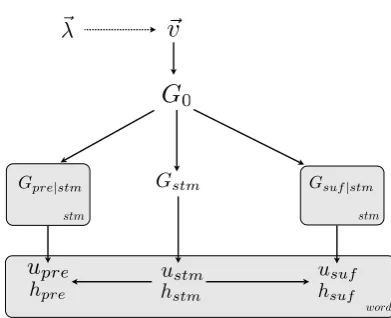
We now give a formal description of the model (see Figure 1 for a graphical overview). There are four basic layers in the generative process:
1. Structural sparsity: draw a set of indicator
variables ⃗λ corresponding to character-edit operations.
2. Character-edit distribution: draw a base
distributionG0 parameterized by weights on character-edit operations.
3. Morpheme-pair distributions: draw a set
of distributions on bilingual morpheme pairs Gstm, Gpre|stm, Gsuf|stm.
4. Word generation: draw pairs of cognates
in the lost and known language, as well as words in the lost language with no cognate counterpart.
G
0word
Gstm
ustm hstm
u
prehpre
usuf hsuf
stm stm
Gsuf|stm Gpre|stm
!
v
[image:4.595.328.524.75.234.2]!λ
Figure 1: Plate diagram of the decipherment model. The structural sparsity indicator variables ⃗λdetermine the values of the base distribution
hy-perparameters ⃗v. The base distribution G0 de-fines probabilities over string-pairs based solely on character-level edits. The morpheme-pair distri-butions Gstm, Gpre|stm, Gsuf|stm directly assign
probabilities to highly frequent morpheme pairs.
We now go through each step in more detail.
Structural SparsityThe first step of the
genera-tive process provides a control on the sparsity of edit-operation probabilities, encoding the linguis-tic intuition that the correct character-level map-pings should be sparse. The set of edit opera-tions includes character substituopera-tions, inseropera-tions, and deletions, as well as a special end sym-bol: {(u, h),(ϵ, h),(u, ϵ), EN D}(whereuandh range over characters in the lost and known lan-guages, respectively). For each edit operationewe posit a corresponding indicator variable λe. The
set of character substitutions with indicators set to one, {(u, h) : λ(u,h) = 1}) conveys the set of phonetically valid correspondences. We define a joint prior over these variables to encourage sparse character mappings. This prior can be viewed as a distribution overbinary matricesand is defined to encourage rows and columns to sum to low integer values (typically 1). More precisely, for each char-acteruin the lost language, we count the number of mappings c(u) = ∑hλ(u,h). We then define a set of features which count how many of these characters map toiother characters beyond some budget bi: fi = max (0,|{u:c(u) =i}| −bi).
lan-guage. The prior over⃗λis then defined as
P(⃗λ) = exp (⃗
f·w⃗ +f⃗′·w⃗)
Z (1)
where the feature weight vectorw⃗ is set to encour-age sparse mappings, and Z is a corresponding normalizing constant, which we never need com-pute. We setw⃗ so that each character must map to at least one other character, and so that mappings to more than one other character are discouraged2
Character-edit Distribution The next step in
the generative process is drawing a base distri-butionG0 over character edit sequences (each of which yields a bilingual pair of morphemes). This distribution is parameterized by a set of weightsϕ⃗ on edit operations, where the weights over substi-tutions, insertions, and deletions each individually sum to one. In addition,G0 provides a fixed dis-tributionqover thenumberof insertions and dele-tions occurring in any single edit sequence. Prob-abilities over edit sequences (and consequently on bilingual morpheme pairs) are then defined ac-cording toG0as:
P(⃗e) =∏
i
ϕei·q(#ins(⃗e),#del(⃗e))
We observe that the average Ugaritic word is over two letters longer than the average Hebrew word. Thus, occurrences of Hebrew character insertions area priorilikely, and Ugaritic character deletions are very unlikely. In our experiments, we set q to disallow Ugaritic deletions, and to allow one Hebrew insertion per morpheme (with probability 0.4).
The prior on the base distribution G0 is a Dirichlet distribution with hyperparameters⃗v, i.e., ⃗
ϕ ∼ Dirichlet(⃗v). Each value ve thus
corre-sponds to a character edit operatione. Crucially, the value of eachve depends deterministically on
its corresponding indicator variable:
ve=
{
1 ifλe= 0,
K ifλe= 1.
whereKis some constant value>1.3The overall effect is that whenλe= 0, the marginal prior
den-sity of the corresponding edit weightϕespikes at
2We setw0 =−∞, w1 = 0, w2 =−50, w
>2 =−∞, with budgetsb′2 = 7, b′3 = 1(otherwise zero), reflecting the knowledge that there are eight more Ugaritic than Hebrew letters.
3Set to 50 in our experiments.
0. Whenλe= 1, the corresponding marginal prior
density remains relatively flat and unconstrained. See (Ishwaran and Rao, 2005) for a similar appli-cation of “spike-and-slab” priors in the regression scenario.
Morpheme-pair Distributions Next we draw a
series of distributions whichdirectlyassign prob-ability to morpheme pairs. The previously drawn base distributionG0 along with a fixed concentra-tion parameterα define a Dirichlet process (An-toniak, 1974): DP(G0, α), which provides prob-abilities over morpheme-pair distributions. The resulting distributions are likely to be skewed in favor of a few frequently occurring morpheme-pairs, while remaining sensitive to the character-level probabilities of the base distribution.
Our model distinguishes between three types of morphemes: prefixes, stems, and suffixes. As a result, we model each morpheme type as arising from distinct Dirichlet processes, that share a sin-gle base distribution:
Gstm ∼ DP(G0, αstm)
Gpre|stm ∼ DP(G0, αpre)
Gsuf|stm ∼ DP(G0, αsuf)
We model prefix and suffix distributions as con-ditionally dependent on the part-of-speech of the stem morpheme-pair. This choice capture the lin-guistic fact that different parts-of-speech bear dis-tinct affix frequencies. Thus, while we draw a sin-gle distributionGstm, we maintain separate
distri-butions Gpre|stm and Gsuf|stm for each possible
stem part-of-speech.
Word Generation Once the morpheme-pair
distributions have been drawn, actual word pairs may now be generated. First the model draws a boolean variablecito determine whether wordiin
the lost language has a cognate in the known lan-guage, according to some priorP(ci). Ifci = 1,
then a cognate word pair(u, h)is produced:
(ustm, hstm) ∼ Gstm
(upre, hpre) ∼ Gpre|stm
(usuf, hsuf) ∼ Gsuf|stm
u=upreustmusuf
h=hprehstmhsuf
In summary, this model structure captures both character and lexical level correspondences, while utilizing morphological knowledge of the known language. An additional feature of this multi-layered model structure is that each distribution over morpheme pairs is derived from the single character-level base distribution G0. As a re-sult, any character-level mappings learned from one type of morphological correspondence will be propagated to all other morpheme distributions. Finally, the character-level mappings discovered by the model are encouraged to obey linguistically motivated structural sparsity constraints.
6 Inference
For each word ui in our undeciphered
lan-guage we predict a morphological segmentation
(upreustmusuf)iand corresponding cognate in the
known language (hprehstmhsuf)i. Ideally we
would like to predict the analysis with highest marginal probability under our model given the observed undeciphered corpus and related lan-guage lexicon. In order to do so, we need to integrate out all the other latent variables in our model. As these integrals are intractable to com-pute exactly, we resort to the standard Monte Carlo approximation. We collect samples of the vari-ables over which we wish to marginalize but for which we cannot compute closed-form integrals. We then approximate the marginal probabilities for undeciphered worduiby summing over all the
samples, and predicting the analysis with highest probability.
In our sampling algorithm, we avoid sam-pling the base distribution G0 and the derived morpheme-pair distributions (Gstm etc.), instead
using analytical closed forms. We explicitly sam-ple the sparsity indicator variables⃗λ, the cognate indicator variables ci, and latent word analyses
(segmentations and Hebrew counterparts). To do so tractably, we use Gibbs sampling to draw each latent variable conditioned on our current sample of the others. Although the samples are no longer independent, they form a Markov chain whose sta-tionary distribution is the true joint distribution de-fined by the model (Geman and Geman, 1984).
6.1 Sampling Word Analyses
For each undeciphered word, we need to sample a morphological segmentation(upre, ustm, usuf)i
along with latent morphemes in the known
lan-guage (hpre, hstm, hsuf)i. More precisely, we
need to sample three character-edit sequences ⃗epre, ⃗estm, ⃗esuf which together yield the observed
wordui.
We break this into two sampling steps. First we sample the morphological segmentation ofui,
along with the part-of-speech pos of the latent stem cognate. To do so, we enumerate each pos-sible segmentation and part-of-speech and calcu-late its joint conditional probability (for notational clarity, we leave implicit the conditioning on the other samples in the corpus):
P(upre, ustm, usuf, pos) =
∑
⃗ estm
P(⃗estm)
∑
⃗epre
P(⃗epre|pos)
∑
⃗ esuf
P(⃗esuf|pos)
(2)
where the summations over character-edit se-quences are restricted to those which yield the seg-mentation(upre, ustm, usuf) and a latent cognate
with part-of-speechpos.
For a particular stem edit-sequence ⃗estm, we
compute its conditional probability in closed form according to a Chinese Restaurant Process (An-toniak, 1974). To do so, we use counts from the other sampled word analyses:countstm(⃗estm)
gives the number of times that the entire edit-sequence⃗estmhas been observed:
P(⃗estm)∝
countstm(⃗estm) +α
∏
ip(ei)
n+α
wherenis the number of other word analyses sam-pled, andαis a fixed concentration parameter. The product∏ip(ei)gives the probability of⃗estm
ac-cording to the base distribution G0. Since the parameters ofG0 are left unsampled, we use the marginalized form:
p(e) = ve∑+count(e)
e′ve′ +k
(3)
where count(e) is the number of times that character-editeappears in distinct edit-sequences (across prefixes, stems, and suffixes), andkis the sum of these counts across all character-edits. Re-call that ve is a hyperparameter for the Dirichlet
prior onG0and depends on the value of the corre-sponding indicator variableλe.
Once the segmentation (upre, ustm, usuf) and
latent morphemes counterparts). Now, instead of summing over the values in Equation 2, we instead sample from them.
6.2 Sampling Sparsity Indicators
Recall that each sparsity indicator λe determines
the value of the corresponding hyperparameterve
of the Dirichlet prior for the character-edit base distributionG0. In addition, we have an unnormal-ized joint priorP(⃗λ) = g(Z⃗λ) which encourages a sparse setting of these variables. To sample a par-ticularλe, we consider the set⃗λin whichλe = 0
andλ⃗′ in whichλe= 1. We then compute:
P(⃗λ)∝g(⃗λ)·v
[count(e)]
e
∑
e′v
[k]
e′
where k is the sum of counts for all edit opera-tions, and the notationa[b]indicates the ascending factorial. Likewise, we can compute a probability forλ⃗′with corresponding valuesve′.
6.3 Sampling Cognate Indicators
Finally, for each wordui, we sample a
correspond-ing indicator variable ci. To do so, we
calcu-late Equation 2 for all possible segmentations and parts-of-speech and sum the resulting values to ob-tain the conditional likelihoodP(ui|ci = 1). We
also calculateP(ui|ci = 0)using a uniform
uni-gram character-level language model (and thus de-pends only on the number of characters inui). We
then sample from among the two values:
P(ui|ci= 1)·P(ci = 1)
P(ui|ci= 0)·P(ci = 0)
6.4 High-level Resampling
Besides the individual sampling steps detailed above, we also consider several larger sampling moves in order to speed convergence. For exam-ple, for each type of edit-sequence ⃗e which has been sampled (and may now occur many times throughout the data), we consider a single joint move to another edit-sequencee⃗′ (both of which yield the same lost language morpheme u). The details are much the same as above, and as before the set of possible edit-sequences is limited by the stringuand the known language lexicon.
We also resample groups of the sparsity indica-tor variables⃗λin tandem, to allow a more rapid ex-ploration of the probability space. For each char-acteru, we block sample the entire set{λ(u,h)}h,
and likewise for each characterh.
6.5 Implementation Details
Many of the steps detailed above involve the con-sideration of all possible edit-sequences consis-tent with (i) a particular undeciphered worduiand
(ii) the entire lexicon of words in the known lan-guage (or some subset of words with a particu-lar part-of-speech). In particuparticu-lar, we need to both sample from and sum over this space of possibil-ities repeatedly. Doing so by simple enumeration would needlessly repeat many sub-computations. Instead we use finite-state acceptors to compactly represent both the entire Hebrew lexicon as well as potential Hebrew word forms for each Ugaritic word. By intersecting two such FSAs and mini-mizing the result we can efficiently represent all potential Hebrew words for a particular Ugaritic word. We weight the edges in the FSA according to the base distribution probabilities (in Equation 3 above). Although these intersected acceptors have to be constantly reweighted to reflect changing probabilities, their topologies need only be com-puted once. One weighted correctly, marginals and samples can be computed using dynamic pro-gramming.
Even with a large number of sampling rounds, it is difficult to fully explore the latent variable space for complex unsupervised models. Thus a clever initialization is usually required to start the sam-pler in a high probability region. We initialize our model with the results of the HMM-based baseline (see section 8), and rule out character substitutions with probability<0.05according to the baseline.
7 Experiments
7.1 Corpus and Annotations
Words Morphemes type token type token
Baseline 28.82% 46.00% N/A N/A
[image:8.595.71.295.62.115.2]Our Model 60.42% 66.71% 75.07% 81.25% No Sparsity 46.08% 54.01% 69.48% 76.10%
Table 1: Accuracy of cognate translations, mea-sured with respect to complete word-forms and morphemes, for the HMM-based substitution ci-pher baseline, our complete model, and our model without the structural sparsity priors. Note that the baseline does not provide per-morpheme results, as it does not predict morpheme boundaries.
To evaluate the output of our model, we anno-tated the words in the Ugaritic lexicon with the corresponding Hebrew cognates found in the stan-dard reference dictionary (del Olo Lete and San-mart´ın, 2004). In addition, manual morphological segmentation was carried out with the guidance of a standard Ugaritic grammar (Schniedewind and Hunt, 2007). Although Ugaritic is an inflectional rather than agglutinative language, in its written form (which lacks vowels) words can easily be segmented (e.g.wyplt.nbecomeswy-plt.-n).
Overall, we identified Hebrew cognates for 2,155 word forms, covering almost 1/3 of the Ugaritic vocabulary.4
8 Evaluation Tasks and Results
We evaluate our model on four separate decipher-ment tasks: (i) Learning alphabetic mappings, (ii) translating cognates, (iii) identifying cognates, and (iv) morphological segmentation.
As a baseline for the first three of these tasks (learning alphabetic mappings and translating and identifying cognates), we adapt the HMM-based method of Knight et al. (2006) for learning let-ter substitution ciphers. In its original setting, this model was used to map written texts to spoken lan-guage, under the assumption that each character was emitted from a hidden phonemic state. In our adaptation, we assume instead that each Ugaritic character was generated by a hidden Hebrew let-ter. Hebrew character trigram transition probabili-ties are estimated using the Hebrew Bible, and He-brew to Ugaritic character emission probabilities are learned using EM. Finally, the highest
prob-4
We are confident that a large majority of Ugaritic words with known Hebrew cognates were thus identified. The remaining Ugaritic words include many personal and geo-graphic names, words with cognates in other Semitic lan-guages, and words whose etymology is uncertain.
ability sequence of latent Hebrew letters is pre-dicted for each Ugaritic word-form, using Viterbi decoding.
Alphabetic Mapping The first essential step
to-wards successful decipherment is recovering the mapping between the symbols of the lost language and the alphabet of a known language. As a gold standard for this comparison, we use the well-established relationship between the Ugaritic and Hebrew alphabets (Hetzron, 1997). This mapping is not one-to-one but is generally quite sparse. Of the 30 Ugaritic symbols, 28 map predominantly to a single Hebrew letter, and the remaining two map to two different letters. As the Hebrew alpha-bet contains only 22 letters, six map to two dis-tinct Ugaritic letters and two map to three disdis-tinct Ugaritic letters.
We recover our model’s predicted alphabetic mappings by simply examining the sampled val-ues of the binary indicator variablesλu,h for each
Ugaritic-Hebrew letter pair (u, h). Due to our structural sparsity priorP(⃗λ), the predicted map-pings are sparse: each Ugaritic letter maps to only a single Hebrew letter, and most Hebrew letters map to only a single Ugaritic letter. To recover alphabetic mappings from the HMM substitution cipher baseline, we predict the Hebrew letter h which maximizes the model’s probabilityP(h|u), for each Ugaritic letteru.
To evaluate these mappings, we simply count the number of Ugaritic letters that are correctly mapped to one of their Hebrew reflexes. By this measure, the baseline recovers correct mappings for 22 out of 30 Ugaritic characters (73.3%). Our model recovers correct mappings for all but one (very low frequency) Ugaritic characters, yielding 96.67% accuracy.
Cognate DeciphermentWe compare the
infre-0 0.2 0.4 0.6 0.8 1
False positive rate
0 0.2 0.4 0.6 0.8 1
T
[image:9.595.76.291.62.225.2]rue positive rate Our Model Baseline Random
Figure 2: ROC curve for cognate identification.
quent words. We also measure the average Leven-shtein distance between predicted and actual cog-nate word-forms. On average, our model’s pre-dictions lie 0.52 edit operations from the true cog-nate, whereas the baseline’s predictions average a distance of 1.26 edit operations.
Finally, we evaluated the performance of our model when the structural sparsity constraints are not used. As Table 1 shows, performance degrades significantly in the absence of these priors, indi-cating the importance of modeling the sparsity of character mappings.
Cognate identification We evaluate our
model’s ability to identify cognates using the sampled indicator variables ci. As before, we
compare our performance against the HMM substitution cipher baseline. To produce baseline cognate identification predictions, we calculate the probability of each latent Hebrew letter se-quence predicted by the HMM, and compare it to a uniform character-level Ugaritic language model (as done by our model, to avoid automatically assigning higher cognate probability to shorter Ugaritic words). For both our model and the baseline, we can vary the threshold for cognate identification by raising or lowering the cognate priorP(ci). As the prior is set higher, we detect
more true cognates, but the false positive rate increases as well.
Figure 2 shows the ROC curve obtained by varying this prior both for our model and the base-line. At all operating points, our model outper-forms the baseline, and both models always pre-dict better than chance. In practice for our model, we use a high cognate prior, thus only ruling out
[image:9.595.303.523.63.105.2]precision recall f-measure Morfessor 88.87% 67.48% 76.71% Our Model 86.62% 90.53% 88.53%
Table 2: Morphological segmentation accuracy for a standard unsupervised baseline and our model.
those Ugaritic word-forms which are very unlikely to have Hebrew cognates.
Morphological segmentation Finally, we
eval-uate the accuracy of our model’s morphological segmentation for Ugaritic words. As a baseline for this comparison, we use Morfessor Categories-MAP (Creutz and Lagus, 2007). As Table 2 shows, our model provides a significant boost in performance, especially for recall. This result is consistent with previous work showing that mor-phological annotations can be projected to new languages lacking annotation (Yarowsky et al., 2000; Snyder and Barzilay, 2008), but generalizes those results to the case where parallel data is un-available.
9 Conclusion and Future Work
In this paper we proposed a method for the au-tomatic decipherment of lost languages. The key strength of our model lies in its ability to incorpo-rate a range of linguistic intuitions in a statistical framework.
We hope to address several issues in future work. Our model fails to take into account the knownfrequency of Hebrew words and mor-phemes. In fact, the most common error is incor-rectly translating the masculine plural suffix (-m) as the third person plural possessive suffix (-m) rather than the correct and much more common plural suffix (-ym). Also, even with the correct al-phabetic mapping, many words can only be deci-phered by examining their literary context. Our model currently operates purely on the vocabulary level and thus fails to take this contextual infor-mation into account. Finally, we intend to explore our model’s predictive power when the family of the lost language is unknown.5
5
References
C. E. Antoniak. 1974. Mixtures of Dirichlet pro-cesses with applications to bayesian nonparametric problems. The Annals of Statistics, 2:1152–1174, November.
Alexandre Bouchard, Percy Liang, Thomas Griffiths, and Dan Klein. 2007. A probabilistic approach to diachronic phonology. In Proceedings of EMNLP, pages 887–896.
Mathias Creutz and Krista Lagus. 2007. Unsuper-vised models for morpheme segmentation and mor-phology learning. ACM Transactions on Speech and Language Processing, 4(1).
Jesus-Luis Cunchillos, Juan-Pablo Vita, and Jose-´
Angel Zamora. 2002. Ugaritic data bank. CD-ROM.
Gregoria del Olo Lete and Joaqu´ın Sanmart´ın. 2004. A Dictionary of the Ugaritic Language in the Alpha-betic Tradition. Number 67 in Handbook of Oriental Studies. Section 1 The Near and Middle East. Brill.
Pascale Fung and Kathleen McKeown. 1997. Find-ing terminology translations from non-parallel cor-pora. In Proceedings of the Annual Workshop on Very Large Corpora, pages 192–202.
S. Geman and D. Geman. 1984. Stochastic relaxation, gibbs distributions and the bayesian restoration of images. IEEE Transactions on Pattern Analysis and Machine Intelligence, 12:609–628.
Alan Groves and Kirk Lowery, editors. 2006. The Westminster Hebrew Bible Morphology Database. Westminster Hebrew Institute, Philadelphia, PA, USA.
Jacques B. M. Guy. 1994. An algorithm for identifying cognates in bilingual wordlists and its applicability to machine translation. Journal of Quantitative Lin-guistics, 1(1):35–42.
Aria Haghighi, Percy Liang, Taylor Berg-Kirkpatrick, and Dan Klein. 2008. Learning bilingual lexicons from monolingual corpora. In Proceedings of the ACL/HLT, pages 771–779.
Robert Hetzron, editor. 1997. The Semitic Languages. Routledge.
H. Ishwaran and J.S. Rao. 2005. Spike and slab vari-able selection: frequentist and Bayesian strategies. The Annals of Statistics, 33(2):730–773.
Kevin Knight and Richard Sproat. 2009. Writing sys-tems, transliteration and decipherment. NAACL Tu-torial.
K. Knight and K. Yamada. 1999. A computa-tional approach to deciphering unknown scripts. In ACL Workshop on Unsupervised Learning in Natu-ral Language Processing.
Kevin Knight, Anish Nair, Nishit Rathod, and Kenji Yamada. 2006. Unsupervised analysis for deci-pherment problems. In Proceedings of the COL-ING/ACL, pages 499–506.
Philipp Koehn and Kevin Knight. 2002. Learning a translation lexicon from monolingual corpora. In Proceedings of the ACL-02 workshop on Unsuper-vised lexical acquisition, pages 9–16.
Grzegorz Kondrak. 2001. Identifying cognates by phonetic and semantic similarity. InProceeding of NAACL, pages 1–8.
Grzegorz Kondrak. 2009. Identification of cognates and recurrent sound correspondences in word lists. Traitement Automatique des Langues, 50(2):201– 235.
John B. Lowe and Martine Mazaudon. 1994. The re-construction engine: a computer implementation of the comparative method. Computational Linguis-tics, 20(3):381–417.
Reinhard Rapp. 1999. Automatic identification of word translations from unrelated english and german corpora. InProceedings of the ACL, pages 519–526.
Andrew Robinson. 2002. Lost Languages: The Enigma of the World’s Undeciphered Scripts. McGraw-Hill.
William M. Schniedewind and Joel H. Hunt. 2007. A Primer on Ugaritic: Language, Culture and Litera-ture. Cambridge University Press.
Mark S. Smith, editor. 1955.Untold Stories: The Bible and Ugaritic Studies in the Twentieth Century. Hen-drickson Publishers.
Benjamin Snyder and Regina Barzilay. 2008. Cross-lingual propagation for morphological analysis. In Proceedings of the AAAI, pages 848–854.
Wilfred Watson and Nicolas Wyatt, editors. 1999. Handbook of Ugaritic Studies. Brill.