Extracting Narrative Timelines as Temporal Dependency Structures
Oleksandr Kolomiyets KU Leuven Celestijnenlaan 200A B-3001 Heverlee, Belgium Oleksandr.Kolomiyets@
cs.kuleuven.be
Steven Bethard University of Colorado
Campus Box 594 Boulder, CO 80309, USA
Steven.Bethard@ colorado.edu
Marie-Francine Moens KU Leuven Celestijnenlaan 200A B-3001 Heverlee, Belgium
Sien.Moens@ cs.kuleuven.be
Abstract
We propose a new approach to characterizing the timeline of a text: temporal dependency structures, where all the events of a narrative are linked via partial ordering relations likeBE -FORE,AFTER,OVERLAPandIDENTITY. We annotate a corpus of children’s stories with tem-poral dependency trees, achieving agreement (Krippendorff’s Alpha) of 0.856 on the event words, 0.822 on the links between events, and of 0.700 on the ordering relation labels. We compare two parsing models for temporal de-pendency structures, and show that a determin-istic non-projective dependency parser outper-forms a graph-based maximum spanning tree parser, achieving labeled attachment accuracy of 0.647 and labeled tree edit distance of 0.596. Our analysis of the dependency parser errors gives some insights into future research direc-tions.
1 Introduction
There has been much recent interest in identifying events, times and their relations along the timeline, from event and time ordering problems in the Temp-Eval shared tasks (Verhagen et al., 2007; Verhagen et al., 2010), to identifying time arguments of event structures in the Automated Content Extraction pro-gram (Linguistic Data Consortium, 2005; Gupta and Ji, 2009), to timestamping event intervals in the Knowledge Base Population shared task (Artiles et al., 2011; Amig´o et al., 2011).
However, to date, this research has produced frag-mented document timelines, because only specific types of temporal relations in specific contexts have
been targeted. For example, the TempEval tasks only looked at relations between events in the same or ad-jacent sentences (Verhagen et al., 2007; Verhagen et al., 2010), and the Automated Content Extraction pro-gram only looked at time arguments for specific types of events, likebeing bornortransferring money.
In this article, we propose an approach to temporal information extraction that identifies a single con-nected timeline for a text. The temporal language in a text often fails to specify a total ordering over all the events, so we annotate the timelines as tem-poral dependency structures, where each event is a node in the dependency tree, and each edge between nodes represents a temporal ordering relation such as BEFORE, AFTER, OVERLAP or IDENTITY. We construct an evaluation corpus by annotating such temporal dependency trees over a set of children’s stories. We then demonstrate how to train a time-line extraction system based on dependency parsing techniques instead of the pair-wise classification ap-proaches typical of prior work.
The main contributions of this article are:
• We propose a new approach to characterizing temporal structure via dependency trees.
• We produce an annotated corpus of temporal dependency trees in children’s stories.
• We design a non-projective dependency parser for inferring timelines from text.
The following sections first review some relevant prior work, then describe the corpus annotation and the dependency parsing algorithm, and finally present our evaluation results.
2 Related Work
Much prior work on the annotation of temporal in-formation has constructed corpora with incomplete timelines. The TimeBank (Pustejovsky et al., 2003b; Pustejovsky et al., 2003a) provided a corpus anno-tated for all events and times, but temporal relations were only annotated when the relation was judged to be salient by the annotator. In the TempEval compe-titions (Verhagen et al., 2007; Verhagen et al., 2010), annotated texts were provided for a few different event and time configurations, for example, an event and a time in the same sentence, or two main-clause events from adjacent sentences. Bethard et al. (2007) proposed to annotate temporal relations one syntactic construction at a time, producing an initial corpus of only verbal events linked to events in subordinated clauses. One notable exception to this pattern of incomplete timelines is the work of Bramsen et al. (2006) where temporal structures were annotated as directed acyclic graphs. However they worked on a much coarser granularity, annotating not the order-ing between individual events, but between multi-sentence segments of text.
In part because of the structure of the available training corpora, most existing temporal informa-tion extracinforma-tion models formulate temporal linking as a pair-wise classification task, where each pair of events and/or times is examined and classified as having a temporal relation or not. Early work on the TimeBank took this approach (Boguraev and Ando, 2005), classifying relations between all events and times within 64 tokens of each other. Most of the top-performing systems in the TempEval competitions also took this pair-wise classification approach for both event-time and event-event temporal relations (Bethard and Martin, 2007; Cheng et al., 2007; UzZa-man and Allen, 2010; Llorens et al., 2010). Systems have also tried to take advantage of more global in-formation to ensure that the pair-wise classifications satisfy temporal logic transitivity constraints, using frameworks such as integer linear programming and Markov logic networks (Bramsen et al., 2006; Cham-bers and Jurafsky, 2008; Yoshikawa et al., 2009; Uz-Zaman and Allen, 2010). Yet the basic approach is still centered around pair-wise classifications, not the complete temporal structure of a document.
Our work builds upon this prior research, both
improving the annotation approach to generate the fully connected timeline of a story, and improving the models for timeline extraction using dependency parsing techniques. We use the annotation scheme introduced in more detail in Bethard et. al. (2012), which proposes to annotate temporal relations as de-pendency links between head events and dependent events. This annotation scheme addresses the issues of incoherent and incomplete annotations by guaran-teeing that all events in a plot are connected along a single timeline. These connected timelines allow us to design new models for timeline extraction in which we jointly infer the temporal structure of the text and the labeled temporal relations. We employ methods from syntactic dependency parsing, adapt-ing them to our task by includadapt-ing features typical of temporal relation labeling models.
3 Corpus Annotation
The corpus of stories for children was drawn from the fables collection of (McIntyre and Lapata, 2009)1and annotated as described in (Bethard et al., 2012). In this section we illustrate the main annotation princi-ples for coherent temporal annotation. As an example story, consider:
Two Travellers were on the road together, when a Bear suddenly appeared on the scene. Before he observed them, one made for a tree at the side of the road, and climbed up into the branches and hid there. The other was not so nimble as his compan-ion; and, as he could not escape, he threw himself on the ground and pretended to be
dead. . . [37.txt]
Figure 1 shows the temporal dependency structure that we expect our annotators to identify in this story.
The annotators were provided with guidelines both for which kinds of words should be identified as events, and for which kinds of events should be linked by temporal relations. For identifying event words, the standard TimeML guidelines for anno-tating events (Pustejovsky et al., 2003a) were aug-mented with two additional guidelines:
1
Figure 1: Event timeline for the story of the Travellers and the Bear. Nodes are events and edges are temporal relations. Edges denote temporal relations signaled by linguistic cues in the text. Temporal relations that can be inferred via transitivity are not shown.
• Skip negated, modal or hypothetical events (e.g. could not escape,deadinpretended to be dead). • For phrasal events, select the single word that
best paraphrases the meaning (e.g. inused to snapthe event should besnap, inkept perfectly stillthe event should bestill).
For identifying the temporal dependencies (i.e. the ordering relations between event words), the anno-tators were instructed to link each event in the story to a single nearby event, similar to what has been observed in reading comprehension studies (Johnson-Laird, 1980; Brewer and Lichtenstein, 1982). When there were several reasonable nearby events to choose from, the annotators were instructed to choose the temporal relation that was easiest to infer from the text (e.g. preferring relations with explicit cue words likebefore). A set of six temporal relations was used:
BEFORE,AFTER,INCLUDES,IS-INCLUDED,IDEN
-TITYorOVERLAP.
Two annotators annotated temporal dependency structures in the first 100 fables of the McIntyre-Lapata collection and measured inter-annotator agree-ment by Krippendorff’s Alpha for nominal data (Krip-pendorff, 2004; Hayes and Krip(Krip-pendorff, 2007). For the resulting annotated corpus annotators achieved Alpha of 0.856 on the event words, 0.822 on the links between events, and of 0.700 on the ordering rela-tion labels. Thus, we concluded that the temporal dependency annotation paradigm was reliable, and the resulting corpus of 100 fables2could be used to
2
Available fromhttp://www.bethard.info/data/ fables-100-temporal-dependency.xml
train a temporal dependency parsing model.
4 Parsing Models
We consider two different approaches to learning a temporal dependency parser: a shift-reduce model (Nivre, 2008) and a graph-based model (McDonald et al., 2005). Both models take as input a sequence of event words and produce as output a tree structure where the events are linked via temporal relations. Formally, a parsing model is a function(W → Π)
where W = w1w2. . . wn is a sequence of event
words, andπ ∈Πis a dependency treeπ = (V, E)
where:
• V =W ∪ {Root}, that is, the vertex set of the graph is the set of words inW plus an artificial root node.
• E ={(wh, r, wd) :wh∈V, wd ∈V, r ∈R=
{BEFORE,AFTER,INCLUDES,IS INCLUDED, IDENTITY,OVERLAP}}, that is, in the edge set of the graph, each edge is a link between a de-pendent word and its head word, labeled with a temporal relation.
• (wh, r, wd)∈E =⇒ wd 6=Root, that is, the
artificial root node has no head.
• (wh, r, wd)∈E =⇒ ((w0h, r0, wd)∈E =⇒
wh=w0h∧r =r0), that is, for every node there
is at most one head and one relation label.
• E contains no (non-empty) subset of arcs
(wh, ri, wi),(wi, rj, wj), . . . ,(wk, rl, wh), that
SHIFT Move all ofL2and the head ofQontoL1
([a1. . . ai],[b1. . . bj],[wkwk+1. . .], E) → ([a1. . . aib1. . . bjwk],[],[wk+1. . .], E)
NO-ARC Move the head ofL1to the head ofL2
([a1. . . aiai+1],[b1. . . bj], Q, E) → ([a1. . . ai],[ai+1b1. . . bj], Q, E)
LEFT-ARC Create a relation where the head ofL1depends on the head ofQ
Not applicable ifai+1is the root or already has a head, or if there is a path connectingwkandai+1 ([a1. . . aiai+1],[b1. . . bj],[wk. . .], E) → ([a1. . . ai],[ai+1b1. . . bj],[wk. . .], E∪(wk, r, ai+1)
RIGHT-ARC Create a relation where the head ofQdepends on the head ofL1
Not applicable ifwkis the root or already has a head, or if there is a path connectingwkandai+1 ([a1. . . aiai+1],[b1. . . bj],[wk. . .], E) → ([a1. . . ai],[ai+1b1. . . bj],[wk. . .], E∪(ai+1, r, wk)
Table 1: Transition system for Covington-style shift-reduce dependency parsers.
4.1 Shift-Reduce Parsing Model
Shift-reduce dependency parsers start with an input queue of unlinked words, and link them into a tree by repeatedly choosing and performing actions like shifting a node to a stack, or popping two nodes from the stack and linking them. Shift-reduce parsers are typically defined in terms of configurations and a tran-sition system, where the configurations describe the current internal state of the parser, and the transition system describes how to get from one state to another. Formally, a deterministic shift-reduce dependency parser is defined as(C, T, CF,INIT,TREE)where:
• Cis the set of possible parser configurationsci
• T ⊆(C→ C)is the set of transitionstifrom one configurationcjto anothercj+1allowed by
the parser
• INIT∈(W →C)is a function from the input words to an initial parser configuration
• CF ⊆ C are the set of final parser
configura-tionscF where the parser is allowed to terminate
• TREE∈(CF →Π)is a function that extracts a
dependency treeπfrom a final parser statecF
Given this formalism and an oracleo ∈(C → T), which can choose a transition given the current con-figuration of the parser, dependency parsing can be accomplished by Algorithm 1. For temporal depen-dency parsing, we adopt the Covington set of transi-tions (Covington, 2001) as it allows for parsing the non-projective trees, which may also contain “cross-ing” edges, that occasionally occur in our annotated corpus. Our parser is therefore defined as:
Algorithm 1Deterministic parsing with an oracle.
c← INIT(W)
whilec /∈CF do
t←o(c)
c←t(c)
end while return TREE(c)
• c = (L1, L2, Q, E) is a parser configuration,
whereL1andL2are lists for temporary storage,
Qis the queue of input words, andEis the set of identified edges of the dependency tree.
• T ={SHIFT,NO-ARC,LEFT-ARC,RIGHT-ARC}
is the set of transitions described in Table 1.
• INIT(W) = ([Root],[],[w1, w2, . . . , wn],∅)
puts all input words on the queue and the ar-tificial root onL1.
• CF = {(L1, L2, Q, E) ∈ C :L1 = {W ∪ {Root}}, L2 = Q = ∅} accepts final states where the input words have been moved off of the queue and lists and into the edges inE.
• TREE((L1, L2, Q, E)) = (W∪ {Root}, E)
ex-tracts the final dependency tree.
The oracleois typically defined as a machine learn-ing classifier, which characterizes a parser configu-rationcin terms of a set of features. For temporal dependency parsing, we learn a Support Vector Ma-chine classifier (Yamada and Matsumoto, 2003) using the features described in Section 5.
4.2 Graph-Based Parsing Model
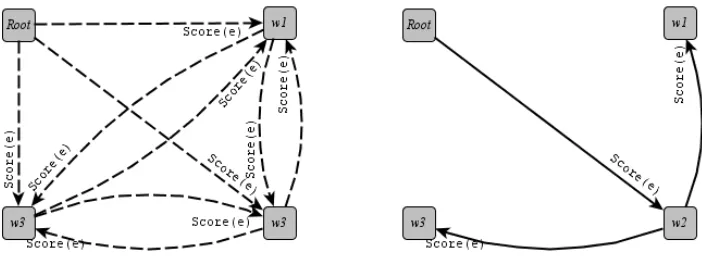
Figure 2: A setting for the graph-based parsing model: an initial dense graphG(left) with edge scores SCORE(e). The resulting dependency tree as a spanning tree with the highest score over the edges (right).
made by the model is final, and cannot be revisited to search for more globally optimal trees. Graph-based models are an alternative dependency parsing model, which assembles a graph with weighted edges be-tween all pairs of words, and selects the tree-shaped subset of this graph that gives the highest total score (Fig. 2). Formally, a graph-based parser follows Algorithm 2, where:
• W0 =W ∪ {Root}
• SCORE ∈ ((W0×R×W) → <)is a function for scoring edges
• SPANNINGTREE is a function for selecting a subset of edges that is a tree that spans over all the nodes of the graph.
Algorithm 2Graph-based dependency parsing
E← {(e,SCORE(e)) :e∈(W0×R×W))} G←(W0, E)
return SPANNINGTREE(G)
The SPANNINGTREEfunction is usually defined using one of the efficient search techniques for find-ing a maximum spannfind-ing tree. For temporal depen-dency parsing, we use the Chu-Liu-Edmonds algo-rithm (Chu and Liu, 1965; Edmonds, 1967) which solves this problem by iteratively selecting the edge with the highest weight and removing edges that would create cycles. The result is the globally op-timal maximum spanning tree for the graph (Geor-giadis, 2003).
The SCOREfunction is typically defined as a ma-chine learning model that scores an edge based on a set of features. For temporal dependency parsing, we learn a model to predict edge scores via the Margin Infused Relaxed Algorithm (MIRA) (Crammer and Singer, 2003; Crammer et al., 2006) using the set of features defined in Section 5.
5 Feature Design
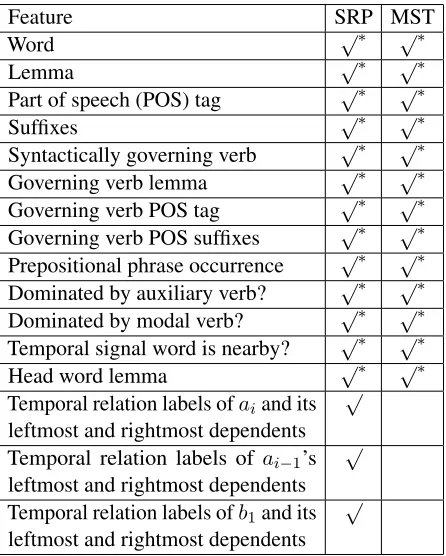
The proposed parsing algorithms both rely on ma-chine learning methods. The shift-reduce parser (SRP) trains a machine learning classifier as the or-acleo ∈ (C → T)to predict a transitiontfrom a parser configurationc= (L1, L2, Q, E), using node features such as the heads of L1, L2 and Q, and
edge features from the already predicted temporal relations inE. The graph-based maximum spanning tree (MST) parser trains a machine learning model to predict SCORE(e) for an edgee = (wi, rj, wk),
using features of the nodeswiandwk. The full set of features proposed for both parsing models, de-rived from the state-of-the-art systems for temporal relation labeling, is presented in Table 2. Note that both models share features that look at the nodes, while only the shift-reduce parser has features for previously classified edges.
6 Evaluations
Feature SRP MST
Word √∗ √∗
Lemma √∗ √∗
Part of speech (POS) tag √∗ √∗
Suffixes √∗ √∗
Syntactically governing verb √∗ √∗ Governing verb lemma √∗ √∗ Governing verb POS tag √∗ √∗ Governing verb POS suffixes √∗ √∗ Prepositional phrase occurrence √∗ √∗ Dominated by auxiliary verb? √∗ √∗ Dominated by modal verb? √∗ √∗ Temporal signal word is nearby? √∗ √∗
Head word lemma √∗ √∗
Temporal relation labels ofaiand its
leftmost and rightmost dependents √
Temporal relation labels of ai−1’s
leftmost and rightmost dependents √
Temporal relation labels ofb1and its
[image:6.612.76.299.59.337.2]leftmost and rightmost dependents √
Table 2: Features for the shift-reduce parser (SRP) and the graph-based maximum spanning tree (MST) parser. The √∗
features are extracted from the heads ofL1,L2andQ
for SRP and from each node of the edge for MST.
only 40 instances of OVERLAP relations were
an-notated when neitherINCLUDESnorIS INCLUDED
label matched, for evaluation purposes all instances of these relations were merged into the temporally coarseOVERLAPrelation. Thus, the total number of
OVERLAP relations in the corpus grew from 40 to 258 annotations in total.
To evaluate the parsing models (SRP and MST) we proposed two baselines. Both are based on the assumption of linear temporal structures of narratives as the temporal ordering process that was evidenced by studies in human text rewriting (Hickmann, 2003). The proposed baselines are:
• LinearSeq: A model that assumes all events occur in the order they are written, adding links between each pair of adjacent events, and label-ing all links with the relationBEFORE.
• ClassifySeq: A model that links each pair of adjacent events, but trains a pair-wise classifier to predict the relation label for each pair. The
classifier is a support vector machine trained us-ing the same features as the MST parser. This is an approximation of prior work, where the pairs of events to classify with a temporal relation were given as an input to the system. (Note that Section 6.2 will show that for our corpus, apply-ing the model only to adjacent pairs of events is quite competitive for just getting the basic unlabeled link structure right.)
The Shift-Reduce parser (SRP; Section 4.1) and the graph-based, maximum spanning tree parser (MST; Section 4.2) are compared to these baselines.
6.1 Evaluation Criteria and Metrics
Model performance was evaluated using standard evaluation criteria for parser evaluations:
Unlabeled Attachment Score (UAS) The fraction of events whose head events were correctly predicted. This measures whether the correct pairs of events were linked, but not if they were linked by the correct relations.
Labeled Attachment Score (LAS) The fraction of events whose head events were correctly pre-dicted with the correct relations. This measures both whether the correct pairs of events were linked and whether their temporal ordering is correct.
Tree Edit Distance In addition to the UAS and LAS thetree edit distancescore has been recently in-troduced for evaluating dependency structures (Tsar-faty et al., 2011). The tree edit distance score for a tree π is based on the following operations
λ∈Λ : Λ ={DELETE,INSERT,RELABEL}:
• λ=DELETEdelete a non-root nodevinπwith parentu, making the children ofvthe children ofu, inserted in the place ofvas a subsequence in the left-to-right order of the children ofu.
• λ =INSERTinsert a nodev as a child ofu in
πmaking it the parent of a consecutive subse-quence of the children ofu.
• λ=RELABELchange the label of nodevinπ
Any two treesπ1andπ2 can be turned one into
UAS LAS UTEDS LTEDS LinearSeq 0.830 0.581 0.689 0.549 ClassifySeq 0.830 0.581 0.689 0.549 MST 0.837 0.614∗ 0.710 0.571 SRP 0.830 0.647∗† 0.712 0.596∗
Table 3: Performance levels of temporal structure pars-ing methods. A∗indicates that the model outperforms LinearSeq and ClassifiedSeq atp <0.01and a†indicates that the model outperforms MST atp <0.05.
Taking the shortest such sequence, the tree edit dis-tance is calculated as the sum of the edit operation costs divided by the size of the tree (i.e. the number of words in the sentence). For temporal dependency trees, we assume each operation costs 1.0. The fi-nal score subtracts the edit distance from 1 so that a perfect tree has score 1.0. Thelabeledtree edit distance score (LTEDS) calculates sequences over the tree with all its labeled temporal relations, while theunlabeledtree edit distance score (UTEDS) treats all edges as if they had the same label.
6.2 Results
Table 3 shows the results of the evaluation. The unlabeled attachment score for the LinearSeq base-line was 0.830, suggesting that annotators were most often linking adjacent events. At the same time, the labeled attachment score was 0.581, indicating that even in fables, the stories are not simply linear, that is, there are many relations other thanBEFORE. The ClassifySeq baseline performs identically to the LinearSeq baseline, which shows that the simple pair-wise classifier was unable to learn anything beyond predicting all relations asBEFORE.
In terms of labeled attachment score, both de-pendency parsing models outperformed the base-line models – the maximum spanning tree parser achieved 0.614 LAS, and the shift-reduce parser achieved 0.647 LAS. The shift-reduce parser also outperformed the baseline models in terms of labeled tree edit distance, achieving 0.596 LTEDS vs. the baseline 0.549 LTEDS. These results indicate that de-pendency parsing models are a good fit to our whole-story timeline extraction task.
Finally, in comparing the two different depen-dency parsing models, we observe that the shift-reduce parser outperforms the maximum spanning
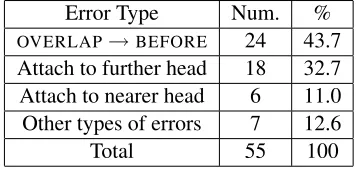
Error Type Num. %
OVERLAP→BEFORE 24 43.7
Attach to further head 18 32.7 Attach to nearer head 6 11.0 Other types of errors 7 12.6
[image:7.612.336.514.61.146.2]Total 55 100
Table 4: Error distribution from the analysis of 55 errors of the Shift-Reduce parsing model.
tree parser in terms of labeled attachment score (0.647 vs. 0.614). It has been argued that graph-based models like the maximum spanning tree parser should be able to produce more globally consistent and correct dependency trees, yet we do not observe that here. A likely explanation for this phenomenon is that the shift-reduce parsing model allows for fea-tures describing previous parse decisions (similar to the incremental nature of human parse decisions), while the joint nature of the maximum spanning tree parser does not.
6.3 Error Analysis
To better understand the errors our model is still mak-ing, we examined two folds (55 errors in total in 20% of the evaluation data) and identified the major categories of errors:
• OVERLAP→BEFORE: The model predicts the
correct head, but predicts its label asBEFORE, while the correct label isOVERLAP.
• Attach to further head: The model predicts the wrong head, and predicts as the head an event that is further away than the true head.
• Attach to nearer head: The model predicts the wrong head, and predicts as the head an event that is closer than the true head.
Table 4 shows the distribution of the errors over these categories. The two most common types of errors,
OVERLAP → BEFOREand Attach to further head, account for 76.4% of all the errors.
Figure 3: AnOVERLAP→BEFOREparser error. True links are solid lines; the parser error is the dotted line.
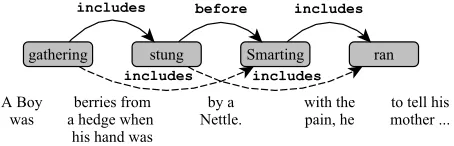
Figure 4: Parser errors attaching to further away heads. True links are solid lines; parser errors are dotted lines.
time in which he was standing. An analysis of these
OVERLAP→BEFOREerrors suggests that they occur
in scenarios like this one, where the duration of one event is significantly longer than the duration of an-other, but there are no direct cues for these duration differences. We also observe these types of errors when one event has many sub-events, and therefore the duration of the main event typically includes the durations of all the sub-events. It might be possible to address these kinds of errors by incorporating auto-matically extracted event duration information (Pan et al., 2006; Gusev et al., 2011).
The second most common error type of the model is the prediction of a head event that is further away than the head identified by the annotators. Figure 4 gives an example of such an error, where the model predicts that thegatheringincludes thesmarting, in-stead of that thegatheringincludes thestung. The second error in the figure is also of the same type. In 65% of the cases where this type of error occurs, it occurs after the parser had already made a label classification error such as BEFORE → OVERLAP.
So these errors may be in part due to the sequen-tial nature of shift-reduce parsing, where early errors propagate and cause later errors.
7 Discussion and Conclusions
In this article, we have presented an approach to tem-poral information extraction that represents the
time-line of a story as a temporal dependency tree. We have constructed an evaluation corpus where such temporal dependencies have been annotated over a set of 100 children’s stories. We have introduced two dependency parsing techniques for extracting story timelines and have shown that both outperform a rule-based baseline and a prior-work-inspired pair-wise classification baseline. Comparing the two depen-dency parsing models, we have found that a shift-reduce parser, which more closely mirrors the incre-mental processing of our human annotators, outper-forms a graph-based maximum spanning tree parser. Our error analysis of the shift-reduce parser revealed that being able to estimate differences in event dura-tions may play a key role in improving parse quality. We have focused on children’s stories in this study, in part because they typically have simpler temporal structures (though not so simple that our rule-based baseline could parse them accurately). In most of our fables, there were only one or two characters with at most one or two simultaneous sequences of actions. In other domains, the timeline of a text is likely to be more complex. For example, in clinical records, descriptions of patients may jump back and forth between the patient history, the current examination, and procedures that have not yet happened.
In future work, we plan to investigate how to best apply the dependency structure approach to such domains. One approach might be to first group events into theirnarrative containers(Pustejovsky and Stubbs, 2011), for example, grouping together all events linked to the time of a patient’s examination. Then within each narrative container, our dependency parsing approach could be applied. Another approach might be to join the individual timeline trees into a document-wide tree via discourse relations or rela-tions to the document creation time. Work on how humans incrementally process such timelines in text may help to decide which of these approaches holds the most promise.
Acknowledgements
[image:8.612.74.301.182.255.2]References
[Amig´o et al.2011] Enrique Amig´o, Javier Artiles, Qi Li, and Heng Ji. 2011. An evaluation framework for aggre-gated temporal information extraction. InSIGIR-2011 Workshop on Entity-Oriented Search.
[Artiles et al.2011] Javier Artiles, Qi Li, Taylor Cas-sidy, Suzanne Tamang, and Heng Ji. 2011. CUNY BLENDER TAC-KBP2011 temporal slot fill-ing system description. InText Analytics Conference (TAC2011).
[Bethard and Martin2007] Steven Bethard and James H. Martin. 2007. CU-TMP: Temporal relation classifica-tion using syntactic and semantic features. In Proceed-ings of the Fourth International Workshop on Semantic Evaluations (SemEval-2007), pages 129–132, Prague, Czech Republic, June. ACL.
[Bethard et al.2007] Steven Bethard, James H. Martin, and Sara Klingenstein. 2007. Finding temporal structure in text: Machine learning of syntactic temporal relations.
International Journal of Semantic Computing (IJSC), 1(4):441–458, 12.
[Bethard et al.2012] Steven Bethard, Oleksandr Kolomiyets, and Marie-Francine Moens. 2012. Annotating narrative timelines as temporal dependency structures. In Proceedings of the International Conference on Linguistic Resources and Evaluation, Istanbul, Turkey, May. ELRA.
[Boguraev and Ando2005] Branimir Boguraev and Rie Kubota Ando. 2005. TimeBank-driven TimeML analysis. InAnnotating, Extracting and Reasoning about Time and Events. Springer.
[Bramsen et al.2006] P. Bramsen, P. Deshpande, Y.K. Lee, and R. Barzilay. 2006. Inducing temporal graphs. InProceedings of the 2006 Conference on Empirical Methods in Natural Language Processing, pages 189– 198. ACL.
[Brewer and Lichtenstein1982] William F. Brewer and Ed-ward H. Lichtenstein. 1982. Stories are to entertain: A structural-affect theory of stories.Journal of Pragmat-ics, 6(5-6):473 – 486.
[Chambers and Jurafsky2008] N. Chambers and D. Juraf-sky. 2008. Jointly combining implicit constraints im-proves temporal ordering. InProceedings of the Con-ference on Empirical Methods in Natural Language Processing, pages 698–706. ACL.
[Cheng et al.2007] Yuchang Cheng, Masayuki Asahara, and Yuji Matsumoto. 2007. NAIST.Japan: Tempo-ral relation identification using dependency parsed tree. InProceedings of the Fourth International Workshop on Semantic Evaluations (SemEval-2007), pages 245–248, Prague, Czech Republic, June. ACL.
[Chu and Liu1965] Y. J. Chu and T.H. Liu. 1965. On the shortest arborescence of a directed graph.Science Sinica, pages 1396–1400.
[Covington2001] M.A. Covington. 2001. A fundamental algorithm for dependency parsing. InProceedings of the 39th Annual ACM Southeast Conference, pages 95–102.
[Crammer and Singer2003] K. Crammer and Y. Singer. 2003. Ultraconservative online algorithms for multi-class problems.Journal of Machine Learning Research, 3:951–991.
[Crammer et al.2006] K. Crammer, O. Dekel, J. Keshet, S. Shalev-Shwartz, and Y. Singer. 2006. Online passive-aggressive algorithms. Journal of Machine Learning Research, 7:551–585.
[Edmonds1967] J. Edmonds. 1967. Optimum branchings.
Journal of Research of the National Bureau of Stan-dards, pages 233–240.
[Georgiadis2003] L. Georgiadis. 2003. Arborescence op-timization problems solvable by Edmonds’ algorithm.
Theoretical Computer Science, 301(1-3):427–437. [Gupta and Ji2009] Prashant Gupta and Heng Ji. 2009.
Predicting unknown time arguments based on cross-event propagation. InProceedings of the ACL-IJCNLP 2009 Conference Short Papers, ACLShort ’09, pages 369–372, Stroudsburg, PA, USA. ACL.
[Gusev et al.2011] Andrey Gusev, Nathanael Chambers, Divye Raj Khilnani, Pranav Khaitan, Steven Bethard, and Dan Jurafsky. 2011. Using query patterns to learn the duration of events. InProceedings of the Interna-tional Conference on ComputaInterna-tional Semantics, pages 145–154.
[Hayes and Krippendorff2007] A.F. Hayes and K. Krip-pendorff. 2007. Answering the call for a standard reliability measure for coding data. Communication Methods and Measures, 1(1):77–89.
[Hickmann2003] Maya Hickmann. 2003. Children’s Dis-course: Person, Space and Time Across Languages. Cambridge University Press, Cambridge, UK.
[Johnson-Laird1980] P.N. Johnson-Laird. 1980. Men-tal models in cognitive science. Cognitive Science, 4(1):71–115.
[Krippendorff2004] K. Krippendorff. 2004.Content anal-ysis: An introduction to its methodology. Sage Publica-tions, Inc.
[Linguistic Data Consortium2005] Linguistic Data Con-sortium. 2005. ACE (Automatic Content Extraction) English annotation guidelines for events version 5.4.3 2005.07.01.
[Llorens et al.2010] Hector Llorens, Estela Saquete, and Borja Navarro. 2010. TIPSem (English and Spanish): Evaluating CRFs and semantic roles in TempEval-2. In
[McDonald et al.2005] R. McDonald, F. Pereira, K. Rib-arov, and J. Hajiˇc. 2005. Non-projective dependency parsing using spanning tree algorithms. InProceedings of the Conference on Human Language Technology and Empirical Methods in Natural Language Processing, pages 523–530. ACL.
[McIntyre and Lapata2009] N. McIntyre and M. Lapata. 2009. Learning to tell tales: A data-driven approach to story generation. InProceedings of the Joint Confer-ence of the 47th Annual Meeting of the ACL and the 4th International Joint Conference on Natural Language Processing of the AFNLP: Volume 1-Volume 1, pages 217–225. ACL.
[Nivre2008] J. Nivre. 2008. Algorithms for determinis-tic incremental dependency parsing. Computational Linguistics, 34(4):513–553.
[Pan et al.2006] Feng Pan, Rutu Mulkar, and Jerry R. Hobbs. 2006. Learning event durations from event descriptions. InProceedings of the 21st International Conference on Computational Linguistics and 44th An-nual Meeting of the Association for Computational Lin-guistics, pages 393–400, Sydney, Australia, July. ACL. [Pustejovsky and Stubbs2011] J. Pustejovsky and A. Stubbs. 2011. Increasing informativeness in temporal annotation. In Proceedings of the 5th Linguistic Annotation Workshop, pages 152–160. ACL. [Pustejovsky et al.2003a] James Pustejovsky, Jos´e
Casta˜no, Robert Ingria, Roser Saur´y, Robert Gaizauskas, Andrea Setzer, and Graham Katz. 2003a. TimeML: Robust specification of event and temporal expressions in text. In Proceedings of the Fifth International Workshop on Computational Semantics (IWCS-5), Tilburg.
[Pustejovsky et al.2003b] James Pustejovsky, Patrick Hanks, Roser Saur´y, Andrew See, Robert Gaizauskas, Andrea Setzer, Dragomir Radev, Beth Sundheim, David Day, Lisa Ferro, and Marcia Lazo. 2003b. The TimeBank corpus. In Proceedings of Corpus Linguistics, pages 647–656.
[Tsarfaty et al.2011] R. Tsarfaty, J. Nivre, and E. Ander-sson. 2011. Evaluating dependency parsing: Robust and heuristics-free cross-annotation evaluation. In Pro-ceedings of the Conference on Empirical Methods in Natural Language Processing, pages 385–396. ACL. [UzZaman and Allen2010] Naushad UzZaman and James
Allen. 2010. TRIPS and TRIOS system for TempEval-2: Extracting temporal information from text. In Pro-ceedings of the 5th International Workshop on Seman-tic Evaluation, pages 276–283, Uppsala, Sweden, July. ACL.
[Verhagen et al.2007] Marc Verhagen, Robert Gaizauskas, Frank Schilder, Graham Katz, and James Pustejovsky. 2007. SemEval2007 Task 15: TempEval temporal
rela-tion identificarela-tion. InSemEval-2007: 4th International Workshop on Semantic Evaluations.
[Verhagen et al.2010] Marc Verhagen, Roser Saur´ı, Tom-maso Caselli, and James Pustejovsky. 2010. SemEval-2010 Task 13: TempEval-2. InProceedings of the 5th International Workshop on Semantic Evaluation, Se-mEval ’10, pages 57–62, Stroudsburg, PA, USA. ACL. [Yamada and Matsumoto2003] H. Yamada and Y. Mat-sumoto. 2003. Statistical dependency analysis with support vector machines. InProceedings of IWPT. [Yoshikawa et al.2009] K. Yoshikawa, S. Riedel, M.