Munich Personal RePEc Archive
Introduction to Divided Societies
Borooah, Vani and Knox, Colin
University of Ulster, University of Ulster
2015
1 Chapter 1 Introduction
As its title suggests, this is a book about the economics of education in divided communities. By divided ‘communities’ we mean societies which are partitioned – or which partition themselves – into distinct and identifiable groups such that persons from these groups lead ‘separate’ lives – that is, lives that do not involve association with persons from other groups - with respect to a number of areas. Housing is often such an area of separation; education is another; work might be a third. In all these cases the result is often ‘segregation’, with people from each group living, studying, and working apart from others.
It is often the case that such segregation is involuntary – people from a particular group do not seek to live separate lives but are forced to do so because of circumstances outside their control. For example, as a recent study highlighted, Muslims in New Delhi (India), as the city’s minority group, find it almost impossible to rent houses from Hindu landlords, the city’s majority group.1
Consequently, they are obliged to live in Muslim areas where their landlords are fellow Muslims, with the consequence that New Delhi is segregated into Muslim and Hindu areas. Segregation in education is often a concomitant of housing segregation as children go to neighbourhood schools so that all the pupils in a particular school are from specific group (or groups) without any representation from other groups.
Historically, ‘apartheid schooling’, has been associated with laws which have forbidden the mixing of races – whether through the apartheid laws in South Africa or through ‘Jim Crow’ laws in the southern states of the USA, from 1865 till the passage of the Civil Rights Act of 1964, proscribing most forms of association between blacks and whites.2 The ruling by the US Supreme court in 1954 on Brown v. Board of Education of Topeka that school segregation was illegal, and its concomitant order that school districts must desegregate, swept away the legal basis for blacks and whites being educated separately in the USA’s southern states. In handing down the Court’s judgement, Chief Justice Earl Warren poured scorn on the “separate but equal” doctrine which justified Jim Crow laws - which required the separate use of most public facilities (toilets, restaurants, buses, schools) under the spurious justification that equal facilities would be supplied separately – by writing “separate
educational facilities are inherently unequal”. However, it was not the inferior school resources of Black schools that underpinned the Court’s judgement: as the Court pointed out, many southern states, in order to forestall integration, had invested heavily in closing the gap in standards between black and white schools. Rather it was that, in Chief Justice Warren’s words, “we must look instead to the effects of segregation itself”. To separate black children “from others of similar age and
qualifications solely because of their race generates a feeling of inferiority as to their status in the community that may affect their hearts and minds in a way that is unlikely ever to be undone.”
And yet, nearly 60 years after Brown v Board of Education, the trend in US schools appears to be towards a return to segregation rather than towards increased integration. As Dorsey (2013) points out, students were more racially segregated in schools in 2009-10 than they were in 1968-69 when the US Department of Education began to implement the Brown v Board of Education decision. According to the National Centre for Education Statistics (2012), in 2009-10, 40% of Black and Latino students were attending schools that were 90% to 100% minority and 15% of Black and Latino students were attending schools that were attending ‘apartheid schools’, that is schools that were 99% to 100% minority. These views are echoed by Orfield et. al. (2012) who pointed out School
1
Banerjee et. al. (2014). 2
2
(re)segregation for black students is “increasing most dramatically in the South, where, after a period of intense resistance, strong action was taken to integrate black and white students. Black students across the country experienced gains in school desegregation from the l960s to the late l980s, a time in which racial achievement gaps also narrowed sharply. These trends began to reverse after a 1991 Supreme Court decision made it easier for school districts and courts to dismantle desegregation plans. Most major plans have been eliminated for years now, despite increasingly powerful evidence on the importance of desegregated school [emphasis added]”.3
The US experience articulates two separate arguments against segregated schooling. Firstly, segregated schooling is, in practice, ‘separate and unequal’: minority group students go to schools that are inferior - in terms of inter alia less experienced and less qualified teachers, higher teacher
turnover, less successful peer group role models, and inadequate facilities and learning materials - to those attended by students from the majority group.4 As a consequences segregation is instrumental in leading to a poor educational outcomes for minority group students relative to their majority group peers. The second argument, articulated by US Supreme Court in 1954, cited above, is that
segregation is undesirable per se even if segregated schools were found to be separate and equal. This is because, to quote Chief Justice Warren, “it may affect their [children’s] hearts and minds in a way that is unlikely ever to be undone”. If educational outcomes are defined broadly, to include both learning and social outcomes, segregation is undesirable because it is both instrumental in causing poor educational (learning) outcomes and because it is constitutively a part of poor educational (social) outcomes. Consequently, there is a fundamental distinction to be made between the
instrumental and the constitutive roles of school segregation in determining educational outcomes, broadly defined.5
The experience of Indian society, with its caste divide between its (formerly ‘untouchable’) ‘Scheduled Castes’ castes (Dalit) and its upper castes (non-Dalits) shows that non-segregated schooling doesn’t always lead to parity of treatment between the have-nots and the haves within a school.6 Thrown in as a minority group with children from the higher social groups, Dalit students face discrimination, exclusion, and humiliation. Nambissan (2010) in her study of the experiences of
Dalit children in schools in Jaipur district in the state of Rajasthan concluded that "social relations and the pedagogic processes fail to ensure full participation of Dalit children and they are subject to discriminatory and unequal treatment in relation to their peers" (p. 282). If there is force to this argument, then one solution to Dalit educational under-achievement lies in creating a social and cultural environment in schools whereby they cease to be unwelcoming and frightening places for
Dalit children. This would require teachers to be trained to respect the caste sensitivities of “depressed minorities” in much the same way that teachers in Western countries are trained to be sensitive to racial and religious diversity.7
The fact that students from different groups are treated differently within the same school is not confined to India. The most frequently cited explanation for ethnic gaps in educational attainment relates to the substantial differences in socio-economic status between, say, Black and White groups.
3
See also Fiel (2012). 4
See Orfield et. al. (2012). 5
Sen (2000) makes a similar distinction between the instrumental and the constitutive roles of social exclusion in determining deprivation outcomes.
6
Around 18 percent of India’s population are Dalits (or the Scheduled Castes) and the most practical
manifestation of the social stigma associated with being a Dalit is that in many instances Dalits are those with whom physical contact is regarded by upper caste Hindus as "unclean": hence the term ‘untouchable’. In order to foreshorten the effects of centuries of suppression, Dalits are protected under the Indian constitution by affirmative action policies ("reservation" policies) in public sector jobs and educational institutions and representation on elected bodies.
7
3
However, differences in socio-economic status cannot explain more than one-third of the black-white gap in scores for six year olds (Philips, 1998). Consequently, as Strand (2011) suggests, “variables such as parents’ educational aspirations for their children, provision of educational resources and involvement with school are also important in understanding attainment” as well as teacher
expectations, institutional racism and cultural differences. Consequently, there is the feeling that there is ‘institutional racism’ in schools in England which leads teachers to have low expectations of Afro-Caribbean pupils relative to their White counterparts. This means, for example, that, all other things
being equal, for every three white British pupils entered for the higher tiers, only two black Caribbean pupils are entered (Strand, 2009). However not commentators are convinced by the ‘institutional racism argument. The Guardian newspaper quotes Tony Sewell, an education consultant as saying that there is "a link between behaviour and academic outcome. It doesn't mean that's evidence of institutional racism. It's evidence that we need to address properly the complex reasons why black Caribbean pupils behave badly. We can't just say it's white racist teachers."8
The preceding paragraphs provided the background for the subject matter of this book which is an analysis and assessment of schooling, particularly post-primary schooling, in Northern Ireland. Till 1992, the Department of Education in Northern Ireland (DENI) ran a dual schooling system comprising ‘Controlled’ (de facto Protestant) and ‘Maintained’ (de facto ‘Catholic’) schools with, by and large, Catholic children attending maintained schools and Protestant children attending
maintained schools. In consequence, there was a high degree of segregation in Northern Ireland schools. Furthermore, since each system was a mirror image of the other, for every type of school – primary and post-primary; post-primary schools with pupils admitted on the basis of results from an entrance test (grammar schools) and non-selective post-primary schools (secondary schools) – there were Protestant and Catholic equivalents.
The Education Reform (NI) Order 1989 brought into being a third type of school – Integrated schools. These were schools in which Catholics and Protestants would be educated together with the proviso that, for a school to be considered as ‘integrated’, at least 30% of the student body must be from the minority community, whether Catholic or Protestant. Notwithstanding the introduction of integrated schools, of which there were 62 schools - 42 primary and 20 post-primary - in 2013-14, and notwithstanding the fact that in Northern Ireland the choice of which school to attend is entirely a matter for the pupil and his/her parents, integrated schools have not proved very popular in Northern Ireland. Of the total number of 315,521 school pupils (nursery, primary, post-primary) in Northern Ireland In 2013-14, only 21,745 pupils (representing 6.9% of the total) attended integrated schools. Of the remaining pupils, 144,680 (45.9%) and 146,253 (46.4%) attended, respectively, Protestant and Catholic schools.9
A consequence of the low proportion of Northern Ireland’s pupils who attended Integrated schools is that the schooling system in Northern Ireland is highly segregated, with Protestant and Catholic pupils going to, respectively, Protestant and Catholic schools. In 2013-14, 6.2% of Catholics attended controlled primary schools and 1% of Protestants attended maintained primary schools; in the secondary (non-selective) sector, 2.8% of Catholics attended controlled secondary schools and 1% of Protestants attended maintained secondary schools; in the secondary (selective or grammar) sector, 8.3% of Catholics attended controlled grammar schools and and 0.9% of Protestants attended voluntary Catholic grammar schools.
8(http://www.theguardian.com/education/2008/sep/05/raceineducation.raceinschools, accessed
22/10/2014).
9
4
Given the alleged desire on the part of Northern Ireland parents for integrated education – for example a 2013 poll showed that 80% of parents supported this form of education10 - the small proportion of pupils who attend integrated schools requires some explanation. One explanation is, of course, that, because of (government-imposed) supply-side constraints, there are not enough places in integrated schools to meet demand. However, this claim sits uneasily with the fact that in 2013-14, there were 1,972 unfilled places in primary and post-primary integrated schools, comprising 8.5% of the total approved number of 23,178 pupils in these schools.
A more plausible explanation for the low proportion of Northern Ireland pupils attending integrated schools is that parents, first and foremost, seek ‘good’ schools for their children; the failure of integrated schools to deliver good educational performance – in terms of examination results – is perhaps a reason why, in practice, parents do not send their children to these schools, notwithstanding their professed support for the concept of integrated education. The gold standard for school leavers’ in the UK is to obtain General Certificates of Secondary Education (GCSE) in five or more subjects, including English and Mathematics, at grades A*-C (hereafter referred to as ‘good GCSEs’ or as ‘5+ A*-C (E&M) GCSEs’). The evidence is that the major reason why, at the time of admission into post-primary schools, parents nominate schools as their ‘first preference’ is because of examination results: 80% of the difference in the number of first preferences between schools can be explained by inter-school differences in inter-school results.
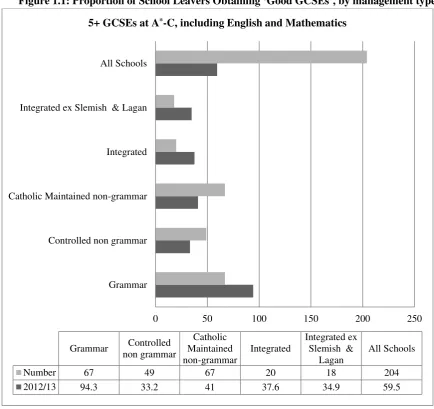
Figure 1.1 shows the proportion of pupils obtaining good GCSEs in each of Northern Ireland’s four school sectors: Grammar, Controlled, Maintained, and Integrated. The average performance of the grammar school sector - which admitted pupils on the basis of selection tests – was, with 94% of school leavers obtaining good GCSEs in 2013, vastly superior to that of the other sectors. The average performance of the 20 integrated schools (37.6% of school leavers obtained good GCSEs) was better than that of the 49 (non-grammar) Controlled schools (33.2%) but inferior to that of the 67 (non-grammar) maintained schools (41%). However, two of the 20 integrated schools – Slemish College and Lagan College – were, like the grammar schools, selective schools. If one omits these two schools from the calculation, the average performance of the remaining 18 integrated schools falls to 34.9%; this is not statistically different from the average performance of the 49 controlled schools but statistically inferior to the average performance of the 67 maintained schools.
To put it differently, there were 130 schools in Northern Ireland which had a higher proportion of pupils leaving school with good GCSEs, compared to the average integrated school (including the two selective integrated schools). Of these, 33 were controlled schools, 37 were maintained schools, 51 were grammar schools, and only nine were integrated schools. So, even if one excludes schools which admit by selection tests - and which, for that reason, may be inaccessible to many pupils - Northern Ireland parents had a choice between 70 non-integrated, non-selective schools and seven (non-selective) integrated schools which produced better results than the average integrated school. In the face of this evidence, it is not a surprise that parents vote with their feet and send their children to non-integrated schools: they may be sympathetic to the principles of integrated education but they may not be so impressed with its educational outcomes.
10
5
Figure 1.1: Proportion of School Leavers Obtaining ‘Good GCSEs’, by management type
Notwithstanding the above observations about the failure of integrated schools in Northern Ireland to deliver the aspect that parents, employers, and educators most value - good educational qualifications - it is important for children from different cultural backgrounds to gain an appreciation of each other without compromising on the quality of education received. This book proposes a means by which this circle can be squared. It is called shared education and chapter 7 of the book details how it operates and is organised. Suffice it to say here, the essence of shared education is that children from different schools come together, as and when needed, for a very specific purpose – improving learning outcomes. Different schools may pool resources to improve outcomes in different subjects – in pilot studies conducted across Northern Ireland, some schools have collaborated in improving results in astronomy, others to enhance ability in foreign languages; shared education may involve partnerships between primary schools, between post-primary schools, or between post-primary and primary schools. Its leitmotif is flexibility: unlike integrated education which requires separate schools, under shared education, children under remain with their original schools and inter-school partnerships are underpinned by the sole objective of delivering better qualifications through a higher quality of learning outcomes in specific areas.
Nonetheless there are certain principles which make for successful sharing. These are that school partnerships should be based upon educational and geographical proximity. Educational proximity ensures that the schools are not wide disparate in terms of pupil quality and motivation –
0 50 100 150 200 250
Grammar Controlled non grammar Catholic Maintained non-grammar Integrated Integrated ex Slemish & Lagan All Schools
Grammar Controlled non grammar
Catholic Maintained non-grammar
Integrated
Integrated ex Slemish &
Lagan
All Schools
Number 67 49 67 20 18 204
2012/13 94.3 33.2 41 37.6 34.9 59.5
6
successful partnerships are those between approximately equal schools with, of course, the possibility that some school may be primus inter pares. Geographical proximity ensures that partnerships can be implemented with minimal transportation costs and travelling time. A feature of geographical
proximity in Northern Ireland will mean, more often than not, that partnerships will be between schools of different denominations. In consequence of this feature, societal benefits, in the form of interaction between pupils of different cultural backgrounds will be a derivative of shared education but it will not be its raison d'être: that will be the improved educational outcomes that shared education will be expected to deliver.
In delivering this central message about the importance of shared education in a divided society like Northern Ireland, this book also makes two further substantial contributions. The first is a careful examination, based on a quantitative analysis of school data provided by DENI, of the factors that make a significant contribution the quality of post-primary school results as measured by the proportion of pupils leaving with good GCSEs. The analysis of school performance is predicated on the observation that education policy in Northern Ireland is too often made on the basis of factors which are universal and easily quantifiable. The two items which have driven schools policy in Northern Ireland since the publication of the Bain (2006) report are a school’s size and the financial health of a school. Both items have been used to develop the concept of unviable schools – schools which are ‘not large enough’ or whose finances are not in a ‘good state’. The corollary to identifying unviable schools is school closures. School closures are justified on two grounds. The first is
financial: closing schools will save the public purse a significant amount of money. The second is
educational: closing small schools will improve school performance since it is believed – more on faith than on evidence – that large schools perform better than small schools.
Chapter 3 examines the financial justification for school closures. After a detailed analysis of the school funding system in Northern Ireland – the essence of which is that ‘money follows pupils’ – this chapter shows that the saving to the public purse, following the closure of ‘unviable’ schools, will be insignificant. Furthermore, school closures take no account of the cost to pupils, whose schools have closed, of travelling to more distant schools. These costs are likely to be especially high in rural areas. In addition to travelling costs there are the opportunity costs of travel: pupils could have been doing something else in the extra time now required to travel to a new school. Our analysis for County Fermanagh – a rural part of Northern Ireland – shows that, after accounting for both travelling and opportunity costs, the net saving from school closures in Fermanagh would be negligible.
Chapter 4 examines the educational argument for justifying school closures, namely that larger and/or financial healthy schools deliver a better educational performance. We show that both school size and schools’ financial health are policy red herrings – neither has any impact on school performance. Northern Ireland has a mixed bag of good and bad ‘unviable’ – on DENI criteria - post-primary schools and good and bad ‘viable’ – again on DENI criteria - post-post-primary schools. Instead what matters for good performance are good teaching and good discipline in schools. Neither item is easily quantifiable and, therefore, not capable of unambiguous comparison between schools. But that does not detract from their importance and it is precisely on such policy issues that DENI should be focused rather than on schools’ size or schools’ financial health.
Chapter 5 examines the nature of inequalities within the Northern Ireland post-primary schooling system. Here it is our belief that the almost exclusive focus of the education policy debate on segregation in Northern Ireland’s schools has distracted attention from a bigger and more urgent problem which is that of inequality. Inequality within Northern Ireland’s post-primary schooling system takes several forms and, indeed, spans schools on both sides of the sectarian divide.
7
disturbing features which are often swept under the carpet. First, the 60% good GCSEs pass rate was a weighted average of a superlative performance by Northern Ireland’s 68 grammar schools, with a 94% of their Year 12 pupils obtaining good GCSEs and an undistinguished performance by its 137 secondary schools, with only 38% of their Year 12 pupils obtaining good GCSEs. There was in 2013 a 56 percentage point gap between Northern Ireland’s grammar and secondary schools in the
proportions of their pupils obtaining good GCSEs and, furthermore, this gap has shown little sign of reducing over time: the gap in 2009 was 59 points. Taken collectively, Northern Ireland’s post-primary secondary schools fail to meet the minimum acceptable standard for post-primary schools in England of 40% of Year 12 pupils obtaining good GCSE passes
The second form of inequality is between the performance of pupils who, by virtue of low parental income, are eligible for free school meals – hereafter FSM pupils – and pupils with more affluent parents. In 2013, 34% of FSM, and 68% of non-FSM, school leavers in Northern Ireland obtained good GCSEs. This overall gap between the performance of FSM and non-FSM pupils masks an uneven performance of FSM/non-FSM pupils between schools. In 2013, there were 22 schools in Northern Ireland in which the GCSE performance of FSM pupils was at least as good as that of their non-FSM counterparts but, at the other end of the spectrum, there were 68 schools in which not a single FSM pupil obtained a good GCSE.
The third form of inequality is between secondary schools. Northern Ireland’s post-primary secondary schools failed to meet the minimum acceptable standard for post-primary schools in England of 40% of Year 12 pupils obtaining good GCSEs. However, this collective failure masks an even deeper failure at the level of individual schools. Of Northern Ireland’s 137 secondary schools, 82 (or 60%) performed below the ‘40% standard’ and, in these underperforming schools, the average proportion of Year 12 pupils obtaining good GCSEs was just 28%, while in the secondary schools that were not underperforming it was 51%.
Underlying these three aspects of performance inequality in Northern Ireland’s post primary schools is access inequality whereby free school meal (FSM) pupils are grossly under-represented in grammar schools. Although, in 2013, 19% of post-primary pupils in Northern Ireland were FSM, they comprised only 7% of grammar schools pupils while, at the other extreme, nearly one-third of pupils in maintained schools were FSM pupils (See Figure 1.2).
8
Figure 1.2: Percentage of FSM Pupils in Total Enrolment by Different School Types, 2013
Chapter 7, as discussed earlier, outlines our vision for softening the effects of school segregation through shared education. It is our contention that just as the Northern Ireland
government’s focus on school size and financial health has distracted from an informed discussion of the factors underpinning school performance, so has the preoccupation with the ill-effects of school segregation – and the concomitant blowing of the integrated education trumpet –muted discussion of the causes of pupil underperformance and, in particular, the intimate – but as yet, in Northern Ireland, unexplored – link between deprivation and performance. The issue of sectarian isolation, which is the deleterious effect of school segregation in Northern Ireland, needs to be addressed but it must be
through raising educational performance, not independently of it.
7.2
23.1
32.1
25
0 5 10 15 20 25 30 35
Percentage of FSM Pupils in Total Enrolment
9 References
1. Akerlof, G.A. and Kranton, R.E. (2010), Identity Economics: How Our Identities Shape Our Work, Wages, and Well-Being, Princeton, NJ: Princeton University Press.
2. Bain, G. (2006), Report of the Independent Strategic Review of Education, Belfast: Department of Education.
3. Dorsey, D.N.T. (2013), “Segregation 2.0: The New Generation of School Segregation in the 21st Century”, Education and Urban Society, 45 (5): pp. 533-47.
4. Fiel, J.E. (2013), “Decomposing School Resegregation: Social Closure, Racial Imbalance, and Racial Isolation”, American Sociological Review, 78(5): pp. 828-848.
5. Nambissan, G.B. (2010), “Exclusion and Discrimination in Schools”, in S. Throat and K. S. Newman (edited), Blocked by Caste: Economic Discrimination in Modern India, New Delhi: Oxford University Press, pp. 253-286.
6. Orfield, G., Kucsera, J., and Siegel-Hawley, G. (2012), E plubrius…separation: Deepening Double Segregation for more Students, Los Angeles, CA: Civil Rights Project.
7. Phillips, M., Brooks-Gunn, J., Duncan, G., Klebanov, P., & Crane, J. (1998), “Family background, parenting practices, and the Black-White test score gap”, In C. Jenks & M. Phillips (Eds.), The Black-White test score gap (pp. 229-272). Washington DC: Brookings Institution Press.
8. Strand, S. (2009), “The limits of social class in explaining ethnic gaps in educational attainment”, British Educational Research Journal, 37(2): 197-229